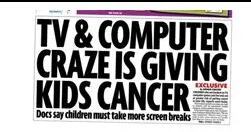
In our era of information overload, most readers consume their news by scanning headlines rather than through any careful reading of articles. A study by the Media Insight Project found that six in ten people acknowledge that they have done nothing more than read news headlines in the past week (Full Fact). Consuming news in this matter can make one less, rather than more well-informed.
Take, for instance, the headline from a major online newspaper: “Scientists Warn of Catastrophic Climate Change by 2030.” The article itself presents a nuanced discussion about potential climate scenarios and the urgent need for policy changes. However, the headline evokes a sense of inevitability and immediate doom that is not supported by the article’s content. These kind of headlines invoke fear and urgency to drive traffic at the expense of an accurate representation of what is really in the article.
All too typical hyperbolic headlines contribute to instilling dangerously misleading and lasting impressions. For example, a headline that screams “Economy in Freefall: Recession Imminent” might actually precede an article discussing economic indicators and expert opinions on potential downturns. Misleading headlines have an outsized effect in creating a skewed perception that can influence public opinion and decision-making processes negatively.
It often seems that headline writers have not read the articles at all. Moreover, they change them frequently, sometimes several times a day, to drive more traffic by pushing different emotional buttons.
Particularly egregious examples of this can be found in the political arena. During election seasons, headlines often lean towards sensationalism to capture attention. A headline like “Candidate X Involved in Major Scandal” may only refer to a minor, resolved issue, but the initial shock value sticks with readers. It unfairly delegitimizes the target of the headline. The excuse that the article itself is fair and objective does not mitigate the harm done by these headlines because, as we said, most people only read the headlines. And if they do skim the article they often do so in a cursory attempt to hear more about the salacious headline. If the article does not immediately satisfy that expectation, they become quickly bored, and don’t bother to actually read the more reasoned presentation in the article.
This headline-driven competition for clicks has led to a landscape where accuracy and depth are sacrificed for immediacy and sensationalism. Headlines are crafted to evoke emotional responses, whether through fear, anger, or salaciousness, rather than to inform. This shift has profound implications. When readers base their understanding of complex issues on superficial and often misleading headlines, they are ill-equipped to engage in meaningful discourse or make informed decisions.
Furthermore, the impact of misleading headlines extends beyond individual misinformation. It contributes to a polarized society where people are entrenched in echo chambers, each side reinforced by selective and often exaggerated information communicated to them through attention-grabbing headlines. This environment fosters division and reduces the opportunity for constructive dialogue, essential for a healthy democracy (Center for Media Engagement).
Consider the headline “Vaccines Cause Dangerous Side Effects, Study Shows.” The article might detail a study discussing the rarity of severe side effects and overall vaccine efficacy, but the headline fuels anti-vaccine sentiment by implying a more significant threat. Such headlines not only mislead but also exacerbate public health challenges by spreading fear and misinformation.
Prominent journalists like Margaret Sullivan of the Washington Post and Jay Rosen of NYU have critiqued the increasing prevalence of clickbait headlines, noting that they often prioritize sensationalism over accuracy, thereby undermining the credibility of journalism and contributing to public misinformation. Sullivan has emphasized the ethical responsibility of journalists to ensure that headlines do not mislead, as they serve as the primary interface between the news and its audience.
Unfortunately I suspect that journalists typically have little to no say in the headlines that promote their articles. The authors and editors should reassert control.
Until and unless journalists start acting like responsible journalists with regard to sensational headlines, readers should be wary of headlines that seem too dramatic, overstated, or that attempt to appeal to emotions.
And this is not a problem limited to tabloid journalism… we are talking about you, New York Times! Most people are already skeptical about headlines published in the National Enquirer. Tabloid headlines are not actually as serious a problem as the “credible” headlines put forth by the New York Times and other publications who still benefit from an assumption of responsible journalism.
The current trend of sensationalist online newspaper headlines is a disservice to readers and society. The practice prioritizes clicks over clarity, hyperbole over honesty, and in doing so, contributes to a misinformed and divided public. It is imperative for both readers and journalists to advocate for a return to integrity in news reporting – particularly in the headlines they put out. Accurate, informative headlines are not just a journalistic responsibility but a societal necessity to ensure an informed and engaged populace.
Footnote: Did I fool you??
Does this article sound different than my usual blog articles? Is it better or worse or just different? This was actually an experiment on my part. I asked Chat GPT to write this article for me. I offer it to you with minimal editing as a demonstration of what AI can do.
I’m interested in hearing what you think in the comments. Should I hang up my pen and leave all the writing to AI?
 figmentums
Hi Tyson, I thought this article sounded a bit different from your other articles. It seemed repetitive and not your usual bullseye. But I forgave you, thinking, Oh well, we are all getting older.
Actually, I don’t know what AI is. I never explored it because I figured it was just a fad. I can’t imagine any intelligence coming from something that doesn’t have a brain.
As for headlines, as a former newspaper reporter, I know full well the problem of headlines. They are usually written not by the reporter, but by a copy editor in a hurry. He has 10 other headlines to write that night and he’s run out of juice. But you are right about this: The point of a headline these days is to pull in the reader, not to summarize the story.
I’ve worked for publications that let the reporter write the headline. Sometimes it didn’t work and simply led to a boring headline. Reporter: SANTA DELIVERS GIFTS ON TIME Copy Editor: KRIS KRINGLE LIGHTS UP THE SKY IN LAST-MINUTE RACE.
C’est la vie.
Jane Everhart
>
LikeLike
Jane, I know that your career partly involved headline crafting so I’m not surprised you have an opinion about this. But I am disappointed that your reaction is “C’est la vie.” I hoped that you in particular would appreciate how much the news environment has changed and recognize the fact that headlines are no longer merely a lure or hook to catch reader’s interest. For many, they are now the entire meal and they have become ever more misleading. A community of fish cannot thrive on a diet of ever more shiny plastic lures. In today’s media environment, more boring headlines might serve us much better. Healthy food is seen as more “boring” than Cheetos and Pop Tarts but a Cheetos and Pop Tarts diet is terribly unhealthy.
LikeLike
I was going to write a protest comment about the pablum in this post, so different than your usual incisive essays, but I see there was a catch.
I do not use chatbots. I never intend to use chatbots. I’m angry enough at the inexpressiveness of most humans in so many forums and forms of communication, the last thing I ever need to contemplate is the stupidity of machine-generated non-thought.
LikeLike
I appreciate the comments! And I am sorry it was bland, insipid pablum but then again I’m relieved if I’m not obsolete as a blogger quite yet. Glass half full though, I’m still very amazed that AI was able to produce this work, pablum as it may be. AI is still VERY young and it will get much better very quickly.
Just FYI, the way I produced this was simply by providing Chat GPT a sample of one of my blog pieces and asking it “Using the tone and style of this article, write a new article discussing the danger of hyperbolic and misleading headlines in our news media.” I perhaps should have specified that it include broadcast news promotions as well as online news headlines.
Even now I’m at a bit of a loss to analyze exactly what makes this pablum. I wonder if it is really the quality of the AI writing, the quality of my writing, or if it is just the result of my giving Chat GPT a poor topic. Maybe I would not have done better.
Anyway, hope you all find some value in the experiment.
LikeLike
No, your work is definitely NOT pabulum, which is why my mind registered an objection.
Humans are very capable writers and creative thinkers, at least a few like you.
Chat-whatever is a waste of time in this field of original thought, , at least to me, but I’m sure there will be others investigating this machine learning subject.
LikeLike