With Great Power Comes Great Vulnerability

You might feel powerful cruising around in your luxury car, but you’ll quickly defer to the first guy in an old beater that decides to run you off the road.

Wealth and power certainly bring with them lots of advantages. In fact great wealth and power bring so many advantages that it’s hard to grasp, let alone sympathize with, the incredible vulnerability and weakness they bring with them.

We have always understood that the greater your wealth, the more you have to lose. What we don’t understand as clearly is that the more you have to lose, the more timid and compliant you become. In ways even the compulsive greed of the wealthy can be understood in part as needing ever more buffer to alleviate their anxiety over losing what they have already acquired. The more they acquire the greater that anxiety becomes and the more they need to feel secure – a self-perpetuating cycle.

As that wealth grows, so does vulnerability and risk aversion. The phrase “I’ve got nothing to lose” is a very scary one. But in the greater society “I’ve got too much to lose” is even scarier.

Rich people are paradoxically more controllable and manageable then poorer ones. They just have too much to lose to make any waves or stand up to more powerful forces, no matter how corrupt. If you want to control someone entirely, enrich them with enough money and power to make them easy to bring to heel.

This applies not only to individuals but to corporations any other entities that amass wealth and influence. Donald Trump has demonstrated clearly that powerful interests are both the strongest weapons for a dictator to control and the easiest to force into compliance. The rich and powerful who should be most capable of protecting democracy and standing up to corruption are the first to abandon democracy and become thoroughly corrupted.

It’s probably futile to expect the rich and powerful to risk anything at all for the greater good. Ultimately the only answer to this and a host of other social problems stemming from great wealth inequality is a wealth cap that prevents anyone, individual or corporation, from becoming both dangerously powerful and easily corruptible by Trump or any other despot.

The Secret Rain

Upon the dusty road that assaults the skin,
where sweat crusts in salt upon the brow,
and the air transmutes into iron, pressing down—
the traveler bows low beneath thirst’s oppression.
There, even haughty princes in bejeweled robes
would ransom kingdoms for one moment’s grace
beneath its cool, flowing caress.

At the silent poles, where marrow freezes,
and the soul hardens into ice,
the body craves not gilded halls
nor velvet cushions or opulent feasts—
but melts only beneath a humble miracle
heat that neither sears nor burns,
touch that neither bruises nor pricks,
but tenderly melts those icicles of bone.

To linger beneath is rebirth—
rivuletted fingers caress every fold,
each sorrow, each exhaustion,
with patience more tender than any lover.
It finds the hollows where longing huddles,
the crevices where memory clings,
and washes away, yet does not erase,
leaving one luminous and reborn—
a desert that at last remembers spring.

What banquet, what marble palace,
what perfumed chambers of emperors
could rival this steamy embrace?
The satiny bed is for forgetting;
this rain of liquid rapture
is for exalting, naked,
body and soul rejuvenated.

Yet how fragile the covenant—
once, waters fell aplenty
to lavish themselves upon our skin;
tomorrow, perhaps, the cisterns echo hollow,
and their gift is offered no more.

So cherish it.
Filter, gather, pour again, unending.
Treat each drop as a jewel,
the last note of a never-repeated song.
When the sky withholds its kindness,
and Earth’s wellsprings but distant longings,
recall how it felt:
your secret rain within four walls,
solace no monarch could command,
joy, intimate and infinite,
vanished, but never mercifully forgotten.

Superman vs the Tech Bros

I just watched the new James Gunn Superman movie for the second time on the big screen. What stands out most for me was not David Corenswet’s supremely noble yet authentically flawed human portrayal of Superman, nor was it Nicolas Hoult’s disquietingly relevant embodiment of a deeply flawed modern tech-genius. Rather it was Lex Luthor’s staff of willing, even exuberant, tech bro employees.

The intentionally discordant portrayal of these fresh-faced henchmen (and equally women) has been widely noted and discussed, but I don’t believe it has been specifically written about as much as is deserved.

Traditionally in comics, and in their movie renditions, the henchmen of the named villain are invariably stupid, thuggish, and cravenly despicable individuals. They are the lackeys who actually perform the hands-on murder, mayhem, and destruction. The scientists who create the death rays that the villain will unleash are typically mad and insanely amoral.

But in Superman, Lex Luthor runs a very wholesome-seeming high-tech enterprise. He hires brilliant, mostly young, people. He clearly treats them well (most of the time) and presumably pays them quite well. These are young people who listen to upbeat music while they work and kick the soccer ball when they have some free time.

And they also high-five each other and express pride and glee as they unleash death and destruction.

When Lex’s tech bros remotely control their creations to torture, pummel, and kill they take great joy in their accomplishments. When they design armies of “bot chimps” (don’t ask) that deluge the public with lies and misinformation, they high-five each other. Even as the dimensional rift they created is leveling Metropolis, and is quite likely to go on to destroy the Earth, they show little concern about the horrific destruction and cost of human life, let alone any thought about their own complicity.

Perhaps most disquieting is at the end, after all that, when Lex is exposed in the media as a liar, they all turn toward him with surprised stares of shock and betrayal.

I don’t want to politicize this article too much by launching into a diatribe about the parallels to leaders like Musk and Trump. But I do want to hold this movie up as a stark mirror reflecting the true image of all those fresh-faced, music-loving henchmen who actually do the dirty work of lying and harming so many people to satisfy the insatiable ego of our deeply flawed, and all-too-real, super-villains.

Without all their enthusiastic efforts, these super-villains would be powerless.

Make AI Why Your New Pastime!

When Ph.D. candidates near the end of their degree programs, they face a major hurdle: the qualifying exam, or oral defense. This is standard for most math and hard science fields, but is also often required in disciplines like history and English literature. During the defense, the candidate stands before a panel of professors, answers questions about their thesis, and then faces a battery of general questions designed to assess their depth and breadth of knowledge.

One tall tale of these oral defenses is the “Blue Sky” story. In these tales, the professors merely ask the candidate a simple question like “why is the sky blue?” After the student answers, they merely respond with “why?” After answering further, they just again ask “why?”

This isn’t just a campus myth, because a good Ph.D. Physicist friend of mine was subject to just such a grilling starting with “Why is the sky blue?” He told me that over the course of the next hour he ended up drawing upon a far wider and deeper range of physics knowledge then he ever realized he knew. All in response to repeated questions consisting of just “why?”

This is a game that confounds and exasperates parents all the time. We say something to our toddler, and they ask “why?” When we answer, they again say “why?” Parents usually give up after perhaps three iterations. A Ph.D. candidate would get through at least a few more iterations within their field of specialization.

It makes me wonder if a “Why-Q” would not be a great intelligence quotient for AI. If a normal parent can score 3, and a well-prepared Ph.D. candidate might score 6, what would AI score? Probably a much higher count reflecting deeper knowledge, and certainly its breadth of knowledge would be essentially unlimited.

Given that we now have essentially Ph.D. level intelligence in every field right at our beck and call 24/7 through AI, I want to suggest that you can play a game I call “AI Why” whenever you like. Take a break from endless YouTube or TicTok videos. Stop reading increasingly crappy articles because you’ve run out of anything actually worthwhile. Instead open your preferred AI app and pass the time playing AI Why.

Ask AI any question, serious or whimsical, even something like “Why is the sky blue?” Read over the answer, and then ask a follow-up question. You can dive deeper into the subject or go off an a different tangent. And you can continue on as long as you like. AI will never think your question is silly or get sick of your questions and it will always give you an interesting answer.

This is very different from simply surfing the Internet. Unlike the few Google or even Wikipedia links provided to you, you are not limited to clicking on a fixed number of links produced by algorithms to manipulate you. AI interaction is conversational. You can take your AI conversation anywhere you like and explore the vastness of human knowledge rather than get funneled down into rabbit holes.

Of course the AI system you use does matter. I would not go near anything under the control of Elon Musk for example. But not all AI systems are configured so that all paths lead you to the oppression of South African Whites. I use Perplexity (see here) because they are strongly dedicated to providing sound, fact-based information.

The other great thing about Perplexity is that it remembers threads of dialogue. That means I can ask Perplexity about a topic, and then come back to that thread days or months later to continue the discussion.

Just to give you a flavor of this great pastime, I asked Perplexity “Why is the sky blue?” It gave me a lot of interesting information to which I followed up by asking “Why does Rayleigh scattering occur?” After reading more about that, I asked “Why do refractive indices differ?” The answer led me to ask “Why is light an electric field?” And that led me to “Why is the self-propagating electromagnetic field of light not perpetual motion?

To explain that last question a bit: light propagates forever in a vacuum. It seems counter-intuitive that something moving forever is not perpetual motion by definition. But Perplexity clearly explained that no, light may move forever, but does no work. That led me to ask the gotcha question, “How can electromagnetic radiation undergo self-propagation between electrical and magnetic fields with no loss of energy?

At that point, it took me into Maxwell’s equations and lost me.

This hopefully illustrates how you can go as deep as you like in your conversations with AI. Or, I could have taken it down another path that led to the family life of Amedeo Avogadro. AI will accompany you anywhere you want to go. (And no, that is not to imply that it just agrees with anything you say. It does not.)

So, my message is to become discussion buddies with your genius AI friend. Learn from it. Expand your brain and have fun doing so. Don’t waste the precious opportunity we have to so easily learn almost anything about almost anything.

Make AI Why one of your favorite pastimes!

I Cannot Exaggerate Exaggeration Enough

Although numbers vary day to day and poll to poll, about 97% of Americans support deporting immigrants who commit violent crimes. About 52% support deporting immigrants who have committed nonviolent crimes. Only 32% support deporting all immigrants who entered illegally, and a vanishingly small number support expelling legal immigrants.

News and political commentators often cite these kind of numbers to point out that people simultaneously support the deportation of criminals but not the harassment of legal immigrants. But this sheds little light on the huge disconnect in public opinion over the wholesale rounding up immigrants by the Trump Administration.

I submit that the missing puzzle piece of our understanding is the role of exaggeration. In fact I cannot exaggerate the awful power of exaggeration enough.

The fact is that undocumented immigrants are about half as likely to commit violent crimes than native-born citizens. They are 4 times less likely to commit nonviolent crimes and 2.5 times less likely to commit drug-related offenses. These numbers hold firm across all geographical boundaries.

But when Trump talks about immigrants, he hyper-exaggerates the level of crime in that population far beyond what the data supports. To hear him talk, one would think that immigrants are running amok and causing mass havoc.

This incredible level of exaggeration, well beyond anything the actual facts support, creates the essential disconnect in our brains that allows people to both conclude that while they support legal immigrants but want to see “all those criminal illegals” deported.

Look at it this way. Just to take a number for illustration purposes, let’s say 5% of illegal immigrants are criminals. Trump makes it sound like 90% are criminals. Even if we are skeptical and fair-minded and allow for some exaggeration, we conclude that let’s say 25% are criminals that should be deported.

So when the actual number is 5% and Trump skews our perception to “feel like” it’s something on the order of 25%, what happens? We naturally expect and demand to see 25% arrested and deported. But there are not 25%, so to show it is meeting expectations the government rounds up and deports a whole lot of innocent immigrants in order to demonstrate it is doing it’s job to keep us safe. It must round up a whole lot of good, honest immigrants to satisfy the false perception it has created. We expect no less.

Using gross exaggeration to create unwarranted expectations is used, particularly by Trump, in a lot of other areas as well. Take Social Security as just one other example. The actual administrative overhead of managing our Social Security program is about 0.6%. This is a fantastically low amount of overhead that private companies and even non-profit organizations cannot come anywhere close to matching.

Yet to listen to Trump, you would think, even allowing for his characteristic hyperbole, that the Social Security system is at least somewhat bloated with waste and inefficiency. So say a 5% cut to eliminate waste, fraud, and abuse might seem like a reasonable, measured, and warranted cost control measure. But if one made such cuts it could in reality only come from reducing legitimate benefits.

That is the power of exaggeration and it is perhaps one of the most destructive weapons that Trump wields wantonly with complete abandon. It dramatically affects how we perceive immigration, Medicare, Medicaid, tariffs, and most everything else that Trump chooses to rail about.

We need to call out Trump more strongly and more often for exaggeration, as well as others who grossly exaggerate, and not simply accept it as a personality characteristic or a legitimate rhetorical style.

Recognizing the destructive power of exaggeration is a first necessary step toward arriving at more sane and fact-based public policy.

And THAT is no exaggeration.

Trump Is Not a Joker

Trump is not a joker, he is The Joker.

In the Batman Universe, the Joker and the Penguin are two iconic villains. But while both are criminals who seek to “take over” Gotham City, they are nothing alike in their tactics and goals.

Oswald Cobblepot, commonly known as The Penguin, is a petty criminal who craves legitimacy. He dons his ostentatious tuxedo in order to appear successful and respectable. He runs crooked but relatively small time businesses to amass money for a run for mayorship, winning him the respect he craves. He makes business deals with other crooks, he suborns police and politicians, and unscrupulously undermines any opposition. But he does build alliances, stands by his allies, and honors his commitments. Upon becoming mayor, while stealing public funds, he still does his best to run a stable government that appears legitimate and respectable.

Some might think that this describes Donald Trump to a tee. But it is far too generous. Donald Trump is no Penguin. He has far more in common with The Joker.

Like the Penguin, the Joker also sometimes takes control of the mayor’s office. But unlike Penguin, Joker takes glee in inciting crazed lunatics to storm City Hall. He doesn’t crave honest respect like the Penguin but takes far more satisfaction from terrorizing people who are repulsed by him into fawning over him. Joker does not care about maintaining the traditions and decorum of his corrupt office, rather he revels in making a mockery of them. He doesn’t care about quiet stability but rather seeks the constant attention produced only by the most garish and capricious displays of power.

In our real world, so similar to comic books, we do see real-life Penguinesque dictators and we also see Joker style dictators.

The Penguin style dictators are our businesslike kleptocrats. They are represented by the likes of Putin, Suharto, Marcos, Mobutu (early), Chavez (debated, early), Abacha, Mbasogo, Nazarbayev, Aliyev, and Mugabe. These dictators, at least early on, attempted to run their countries as profit-driven enterprises serving them and their cronies rather than the people. They maintained just enough stability to maximize wealth extraction and to hold power.

The Joker style dictators are the unstable or negligent leaders. They include Pol Pot, Mobuto (later) , Chavez (debated, later), Amin, Bokassa, Nkurunziza, Gaddafi, Kim Jong-un, Hussein, Milosevic, and Turkmenbashi. Unlike the Penguins who are motivated mainly by self-enrichment and long-term survival, the Jokers are driven by ideology, paranoia, and shocking exhibitions of personal power. They do not attempt to maintain stability but rather allow or even revel in chaos. They do not attempt to conceal their corruption, instead they flaunt it as defiant evidence of their strength and power.

I listed all these names to convey the reality that dictators are not uncommon and that many are not even as “responsible” as Penguin or Putin. Many are truly Jokers, irresponsible, damaged, sociopathic, and even insane people who have taken power but any means.

Jokers have captivated followers and taken control in many, many countries and the United States is not immune. Donald Trump clearly has much in common with The Penguin, but increasingly more in common with The Joker. Like Mobuto who started out as a Penguinesque dictator, expect Trump to descend even further into full-on Joker insanity every day that he holds office.

And one thing we know from the comics is that no one survives long in service of, or even in proximity to, The Joker. So don’t hold any false illusions that once becoming mayor or president, a Joker will produce anything but even greater chaos and destruction, let alone bring anything but ruin upon you.

What are Deficit Hawks Thinking?

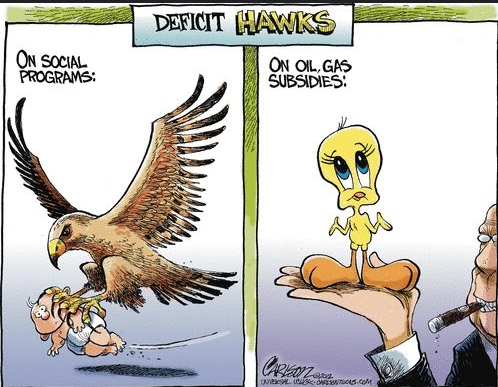
At every budgeting cycle the Republican deficit hawks work themselves into a frenzy of concern about budget deficits. To remind you, the annual deficit is the amount our government has spent beyond what it has taken in that year. Implicitly included under the umbrella of deficit is the debt, which is the credit card balance we owe for all past unpaid deficits.

Certainly debt and deficits are liabilities and it would be great if we could avoid them completely and spend only what we take in, but we realistically cannot operate without dipping into our credit card sometimes. The contention arises around how to control spending in order to avoid crippling credit card payments.

To reduce our credit burden, both parties strive to increase efficiency and reduce waste, fraud, and abuse. Beyond that, Democrats generally aim to raise revenue from the wealthy and corporations, and (to a far lesser extent) reduce military spending, while protecting and expanding social programs. Republicans mostly push for cuts to social programs, while increasing tax cuts (only for the wealthy), and opposing new taxes (only on the wealthy), while maintaining or increasing defense spending.

Democrats assert that the rich and powerful do not pay anything near their fair share and can afford to contribute far more, while Republicans assert (incorrectly) that the rich and powerful deserve even more money that will supposedly then “trickle-down” to help poorer people.

Not many appreciate that the concept of a “trickle-down” economy did not originate with Ronald Regan who put it forth as a credible economic principle. It was originally a satirical joke made by Will Rogers back in 1932 to mock then President Hoover’s response to the Great Depression in giving more money to rich people.

I’m going to forgo a lot of additional argumentation and simply skip ahead to the conclusion that Republicans are simply wrong on both the merits and the ethics of their budget logic, and rather try to understand their thinking.

I’m going to put aside sheer greed and self-interest as uninteresting. My interest is in how well-meaning people can come to support Republican policies.

First and perhaps foremost, Republicans believe incorrectly that rich people and corporations deserve (are entitled to) more money because the rich deserve it and can make the best use of it. Second, they love a strong military because either they are fearful, love having the biggest guns, love war profits, or are just afraid of looking weak on defense. Finally, they believe that regular people deserve nothing and should either get rich or die quietly without bothering anyone.

These biases result in the following internal logic. A) we must give as much as we can to rich people, and B) we must maintain or expand the military, so C) the only way we can accomplish both is to siphon away money from the 99%. This is accomplished by finding new ways to tax or increase costs for regular people, by destabilizing and pillaging the social security fund that they paid into, by compromising or withholding their healthcare, and by deregulation that shifts the cost of doing business from rich corporations to ordinary communities.

To extract wealth, they continue to perpetuate the joke of trickle-down economics. The term may be discredited, but the concept still underpins their worldview. They extract wealth by grossly downplaying the amount of money being spent on the military, and by exaggerating the cost of social service programs (see here).

And they have elucidated no limit whatsoever in just how much more the rich and powerful deserve. In fact the expressed American value is that personal wealth should be unlimited. Therefore, their goal of decreasing the debt and deficit can never be achieved no matter how much they extract, no matter how much damage they do, no matter how many people they impoverish, the rich can and will never have enough under the logical framework they have constructed.

Thus is the folly of their worldview, their rationalizations, and their policies. Their concern about the debt and deficit may or may not be genuine, as is their belief that the rich should receive even more. But to achieve both, the vast majority of people have to suffer. The end result of their thinking can only be incredibly harmful, unsustainable, and unethical budgetary policies enacted under the pretext of responsible deficit reduction.

Cook Your Frog Slowly

In my last article I talked about How We Liberals Destroyed Democracy. I was not saying liberals were wrong to push for social change. But I was making the argument that we made the tactical error of miscalculating our pressure. Or, to put it in a more fanciful way, I have no problem with cooking the frog for dinner. But if you want to end up with tender, juicy frog legs you have to cook it slowly. Turn up the heat too high too quickly and the skittish jumpy frog bolts. You’re left holding only an empty pot, and that’s on you.

I wasn’t giving the normal advise we seem to hear from most every other pundit writing for major publications. In one form or another, their sage advise is essentially “give conservatives what they want and they’ll like you more.” Their wisdom is a little like advising frustrated parents that if you just tell your kids to eat McDonalds Happy Meals every day then they’ll finally listen to you.

I was rather saying, be smarter. Be more patient. Be more strategic, more methodical, more incremental. Cook your frog slowly so that it does not jump out of the pot. To illustrate this further I want to segue into another topic I love to talk about as well, and that is self-driving cars.

In Cars Have to Go, I argued that mankind simply cannot sustain our current system of private car ownership. If we are to survive, cars as we know them have to go. Short of reducing the need for private transportation, for example by redesigning our cities, our only hope is automated fleets of shared vehicles.

And beyond just saving energy and resources, try to think through of all the other advantages a complete self-driving fleet would provide. You would not have to own, maintain, and insure your own car. You could simply call for one anytime. Our driving infrastructure could be far more efficient and cost-effective. All traffic control could be dispensed with if self-driving cars coordinate traffic flow safely and efficiently amongst themselves. No more problems of compromised, drunk, or distracted drivers. No more speeding or running red lights. Automated cars don’t suffer from road rage. No more possibility for vehicles to be used as weapons of mass murder. The social benefits are incalculable and innumerable.

But rather than go on about the benefits reengineering private transportation, where I want to go is the strategic issue of how to get there. How do you boil this frog? If you promise all these dramatic changes, as I am doing here, you run the risk of causing your frog to bolt. My feeling is that Elon Musk, by overhyping self-driving cars, has done harm to the long-term goal I embrace. He made the frogs all panic and jump.

Far smarter and more effective still would have been to get to self-driving fleets quietly and systematically, by offering incremental benefits that anyone and everyone would welcome at every step.

Just to give you a flavor, you start with lane departure warnings. Keep your kids safe. We are all OK with that. Then Smart Cruise. What? The car will slow down and follow a slower vehicle, yes please!

Hmm, self-parking? OMG yes. I hate parking. I want that!!

Wait, my new car can also go off on it’s own to find an open space in a parking garage or at the airport so I can catch my flight and then come pick me up when I return? Where has that been all my life???

And I also have the option of unpacking my car in front of my house and then sending it off to find street parking all by itself? I want that too!

Now if only anyone in my extended family could summon my car if they need to use it too, that would be so cool… wait they can??? Hmm then maybe we should all just go in together on one shared car…

People would generally love and welcome every incremental improvement along the way and find themselves welcoming the natural progression to self-driving fleets. But if you try to pressure them into contemplating a radically different future with self-driving fleets, there can be no surprise when they panic and jump right out of that pot.

In my book, Pandemic of Delusion, I talk at great length about how we can gradually move people from any position A to any other position B. But you have to do it gradually. Push too hard too fast, and impenetrable defenses will arise to block your way.

Liberals should have learned that the hard way recently, and I truly hope that there is still a sure path for both for democracy and for self-driving fleets to accomplish dramatic change through patient, incremental steps.

And equally importantly, success requires restraint to recognize when your frog is optimally cooked and stop there. Too often advocacy groups become institutionalized and they lose any ability to turn down the heat even after the frog starts to fry and burn. But that’s another discussion!

How We Liberals Destroyed Democracy

The title of this article is intentionally provocative. But for good reason. Democrats should at least consider their shared responsibility for destroying our democracy. I’m not trying to be fair and balanced and comprehensive here. I and others have opined ad nauseum about the flaws and dangers of conservative thinking. But in this article I wish to focus on the role of liberals.

Regardless of what we will admit to ourselves or to others, the Supreme Court immunity ruling and the subsequent reelection of Trump has effectively ended our long noble struggle to hold on to our democracy in America. I don’t believe it is hyperbole to acknowledge that we are now firmly, and probably intractably, marching along the path to becoming just like Russia, a brazen kleptocracy flaunting a thin facade of democracy.

And whether they will admit it in that way to themselves and others, half the country is effectively OK with that. It would not have been their first choice for our fate, but they would rather live in a dictatorship than continue to tolerate the excesses, real or perceived, of many democrats, at least of those driving the agenda. I predicted this based on game theory a while back (see here).

To be fair, conservatives have largely tolerated if not embraced a stunning amount of social change since the 1960’s and even before. The end of slavery was social change, women gaining the vote was social change, a sweeping host of equal rights practices was social change, interracial marriage was social change, women entering the workforce and arguably taking half the jobs in the country away from men was social change, the changing expectations of men in the home and in society was social change, accepting gay pride parades and gay marriage was social change. Those are just the broadest reminders of the incredible social change that conservatives tolerated if not always embraced.

But democrats weren’t satisfied. They pushed too hard, too aggressively, too gleefully on social, race, and gender issues mostly. I would suggest that the critical point at which their incessant pressure turned dark and counterproductive was the cancelling of Al Franken. It continued with a cancel culture that vilified everyone from Thomas Jefferson to Matt Damon. It took the form of policing gender pronouns, rallying behind gay wedding cakes, drag queen story hour, transgender surgery, bathrooms, and military service. The entire year leading up to Trumps election I watched liberal women on MSNBC fixate on women’s issues and overtly tell men they should support us or shut up. The list goes on and on and on.

So don’t tell me that democrats are purely the victims here and conservatives are the bad guys. I revile much or even most of what conservatives stand for, but democrats kept making more and more extreme demands until the point at which conservatives said, I’ve had enough of even trying to make this marriage work, I’m out.

One can continue to insist that all those demands were just and right. But even granting that, one must at least question the tactical wisdom of how we went about fighting for them. One can argue that regardless of the provocation and pressure, upending our democracy is a self-destructive and disproportionate response. True enough. But if liberals are capable of any self-examination they must consider their own hubris and lack of restraint in forcing this response.

In the media today there is a lot of coverage of democrats gleefully saying “I told you so” to conservatives in reference to the disastrous actions of Trump. But perhaps conservatives are also justified in saying “I told you so” to the democrats who have been so incessant and extreme in their long history of cattle-prodding conservatives into ever more unpalatable concessions without any apparent expectation of the extreme blowback that was virtually assured to come… and now has.

National Defense and Social Security Myths

Most of us Americans figure we’re pretty well-informed about the realities of our national economy – at least in the big picture. Here are the Top 5 budget categories that you’ve probably seen cited everywhere by most every expert and trusted source:

  1. Social Security: $1,354 billion
  2. Medicaid (also NIH, CDC, FDA and more): $889 billion
  3. Medicare: $848 billion
  4. National Defense (direct budget only): $820 billion
  5. Unemployment (and most family and child assistance programs): $775 billion

Lists like this are usually invoked in order to provide support for a particular (false) mainstream narrative.

Mainstream Narrative: National Defense spending is not where we should be concerned. Rather it’s those big social entitlement programs that are the real problem, and the most worrisome of all is Social Security. In fact, we need to take immediate drastic action to prevent Social Security from bringing us to economic ruin!

But bear with me while I call that narrative into question.

First, that National Defense number of $848 billion is far too low. That only includes certain budgeted expenses. It does not include Supplemental Funding (which pays for most of our wars). Veterans Care and Benefits, Overseas Contingency Operations, Additions to the Base Budget, Interest on War Debt, and many other separately allocated costs.

To understand how misleading that is, imagine trying to convince your spouse that your gambling budget is only a very reasonable $200 per night. But that is just your betting limit. You neglect to include your Vegas hotel, limo rental, meals, bar-tabs, payments on the debt incurred by your previous losses, lost work, and additional payment for any “special deals” that you just can’t pass up.

Similarly, if we tally up all the buried line items that should fairly be included under National Defense spending, the total cost is far higher. The actual figure depends on which items you choose to include, but a conservative total of about $1.7 trillion is what my AI-assisted research came up with. No matter how you cut it, a more honest accounting puts National Defense spending well above Social Security levels. It should be number one by a large margin on any honest list.

Also, military spending has incredibly low stimulative value. While it provides some jobs, it does not stimulate secondary growth as does say a bridge or a building. It is essentially “lost” economic value except for the relatively few who extract wealth from it. But I digress. Maybe I’ll expand on that in a future blog article.

In any case, that addresses the first half of the false narrative, the deceptively low figure cited for military spending. Now let’s shift to the other half, Social Security spending. The figure of $1.3 trillion spent on Social Security is arguably just as misleading as is the figure for military spending.

People paid into their social security fund. Virtually all of that $1.3 trillion is money that is simply being paid to people who invested into it. There is only a relatively small deficit which amounted to $41.4 billion in 2023. That deficit was entirely paid out of the social security trust fund; excess revenue that was set aside in previous years to cover future shortfalls.

Now, those of you who are sophisticated about these things might say – wait a sec. Social Security is not like a savings plan where individual contributions are set aside. Instead, each working generation must fund the benefits paid to the retired generation.

But I contend that that explanation is another part of this false narrative. Regardless of how it is managed, Social Security is for all intents and purposes a savings plan. And isn’t that how all savings banks work? None of them literally put your money away in a lockbox. The money you deposit is used to fund withdrawals by others. When you eventually decide to withdraw your savings, that money will in a sense come from those future depositors.

To provide another analogy, what would you say if you went to take out your savings from your local bank and they tried to explain to you that they don’t have enough revenue coming in to give you back your money? You see, they say, it’s really not a savings plan as much as it is a pay as you go plan. You’d say that’s not acceptable.

We should not be manipulated into thinking of paying into social security as paying for others current benefits, but as paying for our own future benefits. But we tend to buy into the former perspective because we’re worried the funds won’t be there for us. That’s another part of the false narrative.

While it is true that, if we make no changes, Social Security will become “insolvent” in 2033, that is intentionally made to sound more scary than it is. It only means that at that time we’ll have to reduce benefits or increase revenue. It doesn’t all just collapse like some Ponzi scheme.

In fact, it isn’t that hard to “fix” Social Security. Just in the last few years there have been multiple bills proposed to keep Social Security solvent through the population wave. These include the Social Security Fairness Act, Biden’s 2025 budget proposal, and the You Earned It Act. All of these were voted down.

These legislation, and the many that preceded them, were not voted down because they would not work. They were voted down precisely because they would work. Just as with the border crisis, too many lawmakers don’t want to fix it. They want to keep fear mongering about it failing, and they cannot do that if they actually were to fix it.

Even worse, for some legislators it is more like their management of the Post Office. Their interest is in seeing it fail. They wanted the Post Office to fail so that their private business donors could profit from this business. Similarly, their big donors desperately want to get their hands on all that social security money. To those Privateers, Social Security funds are like Blackbeard’s Lost Treasure Hoard.

If President Bush’s full-court press to privatize Social Security had not failed in 2005, all of our Social Security funds might be invested in Bitcoin futures right now. Don’t think for one moment that the Privateers have given up on getting their hands on Blackbeard’s treasure.

If I sound conspiratorial, I’ll admit partially to that. While I don’t believe that a Capitalist cabal of billionaires sits around smoking big cigars and plotting the pillaging of our Social Security trust fund, I do believe that these efforts arise naturally as an emergent collective behavior borne of a lust for profit.

As did those before us, we need to wisely continue to resist these efforts to siphon wealth from the general population into the hands of the few. Toward that end, here is my alternate narrative that I hope you will consider.

Alternate Narrative: Those in power strive to bury, obfuscate, and minimize our level of military spending for many reasons, but mostly just so the population will not push back against it. One method they use to distract from military spending is to compare their fake accounting against social spending numbers, numbers that are also at times misrepresented. Social Security is both their most shiny object to distract us from their levels of military spending and the greatest prize for Privateers who want to control those funds. For our own sake as well as our posterity, we need to resist both excessive military spending and the privatization of critical social services.