Category Archives: Short Story

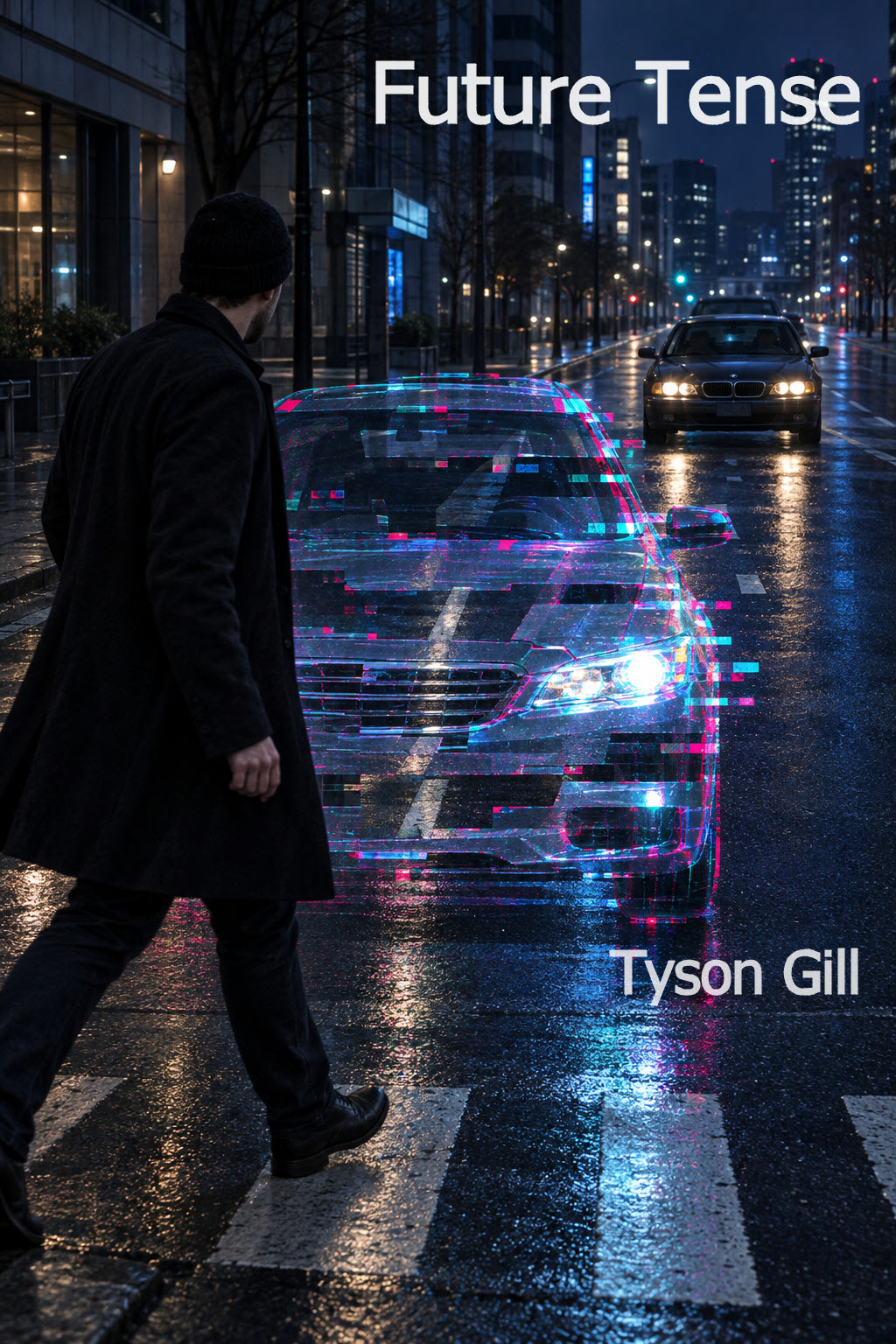
Future Tense Short Stories

My fiction-writing spree continues. Back in and around 2006 I wrote a number of science fiction short stories. Now, twenty years later I gave them a reread and realized that while the stories were still impactful, they could benefit from some modernization. So I updated them with the latest science, tech, and references. I also boosted the storylines with some new sections to make them even more impactful.

So I hope you enjoy these 20th anniversary makeovers. Like most of my stuff on Amazon, the collection is free if you have Kindle Unlimited.

Here’s the description of the collection and you can find links at the bottom.

Three futures. Three choices no one was supposed to make.

Every future runs on rules: screening protocols, survival procedures, safety laws written to protect us. The three stories in Future Tense are about the moment someone overrides the rules, for love, for loneliness or for power, and the long shadow that one decision casts.

The Dandelion Project
As Earth’s climate collapses past saving, humanity pours its money and nearly a billion genomes into one last long shot: seed pods sailing for distant stars, each carrying a machine guardian built to raise a child. This is an end-of-the-world story that turns out to be tender. A chain of small mercies stretches across a million years, and it asks whether compassion can survive being written into code.

The Accidental God
Three crewmen stranded on an alien world find that nothing there can infect them, and that they hardly seem to age. The narrator has endless time and the best intentions. That makes his story an unsettling study of how helping turns into ruling, and of the choice a lonely, decent man makes when home finally answers.

Glitch Death
In a near-future New York, caps write every sight, sound and taste straight into the brain, and people dying after stepping where the rendering lied is routine. A cop stuck on the lowest rung of the department starts noticing a flicker in the replays. This tight techno-thriller is built on real science and plausible law. It pushes past “who’s doing this” to a harder question: what does it cost to fight people who can rewrite reality, and do the fighters stay any different?

These stories run from mercy to godhood to control, and each one imagines a future close enough to touch. Each one also asks who gets to decide.

The Future Tense collection on Amazon

My author page on Amazon

The Bodies Buried in St Mary Mead

I just published a new novella on Amazon Kindle (see here). If you love murder mysteries, Agatha Christie novels, or Miss Marple stories in particular, you might really enjoy this two to three hour read.

Here is the official description…

The quiet garden village of St Mary Mead was once home to the most famous string of murders in British history. Clara West remembers her great-aunt Jane only as a kindly old woman in an Edinburgh garden, and first met “Miss Marple” through the lightly fictionalised accounts made famous by Agatha Christie. Now, as a postgraduate criminology student, Clara returns to St Mary Mead to study the long-term impact of violent crime on a small rural community—and slowly uncovers more bodies buried in the village’s troubled past than even Christie imagined.

What Clara finds in her aunt’s neatly labelled files and in the memories of those who survived reveals subtle hints that point toward something unthinkable. The emerging truth threatens not just a cherished literary legend but an entire village’s sense of itself, exposing a disturbing history that should never be unearthed, but must not be left buried.

The Bodies Buried in St Mary Mead is both an homage to Miss Marple and a critical reexamination of her most famous cases, told in the quiet, deceptively gentle style of a vintage English village mystery. It asks what happens when a modern criminologist is willing to question the official accounts, and what it costs to expose the real truth behind a myth that has comforted generations.

Meticulously crafted and AI-assisted, this novella uses contemporary tools for research, fact-checking, and tonal authenticity, bringing a modern intelligence to the history we thought we all knew.

Hope you enjoy it!

I Want to Sing a Love Song

In today’s world, it’s tough to feel positive let alone inspired by anything. It’s all too easy to think that the worst of us represent all of us. It seems like heroes only ever existed in comic books and today even they have been reinterpreted as deeply flawed creatures.

But true heroes do exist in the world. Singer, songwriter, and activist Harry Chapin was one such real life hero. I was reminded of this when I watched the marvelous documentary about Harry called “When in Doubt, Do Something” on Prime Video (see here).

If you are still a huge Harry Chapin fan, you should watch this documentary. If you are wondering if Harry Chapin is the guy that did “Cat’s in the Cradle,” you should watch this documentary.

Harry Chapin was a musical genre all to himself. Although a few other artists might be identified as storyteller musicians, I doubt that even they would feel worthy to be placed along side Harry Chapin in that category. He told emotionally raw stories, set to the backdrop of sweeping cello strings and ethereal falsettos that bore right through the heart to the soul of the listener. Real, basic, everyman stories that anyone can relate to. His story songs ranged from comedic to sappy to dark but he told all his stories fearlessly. He didn’t pontificate. He was never so obvious as to entreat us to “give peace a chance” or “love one another right now.” He didn’t tell, he showed us universal truths by showing us the everyday people he brought to life through his music.

If you are interested in my recommendations, I’d suggest “Mail Order Annie,” “Mr. Tanner,” and “A Better Place To Be” as just three. If these don’t make you emotional you may have trouble passing the “I am not a robot” test.

Besides being a prolific songwriter and tireless performer, Harry was also a pragmatic idealist who devoted his energy and creativity to combating global poverty, hunger, and homelessness. During the Carter years he gave everything one could possibly give in service of his fellow human beings through both his music and through his dauntless legislative lobbying on behalf of humanity.

One thing that the documentary illustrates vividly is that everyone who interacted with Harry Chapin, and Harry reached many, many people, has their Harry Chapin stories that they can never forget. It is not undue hyperbole to say that most anyone who heard his music was deeply touched. Those who saw him in concert or in more informal performances felt forever connected to him. And those who lived and worked alongside him were transformed by him.

I’m no exception to that. Although I’m only one of millions that were profoundly touched by Harry Chapin, my own Harry Chapin stories are still unique. In true Harry Chapin tradition here are two of them.

I was tending bar in my early twenties. It was one of those local corner family-owned dives there I mostly poured beer for regulars. Every Friday night this young couple would come in and sit at the bar. I never actually learned their names but we had a ritual. At some point during the night they would play “Taxi” on the jukebox and the three of us would share six and a half intimate minutes while we sang Taxi along with Harry Chapin. Like honoring some reverent moment of silence, none of the other working-class patrons would so much as shift on their stool until we were done.

To appreciate my second Harry story, you have to understand that I always went to see Harry Chapin in concert whenever he played in the area. One week, the radio stations kept promoting his upcoming concert at the local Performing Arts Center in Milwaukee where I lived. On concert night, the DJ mentioned that the Harry Chapin concert was to start shortly and I realized that for some reason I had never bought a ticket!

Just out of hopeless desperation I drove over to the PAC. There was no one in the lobby as the concert had already seated. I nevertheless walked up to the ticket window and inquired. Of course there were no tickets left. Sad but unsurprised I turned to walk away but hesitated when I noticed another employee come in from the back and whisper to the agent. The agent turned back to me and said that there was a no-show and they were putting the ticket up for sale. Of course I snatched it up!

It turned out that the ticket was row AAA, the very front row, dead center. I had the best seat in the house to enjoy that Harry Chapin concert. Eventually, Harry came out for the encore. He did Sniper. Now you have to understand, Sniper is a 10 minute magnum opus, exhaustively relating the gut-wrenching story of a clock tower sniper. It was probably longer in concert.

And for this song, Harry came and sat on the edge of the stage with his guitar, feet dangling just inches from my knees. At the finish, exhausted and sweat covered, Harry ended the epic climax of the song. While the audience cheered he just sat there, looking directly at me the entire time, spent and flushed, yet with the kind of connection one only imagines experiencing in feeling of true love at first sight.

I found I just couldn’t clap along with the rest of the audience. I couldn’t call for yet another encore. I feared he might think badly of me, so I just pursed my lips and nodded as if to say, “It’s OK. You have given it all. You don’t have to give any more.” Harry nodded back, every so slightly, and I could see he understood and appreciated my holding back as perhaps his loudest applause of all.

Well, that was my Harry moment was back then. The documentary brings back those memories and shows me how very common my moment was for anyone who interacted with this exceptional human being. But that doesn’t make my moment feel less special. On the contrary, it makes me appreciate him even more.

Harry, you taught me to look at people with all their flaws and quirks and see them as worthy of love, understanding and respect. You taught me to look at all the darkness of the world, to expose it, even to battle against it, and not become jaded or disheartened by it but rather embrace it with compassion and even humor.

I wish there were more like you in the world, Harry, and it is our loss that you died so young. But the fact of your life makes me confident that we all can be better as well.

Harry still reminds us that we are all not just represented by the worst of us, but that we are all also represented by the best of us.

A South Africa Story

I usually write articles to make a clear and specific point or argument. This time I’m going to do something different and simply relate a very short story. Although anecdotal, this story illustrates a wide range of individual and societal dynamics that are universal. But I’ll say little more and hope that it stimulates broader thought and discussion.

This story takes place in rural South Africa. It happened while I was serving in the Peace Corps there. Every day I walked past a heavy construction site. This was interesting as it was the only active job site in the village. They were putting up some sort of commercial multistory building. But what jumped out at me one day was that I never saw any men on the job. All the construction workers were women. This seemed curious.

In fact, it felt so odd that I became increasingly irritated about this. Where were all the men? Why were women forced to do all this heavy labor-intensive construction work?

I got curious enough to ask a local about this. “Where are all the men?” The local pointed down to the next streetcorner and said, “They are all in the bar.”

I was incensed. Every subsequent day as I walked past the site I became even more incensed. What kind of miserable, lazy, good-for-nothing men were these that they drank in a tavern while the women were outside doing heavy labor?

My disgust for the men of the village persisted until one day I could not contain my contempt any longer. I expressed my outrage to another local. That person patiently explained that the government gave very attractive incentives to construction companies to hire women. In fact, these incentives were so attractive and successful, that they let all the men go. Those men in the tavern were displaced and simply could no longer hold jobs in construction. And there were no other jobs.

Needless to say, my sense of outrage toward the men of the village immediately disappeared. My judgmental attitude was replaced with embarrassment over my uninformed indignation.

Amazing how just one new fact can flip the entire narrative of judgments that we passionately believe to be so very obvious.

The Night the Starship Crashed

bandDuring the 70’s and 80’s I attended hundreds of rock concerts and saw most every famous and not-so-famous band that toured throughout those decades. Most were really fun, some were memorable even, but only one stands out as truly epic. Even now, over 40 years later, I recall the event vividly and thought I should memorialize it here before it is completely lost from human memory.

It was 1975 when a friend and I went to see Jefferson Starship in concert at the sports arena in Milwaukee. Starship (see here) was still popular enough at that time to pack such a large venue. As the crowds were slowly meandering in and taking their seats, the preliminary band began to play. Of course audiences are conditioned to largely ignore these startup bands, but this band could not be ignored. It didn’t take long for the chattering to die down and for people to hurry to their seats.

Only few songs in, people began to stand, dance, and clap uncontrollably. The lead singer was a stunning girl with long-black hair whose voice thundered like the gods. Next to her was a quiet blonde with equally long hair masterfully plucking her guitar with cool confidence.  A young guy was handling his lead guitar with the bravado of a superstar, swinging his arm across the strings with wild abandon. Bass and drums were equally well-manned with boundless energy.

It was probably three quarters of the way through their stunning performance, that I fumbled through my pockets to find my ticket stub. I had to know who this band was. Squinting to find a name on the torn paper under sporadic flashes of colored light, I finally caught one word. It said simply “Heart.”

Yes, the largely unknown prelim band was none other than Heart (see here) introducing new songs from Dreamboat Annie (see here) that would soon be blasting non-stop from transistor radios and car speakers all across the nation.

When their set ended, the crowd was on their feet roaring with excitement. I have never seen a preliminary band, even in a major double-bill, work an audience into such a frenzy. The applause continued on long after they stepped off stage with people begging for an encore, even though no opening band would ever do that.

The story doesn’t end there. After a long wait, Starship finally came out. Their performance was tired and unenthusiastic. The audience, especially after being pumped up by Heart, needed far more then they could offer. People started to tune out and talk among themselves. Their response died down to scattered pity-applause.

At one point, some bored and impatient people started calling out “White Rabbit, White Rabbit” which was one of their biggest early hits. Rather than take the opportunity to reclaim their audience, lead singer Grace Slick sneeringly told the crowds “we don’t want to do that old shit anymore.”

With that, the audience had enough of their Starship ride. Almost as one they joined in a defiant new chant. “Heart, Heart, Heart” they demanded, over and over, “Heart, Heart, Heart.” It was a crushing rebuke of the legendary Starship and an unprecedented anointment of the young breakout band. I don’t know how long after that night Heart continued to open for them, but I cannot imagine how that magnitude of upstaging could be tolerated by Starship.

That was the epic night that the Starship crashed and burned in Milwaukee, and a shining new star took their place in the music cosmos.

Heart, we’re still Crazy on You.