Monthly Archives: May 2025

Trump Is Not a Joker

Trump is not a joker, he is The Joker.

In the Batman Universe, the Joker and the Penguin are two iconic villains. But while both are criminals who seek to “take over” Gotham City, they are nothing alike in their tactics and goals.

Oswald Cobblepot, commonly known as The Penguin, is a petty criminal who craves legitimacy. He dons his ostentatious tuxedo in order to appear successful and respectable. He runs crooked but relatively small time businesses to amass money for a run for mayorship, winning him the respect he craves. He makes business deals with other crooks, he suborns police and politicians, and unscrupulously undermines any opposition. But he does build alliances, stands by his allies, and honors his commitments. Upon becoming mayor, while stealing public funds, he still does his best to run a stable government that appears legitimate and respectable.

Some might think that this describes Donald Trump to a tee. But it is far too generous. Donald Trump is no Penguin. He has far more in common with The Joker.

Like the Penguin, the Joker also sometimes takes control of the mayor’s office. But unlike Penguin, Joker takes glee in inciting crazed lunatics to storm City Hall. He doesn’t crave honest respect like the Penguin but takes far more satisfaction from terrorizing people who are repulsed by him into fawning over him. Joker does not care about maintaining the traditions and decorum of his corrupt office, rather he revels in making a mockery of them. He doesn’t care about quiet stability but rather seeks the constant attention produced only by the most garish and capricious displays of power.

In our real world, so similar to comic books, we do see real-life Penguinesque dictators and we also see Joker style dictators.

The Penguin style dictators are our businesslike kleptocrats. They are represented by the likes of Putin, Suharto, Marcos, Mobutu (early), Chavez (debated, early), Abacha, Mbasogo, Nazarbayev, Aliyev, and Mugabe. These dictators, at least early on, attempted to run their countries as profit-driven enterprises serving them and their cronies rather than the people. They maintained just enough stability to maximize wealth extraction and to hold power.

The Joker style dictators are the unstable or negligent leaders. They include Pol Pot, Mobuto (later) , Chavez (debated, later), Amin, Bokassa, Nkurunziza, Gaddafi, Kim Jong-un, Hussein, Milosevic, and Turkmenbashi. Unlike the Penguins who are motivated mainly by self-enrichment and long-term survival, the Jokers are driven by ideology, paranoia, and shocking exhibitions of personal power. They do not attempt to maintain stability but rather allow or even revel in chaos. They do not attempt to conceal their corruption, instead they flaunt it as defiant evidence of their strength and power.

I listed all these names to convey the reality that dictators are not uncommon and that many are not even as “responsible” as Penguin or Putin. Many are truly Jokers, irresponsible, damaged, sociopathic, and even insane people who have taken power but any means.

Jokers have captivated followers and taken control in many, many countries and the United States is not immune. Donald Trump clearly has much in common with The Penguin, but increasingly more in common with The Joker. Like Mobuto who started out as a Penguinesque dictator, expect Trump to descend even further into full-on Joker insanity every day that he holds office.

And one thing we know from the comics is that no one survives long in service of, or even in proximity to, The Joker. So don’t hold any false illusions that once becoming mayor or president, a Joker will produce anything but even greater chaos and destruction, let alone bring anything but ruin upon you.
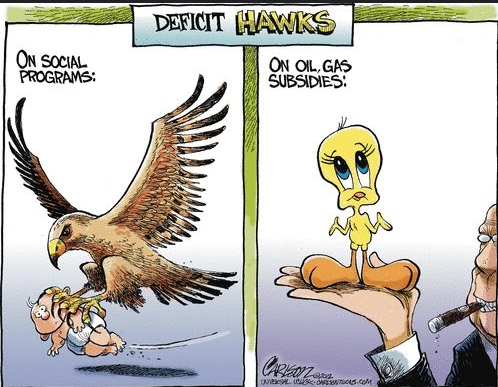
What are Deficit Hawks Thinking?

At every budgeting cycle the Republican deficit hawks work themselves into a frenzy of concern about budget deficits. To remind you, the annual deficit is the amount our government has spent beyond what it has taken in that year. Implicitly included under the umbrella of deficit is the debt, which is the credit card balance we owe for all past unpaid deficits.

Certainly debt and deficits are liabilities and it would be great if we could avoid them completely and spend only what we take in, but we realistically cannot operate without dipping into our credit card sometimes. The contention arises around how to control spending in order to avoid crippling credit card payments.

To reduce our credit burden, both parties strive to increase efficiency and reduce waste, fraud, and abuse. Beyond that, Democrats generally aim to raise revenue from the wealthy and corporations, and (to a far lesser extent) reduce military spending, while protecting and expanding social programs. Republicans mostly push for cuts to social programs, while increasing tax cuts (only for the wealthy), and opposing new taxes (only on the wealthy), while maintaining or increasing defense spending.

Democrats assert that the rich and powerful do not pay anything near their fair share and can afford to contribute far more, while Republicans assert (incorrectly) that the rich and powerful deserve even more money that will supposedly then “trickle-down” to help poorer people.

Not many appreciate that the concept of a “trickle-down” economy did not originate with Ronald Regan who put it forth as a credible economic principle. It was originally a satirical joke made by Will Rogers back in 1932 to mock then President Hoover’s response to the Great Depression in giving more money to rich people.

I’m going to forgo a lot of additional argumentation and simply skip ahead to the conclusion that Republicans are simply wrong on both the merits and the ethics of their budget logic, and rather try to understand their thinking.

I’m going to put aside sheer greed and self-interest as uninteresting. My interest is in how well-meaning people can come to support Republican policies.

First and perhaps foremost, Republicans believe incorrectly that rich people and corporations deserve (are entitled to) more money because the rich deserve it and can make the best use of it. Second, they love a strong military because either they are fearful, love having the biggest guns, love war profits, or are just afraid of looking weak on defense. Finally, they believe that regular people deserve nothing and should either get rich or die quietly without bothering anyone.

These biases result in the following internal logic. A) we must give as much as we can to rich people, and B) we must maintain or expand the military, so C) the only way we can accomplish both is to siphon away money from the 99%. This is accomplished by finding new ways to tax or increase costs for regular people, by destabilizing and pillaging the social security fund that they paid into, by compromising or withholding their healthcare, and by deregulation that shifts the cost of doing business from rich corporations to ordinary communities.

To extract wealth, they continue to perpetuate the joke of trickle-down economics. The term may be discredited, but the concept still underpins their worldview. They extract wealth by grossly downplaying the amount of money being spent on the military, and by exaggerating the cost of social service programs (see here).

And they have elucidated no limit whatsoever in just how much more the rich and powerful deserve. In fact the expressed American value is that personal wealth should be unlimited. Therefore, their goal of decreasing the debt and deficit can never be achieved no matter how much they extract, no matter how much damage they do, no matter how many people they impoverish, the rich can and will never have enough under the logical framework they have constructed.

Thus is the folly of their worldview, their rationalizations, and their policies. Their concern about the debt and deficit may or may not be genuine, as is their belief that the rich should receive even more. But to achieve both, the vast majority of people have to suffer. The end result of their thinking can only be incredibly harmful, unsustainable, and unethical budgetary policies enacted under the pretext of responsible deficit reduction.