Intelligence does not immunize against delusion, and intelligent people can produce sophisticated sounding arguments to support their delusional claims. This has always been epidemic amongst the intelligentsia who believe in, and need to rationalize, the existence of a god that cannot and therefore does not actually exist.
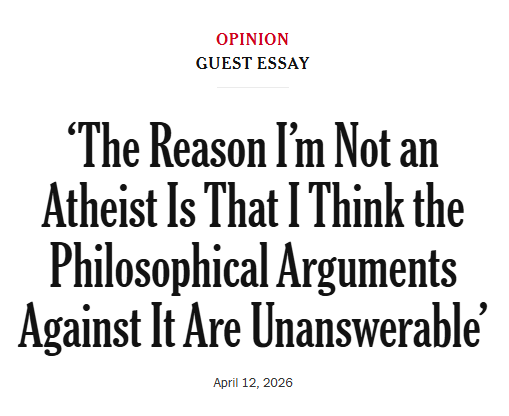
The latest delusional religious reasoning comes from theologian and philosopher David Bentley Hart, in a long New York Times interview (see here) where he announces that the only reason he is not an atheist is that “the philosophical arguments against it are unanswerable.” It’s an impressively confident conclusion, especially given how weak the actual arguments look once you strip away the prose and the piety. Underneath the erudite-sounding facade, what we are dealing with here is just more misrepresented and logically flimsy pseudo‑intellectual religious nonsense.
Hart warms up with a casual swipe at Richard Dawkins’s The Selfish Gene, dismissing it as “decades out of date” when it first appeared and a logical failure. That isn’t just wrong, it’s the kind of wrong you get when you start from “atheists must be idiots” and work backward. Whatever you think of Dawkins’s metaphors, the 1976 book was not peddling obsolete biology; the gene‑centric view it popularized is still one of the basic perspectives in population genetics, even though it has since been supplemented by multi‑level selection and systems thinking, and that’s exactly how its serious critics treat it. Biologists like Denis Noble argue that talking as if genes are little agents oversimplifies a complex causal web, and they argue for reframing and extending, but clearly not for declaring the whole thing “decades out of date” at birth. When Hart actually engages Dawkins elsewhere he mostly attacks the cartoonish way Dawkins talks about “selfish genes” and “lumbering robots,” that is, his metaphors and metaphysics, not the math or the lab work. At no point does he demonstrate that the science was obsolete; he just sneers at a popular book written by an atheist and hopes the insult will do the work of argument. If a Christian apologist wrote a lively popularization of cosmology and an atheist waved it away as “decades out of date” with no evidence, we’d call that what it is: rhetorical BS. If you want to claim modern science has destroyed materialism, you should at least show you can accurately summarize modern science.
The heart of Hart’s case is his insistence that a “mechanistic” view of nature can never explain consciousness, that the scientific picture of the world was built precisely by excluding mental properties, and that trying to add mind back in breaks the machine. He leans toward an idealist picture where consciousness, or “mind,” is fundamental and matter is in some sense derivative. There are at least three big problems with how he plays this. First, he treats “mechanistic” science as if we were still doing physics with brass gears and clockworks. He’s right about one historical point: early modern physics modeled nature as a soulless machine and bracketed talk of purposes and minds to get a clean method going. That was sort of a brilliant move. But he then writes as though that coarse mechanical picture is still the only game in town. It isn’t. Contemporary physics is explicitly non‑mechanistic in his sense; quantum field theory, statistical mechanics, and information‑theoretic approaches do not imagine the universe as billiard balls banging around in absolute space. Contemporary biology is likewise not stuck in clockwork mode; it routinely analyzes feedback, homeostasis, regulatory networks, and even minimal forms of goal‑directedness at cellular and organismic levels without smuggling ghosts into the machine. So when Hart admits that “our sciences are not strictly mechanistic” and yet somehow uses that as a weapon against materialism, he’s trading on an equivocation. Materialism in 2026 does not mean “Descartes’s res extensa forever.” It means that whatever exists is ultimately describable in terms of physical fields, structures, and dynamics—even if those structures are richer than 17th‑century clockwork.
Second, Hart treats “no explanation yet” as if it means “requires a spooky extra force.” He is genuinely offended by the idea that a purely physical story could ever explain why there is “something it is like” to be you. Fine; lots of philosophers share that intuition. But “I don’t see how that could work” is not evidence that it cannot work. Physicalist theories of consciousness—from higher‑order thought theories to global workspace models and integrated information approaches—don’t invoke new metaphysical forces bolted onto physics; they identify consciousness with specific kinds of information‑processing and global availability in the brain. Even critics of those theories generally argue about their completeness or conceptual clarity, not about physics needing to invent some non‑mechanical pixie dust. So there is exactly zero empirical requirement for some mysterious non‑mechanistic “force” to explain consciousness; the conceptual puzzles are real, the data gaps are real, but the demand for a supernatural‑ish add‑on is not. Hart’s move is not “maybe we’ll need a modest additional ingredient.” He jumps from “current models leave an explanatory gap” to “the foundation of all reality is spiritual and mental, not material.” That’s not filling a gap with legitimate science; that’s exploiting any temporary gap to stuff an entire theology into it.
Third, he leans heavily on caricaturing “illusionist” talk about consciousness. Hart loves to quote people like Daniel Dennett saying that “consciousness is an illusion” and then pointing out, correctly, that if you take that literally you’ve sawed off the branch you’re sitting on: if there is no experience whatsoever, there is no one left to be “under an illusion.” But here again he stops at the cheap false victory. Most illusionist or deflationary physicalists mean something much more specific: there is experience, but our naive model of that experience—as a private inner theater with atomic, intrinsic qualia and a simple “self” watching the show—is badly mistaken. On that view, the brain builds a simplified, user‑friendly representation of its own activity and mistakes that representation for a little inner soul; the “illusion” is the brain’s self‑description, not the existence of experience itself. That is not “we gave up on explaining consciousness.” It’s one kind of mechanistic explanation of how an evolved biological control system might misdescribe itself. Saying that consciousness is “in some sense an illusion” is not a concession that mechanistic explanations failed; it is a mechanistic explanation. Hart either does not understand that distinction or finds it more convenient not to. This is not a case where illusion talk admits defeat; it’s a case where Hart is punching a straw man and declaring victory.
Once you clear away the rhetorical fog, the “unanswerable” anti‑atheist case looks very familiar and age old. The pattern goes roughly like this: define “materialism” as a crude, outdated, 17th‑century billiard‑ball picture plus Dennett at his most provocative; show—correctly—that this caricature struggles to account for rational thought, moral value, and consciousness; then declare victory for a vaguely classical‑theist or idealist picture where “mind” or “spirit” is metaphysically basic. The trouble is that many contemporary naturalists explicitly reject the crude “mechanistic” straw man he keeps fighting. They are physicalists, not cartoon mechanists, and they work within a physics that already moved past that picture. Non‑theist philosophers like Thomas Nagel have raised similar worries about materialism’s ability to capture value and reason without concluding “therefore, theism,” and Nagel’s critics have shown in detail how you can respond to those worries from inside a broadly naturalistic framework. There is no valid path from “explaining consciousness is hard” to “the God of Eastern Orthodox Christianity exists,” any more than from “we have not yet fully explained crop circles” to “this proves that aliens created them.”
Hart’s move boils down to this: if he defines “atheism” as commitment to a simplistic metaphysics he dislikes, then his arguments against that metaphysics are “unanswerable,” and therefore atheism is irrational. Sure. And if I define “Christianity” as the belief that the Earth is 6,000 years old and that God personally scripts every toddler’s cancer, I can prove Christianity is evil before lunch. Both maneuvers are lazy. If you want to refute atheism, you have to interact with the best naturalist positions on offer today, not with the weakest airport‑paperback atheism plus your favorite 17th‑century straw man.
None of this means Hart is stupid. He’s obviously not. He’s well read, rhetorically gifted, and very good at exposing shallow, popular atheist arguments. But brilliance in one direction doesn’t inoculate you against motivated reasoning in another. What shows through in that Times piece, and in the wider body of his work, is someone starting from a deep emotional and aesthetic commitment to a Christian‑Platonic picture—beauty as a transcendental, Jesus as uniquely “uncanny,” consciousness as a window into a mental foundation of being—and then retrofitting “philosophical arguments” to protect that picture from contact with a godless universe. Along the way he mischaracterizes contemporary science, caricatures naturalist positions he doesn’t like, and leans hard on loaded definitions (“God” as necessary being; “materialism” as crude mechanism) that atheists simply do not have to grant.
From the outside, this is not a rigorous refutation of atheism; it’s a very educated, very eloquent catechism for people who already want Christianity to be true but don’t want to sound naive. As an unabashed atheist, I have no problem with people finding Christianity emotionally or aesthetically compelling. Believe whatever myths get you through the night. What I object to is pretending that this is where logic forces us to go, that atheism has somehow been rendered philosophically childish by “unanswerable” arguments that fall apart as soon as you stop being impressed by the adjectives. If you want to believe in God, own it as a choice, an intuition, a story that works for you. Just don’t try to tell the rest of us that we’re being irrational for declining to share your delusion.
 figmentums