Author Archives: Tyson

Unknown's avatar

About Tyson

Love writing all kinds of stuff including fiction, non-fiction, editorials, etc. But writing software is the only writing I do for love AND money!

I Have New York Values

TedCruzRecently Ted Cruz got a lot of attention for his disparaging reference to “New York Values.” It’s unclear what Senator Cruz meant unless one is attuned to that particular dog whistle. In fact it may mean different things to different people. But according to Cruz himself, he sees New Yorkers as liberal elitist Jews and Atheists who are pro-abortion, pro-gay marriage, pro-media, and pro-money. He sees New Yorkers as anti-gun and anti-prayer.

You know what Ted? You’re right. Many New Yorkers are wonderfully tolerant and educated, rational and socially-conscious. Most are proudly liberal and some of us are even willing to call ourselves socialists. Our religious communities get along just fine with our Nones. Perhaps you’re frustrated that you cannot divide us along these lines. We do believe it is the legal right for every woman to choose to have a safe abortion if she so decides. We do believe it is the right of every loving couple to enter into marriage if they choose. We do believe in a free and effective Fourth Estate and value culture and theatre and all forms of fine arts. We do practice free enterprise and believe in making a good living, including all those protesting in front of McDonalds for a decent minimum wage. We don’t need to strut around flaunting heat to show how macho we are. And we don’t believe in relying upon prayer when modern medicine and science offer actual measurably beneficial results.

In short, we New Yorkers do not persist in clinging to our guns and our bibles as if we are still living in the Dark Ages. We don’t wrap ourselves in religion or patriotism to conceal our racism and bigotry. And we’re up front about making our money. We don’t pose and pretend we are something we are not like you do. And unlike you, we don’t hide behind sniveling dog whistle comments. We tell you straight up Ted that you are a slimy Joe McCarthy wannabe.

And here’s the thing. It isn’t only New Yorkers that have New York Values. Across the nation people everywhere share our values because they are reasonable, tolerant, open-minded, and hold truly “Christian” values in the best humanist sense.

As a New Yorker myself, I want to now address a few comments to everyone who is not Ted Cruz. New York is not the big city you may imagine it to be. Yes it is big but it is also the biggest small town in the USA. No matter where you live in New York, you live in a distinctive neighborhood, with its own character, with its own community, and with local businesses that are part of that community. Right around my home in Manhattan are lots of local pubs patronized by locals. There are at least 5 local diners where they know me and bring me my usual Sunday morning breakfast without having to ask how I like it. Even at the Subway where I get my lunch, the workers all know me. If I forget my wallet it’s no problem, just bring it whenever. We have local politics and daycare and community theatre in any of the community churches. My wife and I take walks nightly through our parks and along our rivers. In short, it’s really the best of what people dream of when they think of small town America.

We New Yorkers are not the OTHERS that Ted Cruz would like to convince you we are in order to create an enemy to hate and fear and blame. In the final analysis we’re essentially small town folk just like you, no matter where you happen to live.

So to our compatriots everywhere, don’t let fear-mongering hate-spewers like Ted Cruz divide and conquer us. Get yourself a piece of cardboard and a marker. Write “I Have New York Values” in bold letters on the sign and display it proudly so that Ted can see all the potential votes he has kissed goodbye.

Godless Grace

GodlessGraceIf you believe all grace comes from god, then the phrase “godless grace” probably sounds like an oxymoron to you. Or maybe even a blasphemy. You would probably maintain that grace cannot come from anywhere except from god.

But if you know that god does not exist, the word “godless” is just a superfluous qualifier. Of course all grace is godless. Just as is all love and ethics and compassion. We don’t specify “godless gumdrops” after all.

Still, when used in the context of god, grace is certainly a Christian concept defined as divine assistance or favor. The implied threat is that there would be no grace without god. And without divine grace there would be no good will, no altruism, and no self-sacrifice for others. Therefore, many believe, there simply must be a god.

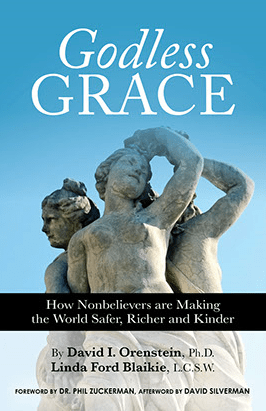
In their book “Godless Grace: How Nonbelievers are Making the World Safer, Richer and Kinder,” (see here) authors David I. Orenstein Ph.D. and Linda Ford Blaikie, L.C.S.W  reclaim the concept of grace from Christians. Grace, they say, cannot be bestowed by a god that after all does not exist. But that doesn’t mean that a purely human godless equivalent of grace is not a force for good in the world. The authors show that in fact grace does exist in the world and it is found in the good works of men and women who have no religious motivations. In the face of that reality, god becomes no more than a rain-dancer claiming credit for spring showers.

In this beautifully written love letter to secular altruists and do-gooders and sleeve-roller-uppers all around the world, Orenstein and Blaikie introduce us to dozens of actual people doing actual good works without any fear or promises from religion. These are not big name celebrity philanthropists, but regular folk from all around the world who are doing modest but important humanitarian work to benefit mankind. The authors did a magnificent job finding these unheralded pearls of humanity’s best. But they would be the first to modestly point out that their job was not all that difficult. There are far, far more “graceful” secular humanist folk than religious proponents would have us believe.

Beyond just identifying these great people, Orenstein and Blaikie help you to get to know them in easy yet pointed prose that make you feel not only that you know these people after only a mere page or two, but that you WANT to know these people. The authors were insightful in learning what motivates each one, non-religious motivations as varied as the people themselves, and are adept at effortlessly sharing those insights with the reader.

About these people overall, the authors conclude:

“… they see themselves as servants to and for humanity – people who do their good work not to please any gods, but to benefit all humans and other beings on the planet.”

Godless Grace is a splendidly crafted book that blends meticulous research and insightful observations into positive and inspiring tones that never sound mushy. It’s not too hot, nor too cold. Godless Grace is just right and you will feel better about your fellow humans and about the world after reading it. Godless Grace is exactly what the atheist/humanist movement needs at this stage. It doesn’t preach, it doesn’t debate, it doesn’t argue, it doesn’t play logic games. It simply shows us, in a positive and sincere way, just a bit of the good that real people do every day without god.

The Original Artists

I still remember with no special fondness the very moment I lost my innocence. I cannot actually possibly forget the singular incident that dashed my faith in my fellow human beings on the cruel rocks of betrayal. My psyche still bears of scars of that dark day when I became painfully conscious of the depth of depravity of my fellow man.

Some say it is only an urban myth, but it happened just this way…

It was the early 70’s and I was a young teen, intently watching I Dream of Jeannie on my 9-inch black and white portable television, occasionally adjusting the single antenna to minimize the ghosting and rolling of the screen, when I heard it. Like a Siren’s Call all, of my favorite pop songs, one after the other, were coming out of my television rather than from my little 9v transistor radio.

Order now, do it quick while supplies last, the announcer was urging me. Get all of your favorite hits in one fantastic album set by The Original Artists! For only $9.99! You’d pay over $50 to get all these incredible hit singles on 45’s! And they are guaranteed authentic hits by The Original Artists!

I frantically adjusted the antenna to better scrutinize the unbelievable offer on the screen. All hits are certified by The Original Artists, it affirmed proudly. It scrolled all the titles along with their artists – Kind of a Drag by The Buckinghams. Check! Incredible as it seemed to get all these amazing hits in one LP set, there it was in black and white. And did we mention that they are all by The Original Artists!?! The announcer even warned me be be careful, not to be fooled by cheap substitutes and demand only The Original Artists.

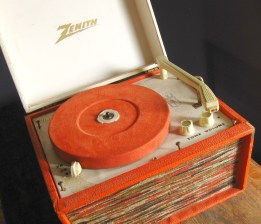
RecordPlayerNeedless to say, I gathered up much of my precious savings and rushed off to the local drug store to buy a money order for $9.99 plus Shipping and Handling, found a stamp, and sent it off. Several weeks later, there it was. My new collection of songs by The Original Artists. I tore it open like it was Christmas morning and dragged my little portable record player out from the closet, flipped open the lid, started the platter spinning, carefully put the record on, set the needle, and sat back to immerse myself in rapturous music.

Except the first song didn’t sound like I remembered it. Then the second sounded an awful lot like the first. Another sing-songy, washed-out, indistinguishably generic regurgitation of the first song. And on they went. Every song a muzak version of the original. Even on my crappy little portable record player it was obvious something was wrong.

Realization came slowly, it tap-tap-tapped at my brain patiently waiting to be let in. Eventually I entertained a small suspicion. Is this really the original artists? But the cover here says clearly that all songs are by The Original Artists…. oh wait…

Yes, shocked and horrified reader, that was the moment that changed me forever. Never again would I accept anything at face value. For evermore thereafter if it sounded too good to be true I assumed it probably was not true.

That formative event forever doomed me to take a second, third, and even a fourth look at laws and legislative actions that sound too good to be true. The Employee Free Choice Act? Hmm. The Internet Freedom Act?? Wait a second. Citizen’s United??? Now come on! When I hear these kind of names The Original Artists counsel me.

Perhaps The Original Artists did me a favor. Maybe in fact they were on a thankless humanitarian mission to teach all kids to be somewhat skeptical, to be a bit dubious about claims, to check their assumptions, confirm their facts, and question the lying truths told by legislators. Maybe it is only thanks to The Original Artists that I became an atheist and an scientist and try my best not to mislead others with spin and clever words that are technically true but intentionally false.

So thanks The Original Artists. Everything that happens to us, welcome or not, makes us who we are. And I for one would not want to be anyone else. $9.99 plus Shipping and Handling was in reality a true bargain.


Gun Liberty Protections

safety-firstAbortion safety advocates have a ton of great ideas about how to protect the life and well-being of expectant mothers. Even though the health risk of abortion procedures is essentially zero, these concerned citizens are so dedicated to health and safety that no legislative restriction is deemed too costly or too onerous. In states all across the country, they are proposing and enacting common sense regulations to ensure that abortion facilities are safe and that expectant mothers are afforded every possible protection.

We should be inspired by their efforts and apply the exact same kind of common sense safety regulations to gun sales to ensure that buyers and sellers alike are afforded their Constitutional right to acquire incredibly dangerous killing machines in the safest manner possible. Following are some proposed gun sales legislations, all modeled upon actual abortion legislation, and intended only to enhance the gun industry and ensure the safety of all concerned in gun sales.

The Gun Seller Freedom Act

  • 14 states require abortion providers to have an affiliation with a local hospital. Although such affiliations offers no benefit whatsoever, we should likewise require that gun shop owners be formally affiliated with a local police department just to be safe.
  • 13 states require that providers have admitting privileges at a local hospital or an agreement with another provider who has admitting privileges. Since guns are far more dangerous than abortions, we should likewise require that gun shop owners have admitting privileges at a local hospital as well.
  • 38 states require an abortion to be performed by a licensed physician. Similarly, we should require that all gun shop staff who sell guns should have to take a 4 year training course and complete a supervised apprenticeship of at least 3 years. After they pass a multipart examination, they may apply to a government-appointed board for a sales license.
  • 18 states require the involvement of a second physician after a specified point in the process. We should likewise require that a second licensed salesperson assist in every gun transaction.

The Gun Store Patriotism Act

  • 22 states have onerous but according to them, essential, licensing standards for abortion clinics that are comparable or equivalent to the state’s licensing standards for ambulatory surgical centers. We should put in place equally stringent licensing standards for gun stores and require meticulous enforcement by the ATF.
  • 21 states specify the size of the procedure rooms and/or specify minimum corridor widths. We should likewise require that all gun store facilities meet minimum size standards to ensure a safe environment with sufficient evacuation capacity in the event of an event. To ensure safety, all walls and windows should be certified to withstand high-velocity sustained gunfire using the most penetrating ammunition available in the store.
  • 10 states require abortion facilities to be within some minimum distance from a hospital. We should likewise extend this protection to gun shops since they have far more potential for catastrophe.
  • 17 states extend regulations to sites where medication abortion (handing out a pill) is provided, even if surgical abortion procedures are not. We should likewise apply all the same gun shop protections to all stores that sell cap guns or BB guns.

The Gun Buyer Defense Act

  • 28 states require a woman seeking an abortion to wait a specified period of time, up to 72 hours, between counseling and the procedure itself. 14 of these states have laws that effectively require the woman make two separate trips to the clinic to obtain the procedure. We should apply these same common sense protections to gun purchasers.
  • 17 states mandate that women be given counseling before an abortion that includes information on at least one of the following: the purported link between abortion and breast cancer, the ability of a fetus to feel pain or long-term mental health consequences for the woman. None of this information is actually true, but the abortion safety advocates care so much about women that they want them to be aware of even imaginary risks. We should likewise require gun stores to provide pre-sales counseling to ensure that purchasers are made aware of the potential adverse consequences of their gun purchase decision.
  • 28 states mandate that an abortion provider perform an ultrasound on each woman seeking an abortion and requires the provider to show and describe the image, or offer the woman the opportunity to view the image. We should likewise require that prospective gun purchasers be shown images of gunshot victims and require that salespersons describe the horrendous gunshot wounds in graphic detail.

The Firearms Integrity Act

  • 4 states require the abortion drug mifepristone to be provided in accordance with the outdated FDA protocol rather than the simpler evidence-based protocol that has been proven to be safe and effective. We should likewise require that sales of any model gun be forced to comply with all safety regulations relating to a Revolutionary War era muzzle loader.
  • 18 states require that the clinician providing a medication abortion be physically present during the procedure, thereby prohibiting the use of telemedicine to prescribe medication for abortion remotely. Likewise all mail order or internet sales of guns should be prohibited.
  • Nearly all states limit the gestational age limit for the procedure. We should likewise limit the size of guns sold to the first trimester of gun and magazine size as there is some anecdotal evidence that guns with more than a 6 bullet capacity have some level of self-awareness.

We owe a great debt of thanks to all those dedicated abortion safety proponents for championing these important protections for expectant mothers.  We should join them in solidarity by proposing and passing similar common sense protections for prospective gun owners.

ADDENDUM

I’ve just become aware that at least one great legislator, Missouri State Representative Stacey Newman, has introduced HB 1397 which is exactly along these lines (see here). As of this moment a hearing on this bill is not scheduled, but keep at it Stacey!!

Nipple Erectile Dysfunction

From:
Jack Offenheimer
VP of NED Division, Phizer Inc.

To:
Rick Kurtzman
Creative Artists Agency

Re:
Engagement of Daniel Craig

Dear Rick

DanielCraigWe at Phizer are thrilled to announce an exciting new product to help women who suffer from the embarrassment of Nipple Erectile Dysfunction (NED). To launch our introductory ad campaign, we would like to engage your client Daniel Craig. We feel that Daniel will be the perfect spokesman for our new NED product line. He has just the “ready for some nipple fondling” look that we feel will be perfect for introducing our product.

The television ad series, that we plan to air all day every day, will be extremely sensitive and dignified. It will follow the highly successful and critically acclaimed format of our Viagra for Men commercials.

The first, patterned after our very tasteful Kelly King commercial, will feature Daniel clad in leopard skin pajamas, lying on a bed and completely ignoring the copy of Fifty Shades Darker in front of him.

His dialogue will be as follows:

“Curling up in bed with a favorite book is nice, but I think men would rather curl up with their favorite woman. But here’s the thing. About half of women over 40 have some degree of nipple erectile dysfunction. Well, Viagra helps gals with NED get and keep a nipple erection. And remember you only take it when you need it.”

The second spot will be similar to our fun and wholesome “Viagra Football” commercial, see it here. In his version, Daniel will be flipping a pair of opera glasses between his hands as he undresses the camera with his eyes.

“Watching opera together is great, but I think men would agree, snuggling with their woman afterwards is nice too. The thing is, about half of women over 40 have some degree of nipple erectile dysfunction. Well, Viagra helps gals with NED get and keep a nipple erection. And you only take it when you need it.”

We hope Daniel will join our family at Phizer to help combat the scourge of nipple erectile dysfunction. We know that he cares deeply about these pressing issues of our times and shares our passion to help women achieve sustained nipple arousal. In addition, we are of course willing to offer an extremely generous compensation package.

Looking forward to hearing from you soon,

Jack Offenheimer


On Elegance

AudreyHepburnFor the generations that frequented movies or browsed magazines back in the 1950’s, Audrey Hepburn became synonymous with elegance. Even for the generations that followed, Audrey Hepburn has remained the iconic symbol of elegance. Ask people for an example of elegance and they are still likely to show you a picture of Audrey Hepburn. When applied to women, she defined elegance as grace and style without ostentatiousness.

MousetrapBut the word elegance can be applied to ideas and designs as well. When applied to things, it suggests something that is both simple and ingenious – ingenious in its simplicity. A mousetrap is a great example of an elegant design. While not pretty to look at, it is nevertheless functionally beautiful. When William C. Hooker patented his spring-loaded mousetrap in 1894, I wonder if he guessed that its elegant design would not be improved upon for at least a century – and maybe never will be. Hooker’s mousetrap has only 5 parts, but it does it’s job as well or better than far more complex and expensive designs. That makes it very elegant indeed.

MousetrapGameTrue elegance, whether in starlets or in devices, is rare. Many people confuse complexity with quality; pretty designs with elegant ones. Inelegance is a very common failing of even the smartest people. In fact the most intelligent people are the most susceptible to producing convoluted, over-complicated solutions to address the simplest problems. But like the mouse-trap game, these clever constructions are fatally flawed in their inelegance.

Elegance separates the talented from the merely smart. Smart people pump out 1000 pages of indecipherably complex manuscript to tell a simple short story. They build contraptions with thousands of moving parts that cannot possibly be maintained. They write computer software that is a brilliant spider’s-web of code that no one but them could possibly comprehend or follow.

The talented author writes a far more powerful tale because it communicates with an economy of perfect words. A gifted engineer achieves the same functionality with an economy of working components that never break down. A master software developer achieves better functionality in a straight-forward, efficient manner that can be easily understood and maintained even by the most junior developers.

An elegant design translated into an elegant solution is often deceptively simple. Many people take this apparent simplicity as indicating a lack of quality or complexity or value, but these impressions in fact demonstrate the strengths of the design.

Mathematicians generally get it. They understand elegance. And they appreciate elegance in equations and theorems and proofs. They have simplification techniques designed specifically to reduce an expression to its simplest, clearest, most elegant form.

Contrary to what many capitalists claim, however, the freemarket does not necessary optimize for elegance. There is this myth that competition results in a sort of Darwinian evolution of products and services into their most elegant form possible. But this does not happen in the real world. In the real world, competition moves toward the most profitable solution that the market will bear. More often than not, the greatest profitability is achieved by ensuring unnecessary complexity to hold the market position and justify high prices. The 5-part mouse trap doesn’t generate very impressive corporate earnings reports.

We can point to things like solid state memory or LED lighting, products that were delayed by the free market because they still made more money on compact disks and incandescent lighting. And those were examples where the market did move, albeit slowly and not entirely willingly. When I worked in research in the 1980’s,  my colleagues were tasked with finding alternatives to ozone-killing CFC coolants. However while there were many cheap, simple, clean alternatives to chlorofluorocarbons readily available, their mission was to find the most expensive, complex alternative possible for which their company exclusively dominated the supply chains.

The free-market does not move us – very far – toward efficiency and elegance. It is focused only on profitability and elegance is not necessarily conducive to profitability. In fact, true elegance, not elegance in appearance only, it is often at odds with the profit-driver of corporations. We need to understand this both as individual consumers and as a planet desperately in need of elegant corporate solutions to the global problems we face.


The Winter Solstice

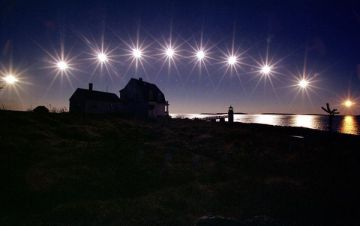
SolsticeDecember 22nd is the Winter Solstice in the Northern Hemisphere. It is the shortest day and longest night of the year. On this day, the noon Sun is at the lowest point of the year, lower the further north you are.

The solstice is the one universal event that all of us humans share in common each year. It has always been the most powerful recurring event in our shared human experience.

This annual solar phenomenon connects us viscerally to all of humanity; to all those living now as well as all those who lived before us. Virtually every culture that has existed has celebrated the Winter Solstice.

Surely every tribe extending back to the very first humanoids able to recognize their surroundings, remember their past, and anticipate their future have noted the significance of the Winter Solstice and have been moved to fear or honor it. Each year we become a part of the unbroken chain of solstice commemorations, formal or informal, that have preceded us.

The significance of the winter solstice lies not simply in the fact that it is periodic and conspicuous, like the return of Halley’s Comet, but because it relates so intimately to our shared human experience.

For most of human history the winter solstice was a time of uncertainty and relief, of fear and hope. As we approach this cyclic transition the Sun falls lower and lower. At the solstice, it gets frighteningly close to abandoning us forever. How easy it would be for it to just sink below the horizon and never return.

Imagine the terrible apprehension this invoked in our ancestors for whom the Sun was everything. Believing that the Sun must be a real being with intelligence and emotions, how could they be assured that it had not decided to simply abandon them to eternal darkness and cold? How could they be sure that they had not done anything to offend it causing it to completely disappear, never to return?

So also imagine our ancestors’ great relief and joy when the Sun resumed its upward ascent for another year.

The Incas of Machu Picchu, for example, believed the Sun was a god named Inti. On the Winter Solstice they performed a ceremony which tied the Sun to a great hitching post of stone in order to prevent it from escaping. The Mapuche people of Chile would stay up all night on that longest night out of fear that dawn may never come again. Only after 3 days, when it became evident that the Sun had returned, would they emerge to celebrate the New Year.

Today of course we know that the Sun will never go away, well not for another 5 billion years at least, but it is still everything to us and we still have compelling reasons for commemorating the solstice.

One day, if we continue our foolish disregard for our planet, if we allow our short-sightedness and greed to destroy our atmosphere, we may no longer be here to appreciate the life-giving gifts of the Sun.

It would be not the Sun who abandons us, but rather we who abandon him, leaving him one again alone and unappreciated in a lifeless solar system.

Sometimes I think that we would be better off still believing that the Sun is a godlike being that we might offend by mistreating animals or ruining the land or spoiling the waters or polluting the air. Perhaps then we would show more appreciation and be less inclined to sully and squander all those precious gifts.

So join our ancestors in once again recognizing the Winter Solstice and contemplating our tenuous place in the universe. As it was with them, the Winter Solstice gives us pause to look back in appreciation for what the Sun has given us and to think about the hard work we must do to ensure another bountiful spring harvest.  It is a time when we humbly celebrate the New Year not of man, but the New Year of our Sun and Earth.


Caution: Slippery Slope

SlipperySlopeThe slippery slope is one of the most commonly invoked arguments and usage of slippery slope arguments seems to be on the rise. One study found that the phrase is used in the media 7 times more frequently than it was just 20 years ago (see here).

These slippery slopes are bandied about quite routinely to sway sentiment and opinion. They are typically used to argue in opposition to something, and they work pretty well. Slippery slope arguments invoke fear, inaction, and even rejection of a proposition by suggesting that if you allow a not-so-bad thing to happen, it will lead to something-much-worse happening.

We hear examples of slippery slope arguments every day. Just a few include:

  • Physician-assisted suicide will open the door to the government pulling the plug on grandma to save Medicare dollars.
  • If we encourage contraception, sexual promiscuity will run rampant and immorality will destroy the fabric of our nation.
  • Legalizing gay marriage will result in incest, polygamy, bestiality, and the breakdown of the American family.
  • Pot smoking is the gateway to heroin addiction.
  • First they came for my gun; then they came for my liberty.

Like the examples above, most slippery slope arguments have extremely dubious connections between the actual and predicted events. Many are in fact completely ridiculous. Most slippery slope arguments are guilty of gross exaggeration and are a form of arguing to the extreme and to fear. They are also a form of false conclusions or invalid extrapolations that mistakenly assume that rational lines cannot be drawn to halt any slippery slope. In short, they tend to violate a large number of basic tests of logical and factual validity.

Apart from appealing to emotion and fear, there is another big reason slippery slope arguments work so well. It is because they are often quite valid. Give them an inch and they’ll take a mile is a valid truism.

First they came for” is granddaddy of slippery slope arguments. It is traced back to a poem by Lutheran Pastor Martin Niemoller that described the decent of Germany into Nazi atrocities. It was a cautionary message about political apathy that described an actual progression of attitudes and events. As a slippery slope argument, it was perfectly valid and substantiated. It was however a retrospective analysis, not a prediction. Nevertheless, today it gets adapted into slippery slope predictions for all sorts of unlikely and implausible outcomes.

This illustrates the fact that we can often only recognize a true slippery slope after we have slid down it. Still, being cognizant and wary of a slippery slope can help us to put on the brakes and avoid sliding too far. We should not necessarily avoid slippery slopes, but we certainly should be cautious and especially sure-footed when negotiating one.

There are criteria that we can use to evaluate the amount of legitimate concern to grant to any particular slippery slope argument. Are the causes and effects that it predicts really likely on the grounds of logic and evidence? Are there any valid precedents to support this slippery slope prediction? Is it only arguing to fear? Is it really likely that such a slippery slope would not be halted before it went too far?

Not all but many invalid slippery slope arguments are put forth by religious people to defend their practices and implement their beliefs in policy. This is understandable. When you do not have facts to argue, slippery slope arguments are very easy to fabricate and usually very effective.

However, we are all guilty of putting forth invalid slippery slope arguments at times when we think it supports our position. Unfortunately this rampant misuse of slippery slope arguments tends to discredit valid slippery slope arguments. Paradoxically it seems that they work very well most of the time but at other times are dismissed out of hand as almost a pejorative. Invalid slippery slope arguments are given far too much credibility and consequently valid ones can be too easily dismissed.

We as fact-based thinkers must be especially cognizant of the rampant misuse of slippery slope arguments and only invoke them after careful consideration. When we do, we must be ready to defend those arguments with supporting evidence or rationale even as we question the basis for the slippery slope claims of others. And most importantly, we must resist the temptation to use specious slippery slope arguments even when they serve our own interests. If we do not reject all such arguments, even when they help our own cause, then we all suffer from a diminution of effective logic and reason and rational decision-making.


Our Fragile Internet

Once upon a time not so long ago we relied upon books as our information storage media. Those rectangular bundles of paper and ink were fragile and ephemeral. But in comparison to today’s digital media, they were etched in granite. Even when formidable powers-that-be expended considerable energy to erase them from existence, it was often still impossible to completely confiscate and destroy every copy in every library and every home. The precious knowledge they held often survived.

Today however, knowledge can be instantly erased with a single press of a button located on an Internet server sitting in some undisclosed location somewhere on the World Wide Web. Certainly the things we see done in movies is pure Hollywood fiction. No one can just hit a button and magically erase all trace of your existence from all computers in the world. We have redundancy and not all of those redundant systems would be accessible by such a purge. And even if some super virus could crawl through every server everywhere deleting all trace of us, there are still backups.

But our information is incredibly fragile nonetheless. If and when the people hosting servers find that it is insufficiently profitable to continue to store and provide access to the information, it is wiped without nary any effort at all. Even if data is hosted by dedicated enthusiasts, they go bankrupt or die or move on. The reality is that despite redundancy and backups, any information located in or accessed through the cloud can simply go poof at any time.

Yes individuals or institutions may have copies of files. But we lose our local files all the time. We accidently delete them, our drive fails, or the software that accessed them becomes obsolete. And because local storage is so fragile, it is becoming increasingly rare to store anything locally. More and more we are relying data hosted “securely” in the cloud. And, like a real cloud, that information can simply evaporate at any time.

This isn’t a theoretical worry. It happens all the time. Here’s just one case study. In 1999, the online gaming universe of Everquest was released. By 2004, there were nearly a half million part-time residents living in the world of Norrath. They filled the Internet with thousands of informational sites, huge databases of information, and literal volumes full of essential stuff. But after a few years, other lands like the World of Warcraft lured players away. When the Everquest player base dropped off, ad revenue to these sites dropped off as well.  When it did, their hosting servers disappeared one by one in rapid succession. Today although many still play Everquest, much of that valuable information is simply gone. In 2004 one would have assumed all that knowledge was carved in stone, enshrined forever in the Internet, eternally available whenever it might be called upon once more by new players or gaming historians. One would have been wrong. All of that information went poof, lost, gone without so much as the warm glow of a book-burning.

You may not care that the walkthroughs, guides, lore, and history documenting the Everquest world are essentially lost to us already. Just as others will probably not care about whatever particular body of knowledge you hold dear. But if we don’t care about all knowledge then no knowledge is secure.

This one case study illustrates the fragility of all information in our Internet-based information age. Yes, there is SO much information out there, but at the same time it is no more enduring than a soap bubble floating on the wind. It can all disappear into thin air just as quickly. The solid permanence of the Internet is illusory.

Consider what this warns us about more important bodies of knowledge like Wikipedia. Wikipedia is arguably the most ambitious and successful accumulation and redistribution of knowledge in the history of mankind. It is a triumph of the Internet Age every bit as marvelous as the Great Library of Alexandria was during the Classical Age.

Yet, like Everquest lore, Wikipedia could disappear in a moment. All it would take is the flip of a switch. This could happen for many reasons. Their resources could dry up or their core team could simply grow old and weary of the effort. If and when this happens, the collective efforts of thousands upon thousands of expert contributors could simply vanish. Poof. This unprecedented compendium of the collective knowledge of mankind could be gone in a wink.

But even more frightening would be if Wikipedia did not simply disappear but was rather corrupted to live on as an unholy shadow of itself. It could be acquired and corrupted and commercialized by a self-interested corporation. It could be censored or even shut down by paranoid politicians. If that were to happen, and it easily could, it would be worse than dead and gone, it would become a tool of profit or propaganda.

As they say “knowledge is power” and the Internet is the portal through which all knowledge now flows. And one does not even need to control sources of information like Wikipedia anymore. They can simply take control of the doors through which information is accessed. Our fragile information age offers that almost irresistible opportunity to control knowledge, to take power. China, UAE, and other countries work to police and censor their doorways to the Internet. The United States struggles against power political and corporate forces that would like to take control of the Internet for financial gain or ideology. Donald Trump just recently talked about how he as President would take control of the Internet. Companies vie and maneuver constantly to take control of the doors to knowledge (and profit) in the Information Age.

This would be unimaginably easy. Those who would control information don’t need to rewrite or censor every web page on the Internet. Rather if they control the supply lines, they can simply switch on software filters or real-time automated editors that can automatically blot out competing information insert alternative viewpoints as easily as they can filter out pornography or spam. The doormen don’t even need to block sites since they can simply drop them down in search engine results until few will ever find them. Even worse, they don’t need to even block or restrict access. Using the justification of protecting us against “dangerous material” they can gain the authority to modify the text, to redact or insert key information without leaving any trace that the source material had been modified.

RedactedIf that knowledge were still printed in physical books, those who wish to rewrite history would leave traces of their censorship by marking out text or ripping out pages. We could at least tell changes were made. We have no such guarantees or indications when it comes to any information we receive in our browser.

If we don’t understand this, if we fail to protect the integrity of data flowing through the Internet, we not only risk losing it all, but we risk becoming, each and every one of us personally, the helpless targets of corporate greed and political propaganda. Our great information age could be corrupted overnight into a new Dark Age. During the last Dark Age the Catholic Church seized control of all knowledge and became the sole arbiters of what would be communicated and how. They would find the control of information infinitely easier today in our Information Age.

We must not let information become just another disposable, devalued, manipulated commodity in a throw-away culture. Our digital information is both a great asset and a great risk.

What Would Kilgrave Do?

If you have not yet watched the Netflix series Jessica Jones, you should definitely check it out. Like so many of the excellent shows available nowadays, it isn’t so much about superheroes as it is an engaging and provocative study of human behavior. You miss out on an awful lot of excellent drama if you are not open to the genre.

KilgraveIn this storyline, Jessica Jones (who is as unenthusiastic about her super-strength as she is about everything else in her life)  is stalked by a sociopathic guy named Kilgrave who has the ability to compel anyone do anything just by telling them to. Look at Kilgrave the wrong way and he is likely as not to tell you to put your head through a wall. And you will. Really piss off Kilgrave, and he might tell you to chew off your own foot, and you would, despite the pain and horror and revulsion.

Clearly an awful guy. But what would you do if you had Kilgrave’s power? Would you use it for good?

I could imagine grand ambitions. In the morning I’d order my way into the boardroom of Exxon-Mobil and suggest politely that they reinvest every cent of their profits into green alternatives to fossil fuels. In the afternoon I’d stroll into the U.S. Congress and tell them to cut the military budget by 75% and invest that money in social programs and infrastructure. Then maybe I’d end the day by dropping in at the United Nations to direct the world powers to dismantle every nuclear weapon in their arsenals.

Would that be an abuse of my power? Or would it be my right and duty to use whatever talents and abilities I have to make the world better? Superman faced this dilemma in “Superman IV: The Quest for Peace.”  He reluctantly decided to gather up every nuclear missile in the world and toss them all into the Sun.

Some agreed with Superman. He was the only one who could rid the world of the nuclear threat so it was his obligation to do so. But even many of those who agreed with his goal were nevertheless outraged by his actions. Just because you have power, they argued, doesn’t mean it is acceptable to impose your will on others. And what, his critics asked, would Superman decide to impose upon the planet tomorrow in the name of protecting us from ourselves?

I for one admit that I would definitely descend from Superman to Kilgrave very quickly. Oh I’d start off innocent enough. I’d use my mind-control power to nudge people into doing the right thing, like “You should apologize you know” or “let that nice old lady have your seat.” But where would I draw the line? Is it so wrong to say “hey you, pick up your cigarette butt and throw it away properly.” Maybe it would teach those litterers an even better lesson if I said, “hey you, pick up your cigarette butt and eat it.

If given his power, it would probably not take very long before I turned into Kilgrave incarnate. I’d like to think I would not order anyone to eat off their foot, but hey, that’s hard to guarantee until one actually has that kind of power.

And the fact is that all great fantasy is allegory. In the real world, some few people do actually have extraordinary power and influence. There are real individuals, like Lex Luthor, whose superpower is wealth and corporate resources. They have the Kilgrave-like power to compel most anyone to do most anything. They may start out innocent an well-meaning enough, like Superman, using their gifts to do what they think is right. But like Lex Luthor, how long before the superpower of wealth turns otherwise ordinary people like the Koch Brothers into real-life supervillains, imposing their will on everyone?

Maybe what the comics teach us most profoundly is that superpowers are something we simply cannot risk in the real world.