Category Archives: Politics

Why White Women Want Trump

By the 2016 election it was undeniably crystal clear to everyone that then candidate Donald Trump was almost a caricature of everything women loathe, hate, and despise. He was not only an overt misogynist but bragged about being physically abusive toward women and exerting coercive pressure to demean them.

This was abundantly, undeniably clear to everyone, most of all to white women who have become extremely sensitive toward, and intolerant of, this kind of Neanderthal. I label Trump, and men like him, as Neanderthals, although I have no evidence that actual Neanderthals were anywhere near as contemptuous toward their women as is Donald J. Trump.

And beyond his incredibly objectionable personality, there is his personal physical attractiveness which has to impact these appraisals. In this regard, again, Trump is perhaps the least likely man in the universe to attract women. He’s old, fat, and arrogant, pretentious, with no sense of humor, a bad comb-over, clownish make-up, wearing ill-fitting suits and reveling in disgusting eating habits. In short, he makes the comic book villain The Penguin look like an absolute charmer in comparison.

Given his incredible abundance of offensive and unattractive characteristics, would any woman possibly vote for Trump to represent their best interests as president?

Well we do know the answer to this. Trump did lose the overall female vote to Hillary Clinton, but how did he fare amongst white women in particular? Did even 20% vote for him? Did he somehow win over 40%?

It was actually 53%.

One could dismiss 53% as a slim majority. But in presidential elections, 53% is typically considered a political landslide. So the reality is, amongst white females at least, Trump won decisively.

How can this be? It seems to confound reason and rationality so completely, that people have a hard time accepting it, let alone explain it. And no, these were not just a lot of befuddled old white ladies living in Florida retirement homes. This 53% included women across the age spectrum.

Journalist Sarah Jaffe examined this perplexing phenomenon in her article “Why Did a Majority of White Women Vote for Trump?” (see here). She cites a number of reasons including a rejection of Hillary Clinton, security, and morals, but while all these rationales may be real factors, they all feel weak and convoluted. Certainly they seem insufficient even collectively to explain the stark magnitude of this disconnect.

In addition to these other “rational” calculations that are often put forth as speculative explanations, I’d like to offer one additional speculation that is not often, if ever, mentioned.

Instinct. Simply put, females evolved to be attracted to Neanderthals. Or, more precisely, to Alpha males who are often the worst, most brutal, meanest Neanderthal in the pack, like Trump.

This is not to demean or be reductionist toward women. It is only to recognize the role of evolved traits and behaviors that may not always serve us well in modern society. One of these is what attracts us at a visceral, unconscious level. Men are irrationally attracted to a great set of boobs, and women are irrationally attracted to the biggest, most thuggish alpha male of the group.

This behavior was clearly observable to me “in the wild” on a trip I booked in Argentina. It was a 24/7 bus-based camping trip that lasted over a month. I was considerably older than the rest of the group and could observe their behavior from a detached perspective.

There were a couple absolutely great guys on the trip. Handsome, college educated, accomplished, witty, considerate. They were everything the women on the trip ought to be attracted to on paper, but I observed no interest of any kind.

Then, halfway through, another guy joined. An extreme Neanderthal. He was slovenly, brutish, uneducated, and never without a cigarette in one hand and a beer in the other. To illustrate the extent to which I am not doing this guy an injustice, his favorite story he told over and over proudly was about how “This chick got in my face at a dance club and says she’s having my baby. I took her in the bathroom and shoved her face in a urinal and told her never come getting in my face when I’m with another chick.”

And yet, a number of those sensible, college educated, suburban type women on the group immediately and overtly started to flirt with this Neanderthal. Flirting so far as grabbing his butt in the bus and loudly “sleeping” with him nightly in turns in his small camp tent.

The last night of the trip I was alone at dinner with the three remaining girls. They were lamenting once more, as they had often over the course of the long trip, about how there were “no nice guys.” I finally felt compelled to point out their behavior, how they had ignored the really great guys on the trip and fallen all over the deplorable Neanderthal.

Initially they dismissed and denied it, but after some mild pressing one of them agreed that yes, she had to admit they did do exactly that. Another turned to me and told me most sincerely by way of explanation that “yes, but when we want to settle down we go for the nice guy.”

I laughed and said, so you’re saying that when you need a man to help raise a baby and fix the toilet, that’s when you’ll give the nice guy a second glance. She answered, as if it made it all understandably fine, that that was absolutely right.

I relate this story not to blame or shame women, but to help us understand and appreciate the extent to which evolved behaviors can and do still play a powerful role in modern life, even in presidential politics. Our innate instincts, uniquely male instincts as well as those of females, manifest in behaviors and rationalizations that do not serve us well any longer in our modern civilized world. Trump is like that guy on the trip. Women, whether we like to admit it or not, are innately attracted to peacocking, even threatening, alpha males like Trump who they perceive, however irrationally, as the strongest and most ruthless leader to protect them and their families.

That’s my hypothesis as least and I’m putting it out there for consideration. I’m not claiming it’s the only factor, but I do suggest that it is a contributing factor that should be at least recognized and factored in if we are to have any hope of overcoming it.

Women, when it comes to the next election, resist getting attracted to the perceived Alpha candidate who brags about grabbing pussy. You know he’s bad for you. Don’t even flirt with the Neanderthal who is only going to abuse you and inevitably shove your face into a urinal. There really are nice presidential candidates who are available. Next time around, go for the boring responsible guy that will help you raise your baby and fix the toilet.

And men, don’t feel the least bit smug or superior because I happen to be focusing on women in this particular situation. You have more than your unhealthy share of evolutionary baggage to acknowledge and leave behind as well!

Why Evangelicals are Hell Bent on Theocracy

I don’t merely repeat other articles in my blogs. But I do sometimes reference and summarize them if I have something, hopefully something important and interesting, to add.

That is the case with “How Evangelical Christians Went From Jimmy Carter to Donald Trump” (see here). In this New York Times article, author Jane Coaston interviews book author Jon Ward who wrote “Testimony,” a book in part at least about the rise of the Evangelical movement.

The interesting part of the interview, for purposes of this article, was Jon Ward’s perspective on the rise of the Evangelical movement. According to Ward, the movement was birthed by the West Coast Hippies of the 60’s. They felt that the religion of their parents was dead and lifeless without enough meaning in their lives. They demanded a new “personal” relationship with Jesus.

This rings true to my own experience growing up. I’m in my sixties now, but growing up, all of my Catholic relatives and everyone else I knew was very laid back about their religion. Even while they had strong political views, their religion really played little part in their thinking. If they dragged themselves to midnight mass on Christmas they were covered for the year.

The Hippies, according to Ward, wanted much more out of their relationship with God.

So then came the presidency of Jimmy Carter. While a devout Christian, Carter was mostly a secular President. According to Ward, this frustrated and angered these newly passionate Christians. Again, this rings true to me. While I have always admired Carter for keeping his faith out of public policy, those newly ambitious Christians became frustrated by it.

Ronald Reagan changed that. He filled them with hope and empowerment and told them they were the good guys. He convinced them that their beliefs were an important and were a legitimate part of political discourse. He made them feel they deserved to be not only heard but be listened to.

According to Ward, the next major step in their rise (or more properly their descent) was under the Clinton presidency. He commented in the interview that Bill and Hillary Clinton taught Christians to hate. What he meant was actually that Conservative talk show host Rush Limbaugh taught Evangelicals to hate, and the Clintons were the target of that hate. Again, having been very aware of both Limbaugh and the Clintons during those years, that rings absolutely true.

Next, according to Ward, was the George W. Bush presidency in which they made Bush their Warrior-King and mobilized into a warrior-army themselves. He did not comment much on the Obama presidency except to say that it was a period of increasing hyperpartisanship.

And all that led to Trump. Whereas Bush was their Warrior-King, Trump became their God-King. A god of destruction. Even though many of them appreciated that Trump would likely “destroy everything,” that was OK. By that point in their radicalization they felt that things were so bad, maybe something good would come from it all being destroyed.

The reason that our newly emerged mainstream of radicalized Christians could take this last nihilistic step, according Ward, is because at each step in their evolution they have had too much sunken cost to pull back. Their only response at each step was to double and then triple down.

So, here’s where I extrapolate past the history that Ward provides.

Since radical Christians have so much sunken cost at this point, after having accepted a “let Trump bring down this whole Tower of Babel” proposition, where can their thinking possibly go next? How can they double-down any further?

The only place left for them to go is to reject Democracy itself and embrace full-on overt Theocracy.

That isn’t actually much of a prediction because we can see this final transformation happening in real time every day.

How can we stop these over-invested and radicalized Christians from destroying any secular, democratic life in America? I don’t know but a first step has to be acceptance of the very real threat that this is where they are headed. If we understand their previous progression as a series of doubling-down to salvage sunken costs, we can better appreciate their inevitable next suicidal step, prepare for it, and hopefully counter it.

We must pull them back from the brink.

Speaking for All Atheists…

So speaking for all atheists in America, I’d like to say we get it and we are on board. We understand the principles that the Supreme Court has made clear and we will abide by them. These include the principle that no one should be made to do anything that might conflict with their deeply help religious beliefs, that they should be given every accommodation of their religious beliefs, and that they should not be required to produce any written or other work product that even hypothetically might conflict with their religious beliefs or 1st Amendment rights.

We won’t fight you any longer regarding the utter silliness and complete folly of these positions.

We also admit that leading religious thinkers like Ken Ham (see here) have been right all along in their insistence that atheism is just another religion. As Ham points out:

“Atheists have an active belief system with views concerning origins (that the universe and life arose by natural processes); no life after death; the existence of God; how to behave while alive; and so much more. Honest atheists will admit their worldview is a faith. Atheism is a religion!”

Atheism is Religion, Answers in Genesis

Well, we do want to be completely honest, Ken Ham, so we agree to abide by your inestimable logic and admit that atheism is a religion. We do admittedly hold a devout, sincere, deeply felt belief in objective reality. And given that we are then a religion, we expect the same rights as you. For example, we atheists will no longer produce any work content of any kind that contains religious iconography, messages, or suggestions. To do so would violate our deeply held beliefs and would be a violation of our 1st Amendment rights. If you wish to have some writing or video work produced, edited, polished or published, we cannot assist you in these or any other creative activities – and all forms of work are creative self-expression in one way or another.

For example, if you wish to have a wedding cake made it must clearly depict a civil marriage or else we cannot in good conscience decorate it. Similarly, we cannot in good conscience produce a web site for your church or charity if it has religious associations. For that matter, under our 1st Amendment rights, we cannot in good conscience perform any action or service which propagates delusional ideas in direct contradiction to our deeply held faith that delusional thinking is bad for sanity.

This is particularly true when religious activities affect children. How can we atheists be forced to even implicitly and indirectly condone and support activities that our devout faith in objective reality tells us are forms of child abuse?

Devout atheists, for example, cannot sell a car to a known Christian. It would violate our deeply held, sincere ethical belief that you might even hypothetically use that car to transport others, maybe even minors, to a church service which would do them clear harm. In fact, we reserve the right to sue any Uber driver or family member who facilitates those activities. The same goes for any other type of sales or service work which we might otherwise be forced to perform for religious customers in violation of our faith.

Further, as employers we atheists cannot in good faith allow Catholics to have Sundays off of work or time off to perform any religious observation. To do so would force us atheists to implicitly express tangible support for those activities that we find morally offensive. This applies also to any company-sponsored benefits or activities that include, directly or indirectly, religious associations.

Atheist doctors and pharmacists, like their Christian counterparts, will, of course, be permitted to withhold medicines or services if they feel that their atheist religious rights would be infringed upon to offer such goods or services as they deem in conflict based upon their personal interpretation of their religious freedom.

In schools, we require that all bibles and other religious reading materials be removed from libraries and from the curriculum in all fields of study. We insist that any history of religion be purged and that any influence of religion in secular matters be expunged from the historical record. We expect that atheist observances at sporting and other events will be protected by our Supreme Court as well. Any school plays with religious themes or references should clearly be prohibited.

Of course, our religious freedom demands that references to god be removed from all coins and any other materials we atheists may be forced use, and we refuse to take any oath that makes reference to god or the bible as those are clearly violations to both our religious freedom and our freedom of speech.

Of course, we atheists stand by our religious brothers and sisters from all religions, no matter how dubious and fringe and crazy their beliefs may be, in their assertions of the same fundamental rights. We trust that our Supreme Court is not simply making up the rules as they go to rationalize and empower an emerging Christian theocracy.

No, given the dedication of our wise Supreme Court to abide by precedent, particularly the intentionally vague and broad precedents they have just recently set, and knowing their profound dedication to intellectual consistency, we are confident that they will rule in support of protecting the religious and 1st Amendment freedom of atheists.

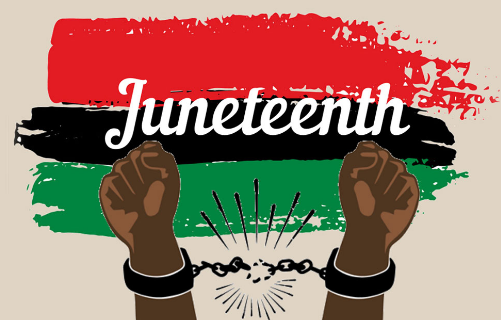
I’m Onboard Juneteenth

In 2021, Juneteenth became the first new federal holiday since Martin Luther King Jr. Day was adopted in 1983. My immediate knee-jerk response was geesh, another silly made-up holiday. That reaction frankly reflected my ignorance. This year, as I learned more about Juneteenth, I have come to appreciate that it is truly a worthy and essential American holiday. In fact, it deserves to be one of our most important holidays.

My first mistake in thinking about Juneteenth was lumping it in alongside all the many holidays and history weeks or months that inundate us constantly. It seems like often there are three holidays going on at any given time. But a federal holiday is special. These are the days that the federal government designates as paid holidays for its workers and there are only twelve of them.

  • New Year’s Day (January 1)
  • Martin Luther King’s Birthday (3rd Monday in January)
  • Inauguration Day (January 20th every 4 years)
  • Washington’s Birthday (3rd Monday in February)
  • Memorial Day (last Monday in May)
  • Juneteenth National Independence Day (June 19)
  • Independence Day (July 4)
  • Labor Day (1st Monday in September)
  • Columbus Day (2nd Monday in October)
  • Veterans’ Day (November 11)
  • Thanksgiving Day (4th Thursday in November)
  • Christmas Day (December 25)

Note that these do NOT include many of the holidays that one normally thinks about like Valentine’s Day, Easter, Halloween, and all the rest. Other holidays may have social, ethnic, or commercial significance, but they are not federal holidays.

Although many of these federal holidays receive their share of criticism, they seem reasonably legitimate to me, mostly.

New Years Day is a no-brainer, as is Independence Day. Honoring notable individuals like Martin Luthor King, Washington, and yes debatably even Columbus, is legitimate. I recoil a bit having two holidays that are typically celebrated as pep-rallies for war, but even I cannot begrudge veterans, living and deceased, their days of recognition. It is nice that we have a day to celebrate labor as well. And, despite its battered history, Thanksgiving Day is a very wholesome and positive excuse to appreciate our blessings.

Christmas however should not be on this list at all. I understand that the federal government is not endorsing religion by offering Christmas as a paid holiday, but it nevertheless should avoid any possible perception of endorsing religion, let alone any particular religion. President Grant should not have made Christmas a federal holiday. Interestingly, his 1870 decision was partially driven by slavery as it was a gesture intended to help unite the north and south.

Why then does Juneteenth deserve a place on this very special list so laden with both explicit and implied significance?

First, given the importance of social justice in the very fabric of America, the inclusion of a social justice holiday, apart from recognizing Martin Luthor King personally, is long overdue.

Second, Juneteenth commemorates defining and transformative events critical to the history and character of our culture. The end of slavery, particularly after our long and bloody civil war to decide the issue, is arguably every bit as significant and important as celebrating Independence Day.

Finally, the events of June 19th represent a powerful and moving event to mark the formal end of our national struggle, and for many, our national nightmare. I can see schoolchildren performing plays depicting Major General Gordon Granger arriving in Galveston two and a half years after the Emancipation Declaration to tell the enslaved citizens that they are free. It is a powerful and moving moment in our history that needs to be commemorated. It reminds us who we are and where we have been, simultaneously at our best and our worst.

So, if you’re like me and are late in giving sufficiently fair consideration to Juneteenth, I urge you to do so now. It is an important holiday that America truly needs and deserves.

Pro-Choice Activists Can’t Play Chess

When I was in grade school, my best friend’s grandfather was a former chess grandmaster. He attempted to teach me the game. And he failed.

Every time I would start to make a move, he would swat my hand, reset the piece, and tell me no. Never move just to move or merely to react. He would demand that I think farther ahead and come up with a better move.

Although I was hopeless at chess, that one lesson did sink in. Never make a move without first anticipating the subsequent moves that may follow. No move should ever be merely a reaction and none should ever be made in isolation. Rather, every move must coordinate with every other move to advance a larger strategy.

It’s that strategic ability to anticipate, to corral your opponent, to control the board, and ultimately to trap them that constitutes the difference between the grandmaster and the novice, the winner and the loser. It is true in chess and it is no less true in the legal and political battle for abortion rights, a game where refusal to play is not an option.

As energetic, creative, and diligent as pro-choice activists may be, we have been outmatched by opponents who think many more steps ahead. Not only do they have more skill at this game, they have a level of ruthlessness and focus that we struggle to overcome, regardless of how passionate we are about preserving a woman’s right to choose.

Abortion activists do work very hard to counter each of the moves that anti-choice grandmasters make toward ending abortion. But while the moves of our opponents are well-coordinated and planned, our moves are mostly reactive. The following list of examples is long, but its very length serves to underscore the magnitude of the problem.

  • When they prohibited Medicaid and/or insurance from covering abortion, we set up funds that provided financial assistance.
  • When they required that patients must be given inaccurate or biased counseling, we developed websites and other sources of accurate info that patients could access.
  • When they required that counseling be provided by a physician days before the actual service, we started using videoconferencing or phone to enable patients to avoid an extra trip.
  • When they required parental approval for minors to have abortion, we set up services that helped minors to seek approval from a judge.
  • When they established unnecessary but onerous requirements about abortion clinic structure or provider credentials that were impossible for many clinics to meet, some clinics closed down. We started mailing pills to patients who were left with no nearby access.
  • When they required patients to have tests before the abortion, we found ways for patients to get the tests in their communities, without having to travel to the clinic itself.
  • When they banned abortion in certain states, we set up clinics in adjacent states, right across the border.
  • When they protested outside clinics, we engaged escorts to help patients get through the picket lines.
  • When they started killing abortion providers, we installed bulletproof barriers and hired guards.
  • When they started to harass or threaten people who had had abortions, we advised patients to say that they were miscarrying.
  • When they required that the provider show the patient any ultrasound pictures, we stopped doing ultrasounds unless they were absolutely necessary.
  • When they required that providers describe the fetus in detail to the patient, we gave patients headphones that they could use to block out the sound.

Again, these are all necessary and hard-fought actions taken to mitigate the damage caused by the anti-abortion movement. But they are isolated and reactive or predictably proactive at best. They do not demonstrate coordinated progress in advancing a strategic plan to win the larger battle. As just one example to illustrate, one prong of a strategic plan might be a generational effort to erect a legal foundation to ultimately establish that a fetus is not a person. None of these reactive efforts contribute to any such wider and longer term effort.

Our activists often lament that we cannot take any initiative because we are continually put on the defensive. But isn’t that the whole point of chess? To advance a strategic plan even as you deploy and defend your pieces?

If my friend’s grandfather were observing the abortion rights game we are engaged in, he would swat the hands of our pro-choice activists and insist that we think strategically, that even as we respond to counter immediate threats we simultaneously maneuver to take ultimate control of the gameboard; hopefully in subtle ways that our opponents never see coming.

Here is what seems clear. If we keep on as we have, if we continue to simply react without advancing a larger strategy to win, abortion is headed to a checkmate. And that checkmate will mean personhood for fetuses and a total nationwide ban on abortion under penalty of murder.

Like any novice in chess, we may be far closer to a loss than we can appreciate. If our opponents succeed and achieve an all-too-sudden checkmate, what should we expect?

Together with my wife, who is a leading abortion researcher, we put together a short video to depict the future that anti-abortion zealots may very well force upon us. It adapts a scene from the popular television show The Wire to illustrate how abortion medications may be administered in the not-too-distant future.

It may be that our best hope for relatively safe and effective abortions will lie with street corner drug dealers who can outthink and outmaneuver the forces arrayed against them to offer abortion medications to people who desperately need that help.

Not to in any way minimize the urgency of avoiding that dystopian future, but streetcorner sales might actually not be as disastrous as many might imagine.

Mifepristone and misoprostol are highly safe and effective abortion medications. Patients can almost always determine on their own whether they are pregnant, whether they want an abortion, and whether they are eligible for the treatment. And, in the rare instances in which the patient misjudges eligibility, the risk of severe complications is minimal. There are very few medical contraindications, and the risk of severe issues is low in even those cases. Studies have shown that the quality of the medications, even when produced by questionable foreign sources is, so far at least, perfectly fine. Supervised follow-up, while desirable, is not essential.

Be that as it may, no one wants to end up relying upon illegal drug sales as the mechanism for health care delivery in America. But to avoid that, we need to stop reacting and start taking control of this deplorable game of abortion chess that anti-choice zealots are forcing us to play.

Pandemic of Delusion

You may have heard that March Madness is upon us. But never fear, March Sanity is on the way!

My new book, Pandemic of Delusion, will be released on March 23rd, 2023 and it’s not arriving a moment too early. The challenges we face both individually and as a society in distinguishing fact from fiction, rationality from delusion, are more powerful and pervasive than ever and the need for deeper insight and understanding to navigate those challenges has never been more dire and profound.

Ensuring sane and rational decision making, both as individuals and as a society, requires that we fully understand our cognitive limitations and vulnerabilities. Pandemic of Delusion helps us to appreciate how we perceive and process information so that we can better recognize and correct our thinking when it starts to drift away from a firm foundation of verified facts and sound logic.

Pandemic of Delusion covers a lot of ground. It delves deeply into a wide range of topics related to facts and belief, but it’s as easy to read as falling off a log. It is frank, informal, and sometimes irreverent. Most importantly, while it starts by helping us understand the challenges we face, it goes on to offer practical insights and methods to keep our brains healthy. Finally, it ends on an inspirational note that will leave you with an almost spiritual appreciation of a worldview based upon science, facts, and reason.

If only to prove that you can still consume more than 200 characters at a time, preorder Pandemic of Delusion from the publisher, Interlink Publishing, or from your favorite bookseller like Amazon. And after you read it two or three times, you can promote fact-based thinking by placing it ever so casually on the bookshelf behind your video desk. It has a really stand-out binding. And don’t just order one. Do your part to make the world a more rational place by sending copies to all your friends, family, and associates.

Seriously, I hope you enjoy reading Pandemic of Delusion half as much as I enjoyed writing it.

But What Would We Do Without Religion?

As an author who focuses primarily on science, fact-based thinking, and atheism, I find that many of my conversations end up stuck in religion. Even those who share a clear and open-eyed view of the completely delusional belief pattern of religion, as well as the real social harm that it causes, still end up at stuck at “yea, but we need religion.”

Their suggestion is that, despite the obvious insanity of it, we’re stuck with religion. After all, some people clearly just need religion to better cope with life. They need the support that religion provides, whether real or fantasy. Implicit in this acceptance is the assumption that there is and can be no secular alternative. We have become co-dependent upon our mass delusions.

To those folks I say, look, we’d be completely fine without religion. In fact, if a miracle actually happened and religion disappeared from the planet, it would be quickly replaced with far more healthy fact-based alternatives. The disappearance of religion would open the space at least for rational secular alternatives to blossom and grow to fill any sane, legitimate need. All the money going to churches would be available to them to grow and flourish.

We have plenty of secular support systems already. We have an arguably helpful and supportive secular government, charities, clubs and associations of all sorts, NGO and volunteer organizations, and familial and interpersonal relationships. If religion were to disappear, I am fully confident that there are plenty of fact-based support and comfort systems that would expand and blossom to provide socially healthy alternatives to provide any legitimate benefits that religion may offer.

You know, we are always irrationally fearful of losing anything we have, even when it is harmful to us. Yes, cigarettes are killing us but don’t you dare take them away! Perhaps gas stoves are no longer needed and are giving our kids asthma, but you can pry my gas stove from my dead burnt fingers!

Moreover, we have a tendency to put too much emphasis on what little good someone or something offers while minimizing all the negatives. At one company we had a true bad apple named Tanya. Tanya did virtually no work and spent all her time proudly fomenting dissent. Yet when I asked my boss why he didn’t fire her he said “well if I did who would do the little bit of work she does?”

Finally, we have another tendency to think of things we rely upon as indispensable, irreplaceable. I am a fan of Amazon, but many folks think it is terrible. Yet, most would not wish to do away with Amazon because, after all, we depend on it too much. Like it or not, they would say, we need it.

But I think it is safe for me to assert that you’d be just fine without your cigarettes or your gas stove. Work will go on just fine with Tanya gone, and in fact less can be more and productivity will probably increase. Someone will pick up her work with hardly a notice. And if -<horror> Amazon went out of business tomorrow? The market would quickly adjust and you’d have plenty of ways to buy whatever it is you need. Within weeks they’d be no more than a distant memory, like Montgomery Ward or Sears and Roebucks.

Similarly, we overly focus on whatever good comes from religion and we mistakenly worry that it is indispensable and irreplaceable to meet our needs. We practically imagine that civilization would crumble without it. But it would not. We’d do just fine, and, as with Tanya gone, probably much better. As much as Amazon executives or church leaders would like you to believe that they alone can sustain you, they are not truly essential and irreplaceable. No one and nothing is, including religion.

So fret not for the loss of religion in the world. The planet will keep spinning and people will end up in a much better place when we finally escape from our delusions.

Wisconsin’s Fall From Grace

I was always proud of being from Wisconsin. I cited my Wisconsin upbringing as a testament to my good Midwestern values.

But for a while now I’ve increasingly felt like, if forced to admit I am from Wisconsin, I need to rush to explain that, despite being from Wisconsin, I’m really not crazy or stupid. To salvage my dignity, I quickly point out that I went to school at Madison (now I know how those Texans feel when they rush to point out that they are from Austin).

It isn’t me that has changed, it’s Wisconsin.

I am a product of Wisconsin as much as Miller Beer or its favorite son, The Crusher (see here). The Crusher was the stage name for a pro-wrestler who reportedly used to train by jogging around South Milwaukee with a barrel of beer on his shoulder. My friends and I used to go to watch the wrestling matches at “The Arena.”

So I have solid Wisconsin creds. I spent my Elementary and High School years roaming the near South side in Milwaukee and camping out in a pup tent at Mauthe Lake. I dragged my overloaded wagon through unplowed snowdrifts to deliver the Milwaukee Journal after school and at 3 am on Sunday mornings. My undergraduate years at Carroll College in Waukesha were challenging and exciting, living in a welfare voucher flop house across from the library. While attending the University of Wisconsin at Oshkosh, I managed a large [reportedly haunted] apartment complex and parented a group home for a great bunch of mentally disabled residents in nearby Ripon. I taught High School in Wisconsin farm country and was particularly proud to attend Graduate School at the University of Wisconsin in Madison, the historic and vibrant epicenter of Midwest progressivism at its best.

Wisconsin has a lot to be proud of beyond beer and pro-wrestlers. It has a long history of bold and progressive leadership.

Throughout the twentieth century, Wisconsin led the country in devising pioneering legislation that aided the vast majority of its citizens. In 1911, the state legislature established the nation’s first workers’ compensation program, a progressive state income tax, and more stringent child-labor laws. The following year, former President Theodore Roosevelt described Wisconsin as a “laboratory for wise, experimental legislation aiming to secure the social and political betterment of the people as a whole.”

The Undoing of Progressive Wisconsin by Dan Kaufman (see here)

The proud historical legacy of Wisconsin was hard-earned by courageous populist leaders like “Fighting Bob” La Follette (see here) and his sons. But the Wisconsin that birthed and raised me is no more. The sane and compassionate Wisconsin that the La Follette’s worked so hard to build was murdered back around 2016 when Conservatives took control.

While Trump’s victory may have shocked the media, it merely heralded the final stage of Wisconsin’s dramatic transformation from a pioneering beacon of progressive, democratic politics to the embodiment of that legacy’s national unraveling. Powerful conservative donors and organizations across the country had Wisconsin in their sights years before the 2016 election, helping Governor Scott Walker and his allies systematically change the state’s political culture.

The Undoing of Progressive Wisconsin by Dan Kaufman

Wisconsinite Dan Kaufman, the author of that article in The Progressive Magazine, also wrote a book on this topic called The Fall of Wisconsin: The Conservative Conquest of a Progressive Bastion and the Future of American Politics (see here).

The Fall of Wisconsin is a deeply reported, searing account of how the state’s progressive tradition was undone and turned into a model for national conservatives bent on remaking the country. 

Kaufman is certainly correct in what is essentially his obituary for the quirky and loveable Wisconsin we once knew and loved. For me, it is viscerally sad to see Wisconsin laid so low by the Trump-fueled Conservative movement. Wisconsin may not be as Red on paper, or at least not receive as much attention, as other states like Arizona, Texas, and Florida. But when one considers how quickly it has been taken over by extreme Conservatism, and how far it has fallen from its former grace, it is particularly shocking. The prognosis seems to be that extreme Conservativism has entrenched itself deep into the very spine of Wisconsin, and that it will not recover back to a sane and rational state for a very very long time.

This one is personal for me. I think of the folks around me when I grew up in Wisconsin. My community was mostly working-class Polish or German stock but there was considerable diversity. Racial or ethnic animus was pretty minimal for that time. Yes, my grandmother locked the doors when we drove through a Black neighborhood, but that was the extent of it. Politics was mentioned after the Packer game, but it was not a particularly divisive issue.

My family were all moderate Conservatives. They complained about welfare, but mostly they treated their politics like their religion. They were Catholics. Now, if you know Catholics, they are very mildly religious. Yes, they believe in god, or profess to for the sake of the kids. They go to church once a year on Easter and Christmas and they figure their souls are safe. It’s all pretty laid back. My uncle who sponsored my First Communion took me to celebrate at the local corner bar afterwards.

These Wisconsinites were pretty much Catholic in their politics too. Yes they were Conservative, but not radically so.

But today, most of my friends and relatives back in Wisconsin are no longer Catholic in their religion or their politics. They are Evangelical Christians and they are MAGA true believers and they are tirelessly active in advancing both. When I spend any time with them they quickly tell me in the strongest terms that my atheism is going to damn my child to hell and that Donald Trump never, ever told a lie.

Their religion and their politics seem linked like two sides of the same coin. They always were, except before it was a moderate Catholic attitude and today it is a radical Evangelical one.

When I look back at Wisconsin, I remember it as that nice State who always brought the best potato dumplings and plenty of Blatz beer to the potluck. But somehow, tragically, got radicalized online and ended up storming the Capitol to lynch our political leaders in praise of god and Donald Trump.

R.I.P. Wisconsin. I hope you can somehow recover from this fever of evangelical religion and radicalized politics and return to the reasonable and sensible Midwesterners that would honor the great ghosts of Wisconsin past.

Game Theory and the End of Democracy

Asian cultures tend to create games and systems that are inherently cooperative, in which everyone wins or loses together as a team. America, by contrast, is an explicitly and proudly antagonistic culture that pits one side against the other in most every aspect of life. Win-lose competitions drive our society starting with our board games, through our sports competitions, our educational system, our legal system, our capitalist financial system, and right up through our highly prized political system of checks and balances.

But in a system where one must lose so the other can win, it’s tough to be a gracious loser and sometimes just as hard to be a gracious winner. Win-lose competitions often do not end well. Yes, once or twice a gracious loser will walk across the field and congratulate a similarly gracious winner. But if the game is imbalanced, that good sportsmanship cannot be maintained. If one side keeps losing and sees no hope of winning, the game quickly goes sour for both sides. That thrilling boxing match suddenly turns into a repulsive beatdown that forces every feeling person turn away in disgust, and neither the winner nor the loser walk away feeling good.

Win-lose competitions are great fun as long as both sides believe they can win. But when one player starts to fall behind, they might try to distract the other player so that they can shift a chess piece, or they might grab some monopoly money from the bank when no one is paying attention. As the game becomes more lopsided, cheating becomes ever more irresistible. Sometimes the cheating becomes so intense that the entire game is corrupted and sometimes, by tacit agreement, both parties just abandon the rules altogether.

If one player finally becomes convinced that they can never win, why should they continue to play at all? When a chess player finally accepts that they cannot compete against world-class masters, or a runner accepts that their knee injuries make them unable to compete and win, why continue to participate? Of course, they lose interest in the game, they decide it’s stupid anyway, they might even angrily claim the other side cheats, upturn the game board, and insist we play some other game.

That is analogous to what has been happening in our real-life competitive game of politics. The Right has long seen that they are losing at this game of democratic elections. They tried cheating, they engaged in the political equivalent of unsportsmanlike misconduct, they exploited and abused the rules of the game, but it is still clear that they will not win another fair electoral match in the foreseeable future. Obviously, their natural inclination is to overturn the board, to declare that Democracy is stupid anyway, to turn it into a WWF version of political performance art, and even to embrace dictatorship.

From the perspective of the side that has no hope of winning in a fair democratic election, a totalitarian dictatorship that is hopefully more aligned to your perspectives is a rationally desirable alternative. Even if that dictatorship does not serve your own self interest, overturning the chess board at least denies your opponent a win.

So the message here is that the Progressives have finally succeeded in their generational effort to convince Conservatives that they can no longer win the game election game in America. It should be perfectly understandable that, once internalizing that stark reality, the Conservatives tried to cheat, tried to change the rules, and are now engaged in overturning the entire game.

This impulse to abandon the game rather than keep losing is aggravated and reinforced by a simultaneously lopsided win-lose economic system in which it is clear that the ultra-wealthy have claimed the winning cup so completely that none of the rest of us, but particularly rank and file Conservatives, can ever hope to do more than pitch in the minor-leagues.

What, did we think that Conservatives would just walk across the Continental divide, shake our hands, congratulate us on a well-earned victory, and accede to the increasingly progressive will of the majority?

Of course not. Of course they prefer to overturn the game, and end Democracy altogether, rather than lose at the competitive win-lose game that we have made it.

Let’s Stop Glorifying Soldiers

Today is Memorial Day. This holiday does make me reflect upon the many soldiers who lost their lives while serving in the military. Without doubt it brings great comfort to many. But for me, those thoughts unavoidably drift far beyond merely acknowledging and appreciating their sacrifice. I’m forced to ask, is this level of glorification justified? Is it a good thing? Does it go too far? And does it cause unanticipated and undesired harm?

How justified really is the extremely high level of recognition we ascribe to soldiers on Memorial Day, Veterans Day, at more routine events, and in the many popular references and acknowledgments that are so pervasive throughout our culture? Many may say it’s far too little and too perfunctory. But many others feel our reverence for and romanticization of the military is borderline pathological.

Yes, some soldiers die during their service. But we have many professions that suffer from similarly high death rates, in fact much higher if you only count combat deaths (see here). And if we look at harm to health and well-being more generally, the terrible cost suffered by other professions is even far more pronounced.

But even while acknowledging the actual numbers, we still like to think that military service is special; that soldiers didn’t merely make the ultimate sacrifice in the course of earning a paycheck. We imagine their sacrifice to be more noble because they were selflessly serving their country to protect our freedom and liberty and our democratic way of life.

In reality, that may at times be the big picture result of military service, but many professions likewise serve those same greater goals. But for individual soldiers, claims of noble motivation are highly exaggerated rationalizations. Many studies have shown that the primary motivation for joining the military is simply money. One such study by RAND (see here) identifies five primary reasons that people join the military:

  • Adventure and Travel
  • Benefits
  • Job Stability and Pay
  • Escaping a Negative Environment
  • Job Training

None of these driving motivations have anything to do with defending freedom and democracy. They are all simply based upon personal gain. Now, that’s not to say that serving a noble cause is not important to many in the military. But for most it’s secondary at best and a rationalization at worst.

That is not as true of many other service professions. Teachers, Peace Corps Volunteers, and many in legal, medical, or other service professions do often cite helping others as primary motivations for working in difficult, low-paying, and sometimes dangerous careers. Not so with most of the soldiers who are so honored by our culture.

So then we ask, what’s the harm? Certainly we should not fail to honor one group simply because we cannot similarly honor all deserving groups. Recognition is often not fair. It never can be. And maybe the goal of inducing soldiers to join the military is indeed so important to democracy that honoring them is a necessary pragmatic white-lie we maintain for the greater good.

Well, my concern about this kind of pragmatic logic is two-fold. First, it is not at all clear that the good accomplished by our huge military overcomes the bad. But secondly, I am pretty confident that our glorification of the military does real, profound harm to our social fabric by propagating guns, military dress and equipment, and paramilitary behaviors that are incredibly damaging to our country. Beyond mass shootings, our fetishizing over everything military has become inextricably intertwined with the greatest dangers to our democracy emerging from within.

I have to think that our exaggerated romanticizing over soldiers is a significant enabling factor in the marketing of the real dangers and threats we face as a people. Glorifying soldiers, their equipment, and military solutions only models and ennobles this kind of behavior in civil society. We see this distorted and dangerous military mimicry escalating almost daily.

Maybe military behavior, however noble in theory, has become so corrupted in popular society that it is time to reevaluate our long-standing military traditions and their increasingly theoretical and irrelevant positive values.

So what should we do differently?

My suggestion is that we treat Memorial Day more like a remembrance of people who died in natural disasters or mass shootings. We remember these people as victims, not heroes. Rather than creating romanticized narratives of altruism and self-sacrifice, we should mourn the tragic, often needless, loss of friends and family. We should show icons of hope and renewal rather than parading our flags and shooting off rifles in militaristic displays. We should mourn the foreign policies that have put so many in harm’s way, dismantle a military-industrial complex that drives so many into the military, and stop feeding the delusions of so many disturbed, gun-crazy individuals in our society who are driven by the distorted ideas of military honor that they take away from Memorial Day and other military exhibitions.