Category Archives: Saving the Planet

Godless Grace

GodlessGraceIf you believe all grace comes from god, then the phrase “godless grace” probably sounds like an oxymoron to you. Or maybe even a blasphemy. You would probably maintain that grace cannot come from anywhere except from god.

But if you know that god does not exist, the word “godless” is just a superfluous qualifier. Of course all grace is godless. Just as is all love and ethics and compassion. We don’t specify “godless gumdrops” after all.

Still, when used in the context of god, grace is certainly a Christian concept defined as divine assistance or favor. The implied threat is that there would be no grace without god. And without divine grace there would be no good will, no altruism, and no self-sacrifice for others. Therefore, many believe, there simply must be a god.

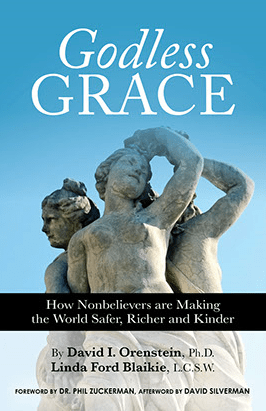
In their book “Godless Grace: How Nonbelievers are Making the World Safer, Richer and Kinder,” (see here) authors David I. Orenstein Ph.D. and Linda Ford Blaikie, L.C.S.W  reclaim the concept of grace from Christians. Grace, they say, cannot be bestowed by a god that after all does not exist. But that doesn’t mean that a purely human godless equivalent of grace is not a force for good in the world. The authors show that in fact grace does exist in the world and it is found in the good works of men and women who have no religious motivations. In the face of that reality, god becomes no more than a rain-dancer claiming credit for spring showers.

In this beautifully written love letter to secular altruists and do-gooders and sleeve-roller-uppers all around the world, Orenstein and Blaikie introduce us to dozens of actual people doing actual good works without any fear or promises from religion. These are not big name celebrity philanthropists, but regular folk from all around the world who are doing modest but important humanitarian work to benefit mankind. The authors did a magnificent job finding these unheralded pearls of humanity’s best. But they would be the first to modestly point out that their job was not all that difficult. There are far, far more “graceful” secular humanist folk than religious proponents would have us believe.

Beyond just identifying these great people, Orenstein and Blaikie help you to get to know them in easy yet pointed prose that make you feel not only that you know these people after only a mere page or two, but that you WANT to know these people. The authors were insightful in learning what motivates each one, non-religious motivations as varied as the people themselves, and are adept at effortlessly sharing those insights with the reader.

About these people overall, the authors conclude:

“… they see themselves as servants to and for humanity – people who do their good work not to please any gods, but to benefit all humans and other beings on the planet.”

Godless Grace is a splendidly crafted book that blends meticulous research and insightful observations into positive and inspiring tones that never sound mushy. It’s not too hot, nor too cold. Godless Grace is just right and you will feel better about your fellow humans and about the world after reading it. Godless Grace is exactly what the atheist/humanist movement needs at this stage. It doesn’t preach, it doesn’t debate, it doesn’t argue, it doesn’t play logic games. It simply shows us, in a positive and sincere way, just a bit of the good that real people do every day without god.

The Original Artists

I still remember with no special fondness the very moment I lost my innocence. I cannot actually possibly forget the singular incident that dashed my faith in my fellow human beings on the cruel rocks of betrayal. My psyche still bears of scars of that dark day when I became painfully conscious of the depth of depravity of my fellow man.

Some say it is only an urban myth, but it happened just this way…

It was the early 70’s and I was a young teen, intently watching I Dream of Jeannie on my 9-inch black and white portable television, occasionally adjusting the single antenna to minimize the ghosting and rolling of the screen, when I heard it. Like a Siren’s Call all, of my favorite pop songs, one after the other, were coming out of my television rather than from my little 9v transistor radio.

Order now, do it quick while supplies last, the announcer was urging me. Get all of your favorite hits in one fantastic album set by The Original Artists! For only $9.99! You’d pay over $50 to get all these incredible hit singles on 45’s! And they are guaranteed authentic hits by The Original Artists!

I frantically adjusted the antenna to better scrutinize the unbelievable offer on the screen. All hits are certified by The Original Artists, it affirmed proudly. It scrolled all the titles along with their artists – Kind of a Drag by The Buckinghams. Check! Incredible as it seemed to get all these amazing hits in one LP set, there it was in black and white. And did we mention that they are all by The Original Artists!?! The announcer even warned me be be careful, not to be fooled by cheap substitutes and demand only The Original Artists.

RecordPlayerNeedless to say, I gathered up much of my precious savings and rushed off to the local drug store to buy a money order for $9.99 plus Shipping and Handling, found a stamp, and sent it off. Several weeks later, there it was. My new collection of songs by The Original Artists. I tore it open like it was Christmas morning and dragged my little portable record player out from the closet, flipped open the lid, started the platter spinning, carefully put the record on, set the needle, and sat back to immerse myself in rapturous music.

Except the first song didn’t sound like I remembered it. Then the second sounded an awful lot like the first. Another sing-songy, washed-out, indistinguishably generic regurgitation of the first song. And on they went. Every song a muzak version of the original. Even on my crappy little portable record player it was obvious something was wrong.

Realization came slowly, it tap-tap-tapped at my brain patiently waiting to be let in. Eventually I entertained a small suspicion. Is this really the original artists? But the cover here says clearly that all songs are by The Original Artists…. oh wait…

Yes, shocked and horrified reader, that was the moment that changed me forever. Never again would I accept anything at face value. For evermore thereafter if it sounded too good to be true I assumed it probably was not true.

That formative event forever doomed me to take a second, third, and even a fourth look at laws and legislative actions that sound too good to be true. The Employee Free Choice Act? Hmm. The Internet Freedom Act?? Wait a second. Citizen’s United??? Now come on! When I hear these kind of names The Original Artists counsel me.

Perhaps The Original Artists did me a favor. Maybe in fact they were on a thankless humanitarian mission to teach all kids to be somewhat skeptical, to be a bit dubious about claims, to check their assumptions, confirm their facts, and question the lying truths told by legislators. Maybe it is only thanks to The Original Artists that I became an atheist and an scientist and try my best not to mislead others with spin and clever words that are technically true but intentionally false.

So thanks The Original Artists. Everything that happens to us, welcome or not, makes us who we are. And I for one would not want to be anyone else. $9.99 plus Shipping and Handling was in reality a true bargain.


Gun Liberty Protections

safety-firstAbortion safety advocates have a ton of great ideas about how to protect the life and well-being of expectant mothers. Even though the health risk of abortion procedures is essentially zero, these concerned citizens are so dedicated to health and safety that no legislative restriction is deemed too costly or too onerous. In states all across the country, they are proposing and enacting common sense regulations to ensure that abortion facilities are safe and that expectant mothers are afforded every possible protection.

We should be inspired by their efforts and apply the exact same kind of common sense safety regulations to gun sales to ensure that buyers and sellers alike are afforded their Constitutional right to acquire incredibly dangerous killing machines in the safest manner possible. Following are some proposed gun sales legislations, all modeled upon actual abortion legislation, and intended only to enhance the gun industry and ensure the safety of all concerned in gun sales.

The Gun Seller Freedom Act

  • 14 states require abortion providers to have an affiliation with a local hospital. Although such affiliations offers no benefit whatsoever, we should likewise require that gun shop owners be formally affiliated with a local police department just to be safe.
  • 13 states require that providers have admitting privileges at a local hospital or an agreement with another provider who has admitting privileges. Since guns are far more dangerous than abortions, we should likewise require that gun shop owners have admitting privileges at a local hospital as well.
  • 38 states require an abortion to be performed by a licensed physician. Similarly, we should require that all gun shop staff who sell guns should have to take a 4 year training course and complete a supervised apprenticeship of at least 3 years. After they pass a multipart examination, they may apply to a government-appointed board for a sales license.
  • 18 states require the involvement of a second physician after a specified point in the process. We should likewise require that a second licensed salesperson assist in every gun transaction.

The Gun Store Patriotism Act

  • 22 states have onerous but according to them, essential, licensing standards for abortion clinics that are comparable or equivalent to the state’s licensing standards for ambulatory surgical centers. We should put in place equally stringent licensing standards for gun stores and require meticulous enforcement by the ATF.
  • 21 states specify the size of the procedure rooms and/or specify minimum corridor widths. We should likewise require that all gun store facilities meet minimum size standards to ensure a safe environment with sufficient evacuation capacity in the event of an event. To ensure safety, all walls and windows should be certified to withstand high-velocity sustained gunfire using the most penetrating ammunition available in the store.
  • 10 states require abortion facilities to be within some minimum distance from a hospital. We should likewise extend this protection to gun shops since they have far more potential for catastrophe.
  • 17 states extend regulations to sites where medication abortion (handing out a pill) is provided, even if surgical abortion procedures are not. We should likewise apply all the same gun shop protections to all stores that sell cap guns or BB guns.

The Gun Buyer Defense Act

  • 28 states require a woman seeking an abortion to wait a specified period of time, up to 72 hours, between counseling and the procedure itself. 14 of these states have laws that effectively require the woman make two separate trips to the clinic to obtain the procedure. We should apply these same common sense protections to gun purchasers.
  • 17 states mandate that women be given counseling before an abortion that includes information on at least one of the following: the purported link between abortion and breast cancer, the ability of a fetus to feel pain or long-term mental health consequences for the woman. None of this information is actually true, but the abortion safety advocates care so much about women that they want them to be aware of even imaginary risks. We should likewise require gun stores to provide pre-sales counseling to ensure that purchasers are made aware of the potential adverse consequences of their gun purchase decision.
  • 28 states mandate that an abortion provider perform an ultrasound on each woman seeking an abortion and requires the provider to show and describe the image, or offer the woman the opportunity to view the image. We should likewise require that prospective gun purchasers be shown images of gunshot victims and require that salespersons describe the horrendous gunshot wounds in graphic detail.

The Firearms Integrity Act

  • 4 states require the abortion drug mifepristone to be provided in accordance with the outdated FDA protocol rather than the simpler evidence-based protocol that has been proven to be safe and effective. We should likewise require that sales of any model gun be forced to comply with all safety regulations relating to a Revolutionary War era muzzle loader.
  • 18 states require that the clinician providing a medication abortion be physically present during the procedure, thereby prohibiting the use of telemedicine to prescribe medication for abortion remotely. Likewise all mail order or internet sales of guns should be prohibited.
  • Nearly all states limit the gestational age limit for the procedure. We should likewise limit the size of guns sold to the first trimester of gun and magazine size as there is some anecdotal evidence that guns with more than a 6 bullet capacity have some level of self-awareness.

We owe a great debt of thanks to all those dedicated abortion safety proponents for championing these important protections for expectant mothers.  We should join them in solidarity by proposing and passing similar common sense protections for prospective gun owners.

ADDENDUM

I’ve just become aware that at least one great legislator, Missouri State Representative Stacey Newman, has introduced HB 1397 which is exactly along these lines (see here). As of this moment a hearing on this bill is not scheduled, but keep at it Stacey!!

On Elegance

AudreyHepburnFor the generations that frequented movies or browsed magazines back in the 1950’s, Audrey Hepburn became synonymous with elegance. Even for the generations that followed, Audrey Hepburn has remained the iconic symbol of elegance. Ask people for an example of elegance and they are still likely to show you a picture of Audrey Hepburn. When applied to women, she defined elegance as grace and style without ostentatiousness.

MousetrapBut the word elegance can be applied to ideas and designs as well. When applied to things, it suggests something that is both simple and ingenious – ingenious in its simplicity. A mousetrap is a great example of an elegant design. While not pretty to look at, it is nevertheless functionally beautiful. When William C. Hooker patented his spring-loaded mousetrap in 1894, I wonder if he guessed that its elegant design would not be improved upon for at least a century – and maybe never will be. Hooker’s mousetrap has only 5 parts, but it does it’s job as well or better than far more complex and expensive designs. That makes it very elegant indeed.

MousetrapGameTrue elegance, whether in starlets or in devices, is rare. Many people confuse complexity with quality; pretty designs with elegant ones. Inelegance is a very common failing of even the smartest people. In fact the most intelligent people are the most susceptible to producing convoluted, over-complicated solutions to address the simplest problems. But like the mouse-trap game, these clever constructions are fatally flawed in their inelegance.

Elegance separates the talented from the merely smart. Smart people pump out 1000 pages of indecipherably complex manuscript to tell a simple short story. They build contraptions with thousands of moving parts that cannot possibly be maintained. They write computer software that is a brilliant spider’s-web of code that no one but them could possibly comprehend or follow.

The talented author writes a far more powerful tale because it communicates with an economy of perfect words. A gifted engineer achieves the same functionality with an economy of working components that never break down. A master software developer achieves better functionality in a straight-forward, efficient manner that can be easily understood and maintained even by the most junior developers.

An elegant design translated into an elegant solution is often deceptively simple. Many people take this apparent simplicity as indicating a lack of quality or complexity or value, but these impressions in fact demonstrate the strengths of the design.

Mathematicians generally get it. They understand elegance. And they appreciate elegance in equations and theorems and proofs. They have simplification techniques designed specifically to reduce an expression to its simplest, clearest, most elegant form.

Contrary to what many capitalists claim, however, the freemarket does not necessary optimize for elegance. There is this myth that competition results in a sort of Darwinian evolution of products and services into their most elegant form possible. But this does not happen in the real world. In the real world, competition moves toward the most profitable solution that the market will bear. More often than not, the greatest profitability is achieved by ensuring unnecessary complexity to hold the market position and justify high prices. The 5-part mouse trap doesn’t generate very impressive corporate earnings reports.

We can point to things like solid state memory or LED lighting, products that were delayed by the free market because they still made more money on compact disks and incandescent lighting. And those were examples where the market did move, albeit slowly and not entirely willingly. When I worked in research in the 1980’s,  my colleagues were tasked with finding alternatives to ozone-killing CFC coolants. However while there were many cheap, simple, clean alternatives to chlorofluorocarbons readily available, their mission was to find the most expensive, complex alternative possible for which their company exclusively dominated the supply chains.

The free-market does not move us – very far – toward efficiency and elegance. It is focused only on profitability and elegance is not necessarily conducive to profitability. In fact, true elegance, not elegance in appearance only, it is often at odds with the profit-driver of corporations. We need to understand this both as individual consumers and as a planet desperately in need of elegant corporate solutions to the global problems we face.


The Winter Solstice

SolsticeDecember 22nd is the Winter Solstice in the Northern Hemisphere. It is the shortest day and longest night of the year. On this day, the noon Sun is at the lowest point of the year, lower the further north you are.

The solstice is the one universal event that all of us humans share in common each year. It has always been the most powerful recurring event in our shared human experience.

This annual solar phenomenon connects us viscerally to all of humanity; to all those living now as well as all those who lived before us. Virtually every culture that has existed has celebrated the Winter Solstice.

Surely every tribe extending back to the very first humanoids able to recognize their surroundings, remember their past, and anticipate their future have noted the significance of the Winter Solstice and have been moved to fear or honor it. Each year we become a part of the unbroken chain of solstice commemorations, formal or informal, that have preceded us.

The significance of the winter solstice lies not simply in the fact that it is periodic and conspicuous, like the return of Halley’s Comet, but because it relates so intimately to our shared human experience.

For most of human history the winter solstice was a time of uncertainty and relief, of fear and hope. As we approach this cyclic transition the Sun falls lower and lower. At the solstice, it gets frighteningly close to abandoning us forever. How easy it would be for it to just sink below the horizon and never return.

Imagine the terrible apprehension this invoked in our ancestors for whom the Sun was everything. Believing that the Sun must be a real being with intelligence and emotions, how could they be assured that it had not decided to simply abandon them to eternal darkness and cold? How could they be sure that they had not done anything to offend it causing it to completely disappear, never to return?

So also imagine our ancestors’ great relief and joy when the Sun resumed its upward ascent for another year.

The Incas of Machu Picchu, for example, believed the Sun was a god named Inti. On the Winter Solstice they performed a ceremony which tied the Sun to a great hitching post of stone in order to prevent it from escaping. The Mapuche people of Chile would stay up all night on that longest night out of fear that dawn may never come again. Only after 3 days, when it became evident that the Sun had returned, would they emerge to celebrate the New Year.

Today of course we know that the Sun will never go away, well not for another 5 billion years at least, but it is still everything to us and we still have compelling reasons for commemorating the solstice.

One day, if we continue our foolish disregard for our planet, if we allow our short-sightedness and greed to destroy our atmosphere, we may no longer be here to appreciate the life-giving gifts of the Sun.

It would be not the Sun who abandons us, but rather we who abandon him, leaving him one again alone and unappreciated in a lifeless solar system.

Sometimes I think that we would be better off still believing that the Sun is a godlike being that we might offend by mistreating animals or ruining the land or spoiling the waters or polluting the air. Perhaps then we would show more appreciation and be less inclined to sully and squander all those precious gifts.

So join our ancestors in once again recognizing the Winter Solstice and contemplating our tenuous place in the universe. As it was with them, the Winter Solstice gives us pause to look back in appreciation for what the Sun has given us and to think about the hard work we must do to ensure another bountiful spring harvest.  It is a time when we humbly celebrate the New Year not of man, but the New Year of our Sun and Earth.


Deeply-Held Beliefs

Our society overall, and even we atheists, have largely bought a bill of goods sold to us by the religious community. It is the flimflam that deeply-held beliefs are more sincere, more legitimate, less crazy, and more irreproachable than any old “ordinary” beliefs. Often these are also marketed under the labels of sincere or cherished or even deeply-cherished™ beliefs.

We have all been manipulated into granting an undeserved level of respect and deference to beliefs when they are immunized by these adjectives. This deference is not only undeserved, but it excuses some of the most damaging practices by those espousing these deeply-held beliefs. We tend to push back on beliefs until someone proclaims that it is deeply-held, sincere, and cherished. Then suddenly it becomes taboo, insensitive, and disrespectful to criticize it. In fact, we often accept that such deeply-held beliefs should be exempted from or even protected by the law.

Well unless of course it’s a deeply-held, sincere, and cherished belief of Muslims. In that case it’s clearly crazy.

Take for instance the vehemence by which “deeply-held” beliefs are defended by Katie Geary from the Becket Fund for Religious Liberty (see here). According to Geary:

“Groups that insist on insulting others’ deeply cherished beliefs are the truly immature ones here. Little do they realize how juvenile they appear to the “fairy tale” believers they so ardently wish to cut down.”

That’s quite a dressing down, and this is only a small sample of her attack against any criticism of deeply-held beliefs. However, as the Humanists of Minnesota point out, it is often impossible to see any difference whatsoever between deeply-held beliefs and plain old bigotry (see here).

KimDavisIt was her deeply-held beliefs that inspired Kim Davis to refuse to grant marriage certificates to gay couples in defiance of the law. Just last week cherished beliefs led right-wing Conservative leader Kevin Swanson to publically call for the mass execution of gay people. Deeply-held beliefs resulted in the owners of Hobby Lobby claiming religious exemptions so that they are free to discriminate.

Likewise, deeply-held beliefs that abortion is murder led anti-abortion extremist Scott Roeder to shoot Dr. George Tiller in the head. It was sincere beliefs that prompted John Salvi to bomb a Planned Parenthood clinic killing two and wounding others.

These are just a few extreme examples but such incidents are hardly rare. We could go on and on citing examples of harmful actions motivated and justified by claiming they are in accordance with deeply-held beliefs.

These are extreme examples, but that does not make them irrelevant to all of those “harmless” deeply-held beliefs that we ought to respect. Quite the opposite, these only point out the danger of ever letting ourselves get taken down this path. Any time we give any special deference to more benign beliefs, we necessarily make it that much more difficult to criticize and curtail any belief no matter how destructive. In a world that is fundamentally based in fantasy, logic offers little assistance in drawing such lines. Our deference to innocent little deeply-held beliefs leads directly to carve-outs that condone and institutionalize bigotry, prejudice, and violations of civil rights.

We don’t accept the notion that racism or terrorism or homophobia are any more legitimate if these beliefs are claimed to be deeply-held, sincere, or cherished. Similarly we should not be bamboozled into accepting this same justification for the acceptance of or favoritism toward religious beliefs.

Norman Coordinate!

I watched the 3rd Republican debate with great amusement. As comedy it was pretty entertaining I must admit. But as a rational debate of public policy it was pretty sad. Beyond all the usual comments about their performance art, a few things jumped out at me.

First, you may have noticed that all the candidates seemed eager to step over each other to scramble to the top of the Bernie Sanders bandwagon with rhetoric about how all of the money has been sucked out of the middle class and into the hands of the ultra-wealthy. Ok, they’re right there even if they’re finally now saying this only because the Tea Party Conservatives agree with Bernie on this.

However whenever asked about the possibility of expecting any more from the ultra-wealthy they are all quick to point out that “you could take all the wealth from the rich and give it to the poor and it wouldn’t make a dent in the wealth inequity.” Now, I’m confused. If as you say the ultra-wealthy have all the money, all the money the middle class used to have when they were an actual middle class, then how is it possible that the wealthy could not make a dent in the wealth gap? Something seems fundamentally illogical here.

Then there was another example. On many occasions they insisted that we absolutely, positively must free business from all those terrible, crippling regulations that force them to do things, you know like produce safe and ecologically responsible products. Or you know, like pay living wages.

But then when asked what they will do when businesses run amok and put their own profits ahead of the social good, as they do more often than not, the answer these candidates give is “that’s no problem because we have or should pass regulations to guard against that!

NormanI’m confused again. Remember the “I Norman” episode of Star Trek? The one where Kirk and Mudd defeated the logical, well-meaning robots by forcing them to try to process illogic until their circuits fried? The robots cried out to their central computer Norman for help processing these contradictions with the plea “Norman Coordinate! Norman Coordinate!

I feel a lot like Norman trying to process Conservative logic.

The wealthy have all the money but they have no money but regulations are bad but regulations protect us but we must eliminate regulations but we must institute them but the poor must pay but the poor have no money but the bible is the source of economic knowledge but the bible says anything but the bible says nothing but… Norman Coordinate! Norman Coordinate! Illogical Illogical! Shutting down!

So, if we ever encounter a planet of ultra-powerful robots dedicated to saving us from ourselves, we only need to send some Conservatives out to explain their public policy positions and those poor logical robots end up with their circuit boards fried like Norman and me.

 UPDATE FROM THE 4th DEBATE:

Apparently the candidates got the message that you can’t claim that we need to end all evil regulations at the same time that they say that regulations are the remedy to corporate excesses. This time, Ben Carson said:

“Well, I think we should have policies that don’t allow them to just enlarge themselves at the expense of smaller entities.And I think this all really gets back to this whole regulation issue which is creating a very abnormal situation.”

So apparently regulations are bad but policies are good. But don’t we need regulations to enforce policies? Norman Coordinate!

Not Buying It Hunters

You’ve got to hand it to them. Hunters are doing a really good job of marketing their passion for animal slaughter. Despite the number of hunters inexorably dwindling, despite the public relations debacle of Cecil the Lion, the general public opinion of hunting continues to improve year after year (see here).

This positive public impression is carefully crafted by companies like Danner boots (see here), who caters to gun-loving hunters, law-enforcement, and military types. They have been airing a pretentious series of commercials celebrating hunting. These commercials are reminiscent of those older Marine Corps recruiting commercials. It portrays hunters as the few, the proud and noble protectors of nature. According to the narrator speaking softly over slow-motion shots of hunters in the backdrop of gorgeous nature scenes:

“There’s not enough wilderness left, not on this Earth, nor in the hearts of man, so we hunt. To stand face to face with nature and hold it for as long as it’s allowed. We hunt for balance, for strength, and for a hope that the outdoors will thrive for years to come. Hunting is more than a sport, it’s a calling.”

That’s good marketing bullshit. And the hunting industry is playing a good game on offense too. If you search Google, you’ll find article after article attacking the critics of hunting. They all tout the reasonableness of “science-based” hunting, as if hunters are all thoughtful servants of the planet, out there in the wilderness tirelessly protecting the animals they love – by killing them. Their claim of “science-based” hunting is about as valid as claims of “theological science.” According to Jon Way at Eastern Coyote/Coywolf Research (see here):

“State wildlife departments often say they use “science-based management” … their technical way of saying, we want hunters (a small minority of the population) to kill as many animals as possible and as long as they don’t go extinct … then it is science-based.”

hunterPro-hunting organizations have jumped all over this science-based™ claim to portray themselves as the informed, pragmatic, responsible parties. These organizations are highly visible and prolific at spreading all sorts of reasonable sounding arguments to rationalize selling equipment to pander to guys – and increasingly girls (see here) – who love to kill stuff. For example, in an article on Hunting Life, hunter Catherine Semcer makes the following arguments in support of trophy hunting (see here):

  1. Trophy hunting provides fresh meat to local people, improving the lives of children.
  2. Habitat loss is the REAL problem.
  3. Trophy hunting reduces illegal poaching.
  4. Those against hunting just want a “bumper sticker” on their Volvo while Africans suffer.
  5. Africans want trophy hunting, it’s not for people living in New York and San Francisco to decide for them.

Of course these are ridiculous arguments. They are all self-fulfilling partial truths, deflections, and red-herrings that pose false choices. The real truth of the matter is that hunters simply love guns and love shooting stuff with their guns – big living stuff. And the industry that supports them loves making money. As Bill Bryson documents in “A Short History of Everything,” so-called “naturalists” just like them have reveled in shooting animals to extinction for much of the last 200 years. Today’s generation of hunters is no more scientific and nature-loving than the self-proclaimed “naturalists” of the 1800’s who gleefully shot the dodo, the sea cow, and innumerable bird and animal species into oblivion.

Some of you may remember the notable TV series called “Wiseguy” that aired in 1987 (see here). FBI agent Vinnie Terranova goes undercover to infiltrate the organization of mob-boss Sonny Steelgrave. When Sonny is finally brought down, he rages with righteous indignation that the government is the real bad guys. They do far more harm than him. That without him much worse mobsters would have taken over. That he in fact actually helped many people by getting his hands bloody and doing what needed to be done.

Sonny’s rationalizations sound a great deal like the usual arguments put forth by hunters like Catherine Semcer to justify and legitimize what they do.

Not Buying It Sonny. You may want to believe you were a benevolent father figure, but in reality you were just a self-serving thug.

Not Buying It Hunters. You may want to believe you are misunderstood defenders of the environment, lovers of wildlife, but you are just pathetic losers who wanna kill stuff.

By the way, I grew up in a large extended family of hunters.

Find Your Cause

Why do some people become activists?

Some become activists because they have a natural passion, a deep sense of empathy for the tragedy or injustice felt by others. Jane Goodall is one such example. Her empathy focused on the animals that she fought for throughout her life.

Others become activists after they are personally struck by tragedy or injustice. John Walsh became an activist after his son was kidnapped and murdered. In response to that life-changing event he dedicated himself to hunting down criminals and saving kidnapped children.

John was transformed into an activist, Jane simply was an activist.

Regardless of how you get there, it is admirable to have at least one cause greater then your own immediate self-interest that you are passionate about. It is not only good for society, not only good for the planet, not only good for future generations, but it is good for yourself as well.

But most of us are not naturally passionate activists like Jane Goodall. And thankfully most of us are never transformed by tragedy into activists as was John Walsh. Most of us don’t have a burning passion and most of us don’t become active in causes until and unless we’re personally affected by them.

Sure, I guess I should care more about starving kids in Africa, but frankly I don’t know any of them personally so it’s hard to get too worked up. We’re apathetic about gay rights until our own child comes out. We don’t think much about cancer until our spouse is stricken. We don’t fight to get guns off the street until our child dies to gun violence. We don’t typically offer anything beyond the mildest philosophical support for the heartfelt passionate causes of others, little more than token responses to their pleas for help and support – unless and until we’re personally affected.

You can still find transformed activists out there working hard for every possible cause. It sometimes seems difficult to accept their impassioned urging that we should care, when they never cared until it personally affected them. Sometimes we even wonder, what kind of person are they that they only became concerned about a problem after it affected them or someone they love personally? Was it not a problem before it impacted them? Did they not pretty much ignore the pleas of those affected before they were personally impacted?

activismThe practical reality is that there are way too many important and worthy causes for us to become deeply, emotionally, actively involved in every one. But surely you have room in your life and in your heart for just one. It would be nice, would it not, to choose a cause, any cause, that you really care about, rather than maybe someday simply adopting a cause only because you have been personally stabbed through the heart by it?

There are so many worthy causes that deserve your help before you personally suffer from their effects; quiet causes and loud causes, modest causes and epic causes, surely there is a cause that matches your interests, abilities, and personal style.

Find your cause before it finds you.

When Smokers Ruled

I hear lots of you, especially my younger friends, express sympathy for smokers. I know you think that I am unduly harsh on them and that society as a whole is excessively severe toward smokers. But frankly you didn’t live through the smoky days when smokers ruled the world. If you had you might not feel we are harsh enough. Your misplaced concern is like expressing sympathy for those poor overregulated coal-fired plants now that the air is finally breathable – breathable only because they were heavily regulated in the first place.

smoker wearing crownTry to imagine the world back when smokers were completely unregulated. I grew up in the 60’s and in those days smokers had absolute uncontested sovereignty. They smoked wherever and whenever they wished and no one had any right to complain. You cannot appreciate how hellish they made the world. Thankfully you don’t have to live in it anymore. Movies glamorize it with dreamily wafting artificial smoke. Even supposedly accurate period pieces like “Good Night and Good Luck” totally sanitize the filth that was the 60’s. In reality, ashes stained every surface. Every table was cluttered with disgusting overflowing ash trays. The surface of every table and chair was riddled with burn marks and littered with butts. The air in any indoor space was a toxic cloud of fumes. Windows were literally browned-out with thick layers of tar. It was a time distinguished by disgustingly yellow teeth and smoke-reeked clothes and upholstery. You don’t see, smell, and feel those things in the movies. The movies don’t make your eyes sting and your throat cough.

smoking while eatingBack then, dinner at restaurants was like eating out of an ashtray. Adults smoked right up until their first bite, immediately after their last bite, and indeed some took a drag between each bite. They would then drop their butts into water glasses or into their leftover mashed potatoes even while others will still eating.

The inside of cars was a hellish torment as well. With all the windows closed in those cold Wisconsin winters, all the adults would smoke nonstop. Once I asked my mom to let me open a window. She refused. When I pleaded with her to stop smoking she answered, “I’m the one smoking, why should it bother you?” So I then flipped the radio switch to full volume. “Turn that off,” she shouted. I mimicked “I’m the one listening, why should it bother you?” My logic was lost on her and I was answered only by a solid smack across the face.

Even the great outdoors provided little respite from the tyranny of smokers. Mounds of ashes lined every curb. Every grassy park lawn was covered with butts, matches, and packaging. When us kids played on the beach we would shovel up handfuls of butts infesting the sand. In the winter the pristine snow was defiled with ashes, butts, and packaging everywhere you looked.

This is only a pale portrayal of everyday existence when smokers ruled the world. Frankly you cannot imagine it any more that I can really imagine the pollution in London during the height of the industrial revolution. So don’t feel sorry for smokers. Don’t give them any of that power back. If you let up, they will return life to the hellscape it was back when they had their way.

And don’t fool yourself into thinking it would not be that bad again. Smokers have not changed. Smokers today are not more enlightened and considerate than smokers back in the 60’s. This is obvious when you still see them blithely toss their cigarette butts on the ground anywhere they happen to be when done with them. They don’t care that you have to walk through them or that your kids play in them. They have not changed. They have no social conscience when it comes to their addiction.

Smokers in fact have turned the new outdoors into the old indoors. In NYC at least, we nonsmokers have to hold our breaths when we go outside and hurry past the gauntlet of smokers. We have to grimace in disgust when they walk ahead of us billowing out smoke like a coal locomotive. We used to escape outside to get a few gulps of fresh air. Now we have to rush inside to escape the smoke.

The only reason smokers still do these things is because we let them. If we let them smoke in restaurants again, they’ll once again smoke between bites and toss their butts into your water glass.

I went on a bus trip in Brazil not long ago. The tour guides laid down the law on the first day. “We will not allow you to stink up the bus and we will not clean up your disgusting soggy butts from the snow slush on the bus floor. Further we will kick you off the bus if you toss your butts all over Brazil.” The tour guides handed out twist-top vials and instructed smokers to only smoke off the bus and to keep their butts in the vial until they could dispose of them properly. The smokers were at first irate at this restriction of their right to litter at will, but did quickly adopt the practices and the trip was a joy for all, including the smokers themselves. Most importantly we were not embarrassed by those smokers flicking their butts our across every scenic place of beauty we visited.

Here’s my advice informed by history. Don’t give an inch to smokers lest they take a mile. Start a movement to make smokers everywhere adopt the eco-friendly tour policy and put their butts into a container until they can be disposed of properly. Even better, force cigarette manufacturers to provide a clever package that makes it easy for smokers to deposit their butts right back into the pack! Smokers and their corporate suppliers must be forced to do this through laws and/or social pressure. They will not do it simply because it is the socially responsible thing to do.

One last addition. At first I was annoyed by the emergence of e-cigarettes because they only encourage more smoking. But I now appreciate that they do have one huge unanticipated benefit. They eliminate a tremendous number of butts being strewn all across our shared spaces. For that reason alone, I think they’re a really, really good thing. If they would just lose the smoke effects and that silly LED on the end, I’d have little reason to complain about smokers except for their impact on my insurance rates!