Tag Archives: Economics

With Great Power Comes Great Vulnerability

You might feel powerful cruising around in your luxury car, but you’ll quickly defer to the first guy in an old beater that decides to run you off the road.

Wealth and power certainly bring with them lots of advantages. In fact great wealth and power bring so many advantages that it’s hard to grasp, let alone sympathize with, the incredible vulnerability and weakness they bring with them.

We have always understood that the greater your wealth, the more you have to lose. What we don’t understand as clearly is that the more you have to lose, the more timid and compliant you become. In ways even the compulsive greed of the wealthy can be understood in part as needing ever more buffer to alleviate their anxiety over losing what they have already acquired. The more they acquire the greater that anxiety becomes and the more they need to feel secure – a self-perpetuating cycle.

As that wealth grows, so does vulnerability and risk aversion. The phrase “I’ve got nothing to lose” is a very scary one. But in the greater society “I’ve got too much to lose” is even scarier.

Rich people are paradoxically more controllable and manageable then poorer ones. They just have too much to lose to make any waves or stand up to more powerful forces, no matter how corrupt. If you want to control someone entirely, enrich them with enough money and power to make them easy to bring to heel.

This applies not only to individuals but to corporations any other entities that amass wealth and influence. Donald Trump has demonstrated clearly that powerful interests are both the strongest weapons for a dictator to control and the easiest to force into compliance. The rich and powerful who should be most capable of protecting democracy and standing up to corruption are the first to abandon democracy and become thoroughly corrupted.

It’s probably futile to expect the rich and powerful to risk anything at all for the greater good. Ultimately the only answer to this and a host of other social problems stemming from great wealth inequality is a wealth cap that prevents anyone, individual or corporation, from becoming both dangerously powerful and easily corruptible by Trump or any other despot.

What are Deficit Hawks Thinking?

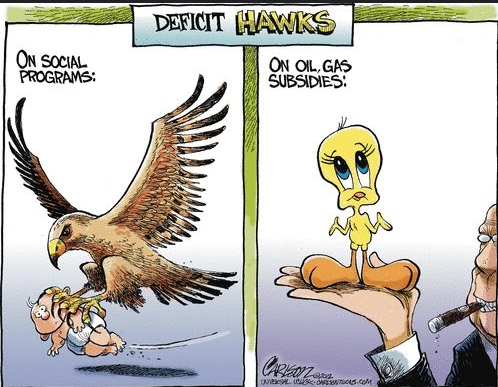
At every budgeting cycle the Republican deficit hawks work themselves into a frenzy of concern about budget deficits. To remind you, the annual deficit is the amount our government has spent beyond what it has taken in that year. Implicitly included under the umbrella of deficit is the debt, which is the credit card balance we owe for all past unpaid deficits.

Certainly debt and deficits are liabilities and it would be great if we could avoid them completely and spend only what we take in, but we realistically cannot operate without dipping into our credit card sometimes. The contention arises around how to control spending in order to avoid crippling credit card payments.

To reduce our credit burden, both parties strive to increase efficiency and reduce waste, fraud, and abuse. Beyond that, Democrats generally aim to raise revenue from the wealthy and corporations, and (to a far lesser extent) reduce military spending, while protecting and expanding social programs. Republicans mostly push for cuts to social programs, while increasing tax cuts (only for the wealthy), and opposing new taxes (only on the wealthy), while maintaining or increasing defense spending.

Democrats assert that the rich and powerful do not pay anything near their fair share and can afford to contribute far more, while Republicans assert (incorrectly) that the rich and powerful deserve even more money that will supposedly then “trickle-down” to help poorer people.

Not many appreciate that the concept of a “trickle-down” economy did not originate with Ronald Regan who put it forth as a credible economic principle. It was originally a satirical joke made by Will Rogers back in 1932 to mock then President Hoover’s response to the Great Depression in giving more money to rich people.

I’m going to forgo a lot of additional argumentation and simply skip ahead to the conclusion that Republicans are simply wrong on both the merits and the ethics of their budget logic, and rather try to understand their thinking.

I’m going to put aside sheer greed and self-interest as uninteresting. My interest is in how well-meaning people can come to support Republican policies.

First and perhaps foremost, Republicans believe incorrectly that rich people and corporations deserve (are entitled to) more money because the rich deserve it and can make the best use of it. Second, they love a strong military because either they are fearful, love having the biggest guns, love war profits, or are just afraid of looking weak on defense. Finally, they believe that regular people deserve nothing and should either get rich or die quietly without bothering anyone.

These biases result in the following internal logic. A) we must give as much as we can to rich people, and B) we must maintain or expand the military, so C) the only way we can accomplish both is to siphon away money from the 99%. This is accomplished by finding new ways to tax or increase costs for regular people, by destabilizing and pillaging the social security fund that they paid into, by compromising or withholding their healthcare, and by deregulation that shifts the cost of doing business from rich corporations to ordinary communities.

To extract wealth, they continue to perpetuate the joke of trickle-down economics. The term may be discredited, but the concept still underpins their worldview. They extract wealth by grossly downplaying the amount of money being spent on the military, and by exaggerating the cost of social service programs (see here).

And they have elucidated no limit whatsoever in just how much more the rich and powerful deserve. In fact the expressed American value is that personal wealth should be unlimited. Therefore, their goal of decreasing the debt and deficit can never be achieved no matter how much they extract, no matter how much damage they do, no matter how many people they impoverish, the rich can and will never have enough under the logical framework they have constructed.

Thus is the folly of their worldview, their rationalizations, and their policies. Their concern about the debt and deficit may or may not be genuine, as is their belief that the rich should receive even more. But to achieve both, the vast majority of people have to suffer. The end result of their thinking can only be incredibly harmful, unsustainable, and unethical budgetary policies enacted under the pretext of responsible deficit reduction.

Scammers Worthy of Respect

I appreciate folks who are good at what they do, including criminals. Once someone stole my backpack while the strap was around my ankle underneath a desk in the far back corner of a busy Internet café in Quito. Picturing that talented thief slipping cat-like under the desk and slicing cleanly through the strap only made me think, well done sir, it was an honor to be burgled by a professional of your caliber! Another time I was pickpocketed by a group of boys who packed in against me in a crowded bus in Kathmandu. I immediately detected what had happened and peered around at the expert team, all looking perfectly innocent, and nodded my respect saying, “Well done lads!”

In the same vein, I respect a well-crafted street con. I have been privileged to observe some quality teams in action. I’ve watched them practice their craft in Calcutta, Manhattan, Moscow, Cape Town, and elsewhere. One of the most impressive was a group plying their trade on La Rambla in Barcelona. They were working the classic shell game. The dealer kept expressing all expected chagrin and frustration as he lost bet after bet and handed over fists of cash to an enthusiastic group of “players” who exclaimed their delight at winning most every round.

Here’s the thing, even knowing it’s a scam, even knowing that all those “players” were plants who were hamming it up just for my benefit, it was still really, really difficult not to think I could win too. I watched all those rubes who were obviously not as smart as me win on bets against the clearly inept shell dealer. And when they lost, it was obvious to me every time where the pea actually was. The lure to join in, even knowing it’s all a scam and that I was the mark who was reacting exactly as they hoped I would, was still tangibly powerful.

The reality of course is that I had no hope of actually winning. The players only “lost” when they wanted to lose and I only knew where the pea was when the dealer intended for me to see it. Even if I were to win a few rounds, it would only have been because the dealer wanted me to win so that they could suck me in even deeper. To think I could beat them at their game would have been the height of foolishness.

I can even give some respect to more “upscale” confidence artists. A televangelist for example. These guys are really masters of bilking people out of a lot of real, hard-earned cash for nothing more than the promise of a heavenly pig-in-a-poke. Even a pyramid scheme scammer deserves some credit in my estimation. They manage to convince people they can make money by doing nothing. While in reality, the only folks that make any money are a few of the top level investors who make enough to sell the lie that everyone below them will profit as well.

I am even willing to give some level of respect to the reprehensible low-life’s who recently called up my son’s grandparents claiming to be him and asking for emergency bail money. Pretty bold and brassy to pull that off!

You might think I have a warped and misplaced set of values, as evidenced by my willingness to accord some respect to unsavory criminals. Maybe you’re right. But even I draw the line at stock traders. Despite my low standards, I can muster no respect for them.

Stock trading is just too big a scam, even as compared to organized religion. It is too entrenched, too manipulatable, too exploitable, and too consequential. It is not only destructive but unnecessary.

Look, of course I recognize the need for banking. We cannot function without socially responsible lending and credit. I also recognize the need for financial vehicles to grow our wealth and to support us in old age.

But despite the apparent “winners” in the market, stock trading does not meet any of these goals in a socially equitable or sustainable way. Stock trading is not, needs not be, and should not be, an essential vehicle for raising funds, growing wealth, or securing our futures. Not when it is such an inherently extractive and destructive force in the world.

Stock investment does not make investors “invested” in those businesses in which they hold shares, encouraging responsible long-term caretaker-ship of those companies. Quite the contrary. Stock investment promises maximum rent-seeking wealth extraction for a given investment. It only encourages investors to push companies into short-term dividend maximizing policies at the expense of workers, the environment, and the companies themselves. Shareholders exert their influence to extract maximum profit and move on as soon as soon as they have milked that cash cow dry. Day traders exert the same pressures even more ruthlessly and carelessly through their investment activities.

And even though the system allows just enough “winners” to make everyone imagine that they are smarter than the system or luckier than the system, those “winners” only make enough to entice others to invest and siphon more money from the middle class into the investor class. And as most of those “winners” eventually discover, as does anyone who thinks they are “winning” at that shell game on La Rambla, their winnings will evaporate quickly if they play long enough.

So no. Even though I can respect grifters of all sorts, I cannot offer even a begrudging modicum of respect for stock traders. They are unnecessary, rent-seeking, exploitative parasites who only extract money, real blood and heartbeats, from the little guys who think, like me looking on at the shell game on La Rambla, that they too can profit by playing the game. The stock trading game may not be controlled by one dealer, but it is an emergent form of the shell game that dupes millions of people into betting and ultimately losing.

So what is the alternative? On that I take my advice from WOPR in War Games. The only way to win is not to play. Instead invest in real, tangible assets and in hard work over get rich quick schemes. Build instead of extract. If you have more money than you know what to do with, try giving it away to support lasting and socially constructive efforts.

Is it finally safe to discuss Socialism?

smaug

May I ask, oh great and powerful Smaug, when thy gold will begin to trickle down upon us?

I was once at a high school party where the prolonged silence became painfully awkward and uncomfortable. Suddenly one precocious girl blurted out, “So, what do you all think about premarital sex?” Just like that, the party got lively with everyone talking about a wide range of topics.

Sometimes all it takes is one person to break the ice and make it acceptable to discuss what were previously taboo topics. Bill Maher made it allowable to talk openly about atheism, and Bernie Sanders made it acceptable to speak honestly about Socialism.

But this new open talk of Socialism frightens a lot of people, especially older people and rich people – and older rich people most of all. To them, and most Americans, Capitalism is tantamount to a religion that requires unwavering faith despite any evidence to the contrary. Therefore, it is not surprising that they spew out a lot of hyperbolic fear-mongering and misinformation in hopes of nipping all this Socialist talk in the bud.

These Capitalist fanatics spread so much misinformation about Socialism that responding to it all in one overview article is nearly impossible. Therefore I’m not going to take the time here to discuss every point in detail. I’ll simply put forth what I feel are the ethical and empirically supported viewpoints. Feel free to investigate each one more thoroughly on your own.

First, let’s talk about what Socialism is today. Let’s not allow opponents to sucker us into explaining whatever Karl Marx had in his mind a century and a half ago nor into defending the aberrant government that emerged out of the Socialist transformation in China under Mao Zedong in 1949.

Modern Socialists do not want to destroy Capitalism. The difference between a modern Capitalist and a modern Socialist it is simply a matter of where the balance point should be between the governmental and private domains.

Capitalists believe that the government is useless and ineffectual and that virtually all problems should be left to the private sector to solve; all needs should be left to the private sector to meet; and that the private sector should not be restrained in any way. They lie routinely about how much social programs like universal healthcare would cost, by failing to subtract the savings from the frightening numbers they cite. 

Socialists believe that government can and must do good things and that some things like healthcare, public infrastructure, utilities, social services, food and drug safety, and education can be best handled by government, and further can only be handled effectively by the government or through a high degree of regulation and oversight.

Between the two sides, it is the Capitalist viewpoint that is far more extreme, dogmatic, and radical. Socialists still want mostly a vibrant Capitalist system, with only some exceptions and regulations as warranted to protect society at large. Capitalists want to extract profit from everywhere without exception and with minimal or no regulation that would ensure that the public good is considered.

The devotees of Capitalism point out that Capitalism made us great. That is not completely true. Yes it was important, but most of our important achievements like worker safety, environmental protections, and many others came about only through violent opposition to the forces of insatiable unbridled Capitalism. Major projects like our highway system were government funded. And even if we give Capitalism all the credit it deserves for bringing us to where we are, that does not make it the right approach – or even a viable approach – to carry us forward into a more sustainable economic model.

And let’s be clear. Unbridled Capitalism is not sustainable. As Marx predicted long ago, the inevitable outcome of unrestrained Capitalism is growing wealth inequality and instability as all wealth is scooped into the coffers of fewer and fewer individuals. You end up eventually with one Pharaoh and a multitude of economic slaves. That level of inequity cannot be maintained for long. But worse, our planet can no longer sustain a humanity driven by a religion of unbridled Capitalism.

Contrary to everything the devout Capitalists try to claim, trickle down economics is really nothing more than voodoo economics. Socialism is not evil, and Capitalism is not “the best system possible.” Grow or die is a lie. Competition does not really yield the best products for the lowest prices, and what is good for the stock market is usually bad for regular workers (see here). Economic Darwinism is not tough love. Intellectual property rights mostly just retard real innovation. In the real world, free-market competition often breaks down completely. Tax breaks to the wealthy do not create jobs or increase wages. Highly progressive taxation on wealth is necessary and essential. A minimum wage – and a maximum wage – are good economics. And you only need sufficient, not unlimited, wages to motivate and reward talent and work. Private corporations are not inherently more cost-effective than their government-run counterparts, especially since they must extract as much profit as possible.

Taxes, by the way, are not “giving away your money.” Taxes are how we agree to fund philanthropic and charitable causes and joint ventures for the essential public good. Taxes are what we pay for our roads, and police, and all the other services that our government provides for us. Make no mistake, under a Capitalist model, all those services would be far more expensive, if they were provided at all. If left to a purely Capitalist system, all our lives would be horribly diminished.

Capitalism simply has no mechanism to fund essential public services when there is too little profit in it. Even worse, in areas like healthcare, the profit motive is fundamentally and intractably in opposition to providing the best outcome. Capitalist fiduciary responsibility requires that healthcare providers provide the lowest level of care for the highest possible price to maximize profit for their shareholders (see here). Anything less would be antithetical to the Capitalist religion.

The kind of extreme Capitalism that many Americans have been convinced they would prefer is nothing more than “I got mine” economics in which every man (and woman) are out for themselves, and screw everyone else. The idea that good can come from selfishness and greed is a morally bankrupt tenet of our Capitalist religion.

Socialism, on the other hand, is simply how we do things together. It is how we pool our efforts for the good of all. Socialism is the “let’s work together” system of economics. Socialism does not inhibit or replace Capitalism. It merely acknowledges that there are some vitally important things that Capitalism cannot do well enough and it provides the model to work together to achieve those services that Capitalism simply cannot address.

So let’s continue to carry on this discussion that Bernie started and continue to work to find the healthy balance. But do start to question the Capitalist catechism that we have all been taught, and don’t let the fanatical Capitalists convince you that you are the extremist if you defend elements of Democratic Socialism.

Competition Improves Healthcare?

MedicalMoneyI really, really wanted to get to my backlog of scientific blog topics today, but was distracted once again by Shawn Spicer at his daily press briefing. In defending “Trump/Ryan Care,” he repeated perhaps a hundred times that “It is an economic certainty that increased competition unquestionably brings down costs.”

(Note that he uses the word “costs” but he presumably intends this to mean “prices.” Cost is really the cost of manufacturing a product. Price is the cost to the consumer. Price minus cost equals profit. I will use these words consistently in this way to eliminate ambiguity and confusion.)

Shawn’s assertion is a meme that is almost universally accepted in America as a fundamental principle, a given, but it is simply untrue. It is part of the falsely simplistic “Economics 101” nonsense that has been repeated so often that it feels like perfectly sound common sense (see here).

Our acceptance of false arguments like this manipulates us into adopting “free market” solutions that harm our own self-interest and shovels money from poor Americans to rich Corporations.

The reality is that the “free market” does not give a hoot about low costs or even about high quality and there is nothing inherently forcing it to provide the highest possible quality at the lowest possible price. Quite the opposite. Businesses in unregulated free markets will minimize cost (quality) and maximize price to realize the highest possible profit.

If their manufacturing costs are reduced through deregulation, they will not lower their prices to the consumer, they will enjoy higher profits. If they are forced to lower prices through regulation, they will lower their costs (quality) before lowering their profits.

But wait you say. Of course that is true and that is why competition works! If there is competition then if a business wants to survive they must deliver higher quality at lower prices than their competitors. Eventually we reach an optimum for the consumer.

Except that rarely works in the real world, and works least well in providing essential services that really matter, things we must have to live and work and even survive.

The example that is invariably given in idiotic Economics 101 courses is the lemonade stand. If Sally sets up a stand in her yard and charges $1 per cup, but then Billy across the street sees her making money and sets up his own competing stand charging $.95 for the same lemonade, then Sally must either increase her quality or lower her prices or accept less profit if she wishes to stay in business.

But in the real world, Sally and Billy would both quickly understand that getting into a price war is a lose-lose scenario in game theory. If they both just keep their prices the same, they both enjoy higher profits than if they compete. If Jimmy were to open up a stand in his yard and sell lemonade for $.50 at no profit, Sally and Billy would quickly buy him out and return prices to $1. Further, they would both lower the quality of their lemonade, thereby increasing their profits, right up to the point at which they lose sufficient customers to cause a net loss.

In reality, the free market optimizes for the lowest quality at the highest price the market will bear to maximize profits.

When I lived in India, I often had to use a rickshaw to get around. The rickshaw wallahs would see that I was a Westerner and smarmily quote me exorbitant prices for a ride. Now, there were at least 100 wallahs waiting around with nothing to do, all perfectly able to take me. But if I went from one to another they would all give me the same inflated prices. Even if I simply left and walked the 5 miles, none would budge. In that free market, like most, businessmen would rather lose customers than lower their prices. The wallahs all knew as big corporations well know, that I would eventually have to pay their high fees to someone and that benefitted them all much more than undercutting each other.

The last people who should be fooled into believing that competition lowers prices are Walmart customers.  Walmart literally destroys all competition and then, as essentially monopolies in their markets, they provide the lowest prices to their customers. Where is the “free market competition” argument here? Monopolies clearly can do way better. They have huge purchasing power and don’t have to pay advertising overhead.

So it is with essential services like healthcare in America. Free market competition will not force healthcare companies to lower their prices, improve their quality, and sacrifice any of their profits. Competition inherently segregates risk pools which particularly damages this industry. Deregulation will only allow insurers to work together to maximize profits by lowering their costs and raising prices to the highest level the market will bear, which in the case of essential healthcare is cripplingly high.

What we need in healthcare is not deceitful free-market snake oil, but a healthcare monopoly like Walmart. We need public healthcare that can create the largest possible nation-wide risk pool, negotiate the best costs, and take all profit out of the equation. Our free-market system has a vested interest in maximizing profits over patient health. These interests are simply not compatible and never can be (further reading).