Tag Archives: Politics

With Great Power Comes Great Vulnerability

You might feel powerful cruising around in your luxury car, but you’ll quickly defer to the first guy in an old beater that decides to run you off the road.

Wealth and power certainly bring with them lots of advantages. In fact great wealth and power bring so many advantages that it’s hard to grasp, let alone sympathize with, the incredible vulnerability and weakness they bring with them.

We have always understood that the greater your wealth, the more you have to lose. What we don’t understand as clearly is that the more you have to lose, the more timid and compliant you become. In ways even the compulsive greed of the wealthy can be understood in part as needing ever more buffer to alleviate their anxiety over losing what they have already acquired. The more they acquire the greater that anxiety becomes and the more they need to feel secure – a self-perpetuating cycle.

As that wealth grows, so does vulnerability and risk aversion. The phrase “I’ve got nothing to lose” is a very scary one. But in the greater society “I’ve got too much to lose” is even scarier.

Rich people are paradoxically more controllable and manageable then poorer ones. They just have too much to lose to make any waves or stand up to more powerful forces, no matter how corrupt. If you want to control someone entirely, enrich them with enough money and power to make them easy to bring to heel.

This applies not only to individuals but to corporations any other entities that amass wealth and influence. Donald Trump has demonstrated clearly that powerful interests are both the strongest weapons for a dictator to control and the easiest to force into compliance. The rich and powerful who should be most capable of protecting democracy and standing up to corruption are the first to abandon democracy and become thoroughly corrupted.

It’s probably futile to expect the rich and powerful to risk anything at all for the greater good. Ultimately the only answer to this and a host of other social problems stemming from great wealth inequality is a wealth cap that prevents anyone, individual or corporation, from becoming both dangerously powerful and easily corruptible by Trump or any other despot.

I Cannot Exaggerate Exaggeration Enough

Although numbers vary day to day and poll to poll, about 97% of Americans support deporting immigrants who commit violent crimes. About 52% support deporting immigrants who have committed nonviolent crimes. Only 32% support deporting all immigrants who entered illegally, and a vanishingly small number support expelling legal immigrants.

News and political commentators often cite these kind of numbers to point out that people simultaneously support the deportation of criminals but not the harassment of legal immigrants. But this sheds little light on the huge disconnect in public opinion over the wholesale rounding up immigrants by the Trump Administration.

I submit that the missing puzzle piece of our understanding is the role of exaggeration. In fact I cannot exaggerate the awful power of exaggeration enough.

The fact is that undocumented immigrants are about half as likely to commit violent crimes than native-born citizens. They are 4 times less likely to commit nonviolent crimes and 2.5 times less likely to commit drug-related offenses. These numbers hold firm across all geographical boundaries.

But when Trump talks about immigrants, he hyper-exaggerates the level of crime in that population far beyond what the data supports. To hear him talk, one would think that immigrants are running amok and causing mass havoc.

This incredible level of exaggeration, well beyond anything the actual facts support, creates the essential disconnect in our brains that allows people to both conclude that while they support legal immigrants but want to see “all those criminal illegals” deported.

Look at it this way. Just to take a number for illustration purposes, let’s say 5% of illegal immigrants are criminals. Trump makes it sound like 90% are criminals. Even if we are skeptical and fair-minded and allow for some exaggeration, we conclude that let’s say 25% are criminals that should be deported.

So when the actual number is 5% and Trump skews our perception to “feel like” it’s something on the order of 25%, what happens? We naturally expect and demand to see 25% arrested and deported. But there are not 25%, so to show it is meeting expectations the government rounds up and deports a whole lot of innocent immigrants in order to demonstrate it is doing it’s job to keep us safe. It must round up a whole lot of good, honest immigrants to satisfy the false perception it has created. We expect no less.

Using gross exaggeration to create unwarranted expectations is used, particularly by Trump, in a lot of other areas as well. Take Social Security as just one other example. The actual administrative overhead of managing our Social Security program is about 0.6%. This is a fantastically low amount of overhead that private companies and even non-profit organizations cannot come anywhere close to matching.

Yet to listen to Trump, you would think, even allowing for his characteristic hyperbole, that the Social Security system is at least somewhat bloated with waste and inefficiency. So say a 5% cut to eliminate waste, fraud, and abuse might seem like a reasonable, measured, and warranted cost control measure. But if one made such cuts it could in reality only come from reducing legitimate benefits.

That is the power of exaggeration and it is perhaps one of the most destructive weapons that Trump wields wantonly with complete abandon. It dramatically affects how we perceive immigration, Medicare, Medicaid, tariffs, and most everything else that Trump chooses to rail about.

We need to call out Trump more strongly and more often for exaggeration, as well as others who grossly exaggerate, and not simply accept it as a personality characteristic or a legitimate rhetorical style.

Recognizing the destructive power of exaggeration is a first necessary step toward arriving at more sane and fact-based public policy.

And THAT is no exaggeration.

What are Deficit Hawks Thinking?

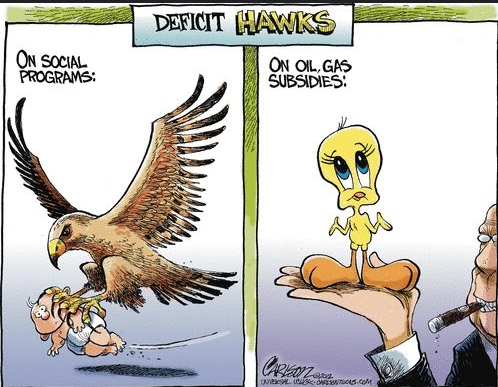
At every budgeting cycle the Republican deficit hawks work themselves into a frenzy of concern about budget deficits. To remind you, the annual deficit is the amount our government has spent beyond what it has taken in that year. Implicitly included under the umbrella of deficit is the debt, which is the credit card balance we owe for all past unpaid deficits.

Certainly debt and deficits are liabilities and it would be great if we could avoid them completely and spend only what we take in, but we realistically cannot operate without dipping into our credit card sometimes. The contention arises around how to control spending in order to avoid crippling credit card payments.

To reduce our credit burden, both parties strive to increase efficiency and reduce waste, fraud, and abuse. Beyond that, Democrats generally aim to raise revenue from the wealthy and corporations, and (to a far lesser extent) reduce military spending, while protecting and expanding social programs. Republicans mostly push for cuts to social programs, while increasing tax cuts (only for the wealthy), and opposing new taxes (only on the wealthy), while maintaining or increasing defense spending.

Democrats assert that the rich and powerful do not pay anything near their fair share and can afford to contribute far more, while Republicans assert (incorrectly) that the rich and powerful deserve even more money that will supposedly then “trickle-down” to help poorer people.

Not many appreciate that the concept of a “trickle-down” economy did not originate with Ronald Regan who put it forth as a credible economic principle. It was originally a satirical joke made by Will Rogers back in 1932 to mock then President Hoover’s response to the Great Depression in giving more money to rich people.

I’m going to forgo a lot of additional argumentation and simply skip ahead to the conclusion that Republicans are simply wrong on both the merits and the ethics of their budget logic, and rather try to understand their thinking.

I’m going to put aside sheer greed and self-interest as uninteresting. My interest is in how well-meaning people can come to support Republican policies.

First and perhaps foremost, Republicans believe incorrectly that rich people and corporations deserve (are entitled to) more money because the rich deserve it and can make the best use of it. Second, they love a strong military because either they are fearful, love having the biggest guns, love war profits, or are just afraid of looking weak on defense. Finally, they believe that regular people deserve nothing and should either get rich or die quietly without bothering anyone.

These biases result in the following internal logic. A) we must give as much as we can to rich people, and B) we must maintain or expand the military, so C) the only way we can accomplish both is to siphon away money from the 99%. This is accomplished by finding new ways to tax or increase costs for regular people, by destabilizing and pillaging the social security fund that they paid into, by compromising or withholding their healthcare, and by deregulation that shifts the cost of doing business from rich corporations to ordinary communities.

To extract wealth, they continue to perpetuate the joke of trickle-down economics. The term may be discredited, but the concept still underpins their worldview. They extract wealth by grossly downplaying the amount of money being spent on the military, and by exaggerating the cost of social service programs (see here).

And they have elucidated no limit whatsoever in just how much more the rich and powerful deserve. In fact the expressed American value is that personal wealth should be unlimited. Therefore, their goal of decreasing the debt and deficit can never be achieved no matter how much they extract, no matter how much damage they do, no matter how many people they impoverish, the rich can and will never have enough under the logical framework they have constructed.

Thus is the folly of their worldview, their rationalizations, and their policies. Their concern about the debt and deficit may or may not be genuine, as is their belief that the rich should receive even more. But to achieve both, the vast majority of people have to suffer. The end result of their thinking can only be incredibly harmful, unsustainable, and unethical budgetary policies enacted under the pretext of responsible deficit reduction.

Cook Your Frog Slowly

In my last article I talked about How We Liberals Destroyed Democracy. I was not saying liberals were wrong to push for social change. But I was making the argument that we made the tactical error of miscalculating our pressure. Or, to put it in a more fanciful way, I have no problem with cooking the frog for dinner. But if you want to end up with tender, juicy frog legs you have to cook it slowly. Turn up the heat too high too quickly and the skittish jumpy frog bolts. You’re left holding only an empty pot, and that’s on you.

I wasn’t giving the normal advise we seem to hear from most every other pundit writing for major publications. In one form or another, their sage advise is essentially “give conservatives what they want and they’ll like you more.” Their wisdom is a little like advising frustrated parents that if you just tell your kids to eat McDonalds Happy Meals every day then they’ll finally listen to you.

I was rather saying, be smarter. Be more patient. Be more strategic, more methodical, more incremental. Cook your frog slowly so that it does not jump out of the pot. To illustrate this further I want to segue into another topic I love to talk about as well, and that is self-driving cars.

In Cars Have to Go, I argued that mankind simply cannot sustain our current system of private car ownership. If we are to survive, cars as we know them have to go. Short of reducing the need for private transportation, for example by redesigning our cities, our only hope is automated fleets of shared vehicles.

And beyond just saving energy and resources, try to think through of all the other advantages a complete self-driving fleet would provide. You would not have to own, maintain, and insure your own car. You could simply call for one anytime. Our driving infrastructure could be far more efficient and cost-effective. All traffic control could be dispensed with if self-driving cars coordinate traffic flow safely and efficiently amongst themselves. No more problems of compromised, drunk, or distracted drivers. No more speeding or running red lights. Automated cars don’t suffer from road rage. No more possibility for vehicles to be used as weapons of mass murder. The social benefits are incalculable and innumerable.

But rather than go on about the benefits reengineering private transportation, where I want to go is the strategic issue of how to get there. How do you boil this frog? If you promise all these dramatic changes, as I am doing here, you run the risk of causing your frog to bolt. My feeling is that Elon Musk, by overhyping self-driving cars, has done harm to the long-term goal I embrace. He made the frogs all panic and jump.

Far smarter and more effective still would have been to get to self-driving fleets quietly and systematically, by offering incremental benefits that anyone and everyone would welcome at every step.

Just to give you a flavor, you start with lane departure warnings. Keep your kids safe. We are all OK with that. Then Smart Cruise. What? The car will slow down and follow a slower vehicle, yes please!

Hmm, self-parking? OMG yes. I hate parking. I want that!!

Wait, my new car can also go off on it’s own to find an open space in a parking garage or at the airport so I can catch my flight and then come pick me up when I return? Where has that been all my life???

And I also have the option of unpacking my car in front of my house and then sending it off to find street parking all by itself? I want that too!

Now if only anyone in my extended family could summon my car if they need to use it too, that would be so cool… wait they can??? Hmm then maybe we should all just go in together on one shared car…

People would generally love and welcome every incremental improvement along the way and find themselves welcoming the natural progression to self-driving fleets. But if you try to pressure them into contemplating a radically different future with self-driving fleets, there can be no surprise when they panic and jump right out of that pot.

In my book, Pandemic of Delusion, I talk at great length about how we can gradually move people from any position A to any other position B. But you have to do it gradually. Push too hard too fast, and impenetrable defenses will arise to block your way.

Liberals should have learned that the hard way recently, and I truly hope that there is still a sure path for both for democracy and for self-driving fleets to accomplish dramatic change through patient, incremental steps.

And equally importantly, success requires restraint to recognize when your frog is optimally cooked and stop there. Too often advocacy groups become institutionalized and they lose any ability to turn down the heat even after the frog starts to fry and burn. But that’s another discussion!

How We Liberals Destroyed Democracy

The title of this article is intentionally provocative. But for good reason. Democrats should at least consider their shared responsibility for destroying our democracy. I’m not trying to be fair and balanced and comprehensive here. I and others have opined ad nauseum about the flaws and dangers of conservative thinking. But in this article I wish to focus on the role of liberals.

Regardless of what we will admit to ourselves or to others, the Supreme Court immunity ruling and the subsequent reelection of Trump has effectively ended our long noble struggle to hold on to our democracy in America. I don’t believe it is hyperbole to acknowledge that we are now firmly, and probably intractably, marching along the path to becoming just like Russia, a brazen kleptocracy flaunting a thin facade of democracy.

And whether they will admit it in that way to themselves and others, half the country is effectively OK with that. It would not have been their first choice for our fate, but they would rather live in a dictatorship than continue to tolerate the excesses, real or perceived, of many democrats, at least of those driving the agenda. I predicted this based on game theory a while back (see here).

To be fair, conservatives have largely tolerated if not embraced a stunning amount of social change since the 1960’s and even before. The end of slavery was social change, women gaining the vote was social change, a sweeping host of equal rights practices was social change, interracial marriage was social change, women entering the workforce and arguably taking half the jobs in the country away from men was social change, the changing expectations of men in the home and in society was social change, accepting gay pride parades and gay marriage was social change. Those are just the broadest reminders of the incredible social change that conservatives tolerated if not always embraced.

But democrats weren’t satisfied. They pushed too hard, too aggressively, too gleefully on social, race, and gender issues mostly. I would suggest that the critical point at which their incessant pressure turned dark and counterproductive was the cancelling of Al Franken. It continued with a cancel culture that vilified everyone from Thomas Jefferson to Matt Damon. It took the form of policing gender pronouns, rallying behind gay wedding cakes, drag queen story hour, transgender surgery, bathrooms, and military service. The entire year leading up to Trumps election I watched liberal women on MSNBC fixate on women’s issues and overtly tell men they should support us or shut up. The list goes on and on and on.

So don’t tell me that democrats are purely the victims here and conservatives are the bad guys. I revile much or even most of what conservatives stand for, but democrats kept making more and more extreme demands until the point at which conservatives said, I’ve had enough of even trying to make this marriage work, I’m out.

One can continue to insist that all those demands were just and right. But even granting that, one must at least question the tactical wisdom of how we went about fighting for them. One can argue that regardless of the provocation and pressure, upending our democracy is a self-destructive and disproportionate response. True enough. But if liberals are capable of any self-examination they must consider their own hubris and lack of restraint in forcing this response.

In the media today there is a lot of coverage of democrats gleefully saying “I told you so” to conservatives in reference to the disastrous actions of Trump. But perhaps conservatives are also justified in saying “I told you so” to the democrats who have been so incessant and extreme in their long history of cattle-prodding conservatives into ever more unpalatable concessions without any apparent expectation of the extreme blowback that was virtually assured to come… and now has.

News Has Become a Geico Commercial

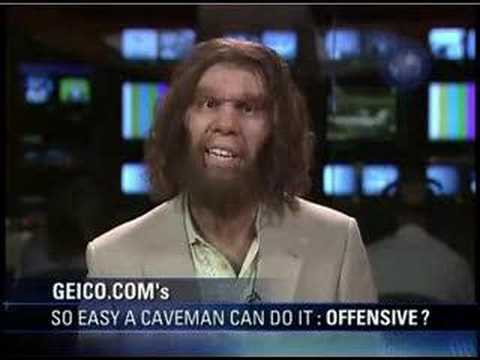
cavemanGreat advertising works because the advertisers uncannily understand the psychological dynamics of the moment even before it is commonly recognized. Take for example the “Great Answer” series of Geico commercials. In these commercials, a person is put in an impossibly tough spot to which they reply that Geico can save you 15% or more on insurance. This is comically accepted by everyone as a “great answer.”

In “Objection,” faced with insurmountable evidence against him in a courtroom, a thief defends himself with the line (see here).

And in “Undercover Agent” an inept undercover agent avoids certain death at the hands of the mob using a similar line (see here).

Then in “He-Man vs Skeletor” the villain escapes amid gleeful laughter after delivering the punch line (see here).

Finally in “Meteor Crash,” when faced with the imminent destruction of the Earth, the General in charge proclaims that Geico is the answer (see here).

Silly as these are, I sometimes I feel like I’m living in a Geico commercial. When we watch news interviews, we essentially see an unending stream of farcical Geico  commercials. The Geico advertising team gets this at some level. That’s why these commercials are not merely funny but they relate, they resonate, they ring true.

Except being subjected to an endless stream of Geico-esque answers to real, important questions that affect our lives and affect the planet is not funny.

When watching news interviews during the day, the nightly news shows, or shows like Meet the Press or Face the Nation over the weekend, the hosts try to ask meaningful and important questions. But the guests invariably reply with “Geico can save you 15% or more” type answers.

Host: Given all the incontrovertible evidence that your tax plan is designed only to benefit the rich, how can you justify it?

Paul Ryan: We are giving the middle class a huge tax cut.

Host: Every independent analysis concludes that your tax plan will explode the deficit which you claimed is the biggest threat to our nation. How do you respond?

Kevin McCarthy: We are giving the middle class a huge tax cut.

Host: You claim that by giving huge tax breaks to big business and ultra-rich individuals, your tax plan will create jobs and increase wages. Yet this promise has been made many times before and it has never proved true. Why should it work this time?

Sarah Sanders: We are giving the middle class a huge tax cut.

Some people would simply call this “good messaging.” But at some point, good messaging becomes formal or informal collusion in a campaign of misinformation. We are way past the point of innocent and healthy message discipline now. We are moving into carefully crafted propaganda territory.

Here’s the thing. If the person you are interviewing has no shame, no compunction about misrepresenting and “spinning” to absurd extremes, no trace of integrity with regard to facts or truth, then you really cannot and should not talk to them. It used to be that most politicians had some baseline of integrity and self-respect, some desire to be truthful, and some capacity to be embarrassed or ashamed. But no more. While this lack of intellectual and moral integrity has been growing for a long time, particularly on the Right, Donald Trump has normalized this to such an extreme that even the most disingenuous scripted politicians can rationalize they are being relatively forthright and reasoned.

Today we are confronted by immediate and immensely important threats like climate change, wealth inequality, automation, and guns. Yet just like the General in “The Meteor” commercial, even when faced by existential challenges, all that our politicians are willing to respond with is the equivalent of “Geico can save you 15% or more.”

My message to Chuck Todd, John Dickerson, and all the rest of you news interviewers is … just give up already. Your guests have just gotten too good at avoiding answering anything fully or honestly. You are wasting your time and our time. You won’t catch them in a candid moment or a self-contradiction any more. I appreciate that you cannot push harder than you do, so you should just focus on reporting facts and providing independent analysis. Yes, independent analysis may not rate as high as partisan vollyball matches in which canned messages get knocked back and forth. Nonpartisan analysts may not draw the audiences of big-name politicians and spokespersons who cackle like Skeletor as they deflect your questions. But at least you would be using that otherwise wasted airtime with real reporting with real value for the nation and the world.

Or you can just continue to serve as the straight-men and women for those “Geico will save you 15% or more” punch lines. Just know that we are not laughing.

Ethical Fallacies

A fallacy is a mistaken belief, particularly those based on invalid arguments. There are many general forms that fallacious arguments take, and they are almost always an indicator of faulty reasoning, incorrect conclusions, and even outright manipulation. Familiar examples of these include the Straw Man, Appeal to Authority, Ad Hominem, Circular Reasoning, and False Choice. If you learn to recognize the general patterns of fallacious logic, you can see through disingenuous or manipulative arguments far more quickly and clearly. I discuss these and many other logical fallacies in my book “Belief in Science and the Science of Belief (see here).

But in addition to logical fallacies, I’d like to suggest that there is also such a thing as ethical fallacies that we encounter just as often. In fact, in this 2016 election cycle we have been ceaselessly deluged by ethical fallacies. Note that it is with deliberate intent that I speak of ethical fallacies and not moral fallacies. Morality is itself a form of ethical fallacy. For a discussion of the difference, see here.

The reason I make that distinction is because moral thinking is typically based on ethical fallacies including “Appeal to the Bible.” Note that a related and no less dogmatic form of ethical fallacy is “Appeal to the Constitution.” In fact, many of the same people who would like to bind us to their interpretation of the Bible would also like to turn the Constitution into another Bible, binding even secular individuals to their particular religiously-based interpretation of yet another literal and unassailable scripture.

Two related ethical fallacies are “Appeal to the Majority” and “Appeal to Individual Rights.” Sometimes these are valid arguments, but often they are not. When some argue that “a majority of Americans support the death penalty,” that does not constitute a valid ethical argument. Likewise when some argue that we should not restrict any gun sales because it is an individual right, clearly this is insufficient ethical justification. Politicians and advocates often similarly appeal to Federal versus State Rights inconsistently and arbitrarily when it serves their narrow interests.

Another set of ethical arguments that are often invoked are fallacies of “Time and Space.” Just because something may have been accepted or considered ethical in Biblical times or even in Revolutionary War days, does not mean it is ethical today. And just because something may be ethical in one place, does not ensure that it is ethical in another. Note that religious people have great trouble with this concept. It is too complicated and messy for them. It requires too much thought. They disparagingly call this kind of ethical thinking “situational” and therefore immoral. They prefer immutable dogma.

Note that just because something is lawful does not make it ethical either. “Invoking the Law” is therefore another possible fallacy. Of course we do our best to create ethical laws, but just because something is law does not make it ethical in all situations. Laws should be fluid enough to ensure fairness in individual situations. This concept is antithetical to some religious thinkers who have trouble with anything beyond simple dogmatic thinking. Ironically, they are most likely to insist the law be adhered to by others, but allow themselves to override the law when they can rationalize that it is in contradiction to their faith.

There are other fallacies related to belief. Many of the same people are most likely to invoke the “Fallacy of Sincerity.” Just because a belief is “sincere or heartfelt” does not make it any more or less ethical. Similarly, there is sometimes an “Appeal to Intent or Ignorance.” These may be extenuating factors, but neither of them make an action any more or less ethical.

In my last article I talked about two other ethical fallacies (see here). The first is the “Ethical Proximity” fallacy. This is the fallacy used grab all benefits for those in closest proximity to us while shifting all blame away to those farthest from ourselves or our group. The second is the “Personal Responsibility” fallacy. This version of ethical proximity is used to argue that those farthest away or least powerful must take personal responsibility for their actions while those closest to us or in the most powerful positions in our society are merely victims of “the system.”

And then there is the “Character versus Issues” fallacy. When we are talking about the flaws in an opposing politician, pundits focus on their basic character failings. But when forced to respond to character flaws in their own candidate, advocates insist that we should instead focus exclusively on “the issues.”

Another ethical fallacy that is constantly used, particularly during elections or during the aftermath of a ginned up march to war, is the “Water Under the Bridge” fallacy. This is frequently invoked by those guilty of past failures or even crimes, to insist that all of that is simply water under the bridge, that we must instead look forward. However, when an opponent has similar past failures, they insist that we must never, ever forget.

shieldoffaithProbably the most hypocritical ethical fallacy that incenses my sensibilities is the “Forgiveness Fallacy.” This is typically invoked by Christians, particularly Evangelical Christians, to serve as both a shield and a sword. Whenever one of their own is guilty of wrongdoing, they insist that we must forgive and that only God can judge. However, when the guilty party is not one of them, they insist that only God can forgive and that we must never forget nor forgive. Seems to me that it is those who most need forgiveness are the ones to advocate for it most strongly, but only when it benefits them.

There is a theme here. We tend to selectively use one set of ethical arguments to rationalize away problems with those in closest proximity to us, and a different and entirely contradictory set of ethical arguments to attack those we disagree with, often for completely unrelated reasons. This is called spin by some, advocacy or good debate tactics by others, and bald-faced hypocrisy by most objective observers. Yet we see and hear these and other fallacious ethical argument all the time.

But this is the thing. Just because almost every line of rhetorical attack or defense in our public discourse is some manifestation of these basic tactics, doesn’t mean we should just tune out. That is simply not an option. However, just as with logical fallacies, by learning to quickly recognize the general forms of ethical fallacies, we can quickly “tune past” all the nonsense intended to obscure and deflect and see through to the heart of contentious issues that are critically important to all of us.

Can you think of any other ethical fallacies? If so, add to this list through your comments!


Data, Data Everywhere…

In The Rime of the Ancient Mariner, poet Samuel Taylor Coleridge lamented “Water, water everywhere, nor any drop to drink.” There seems to be no better way to describe our situation today with regard to information. We sail upon a vast ocean of data and yet we die of thirst. Indeed, we are too often deluged by great waves of facts that batter us relentlessly to and fro upon treacherous seas of data.

It feels particularly disconcerting for me to write this article. In my book, Belief in Science and the Science of Belief (see here), I promote the importance of elevating facts above beliefs. After all, facts should reflect reality. They should be the basis upon which truth is known. Today however, data seems to be used far more effectively to support beliefs, fantasies, and lies than it is used to reveal truths. Indeed, those who wish to sell us nonsense don’t often bother to invoke the bible or faith anymore – they invoke their own “facts” instead.

One reason that facts have become the new champions of beliefs and cons is the sheer amount of it. We now have so much data that one can mine anything they want from the endless mountains of the stuff that we have produced. Misrepresented facts can now be dredged up to fabricate lies far easier than spinning magical stories of gods and devils.

Nowhere is this new perversion of facts more true than in politics. Today politicians like Donald Trump incessantly cite completely misleading facts to support their beliefs and positions and to outright lie. Even if the majority of people do not believe their “trumped up” facts, they nevertheless conclude that all facts are suspect and that no facts can be trusted. This tangibly undermines the level of rational thinking of our entire culture and leaves us without any sound basis for making good decisions as a society.

In his excellent Op-Ed (see here), William Davies points out that “they [facts] seem to be losing their ability to support consensus.” According to Davies, there is clear agreement that “We have entered an age of post-truth politics.” This new age of bullshit is fueled not by assertions of faith, but by assertions of facts. As Davies further points out, “Rather than sit coolly outside the fray of political argument, facts are now one of the main rhetorical weapons within it.

So facts have become the new bullshit. We claim to care about facts, but only because, as with the bible, we can always find something in them to support our beliefs and prejudices and self-interest. Our abundance of data seems to be only serving to diminish and undervalue it; to make it increasingly vulnerable to manipulation, misrepresentation, and lies by half-truth. The sheer volume of it makes it far more difficult to say anything with certainty without some other bit of data seeming to contradict it.

And this perversion and misuse of facts is not just true in politics but has become the new normal in all walks of life. All too often journalists and pundits do not pursue facts to reveal truth, but rather invoke them to advocate for opposing sides of an issue. This makes great theatre, but does little to advance the important questions that we face. It instigates and perpetuates conflict rather than help reach a sound fact-based consensus.

Even scientists, our gatekeepers and guardians of fact, all too often emphasize only those facts that advocate for their positions rather than serving the far greater goal of advancing science as a quest for truth.

Abandoning facts is simply not an option. Allowing the manipulators to turn all fact-based thinking into rationalization games and data manipulation exercises is not an option because without sound facts good decisions simply cannot be made. If we allow facts to be coopted by magical thinkers, by self-serving politicians, or even by well-meaning advocates, we might as well put the psychic hotline staff in charge of our fates.

What is the answer? We must reclaim facts. We must become smarter consumers of facts who are no more likely to be fooled by the bogus facts cited by manipulative politicians or corporations any more than we are by laughably ambiguous bible citations and interpretations. We must learn to recognize valid data and sound conclusions amidst all the cherry-picking and false claims. We must learn to treasure and respect fairly presented facts as diamonds amongst all the heaps of rubble and fool’s gold that we have to sift through every day.

Our overabundance of data should make us value – and demand – sound analysis and conclusions based on that data all that much more.


2017 State of the Union

trumpThe state of the union is … great! It’s the greatest in fact. It is the greatest state of any union ever. The main reason our union is so great is because I am honestly the greatest president ever, no contest, and everyone agrees on this. Am I right?
Our rebranding of America is going really, really well – it’s amazing. The golden Trump sign we installed on the White House is spectacular, so classy. I’ve gotten so many tweets about it you wouldn’t believe. The flashing can be seen all the way from the new Trump Tower. I mean who was this Washington guy anyway? What did he do that was so great? Wear wooden teeth? Give me a break! And we are still looking for an artist to replace the statue in that Lincoln Memorial with one that people care about. Everyone wants it to be me; what can I say? Once I’m sitting there all huge you’ll be so proud to be an American. Also, I’ve got even more exciting news. We’re working on a new flag with the stars forming a constellation in my image. It’ll be classy, trust me, it’ll be so classy you won’t believe it.

And when it comes to the economy, let me tell you, last year we’ve made absolutely the best deals ever. Our deal to sell Atlantic City to The Trump Organization is the greatest deal for this country. It’s a big deal, the biggest. The new Trump City is gonna be fabulous, you’ll be so proud. And let me tell you, once our corporate takeover of Las Vegas is complete, the new Trump City West will be incredible. It’s going to make us the envy of the world that I can tell you. Tourists will flock there by the millions, trust me, millions.

The transition of my cabinet and staff is complete, and all those old losers are out. What morons and scum bags, jeesh. Today I’m pleased to announce that David Duke will be my new FBI Director. He’s going to make sure that the Congress and Supreme Court get in line, believe me. And I’m also happy to announce David Koch as Director of the newly combined Departments of Energy and EPA. I was just gonna disband them but frankly David paid so much money for the job I’d be an idiot to say no, and I’m not an idiot. And here’s the best news. Lovely Melania has agreed to be our new Secretary of State. She asked me, what do they do? I said, don’t worry your pretty head, you just have to look fantastic and keep your mouth shut. She’s so good at that I can’t tell you, she’s the best.

I gotta be honest; there have been some problems, that can I tell you. But now with old lady Ginsburg and hysterical Sotomexicano put away in Guantanamo, my lawsuits should all disappear. OK folks? Look, women and Hispanics and old people all love me by the way. And now that Pelosi is back in her place and Palsy Ryan has slithered back to whatever hick town in Wisconsin he crawled out of – sorry but it’s the truth – everyone else is falling in line with my plan to privatize the Senate and Congress. Excuse me, it’s just a fact… private companies can govern so much better than the “government,” am I right? And don’t worry, I’ll hire only the very best people to run my government, believe me, THE best. I’m personally interviewing the guys who made a killing in Michigan. They know how to get things done let me tell you. After a crash course at Trump National University, they will be ready to take over and make America great again, totally great again.

America will be so great you won’t even recognize it!

Our Curious Public Mood Swings

PolicyMood

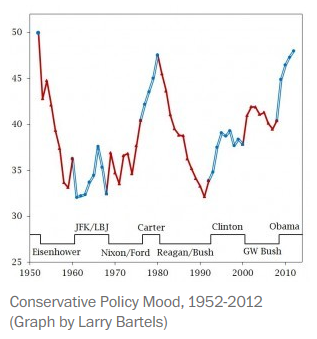
This is a fascinating and revealing chart illustrating our curious public mood swings. It was produced by Larry Bartels (see here) using data compiled by James Stimson (see here). It measures the “policy mood” of the country since 1950. The higher the score, the more conservative was public opinion at that particular point in time.

Stinson derived this policy mood index from responses to a wide range of public policy surveys. Since it does not rely upon self-identification as liberal or conservative, it is arguably a more nuanced and accurate measure of where public attitudes fall on the liberal-conservative spectrum.

The most obvious thing to note here are the dramatic swings. Clearly public attitudes about major issues are not as fixed as we might imagine. Over the past 65 years public opinion has swung up and down by almost 20 points. Clearly public sentiment can be swayed significantly.

The most interesting thing about these swings is revealed when you refer to the Administration timeline that Bartels added to the x-axis. If you study this a bit you’ll undoubtedly start to scratch your head in confusion. Under each Democrat administration the country became more conservative, and under each Conservative administration the country became more liberal. This is entirely counter-intuitive and immensely important.

The nation became dramatically more liberal during the Eisenhower years. Ike was moderately conservative overall but staunchly conservative on economic issues. It became slightly more conservative during the moderately liberal Kennedy/Johnson era but shifted far toward the conservative extreme during the very liberal Carter years. Similarly, during the extremely conservative Reagan era, public sentiment shot back down again toward the liberal end of the spectrum. Under Clinton, the public then became more conservative and after a year or two of George Bush became more liberal again. Finally, under the very liberal President Obama, we have become dramatically more conservative.

The next observation may or may not be significant, but the swing has been between 30 and 50 on this scale of conservatism. I can’t imagine what kind of views it would require to earn a 100% rating on this scale, but for what it’s worth public opinion has remained solidly on the liberal side of the spectrum. This seems to defy the popular meme that America is a “near Right” country. It suggests we are actually (still) a “near Left” country.

But that may not last if trends continue. Although this chart bounces up and down, there is still a clear upward best fit line. This supports the long-term trend toward conversativism reported independently by other sources. Essentially each President since Eisenhower has rated as more conservative. More specifically, each Republican President has been more conservative than the previous Republican President and each Democrat President has been more conservative than the previous Democrat President. This reinforces the observation that despite these swings, the Conservatives succeed year after year in moving the “center” ever farther toward the Right.

So what conclusions can we draw from these data? First, it isn’t true that we are intractably divided and cannot change. Clearly a very significant fraction of us can be moved a substantial amount in one direction or the other. Next, we are perhaps overall more liberal than the Right would like to have us believe. However, we are trending ever more conservative and that is never likely to reverse as long as liberals keep voting for the “lesser of two evils” who is still ever more conservative than his or her predecessor.

Finally, as Bartels pointed out in his article, Presidents do not actually succeed in shifting public opinion their direction. The data rather show that the public tends to recoil reliably away from the President in their attitudes. Paradoxically and counter-intuitively, these data suggest that the fastest way to shift public sentiment toward the liberal end would be to elect a highly conservative President. And the best way to reverse the long-term trend toward conservatism may be to allow our “lesser of two evils” Democratic candidates to lose.