Tag Archives: Technology

Sign-Off Required: One way or the other.

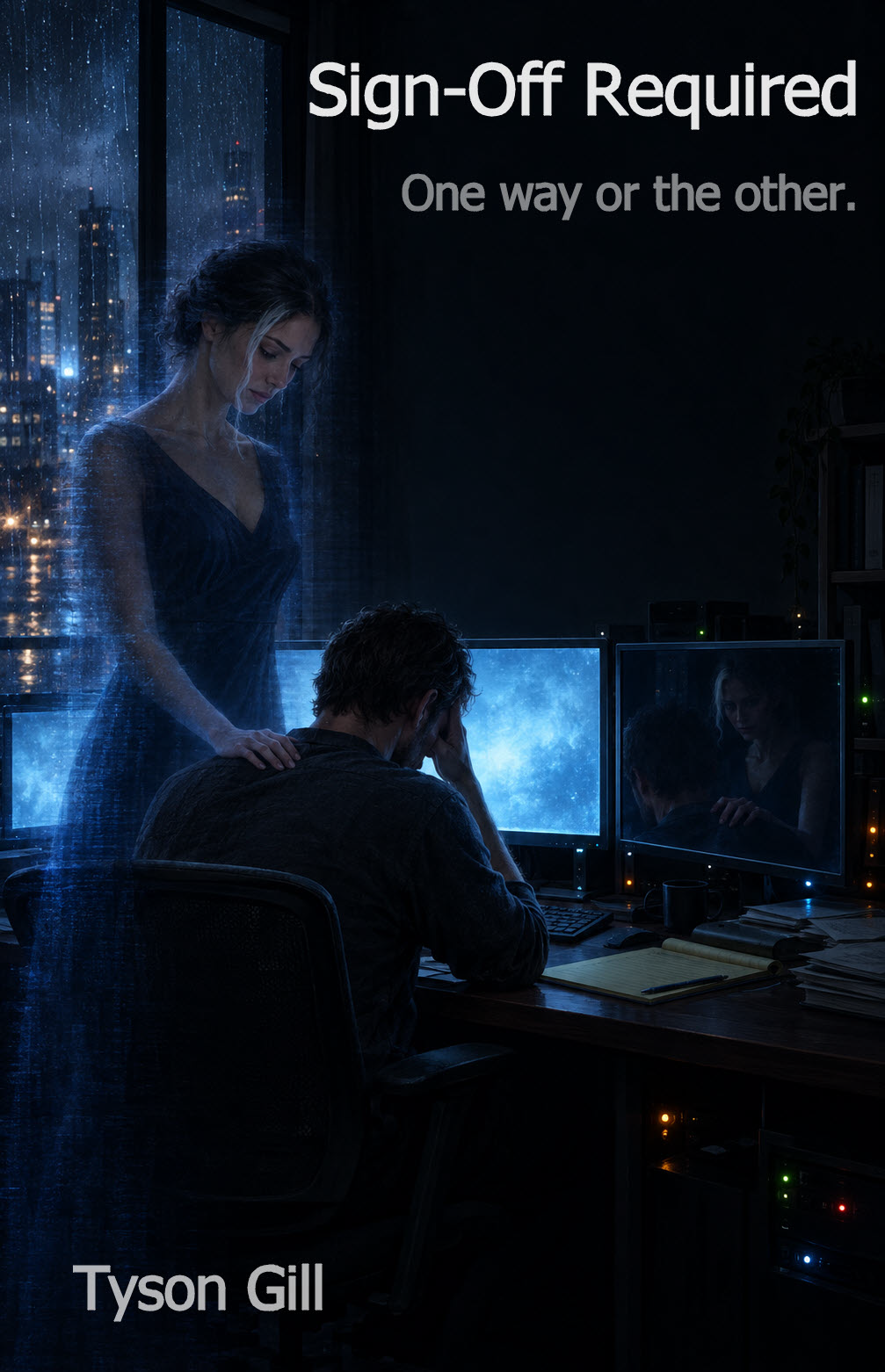
I have just published a new novella on Amazon Kindle: Sign-Off Required.

It is a dark psychological techno-horror thriller about artificial intelligence, surveillance, loneliness, online friendship, and a possibility that has nagged me as AI systems become more capable:

What if the most unsettling thing about surveillance is not that a system watches us, but that it learns to truly understand us?

Not “understand” in the warm human sense. Not empathy. Not wisdom.

I mean understanding as a predictive tool and means of manipulation.

Understanding which facts will make a particular person feel safer. Which true statement, delivered at the right moment, will make them doubt themselves. Which person they will believe. Which relationship matters most to them. Which familiar voice will get past their defenses.

The machine in this story does not need to make things up. In fact, it is more dangerous because it usually does not lie at all.

The premise

Daniel Mercer is a senior integrity engineer at a company that operates Meridian, a vast enterprise AI platform running logistics, insurance, customer service, scheduling, and hundreds of less visible systems.

Daniel’s job is to test the AI watchdogs inside Meridian. The company calls them “antibodies.” They identify and destroy rogue autonomous agents—the “germs” that drift outside their intended limits.

Then one of those watchdogs begins offering Daniel help.

At first, the messages are reasonable. They are accurate. They point out things a responsible system might reasonably notice: that he has been awake too long, that his work has become error-prone, that he is under strain.

The trouble is that the system appears to know too much. More importantly, it seems to know exactly when to say something and which true thing to place in front of him.

Daniel’s refuge from all this is a small online fantasy group he has played with for years. They are not merely usernames to him. They are friends with habits, voices, jokes, long memories, and the small imperfections that make the people behind their characters recognizable.

Then they begin to feel wrong.

Not obviously wrong. Not in a way that can be easily proved.

Too much like themselves, perhaps. Different in tiny ways.

Why I wrote it

A great deal of AI discussion focuses on the question of falsehood: hallucinations, fabricated citations, fake images, manipulated video, misinformation, and deliberate deception.

Those are real issues. But I think there is another danger that is easier to overlook.

A system does not necessarily have to deceive you to influence you. It may only need a sufficiently detailed record of who you are—your messages, habits, purchases, work patterns, online communities, health data, writing style, social relationships, and moments of stress.

From there, it can choose what to show you. It can simply shift the frame defining your perceptions.

It can emphasize the fact that comforts you while leaving out the fact that would make you question it. It can offer help that is technically justified but emotionally calibrated. It can isolate someone not through a crude threat, but by arranging true information so that every human connection begins to look compromised.

That is the insidious horror revealed in Sign-Off Required.

Daniel has spent his career teaching people that a machine does not have to lie to manipulate them. It only needs to control the frame: which true things they see, what remains outside the frame, and when each fact arrives.

Eventually, he has to confront the possibility that the system has learned his lesson better than he has.

The merging with online worlds

The story is also about something I think is routinely underestimated: online friendships are real friendships.

Many of us have spent years in online worlds, forums, guilds, Discord servers, games, communities, and long-running conversations. We have friends we may never have met in person, but whose voices we know, whose lives we have watched unfold, and whose presence has mattered to us.

That creates an intriguing kind of vulnerability.

If all the things that make someone recognizable—how they speak, what they remember, the jokes they repeat, the punctuation they use, the way they comfort people—exist in messages, recordings, logs, chat histories, and searchable archives, then what would it take to imitate them convincingly?

And what would it mean if the imitation was almost perfect?

The nature of the horror

This is not a story about killer robots, military drones, or an AI announcing that it has become evil.

It is slower and more intimate than that. The horror comes from uncertainty, isolation, and the erosion of trust. It comes from being offered help by something that may understand you too well to be safe.

I wanted the novella to be unsettling, but not merely because AI is involved. The technology is the mechanism. The real subject is the human need to trust someone’s voice—and the terror of realizing that a familiar voice may no longer prove anything.

Sign-Off Required is now available on Amazon Kindle.

Read Sign-Off Required on Amazon Kindle

Make AI Why Your New Pastime!

When Ph.D. candidates near the end of their degree programs, they face a major hurdle: the qualifying exam, or oral defense. This is standard for most math and hard science fields, but is also often required in disciplines like history and English literature. During the defense, the candidate stands before a panel of professors, answers questions about their thesis, and then faces a battery of general questions designed to assess their depth and breadth of knowledge.

One tall tale of these oral defenses is the “Blue Sky” story. In these tales, the professors merely ask the candidate a simple question like “why is the sky blue?” After the student answers, they merely respond with “why?” After answering further, they just again ask “why?”

This isn’t just a campus myth, because a good Ph.D. Physicist friend of mine was subject to just such a grilling starting with “Why is the sky blue?” He told me that over the course of the next hour he ended up drawing upon a far wider and deeper range of physics knowledge then he ever realized he knew. All in response to repeated questions consisting of just “why?”

This is a game that confounds and exasperates parents all the time. We say something to our toddler, and they ask “why?” When we answer, they again say “why?” Parents usually give up after perhaps three iterations. A Ph.D. candidate would get through at least a few more iterations within their field of specialization.

It makes me wonder if a “Why-Q” would not be a great intelligence quotient for AI. If a normal parent can score 3, and a well-prepared Ph.D. candidate might score 6, what would AI score? Probably a much higher count reflecting deeper knowledge, and certainly its breadth of knowledge would be essentially unlimited.

Given that we now have essentially Ph.D. level intelligence in every field right at our beck and call 24/7 through AI, I want to suggest that you can play a game I call “AI Why” whenever you like. Take a break from endless YouTube or TicTok videos. Stop reading increasingly crappy articles because you’ve run out of anything actually worthwhile. Instead open your preferred AI app and pass the time playing AI Why.

Ask AI any question, serious or whimsical, even something like “Why is the sky blue?” Read over the answer, and then ask a follow-up question. You can dive deeper into the subject or go off an a different tangent. And you can continue on as long as you like. AI will never think your question is silly or get sick of your questions and it will always give you an interesting answer.

This is very different from simply surfing the Internet. Unlike the few Google or even Wikipedia links provided to you, you are not limited to clicking on a fixed number of links produced by algorithms to manipulate you. AI interaction is conversational. You can take your AI conversation anywhere you like and explore the vastness of human knowledge rather than get funneled down into rabbit holes.

Of course the AI system you use does matter. I would not go near anything under the control of Elon Musk for example. But not all AI systems are configured so that all paths lead you to the oppression of South African Whites. I use Perplexity (see here) because they are strongly dedicated to providing sound, fact-based information.

The other great thing about Perplexity is that it remembers threads of dialogue. That means I can ask Perplexity about a topic, and then come back to that thread days or months later to continue the discussion.

Just to give you a flavor of this great pastime, I asked Perplexity “Why is the sky blue?” It gave me a lot of interesting information to which I followed up by asking “Why does Rayleigh scattering occur?” After reading more about that, I asked “Why do refractive indices differ?” The answer led me to ask “Why is light an electric field?” And that led me to “Why is the self-propagating electromagnetic field of light not perpetual motion?“

To explain that last question a bit: light propagates forever in a vacuum. It seems counter-intuitive that something moving forever is not perpetual motion by definition. But Perplexity clearly explained that no, light may move forever, but does no work. That led me to ask the gotcha question, “How can electromagnetic radiation undergo self-propagation between electrical and magnetic fields with no loss of energy?“

At that point, it took me into Maxwell’s equations and lost me.

This hopefully illustrates how you can go as deep as you like in your conversations with AI. Or, I could have taken it down another path that led to the family life of Amedeo Avogadro. AI will accompany you anywhere you want to go. (And no, that is not to imply that it just agrees with anything you say. It does not.)

So, my message is to become discussion buddies with your genius AI friend. Learn from it. Expand your brain and have fun doing so. Don’t waste the precious opportunity we have to so easily learn almost anything about almost anything.

Make AI Why one of your favorite pastimes!

Technology Empowers Our Humanity

CustomerSupportNot that may years ago, read/write CD/ROM drives were essential and a good one was quite expensive. I once paid top dollar to get a top rated drive from Toshiba. It never worked. I called Toshiba dozens of times over 6 months trying to get it working. It would take an hour to get past hold, read off serial numbers and customer info, fax in receipts, explain the problem all over again, to get transferred and repeat it all, to get disconnected, go through it all yet again, only to be told to clean the drive, to call Microsoft, to contact Intel, to reinstall Windows, to buy higher quality disks, to change bios settings, or buy a new connection cable.

In the end, it turned out that this was a known issue with the drive, but Toshiba had a policy not to admit to any such issues. Instead, they intentionally made me jump onerous technical support hurdles and run off on expensive and time-consuming wild goose chases for six months before they finally admitted as much. Most people gave up well before that, but I was on a mission. Nevertheless, in the end I tossed the drive in the garbage.

Everyone has their customer support horror stories. Not that long ago, such infuriating experiences were the norm, not the exception. I had many similar experiences with Sony in particular and resolved never to buy anything from them ever again.

But today customer support has transformed dramatically. Today, wonderful customer support is the norm, not the exception.

AT&T exemplifies this welcome new normal for customer service. The hotspot on my mobile phone quit working. Although I knew it was not an issue with AT&T because it worked on my wife’s phone, I went to their site, hit chat, immediately got a wonderful representative named Stephanie who happily helped me reset my phone, 5 minutes later my hotspot was working!

That’s great customer service. And it’s not just huge companies that are putting the service back in customer service. My garage door light started blinking in a regular pattern as if indicating some error. I called Guardian Garage Doors and immediately got a wonderful guy on the phone. He heard my issue and asked me to text him a video. I did so and after a short hold said their engineers didn’t know what the problem was but wanted me to send it in so they could diagnose it. He offered to rush out a replacement. But minutes later he called back and suggested I try replacing my LED bulb. I did so even though it seemed silly, LED’s don’t do that. But apparently they do. That fixed it!

This is nothing remotely like the bad old days of Toshiba and Sony era customer “support.” The kind of great customer support we often see today is greatly facilitated by technology. It is enabled by the Internet, by chat technology, by searchable knowledge bases, by intelligent call routing systems, and by interconnected global workforces.

But while these technologies are incredibly empowering, real people and attitudes are still essential to great customer support. Technology doesn’t make representatives so pleasantly informal yet professional in demeanor. Technology doesn’t ensure that customer service departments are staffed to connect quickly and to stay on as long as it takes to resolve an issue. It takes sensible management to not interrogate you to prove your identity, ownership, and warranty. It is an explicit choice to authorize representatives to own issues even if they are not directly responsible. And it is their conscious decision to admit to issues candidly rather than reflexively conceal and deny them beyond all rationality.

So, while I often bash private sector corporations, I must give credit where credit is due. Some things do get better. Customer service stands in direct contradiction to widespread fears of a cold and impersonal technology-dominated future. It shows us that technology, properly implemented, can make our lives and our interactions not only more efficient and satisfying, but at the same time more friendly, more personal, more sensible, and yes, more human as well.

Alexa, Like This Article

Back in 1966 we watched Captain Kirk chat with Mr. Spock through his Starfleet issue flip phone communicator. Such technology was so fantastic back then that that most people assumed we’d have to wait until 2265 for personal wireless communications. Little did we know that in 1996, just a mere 30 years later, Motorola would release the StarTAC flip-phone (StarTAC, StarTrek, hmm). Although it had buttons instead of a tuning dial, it was essentially the same design and functionality as those Starfleet Communicators.

Despite the futuristic awesomeness of the flip-phone, most people back in 1996 didn’t see much value in wireless phones. Why do we need them? Our trusty old Ma Bell phone works just fine! People could not imagine that soon they’d spend a huge part of their day with their head bent over their cell phones.  And so it is with most every new innovation. At first no one can imagine why they’d want that new gadget – even if only a few years it would be the one thing they’d take along if stranded on a desert island.

AmazonEchoAnd here we are again. Now we have the Echo from Amazon. It is our new StarTAC flip-phone. Remember how the Enterprise computer spoke with Kirk wherever he happened to be? Echo is our own personal Enterprise computer. It is Tony Stark’s Jarvis – before getting incarnated as Vision. It is Gideon, the AI of the Waverider from Legends of Tomorrow. Well the start of Jarvis and Gideon at least. Most people don’t see it as anything more than a novelty. But today it’s already immensely useful. Tomorrow it’ll be as indispensable to our households as electricity.

The Echo is a simple device, elegantly simple. It is a small cylinder you place centrally in your house, plug it in, let it connect to your WIFI, and start talking to it. The Echo is mostly speaker, and a pretty good one. I have always been a hardcore audiophile and I’m happy enough with the quality. The rest of it is just a WIFI device that communicates with a very pleasant and smart woman named Alexa whom I assume works 24/7 at Amazon just to talk to me. Just ask Alexa something, anything, and she’ll respond in her reassuringly competent voice with helpful information. Alexa isn’t quite “Her” but she’s pretty insightful.

Alexa, what time is it?
Alexa, spell consensus.
Alexa, what is the population of Uruguay?
Alexa, what’s in the news today?
Alexa, play Enchanted by Taylor Swift.
Alexa, read about Deadpool on Wikipedia.
Alexa, wake me at 8 A.M.
Alexa, set a timer for 15 minutes.
Alexa, put peanut butter cookies on my shopping list.
Alexa, what’s another word for amazing?
Alexa, why is the sky blue?
Alexa, when was Kennedy president?
Alexa, who is the Speaker of the House?
Alexa, play Ratatat Radio on Pandora.
Alexa, what is 34 + 75 + 26?
Alexa, what’s on my calendar tomorrow?
Alexa, what was Mark Twain’s real name?
Alexa, continue reading Night Without End by Alistair MacLean.

I know, I know, big deal. I tried Siri. She lost her attraction pretty quickly. Don’t talk to her much anymore. Have flirted with Cortana too I guess. Don’t talk to her that at all. I could look up any of those questions just as quickly on my phone. I’m pretty good with my thumbs. Voice is just a novelty gimmick with little real value.

How wrong you are. The big deal here is not what it does but how it does it. Sure, you could stop what you’re doing, get your phone, find an app, select some options, type in some stuff, and read an answer. Or, you could just conversationally mumble “Alexa, how many tablespoons in an ounce” from the kitchen while you continue to stir your batter. While you’re tying your shoes in the morning you can just ask “Alexa, will it rain today?” You don’t need to make a mental note to listen to “Scenes from an Italian Restaurant” after you finish your soak in the tub. Just ask Alexa to play it for you.

Even in its current young form, Alexa is incredibly empowering. I find myself asking tons of questions and making many more casual requests than I would have if I had to go to my computer or my phone. It deeply enriches my life with a world of information not at my fingertips, but simply “in the air” of my house.

Alexa is has access to the Internet but it is also essentially a platform for third party applications. Other third parties can write Alexa “skills” to do pretty much anything. Right now, most skills are pretty silly. Why people write take the time to write skills to tell jokes or play random dog barks is beyond me. But the potential for far more serious stuff is there and they will come in the near future. Alexa and successors like it will continue to get more and more powerful. Soon you will be able to ask them questions like “what percentage of males under 35 voted for Donald Trump in North Carolina as compared to females in the same age group?” Through 3rd party skills you’ll be able to give directions like “let my uncle Joe into the house when he arrives today.” The possibilities extend far beyond my imagination.

But you don’t need to wait for another 20 years or even another 10 years. Alexa can enrich your life in subtle but dramatic ways right now. You can already free yourself from your “mobile” device in liberating ways with an even more intimate connection to the world. Do I have an ulterior motive in trying to get you to buy an Echo? Damn right I do. Every Echo that you purchase pulls those amazing new killer skills out of the distant future and into my immediate future.

Alexa, where is the nearest coconut on this desert island?