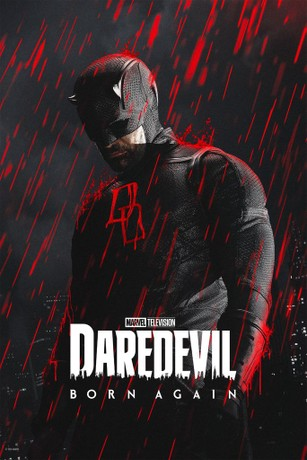
I have never been one to rant about movies and shows. I hate those haters who compulsively rush to nitpick and complain about everything to prove they have better taste than everyone else and that nothing is ever as good as it used to be. If I do rarely write about shows, it is because I particularly loved them. One was Penny Dreadful which was the topic of my very first Figmentum back in 2015. Another of my rare fanboy raves was over the Netflix Daredevil series when that first came out (see here).
But here I am today to rant about Daredevil Born Again. In particular, the absolutely horrible season two finale.
The ending actually made me outraged and angry.
Warning, a spoiler follows...
I am outraged not only by a terrible end to an otherwise great series, but by the larger messages it sends. Storytelling can bend physics, ignore the finer points of criminal procedure, and occasionally tape over plot holes with a well‑timed quip. What it cannot do, at least not without breaking my trust, is casually invert the moral core of its own protagonist and then ask me to applaud. That is what the “Fisk goes free” ending does.
The series doesn’t merely show Wilson Fisk as a corrupt politician or an off‑screen orchestrator of crime. The finale graphically shows him rampage through the NYC courthouse brutally butchering crowds of protesters, with deliberate January‑6‑style imagery, in full public view. We aren’t dealing with a shady back‑room deal or a body count the characters can plausibly hand‑wave away; this is a literal spine-smashing massacre in the heart of the justice system and in full view of the cameras.
In response, Matt Murdock does two things. First, he stops the mob from killing Fisk, which is consistent with his established refusal to become an executioner. Then he does something else entirely: he presses Fisk to accept a political deal that allows him to avoid trial and prison altogether, provided he promises to leave New York.
First off, I will just point out that the idea that Matt could broker such a deal is absurd beyond words. The suspension of disbelief it requires to allow this goes well beyond absurdity. It is just utterly unrealistic and ridiculous even in a superhero show. No city anywhere would allow Fisk to walk away unpunished after such blatant and heinous crimes.
But even if we can get past that small point, in a universe that pretends to care about justice, this is not mercy. It’s complicity. Daredevil has always walked a line between vigilante violence and belief in the rule of law. He beats people up in alleys not because he enjoys it (usually), but because it is his ugly way of dragging them toward a system he still, somehow, wants to work. His no‑kill rule is tolerable precisely because it’s tethered to a conviction that real accountability must happen somewhere else — in a courtroom, in a cell, in a moment where the state, not the man in the mask, passes sentence. Here, that delicate tether is simply cut. Matt doesn’t just refuse to kill; he actively helps dismantle any chance of justice at all. The man who has no compunction about shattering the bones and livelihoods of low‑level crooks suddenly discovers boundless scruples when it comes to the one person proven to be beyond redemption. That is not a subtle ethical tension. It is moral whiplash.
Watching this, I found my mind wandering somewhere I didn’t expect it to go: Batman and the Joker. In the darker takes on that relationship, Batman’s refusal to kill the Joker stops looking noble and starts looking pathological. The body count mounts. Gotham burns. At some point, you have to ask whether Bruce is more attached to his identity as “the man who doesn’t kill” than he is to the lives being lost as a direct consequence. Fans have wrestled with this for years. Daredevil, by contrast, has usually felt healthier. Matt is tormented, but he isn’t supposed to be in love with the endlessness of his war. He wants his enemies actually stopped. His Catholic guilt is directed inward, not fetishized as an excuse to keep the real villains around to justify his own existence.
Fisk’s exile ending throws that distinction away. By brokering a deal that allows a mass‑murdering Fisk to simply walk free, Matt crosses into exactly the territory that makes many Batman stories uncomfortable: the hero who, whether he admits it or not, needs his monster so badly that he is willing to give up on everyone else’s safety to preserve the dance. Except in this case, it’s worse. Batman usually at least turns Joker over to Arkham and pretends the system is trying. Matt skips that step entirely. Instead of “I won’t kill you because I believe you should face justice,” the message becomes “I won’t kill you and I will also help you dodge justice.” It’s not a tragic compromise; it’s a psychotic level of enablement.
The obvious question, and the one that has kept nagging at me, is: how did this get through? How did an entire chain of professionals — writers, producers, executives — look at this and say, “Yes, this is the necessary and best culmination of our story”? The answer, I suspect, has less to do with anyone secretly believing that this is actually a strong ending and more to do with the mundane, grinding logic of franchise management. Marvel has been very clear, in ways both public and implied, that you do not permanently break your toys. As far back as the original Netflix run, creators talked about needing to leave key villains alive and reusable. The Disney+ era doubles down on that. Kingpin is a valuable asset, needed in other corners of the MCU. Born Again needed to end the “Mayor Fisk” storyline without killing him or burying him in a hole the wider franchise couldn’t easily dig him out of.
Within that box, the writers’ room still wants poetry. One man in jail, one man in exile. One in chains, one in a self‑made hell. It looks good on a whiteboard. It sounds powerful in a pitch. You can drape it in Frank Miller shadows and Catholic symbolism and convince yourself you have done something bold. The problem is that the poetry is built on sand. The more clearly the show depicts Fisk’s crimes, the more absurd and grotesque the “deal” becomes. Critics who otherwise liked the episode acknowledge that it “pushes credibility” and amounts to a “grave injustice.” Fans whose tolerance for comic‑book nonsense is usually high describe the logic as “breaking my brain.” And here I am, the usually easy‑going guy muttering “take it easy” at other people’s outrage, pacing my living room and inventing new synonyms for “what were they thinking?”
Although the show did not intend it, perhaps the calculation of Marvel, Disney, and the showrunners here reflects a deeper rot in our society when real supervillains escape justice only to be rebooted over and over because they are “franchise characters” in a gigantic money-making machine. So the larger question is about what our stories teach us to accept. We live in a world where powerful men commit public harms and then negotiate quiet “exiles”: golden parachutes, consulting gigs on another continent, opportunities to reinvent themselves while their victims get, at best, a carefully crafted press release. We already know, at some level, that this is wrong. Fiction has an opportunity — maybe even a duty — to state that clearly, to dramatize the difference between mercy and complicity.
Stories are one of the ways we shape our collective morality. Instead of a nuanced study of justice and retribution, Born Again perverts the pattern and frames it as tragic nobility. The hero of Hell’s Kitchen, the man whose greatest virtue is supposed to be his insistence that regular folks’ lives matter, chooses to let a rich and powerful mass murderer walk because killing him would stain his soul, and the narrative nods approvingly. The dead in the courthouse are reduced to set dressing for Matt’s spiritual aesthetics and Fisk’s franchise viability. This is not an inconsequential message.
There is, in theory, a way to redeem this. Season 3 could treat Matt’s decision not as a clever bit of symmetry but as a catastrophic mistake. Fisk could go on to commit greater horrors precisely because he was allowed to leave. Matt, sitting in his cell, could be forced into the kind of genuine reckoning that Daredevil is uniquely qualified to handle: confronting the difference between refusing to kill and refusing to demand accountability. Forgiveness without consequences could finally be named for what it is: not saintly restraint, but a sin of omission. The man who wears a devil on his chest could realize that in this case, he sided with the wrong one.
I do not expect that to happen. The way the ending has been discussed by the show’s creative leadership and covered by the trades suggests they see it as a striking status quo, not a grotesque misstep. Fisk will be exiled, then of course he will be back, and the story will move on to new villains, new costumes, new hallway fights. Maybe some of that will be good. Maybe I will keep watching out of habit and because I still, stubbornly, like these characters.
So this is not just about one bad decision in a TV writers’ room. It is about the kind of stories we are willing to tell and the kind of compromises we are willing to shrug off because the larger machine needs to keep milking their cash cows. If even Daredevil can lose sight of what justice means, maybe it’s worth pausing to ask whether we might be doing the same thing — in our entertainment, in our politics, in the stories we tell ourselves to rationalize our own righteousness.
I am not the only one disappointed and outraged by this ending, and perhaps that in itself is a tiny piece of evidence that some lines are still visible, even in a world where morals and values must be twisted to serve the sacred franchise.

