Author Archives: Tyson

Unknown's avatar

About Tyson

Love writing all kinds of stuff including fiction, non-fiction, editorials, etc. But writing software is the only writing I do for love AND money!

Ken Ham Crib Sheet

As a follow-up to yesterday’s blog questioning the sanity of Ken Ham (found here), I have compiled a list of the essential arguments put forth by Ken during his debate with Bill Nye. While it seems at first viewing that he commands a dizzying array of arguments, they are mostly rephrased or derivative versions of the same few silly assertions. Distilled below is pretty much the entire Creationist repertoire that he repeats over and over in different ways with great airs of authority. I added my own sometimes mostly snarky rebuttals. Feel free to use these when you feel compelled to respond quickly to friends or coworkers who repeat these delusional arguments.

ken-ham

Man is not the ultimate authority. God is.

Science agrees that man is not the ultimate authority. It simply acknowledges that verifiable and reproducible facts are.

Science has been hijacked by secularists.

Ballsy try, but it’s clearly the other way around, with creationists like Ken desperately trying to gain legitimacy by donning the mantle of science.

Some scientists are creationists.

Ken repeatedly attempts to argue by authority by trotting out testimonials from scientists who share his delusions. Yes a very few scientists are creationists – and some priests are child-molesters. What does that prove except that some priests can be immoral and some scientists can be crazy? By the way, I sincerely doubt that he would accept the literal belief of a few demented Hindi scientists as proof that the universe was created by Brahma.

Interpretations depend upon your presuppositions.

Absolutely, and the scientific method is the only method we have to prove or disprove those presuppositions. But science doesn’t start by proudly proclaiming its presupposition that the bible is the inerrant and irrefutable source of all truth.

The bible predicts things and we see them actually confirmed.

No surprise when you proclaim anything you choose in the bible to be “symbolic” and then take license to interpret those symbols however necessary to confirm your desired predictions. Nostradamus made many more correct predictions than the bible.

How could we have logic without god if we are just random?

This is a centuries-old argument that is unworthy of a first-year philosophy class. The cosmos is not random and logic has no need for god when it can depend upon physical laws and causality.

Observational science is legitimate but Historical science is not.

There is no such distinction except within Ken Ham’s addled brain. He simply fabricated this artificial distinction to dismiss any science he does not like. Science is science. But when you try to understand what qualifies as ‘Observational’ science and what qualifies as “Historical” science, you quickly see that the only criterion is whatever Ken Ham wants to believe. Anything he agrees with is by his definition the good “Observational” science. Anything he wants to deny is by his definition illegitimate “Historical” science.

You must understand that parts of the bible are Literal and other parts are Poetic.

Just as he dismisses any science he finds inconvenient as “Historical,” he conveniently dismisses anything in the bible he disagrees with as “Poetic” while anything he chooses to believe is “Literal.” It must be very convenient when you can define reality based on whatever you want to believe. But that is also the unmistakable hallmark of delusion and even insanity.

The evolutionary tree should really be organized into Kinds.

Another way Mr. Ham attempts to redefine reality to fit his insanity is in his concept of biological “Kinds.” This is a cornerstone fabrication by Mr. Ham. By imposing his completely artificial notion of “Kinds” of species as a starting point, he is then able to make ridiculous claims and suggest completely contrived flaws in evolutionary theory. By starting with his “Kinds” construct, he is then able to argue that Noah could reasonably have carried every “Kind” of animal in the Arc, that the species diversity we see today could have plausibly arisen out of his “Kinds,” and that there is no evidence of his “Kinds” evolving into another “Kind,” thus denying the evolution of species. This is of course all utter nonsense, but if he can get people to accept his premise of “Kinds” as a starting point, then he can get them to follow him down this rabbit hole into Alice in Wonderland-land. The Mad Hatter was quite inventive and clever.

You can’t know that what is true today was true in the past.

Only if you are delusional. We actually do know that the laws of chemistry and physics apply always and everywhere in our universe without exception.

You didn’t observe the past directly so you can’t know anything about it.

So then Ken can’t know anything about his family history by leafing through a photo album – he didn’t observe the events directly after all. The simple truth is that we can and do know a tremendous amount about the past. We can observe the past directly just by looking into space after all. Or we can simply study all the evidence just lying all around us like little fossilized photographs.

Dating methods don’t agree.

Technically true, but still an obvious lie. Any differences between various scientific dating methods are minuscule compared to their vast disagreement with biblical claim of 6,000 years.

Can you name one piece of technology that could only have been developed starting with a belief in molecules-to-man evolution?

This is a red-herring, an invalid diversionary question. But sure we’ll play this game. How about clones, genetically modified foods, transgenic plants and animals, hybrid species, designer bacteria, and an exploding number of patents for new life forms? The list goes on and on.

You can’t prove any instance of a new trait appearing that wasn’t already there.

If Ken merely did a simple Google search of popular articles, he might find “10 Astounding Cases of Modern Evolution” reported by Popular Science (found here). There are thousands of such examples including the sudden development of new survival traits amongst bedbugs here in New York City. But this is yet another red-herring since most changes are incredibly tiny and only accumulate into observable traits after exceedingly long periods of time.

I hope this summary helps you to recognize and respond to these laughably fallacious sorts of arguments that some Creationists put forth. Unfortunately, guys like Ken are practiced at making themselves appear to be scientifically literate and they do appear to cite a plethora of legitimate arguments raising doubt in the science of evolution, but in reality they offer only smoke floating on air.

From Belief to Delusion

When I wrote my 2008 book Belief in Science and the Science of Belief (here on Amazon), I intentionally treated belief as just, well – belief. I intentionally softened any characterizations that might seem excessively inflammatory and personal. But in this more intimate setting amongst friends like you, we can ask whether the word belief is far too weak and benign, even inaccurate, to describe many of the assertions of the Religious Right.

Remember the formal debate between Bill Nye and Ken Ham on creationism? Ham challenged Nye to debate the topic and the notable exchange took place on February 4th, 2014. You can find the debate online if you missed it (here on YouTube). If you are old enough, you might know Bill Nye as the amiable “Science Guy” from his highly-regarded science show that ran from 1993 through 1998. Mr. Nye continues to be a passionate advocate and popularist of science.

Creation Museum

“Learning” at the Creation Museum

His opponent, Mr. Ham, was and is the President of the Answers in Genesis Ministry and is a tireless evangelist preaching young Earth creationism – mainly targeting kids. Mr. Ham is a key principal behind the Creation “Museum” (website) – a Biblical-themed amusement park that you may have glimpsed in the film Religulous by Bill Maher.

As I listened to the specious and frankly ludicrous arguments put forth with such conviction by Mr. Ham (see here), I could not help but wonder whether belief is far too mealy-mouthed a word for what Ham and those like him suffer from. Is not delusion is a far more accurate word to describe his kind of thinking? And if so, is it really helpful to be so very reluctant to call it what it is?

Now, before the psychologists amongst you get all up in arms that I’m diagnosing my fellow human beings, let me assure you that I use the word delusional purely in a lay sense, not as any kind of clinical diagnosis. But just because the word has particular meaning in clinical settings, does not mean we are not allowed to use it in a more general sense. We don’t need a judge to certify certain criminal activity as criminal and we don’t need a priest to proclaim certain behaviors as evil. We are perfectly free to do so as well.

For a fair and impartial definition of delusion we can most conveniently start with Wikipedia (go to link), which defines it as follows:

“A delusion is a belief held with strong conviction despite superior evidence to the contrary. As a pathology, it is distinct from a belief based on false or incomplete information, confabulation, dogma, illusion, or other effects of perception.”

That definition establishes a very clear distinction between belief and delusion, one which is easily recognizable at least at the extremes. A belief is simply an unsupported conclusion based on insufficient or incorrect information. A delusion is a belief that persists regardless of any amount of evidence to the contrary.

In the case of Ken Ham, his creationist views go far beyond a mistaken belief based on false or incomplete information. He maintains his unalterable convictions despite incomparably superior evidence to the contrary. No doubt, he would argue that the evidence for evolution is not actually superior, but any delusional person would similarly deny all evidence contrary to their delusion. Any objectively rational person could not help but conclude that the evidence for evolution goes far beyond merely superior to overwhelming and that the convoluted arguments that Ham puts forth to deny this evidence are utterly irrational.

According to Wikipedia again, delusions are further subcategorized into four distinct groups. One of these, the “Bizarre Delusion,” is defined as follows:

“A delusion that is very strange and completely implausible; an example of a bizarre delusion would be that aliens have removed the reporting person’s brain.”

I contend that the thinking of Ken Ham and other evolution deniers should be fairly and accurately categorized as a Bizarre Delusion. Their creationist views are certainly “completely implausible” and it would be considered “very strange” if they were not so commonplace. It is important to recognize that they have studied this a lot, and do not simply hold a completely uninformed and clueless belief in creation like presumably say, Rick Perry. And they are evidently not just lying about their belief like at least some other Conservative politicians. They are truly delusional.

Words matter and they should be used accurately. In principle, if a more accurate word is available it should be used. It seems undeniable that Bizarre Delusion is a far more appropriate word than belief to describe the thinking of Ham and those who share his delusions. But words also have power, and we should avoid words that convey implications or elicit reactions we would like to avoid. So even if the bizarre thinking of Ham and others like him is in fact delusional by definition, what value is there in labeling it as such? Doesn’t that just necessarily alienate those you would like to bring around to a less delusional way of thinking?

Even considering those possible undesirable side-effects, the word belief is neither accurate nor helpful in describing these delusions. It is not merely polite and non-confrontational but it actively helps enable these delusions. It suggests that such delusional thinking is harmless and even reasonable and acceptable when sheltered under the protective umbrella of other more rational beliefs. But delusions are seldom harmless and never reasonable or acceptable. Calling this kind of delusional thinking “belief” gives it more legitimacy than it deserves. If we were to consistently refer to this kind of thinking as delusions rather than as beliefs, we would more accurately communicate the true nature and real-world implications of these tangibly harmful assertions.

Certainly using the word delusion instead of belief would elicit a much more visceral response by opponents and allies alike, but I for one would welcome that reaction. I say call a delusion a delusion and stand by the implicit assertion that such delusional thinking goes way beyond mere belief and that it is irrational, unacceptable, and harmful. Calling a delusion a delusion may be just the hit of reality that these deluded people need, or at least those influenced by them need, to honestly reconsider the soundness of their reasoning. At the very least, it may give some people, politicians in particular, some hesitation in associating themselves with these delusional ideas.

So the next time someone espouses delusionary thinking, consider calling it out (nicely) as delusion. Instead of responding with the customary “I respect your beliefs but I don’t share them,” you might say something more provocative like “sorry but I can’t give any credence to such delusions.” If the other party questions how you dare characterize their sincere, heartfelt belief as a delusion, you should be able to give them a very clear and compelling justification for your use of that word. Or just refer them to Wikipedia.

But do not overuse it. Although one could arguably call any belief in god delusional, to do so would only dilute its effectiveness. There is a wide grey spectrum between belief and delusion. Reserve the label of delusional to those like Ken Ham who are clearly at the delusional end of the spectrum.

Here is an extra credit homework question for you. If Ken Ham has clearly slipped from belief into delusion, how far has he slid down the slope from delusion to insanity?

On Grammar, Punctuation, and Serial Commas

Commas

Dear Editor

Yes, you personally! Stop messing with my Serial commas, or my Oxford commas, or my Harvard commas, or my Series commas or however else you wish to refer to that punctuation mark I placed before the “and” at the end of a series. I do know quite well that you are philosophically opposed to them, but there are good reasons why I keep putting them in anyway – I mean apart from my sadistic compulsion to make your job miserable or to cleverly distract you from focusing on actual flaws in my manuscript.

Believe me I do sympathize with the visceral pain of abandoning a proofreading rule that was drilled into you back in Editing 101. After all, the AP Stylebook banned it for all eternity. But that journalism convention is now an archaic remnant of the olden days when every character had to be manually typeset on the printed page and every “excess” character that could be eliminated meant less typesetting effort, faster time to print, and greater profits. But that is no longer a concern today, and there is no longer any need to continue to sacrifice clarity and precision in order to avoid the manual placement of another comma.

And make no mistake; any writing that abandons the correct use of the serial comma is far less precise. For example, if I craft the following sentence…

We received shipments of produce, livestock, tea, and spice.

I intend this to clearly communicate that four separate shipments were received. If you automatically remove my serial comma as follows…

We received shipments of produce, livestock, tea and spice.

You have materially undermined my intent. Does this sentence now communicate clearly that four shipments were received or might it have been only three? The reader can no longer be sure. By automatically removing all of my serial commas, you have reduced the richness of information, lowered precision, created ambiguity, and even introduced an error.

And depending on the context and purpose of the statement, it might really, really matter whether four shipments were received instead of only three. You would not willy-nilly delete “unnecessary” parentheses from a mathematics equation, so why would you effectively do the same with my precisely punctuated prose?

Deletion of the serial comma is especially egregious to anyone with a math, science, legal, or computer programming background. We are trained to be as clear and unambiguous in our writing as possible. But when you are editing any work, let alone a scientific paper or technical manual, you probably do not have the subject matter expertise to determine if and how you might be changing the precise meaning that the author has communicated by including or omitting a serial comma.

Even in fiction and non-technical writing, a smart author uses the serial comma in a smart manner. Not only to indicate non-grouping of the final items in the series, but to establish style. I read all my writing out loud, especially dialog, to get just the right, natural-sounding cadence from the character’s unique voice. Sometimes that calls for a comma to make it sound or read the way I intend. When you remove that carefully crafted comma, you undermine not only the meaning, but also the artistic voice of the author. That frankly violates what should be your most sacred prime directive as an editor – do no harm.

Editors: Get over what you were taught about serial commas. Even the AP Stylebook endorses its use when it enhances clarity. But more importantly, trust the author to appropriately express subtleties of meaning and style through their careful use of the serial comma. Unless they obviously misuse it, like if they include it when they really intended the final two items to be grouped, or vice versa, don’t presume that you fully understand how the comma might alter the intent and meaning of the text.

Authors: Don’t be bullied into following some archaic rule of grammar here, but do be consistent. Use the serial comma if the final two items are ungrouped; exclude it if they are grouped. And if it makes no difference, use it artistically to express nuances of cadence or style.

And to both of you, take heart. You are not out on a limb here. If your literary competency is questioned, you can simply refer your critic to the Chicago Manual of Style, MLA Style Guide, and many other institutions who all endorse consistent use of the serial comma. Proof by authority is all some people will accept.

But if that isn’t enough to sufficiently pacify the stubborn stickler regarding the serial commas included by you, cite starting conjunctions, split infinitives, passive verbs, and ending prepositions as other outmoded grammatical proscriptions that should no longer be mindlessly adhered to.

Sincerely, Author

P.S. Further reading can be found in this post on Tin House.

Comic Book Kid

As a kid I had a super power. It was reading comics. And I read lots. I mean lots. I mean like every one ever printed up until that time. And that was a lot. Moreover I read each one many, many times. Not online, but actual ink imprinted upon actual paper. They were best savored at 2 a.m. on a school night under the covers with a flashlight.

During grade school in the 60’s, my friend Mike and I were mentored in superhero comportment by George Reeves in Superman reruns from the 50’s. From our super-secret base in Mike’s garage, we protected South-side Milwaukee from super-villains who were only detectable by means of our super-vision. Equipped with dramatically flowing capes fabricated from advanced bed sheet technology, we tracked them using our super-computer cleverly disguised as an old hub cap and leapt into action to foil their diabolical plans that always seemed to unfold in Mike’s back yard.

Other than George Reeves, superheroes pretty much only lived in comics and in our imaginations. At that time, new comics only appeared on drug store racks every Thursday. I’d make the rounds every week before the new stock even made it to the rack, ready with my 12 cents per copy that I mostly earned by collecting newspapers door-to-door for recycling; old boring paper out, new exciting paper in. I was hit hard by the big financial disaster of ’69 when comic prices jumped to 15 cents.

There was no real “comic collecting” back then. In fact, comics were almost universally seen as even less valuable than old newspapers. Not even suitable for parakeet cage liners. There were no dedicated stores, no conventions, no fan magazines, no web sites, no price guides, no Comic Book Men TV show, nothing. The entire industry around comic collection is a relatively recent invention.

Back then I procured my old comics from Mary’s second-hand store. It was a tiny hole-in-the-wall with all kinds of useless junk and even in that setting Mary didn’t feel that comics deserved to be placed out in public view. She acquired them when she could buy them dirt cheap and tossed them into a box under her cluttered desk that she dragged out for me each Saturday.

Gradually, week by week, my collection expanded organically. I rescued many of the virtually discarded comics from Mary’s box under the desk like they were abandoned kittens, sheltering them in my bedroom where their number grew steadily. To be clear, I never had any intent to collect. My only goal was to discover these precious comics so I could read them over and over and fill in the gaps as I read episodes of mostly forgotten old story lines in random order.

When I started my paper delivery route (again my fortunes were tied to the newspaper industry), I became flush with actual dollar bills every week. I quickly exhausted Mary’s relatively meager supply and discovered the “Old Town” vintage store in downtown Milwaukee. Although ostensibly a “collectable” store, it was really pretty much just an upgraded version of Mary’s second-hand junk store. But they did value comics and had a whole section in back with boxes bulging with them. It was the mother-load of those flat, rectangular gems!

So my Saturdays throughout the 60’s and 70’s routinely entailed trekking west out to Mary’s and then east back across the viaduct to Old Town to spend my paper route money or earnings from subsequent jobs. My collection gradually grew into many thousands of issues. Let’s be clear, my mother was not enthusiastic about this. Every time she ventured into my bedroom she would direct me to “get rid of all this crap.” Somehow I never got around to it. Each one was too valuable to part with. Not because of their monetary value but because they were innately precious. They told long lost stories that needed to be protected. Parting with even one issue in a series would be to leave a hole in a puzzle; a missing page in a larger book.

In 7th grade I augmented my paper route money with a second job as a bus boy at a Vera’s restaurant. That same 7th grade summer Mike and I took a roadtrip to central Manhattan where we visited DC comics where we appeared unannounced and talked ourselves into a personal tour from Carmine Infantino. A waitress at the restaurant introduced me to her son Greg, twice my age, who had also amassed a large comic empire. I became friends with him and he introduced me to a larger world of collecting, buying, and even selling. At that time there was not yet any formal comic market. It was just enthusiasts who mostly knew each other and communicated by letters or phone calls. There were new “fanzines” that were very crudely “published” advertisements from individuals to buy and sell comics between each other.

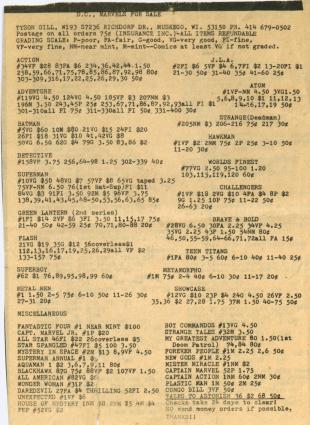
Comic AdSo, in order to satisfy my comic appetite quicker, I started to buy and sell too. I would sell duplicate issues for comics I needed to fill out my series. That entailed road trips to get together with other collectors to swap directly or typing out ads to publish in a fanzine, describing each item’s individual condition in meticulous detail. As a kid with no adult supervision whatsoever I was engaged in mail-order commerce, fulfilling daily orders for comics, carefully packaging them, and hauling them down to the post office. One had to be scrupulous in all these regards as in this small community one misrepresentation could destroy ones credibility.

Eventually my mom started to realize that these comics were actually worth real money. Suddenly the attitudes about my now barely tolerated collection, then well over 10,000, changed dramatically. Now suddenly it was respectable, even valued. My family quickly subsidized my passion with bookcases and wall-shelving for my bedroom to store all these suddenly precious comics. But I always found this distasteful. To me their worth was purely in their stories, never in their monetary value. I felt scorn for those who only started caring about comics after they became it became popular and lucrative and geeky-sheek to do so.

In fact, as the entire nation woke up to the “value” of comics, as more and more people started to buy them mostly because of their rapidly inflating monetary value, I inverse-proportionately lost interest. After I left home and it became logistically unfeasible to haul around my collection, I finally sold it all off. Collecting is best suited to sedentary types, not college students barely living in one dorm room very long, let alone in any one country.

When Greg bought up the remainder of my collection in one big bulk purchase, my puzzle was virtually complete with every issue, from #1 onwards, of every series printed up to that time. My DC collection went way back to a 1938 issue of Adventure comics and included series that went back as far as Action #10 and Batman #5. At one point I held in my very own hands a “good” copy of Action #1, agonizing over buying it, but I decided to put the $500 that was being asked into other issues. In the relatively recent Marvel world I had every single issue – right back to multiple copies of Spiderman #1, Fantastic Four #1 and the rest.

When I sold off my collection it was just at the start of the skyrocketing price curve. So I didn’t make a fortune my any stretch. But I did make enough profit to help see me through college. Do I regret selling off what would today be an immensely valuable collection? A bit but not really. The thing about collecting is that there is never a good time to sell. If you hold on it will always eventually get more valuable, if not for you for your children.

But making or losing money didn’t matter anyway. What mattered was not the short-term profit my efforts yielded, but the priceless and undying experiences those comics gave me. They instilled me with a “comic book” sensibility and a heroic world-view that I proudly retain to this day.

Back when Mike and I ran around zapping villains in his yard, we dreamed of an impossible future when we might see our heroes portrayed in the movies. We specifically speculated about the possibility of a day when Green Lantern might come to life in a live-action movie, showing off the full capability of his amazing Power Ring. What amazes me is that we lived to see that impossible dream come to life pushing 50 years later. I have to think that comics were instrumental in giving us the imagination to dream that crazy dream and the enduring spirit to remain “true believers” until it became reality.

Religion and Torture

Recently we Americans have been forced to confront real questions arising from our use of torture. Do we rationalize its use in certain circumstances but not others? Even ignoring the question of whether it actually works, does the end ever really justify the means? Is torture acceptable when our government is responsible but unacceptable when conducted by some foreign entity? Do we outright deny the validity of the Geneva Conventions or do we merely deny that what we do is technically torture? Do we view it as a necessary evil to protect our lives and freedoms?

Or do we condemn torture categorically regardless of any rationale? Do we support the prosecution of those who engage in torture regardless of their position in our government or even within our own party?

It turns out that our views on religion are a strong indicator of how we are likely to answer these important questions.

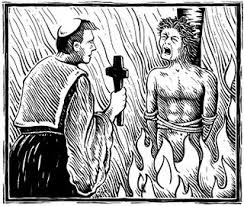
Religion has long walked hand in hand with violence, war, and torture; neither leading, neither following, but each symbiotically sustaining the other. Most of us are quick to draw an unholy relationship between radical Islam and a culture of war and torture. But we are extremely reluctant to acknowledge that a majority of Christians are also willing to embrace violence and even torture. The marriage of guns and Bible has been a long and horrific union, but the Christian embrace of torture goes back to the Inquisitions and far beyond that to the Old Testament.

ReligionAndTorture

And this tendency still persists. That is not merely a biased, anecdotal assessment based on long-abandoned barbarisms of the distant past, or even more recent cultural memories of racial atrocities perpetrated by Christian zealots during the last century. Religious rationalizations of and even engagement in violence and torture is still alive and well today. Certainly, many Christians and Muslims alike denounce violence and torture in word and deed, but amongst Christians at least, those who take a stand against torture are a statistical minority.

The Christian willingness, and even eagerness, to embrace the inhumanity of man towards man is exposed and quantified by the findings of current and credible polling studies. According to a recent Pew survey, people who attend church at least once a week are more likely to say that torture is often or sometimes justifiable. Christians in fact are often measurably ahead of the rest of the country when it comes to waging war or condoning brutality and violence. Indeed, Evangelicals supported President Bush and his fabricated Iraq war more strongly than most any other demographic.

And the Pew poll is hardly the only one confirming that this Christian embrace of violence extends to torture. A recent Washington Post/ABC News poll found that while 59% of Americans believe that the CIA treatment of suspected terrorists while held in detention was justified, the level of approval was much higher among Christians. That poll found that while 72% of non-religious people believe that the CIA treatment of detainees amounted to torture, only 39% of Evangelicals agree with that assessment. By all measures, Christians are more likely to condone torture than non-religious folk.

When the same poll asked whether the CIA “treatment” was justified, approval for this activity (whether or not you call it torture) was dramatically higher amongst all religious demographics than non-religious ones. Conversely, disapproval was far higher amongst non-religious respondents than it was for any religious demographic.

Demographic
Evangelicals
Protestants
Catholics
Non-religious
Approve
69%
75%
66%
41%
Disapprove
28%
22%
23%
53%


As is evident in these results, non-religious Americans are far more likely to view this treatment as torture and likewise to disapprove of its use than any Christian demographic. These findings directly dispute the raison d’être of religion, which is the claim that it imparts superior moral and ethical principles and that a lack of a religious foundation results in less developed moral reasoning.

We atheists and other non-religious groups clearly hold the moral high-ground on torture as well as on a wide range of critical moral and ethical issues. But we need to do far better in translating our deeply held humanist convictions into tangible actions that make the world a more humane place in which to live, starting with abolishing torture in our own country – even with regard to enemy combatants. We need to not only hold the high ground here, but build a great beacon of light upon it and shine it upon the world. We need to speak out and even march at every opportunity against violence, war, and torture and draw clear and unmistakable lines between where we stand on these issues, and the culture of violence and torture that many in the religious community would like perpetuate and even expand.

You can explore this topic further by starting with this post by Sarah Posner.

The Dandelion Project

Dandelion

A Fond Farewell to the Planet

Copyright © 2006 by Tyson Gill

Adrian made one final inventory, carefully confirming each item against the checklist provided. He inserted the payment form into the pre-addressed mailer last, with no trace of hesitation about having spent an entire year of graphic editing work to cover the submission fee. Finally satisfied that nothing had been overlooked, he sealed the package with the reverence of a precious time capsule. Now that it was finally ready to mail, he could hardly bring himself to part with it.

“The postman is coming,” his golden retriever alerted him with a familiar woof.

Securing the package in his lap, Adrian swung his wheelchair around and rolled silently toward the door, tapping the over-sized button open it. A gust of hot, wet air swept in through the doorway, laying siege to the air-conditioners defending the widely spaced entryway.

Against the spectacular backdrop of an angry, storm-crazed sky, the nonchalant approach of the postman might have seemed incongruous were it not an everyday occurrence. The approaching postman adjusted his balance adroitly as the frenetic wind buffeted him from every angle. All in all, it was relatively pleasant weather.

Adrian always wished he could be a postman too, strolling from house to house, warmed and cooled within one of those signature post-office blue all-weather suits. He had read that they were made of high-tech Nanobiotic™ fibers that adjusted automatically to almost any weather condition. But it could never be. The nature of his injury precluded ever being able to even use prosthetics.

“Lovely weather we’re having today eh Adrian?” Mailman Max called when he got close enough to be heard over the wind without shouting. It was Max’s usual greeting. Adrian typically came out to greet him to break up his otherwise humdrum days. In fact he ordered supplies in separate shipments to ensure that daily bit of human contact.

“It’s beautiful,” Adrian confirmed, grinning, as he rolled forward to the outermost fringe of the household climate systems protection.

Max halted, a gust of rain pelting him from out of nowhere, as he regarded the package proudly resting in the lap of the crippled boy.

“That it?” he asked simply, following up with an easy smile.

“This is it,” Adrian announced proudly, holding out the package like a holy offering.

“Right,” said Max. “I’ll send it right off then.”

Max exchanged the precious mailer for a bundle junk mail.

“Don’t worry,“ Max assured the boy as he patted the parcel. “I’ll see to this one personally.”

“Thanks. Maybe I’ll run around some day still,” Adrian whispered, like making an almost sinful admission of improbable hope.

“Maybe you will at that,” Max agreed with a wink.


Max pulled his mail truck up to the massive door of the post office and pressed his entrance card up against the rain-pelted window. He hoped that the card reader would cooperate today because he didn’t want to open the window. The weather had suddenly turned more nasty than usual and he was still suffering from the alternating gusts of frigid and burning air that overwhelmed his all-weather suit before he finally found refuge in his vehicle. People imagined that mail deliverers were always comfortable in their suits, but more often than not the internal regulators just couldn’t respond to the weather fast enough to ever be just right.

After the fourth swipe, the door finally lifted open and Max pulled forward into the garage with relief. The lumbering metal started to lower back down even before his mail truck cleared the entrance. He hopped down from the driver’s compartment, unzipping his suit as he looked around.

“Hey Max-eee!” a familiar voice called his way. “How the fuck you doing bro?”

“Hey Vince,” Max didn’t need to look to know the source of the familiar greeting. “I’m good.”

Vince had already reached the rear of the delivery truck. It was his job to unload the outgoing mail and transfer it to the automated sorter.

“Ouch!” Vince cried out like a cuss as his hand recoiled from the door latch.

“Ya, it’s pissing down hot rain out there,” Max confirmed needlessly.

“Fucking hot rain is the worst,” Vince complained. Whatever the weather was doing at any given moment was by definition the worst to Vince.

Max walked over and looked on as Vince heaved the back open and rolled the mail cart out.

“Saying on the radio that Florida lost another 500 square miles last month,” Max told him by way of small talk.

“Fuck,” Vince commented, pausing to shake his head. “Where is all the fucking water coming from? The fucking north pole is gone but we still ain’t got none to flush a crap.”

“Still lots of ice left in the Antarctic,” Max remarked.

“And we’re spending half the fucking national budget on those fucking see-oh two reduction plants,” Vince spat. “Thought they were supposed to clean up this fucking shit.”

“They are, but it takes time,” Max was used to having the same conversation every day.

“Fuck that,” Vince remarked as he pulled the mail cart toward the clanking sorter. “I don’t think they are doing crap. I think it’s all a croc of shit to keep us from realizing the fucking end of the world is already here.”

“Ya, you’re probably right,” Max always found it easier to just agree with Vince.

“Fucking right I’m fucking right,” Vince agreed wholeheartedly.

Suddenly, Max remembered something and darted back to the truck cab. He snatched a package off the passenger seat and ran to catch back up with Vince.

“Hey V, can you route this one personally? It’s kind of special and I don’t want that old crapper sending it off to Chinese-controlled Russia or something,” Max said, handing him Adrian’s package.

“You got it Max-eee,” Vince assured him, receiving the hand off like a football. “I’ll treat it like my own little baby.”

Somehow that didn’t reassure Max very much.


Sayonara Cheng reached for another package from atop the heaping mail container next to her desk. It had already been a long day and it was not getting any shorter. She had started working at The Dandelion Project as a temp over eight months earlier. Now they employed over 8,000 people doing the same job as her at different processing locations around the world.

It was a good temp job for as long it lasted. Open enrollment was supposed to end in three more months but she heard it would take another six to sort through the backlog. Probably more if submissions kept increasing as quickly as they had been.

Twenty-two million was the magic number. They needed at least that many paying donors to finance the project. They had reached that mark last month and were already at 36.5 million last she heard. Frenzied plans were underway to scale up the whole operation.

Their unlikely success thrust The Dandelion Project into the world spotlight. It graduated overnight from a wacky Internet scheme to a massive and controversial international joint venture. The protesters and picketers didn’t bother her much. Their office didn’t see many violent demonstrations. Sayonara just kept her head down, quietly and unobtrusively processing submission packages.

She opened the next kit, scattering the contents across her desk at the foot of her diet cola. She ignored the ancillary materials and picked out the data stick, deftly inserting it into a worn plug on her terminal.

Sayonara clicked the Import option from the custom application menu. After a momentary hourglass came and went, a graphic popped up on the screen. It was a cute young man, trying to appear as if he wasn’t imprisoned by the wheelchair in which he was obviously confined. His hand waved tentatively in front of a shy smile that made her feel as if he could see her there looking at his video portrait. The caption under the picture read “Adrian Davis, Age 24.” It was followed by a long personal data summary in a scrolling window.

She carefully opened the sample tube and placed it into the DNA Scanner. She absent-mindedly hit Scan Now on a popup menu and the device began to whir and hum softly, sending spectroscopic data to the central supercomputer for analysis. Sayonara used the time, as was her routine, to sip cola and review the notarized legal wavers and agreements.

A discouraging beep made her look up to see the garish  message flashing in red on the screen. That was fast, she thought, oddly disappointed. She had rejected thousands of applications without a second thought so it came as a surprise to her to feel reluctant to have to reject this particular applicant in accordance with her very specific selection protocols.

As she moused-over to select the Reject option, Adrian looked up at her from his wheelchair with renewed hope and longing. Sayonara peered deep into his pixilated eyes and felt as if they exposed his very soul to her. Her finger hesitated, hovering millimeters above the mouse button. She sensed a young man who wanted desperately to get up out of his rolling prison and play among the stars. How could she deny him that chance?

On an impulse, she clicked Accept, Override, and Confirm in rapid succession. She really hoped the auditors wouldn’t catch her on this one but didn’t much care.

“Bon voyage,” she told his image in a conspiratorial whisper.


It was obvious to Edwin Daniels long ago as a student at Cal Tech that global warming had exceeded the critical cascade threshold. No effort, no matter how extraordinary, could prevent atmospheric collapse. The extinction of mankind was imminent and inevitable.

That certainty had caused him to ponder the question; to what worthy cause can Man dedicate itself to even as Death is swinging his scythe? Then it came to him. He envisioned a great cosmic dandelion, releasing its seeds on solar winds far out into the great expanse of space.

He enlisted specialists with far more talent than he to join him in his mad project. His unprecedented plan required impossible advances in materials science, genetics, psychology, robotics, nanocircuitry, and artificial intelligence. If successful, mankind would perish in a glorious supernova of new knowledge and progress.

By force of raw passion and charisma, he organized a brotherhood of scientists who dedicated whatever free time they could manage to the project. They kept a low profile for two decades, working on the fundamental technical challenges in obscurity.

Once his team became relatively optimistic that the key obstacles could be overcome, they launched The Dandelion Project on the World Wide Web to fund development. They had never dreamt that it would capture the imagination and passion of the entire globe as it did. Though they never publicly admitted that this was a doomsday project, people around the world sent in their money and their DNA samples. Their database now contained over 173 million DNA fingerprints.

The Dandelion Project had taken in more money more quickly than any business in history. With it, they spent the next 18 years prototyping, developing, and testing the impossible.

Now, 37 years after the crazy dream first took seed, the project was coming to life without any further need of him. He could finally just relax and watch it unfold.

The daily launches continued despite the mass protests. Now that the deployment had actually begun, many religious leaders toned down their vehement rhetoric. The Chinese government finally gave the project their official sanction, lending the support of the largest and most influential country on Earth. Public relations continued to cite audits by independent auditing firms to quash conspiracy speculations that the DNA lottery was rigged.

Amidst the storms of nature and controversies of Man raging across the globe, the pods continued to launch night and day from locations across the United States, throughout China and its Russian territories, Europe, Australia, Africa, South America, India, and others. Every country was represented in the precious payload.

Edwin watched the television monitors replaying the time-lapse images taken from the international space station and the Moon base. There lay the solitary Earth, dying amidst the unsympathetic darkness of space, flinging thousands of pods out into the eternal blackness. It looked like a great cosmic dandelion, its metal composite seed pods brimming with databases of human DNA, flying out in all directions, going for broke on the longest of odds.

It was an unprecedented event in human history. The supernova of mankind as it died. All of humanity watched and marveled, strangely contented and satisfied as if collectively sharing one last fireworks finale.


“To be truthful, the odds are too infinitesimal to bother calculating. One in a thousand pods might survive millions of years of random collisions with space particulates to find a candidate planet. One in a hundred of those might find conditions compatible with human life. One in ten of those might succeed in re-synthesizing a random DNA record and growing a human clone. One in a score of those clones might survive and grow to into a functional human being. But the odds don’t matter. We are humans and all that matters is that we try. It is the only way that we frail humans can ever explore the universe first hand.”

Adrian looked up from the monitor. He had been watching an interview recorded back on Earth in some incomprehensible time past.

Mother, his robotic parent, stood protectively nearby. Nine years earlier, she had booted up and begun to execute her programming. She had reconfigured the pod into a shelter, acquired raw materials, and replicated a randomly selected sequence from the DNA database. Since then she had protected the child and tutored him in all the age-appropriate data available in their comprehensive Earth library.

“So that was him, Mother? That was the man who sent us here?”

Mother answered him with an exquisitely archetypical motherly voice.

“Yes Adrian that was Edwin Daniels. But many tens of thousands of people worked together to send us here, to our new home. All of humanity wished you bon voyage,”

“But I am all alone,” Adrian said to her. “What good is one person?”

Mother reproduced a tender smile, engaging all the micro-transducers of her synthetic face.

“One human isn’t much good at all,” she told him, squatting down to gaze into his eyes. “But one day soon you will choose another and we will raise her together.”

The boy was about to follow up with another question but Mother gave him a gentle shove.

“Go play now in the grass,” she urged him. “Bring some berries for a snack later.”

Adrian, naked in the warm, gentle air, jumped up and smiled, running off into the field. Animals, vaguely resembling little deer, bounded in around him to join in the romp.

In the pod, Mother set about cooking and cleaning as directed by her AI adaptive processor. On their little table, one old-fashioned picture rested prominently within a homemade frame. It was the still-picture of a young man that looked just like Adrian only older, sitting in a wheelchair and waving to them with wistful contentedness.

The Atheist Monster in Penny Dreadful

Vanessa speaks with John

Vanessa speaks with John

I’d like to share a powerful scene from a recent episode of Penny Dreadful, aired on Showtime on Mother’s Day.

Seeking a measure of solace from her struggles, Vanessa Ives (played by Eva Green) has come to volunteer in a cavernous underground serving as a makeshift cholera ward “in the shadow of so much wealth such suffering” of 19th century London.

There she encounters a horrendously scarred man named John Clare (played by Rory Kinnear). Not incidentally but as yet unknown to Vanessa, John is also the sensitive and articulate “monster” reanimated by the Doctor Frankenstein character in the show.

She notices John reading off in an alcove by himself. Intrigued, she approaches him. After an offer of soup and some preliminary introductions, Vanessa sits next to him.

“They make me nervous,” she confides, nodding toward a woman in a habit. “The nuns.”

“Why?” he asks.

“I was raised in the faith,” she admits. “It was arduous for me.”

“Have you religion?” she asks, changing the subject tangentially.

“Are you offering it?” John counters.

“Do you require it?” she answers with another question, smiling warmly.

“I never have,” he replies.

“Then I shan’t offer,” she reassures him. “And I would be a poor advocate. The Almighty and I have a challenging past. I’m not sure we’re speaking these days.”

A laugh comes awkwardly upon John as he returns a confidence. “I read the Bible when I was younger. But then I discovered Wordsworth. And then the old platitudes and parables seemed anemic, even unnecessary.”

“Mr. Wordsworth has a lot to answer for then,” she teases.

Summoning up deeply considered but rarely spoken words, John elaborates. “The glory of life surmounts the fear of death. Good Christians fear hellfire. So to avoid it, they are kind to their fellow man. Good pagans do not have this fear, so they can be who they are. Good or ill, as their nature dictates. We have no fear of God, so we’re accountable to no one but each other.”

“That’s a profound responsibility,” Miss Ives replies.

“And why you do this, no doubt” he asks, “helping those in need?”

“I came here for selfish reasons,” she confesses. “Do you truly not believe in heaven?”

John’s shy self-consciousness is replaced by a joyful radiance. “I believe in this world. And those creatures that fill it. That’s always been enough for me. Look around you – sacred mysteries at every turn.”

“But no exaltation in life beyond this?” Vanessa challenges, seeking confirmation.

“To see a world in a grain of sand, and a heaven in a wildflower. Hold infinity in the palm of your hand. And eternity in an hour,” John responds, paraphrasing William Blake’s “To See A World…”

Vanessa looks a bit sad, “With respect to Blake, I see no wildflowers here, only pain and suffering.”

“Then you need to look closer,” John tells her with compelling certainty.

The conversation is interrupted when Vanessa is called away by a nun who casts a disapproving glance at John.

“Thank you for the soup,” he says.

“Thank you for the conversation,” she answers as she takes her leave. And then, pausing to look back, she adds, “You have beautiful eyes.”

I will not attempt to do a deep analysis of this scene. It is so rich with poetic humanist themes that it is best to let every reader take from it what they will. But I will point out how notable this treatment of humanist ideas is, not only in today’s mass media, but in the context of a show in which demons and by inference god are undeniable realities. It suggests that “even if” god were real, there would still be merit in a purely humanist worldview.

It is certainly not an accident that John, shunned as a monster by his society, was chosen to represent the atheist-humanist character in the show. Of more subtle symbolism is that he is undeniably the product of purely human manufacture. Certainly he was not endowed with a soul by his human creator. Yet he is uniquely passionate and thoughtful with an incredibly “soulful” sense of awe and empathy.

On the other side, Vanessa’s deep faith and powerful mysticism have only left her in desperate need of the comfort and inspiring humanist perspectives offered by this apparent monster.