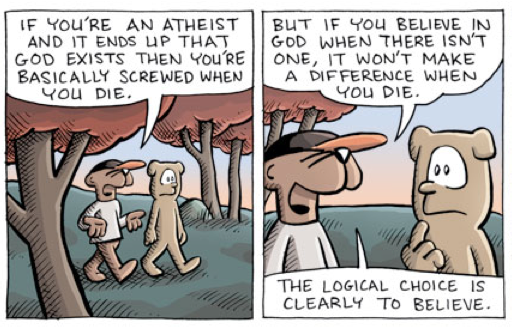
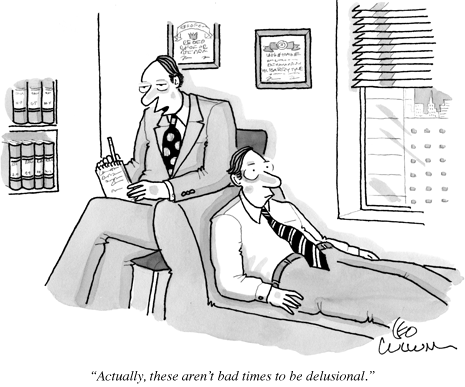
Category Archives: Atheism

The Last Gasp of God

One book that I frequently recommend is “The Merchants of Doubt” (see here). It was even made into a documentary film. The authors document the decades-long campaign of misinformation orchestrated largely by a small group of “reputable” scientists with the goal of discrediting any legitimate arguments against DDT and other hazardous pollutants, ozone-destroying CFC propellants and refrigerants, acid rain caused by coal burning, tobacco and its links to lung cancer, and most recently man-made climate change.

These scientists employed well-refined tactics to delay any meaningful reform in these areas. Essentially, their strategy was to create doubt about these dangers. As long as they could manufacture even the thinnest illusion of doubt, they could delay any efforts to restrict those industries. They succeeded for a long time – and still succeed with climate change – but only with the complicity of mainstream media organizations that publish their made-up arguments over and over again because they create bankable controversy and bolster the impression that their media coverage is fair-mined and impartial.

The New York Times has consistently been, unwittingly or not, one of the most influential misinformation machines for these merchants of doubt. And they are still helping them out. The other day they published an opinion called “God Is a Question, Not an Answer” (see here). In it, author William Irwin, a Professor of Philosophy at King’s College, puts forth ridiculous arguments in an attempt to discredit atheism. Or, more specifically, to create doubts about the fundamental intellectual validity of atheism.

Irwin claims that any reasonable, intellectually honest atheist must admit some possibility that god might actually exist. This is the exact same manipulation that pro-tobacco advocates put forth for years – surely any scientist with integrity must admit that he has some doubt that tobacco causes lung cancer. Similarly, Irwin attempts to shame us at least into a position of agnosticism that legitimizes religious belief. He says:

“Any honest atheist must admit that he has his doubts, that occasionally he thinks he might be wrong, that there could be a God after all …”

“People who claim certainty about God worry me, both those who believe and those who don’t believe. They do not really listen to the other side of conversations, and they are too ready to impose their views on others. It is impossible to be certain about God.”

These are false and totally ridiculous assertions. The only people that actually worry me are those that express any doubt whatsoever. As to the first claim, it is simply as silly as if one said:

“Any honest atheist must admit that he has his doubts, that occasionally he thinks he might be wrong, that there could be an Easter Bunny after all …”

This is a totally fair substitution since God has not one iota more factual credibility than the Easter Bunny. And again – just as with DDT, and tobacco, and CFC’s – the New York Times is complicit in helping to propagate and maintain this illusion of legitimate doubt by publishing this article.

I don’t condemn the New York Times for printing a viewpoint that doesn’t agree with me; I don’t condemn them for publishing a wide range of ideas; and it isn’t my goal to muzzle free-speech; but it is fair to criticize the New York Times for publishing harmful factual nonsense – just as they did in all those other areas so well documented in the Merchants of Doubt. And facts aside, this particular article is not even theoretically sound as an intellectual debate or legitimately valid discussion.

Make no mistake, belief in god is harmful factual nonsense. And this campaign to create intellectual doubt has been working. Even the vast majority of my atheist friends have been at least partially influenced by this argument and shamed by articles like this one, published by respected organizations like the New York Times, into a false position of agnostic intellectual “honesty.” But in my opinion, the only intellectually honest and courageous position is that there simply can be, is no god.

I would have come away dispirited and disappointed by this article, but happily the New York Times readers are far more intelligent and less gullible than New York Times contributors and reviewers. When I scanned the more than 750 comments, I found that essentially all of them see right through this nonsense for exactly what it is. The vast majority were clear-eyed and astute in calling bullshit on this transparent manipulation.

DyingCandleThat makes me VERY encouraged. When merchants of doubt like William Irwin have to resort to manufacturing doubt, it is an admission that they know they cannot win on the merits of their position. It is their last gasp to cling to religion and delay the widespread outright rejection of god. That the dying candle of religion should finally burn out is inevitable because facts inevitably win in the end. Tobacco does cause cancer whether you admit it or not. Man-made climate change threatens our planet whether you choose to believe it or not. And there is no god to come and save us no matter how much you would like there to be. It’s all up to us and only us.

The public is obviously figuring that out. Too bad it is taking so long for the New York Times, once again, to stand for facts rather than propagating manufactured illusions of doubt on factual matters. I thank all the New York Times readers who posted their comments to this article and thereby reminding me that just because some professor of philosophy publishes some nonsense, even if it is published in the New York Times, many, many of us are simply not buying the doubt they’re selling any longer.

Let’s hope that desperate articles like this one are nothing more than the last gasps of a dying god.

 

Dismissed with Prejudice

ElvisDo you have one of those wacky friends? The ones with a deep, sincere, heartfelt conviction that Elvis still lives. That he is actually in seclusion preparing for his epic comeback? Busy rehearsing for the ultimate Elvis concert that will transform the world?
Your friend undoubtedly has an articulate rebuttal for every possible reason you can throw at him for dismissing the possibility that Elvis might still be alive. His death was staged. The witnesses are all in on it. The corpse in Graceland is a DNA-identical clone of him. He is being kept young by a chemical concoction that the pharmaceutical industry has suppressed.

Your friend probably turns the tables on your skepticism quite easily. How can you be so arrogant to claim to know everything? Are you that close-minded? Surely you can’t prove and therefore can’t know for certain that he isn’t still alive. If you are as scientifically open-minded as you claim you must admit some possibility that he might still be alive. Surely you can admit that reasonable people can disagree on this unless you believe he is dead purely as a matter of faith. The only intellectually honest position on this question must be agnosticism.

Your friend points to several well-regarded scientists who admit that it is possible Elvis is alive. He recommends a plethora of scholarly books that debunk all those fallacious “scientific” arguments claiming that Elvis is dead.

Or perhaps your friend has a different but similarly wacky belief that he clings to and argues for with great passion.

All that was my way of setting the stage for the real point of this article – that I do not need to read any of those books purporting to prove that Elvis might be alive. Elvis is dead. Period. Any book that starts with the premise that he may still be alive is necessarily idiotic. There is no need for me to actually read them in order to legitimately dismiss them out of hand. Good scientists dismiss an infinite number of implausible claims all the time every day.

So there is no need for me to entertain arguments about how Elvis might still be alive. And there is no reason for me to read a book that starts with the premise that Elvis is alive or the Holocaust did not happen or the Moon landing was faked or alien overlords built the pyramids. I can dismiss them all out of hand without even reading the book jacket. The only reason to read them may be if your interest is studying delusional thinking or the infection of magical thinking amongst otherwise healthy individuals.

And I have read a great many of these books that purport to present a logical or scientific argument for at least allowing the possibility that god might exist. When I wrote my book Belief in Science and the Science of Belief (see here) I took the time to slog through a 4-foot stack of books that undoubtedly made Amazon the lucrative enterprise it is today. It was largely a waste of time and money on my part. Believers have had two millennia to come up with arguments so there are simply no new ones to be found.

As a concrete example, I bought several books on Neurotheology (see here). I did the world a service by throwing these out rather than reselling them. Written by Andrew B. Newberg and a host of his followers, these books typically spend 250 pages citing brain imaging and cognitive studies related to belief and god. Their real goal is to establish their science creds so that you will believe them when, in the last 50 pages, they leap to outlandish claims that go something like “since we have clearly evolved to believe in god, the only conclusion must be that god himself designed us to believe in him.”

The only conclusion is that this is an idiotic conclusion. But then again what can you hope to get from any author that starts from the silly premise that god exists and works backwards?

Religious books purporting to be scientifically legitimate examinations of the “evidence” for god pop up on Amazon every day like so many weeds. I can’t read them all but I can still dismiss them all out of hand. There simply is no god, can be no god, and therefore every book claiming to argue this point is necessarily as idiotic as books arguing that Elvis is alive and well and living in a secret wing of Graceland.

And thus, dear reader, we finally reach the heart of my dilemma: Do I read these silly books and respond to them or do I simply ignore them?

Ignoring them is not easy. If no one pushes back on them, they seem to win the argument. And there are so many of them saying the same silly things that many readers mistake quantity as an indication of quality. On the other hand, the time for engaging these silly debates is over. At this stage of the atheist movement, we must move past engaging in and thereby legitimizing these ridiculous debates. We should give no more consideration to religious ideas than we do to racist ideas or homophobic ideas or sexist ideas or the idea that Elvis is amongst us.

Still it’s hard to resist getting sucked in. Recently a new book appeared on Amazon called “Can Science Explain Religion” (see here) written by a priest who is also a Professor of Religion. It apparently “debunks” the very theory of the evolution of belief that I present in my own book. Do I buy this and read it so I can credibly criticize it and defend my position, and thereby risk encouraging this nonsense? Or is it best not to even respond and hope that the rest of the country follows my sensible example?

After struggling with this dilemma for many years, I have come to believe that refusing to engage is the best strategy moving forward. Engaging in further debate with them only feeds the beast. Like booing Donald Trump at a rally.

It’s not an easy course of action nor is it without risk or criticism. But in science, we must first ask whether our basic assumptions are valid before we enter into discussions of the resulting questions. We must not let ourselves get caught up in grand debates over how Santa manages to deliver all those presents in one night when the very premise of Santa is pure fantasy.

And that is how we should respond to these books and these arguments – by dismissing them out of hand and with great prejudice and by refusing to entertain dependent arguments arising out of purely implausible assumptions.


Godless Grace

GodlessGraceIf you believe all grace comes from god, then the phrase “godless grace” probably sounds like an oxymoron to you. Or maybe even a blasphemy. You would probably maintain that grace cannot come from anywhere except from god.

But if you know that god does not exist, the word “godless” is just a superfluous qualifier. Of course all grace is godless. Just as is all love and ethics and compassion. We don’t specify “godless gumdrops” after all.

Still, when used in the context of god, grace is certainly a Christian concept defined as divine assistance or favor. The implied threat is that there would be no grace without god. And without divine grace there would be no good will, no altruism, and no self-sacrifice for others. Therefore, many believe, there simply must be a god.

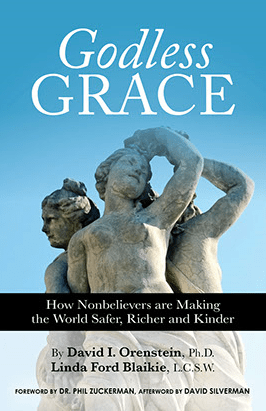
In their book “Godless Grace: How Nonbelievers are Making the World Safer, Richer and Kinder,” (see here) authors David I. Orenstein Ph.D. and Linda Ford Blaikie, L.C.S.W  reclaim the concept of grace from Christians. Grace, they say, cannot be bestowed by a god that after all does not exist. But that doesn’t mean that a purely human godless equivalent of grace is not a force for good in the world. The authors show that in fact grace does exist in the world and it is found in the good works of men and women who have no religious motivations. In the face of that reality, god becomes no more than a rain-dancer claiming credit for spring showers.

In this beautifully written love letter to secular altruists and do-gooders and sleeve-roller-uppers all around the world, Orenstein and Blaikie introduce us to dozens of actual people doing actual good works without any fear or promises from religion. These are not big name celebrity philanthropists, but regular folk from all around the world who are doing modest but important humanitarian work to benefit mankind. The authors did a magnificent job finding these unheralded pearls of humanity’s best. But they would be the first to modestly point out that their job was not all that difficult. There are far, far more “graceful” secular humanist folk than religious proponents would have us believe.

Beyond just identifying these great people, Orenstein and Blaikie help you to get to know them in easy yet pointed prose that make you feel not only that you know these people after only a mere page or two, but that you WANT to know these people. The authors were insightful in learning what motivates each one, non-religious motivations as varied as the people themselves, and are adept at effortlessly sharing those insights with the reader.

About these people overall, the authors conclude:

“… they see themselves as servants to and for humanity – people who do their good work not to please any gods, but to benefit all humans and other beings on the planet.”

Godless Grace is a splendidly crafted book that blends meticulous research and insightful observations into positive and inspiring tones that never sound mushy. It’s not too hot, nor too cold. Godless Grace is just right and you will feel better about your fellow humans and about the world after reading it. Godless Grace is exactly what the atheist/humanist movement needs at this stage. It doesn’t preach, it doesn’t debate, it doesn’t argue, it doesn’t play logic games. It simply shows us, in a positive and sincere way, just a bit of the good that real people do every day without god.

Indeterminism

FreeWill

Free-will and determinism are concepts that religious and non-religious thinkers alike love to debate about. Unfortunately both exist largely in the realm of fantasy and any discussion of these concepts only serves to strengthen religion and mysticism. We atheists should be very careful about when and how we discuss these concepts.

First let’s consider free-will. Regardless of any non-religious discussions one might like to engage in about free-will, this term has become inextricably synonymous with religion. It was popularized largely by theologians to counter the problem of evil in the world. How can a good god allow evil? Well he gave us free-will of course! Since the universe cares not, God alone can define good and evil and give us the magical ability to choose between them. Free-will unavoidably suggests something outside of science, something divine, bestowed by god to humans only. Any discussion about free-will is to enter into a logical discussion about an illogical construction.

In direct opposition to free-will is determinism. Although it comes in many varieties, determinism is essentially the idea that we actually have no free-will at all. Everything in the universe is determined by the laws of chemistry and physics. You could predict every feeling and thought you are experiencing right now if you calculated forward correctly from the Big Bang. You may think you have a choice about what you do next, but that’s an illusion. Your every movement, thought, and choice was predetermined when the cosmic cue ball broke the table and the universe was set into motion.

Such discussions about determinism, while stimulating, only ultimately encourage religious thinking. If the universe is deterministic then there can be no good or evil, right or wrong. Most people refuse to accept such a universe or the idea that we have no choice. After all, we all feel something we perceive as choices between right and wrong. So any discussion of determinism quickly sends most people flocking in droves to the religious side. Their reasoning and their emotional reaction to determinism may be arguably flawed, but that is the result nevertheless. Secular philosophers may think they can logic our way out of this recoil into the arms of religion, but their logic is insufficient for most people.

Part of the problem here is that free-will and determinism are both extreme conceptual constructs, like positive and negative infinity. On one extreme, there is no right or wrong or choice. On the other extreme, right and wrong are defined by god and choice is bestowed by him and everyone is wholly responsible for everything they do. If good and evil and defined clearly by god, there can be no room for “situationalism.”

But reality is the continuum between these theoretical extremes. We live in the grey regions of choice and responsibility. We certainly perceive that we have choices and that we make choices. So choice is real to us at least. And regardless of whether those choices are ultimately predetermined in some sense, we as individuals and collectively as a society have no alternative but to judge and to respond to the choices we make.

To resolve the apparent contradiction between living in a “clockwork” universe that can only operate according to the mechanics of its particular gears and coils, and our perception of choice, consider randomness. One might argue that in a predetermined universe there is no such thing as a truly random number. You could in theory predict every random number in advance if you knew the state of the universe at any point in time and understood all the rules of physics sufficiently. However, according to every practical test we could perform and every objective purpose to which we could apply them, random numbers are demonstrably random to us. It would be silly to base our technology on the idea that there are actually no random numbers. And it is equally silly to base our beliefs or our society on the notion that choice does not exist.

But we should also recognize that in the grey area we live in, choice and responsibility are mitigated by a large number of deterministic factors. We recognize that if you look far enough back everyone is a victim of deterministic influences. At the same time, we must acknowledge that everything is to some extent a choice as well. We have to draw a line somewhere to decide when and how to hold people accountable for their actions. The extent to which people actually have a choice and the extent to which we hold them accountable for their choices is a judgment mitigated by many factors. These factors include age, state of mind, delusion or drug influence, intentions, ignorance, upbringing, circumstance, coercion, whether this behavior is treatable, how dangerous it is, and whether it is likely to repeat.

Clearly it’s not practical to consider everyone an innocent victim of the big bang and hold no one accountable for their actions. We have to hold people accountable for their choices. But it’s just as impractical to fail to consider the many physiological and social factors that determine behavior and effectively give people little or no choice in their choices. As individuals we have to draw our own lines and as a society we have to draw a collective line with treatment and help on one side and prevention and punishment on the other. Understanding, however, can span the entire spectrum. It is not inconsistent to understand the determinants of choice and still punish those who make those choices.

For example, even a suicide bomber may ultimately have no real choice given the horrific situation that we have created in their country. If we had not bombed their home into the stone age and taken away every other course of action, they likely would never have strapped a bomb to their chest. We may actually be more responsible then them, and yet still we must prevent and punish their behavior. We can understand the causal factors that forced that behavior and to the extent that we can and change those conditions we should. Understanding that every decision is neither completely a choice nor completely excusable, is to live in the very messy real world lying somewhere between the theoretical extremes of free-will and determinism.


Deeply-Held Beliefs

Our society overall, and even we atheists, have largely bought a bill of goods sold to us by the religious community. It is the flimflam that deeply-held beliefs are more sincere, more legitimate, less crazy, and more irreproachable than any old “ordinary” beliefs. Often these are also marketed under the labels of sincere or cherished or even deeply-cherished™ beliefs.

We have all been manipulated into granting an undeserved level of respect and deference to beliefs when they are immunized by these adjectives. This deference is not only undeserved, but it excuses some of the most damaging practices by those espousing these deeply-held beliefs. We tend to push back on beliefs until someone proclaims that it is deeply-held, sincere, and cherished. Then suddenly it becomes taboo, insensitive, and disrespectful to criticize it. In fact, we often accept that such deeply-held beliefs should be exempted from or even protected by the law.

Well unless of course it’s a deeply-held, sincere, and cherished belief of Muslims. In that case it’s clearly crazy.

Take for instance the vehemence by which “deeply-held” beliefs are defended by Katie Geary from the Becket Fund for Religious Liberty (see here). According to Geary:

“Groups that insist on insulting others’ deeply cherished beliefs are the truly immature ones here. Little do they realize how juvenile they appear to the “fairy tale” believers they so ardently wish to cut down.”

That’s quite a dressing down, and this is only a small sample of her attack against any criticism of deeply-held beliefs. However, as the Humanists of Minnesota point out, it is often impossible to see any difference whatsoever between deeply-held beliefs and plain old bigotry (see here).

KimDavisIt was her deeply-held beliefs that inspired Kim Davis to refuse to grant marriage certificates to gay couples in defiance of the law. Just last week cherished beliefs led right-wing Conservative leader Kevin Swanson to publically call for the mass execution of gay people. Deeply-held beliefs resulted in the owners of Hobby Lobby claiming religious exemptions so that they are free to discriminate.

Likewise, deeply-held beliefs that abortion is murder led anti-abortion extremist Scott Roeder to shoot Dr. George Tiller in the head. It was sincere beliefs that prompted John Salvi to bomb a Planned Parenthood clinic killing two and wounding others.

These are just a few extreme examples but such incidents are hardly rare. We could go on and on citing examples of harmful actions motivated and justified by claiming they are in accordance with deeply-held beliefs.

These are extreme examples, but that does not make them irrelevant to all of those “harmless” deeply-held beliefs that we ought to respect. Quite the opposite, these only point out the danger of ever letting ourselves get taken down this path. Any time we give any special deference to more benign beliefs, we necessarily make it that much more difficult to criticize and curtail any belief no matter how destructive. In a world that is fundamentally based in fantasy, logic offers little assistance in drawing such lines. Our deference to innocent little deeply-held beliefs leads directly to carve-outs that condone and institutionalize bigotry, prejudice, and violations of civil rights.

We don’t accept the notion that racism or terrorism or homophobia are any more legitimate if these beliefs are claimed to be deeply-held, sincere, or cherished. Similarly we should not be bamboozled into accepting this same justification for the acceptance of or favoritism toward religious beliefs.

Pascal’s Folly

PascalsWagerYou’re probably familiar with Pascal’s Wager. It says that even if there is only an infinitesimally small possibility that god exists, the consequences of eternal reward or punishment far outweighs any earthly cost. Therefore, a smart person should “hedge their bets” and believe in god.

This is incredibly specious logic but it nevertheless holds powerful sway over a great many people. Lots of otherwise intelligent thinkers put it forth as a reasonable argument, even as an inescapable iron-clad rationale. But there are many flaws in it including the assumption that belief is a harmless hedge. In the end it is no more than a silly trick of logic that can equally justify anything whatsoever. By this logic, for example, the proposition you received via email from a Nigerian Prince might be legitimate. However small the chance that it’s real, isn’t it worth responding? In fact, the Nigerian Prince is far more likely to be real than is god. Such a prince could actually exist.

But you might reject that argument with yet more pseudo-logic. You might argue that only heaven is sufficient reward to offer compelling enough stakes to accept Pascal’s Wager. And I then counter by suggesting right here and now that you cannot get into heaven unless you give up ice cream. Regardless of how small the chance that god only favors those who prove their faith by forsaking ice cream, Pascal’s Wager demands you give it up. But I doubt you would accept that wager and actually swear off ice cream.

We reject most such nonsense out of hand. Here is yet one more flaw of Pascal’s Wager. We apply it only to one extremely specific assertion and reject an infinite number of others even though they are equally legitimate according to the logic put forth. You can counter yet again and say, well but I cannot play all possible lottery games, and I choose to play this one. Fair enough, so I can counter your counter. This logical fencing goes on and on unendingly without resolution. Playing mental games is something we humans do extremely well.

But why do we reject the same logic for pretty much anything else except the god proposition? We reject it because such logic is clearly stupid. And this brings us to yet another problem with Pascal’s Wager. There is actually in fact no possibility, none, nada, nil, zero, absolute zero, that god actually exists. Someone will in fact actually win the $100M lotto, so that might be worth a $2 ticket by Pascal’s logic. But no one can actually go to heaven because it does not exist. And you cannot claim “but it could” unless you really are equally willing to ACT ON every other impossible proposition.

This illustrates a fundamental problem with logic. As powerful and important as it is, logic has limitations. Thinking that abstract logic necessarily reflects reality can be like a Chinese Finger Trap. I just read an interesting book by Jordan Ellenberg called “How Not to be Wrong: The Power of Mathematical Thinking” (see here). I do recommend it highly. But in it he twice states emphatically that “reason cannot answer the question of god.” If that is true, then it is our reason that is flawed. And it’s easy to see how. Ellenberg is a mathematician. Even a mathematician can become too familiar and comfortable with mathematical concepts like infinity that have no actual basis in reality. Our minds can conceive of symbols and rules of logic that cannot exist in reality. God is one of those. Pascal’s Wager is one of those. It is a human conceptual model that leads to seemingly incontrovertible but nevertheless absurd conclusions.

To illustrate the problem of blindly accepting a “logical” argument without insisting upon testing that logic against reality, consider Zeno’s Paradox. In the 5th century Zeno gave us his famous paradox that says that since we cannot arrive at our destination without infinitely cutting the remaining distance in half, we can never actually arrive at it. The “logic” of this proposition has confounded thinkers ever since as it is extremely difficult to refute by the rules of logic. But a guy called Diogenes the Cynic disproved it by simply standing up and walking across the room.

We humans have an amazing capacity to imagine things outside physical reality and to conceptualize logical systems of rationality that are imperfect in describing that reality or that extend beyond physical boundaries. But we have to be careful that our own cleverness does not make us stupid. Get up and walk across the room. God does not exist and religion is not a harmless hedge.

Here’s the bottom line. If your system of logic leads you to the conclusion that god might exist or that you cannot ever reach the other side of the room, it’s because your system of logic is flawed or ever-extended or you just want it to be true. If your logic cannot disprove flying pigs or gods, you are not thereby proving that god might actually exist. You are merely encountering the limitations or failings of your logic.

And to my agnostic atheist friends who refuse to say with certainty that god does not exist, if you allow for any possibility that god might exist, you have essentially lost the argument. You have admitted that Pascal’s Wager is reasonable and that belief and religion are therefore reasonable. You may think you can logic your way out of that shifting maze, but that only leads to endless ridiculous arguments that mostly serve to give undue credibility to the ridiculous.

The False Security of our Wall

wwzPeople build walls of all kinds and trust in them for protection. But walls are defenses of last resort. If determined enemies reach your walls, you are probably already doomed. Your walls may repel the initial wave, they may block a host of arrows, but eventually they fall to sappers, they’re breached by catapults, or they’re simply overrun by sheer unrelenting numbers. Even the Great Wall of China did little to defend against the Huns who never ceased probing for gaps, weaknesses, and vulnerabilities. Nor did it offer protection against the Manchus who simply bribed their way through a major gateway. The seemingly insurmountable wall built in the movie World War Z to keep the world on the other side did little to protect civilization in the end.

Still, we continue to imagine that walls will protect us against most any threat. Many think a wall will protect them from the imagined threat of illegal immigration. Many think the walls of their gated community will protect them from the increasingly impoverished masses. Many think flood walls will protect their cities from the inexorable tides of rising oceans. Clearly they are all tragically mistaken. If Mexicans really wished to find ways into America, a wall would prove to be little more than an inconvenience. A gated community is not a self-contained biosphere and the poverty of the surrounding world will still have deadly impact on those barricaded within. And if we have not taken action to halt greenhouse gas emissions before the oceans rise to claim our coastal cities, our seawalls will prove to be no more than pathetic proof of our folly.

It is similar folly to imagine that our great Wall of Separation of Church and State truly protects secular society from the relentless incursions of religion. For every religious initiative it blocks, many more get through. This Wall, like any physical wall, cannot endure continual attacks without continual vigilance. And the reality is that its defenders are few and they get tired and need to rest while their attackers are endless and inexhaustible. If we naively hope to limit the harmful impact of religious delusion, to contain it harmlessly segregated outside the Wall, we are doomed to either suffer the slow death of a thousand religious slings and arrows or fall beneath an eventual catastrophic collapse.

This is not to say the Wall is not important. It is vitally important. But it is only a seat-belt that can limit injury but cannot address fundamental car safety. It is a pair of safety goggles that helps minimize some accidents but cannot hope to protect against unsafe lab practices. The Wall can shield us somewhat but if we rely solely upon it for our protection and safety, we cannot long survive.

Yet far too many secular leaders see protecting the Wall as a sufficient end goal of secularism. Even worse, they argue that it is not our place to dictate what goes on beyond that Wall. They imagine that as long as we have the Wall, secular and religious folk can coexist happily, separate but equal, on their respective sides.

This is folly. It is folly not only because religious people will never cease their efforts to breach the Wall – though they certainly will not. But moreover as long as we condone their ideas by giving them undue respect, as long as we give mass delusions any credibility or any benefit of any doubt, the believers conclude that their beliefs have as much legitimacy as our conclusions and they will understandably never be satisfied with anything less than a decisive voice in public policy decisions.

Consider the inevitable result of halting our secular outreach at the Wall. Religious people then have the relatively unchallenged freedom to exercise their delusions on their side. On their side they will continue to educate their children to believe fairy tales. They will continue to preach to the faithful to ignore science and reason. Some will continue to incite religious radicalism. These believers can then reach right through our mighty Wall at any time with their vote and their representatives are duty-bound to represent their religious views in public policy.

The only way to ensure a sane and stable society is to eliminate the need for any Wall. And the only way to do that is to evangelize science and fact-based thinking and stop showing undeserved respect or deference for religious or new age thinking. If we do that, if we venture outside the Wall and fight for a society where science and reason are taught to all and respected by all, religion simply fades away on its own. If we do not, if we trust in our Wall to protect our secular way of life and let religious thinking fester and grow, then we cower inside the false security of a death-trap.

It is naïve, even cravenly irresponsible, to set merely protecting the Wall as the boundary of our legitimate self-interest as a secular nation. No beliefs are benign and no beliefs are without wider consequences. They are all infections that compromise the rational capacity of the greater society. We must take the fight of reason and rationality directly to religious people. If we do not eventually eliminate the magical thinking that makes us require a Wall, and probably quite soon, then we will one day look around to find that it has been trampled to rubble under the march of believers.

The Damage Done by Dawkins

I am really, really frustrated by the spineless unwillingness of my fellow atheists to just say simply, clearly, and without qualification that god does not exist. Period. End of story. Not worth debating. Drop the mic.

Instead, most are agnostic atheists who have followed the misguided lead of Richard Dawkins. Like him, they feel incessantly compelled to show how reasonable they are by pointing out that “of course scientists cannot say for certain that god does not exist” or “we can only say that god probably does not exist.” Even rabid, angry atheist “firebrand” David Silverman appends his comments with the same expected declaration of reasonableness.

The British Humanist Association did a now famous series of bus ads which said “there’s probably no god” (see here). Organizer Ariane Sherine defended the use of the word “probably” by invoking Dawkins:

There’s another reason I’m keen on the “probably”: it means the slogan is more accurate, as even though there’s no scientific evidence at all for God’s existence, it’s also impossible to prove that God doesn’t exist (or that anything doesn’t). As Richard Dawkins states in The God Delusion, saying “there’s no God” is taking a “faith” position. He writes: “Atheists do not have faith; and reason alone could not propel one to total conviction that anything definitely does not exist”.

I do understand some of the motivations behind this. First and foremost we atheists over-compensate out of fear of being called dogmatic. And we are cowered into sissy-talk to avoid the criticism that we too rely upon faith in the end. Finally, we are buffaloed into believing that a good scientist must be “open-minded” (agnostic) about everything.

Look, whenever you need to judge the reasonableness of any statement regarding god, just substitute “Easter Bunny.” It is neither dogmatic nor an expression of faith to state with absolute certainty that the Easter Bunny does not exist. You are not a bad scientist if you dismiss the Easter Bunny hypothesis out of hand. Quite the opposite, a good scientist is not a gullible scientist and good science does not require the suspension of rational thinking. A good scientist does in fact reject fundamentally implausible propositions out of hand. A good scientist does not acknowledge any possibility that perpetual motion machines might exist or that one might be able to chemically change lead into gold or that god might exist.

Although Dawkins has done a huge amount of good, this is one place where his tremendous influence has greatly undermined the cause not only of atheists but of rational thought. It does not show reasonableness to entertain unreasonable ideas and it is not enlightened to give any measure of credulity to absurd propositions.

This idea that “we cannot know anything with absolute certainty” may make for a stimulating discussion in a Philosophy 101 class, but science is built upon the foundational bedrock that we can indeed know the cosmos with certainty. Might we actually be hooked up to The Matrix being fed a simulated reality while we lie in suspended animation in a huge alien complex? Maybe, and that’s actually more plausible than granting any shred of doubt as to whether god exists. But we do not feel coerced into acknowledging that the idea we are all sleeping in The Matrix is a real possibility. Maybe when The Matrix becomes our next religious mass delusion, Richard Dawkins will feel compelled to point out that he cannot be certain it is not true.

Many argue that expressing this uncertainty is merely intellectual honesty. However it is not insignificant that no one goes to such great lengths to append this caveat to other absurd propositions. I have never heard anyone take pains to point out that “of course we cannot be certain that suicide bombers will not be greeted by 77 virgins.” We apply this only to our own Christian god proposition. And that is because this is not a principled expression of general intellectual integrity. This is a matter of showing a particular undeserved deference to our own preferred delusion. Our exceptional application of this disclaimer gives it disproportionate weight and distinction.

This is not just an academic nitpick. Repeating the meaningless truism that we cannot know anything with certainty in the context of our belief in god is highly counterproductive. When you say it, most listeners only hear “even you atheists have doubt,” and “even Richard Dawkins acknowledges that we cannot know for sure that god does not exist,” and “even David Silverman admits that we could be right.” Christians turn this language back against us with great success. Most believers or even impressionable fence-sitters are not impressed by Richard Dawkins philosophical honesty. They’re more like Jim Carrey in Dumb and Dumber with Richard Dawkins playing the role of Mary Swanson.

chanceLloyd Christmas: What are the chances of a guy like you and a girl like me? One in a thousand?
Mary Swanson: Um, more like one in a million.
Lloyd Christmas: “So you’re telling there’s a chance then! YAAAY!!”

Mary should have simply said “no chance whatsoever – not gonna happen!” So come on atheists, stop being namby-pamby agnostics already. We can say with absolute certainty that pigs cannot fly and we can say with equal certainty that god does not exist. We can say this because there has never been any evidentiary proof of god when we should expect to see some, and there is no logical inference anyone can make based upon what we do observe to suggest he might exist in the way we might postulate a form of life on a distant planet or an evolutionary descendent in our far future.

I am an Absolute Atheist and proud of it. Does that make me arrogant? Well if it is arrogant to claim certainty that the Easter Bunny does not exist, call me arrogant. The day any legitimate evidence of an Easter Bunny is credibly reported, I’ll change my mind. Wait, I take that back. Even that qualification imparts way too much undeserved legitimacy to the beliefs of the Church of the Holy Easter Bunny.

The Language of Reason

reasonWe routinely use a large number of very similar words when we talk about thinking: rational, rationale, rationality, irrational, rationalize, rationalization, reason, reasonable, and even superrational. We all kinda-sorta mostly generally understand the nuanced differences between these words, but since they are so very important and so often confused, it may be helpful to put them all on the table where we can clearly compare and contrast them.

Rational describes thinking that is based upon true facts and sound logic. This is the good kind of thinking. It requires that the thinker is unbiased, fact-based, sane, logical, and as objectively correct as one can be given the best information available. Note that the threshold here is quite high. It is not enough to merely follow “my own logic” to reach a conclusion, but that one follow independently valid logic and adhere to independently validated facts. One cannot merely feel they are being rational; they must in fact be objectively, measurably, demonstrably rational. A certifiably crazy person may be absolutely convinced they are perfectly rational in concluding that aliens are beaming signals into their brain, but that does not make them so.

Rational thinking implies that one meets all these requirements in a particular line of thought. A rational thinker is one who generally employs rational thinking. Often this term implies that one consciously values rational thinking as well. Although religious thinkers insist upon being shown respect as rational thinkers, it is difficult to see how their claims in any way reach the threshold of rational thinking. They seek to dilute and diminish the term so that it applies to them.

The term rationality is generally used in the context of questioning one’s rationality. That is, when we wish to make an assessment of a person’s capacity to be rational, either generally or at a given time.

Superrational is a term coined by cognitive scientist Douglas Hofstadter to describe a cooperative group behavior in game theory. However like many scientific concepts it has been incorrectly hijacked by New Age types. They invoke it to suggest that there is some intuitive mode of thought that transcends normal rational thinking – which they then invoke to justify any magical thinking they wish. They might say, for example, I believe in psychic powers because I’m a superrational thinker.

The word reason is trickier. In its basic form it is inherently neutral with regard to truth or rationality. It simply describes the cause, explanation, or justification one uses to explain their conclusion or action. But we also use it more generally to describe our rational capacity. It is in this sense that it is used for example in the “Reason Rally.” It sounds better there than would the “Rationality Rally.” The word reason also has the benefit of invoking feelings of reasonable or reasonableness.

However the connection between reason and reasonable is also a problem. Reason shares the fairly high bar with rational. But to be reasonable only requires that one be fair, moderate, and sensible. That’s why the word reason is a dangerous one to substitute for rational. Using reason as a synonym for rational can lower the bar for rationality in the minds of many people who might like to claim that their “reasonable” beliefs are rational conclusions because they are reasonable. Reasonable people can agree to disagree. Rational people cannot disagree for very long.

And that is a great segue into the biggest source of confusion amongst these terms. Just as the word reasonable dilutes the word reason, the word rationalization dilutes the word rational. Even worse, it totally reverses it!

Although it seems like they should be different forms of the same word, rationalize is almost the complete opposite of rational. To rationalize is to contrive some rationale, some apparent logic, to make the illogical appear perfectly rational. It is to “rationalize away” facts, logic, and reason. It is the process of deluding one’s self into thinking that some possibly preposterous idea is sound and credible regardless of the facts of the matter. We rationally reach scientific conclusions, but we rationalize our religious beliefs to convince ourselves that we are rational thinkers. These are not remotely equivalent.

This is insidious because once we have rationalized something, it then seems completely rational to us. Once rationalized, we become certain that our thinking is perfectly sound and reasonable. And we have evolved to be incredibly good at rationalizing. From the evolutionary perspective it was evidently far more important that we feel certainty in the face of ambiguity or the unknown; that we reach harmonious consensus in a delusion, than that we know the real facts of the world. There is also evidence that belief served a benefit of requiring less energy consumption as well (see here). But belief is no longer a beneficial or even harmless adaptation in our modern world.

Despite the fact that it no longer serves us well, we as a species remain incredibly good at rationalizing. Clinically delusional people are often completely certain that their delusions are perfectly rational. But this isn’t just an affliction of the insane. Rationalization is our normal human brain function that we are all susceptible to. Once rationalized, we normally continue to believe any ridiculous belief without reevaluation. We don’t need to be beyond the threshold of insanity to hold some insane rationalizations.

The lesson then is to be very skeptical when anyone insists that their conclusions are rational – even when it is ourselves. Few of us can distinguish between our own truly rational positions and completely rationalized ones. Fortunately science gives us methods to help us assess whether our conclusions are fact-based and soundly logical.

Likewise, we don’t need to train our young thinkers to rationalize problems, as they are innately quite adept at that already. Education in debate, law, marketing, sales, religion and many other fields mostly enhance our innate ability to create any argument that convinces others – to rationalize. We need far more training in science and skeptical thinking so that we can  better judge whether the rationalizations that impact our lives are truly rational.

The Delusion Defense

In a previous article I made the case that all religious beliefs are delusions and should be called out as such (found here). I really do keep this view in perspective however and don’t actually feel particularly compelled to call out all my religious friends and associates as delusional at every opportunity. But I still maintain that it is absolutely necessary to do so without compunction when it comes to extremely delusional thinkers like Ken Ham (see here) who publically propagate a large number of very bizarre delusions.

Regardless of how accurate and justified it may be to characterize all religious beliefs as delusions, doing so is problematic simply because of the huge number of people who believe. If you call religious beliefs delusional, then all religious people are at least somewhat delusional. And that is most of us. And if believers are all delusional, that would produce profound ramifications in all manner of social and legal interactions.

In his book “Bad Faith” (found here), Paul Offit looks at the insane faith healing beliefs of Amish, Christian Scientists, and Jehovah’s Witnesses who feel compelled by their faith to commit murder through the withholding of medical care for their children and other loved ones. In a recent lecture I attended, Offit observed that our legal system essentially gives these families “one free murder” before the State is willing to characterize their beliefs as dangerous and harmful.

Sure they are clearly crazy. But non-religious people can be crazy too. Most normal religious beliefs are entirely reasonable.

Except it is not that simple.

In his book “Under the Banner of Heaven’ (found here), John Krakauer documents the insane history of Mormonism and the 40,000 Mormons who still believe much of it and practice polygamy. In particular, he documents the story of Ron and Dan Lafferty, Mormon brothers who felt compelled by their faith to commit multiple murders. The defense in that case argued for an insanity plea based largely upon the craziness of their religious beliefs.

Their defense argued that the delusional beliefs of the Lafferty brothers rose to the level of insanity and that their clients were therefore not fit to stand trial. However, psychiatrists for the State argued that their beliefs were essentially no different in any qualitative way from any other belief considered “normal.” (It could be argued that no person who believes in an afterlife truly understands the consequences of their actions.)

In his book “Thinking About the Insanity Defense” (found here), author Ellsworth Fersch lays out the fundamental problem in the Lafferty case:

“Their strategy was to show that he was sane through comparison with other individuals. First, they pointed out all the similarities between his fundamentalist religious beliefs and the religious beliefs of people with ordinary religious faiths. By doing so, they made his seemingly outlandish claims and ideas seem much more normal. For example, Dr. Gardner compared Ron Lafferty’s belief in reflector shields to belief in guardian angels. This strategy was effective because it forced anyone who was willing to consider whether he was insane to also consider the larger question of whether any religious person is insane.”

Belief ties sanity and delusion into an almost inescapable Gordian knot. To uphold an insanity defense would be to imply that all religious believers are similarly insane. That would never be acceptable. But to exempt religious beliefs would make it extremely difficult to ever characterize anyone as insane or make any value judgment about any belief. It would make it difficult to interfere with any dangerous behavior such as faith healing when it is claimed to be based upon a “deeply held belief.” That in fact serves the narrow self-interest of believers.

DelusionDefenseThese are extremely vexing conundrums even for psychologists.  They have been completely muddled over this all the way back to Freud who suggested that all religious beliefs are delusional and that religion is a mass-delusion. On the more diplomatic side of the argument is the definition established by the American Psychiatric Association (codified in DSM-IV) which says essentially that a belief is a delusion – well unless enough people believe it that is. Clearly if Freud is right, then that conclusion leads necessarily to widespread clinical, social, and legal ramifications. However, if the APA is correct, then sanity is completely contextual. What might be sane in one society or in one group or at one time in history may be completely delusional and result in institutionalization in another setting. Precisely how many believers must I recruit in order for my insane delusions to be considered sane and immunized from ridicule? The APA view creates significant social problems for all aspects of society.

In his paper “Faith or Delusion? At the Crossroads of Religion and Psychosis,” Joseph M. Pierre attempts to review the psychiatric literature in order to find a sensible middle ground. Pierre points out that:

“Neither Freud’s stance that all religious belief is delusional nor DSM-IV’s strategy of avoiding mention of religious thinking in discussions of psychosis is an acceptable way to resolve the ambiguity between normal religious belief and religious delusion.”

One might think this question should be resolvable by simply looking at other criteria to evaluate sanity, not merely the presence of religious beliefs. But Pierre goes on in his paper to review the body of psychiatric works that attempt to distinguish faith from delusion using a wide range of possible criteria. None of these attempts prove to be satisfactory. Since every belief is inherently not based on any objective facts, it is impossible to make qualitative distinctions between “normal” beliefs and “delusional” beliefs. Attempts to measure their impact by other indirect measures, such as excessive preoccupation, conviction, emotional valence, claims of universal validity, and level of contradiction all fail to provide a satisfactory distinction.

So the situation we are left with is that we are precluded from ever admitting that religious beliefs are delusional, even though the APA defines beliefs as delusions held by a sufficiently large number of people. Instead we are forced to make mostly arbitrary decisions about when to characterize a belief as a delusion. But I think I have a suggestion to help with this problem. It seems to me that much of this Gordian Knot is glued together by a presumption, a prejudice, and a conceit that says that sanity and insanity are exclusive binary conditions.

As I argue in my book (found here), we each have a myriad of ideas that could each be placed along a wide spectrum from sane to insane. If someone has a lot of delusional ideas a lot of the time, that person may cross the threshold of clinical insanity, but we all still do have some insane ideas some of the time.

If we would only stop applying to word delusional to people and instead start applying it with less reluctance to ideas, recognizing that we all have some delusional ideas some of the time, then I think we go a long way toward reaching the balance we need to respond to mass-delusional thinking in a more reasonable and consistent manner.

But I’m out of room for now. I’ll expand on this in a future article.