Category Archives: Education

The Multiverse is Bigger than God

MultiverseOur gods used to be gods of specific things; the sky, the sea, war, love. Then God took over and became the god of everything. But our understanding of “everything” keeps expanding, and as it does, our fanciful notion of God has to expand along with it to remain ever beyond the limits of mere science.

The visible horizon of our observable universe is 46.5 billion light years away in any direction. That is an immense distance, and this visible sphere around us contains about 100 billion galaxies, each with perhaps 100 billion stars. Our God of everything created all that too, presumably just for us to look at.

But wait, there’s more, much more. Today we understand that our universe is almost certainly unimaginably larger than that which we can observe. It is perhaps 100 billion trillion times larger than our observable universe. That makes what we can see just the tiniest mote of dust in our greater universe. In our observable universe we can look into the sky and at least see what happened in the distant past. We can not even see out into the darkness beyond that. But since it apparently exists, believers have no choice except to inflate God once more. God presumably created all that inaccessible space beyond the horizon as well, and just for us.

It gets better. Now we are beginning to understand that God apparently created an infinite multiverse just for us as well. I first recall being fascinated by the idea of multiple universes in 1966 when Mr. Spock met Captain Kirk’s evil counterpart from an alternate universe (see here). But just as Star Trek communicators became everyday reality, the science fiction of multiple universes has become legitimate science.

There are many forms that the multiverse may take, but for now let it suffice to think of an infinite number of universes just like ours, maybe isolated in pockets of space, maybe superimposed upon each other, maybe both. Their infinity extends through both time and space. This infinite multiverse is not static. In it (if the word “in” even applies to an infinite space) universes appear, grow old, and die. Each is born with a particular set of fundamental parameters. Only a relatively tiny (but still infinite) fraction have parameters in the “Goldilocks” range that allow organized structures. In a tiny fraction of those, life is possible. The rest are stillborn or survive for a short while as unsustainable regions of chaos.

How can it get more mind-blowing? Well it is an inescapable logical conclusion is that in an infinite multiverse everything that could possibly happen must happen. For example, there must be a universe in which every possible variation of our own exists, in fact there must be an infinite number of each possible variation – infinite numbers of each of us.

Whatever form it takes, we become even more insignificant within the time-space grandeur of the multiverse. So our notion of God must once again expand dramatically to exceed even the non-existent bounds of an already infinite multiverse in order to remain the unbounded God of all things. And of course God created that infinite multiverse, so far beyond our ability to grasp let alone interact with, just for we infinitesimal humans.

I talk about god here knowing full well that it is of course completely silly to do so. I might as well talk about the how our notion of Santa Claus must expand to encompass the belief that he has to deliver Christmas presents to all children in the multiverse on one night. Yet, unfortunately we do focus our attention on our fantasy of god whenever these cosmological discussions take place.

Some “religious scholars” try desperately to keep god relevant in the face of our growing awareness by arguing that in a multiverse in which all things are possible, god must exist somewhere. In an otherwise decent article author Mark Vernon (see here), perpetuates this fallacy by repeating that since “everything is possible somewhere … it would have to conclude that God exists in some universes.

This will certainly keep getting repeated but it is simply not a correct interpretation of the science to say that in a multiverse “everything is possible.” This is a perversion of the correct formulation which is “everything possible must happen.” These are completely different ideas. Any particular universe is still governed by its own physics and there is a limit to the possible physics of any given universe. Impossible things, like gods and ghosts, can not happen in any universe.

And even if some universe had some being approaching a god, it would still not be an omnipotent god of everything and it would certainly not be our god. Therefore I am not sure how claiming that a God exists in some other universe does anything but admit that one does not exist in our own.

So what is the most rational of the possible irrational responses for someone clinging to their belief in god in the face of a multiverse? The best would be simply to claim that god created the multiverse and not even try to invoke any pseudo-scientific arguments. As you always have, just keep expanding your definition of god to supersede whatever new boundaries science reveals.

But really, adding God to the multiverse is simply adding fake infinity on top of real infinity. Like infinity plus infinity, the extra infinity is entirely superfluous and unnecessary. And what does it add to place God beyond infinity? It only replaces the insistence that something had to create the multiverse with an acceptance that nothing had to create God. It’s silly, especially given the fact that our limited concept of “before” has little relevance in an infinite multiverse.

Better yet would be to finally give in and acknowledge that the multiverse has rendered your god small and insignificant and kind of pathetic. God is like a quaint old Vaudeville act that can no longer compete with huge 3-D superhero blockbusters, and looks silly trying. Back in the day, it might have been an understandable conceit to believe that God created the Earth just for us… or even maybe the solar system. But the level of conceit required to believe that some God created the entire multiverse just for us is wildly absurd. The idea that such a God would be focused on us is insanely narcissistic.

The multiverse forces God to grow SO large, that it swells him far beyond any relevance to us or us to him.

So abandon your increasingly simplistic idea of god and find comfort, wonder, and inspiration in our incredible multiverse. You do not need to feel increasingly insignificant and worthless in this expanding multiverse. You don’t need God to give you a phony feeling of significance and meaning within it. All it takes is the flip of a mental soft-switch and you can find comfort and wonder and meaning in our amazing multiverse. It’s all just in your head after all.

I do not share the pessimism of some that we can never “see” or understand the multiverse. My working assumption is that even the greater multiverse is our cosmos, that it is knowable. If we survive Climate Change, we may eventually understand it more fully through indirect observations or through the magical lens of mathematics. Until then, if you are intrigued and stimulated by these real possibilities, I highly recommend that you read the excellent overview article by Robert Lawrence Kuhn (see here).

The Day I Met Lucy Liu

LucyLiuSo speaking of celebrity encounters in NYC, one time I was waiting for a date in front of a restaurant near my apartment in lower Manhattan, when Lucy Liu walked up and stood next to me. She was waiting for someone as well and we exchanged pleasantries.

Oh wait… that never happened. In fact, once I impulsively related this story to a group of friends. As I did, I had a growing feeling of uneasiness as if something was wrong. Then one of my friends said, “hey that’s the story I told you!” It then hit me that I was remembering her experience. I was so mortified that I tried clumsily to cover up for my humiliation.

I had had the actual experience of waiting outside that same restaurant several times to meet dates. I had had actual experiences of encountering other celebrities in NYC. I was obviously familiar with Lucy Liu from television and movies. The presence of my friend who told me that story probably triggered a temporary conflation of all of these to produce a false memory.

How can this happen? Well it happens all the time but we are not usually made aware of it in such an embarrassing fashion. You see, we do not recall events like a tape recorder. Rather our memories are like notes scribbled along the margins of our brains, associated by proximity or by little arrows. When we try to retrieve a memory, we do not hit “replay,” rather we check our scribbled, fragmented notes and try to piece the events back together as best we can. Our memories are not recordings, but are rather more like docudramas that we recreate from scraps of information each time we invoke them.

These little docudrama memories are never recreated exactly. They are full of errors and omissions. Not only are they constructed incompletely, but they are colored by our biases, fears, hopes, and needs at the time we recreate them. Even worse, each time we recall them, our scribbled notes are updated with these changes and this modified version forms the basis of our next recollection. It’s like basing your documentary of JFK on a previous documentary. Our memories are like the message in a game of telephone, changing and morphing each time we invoke them. If my friend had not been present to point this out about Lucy Liu, I may well have further integrated her story more solidly into my own memories.

As marvelous as our memories are, these things happen. Anyone, like our President, who thinks they have “one of the great memories of all time” is simply not paying close enough attention. And it’s hard to question our very memories. After all, they form the basis of who we are and all we think we know. To question our memories is to question our own competence, our own sanity, and even the very foundation of our self identity.

Yet we must be skeptical of memories, particularly our own. Most of our memories are not as falsifiable as a misremembered encounter with Lucy Liu. There is no one to call us out of most of the memories that form our experiences and define us as who we are. Most of our memory glitches aren’t exposed on a witness stand. We recall certain things about how our parents treated us but not other things. We recall a friend insulting us when it was actually a comment made on a television show. We clearly recall a pivotal experience in our life that was in fact only a recurring dream.

I noticed that when I gave lectures, I told an abbreviated story that was a composite of a number of other stories, just to illustrate a point. Before too long I could no longer recall the individual stories but only the abbreviated composite. Each time we retell a story, that replaces our old memories and our memories change and morph over time.

You can experiment on yourself to test my claims. Just start telling some story about yourself – make it somewhat plausible. I guarantee that before too long you’ll have trouble recalling that you made this up. Before much longer, and you’ll become absolutely certain it is completely true. You remember it clearly after all, so it must be. That’s how your neural network works. You cut you bleed. You repeat experiences through stories or dreams or whatever, and they become memories. They become your self.

Even more important than recalling events is the problem of remembering feelings. Our recollection of feelings is extremely malleable. We can quickly grow to hate a dear friend or spouse largely because we retell stories over and over again that gradually deteriorate into a “powerful, unforgettable recollection” of how terribly we have been treated in the past. If we are disposed to think badly of someone, all our memories will be colored by that lens. Perhaps, a good indicator of the person we are now is the tone we impart upon the docudramas we recreate to recall events and how those events made us feel.

In fact, studies have suggested that having a “great memory” makes you less happy. People with so-called great memories tend to never let go of any slight or insult. They only get angrier and more unhappy as time goes on. I submit that their memories are not actually that great and that they likely have a tendency to create a more unforgivably offensive version of their memory each time they recall it.

Lucy Liu reminds me that a little humility when it comes to the fallibility of our own memories is a good thing. Maybe it would make Donald Trump a less angry and spiteful person if he were not quite so confident that he has “one of the great memories of all time.” Or, maybe angry and spiteful people just cannot help but create memories that reinforce their anger and spitefulness.


Data Management Primer

data_analysisI spent the better part of 40 years working with data. As a scientific researcher and then as a software developer, my work was all about acquiring, managing, analyzing, and reporting data. That experience taught me lots of lessons. I shared many of those lessons by teaching database design and development at the college level and by writing books on the topic.

Chances are that as a professional in the information age, you do a lot of work with data as well. Here’s the most important thing to know right off… this doesn’t come naturally. Collecting and storing data properly is deceptively difficult. I know because as a software consultant I was called in to fix innumerable systems that were failing catastrophically because they were grown organically by clever, smart people using spreadsheets with complete confidence they were doing a great job.

Even good data gets ruined if it is badly stored.  This applies to small projects as much as large ones. Poorly stored data becomes the “garbage in” for your subsequent analyses and reports. Therefore I thought I would share a brief summary of some of the most important “do’s and don’ts” when I comes to collecting and storing your data. I won’t try to explain or justify all of these rules, but trust me, if you follow them your work will be far more efficient and effective:

  1.  Always create a key field. This field should uniquely identify each record. I recommend you identify each record with a simple incrementing number, one that has no real-word meaning and that you never report to external users of the data.
  2. Don’t create derived fields. It is generally not good practice to store fields of data that are derived or calculated from other fields. It is better to compute these when needed to ensure the values are current.
  3. Make sure every column or field of data is atomic. That is, each field value should contain only one irreducible piece of information. You never want to put say, two phone numbers in one field. Store only one piece of information per field by creating separate columns if necessary.
  4. Think ahead carefully about how atomic a field needs to be.  Will I need to break up phone numbers into separate parts? You have to consider how the data will likely be used and the best choice is still not always obvious. Do you ever need to know the street name in an address? If so, you might consider storing the house number and street in separate fields as this is extremely difficult to parse. Will you need the month from a date? You probably still don’t need to store that separately since it is extremely easy to extract months from dates when needed.
  5. Avoid series of columns. You don’t want Phone1, Phone2, and Phone3 fields. Better to have a separate “phone numbers” table with a record for each phone number along with the type of phone linked through a key field. A relational table like this is much more flexible, efficient, maintainable, and expandable.
  6. Don’t stick data where it doesn’t belong. When you don’t have a column, it is tempting to just jam some values into a column where they do not really belong. For example, you have a pregnancy field that does not apply to men. So why not stick prostate indicator into this column in records for males? This is a major no no. Every value in a column should describe only one attribute.
  7. Don’t append or prepend. Always avoid appending or prepending data values to add further information. For example, adding “fax” or “mobile” after phone numbers. Instead add a separate phone type column or better yet create a separate relational table to store these values.
  8. Don’t vary record types in a given table. You can have a column that indicates whether the record is a Parent or Child, but you should not then change the meaning of subsequent fields depending on whether the record belongs to a parent or a child. If parents and children require different information, create separate tables.
  9. Never use “special” values. Never put in a reserved value like “NONE” or “1/1/1999” “to indicate some special condition. This is a very bad practice that inevitably results in errors, hair-pulling, and tooth-grinding.
  10. Give your columns clear and meaningful names. Don’t use cryptic names. If the column contains first names, simply call the column “First Name.” This makes it completely unambiguous, reduces errors in analysis, and makes reporting clear, consistent, and easy
  11.  Format your data consistently. For example, store SSN with hyphens or without as you prefer, but don’t mix these. With hyphens is preferable since it is best to store data so that it does not require formatting upon reporting.
  12. Use Null and Empty values correctly. -Assuming your data storage system supports these, use them correctly. Null means that value was never entered. Empty means it was entered, and it was explicitly entered as empty.
  13. Allow Null and Empty responses on your forms. Forcing users to put in an answer they don’t know yet just to save the form only opens the door to garbage data. If you force an answer too early, you may be forcing the user to make something up just to move on, and later there is no way to spot this as “fake” data. Better to wait until the last possible point prior to finalization before verifying that all data entry is complete.
  14. Don’t allow bad values to be entered. Provide dropdown or selection lists wherever possible rather than text data entry. Text (freeform) data values are usually garbage data values that are very problematic to search, analyze, and report.
  15. Don’t duplicate any information. No information should be repeated in rows. For example, you should have one parent table with customers and another child table with orders records for each customer. You should not have one “flat” table which repeats the same customer information on every order record for that customer. This is one key difference between simple “flat table” data storage and a normalized relational database.
  16. Break the rules when needed. The only thing worse than not following these rules is mindlessly following them. Break these rules only when it makes good sense to break them. You can’t make that assessment if you do not understand them, and the reasons for them, intimately.
  17. Think long-term. Don’t assume you’ll never need your data again or that you will be the only one to ever look at it. You may know how you violated these rules, but others might need to understand this data in the future and they will not. Following these rules will ensure that this valuable data you collected is not wasted just because you could not anticipate how they might be used in the future.

Some of these rules simply cannot be achieved using a single (denormalized) table like you typically create with Excel. They require multiple tables following a normalized design structure of parent and child tables.

If you don’t see any way you can avoid breaking these rules, then your data storage requirements probably exceed the limitations of a simple table. If that is the case, the fact that you cannot implement these rules should alert you that you need to consult a data management professional to produce an efficient relational database schema using SQL Server or some other professional database.

Compartmentalizing Delusion

CompartmentsReligious people hold a lot of beliefs that nonbelievers conclude are delusional (see here). Many of these believers also hold important positions of responsibility in the government, in the media, and business. Some of them even sit on our Congressional Science Committee. Their decisions deeply impact public policy and the very existence of us and of our planet.

Those most fervent in their beliefs proudly tout the fact that their deeply held religious beliefs guide and influence all of their decisions as a lawmaker. But when someone points out that those deeply held religious beliefs are in direct conflict and contradiction to basic reason and accepted public policy, they then typically claim compartmentalization.

Essentially the contradictory claim they make is that while they affirm that they are deeply influenced by nonsensical ideas, those nonsensical ideas do not influence their thinking in rational matters. They insist that they can wail over rapture on Sunday and make prudent, long-term budget decisions on Monday. They can enumerate why evolution is a hoax cooked up by scientists at Wednesday evening Bible study, then properly assess the advise of climate change scientists in their Thursday morning advisory board meeting. They can affirm that the Bible is the only source of truth on Saturday morning, then go home and work on educational text book selections all afternoon. They assert that one is not affected by the other in the least – except when they want to tout the fact that it is.

Their amazingly selective isolation of thinking, they claim, is all thanks to the magic of compartmentalization. It lets them espouse crazy beliefs and claim to be perfectly sane and rational too. This claim is made so often and with such matter-of-fact certainty, that most people just tend to accept it as true.

But let’s examine this claim of compartmentalization more closely.

All of us compartmentalize somewhat. In fact, such compartmentalization is critical to our functioning. We mentally separate work and home, parent and spouse, private and public. When we think of scientific models, we hold two seemingly different views at the same time (see here). Compartmentalization is an essential rational and emotional adaptation. Maybe that’s partly why we accept their claim of exceptional compartmentalization so easily.

But all normal and highly functional behaviors can become abnormal and dysfunctional at some point. At the extreme, we see people with multiple personalities that are split so completely that they are not even aware of each other. And although some extremely rare individuals can apparently completely isolate their thinking, most of us cannot. For most of us, any irrational, dysfunctional thinking does spill over and taints our rational thinking.

We humans can do hand-stands too. When I was in high school, there were a couple of guys on my gymnastic team who could literally walk up and down stairs between classes, in a crowd at full speed, on their hands with perfect form. But because those rare individuals could do it doesn’t mean we can all claim it. Just because Jimmy Carter seemed to isolate his religious belief from his rational thinking in a healthy way, doesn’t mean that many of us can do that. Jimmy Carter was more like the gymnast who could walk up and down stairs on his hands. Most others who believe they can isolate belief from rationality will invariably plummet down the stairs, taking innumerable others crashing down with them.

As I point out in my book, Belief in Science and the Science of Belief (see here), religious belief is the pot smoking of rational thought. Every pot smoker or alcoholic is convinced that they can handle it. That their rational thinking is not affected. They think what they are expounding while high is really profound, but it’s really just nonsensical gibberish. Religious people can’t see how ridiculous they sound while they’re high on the Bible and only listening to others who are just as stoned.

We don’t easily accept this same claim of compartmentalization in any area other than religion. We don’t fully accept that ones stressful job as a homicide cop has no affect on their home life. We would not accept the assertion by a racist that while he may attend Klan meetings on Friday nights, this has no impact on his professional behavior as a hiring manager. Most of us would be at least skeptical in accepting any opinion expressed by a Wiccan who claimed to have supernatural powers, despite any claim of compartmentalization.

Even religious people don’t accept any compartmentalization except the one they claim. If I ran for public office as an atheist, I don’t have any illusions that my claim that I can compartmentalize my atheism would be sufficient to convince any religious people to trust that my judgement has not been tainted by my atheism.

Religious thinkers claim compartmentalization to avoid legitimate skepticism regarding their compromised rationality. Sadly, we accept this claim for the most part. We should stop giving them this free pass. Not only can such fervent “deeply held” delusions not be sufficiently compartmentalized, but believers don’t really want or intend to compartmentalize away their beliefs in any case.

Religious people want and need to propagate their beliefs and weave them inextricably into public policy. Our polite acceptance of their dubious claim of compartmentalization only helps enable them to do that.


Taking Stock-Well

john-stockwellSome of us are lucky enough, or unlucky enough, to stumble into a pivotal event in our lives that reshapes us, blows our minds, opens our eyes, changes our perspective, forever and irrevocably. I stumbled into mine back in college in the 1980’s when I blundered into a lecture by former CIA bureau chief Major John Stockwell (see here). I walked into the event as a relatively naïve and oblivious college kid, and walked out a stunned and shell-shocked cynic with regard to official motivations and storylines. Never again could I accept any official news story without some degree of skepticism and doubt, or for that matter dismiss any “conspiracy theory” out of hand simply because it questioned the official narrative.

Stockwell walked the audience through his recruitment as a young CIA officer in Vietnam and his rapid rise through the ranks, eventually attaining one of the highest positions in the bureau. He told how, during his career, he was repeatedly asked to perform actions that seemed not only immoral but counterproductive. Each time that he asked for some rationale to justify the actions requested of him, his superiors would tell him “if you only knew what we know you’d understand why this is necessary.” He believed that line, over and over, because he had to. Working under that assurance, he was personally aware of or responsible for operations to bomb infrastructure in other nations, disrupt business transactions to destabilize economies,  plant rumors to spread discord in legitimate governments, assassinate key leaders, and foment war. He detailed one of his most shameful accomplishments, how he personally orchestrated his totally contrived build up to the otherwise improbable war in Angola.

His own moment of realization finally came when reached one of the highest levels in the bureau, the level of a world chief. When he got close to the pinnacle of his career ladder, it became obvious that there was no actual reason, no secret justification, for the terrible things he did. It was painful to watch him in the lecture, almost vomiting out his pained confession like an act of penance. In a period of despair, he met for drinks with the few other world chiefs at his peer level in the CIA. They asked each other for just one example of anything they had ever done that was good for the world. None of them could justify even one thing.

That was when he “came out” and wrote his exposé “In Search of Enemies” which the CIA litigated and suppressed for many years. For most of my life it was essentially impossible to find, but I see that it is now finally available on Amazon (see here). In it, Stockwell answers the question “if they CIA accomplishes nothing, why do they do what they do?” His analysis is that the CIA is a bureaucracy that was formed to gather intelligence and take covert action during a time of war. Post-war, they have had to justify their continued existence and their obscene undisclosed budget. How do they prove their worth? They can only do this by finding enemies of the State. They are constantly “In Search of Enemies.” And since they cannot find enough enemies, they create them. They manufacture enemies so that they can then expand operations to combat them. In this way, their self-justification and self-preservation synergizes with an industrial-military complex in which the rich profit from every new or expanded conflict and war.

Stockwell spoke about the “tricks” the CIA uses to destabilize governments, ruin economies, and foment war. One of the most reliable excuses was the old “Russian Arms!” ploy. They would plant and then brilliantly discover Russian arms in a country. They would go back and report this to Kissinger of this who would then order a modest increase in their activities in that nation to counter “Russian Aggression.” It was always an increase. The Russians would see these increased activities (the CIA in fact ensured that they would) and counter, which the CIA would then report back to Kissinger to obtain the go-ahead for even further escalation… And so it goes, the game is repeated over and over and replicated all across the globe.

Unsurprisingly, his obviously heartfelt and first-hand account was NOT well-received by that college audience. They asked very tough and skeptical and even hostile questions. This is natural. No one wants to admit even to themselves that they live in a nation that does terrible things. No one wants to admit that they, by virtue of citizenship, are partially responsible and culpable for those terrible things. So we reject everything. To admit anything is to open the door on all of it. So we simply don’t want to hear it, we dismiss it all as conspiracy theory, we call it hating America and unpatriotic, we excuse it as unfortunate but necessary, we claim “they do it too.” Worst perhaps are those that tell themselves that by being avid readers of the New York Times, they would have been informed if there was anything to this stuff.

But for my part, after Stockwell’s lecture I never again accepted news reports of government accounts with the same level of trust I had earlier. When Ronald Reagan inexplicably invaded Granada, he got on television and fended off questions from the press by assuring them “If only you knew what I know.” That didn’t quite satisfy the press because they continued to ask tough questions. The next night he came out and announced that “Russian arms have been found in Granada,” and suddenly most of the press corps said, oh ok then.

When the first Iraq war came along I was similarly skeptical, but had no alternate theory of the action. I had maintained some personal contact with John Stockwell since that lecture and spoke to him occasionally. So I gave him a phone call and asked for his take on the war. He shared that Bush Senior had used back channels to assure Saddam that the US would not interfere if Iraq took action against Kuwait for their slant drilling into their oil fields. This was just a set-up by Bush who needed a war partially to boost his historically low ratings. This was later confirmed to be largely if not completely true by many corroborating reports.

When Bush Junior initiated the second Iraq war, my Stockman-esque skepticism resurged. Bush put forth – by one accounting – over 40 discrete falsehoods to lie us into that war (see here). When Bush first announced that Iraq was seeking “aluminum tubes” to refine uranium for a nuclear bomb I did an immediate Internet search and found a large number of credible experts already shouting that these tubes were not the type that would be needed for that purpose. Yet the Bush Administration kept citing this false “evidence” and the media kept reporting it, the whole while scoffing at “conspiracy theories” that called this evidence into question. It was almost a year later, after the war was inextricably committed, and after the truth about these tubes was everywhere to be seen except in the mainstream press, that they finally “broke” this revelation with their crack and bold investigative reporting.

And now today we are still hearing stories about why we must – regrettably – launch attacks against a large number of countries. We just launched missiles into Syria. One has to at least wonder if “Chemical Attack!” is the new “Russian Arms!” ploy. It works every time. And overt attacks such as this are only a very small part of our effort to ensure that there are plenty of permanent wars to feed the insatiable machine.

Look, I’m not asking you to believe every seemingly crazy story out there – you shouldn’t. But a healthy skeptic questions both sides – including what their government tells them. If you are only skeptical of the alternative view, then you are NOT a healthy skeptic, you are a Kool-Aid drinker. In fact, I argue that it is better to err on the side of skepticism of our self-perpetuating war-making machine, and force them to provide extreme evidence for their operations, rather than continuing to drink the official Kool-Aid and placing rigorous burdens of proof only on the whistle-blowers while the government merely has to appeal to their own authority as proof of their claims.

This alternate perspective used to be terribly hard to research, but today it is easy. Stockwell was hardly a lone voice but he was one of the bravest and most credentialed voices. Heck, in his 1989 lecture, Stockwell referenced over 120 books out of the thousands available at that time. Today there are innumerably more. So there is no longer any excuse for ignorance and the only ignorance possible is willful. You can start with this YouTube video of John Stockwell speaking at American University, broadcast on C-SPAN in 1989 (see here). It is still relevant today. The lecture part takes up the first hour and the remainder is questions. That hour only scratches the surface exposing the filthy and disgusting rats nest that is American Intelligence.

I urge you to give this video a fair look and consider it in the light of today’s current events. Hey, it’s only an hour and I know you find way more time than that to browse adorable cat videos. Be brave and crack the door open and peek inside. The truth will not destroy you, it will set you free. Becoming aware of and acknowledging the extent of our intelligence operations will not fix anything in and of itself, but we certainly can’t begin to fix anything until we are all willing to take that first crucial step.


Anecdotal Evidence Shows

The titular phrase “anecdotal evidence shows that…” is very familiar to us – with good reason. Not only is it very commonly used, but it is subject to a great deal of misuse. It generally makes an assertion that something is probably true because there is some observed evidence to support it. While that evidence does not rise to the level of proof, it does at least create some factual basis for wishful thinking.

Anecdotal evidence is important. It is often the only evidence we can obtain. In many areas, scientists cannot practically conduct a formal study, or it would be ethically wrong to do so. It may simply be an area of study that no one is willing to fund. Therefore, even scientists often have no alternative but to base conclusions upon the best anecdotal data they have.

Anecdotal evidence is essential to making everyday decisions as well. We don’t normally conduct formal studies to see if our friend Julie is a thief. But if ear rings disappear each time she visits, we have enough anecdotal evidence to at least watch her closely. Likewise, even court proceedings must often rely upon anecdotal evidence, which is slightly different than circumstantial evidence.

Knowing when anecdotal evidence is telling, when it is simply a rationalization for wishful thinking, and when it is the basis for an outright con job is not always easy. The fact that sometimes all we have to work with is anecdotal evidence makes it all that much more dangerous and subject to misuse and abuse.

All too often, anecdotal evidence is simply poor evidence. I once presented anecdotal evidence of ghosts by relating a harrowing close encounter that I had. The thing was, I totally made it up (see here). People don’t always intentionally lie when they share an anecdote, but those people who in good faith repeated my story to others were nevertheless sharing bad anecdotal information.

Testimonials are a form of anecdotal claim. Back in the 1800’s a Snake Oil Salesman would trot out an accomplice to support his claims of a miracle cure. Today we see everyone from television preachers to herbal medicine companies use the same technique of providing anecdotal evidence through testimonials. Most of these claims are no more legitimate than my ghost story.

We also see anecdote by testimony performed almost daily in political theatre. The President points to the crowd to identify a person who has benefitted greatly from his policies. In Congressional hearings, supposedly wronged parties are trotted out to give testimony about how badly they were harmed by the actions of the targeted party. Both of these individuals are put forth as typical examples yet they may be exceedingly unusual.

So here’s the situation. We need anecdotal evidence as it is often all we have to work with to make important decisions that must be made. However, basing decisions on anecdotal information is also fraught with risk and uncertainty. How do we make the wisest use of the anecdotal information that we must rely upon?

First, consider the source and the motive of the anecdote. If the motive is to try to persuade you to do something, to support something, to accept something, or to part with your cash, be particularly suspect of anecdotal claims or testimonials. One great example are the Deal Dash commercials. You hear a woman claim that she “won” a large screen television for only $49. Sounds great, until you realize that the anecdote doesn’t tell how many bids she purchased to get it for $49, how much she wasted on other failed auctions, and how much was spent in total by the hundreds of people bidding on that item. Anecdotal evidence are not always an outright lies, but they can still tell huge lies by omission and by cherry-picking.

Second, consider the plausibility of the anecdote. If the anecdote claims to prove that ghosts exist, someone made it up. Likewise with god or miracles or angels or Big Foot. Just because someone reports something incredible, no matter how credible that person may be, demand credible evidence. As Carl Sagan pointed out, “extraordinary claims require extraordinary evidence.”

Third, consider the scope of the anecdotal claim. Does it make sweeping generalizations or is it very limited in scope? If the claim is that all Mexicans are rapists because one Mexican was arrested for rape, we end up with a Fallacy of Extrapolation which is often the result of the misuse of anecdotal information.

Finally, consider the cost/benefit of the response to the anecdotal claim. If the anecdote is that eating yoghurt cured Sam’s cancer, then maybe it’s reasonable to eat more yoghurt. But if the anecdote is that Ed cured his cancer by ceasing all treatments, then perhaps that should be considered a far more risky anecdote to act upon.

Anecdotal information is essential. Many diseases such as AIDS have been uncovered by paying attention to one “anecdotal” case report. In fact, many of the important breakthroughs in science have only been possible because a keen-eyed scientist followed up on what everyone else dismissed as merely anecdotal or anomalous data.

Anecdotes are best used to simply make the claim that something may be possible, but without any claims as to how likely it is. For example, it may be that a second blow to the head has seemed to cure amnesia. However, this cannot be studied clinically and it is not likely to occur often enough to recommend it as a treatment. Still, sometimes it is extremely important to know that something has been thought to happen, no matter how uncertain and infrequent. If a severe blow to the head MAY have cured amnesia at least once, this can help to inform further research into it.

Don’t start feeling overwhelmed. We don’t actually need to stop and consciously analyze every anecdote in detail. Our subconscious pattern-recognition machines are quite capable of performing these fuzzy assessments for us. We only need to be sure to consciously internalize these general program parameters into our pattern recognition machines so that they produce sound conclusions when presented with claims that “anecdotal evidence shows.”


Aborting the Lies

Is it any surprise that there are many more fake pro-life “abortion clinics” than there are actual abortion clinics? Is it any surprise that if you try to Google anything related to abortion services, you will get many, many more hits for fake pro-life Trojan-Horse sites than actual legitimate abortion service sites?

Frankly this should come as no surprise to anyone. This is what these fanatical pro-life activists do. As documented in the excellent HBO film “12th and Delaware” (see here) and others, Christians set up fake abortion clinics to lure in distressed, vulnerable pregnant women under false pretenses. Like any good confidence operation, they are warm and welcoming and sprinkle in as many facts as they can so that they can manipulate these women.

However, once lured into these “abortion counseling services,” the women find that the pressure on them will build and build, becoming more manipulative as these pro-life fanatics try to persuade or coerce or even trick the woman into delivering her baby. This manipulation is not merely limited to appeals to emotion, but includes many outright distortions and lies. One such tactic is to intentionally under-report the gestational age of the baby to make the client believe she has much more time than she actually has to perform the abortion. They outright lie to trick the women into delaying their abortion until it is too late. In fact, they feel justified to lie about anything and everything necessary to “save” the baby.

Clinics and web sites make the women watch “informational videos” to help in this coercion. Many are produced by an infamous anti-abortion doctor named Dr. Anthony Levitano. He has one such propaganda video on medical abortion (see here), which is an extremely safe and effective procedure. I encourage you to watch this because it provides a great crash course in how to manipulate others and what to watch for to avoid being manipulated. It starts out for the first minute or so as a fairly straight-forward description of medical abortion. The manipulation kicks in by pointing out that the medical abortion can be “reversed.” This is factually inaccurate, but pro-life advocates like to say it anyway to plant the seed of doubt – the doubt that many women “come to their senses” too late to save their baby.

At about a 90 seconds in, the video starts to turn palpably darker, emphasizing ominous words like “severe” and “heavy” and introducing phrases intended to appeal to emotion like “force the dead baby out.” Notice that they intentionally call it a baby, not a fetus or embryo, because they use every possible ploy to make the mother feel emotionally connected. After that, Levitano proceeds to up the temperature by warning that the process can be “very intense and painful.” From there it gets quickly worse, gratuitously pointing out that the woman could “loose her baby” at any time, then following up with images of a woman on a toilet “expelling her baby down the toilet which she will then flush.” The repulsive imagery that Levitano fully intends to invoke is masked under a transparently thin veil of clinical detachment.

And this is only half-way through the thing! The video goes on to repulse the viewer with increasingly horrific and increasingly blatant appeals to fear, guilt, and revulsion. He points out, for example, how [if the woman were to sift through the tissue in the toilet] she might be able to detect fingers and toes. Levitano claims that 1% of women require hospitalization after a medical abortion, but this is at least a hundred-fold exaggeration and in the extremely rare case when there is hospitalization, it is rarely serious or even the result of the abortion drug. Levitano closes his manipulation by sharing his own personal realization that “all abortions are wrong.”

Let me be perfectly clear. This is factual and emotional manipulation with no tactic too subtle or too blatant. Whatever true facts are presented are only included to establish enough credibility to sell the big lies and manipulations to come. It is sad that so many women fall prey to this kind of hateful and harmful manipulation dressed up and rationalized as Christian morality and charity. Whether they are in front of abortion clinics or hosting their Trojan-Horse web sites, in their minds no tactic is out of bounds, no lie is a lie to them if it advances their cause.

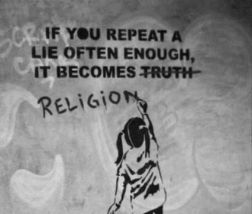
liesBut this should come as no surprise. After all, all of religion is nothing but selling lies. It can be nothing else because it has nothing but lies to offer. Scriptures, angels, salvation, afterlife, god, devils… its all lies and Christians spend all their energy believing or convincing others to believe these lies. Is it any wonder then that Christians should have no trouble believing and spreading lies about abortion as well? Religion is not benign. Becoming comfortable rationalizing religious nonsense directly impacts our capacity to rationalize equally crazy thinking in consequential matters like abortion.

And as with religious fantasy, it is immaterial whether they sincerely, devoutly, fervently believe the nonsense they spread about abortion or how selfless their intentions might be. Their lies, deceits, manipulations, misinformation, and misguided efforts do great harm to a great many people regardless of their motivation – harm to the women directly affected as well as to the men and families in their lives.

If you are seeking an abortion, ask the clinic early and directly if they provide abortions on their premises. If you do not receive a clear and unambiguous yes, hang up. Ask again the minute you walk in the door. If they begin to use any of these tactics on you, leave immediately because their only goal is to do whatever it takes to prevent you from obtaining a legal and safe abortion.


Ethical Fallacies

A fallacy is a mistaken belief, particularly those based on invalid arguments. There are many general forms that fallacious arguments take, and they are almost always an indicator of faulty reasoning, incorrect conclusions, and even outright manipulation. Familiar examples of these include the Straw Man, Appeal to Authority, Ad Hominem, Circular Reasoning, and False Choice. If you learn to recognize the general patterns of fallacious logic, you can see through disingenuous or manipulative arguments far more quickly and clearly. I discuss these and many other logical fallacies in my book “Belief in Science and the Science of Belief (see here).

But in addition to logical fallacies, I’d like to suggest that there is also such a thing as ethical fallacies that we encounter just as often. In fact, in this 2016 election cycle we have been ceaselessly deluged by ethical fallacies. Note that it is with deliberate intent that I speak of ethical fallacies and not moral fallacies. Morality is itself a form of ethical fallacy. For a discussion of the difference, see here.

The reason I make that distinction is because moral thinking is typically based on ethical fallacies including “Appeal to the Bible.” Note that a related and no less dogmatic form of ethical fallacy is “Appeal to the Constitution.” In fact, many of the same people who would like to bind us to their interpretation of the Bible would also like to turn the Constitution into another Bible, binding even secular individuals to their particular religiously-based interpretation of yet another literal and unassailable scripture.

Two related ethical fallacies are “Appeal to the Majority” and “Appeal to Individual Rights.” Sometimes these are valid arguments, but often they are not. When some argue that “a majority of Americans support the death penalty,” that does not constitute a valid ethical argument. Likewise when some argue that we should not restrict any gun sales because it is an individual right, clearly this is insufficient ethical justification. Politicians and advocates often similarly appeal to Federal versus State Rights inconsistently and arbitrarily when it serves their narrow interests.

Another set of ethical arguments that are often invoked are fallacies of “Time and Space.” Just because something may have been accepted or considered ethical in Biblical times or even in Revolutionary War days, does not mean it is ethical today. And just because something may be ethical in one place, does not ensure that it is ethical in another. Note that religious people have great trouble with this concept. It is too complicated and messy for them. It requires too much thought. They disparagingly call this kind of ethical thinking “situational” and therefore immoral. They prefer immutable dogma.

Note that just because something is lawful does not make it ethical either. “Invoking the Law” is therefore another possible fallacy. Of course we do our best to create ethical laws, but just because something is law does not make it ethical in all situations. Laws should be fluid enough to ensure fairness in individual situations. This concept is antithetical to some religious thinkers who have trouble with anything beyond simple dogmatic thinking. Ironically, they are most likely to insist the law be adhered to by others, but allow themselves to override the law when they can rationalize that it is in contradiction to their faith.

There are other fallacies related to belief. Many of the same people are most likely to invoke the “Fallacy of Sincerity.” Just because a belief is “sincere or heartfelt” does not make it any more or less ethical. Similarly, there is sometimes an “Appeal to Intent or Ignorance.” These may be extenuating factors, but neither of them make an action any more or less ethical.

In my last article I talked about two other ethical fallacies (see here). The first is the “Ethical Proximity” fallacy. This is the fallacy used grab all benefits for those in closest proximity to us while shifting all blame away to those farthest from ourselves or our group. The second is the “Personal Responsibility” fallacy. This version of ethical proximity is used to argue that those farthest away or least powerful must take personal responsibility for their actions while those closest to us or in the most powerful positions in our society are merely victims of “the system.”

And then there is the “Character versus Issues” fallacy. When we are talking about the flaws in an opposing politician, pundits focus on their basic character failings. But when forced to respond to character flaws in their own candidate, advocates insist that we should instead focus exclusively on “the issues.”

Another ethical fallacy that is constantly used, particularly during elections or during the aftermath of a ginned up march to war, is the “Water Under the Bridge” fallacy. This is frequently invoked by those guilty of past failures or even crimes, to insist that all of that is simply water under the bridge, that we must instead look forward. However, when an opponent has similar past failures, they insist that we must never, ever forget.

shieldoffaithProbably the most hypocritical ethical fallacy that incenses my sensibilities is the “Forgiveness Fallacy.” This is typically invoked by Christians, particularly Evangelical Christians, to serve as both a shield and a sword. Whenever one of their own is guilty of wrongdoing, they insist that we must forgive and that only God can judge. However, when the guilty party is not one of them, they insist that only God can forgive and that we must never forget nor forgive. Seems to me that it is those who most need forgiveness are the ones to advocate for it most strongly, but only when it benefits them.

There is a theme here. We tend to selectively use one set of ethical arguments to rationalize away problems with those in closest proximity to us, and a different and entirely contradictory set of ethical arguments to attack those we disagree with, often for completely unrelated reasons. This is called spin by some, advocacy or good debate tactics by others, and bald-faced hypocrisy by most objective observers. Yet we see and hear these and other fallacious ethical argument all the time.

But this is the thing. Just because almost every line of rhetorical attack or defense in our public discourse is some manifestation of these basic tactics, doesn’t mean we should just tune out. That is simply not an option. However, just as with logical fallacies, by learning to quickly recognize the general forms of ethical fallacies, we can quickly “tune past” all the nonsense intended to obscure and deflect and see through to the heart of contentious issues that are critically important to all of us.

Can you think of any other ethical fallacies? If so, add to this list through your comments!


But I Know What I Saw!

A while back I wrote a blog about the likelihood (or unlikelihood rather) that we could ever meet aliens from another planet (see here). Even though it is highly unlikely we’ll ever meet them, I also wrote another article about what aliens probably look like (see here). In response to the latter article, I received the following comment and question. I thought it might be useful to respond in some detail.

Hi my name is Mark. 2 days ago around 1pm I had a encounter. It almost brought tears to my eyes and my emotional state was altered with unknown feelings. I was sitting on my patio when I noticed something watching me. I looked up at it. And it was aware of me spoting it and its prescense. The alien was a pure white flame/orb??? It flew down wards looked towards me and dissapered. I wrote all I could down about it and what and how I thought it worked or functioned. Some ppl wait there whole life to see what I saw. It was real!!!!!!!! It was so different. The light was extremly bright yet it had no glow to it. It was alive. (It somehow uses the golden ration to dissaper. Such as folding our perpective dimension. Only my theory ) Help Me………. I wanna let the world know how beautiful diffrent strange and awe strucking it was. The scariest part was it was spying on me. It came close and vanished??? Into nothing. Thank you this is no joke please let me know of what u think.

Let’s consider the rational way to respond to such an incident. First, I cannot completely accept this report as is. It could be, Mark, that you are just profoundly delusional. Or it could be that you simply cooked this up to troll and get a response. Or it could be that this was not actually your experience, but something someone told you that you are representing as a first-hand account. Crazy stories like this get started all the time (see here).

But Mark, let’s assume that you are not insane and are not pulling a joke but that you truly believe this experience happened to you. There are still many, many ways of intellectually and emotionally responding to such an incident that do not require you to suspend all of your rationality and accept incredible explanations.

Indeed, such an incident happened to me. I write about it in my book, Belief in Science and the Science of Belief (see here). I highly recommend you read it as it goes into far greater depth about how one should interpret unexplainable experiences. Indeed, it is not particularly rational to acknowledge that you have five fingers. Only when our rationality is sorely tested can we truly discover whether we are really rational thinkers. It is only when  we refuse to accept easy explanations, when we reject the ridiculous beliefs of others, that we can claim to be rational. If we believe ridiculous propositions like alien visitations, psychic powers, ghosts, or even gods – no matter how many other people may believe these things – then we are not truly rational.

As to your particular experience Mark, there are many explanations that are far more likely than that you were visited by aliens. First, you may be remembering a dream. I have difficulty differentiating some dream memories from actual memories. You may have had a waking dream. And realize that none of us are either fully sane or insane. None of us are immune to an occasional delusion. It is only when these episodes become profoundly persistent that they become a mental illness. We are all somewhat susceptible to paranoid delusions (see here), and frankly your report has elements of paranoia.

I’m sure, Mark, that you’ll insist that none of those things apply to you, and they may not. But that doesn’t mean that therefore you are at liberty to believe that you were spied upon by aliens. When we don’t understand something, the truly rational response is to suspend any judgement, forestall any conclusions, until if and when we learn more. A rational person, as does any good scientist, accepts not knowing what happened rather than accept some implausibly easy fantasy as a substitute for knowing.

My ghost-encounter happened 30 years ago Mark, and I still am far happier not knowing what happened than to accept that I actually saw a ghost. By remaining in the dark with my eyes open, I leave open the possibility of one day seeing the real truth, even if that truth turns out to be that I simply had a momentary brain-fart.


Data, Data Everywhere…

In The Rime of the Ancient Mariner, poet Samuel Taylor Coleridge lamented “Water, water everywhere, nor any drop to drink.” There seems to be no better way to describe our situation today with regard to information. We sail upon a vast ocean of data and yet we die of thirst. Indeed, we are too often deluged by great waves of facts that batter us relentlessly to and fro upon treacherous seas of data.

It feels particularly disconcerting for me to write this article. In my book, Belief in Science and the Science of Belief (see here), I promote the importance of elevating facts above beliefs. After all, facts should reflect reality. They should be the basis upon which truth is known. Today however, data seems to be used far more effectively to support beliefs, fantasies, and lies than it is used to reveal truths. Indeed, those who wish to sell us nonsense don’t often bother to invoke the bible or faith anymore – they invoke their own “facts” instead.

One reason that facts have become the new champions of beliefs and cons is the sheer amount of it. We now have so much data that one can mine anything they want from the endless mountains of the stuff that we have produced. Misrepresented facts can now be dredged up to fabricate lies far easier than spinning magical stories of gods and devils.

Nowhere is this new perversion of facts more true than in politics. Today politicians like Donald Trump incessantly cite completely misleading facts to support their beliefs and positions and to outright lie. Even if the majority of people do not believe their “trumped up” facts, they nevertheless conclude that all facts are suspect and that no facts can be trusted. This tangibly undermines the level of rational thinking of our entire culture and leaves us without any sound basis for making good decisions as a society.

In his excellent Op-Ed (see here), William Davies points out that “they [facts] seem to be losing their ability to support consensus.” According to Davies, there is clear agreement that “We have entered an age of post-truth politics.” This new age of bullshit is fueled not by assertions of faith, but by assertions of facts. As Davies further points out, “Rather than sit coolly outside the fray of political argument, facts are now one of the main rhetorical weapons within it.

So facts have become the new bullshit. We claim to care about facts, but only because, as with the bible, we can always find something in them to support our beliefs and prejudices and self-interest. Our abundance of data seems to be only serving to diminish and undervalue it; to make it increasingly vulnerable to manipulation, misrepresentation, and lies by half-truth. The sheer volume of it makes it far more difficult to say anything with certainty without some other bit of data seeming to contradict it.

And this perversion and misuse of facts is not just true in politics but has become the new normal in all walks of life. All too often journalists and pundits do not pursue facts to reveal truth, but rather invoke them to advocate for opposing sides of an issue. This makes great theatre, but does little to advance the important questions that we face. It instigates and perpetuates conflict rather than help reach a sound fact-based consensus.

Even scientists, our gatekeepers and guardians of fact, all too often emphasize only those facts that advocate for their positions rather than serving the far greater goal of advancing science as a quest for truth.

Abandoning facts is simply not an option. Allowing the manipulators to turn all fact-based thinking into rationalization games and data manipulation exercises is not an option because without sound facts good decisions simply cannot be made. If we allow facts to be coopted by magical thinkers, by self-serving politicians, or even by well-meaning advocates, we might as well put the psychic hotline staff in charge of our fates.

What is the answer? We must reclaim facts. We must become smarter consumers of facts who are no more likely to be fooled by the bogus facts cited by manipulative politicians or corporations any more than we are by laughably ambiguous bible citations and interpretations. We must learn to recognize valid data and sound conclusions amidst all the cherry-picking and false claims. We must learn to treasure and respect fairly presented facts as diamonds amongst all the heaps of rubble and fool’s gold that we have to sift through every day.

Our overabundance of data should make us value – and demand – sound analysis and conclusions based on that data all that much more.