In The Rime of the Ancient Mariner, poet Samuel Taylor Coleridge lamented “Water, water everywhere, nor any drop to drink.” There seems to be no better way to describe our situation today with regard to information. We sail upon a vast ocean of data and yet we die of thirst. Indeed, we are too often deluged by great waves of facts that batter us relentlessly to and fro upon treacherous seas of data.
It feels particularly disconcerting for me to write this article. In my book, Belief in Science and the Science of Belief (see here), I promote the importance of elevating facts above beliefs. After all, facts should reflect reality. They should be the basis upon which truth is known. Today however, data seems to be used far more effectively to support beliefs, fantasies, and lies than it is used to reveal truths. Indeed, those who wish to sell us nonsense don’t often bother to invoke the bible or faith anymore – they invoke their own “facts” instead.
One reason that facts have become the new champions of beliefs and cons is the sheer amount of it. We now have so much data that one can mine anything they want from the endless mountains of the stuff that we have produced. Misrepresented facts can now be dredged up to fabricate lies far easier than spinning magical stories of gods and devils.
Nowhere is this new perversion of facts more true than in politics. Today politicians like Donald Trump incessantly cite completely misleading facts to support their beliefs and positions and to outright lie. Even if the majority of people do not believe their “trumped up” facts, they nevertheless conclude that all facts are suspect and that no facts can be trusted. This tangibly undermines the level of rational thinking of our entire culture and leaves us without any sound basis for making good decisions as a society.
In his excellent Op-Ed (see here), William Davies points out that “they [facts] seem to be losing their ability to support consensus.” According to Davies, there is clear agreement that “We have entered an age of post-truth politics.” This new age of bullshit is fueled not by assertions of faith, but by assertions of facts. As Davies further points out, “Rather than sit coolly outside the fray of political argument, facts are now one of the main rhetorical weapons within it.”
So facts have become the new bullshit. We claim to care about facts, but only because, as with the bible, we can always find something in them to support our beliefs and prejudices and self-interest. Our abundance of data seems to be only serving to diminish and undervalue it; to make it increasingly vulnerable to manipulation, misrepresentation, and lies by half-truth. The sheer volume of it makes it far more difficult to say anything with certainty without some other bit of data seeming to contradict it.
And this perversion and misuse of facts is not just true in politics but has become the new normal in all walks of life. All too often journalists and pundits do not pursue facts to reveal truth, but rather invoke them to advocate for opposing sides of an issue. This makes great theatre, but does little to advance the important questions that we face. It instigates and perpetuates conflict rather than help reach a sound fact-based consensus.
Even scientists, our gatekeepers and guardians of fact, all too often emphasize only those facts that advocate for their positions rather than serving the far greater goal of advancing science as a quest for truth.
Abandoning facts is simply not an option. Allowing the manipulators to turn all fact-based thinking into rationalization games and data manipulation exercises is not an option because without sound facts good decisions simply cannot be made. If we allow facts to be coopted by magical thinkers, by self-serving politicians, or even by well-meaning advocates, we might as well put the psychic hotline staff in charge of our fates.
What is the answer? We must reclaim facts. We must become smarter consumers of facts who are no more likely to be fooled by the bogus facts cited by manipulative politicians or corporations any more than we are by laughably ambiguous bible citations and interpretations. We must learn to recognize valid data and sound conclusions amidst all the cherry-picking and false claims. We must learn to treasure and respect fairly presented facts as diamonds amongst all the heaps of rubble and fool’s gold that we have to sift through every day.
Our overabundance of data should make us value – and demand – sound analysis and conclusions based on that data all that much more.
 Of course job loss is not the only concern or even the major concern. The number of people forced to retrain and change jobs is not included in these projections. Certainly jobs always evolve, but periods of rapid and widespread job disruption are nevertheless painful and difficult. Even those who can transition through the major upheaval being caused by automation and globalization may find themselves forced into jobs they no longer love. More importantly those new jobs may pay far less than the old ones. This loss of standard of living must be mitigated through responsible corporate and governmental policies.
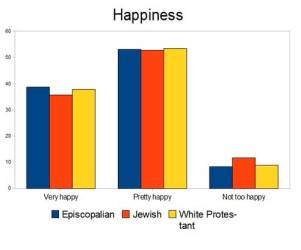 These articles invariably cite scientific studies and statistics to support their claims. But those claims frequently go far beyond study design or the conclusions made by the scientists involved.
 In science fiction, this kind of magic is routinely accomplished by means of technology. Upgraded hair-dryers transfer the person’s consciousness into a computer or some external storage unit. There it is retained until it can be transferred back to the original host or into some new person or device. This science fiction mainstay goes back at least to the 1951 novel “Izzard and the Membrane” by Walter M. Miller Jr.
 In the climax of the film, with the city exploding around them, Pygar swoops down and rescues both Barbarella and the Dark Tyrant, flying off with one woman in each arm. Barbarella looks up at his angelic face, confused, and says “Pygar, why did you save her, after all the terrible things she did to you?” Pygar answers serenely, “Angels have no memory.”
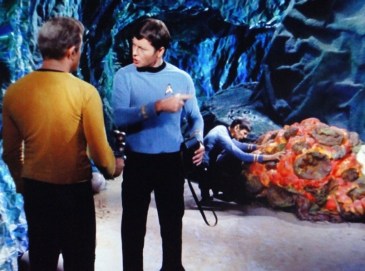 In Star Trek, after Doctor McCoy got over his initial revulsion (You expect me to treat that thing Jim?!?), he was able to patch up even the exotically alien silicon-based Horta with some simple spackle compound.
 But we create human-like creatures even when there are no technical constraints. The astoundingly terrifying alien created by HR Giger is remarkably human-like with 2 arms, 2 legs, a head, a tail, a mouth, and so on. Despite having acid for blood, his alien follows the evolutionary design model of a human quite closely. It is likely not the case, as many imagine, that such alien depictions represent an unimaginative human conceit and lack of imagination. Rather, it is likely that such physics-defying aliens are actually much more fanciful than evolution is mechanically capable of producing – on any planet.
 Yup, in retrospect I should have owned up to my prank right then and there. But Steve was so pumped up I decided to tell him in the morning. By the next morning I had forgotten all about it, and anyway Steve had already left to go somewhere before I woke up. I was reminded of my folly when Steve returned and proudly related how he had gone to the craft shop, paranormal investigator like, to sleuth out the origins of this demon doll. The owner told him that by the greatest of coincidences, the doll-maker, a lady by the name of Ramona Audley (pictured right) happened to be paying a visit at that very same moment. Steve politely confronted Ramona and asked her whether she knew that she was crafting possessed dolls. Ramona apparently nearly went into a terrified state of shock and I was later to learn that the dolls were removed from the store window that very day (Ramona, I did you wrong and I’m so sorry).
 I’m reminded of a formative event back in the 1970’s when I went to a performance by the late magician Doug Henning. Between making live tigers disappear, he would walk out to the edge of the stage and do slight-of-hand magic. In one such interlude, he held up a newspaper and showed it to us, turning each page so we would remember the layout. He then proceeded to methodically tear it into smaller and smaller pieces. As he did so he kept a great dialog going:
 “A small dusty man in a small dusty room. That’s how I’d always remember him, just a small dusty man in a small dusty room.”
