Category Archives: Politics

The Art of Technical Lying

bart-simpson-I-didntWe discover the fine art of technical lying at a young age. It might be more accurately described as technical truth-telling, but technical lying is catchier and more descriptive. It is the practice of lying by making false statements that are technically true or at least defensible. One example of technical lying might be when our parents demand to know whether you went to that unsupervised party at Kim’s house. With feigned affront you lie and insist you did not. When confronted with evidence you claim that you didn’t really lie because it wasn’t technically a party it was a “get-together,” and you didn’t go because technically you were “taken” by Josh on his bike, and in any case it wasn’t Kim’s house since technically her parents are the ones that own it.

We all spin the truth and try to mislead and misdirect through technical nuances when it serves us, but this becomes formalized in the legal sphere where lawyers are taught to exploit technical lying in depositions and court testimonies. They coach clients to answer questions with short answers, in part to leave open ways to later claim they did not perjure themselves using some technical rationale.

Fortunately, parents generally know when their kids are playing these games and usually don’t let them get away with it. Sometimes technical lying can help in legal situations, but lawyers, like our parents, are very good at exposing such obfuscation. In legal proceedings there is usually sufficient opportunity to follow-up with probing questions that trip up and expose technical lies. Lawyers are happy to play this game in court because when a pattern of technical lying is exposed thus, it generally backfires badly on the liar and harms their credibility resulting in a worse outcome for them.

But technical lying isn’t limited to family squabbles and court proceedings. It is rampant in the public sphere and in the semi-formal environment of Congressional hearings. In responding to questions from the Press, some people engage in serial technical lying. Even in testimony to Congress, these individuals engage in technical lying with seeming impunity.

Did the President offer you a pardon? He did not. No I did not lie because it wasn’t the President, it was his lawyer and it wasn’t an offer, it was a possible offer, and it wasn’t a pardon, it was “everything in his power.”

The reason this pattern of technical lying is so frustrating is because it can be quite effective. It can really frustrate and delay efforts to arrive at the truth in situations in which the follow-up questioning is limited and delayed. In these settings, to delay temporarily is to win. This is the case for public statements, media interviews, and to a large extent even Congressional hearings. These are disparate and enough time goes by between follow-up questions that the narrative can keep changing, the goal post keep moving, and impartial observers have difficulty recognizing the extent of gamesmanship being conducted over time.

In an age in which truth is under methodical attack using every possible form of deceit and deception, technical lying is rampant. It is particularly well-suited to frustrate efforts by society to arrive at truth outside of courtroom walls. Technical lying has grown into an art form celebrated by proud dissemblers like Roger Stone.

In this ridiculous era of Trump, we have had to become far more willing to call a lie a lie. This must include lies in all their forms, and for Trump and all those who lie incessantly for him, a technical truth is most likely just another type of lie.


Is it finally safe to discuss Socialism?

smaug

May I ask, oh great and powerful Smaug, when thy gold will begin to trickle down upon us?

I was once at a high school party where the prolonged silence became painfully awkward and uncomfortable. Suddenly one precocious girl blurted out, “So, what do you all think about premarital sex?” Just like that, the party got lively with everyone talking about a wide range of topics.

Sometimes all it takes is one person to break the ice and make it acceptable to discuss what were previously taboo topics. Bill Maher made it allowable to talk openly about atheism, and Bernie Sanders made it acceptable to speak honestly about Socialism.

But this new open talk of Socialism frightens a lot of people, especially older people and rich people – and older rich people most of all. To them, and most Americans, Capitalism is tantamount to a religion that requires unwavering faith despite any evidence to the contrary. Therefore, it is not surprising that they spew out a lot of hyperbolic fear-mongering and misinformation in hopes of nipping all this Socialist talk in the bud.

These Capitalist fanatics spread so much misinformation about Socialism that responding to it all in one overview article is nearly impossible. Therefore I’m not going to take the time here to discuss every point in detail. I’ll simply put forth what I feel are the ethical and empirically supported viewpoints. Feel free to investigate each one more thoroughly on your own.

First, let’s talk about what Socialism is today. Let’s not allow opponents to sucker us into explaining whatever Karl Marx had in his mind a century and a half ago nor into defending the aberrant government that emerged out of the Socialist transformation in China under Mao Zedong in 1949.

Modern Socialists do not want to destroy Capitalism. The difference between a modern Capitalist and a modern Socialist it is simply a matter of where the balance point should be between the governmental and private domains.

Capitalists believe that the government is useless and ineffectual and that virtually all problems should be left to the private sector to solve; all needs should be left to the private sector to meet; and that the private sector should not be restrained in any way. They lie routinely about how much social programs like universal healthcare would cost, by failing to subtract the savings from the frightening numbers they cite. 

Socialists believe that government can and must do good things and that some things like healthcare, public infrastructure, utilities, social services, food and drug safety, and education can be best handled by government, and further can only be handled effectively by the government or through a high degree of regulation and oversight.

Between the two sides, it is the Capitalist viewpoint that is far more extreme, dogmatic, and radical. Socialists still want mostly a vibrant Capitalist system, with only some exceptions and regulations as warranted to protect society at large. Capitalists want to extract profit from everywhere without exception and with minimal or no regulation that would ensure that the public good is considered.

The devotees of Capitalism point out that Capitalism made us great. That is not completely true. Yes it was important, but most of our important achievements like worker safety, environmental protections, and many others came about only through violent opposition to the forces of insatiable unbridled Capitalism. Major projects like our highway system were government funded. And even if we give Capitalism all the credit it deserves for bringing us to where we are, that does not make it the right approach – or even a viable approach – to carry us forward into a more sustainable economic model.

And let’s be clear. Unbridled Capitalism is not sustainable. As Marx predicted long ago, the inevitable outcome of unrestrained Capitalism is growing wealth inequality and instability as all wealth is scooped into the coffers of fewer and fewer individuals. You end up eventually with one Pharaoh and a multitude of economic slaves. That level of inequity cannot be maintained for long. But worse, our planet can no longer sustain a humanity driven by a religion of unbridled Capitalism.

Contrary to everything the devout Capitalists try to claim, trickle down economics is really nothing more than voodoo economics. Socialism is not evil, and Capitalism is not “the best system possible.” Grow or die is a lie. Competition does not really yield the best products for the lowest prices, and what is good for the stock market is usually bad for regular workers (see here). Economic Darwinism is not tough love. Intellectual property rights mostly just retard real innovation. In the real world, free-market competition often breaks down completely. Tax breaks to the wealthy do not create jobs or increase wages. Highly progressive taxation on wealth is necessary and essential. A minimum wage – and a maximum wage – are good economics. And you only need sufficient, not unlimited, wages to motivate and reward talent and work. Private corporations are not inherently more cost-effective than their government-run counterparts, especially since they must extract as much profit as possible.

Taxes, by the way, are not “giving away your money.” Taxes are how we agree to fund philanthropic and charitable causes and joint ventures for the essential public good. Taxes are what we pay for our roads, and police, and all the other services that our government provides for us. Make no mistake, under a Capitalist model, all those services would be far more expensive, if they were provided at all. If left to a purely Capitalist system, all our lives would be horribly diminished.

Capitalism simply has no mechanism to fund essential public services when there is too little profit in it. Even worse, in areas like healthcare, the profit motive is fundamentally and intractably in opposition to providing the best outcome. Capitalist fiduciary responsibility requires that healthcare providers provide the lowest level of care for the highest possible price to maximize profit for their shareholders (see here). Anything less would be antithetical to the Capitalist religion.

The kind of extreme Capitalism that many Americans have been convinced they would prefer is nothing more than “I got mine” economics in which every man (and woman) are out for themselves, and screw everyone else. The idea that good can come from selfishness and greed is a morally bankrupt tenet of our Capitalist religion.

Socialism, on the other hand, is simply how we do things together. It is how we pool our efforts for the good of all. Socialism is the “let’s work together” system of economics. Socialism does not inhibit or replace Capitalism. It merely acknowledges that there are some vitally important things that Capitalism cannot do well enough and it provides the model to work together to achieve those services that Capitalism simply cannot address.

So let’s continue to carry on this discussion that Bernie started and continue to work to find the healthy balance. But do start to question the Capitalist catechism that we have all been taught, and don’t let the fanatical Capitalists convince you that you are the extremist if you defend elements of Democratic Socialism.

The Mortal Sin of GHW Bush

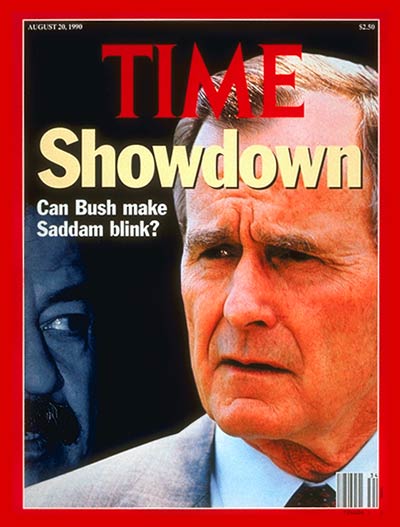
BushTimeCatholic mythology includes the concept of “mortal sin.” A mortal sin is such a grievous act that it condemns ones soul to eternal damnation – unless the sinner receives divine forgiveness. Although of course heaven and hell and god are all pure fantasy, the notion of mortal sin is based on real human ethics. It is the reality that a thousand good deeds cannot necessarily make up for one egregiously heinous act.
In his career GHW Bush certainly did a great many good things and a great many not so good things. So one could rightly view Bush as neither a sinner nor a saint, but as a typically flawed and complex human being with a mixed bag of achievements and failings.

Except for his great mortal sin.

In January of 1991 I watched, along with much of the world, as GHW Bush began what would become 42 consecutive days and nights of raining down nonstop aerial and naval bombardment upon Iraq followed by unparalleled human tragedy that still reverberates to this day. The official story is well-known. GHW Bush had to reluctantly order this massive invasion as the only way to counter reckless aggression by Saddam Hussein.

The historical record is correct of course, but it normally leaves out one crucial fact. On the first day of bombardment I was on the phone with an acquaintance who happened to be connected at the highest level in the government. He told me what he and his fellow high officials knew was happening at the time.

In February of 1989, GHW Bush had a shockingly low approval polling of 14%. He was widely seen as weak and mealy-mouthed – kind of a Barney Fife President. Bush desperately needed a war to bolster his image as a strong leader. So, ex-CIA director that he was, he looked around for an unwitting dupe to start a war with.

He found the perfect patsy in Saddam Hussein, the US-backed President of Iraq. Saddam had been vocally complaining about his neighbor Kuwait violating their oil production agreements and about their slant-drilling into his oil fields. GHW Bush sent back-channel messages to Saddam that were intended, and succeeded, in assuring him that the US would not interfere if he took action against Kuwait.

So he did. Saddam invaded Kuwait. And Bush followed up almost immediately by condemning Saddam and mustering a world-wide coalition to attack him. Is it any wonder that Saddam cursed Bush to his dying breath?

Americans reacted as they almost always do to war. Bush quickly became viewed as the strong leader he aspired to be. The rally effect skyrocketed his approval ratings to over 90% in polls conducted in March of 1991. In less than two years, Bush’s war gambit propelled his approval from 14% to 90%.

I suppose one could count this among Bush’s great successes.

And all that these fantastic poll numbers cost was an incalculable loss of life and property and the pounding of an entire region of the world into a chaotic “stone age” for generations to come.

Add to that the cost of the Second Iraq War that his son waged against Iraq, after having told by some estimates 33 distinct documented lies to justify his invasion. These were repeated by Bush Jr. and his aides over 900 times (see here). Like father, like son.

And one cannot rationalize away this war by saying that Saddam was a bad guy anyway and we cannot know what would have happened had he stayed in power. If one blows up a dam, one knows what will happen. One does not need a counterfactual in this case either. Saddam, dictator that he was, kept the region in a relatively peaceful and prosperous state. And most experts, even at the time, warned that his demise would destabilize the entire region.

Historians and analysts don’t usually include Bush’s full role in instigating this war when they discuss his legacy. Since my learning this story while talking to officials on the phone as the bombs fell, I have been dismissed every time I have tried to relate it. Only recently are some authors even alluding to it. A recent article in Politico mentions it only very mildly (see here).

As Saddam Hussein was preparing to invade Kuwait, Bush sent the Iraqi strongman clear signals, through the American ambassador, that the United States had no interest in intra-Arab disputes—the exact opposite position of the one he took very shortly thereafter, in which he drew a “line in the sand.”

So I for one cannot take a “balanced” view of the life and legacy of GHW Bush. I for one cannot forgive his great mortal sin that has cost such unthinkable loss and inflicted such horrendous pain and suffering on a global scale. His self-serving war-making eclipses any good he has done by a hundredfold.

Only god can forgive a mortal sin on this scale, and god does not exist.


But My District Is Safe

ishouldvevotedstickerWe hear it quite often, especially from younger voters:

“I am not planning to vote but my district is safe.”

There are several problems with this position.

First, it may not actually be true that your district is really safe. Polls get it wrong. Sometimes all the polls get it all wrong, badly wrong. All too often, this false confidence leads to “shocking” upsets.

Second, if enough people adopt this “but my district is safe” attitude they will make it unsafe. At some point, if enough people think like you, the bad guy wins. That is why the bad guys work so very hard to suppress voting and to convince you that your vote doesn’t matter. The people you don’t want in office don’t want you to vote.

Third, there are the softer arguments that appeal to civic duty, tradition, and social responsibility. We hear all these arguments and admonitions often enough, but these are seldom enough to overcome the pragmatic rationalization of “but my district is safe.”

But here is an argument that amazingly I have never heard articulated by a voting advocate. And that is simply… margins matter. Even if you are correct and your district is perfectly safe, the margin by which your side wins is immensely important.

If a candidate wins by only a slim margin, partly because you stayed home, they have less political capital to spend once in office. They do not have a clear and strong mandate to push through the kind of legislation you hope for. They are seen as vulnerable and attacked more aggressively next time around. Therefore, they feel far less secure and are less likely to support the kind of bold initiatives you want to see happen.

On the other hand, if by voting all you have done is increase your candidates margin of victory by one more vote, you have done something very helpful, substantive, and important. You have given your candidate more leverage and security to advance the agenda you want to see championed. By increasing their margin of victory, you secure support for them and for their agenda while demoralizing and discouraging would-be opponents and challengers.

So next time you think about skipping out on the voting process because you feel that yours would be a superfluous, wasted vote… think of margins. Think of your vote as adding one more coin on the scales in favor of all the things you care about. Think of it as a measurable data point to disillusion and discourage those on the wrong side of the issues. Think, margins matter!


They Didn’t Really Hold Their Noses

Portrait of a young woman holding her nose because of a bad smel“The Religious Right held their noses and voted for Trump.”
You know this line all too well. Unless you live in a sensory deprivation tank, you probably hear it many times a day from pretty much every expert analyst. You’ve heard it so many times that you probably believe it without even thinking to question it.

But it is simply baseless nonsense.

The Religious Right did not in fact hold their noses and vote for Trump. They enthusiastically embraced Trump AND all of his vile, disgusting behaviors and rhetoric.  And even after nearly two years of incessent exposure to his lies and indictments and mean-spirited policies, these supposed nose-holders still support Trump without significant reservation or qualification. At this point it is fair to ask whether they support him precisely because of all his vile, disgusting behaviors and rhetoric.

You can reality-check this for yourself. Simply tune in any talk show that accepts calls from the Religious Right. The overwhelming number of these callers not only still support Trump, but they support him passionately and vehemently. You won’t detect any nose-holding from them.

The next time you hear an analyst repeat this meme, notice that they never provide any evidence or data to support it. In fact, this narrative of the mythological nose-holding, morally conflicted religious right voter is definitively disproven by impartial analysis of the facts. In a study of voting data, political science professor Paul J. Djupe at Denison University concluded that:

“To the central claim: noseholding is not disproportionately common (or uncommon for that matter) among white evangelicals (see here).”

Professor Djupe goes on to point out that:

“I understand why the claim of noseholding is attractive. It suggests that you and your group are better, more pure than a political candidate, that your support is temporary and subject to revocation. It is a claim of both independence and moral superiority.”

So any such claim of moral angst in a Trump voter is a false claim. Rather, it is a strong indicator of moral deficiency. It is analogous to my admitting to my wife that I had an affair with a seedy prostitute, but that I had to “hold my nose” to do it. And this moral failure is not only evident in their support of Trump, but in their wholehearted support of a Conservative Congress that engages in similarly egregious behaviors that are in direct conflict with their espoused moral values.

It is clear why the elite on the religious right like to push this narrative to make themselves look and feel better, particularly while they support politicians who engage in blatant behavior that is antithetical to everything they falsely claim to stand for.

But this nose-holding meme is also repeated without legitimate skepticism by mainstream analysts. I suspect this is partly because they themselves would be conflicted in such a situation. Perhaps they genuinely held their nose and voted for Hillary when their heart was with Bernie. It is natural then that they would naively project their own angst into those on the religious right.

But do not make the mistake of giving the Religious Right too much credit for basic human decency and morality. Do not underestimate their capacity to rationalize terrible behaviors as somehow moral and justifiable. I previously wrote about their support for torture as one example (see here). In the case of Trump, they did not, and still do not, even have the rudimentary decency to actually hold their noses while they fervently embrace both him and all his enablers.


Our Next Existential Battle

Right now most of us feel caught up in an existential battle against the Trumpian forces of corrupt dictatorship. With so much to deal with, it is natural to not even want to think about our next battle. Yet, assuming our democracy survives the reign of Trump, we need to prepare for the likely struggle to follow. Our next war will almost certainly be against Mike Pence and the forces of theocracy.

It is my theory of presidential succession that voters swing, pendulum-like, from one extreme to another as we recoil from and overcompensate for what we perceive as the flaws in our last president (see here). It is very likely that the disaster of Donald Trump is going to push our collective emotional pendulum right into the waiting arms of the Religious Right.

As the catastrophe that is Donald Trump unravels, Conservatives will argue that Trump was no “true” Christian, that he was rather a secular leader and that his abject moral failure as a person and as a president is proof that secular values is an oxymoron. What Donald Trump will prove is that we need a good Christian leader of high moral character to lead us. And make no mistake, many, many liberals and progressives will accept that argument.

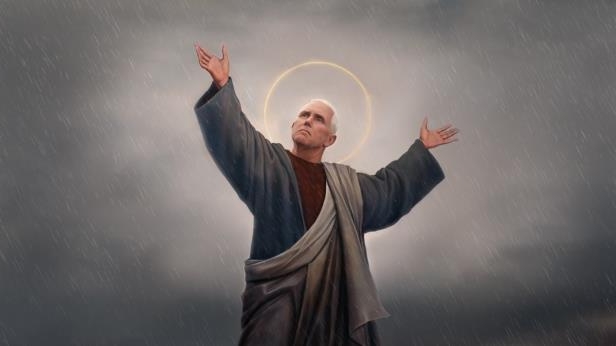
HolyPenceMike Pence, or perhaps someone else, will eagerly assume the role of our new moral savior. Certainly Mike Pence is poised and waiting for his opportunity. In fact many Christian leaders explicitly proclaim that the Donald Trump presidency will pave their way to theocratic dominance (see here).

And as soon as the Religious Right gains even more legitimacy and power than they already have, they will proceed quickly and vigorously to impose their theocratic beliefs on everyone else. They will roll back many of the secular freedoms that we have achieved as a society through generations of blood and tears. They will impose religious tests in every public matter, further marginalize science and reason, and disadvantage anyone who does not share their particular faith.

It is certain that the Religious Right will leverage the moral and political failures of Donald Trump to push us as far toward their extreme as they can. We should not fall prey to this set-up for a disastrous pendulum swing. We should not accept any kind of false choice argument between vile Trumpian delusion and vile Religious delusion.

On the hopeful side, this is a battle we can win if we are smart. People often speculate on whether it would be a good thing to impeach Trump tomorrow if we could, and accept Pence as president. I say yes! Our democracy is frankly not well-equipped to deal with corrupt and crazy. However, we do have explicit Constitutional protections against religious extremism, provided we defend those protections.

Trump’s greatest historical impact will likely not be pulling us into a dictatorship as he intends, but rather pushing us into a theocracy as he does not intend. Protecting our separation of church and state and establishing strong secular leadership are more important than ever. If not because of Donald Trump specifically, then because of the even more consequential battle against theocracy that is almost certain to follow in his wake.


Privatizing Theocracy

privatizationThe strategy is clear. Privatize as much of the government as possible and exempt those privately run services from Constitutional protections.

If we do not wise up, we could gradually privatize our way to theocracy.

Conservatives love privatization. Regardless of where they lie on the not-so-wide spectrum from capitalist to libertarian, they all share a foundational belief that the private sector does everything better than publicly run counterparts. To them, it is self-serving economic dogma that a hard-nosed, self-interested, profit motive is somehow inherently superior to a sincere mission to serve the public good. Therefore everything that can be privatized should be privatized.

Of course, there is no actual proof of any such inherent superiority. Sure, some privately run companies can be more efficient than governmental programs. But many are not. For every inefficient, bureaucratic, slow-moving government agency, one can point to dozens of disastrous, failed, bankrupt, unresponsive, and socially irresponsible private companies with obscenely overpaid corporate leaders.

Moreover, the primary function of private businesses is not to serve their customers with the best possible goods and services, but to extract maximum profit for shareholders and executives. The idea that competition always optimizes to result in the best possible services at the lowest possible price is a convenient fiction. Private businesses actually optimize to extract the highest possible profit by providing the cheapest possible services. Their fiduciary obligation is not to serve the public good, but on the contrary it is to pass off as many of their harms and risks as possible onto the public sphere.

It is simple math. All else equal, a well-run private company simply cannot provide better services than a well-run governmental agency because the private company must extract maximum profits. And it is a lie that government agencies cannot be just as well-run. In fact, our Conservative leaders know this, which is why they work so hard to make the Post Office and other services fail so that they can justify privatizing them.

Further, there are some public functions that are simply incompatible with the profit motive, these include things like health care. I am not against all private business, but I am against private businesses running essential social services that fundamentally conflict with their profit motive. I wrote a blog on the conflict between profit and healthcare (see here). And we have all seen how well has privatization worked for prisons.

This fanatical push for privatizing everything from military service to social security in order to extract private profits has been bad enough. But now, with Citizen’s United and Hobby Lobby and the dominance of Church-friendly executives in public office, we should clearly see another terribly dark side of privatization – the synergy of privatization and religion.

As more and more government services, from social services to education and beyond are privatized, those new “public service” companies can then exert their growing independence to reject governmental policies and even Constitutional protections to inject religious beliefs into those services. Rather than serve the general public good, rather than adhere to restrictions put in place to ensure the public good, these newly privatized services can now exert their “religious freedom” to limit those services in accordance with their religious beliefs.

The Religious Right has been frustrated because they have been thwarted in their efforts introduce prayer and intelligent design in schools. Their new strategy is focused on privatizing education so that they can “teach” whatever they wish to larger numbers of children. By simultaneously asserting religious rights of conscience for these private companies, they can do an end-run around the Constitution.

As another case in point consider hospitals. We used to have a lot of public hospitals. But we have allowed private, for profit hospitals to take over without requiring them to provide the same level of service to underprivileged populations. Increasingly, churches are assimilating all of these private hospitals and refusing to offer essential services that they feel violate their religious beliefs. The New York Times recently highlighted this (see here).

Now duplicate this same strategy to privatize every government service with an ideological or profit interest. If the greedy and the religious can remove all such operations from governmental oversight, then the protections of our Constitution become moot. How can the Constitution protect us with nothing remaining under its jurisdiction? The Conservatives want less, not more of the regulations that would be required.

Make no mistake. This trend toward theocracy by privatization will continue to accelerate unless we understand the following:

  1. Private corporations do not really do everything better, and some essential public services are fundamentally undermined by a profit imperative.
  2. Private companies must not be allowed to claim personhood and religious liberty in order to abdicate ethical responsibilities and circumvent Constitutional protections.
  3. Political leaders must not be allowed to be complicit in this theocritization by intentionally destroying working public services and by putting in place governmental structures to assist in privatization and the expansion of religious exemptions.

For further reading I recommend a previous blog entitled Why Wall Street Loves Trump (see here).

Time To Stop Debating

argumentAs has every successful movement before it, the atheist movement must now move past the debate stage. There are no new arguments to be made, no new evidence to be presented, and further debate only distracts us, legitimizes ridiculous claims, and introduces unfounded doubts about objective reality itself.  As long as we continue to treat religious fantasy with undue respect, we are not fighting back but rather are complicit in perpetuating mass delusion. 
For example, we must quit debating creationism as if it were a legitimate theory. We must stop quibbling over biblical interpretations and contradictions as if they matter. We must cease the sham of conducting research to disprove prayer. We must stop discussing faith-healing as if it were merely a cultural difference. Rather we must quietly assert, through our refusal to entertain religious claims and rationalizations, that the reality-based world has moved on. 

It is not closed-minded or insensitive to simply discard out of hand any claims or opinions based upon religious authority or dogma. We don’t feel conflicted about summarily dismissing assertions that are based upon a belief in white supremacy or a flat Earth and these who espouse them are rightfully marginalized.  

Of course, we cannot eliminate delusional beliefs, but as with many other anachronistic ideas, we can denormalize and marginalize them so that their influence is kept to a minimum. And make no mistake, many religious beliefs are dangerous, and even laudable religious beliefs inherently undermine our capacity for rational thought. 

None of this suggests that secular society can or should relegate religious citizens to voiceless second-class status. On the contrary, we must engage in social justice debates with everyone. But like a judge who rules on the admissibility of arguments in court, we should reject out of hand any religiously based argument that is not consistent with objective facts and universal humanistic values. Practically speaking, a pluralistic society cannot function in any other way – unless it becomes a theocracy. 

This stance is already standard for any number of groups who hold bizarre beliefs. Many people believe in ghosts, or discredited conspiracy theories, or Bigfoot. The difference is that those groups do not attempt, or are not powerful enough, to substantially influence public policy. We don’t have a political Bigfoot-wing fighting to introduce a Bigfoot curriculum in our schools, to build Bigfoot memorials on public property, and to push through legislation based on the teachings of Bigfoot. That makes it all the more important that we do not continue to indulge and normalize religious belief. 

The gap between our secular and religious worldviews is deep. At times it seems like a bottomless chasm. But that gap is not wide. Our common goals and needs as humans bring our two sides close enough together to form strong bridges on a wide range of social justice issues. But atheists must insist that where we disagree, those bridges have to be built upon facts and reason and universal values. Religious beliefs cannot serve as the foundation to bring together those who do not share them. We must insist that our government limit itself to the real-world in which we all live. 

Although even atheists can get caught up in silly debates, the main reason we are activists is because we see powerful religious interests, perhaps unwittingly and with sincerely good intentions, pushing America toward delusional thinking and theocratic behaviors. And both, at any level, are anathema to our American ideals, including the free exercise of religion. Ironically, while we do not believe in religion, we atheists actively defend the separation of church and State that ultimately protects religious liberty. 

So, in order to move forward, we must refuse to engage in arguments over fictions and get to work in the real world. We must listen to any reasonable, fact-based arguments. But we must insist that if religious believers wish to inform social policy in keeping with their religious beliefs, that they do so by sticking to objective facts and sound logic. 

Why the Facebook Problem Matters

facebook-cambridge-analyticaMost of us know the basics of the Facebook scandal involving the political consulting firm, Cambridge Analytica, which has close ties with Steve Bannon and Robert Mercer. Cambridge Analytica obtained massive amounts of Facebook user data through an outside researcher in violation of that person’s usage agreement with Facebook. This data included not only public information, but private data as well as detailed “metadata” about user behavior. Cambridge Analytica analyzed this “big data” to perform “psychographic profiling” in order to conduct “psychological warfare” and “influence operations” to benefit the campaign of Donald Trump.

When you speak with people about this Facebook controversy, many of them will respond by saying that they don’t feel like it’s a very big deal. After all, when users sign up for Facebook, what do they expect? Of course their information is public. This is really a generational problem because people are far too promiscuous in exposing all of their private and personal information. It’s just the world we live in today. And anyway, Cambridge Analytica may have talked big but really had very little impact in the scheme of things. Of course Facebook shares data with advertisers and that benefits us all!

The thing is though, what is actually going on isn’t necessarily benign and it isn’t at all what Facebook users did or should have expected. Analysts keep saying that Facebook “shared” the data. Facebook doesn’t “share” user data. They sell it. They either profit from it directly or leverage it as tangible value to attract their lucrative partner relationships. The profit motive does not in itself corrupt the relationship, but it does potentially shift it from wholesome sharing toward unsavory exploitation.

And they don’t just sell your public postings. They sell subtle usage metrics that go way beyond what you intended to make public and what any one individual could ever see just by looking at your Facebook page. They sell deep metadata that can give insight into how you think and respond and thereby how to manipulate you. They create data sets that contain not only details about your behavior but they can link that behavior in real time to a huge number of other user behaviors and to events going on at that exact moment in the world and in the web of public consciousness.

Given the amount of data they accumulate, sophisticated programs can deduce things about you that you did not intend to make public. You posted that you had zucchini for lunch and like pandas? You might have just divulged your sexual orientation to these sophisticated big data systems. The amount of detail recorded and our ability to analyze, predict, and even modify behaviors based on that data is difficult for most of us to comprehend. What can be done goes way beyond just picking who to target with Cialis or Trump campaign ads. It includes detailed information that provides insight into your deepest psychology, how you think, how you respond, and how you can be manipulated.

Further, this deep metadata isn’t merely sold to well-meaning researcher or advertisers, but it can make its way into the hands of unscrupulous and nefarious players like Cambridge Analytica. They can analyze all this data to determine things about you that you did not intend to make public. They can then use that information to influence how you think about critical matters like elections. If you are important enough, such organizations can even use private information extracted from your public activities to smear, discredit, or even blackmail you.

So the concern about the relationship between Facebook and Cambridge Analytica is not just a matter of silly people being too indiscreet with their postings. Concerns about the kind of activities exposed by the nexus between big data analysis and political activity are far more disturbing and potentially consequential. The ability to acquire massive amounts of metadata not intended to be public and to analyze that big data along side other external events to produce individualized predictive algorithms,  moves innocent Facebook postings into the dark and scary region of mass undercover surveillance and psychological manipulation. Even if Cambridge Analtyica came nowhere near achieving their ambitious goals in the Trump campaign, make no mistake, the ability to assure elections is their business objective.

Facebook is not the only company profiting from massive information gathering. Google, Amazon and others are also sweeping up data that could be exploited by unscrupulous players like Cambridge Analytica. We need to take this seriously and take steps to ensure that big data works to empower and inform us, not to manipulate us. We need to push back now, and strongly, to ensure that this infant monster born of the information age is controlled before it grows into something powerful enough to ensure its own existence.


We Can Transform Our Gun Culture

GunCultureI was inspired and encouraged by our local “March For Our Lives” event in Tacoma, and by those held concurrently around the world. A number of speakers conveyed their passionate optimism regarding our prospects for implementing “sensible gun laws.” Some cited our eventual acceptance of seat belt laws, despite tremendous initial resistance, as one example of how important change can and does happen.

And there is an even more compelling precedent for optimism. I grew up in the 1960’s. At that time smoking was epidemic. Every indoor space was visibly thick with noxious, stifling smoke. Every tabletop was marred by ashes and burns. Beaches, park lawns, and other public spaces were strewn with disgusting butts. Workplaces and restaurants were more like Marakesh hookah bars than the clean, safe, and wholesome places they are today. Smokers could not be persuaded to change their behavior regardless of the cost to themselves let alone to others. Their right to enjoy unrestricted smoking was fueled by a powerful tobacco industry and protected by a complicit government. The result was that no one, even non-smokers, could find safety from the horrific health toll that this unrestricted smoking claimed. And certainly, few people believed there was any realistic chance to challenge the seemingly unassailable right and all-powerful compulsion of so many to smoke anywhere and everywhere they pleased.

Their arguments and excuses were much the same as those used in our current gun debate. But all those who said that significant changes in our smoking culture were impossible… were wrong. And they are wrong today about the hopelessness of achieving significant gun control.

But the relatively smoke and butt free world we enjoy today, that younger people thankfully take for granted, did not come about naturally or by accident. It came about because people fought for it. It came about because some ignored all those who maintained that smoking was too ingrained in our culture, that smokers could never be persuaded to curtail their habit to any extent whatsoever, and that in any case big tobacco was far too powerful to fight.

Big tobacco, as invincible and all-powerful as they seemed, lost that war. Smokers, as uncaring to suffering as their addiction made them, did eventually accept dramatic restrictions of their previously unrestricted right to smoke. And once the culture shifted under them, dramatic and fundamental change did not take long.

So don’t let anyone tell you that the NRA is too powerful. Don’t let anyone tell you guns are not the problem. Don’t let anyone tell you that gun owners will only allow their guns to be pried from their “cold dead hands.” Don’t let anyone convince you that the world will not be a far safer place with fewer guns. And don’t accept that our goals must be limited to “sensible gun restrictions,” because by taking this very meek approach we implicitly concede that guns are good and reasonable things to own – except for say crazy people or known criminals.

Rather than enumerating who cannot own guns, we should enumerate who can own them. The right to own guns should require proof of exceptional need. Such exceptions allowing ownership can include authorized facilities who “loan out” guns for controlled sporting or hunting activities, for guns held in secure armories for the use by “well regulated” militia groups, and for people with exceptional security needs.

Lest you think that such ambitious goals are impossible, consider that New York City has largely accomplished them. A little over a year ago we moved from New York City to Washington State. Despite the far greater population density, we frankly felt safer there. This is partly due to their very restrictive gun control laws. You are not allowed to own guns in NYC unless you can demonstrate an exceptional circumstance. Their laws effectively make gun ownership the exception. This has arguably contributed greatly to reducing gun violence, unarguably made us feel safer, has been accepted by the population, and has survived Constitutionality challenges in the courts. If such significant restrictions can work there, then there is no reason to accept any less nationwide.

As with seat belts, and more dramatically as with smoking, change can happen. New York City shows us that such change can be more transformative than we may believe – even when it comes to guns. The rallies and marches today give me a new sense of optimism that meaningful and significant change, akin to our transformative changes in smoking behavior, may be on the way for our insane gun culture. We just have to keep working to make it happen.

For other blog posts on our gun epidemic, click on the Guns category on the right!