Category Archives: Saving the Planet

The Political Pickup Artist

mysteryIn 2007, a show called “The Pickup Artist” ran for two seasons. It was a reality-show contest format in which an elite Pickup Artist named Mystery mentored a motley group of misfits and losers in techniques for picking up women. Which dweeby kid would apply their lessons well enough by the end of the season to earn the title of “Pickup Artist?” Stay tuned!

People had lots of negative reactions to the unsavory methods taught in the show and by the suggestion that women are really that manipulable (though the same is certainly true of men). They were especially vexed by the fact that they could not completely dismiss the reality that the techniques promoted in the show really do work. By applying a few seemingly counterintuitive principles, these Pickup Artists really are able to pretty much walk into any kind of venue and walk out with the very willing phone number of pretty much any woman they choose.

Here are some of the important techniques taught by Mystery:

  1. Peacocking is critical. Even if you look silly, you need bling to stand out.
  2. You have to project more worth than anyone else in the room to be desirable.
  3. You have to establish outcome independence with an attitude that you really don’t care if she goes home with you or not.
  4. You have to project absolute confidence and not show a hint of self-doubt.
  5. You have to show the target you don’t particularly care about them. You need to even dis them and put them down in a mild way to make them want you more.
  6. You have to engage and actively listen.
  7. You have to be fun and actually have fun.

The series showed us that if you are able to execute these techniques successfully, pretty much any woman will give you her number. Even if she knows you’re bad news. Even if all her friends warn her you’re terrible for her. Even if she knows that there are way more sensible choices out there that would be far better for her. Despite all reason and common sense shouting “stay away” she’ll still want you anyway.

trumpNow The Pickup Artist reality show is back for another run. This time it stars The Donald as the Master Pickup Artist and he is schooling another motley group of misfits and losers in how to pick up voters. This season’s cast includes math club runt Bobby Jindal, pathetically desperate Jeb Bush, awkward twit Marco Rubio, sickeningly nice Rick Santorum, creepy-crawly Ted Cruz, messed-up-by-religion Mike Huckabee, tries-too-hard Rick Perry, and only-one-who-thinks-he’s-smart Rand Paul. None of these poor losers has a hope of getting a voter to give him their vote, let alone their phone number.


Here are some of the critical voter pick-up lessons that The Donald demonstrates this season:

  1. Peacocking is critical. That hair may look ridiculous, but bling is bling and he certainly stands out amongst the other stuffed shirts.
  2. Everything about Trump implicitly and explicitly shouts “I’m worth more than anyone else in the field and I know it.”
  3. Trump’s attitude of outcome independence says sure, I’ll be your President if you beg for it but I don’t need to be. I’m just as happy to move on to something better.
  4. Trump projects absolute confidence in everything he says and does. He never gives any hint of hesitation or self-doubt.
  5. In talking to voters whether it be women, Hispanics and pretty much everyone else, Trump is happy to put them down to make them want him that much more despite all their better judgment.
  6. Trump doesn’t hold press conferences; he holds conversations with the press and the public. Whether he cares what you have to say or not, he makes you feel that he actively engages with you and genuinely listens to you rather than delivering rehearsed pickup lines.
  7. He definitely is fun and actually sincerely seems to have fun out there playing The Political Pickup Artist game.

So, tune in this election season and see how many voters, men and women, despite all logic and reason and common sense to the contrary are nevertheless drawn like moths to the flame of The Donald. No matter how bad for us we know he is, no matter how self-destructive the attraction, we’ll secretly be drawn to him anyway. He’s the master political pick-up artist, the bad boy, the alpha male of the pack and we desire him regardless of how ridiculous that may be. It’s in our DNA.

Can you resist his repulsive attraction? Yea, right, sure you can…

Yosemite Sam on Target

Gun-related murders, particularly mass murders, continue to rise in America (see here).

yosemitesamBut gun spokesperson Yosemite Sam reminds us that guns don’t kill people. After all, as hunting enthusiast Elmer Fudd points out, even if there were no guns those kwazy wabbits would just murder you with carrots. Wile E. Coyote, acknowledged expert on absurdly dangerous weapons, adds that even without guns some deranged Tasmanian Devil could run amok hacking preschoolers up with an Acme™ turbocharged meat cleaver. The entire cast of Looney Tunes agrees that the obvious and best solution to the plague of too many guns is yet more guns in the hands of animated characters who really, really love to shoot them. They maintain that in their cartoon-view, guns are not actually the problem anyway. Mental illness is the real problem.

I could not agree more with our Looney Tune friends! Mental illness is the real problem and we should focus our attention on that. Even though so-called real-world “scientific” studies have shown that there is no correlation whatsoever between violence and a history of mental illness (see here), anyone who shoots up a school or movie theater must obviously be mentally ill. And what does “correlation” really mean anyway? No, clearly mental illness is the problem, not guns. Case closed!

So then the only real question is how to identify these mentally ill people BEFORE they rip through an abortion clinic using their legally-purchased semi-automatic weapons supercharged with Brownells™ high-capacity magazines. Hmm. Let me think a second… could there be some factor, some objectively measurable indicator, that clearly flags individuals as mental health risks to society? Anything at all?

I know! How about we red-flag people who buy semi-automatic weapons with high capacity magazines as dangerous risks by virtue of mental illness? Clearly, people who are so paranoid, pathologically fearful, and sociopathic that they feel compelled to buy semi-automatic weapons with high-capacity clips – especially if they buy many of them – are mentally ill and need help. Maybe we should “register” them somehow so we can “monitor” their activities and administer appropriate mental health services.

hunterWe should be reasonable about this of course so that those few non-crazy gun owners, or at least those few crazy but harmless gun owners, are not unduly monitored thereby wasting our surveillance capacity. We should restrict our high-risk group of crazy gun owners to those who buy more than, say four mass-murder machines. High capacity clips should earn them a double-red flag status.
How many people would this high risk group include? I took the liberty of doing some back-of-napkin calculations. Roughly 24% of American adults say they own at least one of the estimated 310 million guns in circulation in our country. So, out of a total 245 million adults that means that 59 million of us are gun-crazy. Of those, 48% own 4 or more guns. That means that roughly 12% (30 million) of Americans are profoundly gun-crazy. That list would be whittled down to the subset of those that own four or more high-capacity modern non-hunting weaponry who are therefore profoundly and dangerously gun-crazy.

This “registration” and “monitoring” of high-risk mentally ill individuals is clearly quite doable. Not only are these mentally ill gun owners readily identifiable simply by tracking their gun purchases, but the numbers are manageable too. The terrorist watch list monitors over a million people. Amazon manages upwards of 300 million customer accounts. We routinely issue and manage hundreds of millions of driver’s licenses without breaking much of a sweat. So clearly monitoring our population of profoundly and dangerously mentally ill gun owners is well within our capability.

So let’s start a movement. We don’t want to unfairly blame guns when mental illness is the real problem. So let’s focus on that and provide the mental help needed to all those individuals flagged as mentally ill by virtue of their insane gun ownership. Maybe we could start a White House Petition. Let’s force the government to help these mentally ill gun owners to get the help they need and the intervention they require.

Pro-gun is pro-murder.

Ares Targets Iran

GodOfWarIn Wonder Woman comics, the Amazon Princess often does battle with Ares. The God of War ceaselessly and eternally dedicates himself to instigating violence and fomenting war. He is especially difficult to combat since he doesn’t usually act directly. Most of the time he works covertly, behind the scenes, pulling strings and pushing buttons to ensure that greedy, ideological, or even well-meaning humans are tricked or prodded and driven to war. Two of Ares most powerful lies are convincing people that war is inevitable and that war is necessary to ensure peace.

Ares would have been proud of our 1990 Gulf War which was based on “a pack of lies” (see here). In the comics, he often takes the form of humans to influence events. He certainly might have taken the form of Bush Senior in snookering Saddam into attacking Kuwait. Then, he no doubt might have inhabited Dick Cheney to lie us into the second Gulf War and subvert Colin Powell into supporting him.

We really need Wonder Woman right now because Ares has long set his gaze upon Iran as the next great senseless battleground and he is hard at work to sabotage any possible deal with them that might delay his carefully laid plans.

Of course I refer specifically to the battle over approval of the Joint Comprehensive Plan of Action (JCPOA), commonly referred to as the “Iran Deal.” The opposition to this agreement is much more than merely an honest policy debate between well-meaning people of good-will. This really is a clash between those who align with war-imperative of Ares versus the peace-making ethic of Wonder Woman. For Ares, this Iran deal threatens to delay his plans to ensure uninterrupted and perpetual war.

While Ares and Wonder Woman may be only metaphors, these figures nonetheless personify our real, iconic struggle against those who are dedicated to the ideology of war and crave the plunder that wars yield. And the rest of us are not merely spectators of this struggle, we are participants in it whether we accept it or not.

But we cannot win this war against war if we do not understand our enemy. If we naively refuse to consider that anyone would actually WANT war, we cannot hope to defeat those who do. And make no mistake. There are many people with tremendous amounts of power and influence over the political process in America who greatly desire a steady stream of war and will do anything to ensure the uninterrupted flow of the war pipeline.

In 2011, the 100 largest contractors sold $410 billion in arms and military services with some of the highest profit margins of any industry. Is that a lot you ask? Well consider that the entire world-wide cell phone market is expected to reach $341 billion in 2015. So yes, the military industry is indeed humongous by any comparative measure with far higher profit margins to boot.

But the mobile phone industry has something the war industry does not. Cell phones wear out, get lost, and need to be upgraded constantly. The viability of their market, their prospect for sustainable revenue, has no inherent limit barring some completely unforeseen new technology to replace it. The war industry however has a fundamental sustainability and growth problem. Without a constant stream of new wars to consume all those bombs they produce, without a constant stream of existential crises to convince people to pay for wars rather than for the betterment of the human condition, their entire industry collapses. Their gravy-train of war hits a brick wall.

Simply put, the war industry withers and dies without perpetual wars, and the war-profiteers understand that uncomfortable reality even if you do not. And the most foolish thing is to imagine that there just happen to be enough legitimate “organic” wars to keep the war profiteers in business and satisfy their lust for profit. There are not. On the contrary, without Ares-grade machinations, the war industry would dry up very quickly. In fact, we have innumerable quotes that reveal the determination of the war industry to ensure a permanent war economy by any means. Immediately after WWII, corporate war-moguls terrified at the prospect of peace set about ensuring that America would never return to a peace-time economy. I still recall just one memo that was circulated decades ago. It was written by a former President of General Electric and it said something close to the following:

“We can anticipate in the foreseeable future a time when aversion to war might become an insurmountable obstacle to our corporate interests. We must therefore take every action to assure a permanent war economy in the United States.”

This is not an anecdotal wacky comment. This general sentiment has been repeated by corporate leaders over and over again, often proudly. And “every action” includes searching for enemies and creating new ones to ensure wars. It includes destabilizing other countries to make them ripe for war. It includes making sure the “defense” industry is too big to fail so that any cuts can be linked to losing jobs. It includes ensuring that we remain in a perpetual state of fear. And of course it includes blocking any initiatives like the Iran Deal that might result in peace.

Some of these warmongers may truly be motivated by ideology rather than profit. But it’s hard to separate motivation from rationalization. It’s difficult to know when ideology is just a rationalization for profiteering or when ideology is the pawn of profiteers. In any case, it kind of doesn’t matter. Either way, the result is reprehensibly glib calls to “bomb bomb bomb, bomb bomb Iran.”

The bottom line is that we must recognize that Ares is not a nice, well-meaning guy who may simply be misguided or uninformed. We must acknowledge that he and real people with financial and political power actually DO want war, even cataclysmic war. They have worked a long time to set Iran up as the next bad guy in their domino chain and they don’t want see those war profits slip away.

If we keep assuming, as we typically do, that our opponents don’t really want war, or that they don’t understand that their obstructions could lead to war, we cannot hope to combat them. As unthinkable as it may be, many opponents of the Iran Deal do understand it would likely lead to war and that is exactly what they want.

If we don’t understand that reality, the real nature of our opponent, we cannot hope to help Wonder Woman to defeat Ares. And she cannot fight him without your help.

Sociopath’s Elevator Guide

If you do not happen to live in a 3D city like Manhattan, you probably don’t spend a good portion of your day getting hoisted up and lowered down again in elevators. We New Yorkers tolerate them in order to conserve the calories we need to hit the stair-master at the gym. But elevators aren’t as exciting as one might think. If these people-crates were made of glass they would be more fun, but for the most part we have to find ways to amuse ourselves during these awkward and boring rides. The good news is that there are a whole lot of shenanigans and hijinks one can play with elevators. Following is a helpful Sociopath’s Guide to Elevators.

Beat the Crowd
Here’s your first scenario. You arrive at the elevator bank to find 15 people waiting for the next elevator with a maximum occupancy rating of 12 persons. What I do in this situation is to nonchalantly meander to the middle of the crowd so that I can rush quickly ahead of the pack into the first door that opens. Admittedly I could probably get to my floor faster by waiting a moment for the next elevator which will likely be empty and make fewer stops, but the satisfaction of beating out those other losers into the first elevator is totally worth it!

Temple of Doom
Every time I see those elevator doors closing, I get a rush of adrenaline like Indiana Jones escaping from the Temple of Doom. It is super fun to lunge for the closing door and halt it in devil-may-care fashion at the last possible moment. The best part is that while the doors will grudgingly reopen, they are usually programmed to punish everyone with a long reset timer. If another Indiana Jones type comes along before they fully reclose, this fun can go on for hours!

The Ninja
While waiting impatiently for the doors to close before any more losers arrive, my best strategy is to play Ninja. The way I do this is to stealthily hide in the corner toward incoming traffic. If I can’t see anyone coming, I cannot be expected to hold the door open for them. But sometimes I cannot conceal myself in a position of plausible deniability. In these cases, I have to perform the Fake Button Reach move. As that pregnant mom is rushing for the elevator, I pretend I’m desperately trying (but failing) to reach the Open button. If you want to become a Ninja Master it pays to practice your “on no I’m too late!” expression in the mirror. Practice makes perfect!

Hold that Door!
When returning to the office with coworkers, they think I’m very chivalrous when I rush ahead and block the elevator door until they finally stroll up. This is great because the irritated people inside cannot complain for at least a minute or so without looking like jerks themselves. Also, if you’re married like me, your wife will reward you if you agree to run ahead and hold the door while she takes care of those 27 last minute urgent matters back in your apartment. Your ability to endure the hate-filled glares of everyone waiting in the elevator will prove to her how much you really do love her.

The Cigarette Run
I’m not a smoker myself, but one of the most satisfying activities for the veteran elevator sociopath is to run down and out for a quick cigarette fix five minutes before the start of that long, boring 2 o’clock meeting. If you puff frantically on that cigarette for 2 minutes you are guaranteed to reek. I mean gut-wrenching, rotting-corpse, dive-bar, up-chucking reek. Even though you can’t smell it on yourself, do not worry because I guarantee every non-smoker in the elevator will. It must be huge fun to watch them grimacing in disgust as they try to hold their breaths until the doors open and they can suck in that sweet air-conditioned oxygen! If you are a non-smoker like me, don’t worry because you accomplish almost the same effect by drenching yourself in a gallon of that “Trancher les Oignons” cologne you got from your secret Santa at last year’s office gala.

Ear Bud Antics
This elevator sociopath tip takes a bit of investment. Get a smart phone. Get crappy ear buds. Get your favorite music. Play said music at max volume on your crappy ear buds. Enter crowded elevator. Remember that while most people do love music, some inexplicably do not actually like your music, and certainly not when all they hear are the tinny frequencies that leak from your crappy ear buds. If it’s horrible music to them it’s doubly horrible coming from your crappy ear buds. Maybe if you play it loud enough through your crappy ear buds they’ll learn to appreciate it. If it’s music that your coworkers already love and treasure, it’ll be a particularly excruciating affront to hear it massacred by your crappy ear buds. No matter how you look at it, cranking music through your crappy ear buds is the best way for the elevator sociopath to make everyone cringe for the entire ride. The only way you can be even more annoying is to sing along at unnaturally high volumes like I do.

Fun with Positioning
For you more cerebral elevator sociopaths, it is great fun to experiment with positioning as the elevator fills and empties. I like to intentionally stand in non-optimal non-equidistant spacing positions and gather data on how much it freaks people out. Also, I like to stand right in front of the buttons so that people have to beg my pardon if they would like the elevator to stop at their floor. It effectively makes me the ruler of the elevator. I’m not especially tall, but if you are you can use that advantage by standing right in front of the video monitor. It’s fun to force everyone to crane their heads to read the latest stock indices or witty elevator wisdom. You can take great satisfaction that when they return to their office they will have no idea what is happening in the world and have no elevator witticisms to relate.

MonsterStrollerBundles of Joy
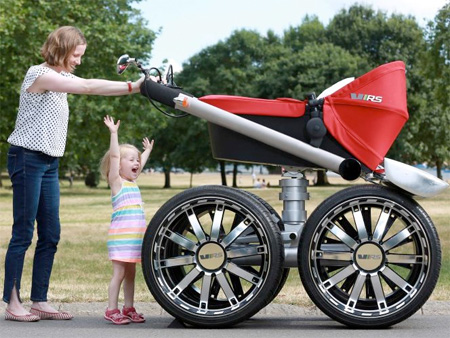
For more fun, wear a bulky backpack in the elevator. It’s a hoot to act like you are totally oblivious to the fact that your backpack is smooshing into the chest or face of the person behind you. If you don’t have a backpack with you, try dragging around one of those huge suitcases on a stick containing God-knows-what and wait until that 12 person elevator has at least 15 inside before deciding it can still fit you and your pet suitcase of God-knows-what. Finally, if you are a parent, be sure to invest in one of those impressive Hummer mega-strollers that take up the entire elevator. Make sure your child is at the peak of their screeching tantrum before entering the elevator to achieve maximum impact. It’s a joy that parents can only share for far too short a short time, so make the most of it while you can!

Sociopathic Politeness
Even if you don’t have crappy ear buds or a Hummer stroller, you can still be really annoying just by being polite. Try it! Guys, when the elevator opens, stand in the doorway ushering everyone in or out as if the elevator is a ship and you are its captain. Yes, it does make it far more difficult for everyone to squeeze past you and slows everything down, but tell yourself it is necessary so that the ladies will not speak ill of your discourteous behavior.

And ladies, even without being overly eager, doors do close on people. Doors are evil, it’s what they do. But despite the fact that there are virtually no injuries related to doors closing, you can still offer matronly admonishments to be careful every time someone gets caught in a door or uses their foot or hand to stop it from closing on them. The great thing is that while everyone finds this super-annoying, they can’t complain because you’re only being polite! You can practice this skill out on the street as well. Watch for someone to stumble or trip. When they do, loudly caution them to be careful and ask if they’re all right. Everyone “loves” that!

That’s all the tips for now. Watch for the upcoming Sociopath’s Guide to Subways!

The Pillaging of Greece

Today’s article is about the Greek Financial crisis. But wait! Don’t click that Back button. I promise it will be interesting and will hopefully provide some thought-provoking perspectives on the important and consequential shenanigans unfolding there.

If you are like me, and despite your best efforts to avoid knowing anything about this, you have still absorbed a fairly strong narrative from our media. It probably goes something like this:

Greeks spent like drunken sailors and lived way beyond their means. They committed rampant tax evasion while overpaid public employees suckled from the public teat. Throngs of retirees lounged blissfully on Aegean beaches while enjoying their lavish pensions. The Greeks bankrupted their nation through greed and incompetence and now more responsible nations and major financial institutions have to bail them out to prevent their economic contagion from infecting the European Union and beyond.

That narrative sounds familiar doesn’t it? It sounds a lot like the narrative that many of us were led to believe about the 2008 mortgage crisis here in America. That meme was that greedy and irresponsible home buyers bought houses way beyond their means and lived the good life until their mortgages became due. When they defaulted, those poor lending institutions were the ones to suffer as they struggled to absorb massive foreclosures.

I know that was the common meme because many, many people voiced it at the time. It was also clearly, flatly wrong. Sure, it had an element of truth. All good lies and cover stories do. But all of us should understand by now that those homeowners were the victims of predatory lending practices and irresponsible financial speculation by large financial institutions (summary here). Yet the homeowners were the ones to suffer most profoundly as a consequence.

In the same way, the current meme about the Greek financial crisis may have elements of truth, but those half-truths conceal even bigger lies and malfeasance at the international institutional level. But how can we know the real truth? When trying to understand complex issues we cannot all be experts. So we have to find experts we trust. In my experience, you are best served by looking for a relatively independent expert with a track record of being right. These are usually not the big names. Big names tend to repeat the half-truths that serve big interests far too often. After all, they have way too much to lose if they don’t stay mostly in line with the corporate message.

In cases like this I most trust a more independent expert like Naomi Klein. She wrote a landmark book called “The Shock Doctrine” (found here) which meticulously detailed “crises” just like this one that have been exploited or even manufactured by large financial interests over the last 50 years. You can see an excellent synopsis of her research and analysis here along with a summary of some  countries where similar “disaster economics” have been applied.

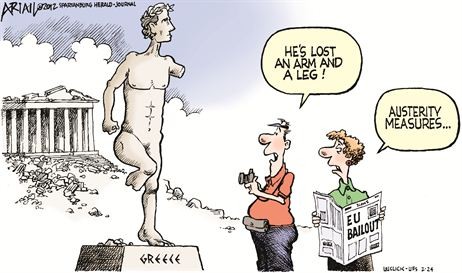
GreeceNaomi sees the current Greek crisis as yet one more example of the “Shock Doctrine” being applied to force Greece into crippling austerity measures (see here). The goal of this shock campaign is to force them to sell off fossil and mining resources, as well as any other pillageable assets, for pennies on the drachma. Think of these banking institutions as lions that pick a weak prey and run it down until it collapses to be devoured flesh and bone, leaving a carcass. Greece is the most recent prey that these predators have pulled out of the pack of nations.

Even if you agree that the lions are on the hunt to feast upon the financial problems in Greece, you may still believe that greedy and irresponsible Greeks are nevertheless guilty of making themselves vulnerable in the first place. Perhaps a weak and feeble antelope deserves no sympathy if it is culled from the herd. Maybe the lions are performing an important and essential function in a jungle of economic Darwinism.

But a very credible CNN article (found here) disputes this blame-the-victim mentality. It points out a number of things that those big news sources who repeat the meme fail to mention. For one thing, the article points out that the meme of “rampant tax evasion” is deeply misleading.

“In Greece the culprit has been rampant tax evasion by corporations owing millions in taxes and self-employed professionals who can hide their earnings, unlike salaried employees and pensioners. Under international pressure to balance its budget, the outgoing Greek government axed salaries and pensions and slapped new taxes on the bulk of citizens who were not tax-delinquent. “

We see the very same thing happening with tax “minimization” by corporations and the ultra-wealthy here in the United States, do we not? And as in our own financial crises, it was the insatiable greed of wealthy people and corporations that drove this crisis in Greece, not the greed and indolence of ordinary Greeks as it is portrayed. And just as the media propagated this “blame-the-homeowners” meme in America, they conveniently fail to specify that it is largely wealthy interests who are guilty of tax “minimization” in Greece. Also as in America, it is the regular Greeks who end up footing the bill and paying the price for the avarice of the rich.

How many times will we believe the memes spread through mainstream media? How often will we allow powerless ordinary people to be scapegoated for crises created by the same financial institutions holding all the power? How many more countries must fall to these big financial institutions before we finally begin to see them for the ravenous predators they are?

Our Secular Pope

Well it’s official. Hell has frozen over. Even as a devout secularist, atheist, and humanist I now feel that even I have a Pope. His name is Francis.

I have always had respect for the Dali Lama whom I once had the privilege of meeting. Many years ago the Dali Lama told Carl Sagan that if a tenant of Buddhism were to be disproven by science, then “Tibetan Buddhism would have to change.” This was a refreshingly rational acknowledgment from a major religious leader that science must trump belief. Of course he was still stubbornly irrational in maintaining an implausible, untestable, and wholly unscientific belief in reincarnation, but it was an encouraging concession nonetheless.

I also recognize that Pope Pius XII made a similar acknowledgment in his 1950 encyclical Humani Generis. In it he acknowledged the scientific fact of polygenism and went on, in deference to science, to specifically abandon the disprovable Adam and Eve story of human origins. He also expressed openness to the legitimacy of the relatively early evolutionary science of the 1950’s. Of course he still held that God existed and endowed humans with a divine “soul.” Like the Dali Lama, he conceded to science on the disprovable parts while still falling back upon the un-disprovable beliefs as faith.

But I’ve never been an unqualified fan of a religious leader until now. Through his recent encyclical letter Laudato Si’ (found here), Pope Francis threaded essentially the same needle as these previous religious leaders. He acknowledged the irrefutability of established climate science while still clinging to his belief in god and souls. Like Pope Pius and the Dali Lama, he is rational enough to understand that religion is better served by deferring to science on matters of fact and that it is ultimately self-defeating both for the Church and for mankind to deny established science. Like those others he is also sophisticated enough to understand that the fundamental tenants of his faith can never be specifically disproven by science and that is enough for most believers. But unlike those others, he has gone far, far beyond merely acceding to science to embracing it in an active fashion.

Even given the widespread consensus on global climate change, Pope Francis was nevertheless frank and courageous in Laudato Si’. It takes courage for any leader to acknowledge the science of global climate change, to disavow the environmentally irresponsible worldviews held by many Christians today, and to call for deep changes to the status quo. This is a courage that many of our secular leaders still sadly lack. The Pope acknowledged that man is responsible for protecting the Earth, that we are responsible for catastrophic global climate change, that climate change endangers our very survival, and that it is our responsibility to fix it.

Following are some important points that I pulled from my reading of his encyclical:

  • The Pope challenged us to “protect our common home,” entrusted to us by God.
  • He discussed many real threats to the planet including “pollution, waste and a throwaway culture,”  “the issue of water,” and “loss of biodiversity.”
  • He pointed out that the climate is a “common good” that is “a complex system linked to many of the essential conditions for human life.”
  • He acknowledged that a “very solid scientific consensus indicates that we are presently witnessing a disturbing warming of the climatic system.”
  • He acknowledged that all these things result in “global inequality” and a “decline in the quality of human life and the breakdown of society.”
  • He acknowledged “the human roots of the ecological crisis.”
  • He pointed out that our responses to these challenges so far have been “weak.”
  • He challenged people who defend the status quo by rejecting “those who doggedly uphold the myth of progress and tell us that ecological problems will solve themselves simply with the application of new technology and without any need for ethical considerations or deep change.”
  • He acknowledged the dangers of “misguided anthropocentrism” that places the gratification of mankind above all other considerations.
  • He acknowledged the principle of the “common good” and called for “justice between the generations” which imposes a responsibility to pass along a habitable planet to future generations.
  • He issued many calls for “dialog” and immediate action.
  • He held that the role of religion is to “guide” science.

Although these may all seem like obvious points to some, it is critically important that the Pope made them. Many religious people still do not accept the 1950 encyclical regarding evolution and they are not likely to accept this encyclical on climate change, or our role in creating a sustainable planet, let alone our responsibility to respond to the social and ecological challenges we face.  It is amazing to see the Pope and the Catholic Church taking such a strong leadership role for social justice and environmental sanity.

But it is important to also look at what the Pope did not say. Most noticeably, while he called for action by others, he did not so far lead by example with tangible actions within his power to initiate. I hope these kinds of actions are to come.

  • He did not call for divestment from the fossil fuel industry and other environmentally irresponsible industries nor did he promise to do so with the reported $8B Vatican portfolio.
  • He did not call for the extremely large worldwide Church infrastructure to “go green” and lower their very substantial carbon footprint.
  • He did not specifically instruct his clergy to take tangible local action to promote a culture that helps to achieve the goals he outlines so passionately.

Less obviously but more notably, Pope Francis did not call for prayer as a solution to our environmental crisis. In fact, he only used the word “prayer” a few times in the entire encyclical and never in the context of a call to action. Instead he used the words “science” and “scientific” dozens of times in the context of providing real solutions.

Evidently even though the Pope supposedly believes in an active, caring, and omnipotent god, even he is not silly enough to rely upon the power of prayer when the outcome really matters.

PopeFrancisI close with sincere thanks to Pope Francis. He is courageously using his bully pulpit in a responsible way that most secular leaders including President Obama have not. His strong statements regarding climate change in particular and social justice generally are desperately needed. I particularly appreciate his continuing calling out of “people, managers, businessmen who call themselves Christian and they manufacture weapons” as the immoral hypocrites that they are (see here).

Thanks Francis. You go Pope! Keep it up!

The Polling Crisis

poll-box“Election polling is in near crisis, and we pollsters know. Two trends are driving the increasing unreliability of election and other polling in the United States: the growth of cellphones and the decline in people willing to answer surveys. Coupled, they have made high-quality research much more expensive to do, so there is less of it.”

 “In short, polls and pollsters are going to be less reliable. We may not even know when we’re off base. What this means for 2016 is anybody’s guess.”

This is a quote from a recent NYT opinion article by Cliff Zukin entitled “What’s the Matter With Polling?” If you pay for access to the NYT website, the link is here (NYT Article).  In short, the author points out that the polling industry is in crisis. It has become hugely more expensive, if not essentially infeasible, to do reliable polling anymore. Trends including the disappearance of land-lines and growth of the Internet have converged to undermine what little reliability polls used to have. The main takeaway is that polling “science” is really bad and is only getting worse and pollsters have no idea how to make it better.

The author focuses primarily on the growing financial and logistical challenges for the polling companies. Since pollsters must make a huge number of calls to obtain even a remotely valid sampling of reliable data, the cost of doing accurate polling has become extremely high – even prohibitively high.

However I prefer to focus on the problems that this situation creates for rational governance. Even good polls have undesirable consequences. Their mere existence creates an almost irresistible compulsion for politicians to pander to poll results, saying whatever the numbers tell them that likely voters want to hear. Even if the polls are accurate, this may not be the best way to govern – or even to campaign. But if polls have become woefully inaccurate to boot, and yet we continue to pander to them, then we have taken what was already a problematic approach to governance and made it far, far worse.

One specific problem I’d like to focus upon more deeply is the self-fulfilling prophesies that these polls create. If the polls tell us that, for example, Bernie Sanders cannot possibly win, then those polls influence huge numbers of people to respond by not voting for Bernie Sanders – creating a self-fulfilling feedback loop. And what if those admittedly unreliable polls were simply wrong? What if perhaps they were even disingenuously promoted as a stealth strategy by a big money Clinton campaign (theoretically) for exactly that purpose?

Maybe we’re better off without any polls. Good riddance, I say. Maybe we’re better off if politicians campaign and govern according to actual scientific data and humanistic ethical principles, not according to polling. Maybe we voters are far better off if we remain uninfluenced by polls as well.

Whoa there, you say. If you have read my book “Belief in Science and the Science of Belief” (found here) you know that a fundamental principle I champion is that decisions based on facts are inherently better than decisions based on beliefs. If that is the case, aren’t polling facts important information to consider in campaigns and in governance?

Yes but I’m also suggesting that polls aren’t the best facts to use and that they push all the air out of the space for actual, more important and more reliable facts to sufficiently drive political campaigns and decision-making.

Poll any group of alcoholics and the data will likely show that they want more alcohol. As antithetically “paternal” as this may sound to some, a government must provide what society needs, not necessarily what people want. Private corporations can be driven by market research to provide exactly what their customers want (when not unethical or illegal). But a government simply cannot make policy based primarily on polls if they are there to serve the common good.

Now if even accurate polling can create unhealthy pressures for governance, imagine the consequences if we continue to listen to polls that have now become even less reliable. Now we are making decisions that impact the lives of people and the life of the planet that are primarily based not merely on polling data but on really bad polling data.

I say again, good riddance to polls. My hope is that we turn this crisis into opportunity. This is our chance not to merely improve polling methodologies, but to start to weigh polling data far lower in our decisions and instead find ways to make policy decisions based more upon the best objective science and rational decision-making possible. I hope that our emphasis on “what people polled want” is permanently diminished and replaced by more indirect and sophisticated methods of data mining to understand what they actually need and what will best serve humanity and planet Earth in the long-term.

The Dandelion Project

Dandelion

A Fond Farewell to the Planet

Copyright © 2006 by Tyson Gill

Adrian made one final inventory, carefully confirming each item against the checklist provided. He inserted the payment form into the pre-addressed mailer last, with no trace of hesitation about having spent an entire year of graphic editing work to cover the submission fee. Finally satisfied that nothing had been overlooked, he sealed the package with the reverence of a precious time capsule. Now that it was finally ready to mail, he could hardly bring himself to part with it.

“The postman is coming,” his golden retriever alerted him with a familiar woof.

Securing the package in his lap, Adrian swung his wheelchair around and rolled silently toward the door, tapping the over-sized button open it. A gust of hot, wet air swept in through the doorway, laying siege to the air-conditioners defending the widely spaced entryway.

Against the spectacular backdrop of an angry, storm-crazed sky, the nonchalant approach of the postman might have seemed incongruous were it not an everyday occurrence. The approaching postman adjusted his balance adroitly as the frenetic wind buffeted him from every angle. All in all, it was relatively pleasant weather.

Adrian always wished he could be a postman too, strolling from house to house, warmed and cooled within one of those signature post-office blue all-weather suits. He had read that they were made of high-tech Nanobiotic™ fibers that adjusted automatically to almost any weather condition. But it could never be. The nature of his injury precluded ever being able to even use prosthetics.

“Lovely weather we’re having today eh Adrian?” Mailman Max called when he got close enough to be heard over the wind without shouting. It was Max’s usual greeting. Adrian typically came out to greet him to break up his otherwise humdrum days. In fact he ordered supplies in separate shipments to ensure that daily bit of human contact.

“It’s beautiful,” Adrian confirmed, grinning, as he rolled forward to the outermost fringe of the household climate systems protection.

Max halted, a gust of rain pelting him from out of nowhere, as he regarded the package proudly resting in the lap of the crippled boy.

“That it?” he asked simply, following up with an easy smile.

“This is it,” Adrian announced proudly, holding out the package like a holy offering.

“Right,” said Max. “I’ll send it right off then.”

Max exchanged the precious mailer for a bundle junk mail.

“Don’t worry,“ Max assured the boy as he patted the parcel. “I’ll see to this one personally.”

“Thanks. Maybe I’ll run around some day still,” Adrian whispered, like making an almost sinful admission of improbable hope.

“Maybe you will at that,” Max agreed with a wink.


Max pulled his mail truck up to the massive door of the post office and pressed his entrance card up against the rain-pelted window. He hoped that the card reader would cooperate today because he didn’t want to open the window. The weather had suddenly turned more nasty than usual and he was still suffering from the alternating gusts of frigid and burning air that overwhelmed his all-weather suit before he finally found refuge in his vehicle. People imagined that mail deliverers were always comfortable in their suits, but more often than not the internal regulators just couldn’t respond to the weather fast enough to ever be just right.

After the fourth swipe, the door finally lifted open and Max pulled forward into the garage with relief. The lumbering metal started to lower back down even before his mail truck cleared the entrance. He hopped down from the driver’s compartment, unzipping his suit as he looked around.

“Hey Max-eee!” a familiar voice called his way. “How the fuck you doing bro?”

“Hey Vince,” Max didn’t need to look to know the source of the familiar greeting. “I’m good.”

Vince had already reached the rear of the delivery truck. It was his job to unload the outgoing mail and transfer it to the automated sorter.

“Ouch!” Vince cried out like a cuss as his hand recoiled from the door latch.

“Ya, it’s pissing down hot rain out there,” Max confirmed needlessly.

“Fucking hot rain is the worst,” Vince complained. Whatever the weather was doing at any given moment was by definition the worst to Vince.

Max walked over and looked on as Vince heaved the back open and rolled the mail cart out.

“Saying on the radio that Florida lost another 500 square miles last month,” Max told him by way of small talk.

“Fuck,” Vince commented, pausing to shake his head. “Where is all the fucking water coming from? The fucking north pole is gone but we still ain’t got none to flush a crap.”

“Still lots of ice left in the Antarctic,” Max remarked.

“And we’re spending half the fucking national budget on those fucking see-oh two reduction plants,” Vince spat. “Thought they were supposed to clean up this fucking shit.”

“They are, but it takes time,” Max was used to having the same conversation every day.

“Fuck that,” Vince remarked as he pulled the mail cart toward the clanking sorter. “I don’t think they are doing crap. I think it’s all a croc of shit to keep us from realizing the fucking end of the world is already here.”

“Ya, you’re probably right,” Max always found it easier to just agree with Vince.

“Fucking right I’m fucking right,” Vince agreed wholeheartedly.

Suddenly, Max remembered something and darted back to the truck cab. He snatched a package off the passenger seat and ran to catch back up with Vince.

“Hey V, can you route this one personally? It’s kind of special and I don’t want that old crapper sending it off to Chinese-controlled Russia or something,” Max said, handing him Adrian’s package.

“You got it Max-eee,” Vince assured him, receiving the hand off like a football. “I’ll treat it like my own little baby.”

Somehow that didn’t reassure Max very much.


Sayonara Cheng reached for another package from atop the heaping mail container next to her desk. It had already been a long day and it was not getting any shorter. She had started working at The Dandelion Project as a temp over eight months earlier. Now they employed over 8,000 people doing the same job as her at different processing locations around the world.

It was a good temp job for as long it lasted. Open enrollment was supposed to end in three more months but she heard it would take another six to sort through the backlog. Probably more if submissions kept increasing as quickly as they had been.

Twenty-two million was the magic number. They needed at least that many paying donors to finance the project. They had reached that mark last month and were already at 36.5 million last she heard. Frenzied plans were underway to scale up the whole operation.

Their unlikely success thrust The Dandelion Project into the world spotlight. It graduated overnight from a wacky Internet scheme to a massive and controversial international joint venture. The protesters and picketers didn’t bother her much. Their office didn’t see many violent demonstrations. Sayonara just kept her head down, quietly and unobtrusively processing submission packages.

She opened the next kit, scattering the contents across her desk at the foot of her diet cola. She ignored the ancillary materials and picked out the data stick, deftly inserting it into a worn plug on her terminal.

Sayonara clicked the Import option from the custom application menu. After a momentary hourglass came and went, a graphic popped up on the screen. It was a cute young man, trying to appear as if he wasn’t imprisoned by the wheelchair in which he was obviously confined. His hand waved tentatively in front of a shy smile that made her feel as if he could see her there looking at his video portrait. The caption under the picture read “Adrian Davis, Age 24.” It was followed by a long personal data summary in a scrolling window.

She carefully opened the sample tube and placed it into the DNA Scanner. She absent-mindedly hit Scan Now on a popup menu and the device began to whir and hum softly, sending spectroscopic data to the central supercomputer for analysis. Sayonara used the time, as was her routine, to sip cola and review the notarized legal wavers and agreements.

A discouraging beep made her look up to see the garish  message flashing in red on the screen. That was fast, she thought, oddly disappointed. She had rejected thousands of applications without a second thought so it came as a surprise to her to feel reluctant to have to reject this particular applicant in accordance with her very specific selection protocols.

As she moused-over to select the Reject option, Adrian looked up at her from his wheelchair with renewed hope and longing. Sayonara peered deep into his pixilated eyes and felt as if they exposed his very soul to her. Her finger hesitated, hovering millimeters above the mouse button. She sensed a young man who wanted desperately to get up out of his rolling prison and play among the stars. How could she deny him that chance?

On an impulse, she clicked Accept, Override, and Confirm in rapid succession. She really hoped the auditors wouldn’t catch her on this one but didn’t much care.

“Bon voyage,” she told his image in a conspiratorial whisper.


It was obvious to Edwin Daniels long ago as a student at Cal Tech that global warming had exceeded the critical cascade threshold. No effort, no matter how extraordinary, could prevent atmospheric collapse. The extinction of mankind was imminent and inevitable.

That certainty had caused him to ponder the question; to what worthy cause can Man dedicate itself to even as Death is swinging his scythe? Then it came to him. He envisioned a great cosmic dandelion, releasing its seeds on solar winds far out into the great expanse of space.

He enlisted specialists with far more talent than he to join him in his mad project. His unprecedented plan required impossible advances in materials science, genetics, psychology, robotics, nanocircuitry, and artificial intelligence. If successful, mankind would perish in a glorious supernova of new knowledge and progress.

By force of raw passion and charisma, he organized a brotherhood of scientists who dedicated whatever free time they could manage to the project. They kept a low profile for two decades, working on the fundamental technical challenges in obscurity.

Once his team became relatively optimistic that the key obstacles could be overcome, they launched The Dandelion Project on the World Wide Web to fund development. They had never dreamt that it would capture the imagination and passion of the entire globe as it did. Though they never publicly admitted that this was a doomsday project, people around the world sent in their money and their DNA samples. Their database now contained over 173 million DNA fingerprints.

The Dandelion Project had taken in more money more quickly than any business in history. With it, they spent the next 18 years prototyping, developing, and testing the impossible.

Now, 37 years after the crazy dream first took seed, the project was coming to life without any further need of him. He could finally just relax and watch it unfold.

The daily launches continued despite the mass protests. Now that the deployment had actually begun, many religious leaders toned down their vehement rhetoric. The Chinese government finally gave the project their official sanction, lending the support of the largest and most influential country on Earth. Public relations continued to cite audits by independent auditing firms to quash conspiracy speculations that the DNA lottery was rigged.

Amidst the storms of nature and controversies of Man raging across the globe, the pods continued to launch night and day from locations across the United States, throughout China and its Russian territories, Europe, Australia, Africa, South America, India, and others. Every country was represented in the precious payload.

Edwin watched the television monitors replaying the time-lapse images taken from the international space station and the Moon base. There lay the solitary Earth, dying amidst the unsympathetic darkness of space, flinging thousands of pods out into the eternal blackness. It looked like a great cosmic dandelion, its metal composite seed pods brimming with databases of human DNA, flying out in all directions, going for broke on the longest of odds.

It was an unprecedented event in human history. The supernova of mankind as it died. All of humanity watched and marveled, strangely contented and satisfied as if collectively sharing one last fireworks finale.


“To be truthful, the odds are too infinitesimal to bother calculating. One in a thousand pods might survive millions of years of random collisions with space particulates to find a candidate planet. One in a hundred of those might find conditions compatible with human life. One in ten of those might succeed in re-synthesizing a random DNA record and growing a human clone. One in a score of those clones might survive and grow to into a functional human being. But the odds don’t matter. We are humans and all that matters is that we try. It is the only way that we frail humans can ever explore the universe first hand.”

Adrian looked up from the monitor. He had been watching an interview recorded back on Earth in some incomprehensible time past.

Mother, his robotic parent, stood protectively nearby. Nine years earlier, she had booted up and begun to execute her programming. She had reconfigured the pod into a shelter, acquired raw materials, and replicated a randomly selected sequence from the DNA database. Since then she had protected the child and tutored him in all the age-appropriate data available in their comprehensive Earth library.

“So that was him, Mother? That was the man who sent us here?”

Mother answered him with an exquisitely archetypical motherly voice.

“Yes Adrian that was Edwin Daniels. But many tens of thousands of people worked together to send us here, to our new home. All of humanity wished you bon voyage,”

“But I am all alone,” Adrian said to her. “What good is one person?”

Mother reproduced a tender smile, engaging all the micro-transducers of her synthetic face.

“One human isn’t much good at all,” she told him, squatting down to gaze into his eyes. “But one day soon you will choose another and we will raise her together.”

The boy was about to follow up with another question but Mother gave him a gentle shove.

“Go play now in the grass,” she urged him. “Bring some berries for a snack later.”

Adrian, naked in the warm, gentle air, jumped up and smiled, running off into the field. Animals, vaguely resembling little deer, bounded in around him to join in the romp.

In the pod, Mother set about cooking and cleaning as directed by her AI adaptive processor. On their little table, one old-fashioned picture rested prominently within a homemade frame. It was the still-picture of a young man that looked just like Adrian only older, sitting in a wheelchair and waving to them with wistful contentedness.