4:17 AM Tweet
“MadCow Madow claims I have a small penis… Wrong! Lie. Fak NEws!!! So Sad. She is the one with tiny penis. Mine is the biggest ever! Tremendous. I’ll show her…”
4:23 AM Reince Priebus on call from President
Reince: I saw it. Yes Mr. President, I’ll clear our entire schedule… yes even the terrorism briefing. I know, they’re boring anyway. No we’ll keep the meeting with Putin. He makes you happy. Will assemble the full cabinet for an emergency meeting at 6 AM. OK bye.
5:30 AM Melania during breakfast with Donald
Melania: That’s outrageous my love. You need to teach this Maddow a lesson putchkin. Make her suffer tenfold for saying my big strong Donny has a tiny penis… Yes dear you make me SO horny I have to go… <Click and dial tone heard from Melania’s end of the phone>
5:45 AM Personal Valet while lengthening President’s tie to penis level
Valet: Yes sir. Amazing sir. It’s amazingly huge. I can see that sir. Very impressive.
6:34 AM Emergency “War Room” meeting continues
Nikki Haley: No sir, again, we really don’t need to see it. We believe you.
Jeff Sessions: Have no fear sir, we’ll bring the entire Justice Department to bear against this Maddow woman. I never liked her much myself. She once made a totally inappropriate remark about my chin.
Rex Tillerson: I am not sure this actually rises to the level of an “International Incident,” but I’ll look into having that scope broadened.
James Mattis: Just to be clear, Mr. President, we can’t actually “nuke” an individual person. Yet. But we’re working on the technology.
10:03 AM Sarah Huckabee Sanders morning press briefing
Sarah: I’ll just say that the President has the hugest penis ever. No one denies that and it is just totally inappropriate for members of the media to be launching personal attacks like this against a sitting President.
Reporter: Have you seen it personally?
Sarah: No I have not but I don’t need to because everyone knows it’s the biggest. He’s the President after all. Next.
Reporter: How can you stand up there and communicate reports as fact that you have not confirmed to be true?
Sarah: I’ll have to check with the President and get back to you on that. Can we discuss another topic? There are many cancelled meetings today that are more important to the nation than this penis story which is totally fabricated by the fake news media.
Reporter: Sarah, we cannot find any records of Rachel Maddow making any penis comments that could be construed as maligning the President. Can you produce the tapes to substantiate this accusation?
Sarah: Those tapes will be coming.
Reporter: When?
Sarah: Soon. Next
Reporter: How do you respond to the leaks from within the Cabinet that this entire accusation is based on a dream that the President had this morning after eating an entire pepperoni pizza last night?
Sarah: Look, I’m not going to engage in who said what where or whether something was a dream or not or for that matter whether pepperoni pizza was involved. The President’s tweet speaks for itself and he has moved on. We should all move on as well.
Reporter: But it was just a dream!
Sarah: If the President dreams it, it’s real. End of story.
1:12 PM The President in response to a reporter’s shouted question
President: No I have not moved on. I will never move on until she apologizes personally for this small penis comment. I’m instructing my lawyers to file a libel suit against this Madcow Madow. I also have men looking into the size of my penis and what they are finding will shock you, let me tell you. That’s all I have to say. But I’ll just say that I have the utmost respect for women. No one has more respect for women than Donald Trump, OK? But the Madcow Madow isn’t really a real woman if you know what I mean…
3:54 PM Betsy DeVos on call with the President
Betsy: Yes sir, I got the pictures. Umm, thank you. Very impressive. Yes, I’ll definitely work on getting these put into education text books as soon as possible.
5:16 Dinner with Ivanka and Jarod
Ivanka: Well daddy, here’s one idea. We could pitch “The Biggest Penis Loser” to NBC. It would be a great vehicle to launch some new Ivanka Collection merchandise. Plus we could hold it at Trump hotels. Jared dear, what do you think.
Jared: <continues smiling and staring into the distance sagely>
 11:48 PM Personal Valet after being called into the Presidential Bedroom
Valet: Yes sir. It’s the most amazing penis I’ve ever seen. No… I mean the most amazing penis ever in the history of penises.
Trump: Ok, if you’re sure. Oh and could you bring me another pepperoni pizza? It reminds me of someone that makes my penis even bigger.
 Religious people hold a lot of beliefs that nonbelievers conclude are delusional (
 There was no actual meeting. No normal business was conducted. No information was exchanged. It began unsurprisingly with Trump touting how he is the greatest President ever. His obscene self-aggrandizement was followed with each of his cabinet ministers taking their turn to genuflect at his feet and pour praises upon him in the most hyperbolic manner they could (
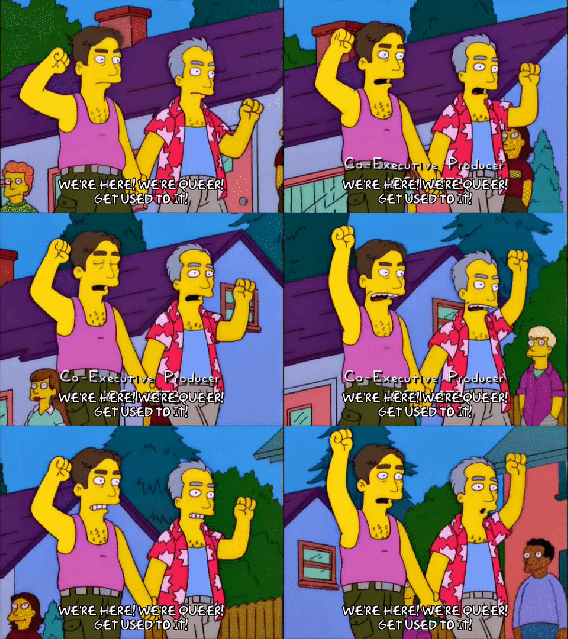 In the early 1990’s, a group called Queer Nation came up with the “We’re here! We’re queer! Get used to it!” chant. It was wildly successful and contributed greatly to the phenomenal success of the Gay Rights movement. That movement was so successful that other movements still look to it as the gold standard for both inspiration and strategy. Many of them have adapted and adopted the “We’re here!” slogan-as-a-strategy in form, in spirt, and in attitude.
 With radical crazies infesting the government and with Trump running a for-profit White House, we can no longer accept the “Accept the things I cannot change…” platitude. We cannot accept the fact that Donald was elected President. This picture posted like subversive graffiti on a telephone pole near my house. It reflects the new, more engaged attitude. It reads “I am no longer accepting the things I cannot change. I am changing the things I cannot accept.”
 It is obscenely immoral when Conservatives argue that healthcare is a privilege reserved only for the privileged few who deserve it, especially when the only criteria that determines whether the privileged few deserve healthcare is whether they happen to be rich enough to afford it. For Conservatives, wealth is the only measure of merit and the wealthy are the only ones meriting healthcare.
 Are you old enough to have watched those wonderful old Spaghetti Westerns? The typical story went something like this…
 In the Grey Matter section of the Sunday Review in the New York Times, Cornell Professors Wendy M. Williams and Stephen J. Ceci published an article entitled “Charles Murray’s ‘Provocative’ Talk.” In it, they described a small ad hoc study that they conducted to test whether the words of Charles Murray are objectively offensive and thus deserving of the level of resistance to his lecture at Middlebury College (
 Some of us are lucky enough, or unlucky enough, to stumble into a pivotal event in our lives that reshapes us, blows our minds, opens our eyes, changes our perspective, forever and irrevocably. I stumbled into mine back in college in the 1980’s when I blundered into a lecture by former CIA bureau chief Major John Stockwell (
 To sum it up in typical Hollywood fashion: Feud delivers a spicy pair of dishes!
 The series doesn’t rely only upon these great lead performances. The 1960’s sets are recreated with impeccable attention to detail and the supporting cast is just wonderful. Catherine Zeta Jones is radiant as always in her portrayal of Davis’ friend Olivia de Havilland. Kathy Bates is believably engaging as actress Joan Blondell and Alfred Molina resonates as the beleaguered film director Robert Aldrich. Judy Davis is shamelessly scheming as gossip columnist Hedda Hopper and Jackie Hoffman delivers a comically low key performance as Crawford’s Lady Friday, Manacita. Many other classic stars make “cameo” appearances.
