Author Archives: Tyson

Unknown's avatar

About Tyson

Love writing all kinds of stuff including fiction, non-fiction, editorials, etc. But writing software is the only writing I do for love AND money!

Indeterminism

FreeWill

Free-will and determinism are concepts that religious and non-religious thinkers alike love to debate about. Unfortunately both exist largely in the realm of fantasy and any discussion of these concepts only serves to strengthen religion and mysticism. We atheists should be very careful about when and how we discuss these concepts.

First let’s consider free-will. Regardless of any non-religious discussions one might like to engage in about free-will, this term has become inextricably synonymous with religion. It was popularized largely by theologians to counter the problem of evil in the world. How can a good god allow evil? Well he gave us free-will of course! Since the universe cares not, God alone can define good and evil and give us the magical ability to choose between them. Free-will unavoidably suggests something outside of science, something divine, bestowed by god to humans only. Any discussion about free-will is to enter into a logical discussion about an illogical construction.

In direct opposition to free-will is determinism. Although it comes in many varieties, determinism is essentially the idea that we actually have no free-will at all. Everything in the universe is determined by the laws of chemistry and physics. You could predict every feeling and thought you are experiencing right now if you calculated forward correctly from the Big Bang. You may think you have a choice about what you do next, but that’s an illusion. Your every movement, thought, and choice was predetermined when the cosmic cue ball broke the table and the universe was set into motion.

Such discussions about determinism, while stimulating, only ultimately encourage religious thinking. If the universe is deterministic then there can be no good or evil, right or wrong. Most people refuse to accept such a universe or the idea that we have no choice. After all, we all feel something we perceive as choices between right and wrong. So any discussion of determinism quickly sends most people flocking in droves to the religious side. Their reasoning and their emotional reaction to determinism may be arguably flawed, but that is the result nevertheless. Secular philosophers may think they can logic our way out of this recoil into the arms of religion, but their logic is insufficient for most people.

Part of the problem here is that free-will and determinism are both extreme conceptual constructs, like positive and negative infinity. On one extreme, there is no right or wrong or choice. On the other extreme, right and wrong are defined by god and choice is bestowed by him and everyone is wholly responsible for everything they do. If good and evil and defined clearly by god, there can be no room for “situationalism.”

But reality is the continuum between these theoretical extremes. We live in the grey regions of choice and responsibility. We certainly perceive that we have choices and that we make choices. So choice is real to us at least. And regardless of whether those choices are ultimately predetermined in some sense, we as individuals and collectively as a society have no alternative but to judge and to respond to the choices we make.

To resolve the apparent contradiction between living in a “clockwork” universe that can only operate according to the mechanics of its particular gears and coils, and our perception of choice, consider randomness. One might argue that in a predetermined universe there is no such thing as a truly random number. You could in theory predict every random number in advance if you knew the state of the universe at any point in time and understood all the rules of physics sufficiently. However, according to every practical test we could perform and every objective purpose to which we could apply them, random numbers are demonstrably random to us. It would be silly to base our technology on the idea that there are actually no random numbers. And it is equally silly to base our beliefs or our society on the notion that choice does not exist.

But we should also recognize that in the grey area we live in, choice and responsibility are mitigated by a large number of deterministic factors. We recognize that if you look far enough back everyone is a victim of deterministic influences. At the same time, we must acknowledge that everything is to some extent a choice as well. We have to draw a line somewhere to decide when and how to hold people accountable for their actions. The extent to which people actually have a choice and the extent to which we hold them accountable for their choices is a judgment mitigated by many factors. These factors include age, state of mind, delusion or drug influence, intentions, ignorance, upbringing, circumstance, coercion, whether this behavior is treatable, how dangerous it is, and whether it is likely to repeat.

Clearly it’s not practical to consider everyone an innocent victim of the big bang and hold no one accountable for their actions. We have to hold people accountable for their choices. But it’s just as impractical to fail to consider the many physiological and social factors that determine behavior and effectively give people little or no choice in their choices. As individuals we have to draw our own lines and as a society we have to draw a collective line with treatment and help on one side and prevention and punishment on the other. Understanding, however, can span the entire spectrum. It is not inconsistent to understand the determinants of choice and still punish those who make those choices.

For example, even a suicide bomber may ultimately have no real choice given the horrific situation that we have created in their country. If we had not bombed their home into the stone age and taken away every other course of action, they likely would never have strapped a bomb to their chest. We may actually be more responsible then them, and yet still we must prevent and punish their behavior. We can understand the causal factors that forced that behavior and to the extent that we can and change those conditions we should. Understanding that every decision is neither completely a choice nor completely excusable, is to live in the very messy real world lying somewhere between the theoretical extremes of free-will and determinism.


Deeply-Held Beliefs

Our society overall, and even we atheists, have largely bought a bill of goods sold to us by the religious community. It is the flimflam that deeply-held beliefs are more sincere, more legitimate, less crazy, and more irreproachable than any old “ordinary” beliefs. Often these are also marketed under the labels of sincere or cherished or even deeply-cherished™ beliefs.

We have all been manipulated into granting an undeserved level of respect and deference to beliefs when they are immunized by these adjectives. This deference is not only undeserved, but it excuses some of the most damaging practices by those espousing these deeply-held beliefs. We tend to push back on beliefs until someone proclaims that it is deeply-held, sincere, and cherished. Then suddenly it becomes taboo, insensitive, and disrespectful to criticize it. In fact, we often accept that such deeply-held beliefs should be exempted from or even protected by the law.

Well unless of course it’s a deeply-held, sincere, and cherished belief of Muslims. In that case it’s clearly crazy.

Take for instance the vehemence by which “deeply-held” beliefs are defended by Katie Geary from the Becket Fund for Religious Liberty (see here). According to Geary:

“Groups that insist on insulting others’ deeply cherished beliefs are the truly immature ones here. Little do they realize how juvenile they appear to the “fairy tale” believers they so ardently wish to cut down.”

That’s quite a dressing down, and this is only a small sample of her attack against any criticism of deeply-held beliefs. However, as the Humanists of Minnesota point out, it is often impossible to see any difference whatsoever between deeply-held beliefs and plain old bigotry (see here).

KimDavisIt was her deeply-held beliefs that inspired Kim Davis to refuse to grant marriage certificates to gay couples in defiance of the law. Just last week cherished beliefs led right-wing Conservative leader Kevin Swanson to publically call for the mass execution of gay people. Deeply-held beliefs resulted in the owners of Hobby Lobby claiming religious exemptions so that they are free to discriminate.

Likewise, deeply-held beliefs that abortion is murder led anti-abortion extremist Scott Roeder to shoot Dr. George Tiller in the head. It was sincere beliefs that prompted John Salvi to bomb a Planned Parenthood clinic killing two and wounding others.

These are just a few extreme examples but such incidents are hardly rare. We could go on and on citing examples of harmful actions motivated and justified by claiming they are in accordance with deeply-held beliefs.

These are extreme examples, but that does not make them irrelevant to all of those “harmless” deeply-held beliefs that we ought to respect. Quite the opposite, these only point out the danger of ever letting ourselves get taken down this path. Any time we give any special deference to more benign beliefs, we necessarily make it that much more difficult to criticize and curtail any belief no matter how destructive. In a world that is fundamentally based in fantasy, logic offers little assistance in drawing such lines. Our deference to innocent little deeply-held beliefs leads directly to carve-outs that condone and institutionalize bigotry, prejudice, and violations of civil rights.

We don’t accept the notion that racism or terrorism or homophobia are any more legitimate if these beliefs are claimed to be deeply-held, sincere, or cherished. Similarly we should not be bamboozled into accepting this same justification for the acceptance of or favoritism toward religious beliefs.

Jefferson’s Grand Nightmare

ThomasJeffersonThomas Jefferson was our Einstein of social and political science. He had an uncanny ability to understand human behavior and to envision what would ultimately grow from the seeds being planted in his times. Because of his visionary insight he fought for many years with his contemporaries, including his protégé Madison, to convince them to adopt several key provisions into our new Constitution. In fact he threatened to dismantle the effort to build a new nation if they were not included. He was adamant that a nation without these essential protections would be worse than none at all.

The first was Separation of Church and State, for without that protection he foresaw that our secular freedoms would inevitably be corrupted into a Theocracy. Jefferson would probably be relieved to see that we still do protect our wall of separation and that it offers some protections against Theocracy, but he would probably still be shocked and disappointed at the extent to which religion has succeeded in subverting or bypassing that wall.

The second thing he insisted upon was a ban against a standing army, for he feared that a standing army would only ensure perpetual war and war-profiteering. On this Jefferson would most certainly be horrified and most gravely disappointed. We do have a standing army that is only in principle under the command of a “civilian” President. In truth his worst fears in this regard have been realized with our huge standing army and the almost irresistible profit motive that ensures unending warfare.

The third thing Jefferson fought for was protections against corporations, for he saw that without very strong protections, our nation would inevitably be coopted into a Corporatocracy to serve the interests of corporate enterprises. He feared that these ravenous “wolves at the door” as he called them would eventually devour the government.

Jefferson did win this battle – for a while. The founders explicitly and deliberately never used the word “corporation” in the Constitution because they feared that merely by mentioning the word, corporations would be conferred with some status. For our first 100 years or so, most States had extremely stringent laws in place to prohibit any political action whatsoever by corporations. In fact, until as late as 1950 some states still had laws on the books forcing companies to disperse completely every 20-40 years to prevent them from amassing too much power and wealth that could corrupt the government.

When did the protections Jefferson put in place all fall apart? The root is the 1857 Dred-Scott decision that essentially said that people could be property. This resulted in the Civil War and the Civil War had the horrible side-effect of creating a monstrous gun industry (and a gun-culture) in America as the government cranked out untold numbers of guns that eventually ended up in the general population. The second corporate behemoth that was created by the Civil War was the rail industry as President Lincoln pumped huge amounts of money into rail to mobilize his war effort. These newly giant corporations helped win the war, but also became corporate monsters with new-found wealth and appetite for more.

Unsatisfied with accepting the corporate restrictions that had held corporate influence at bay since the Constitution, the rail industry started to direct its wealth into politics in an explicit effort to dismantle corporate restrictions on political influence. In the 1875 Santa Clara County vs. Southern Pacific Railway case, the claim was put forth that the 14th amendment protected companies as persons. The court explicitly ruled that “it made no ruling” on this assertion. However, in a published headnote the reporting journal “mistakenly” said that it did so. This was completely erroneous and absolutely non-binding, but yet law students to this day believe that personhood for corporations was actually part of the ruling.

It all went horribly wrong from there. A subsequent court cited this mistaken report as precedent and conferred rights upon companies as persons, even though no such precedent existed. By doing so, they set an actual binding precedent that impacted dozens of subsequent rulings leading right up to our most recent one which essentially gives corporations unlimited and unfettered power. Citizens United gives them such power that the dictates of corporate greed now arguably overwhelms any other institutional force working on behalf of the social good.

And the irony is that even the citation in the 14th Amendment used to justify this claim of personhood in Santa Clara County was false. Throughout that section, the authors of the Constitution refer to “natural persons” to explicitly exclude corporations. In only one little clause, they omitted the word “natural” totally by mistake, and this omission has served as the ultimate Constitutional basis for all of the rights of personhood that corporations have won.

Citizens United was a horrible, horrible decision based on a tragically comical sequence of false legal precedents. If Thomas Jefferson were here today he would most certainly be crushed to see that the wolves are no longer at the door, they have the run of the house.

There are only two Constitutional remedies for this corporate subversion of our government. The first is for the Supreme Court to reverse itself and all previous rulings. The second is for a Constitutional Amendment to simply insert the word “natural” into the Constitution where it was meant to be. That would perhaps force the Court to reverse itself.

I am glad to see Jefferson is not here to see his worst nightmares for our nation come true. But none of these alone are the Grand Nightmare I refer to. Jefferson’s grand nightmare would be the truly horrifying synergy of these three anti-democratic forces working together; religious zealotry fueled by corporate power and greed wielding the power of a huge standing army.

Norman Coordinate!

I watched the 3rd Republican debate with great amusement. As comedy it was pretty entertaining I must admit. But as a rational debate of public policy it was pretty sad. Beyond all the usual comments about their performance art, a few things jumped out at me.

First, you may have noticed that all the candidates seemed eager to step over each other to scramble to the top of the Bernie Sanders bandwagon with rhetoric about how all of the money has been sucked out of the middle class and into the hands of the ultra-wealthy. Ok, they’re right there even if they’re finally now saying this only because the Tea Party Conservatives agree with Bernie on this.

However whenever asked about the possibility of expecting any more from the ultra-wealthy they are all quick to point out that “you could take all the wealth from the rich and give it to the poor and it wouldn’t make a dent in the wealth inequity.” Now, I’m confused. If as you say the ultra-wealthy have all the money, all the money the middle class used to have when they were an actual middle class, then how is it possible that the wealthy could not make a dent in the wealth gap? Something seems fundamentally illogical here.

Then there was another example. On many occasions they insisted that we absolutely, positively must free business from all those terrible, crippling regulations that force them to do things, you know like produce safe and ecologically responsible products. Or you know, like pay living wages.

But then when asked what they will do when businesses run amok and put their own profits ahead of the social good, as they do more often than not, the answer these candidates give is “that’s no problem because we have or should pass regulations to guard against that!

NormanI’m confused again. Remember the “I Norman” episode of Star Trek? The one where Kirk and Mudd defeated the logical, well-meaning robots by forcing them to try to process illogic until their circuits fried? The robots cried out to their central computer Norman for help processing these contradictions with the plea “Norman Coordinate! Norman Coordinate!

I feel a lot like Norman trying to process Conservative logic.

The wealthy have all the money but they have no money but regulations are bad but regulations protect us but we must eliminate regulations but we must institute them but the poor must pay but the poor have no money but the bible is the source of economic knowledge but the bible says anything but the bible says nothing but… Norman Coordinate! Norman Coordinate! Illogical Illogical! Shutting down!

So, if we ever encounter a planet of ultra-powerful robots dedicated to saving us from ourselves, we only need to send some Conservatives out to explain their public policy positions and those poor logical robots end up with their circuit boards fried like Norman and me.

 UPDATE FROM THE 4th DEBATE:

Apparently the candidates got the message that you can’t claim that we need to end all evil regulations at the same time that they say that regulations are the remedy to corporate excesses. This time, Ben Carson said:

“Well, I think we should have policies that don’t allow them to just enlarge themselves at the expense of smaller entities.And I think this all really gets back to this whole regulation issue which is creating a very abnormal situation.”

So apparently regulations are bad but policies are good. But don’t we need regulations to enforce policies? Norman Coordinate!

Evolution Did It!

While serving in the Peace Corps in rural South Africa, I loved to visit different schools to talk about science. One of my favorite activities was playing the “Why” game. I’d encourage the kids to ask “Why” about anything at all and we’d use scientific thinking to formulate hypotheses.

It would take a while to coax even one “Why” out of the kids as they were totally unfamiliar with any kind of meaningful dialog with a teacher. When I invited them to ask “Why” questions, the only responses I got were dazed and confused expressions. Students were seldom encouraged to ask any questions, and if they did the only answer they were likely to get was “because it is” or “god made it that way.” But clearly those answers are not really satisfying because as soon as just one kid bravely took the chance to venture a question, the floodgates of pent-up curiosity unfailingly broke loose and a deluge of “Why” questions came pouring out from the entire class.

Tellingly, one of very first questions was inevitably “Why am I black while you are white?”

Now that might seem like a tricky question but it isn’t really hard at all. In everything to do with life, be it human or animal or plant or microbial, the answer to pretty much any question is “evolution.” Even if that isn’t a complete answer, it’s the perfect foundation upon which to discuss further nuances.

Why are you reading this article right now? Evolution! Granted, we could just as legitimately answer “chemistry” or “physics” and start from there. But when it comes to the traits and behaviors of living things that most kids are naturally most interested in, “evolution” is always the sensible starting point.

eggsTo get things started I would often hold up a hard-boiled egg that I typically carried around for a snack. Why do you suppose eggs are egg-shaped? This question would be met with confused looks, so I’d oil the hinges of their flood gates with squirts of evidence. Do you think it means anything that eggs of birds become increasingly oval as the land they live on becomes steeper? Within minutes we’d find ourselves testing the evolutionary importance of egg shape by rolling my lunch down a slanted desk-top and speculating on how rolling behavior can help or hinder the survival of those birds.

You don’t need to join the Peace Corps or teach school to play the “Why” game. You can play it with family and friends or even all by yourself. Think of any characteristic of living things, make it as simple or hard as you can, and start by asking why it is so. The answer of course is “evolution,” but now the real fun begins. Now you can think about “Why” that particular trait or behavior might have been an evolutionary advantage or hindrance.

To help you play the evolution game, here are some rules that are not always obvious:

1. Every trait of living things – physical, mental, behavioral, social, temperamental – all arise through evolution. Practically anything at all is fair game.

2. It is OK to personify evolution to help us talk about it. Personification makes it much easier to understand and relate how evolution works. It just needs to be understood without necessarily saying that personification is only a communication technique and that evolution does not really have motivation or intent.

3. Not all traits are necessarily helpful. Some are simply the result of innocuous mutations that don’t particularly help but they don’t hinder enough to get selected out. However the best starting hypothesis is to assume evolutionary significance. And just because we cannot imagine the significance of a trait, that doesn’t mean it has none.

4. Most traits have many advantages and disadvantages. In the grand dice-roll of evolution, the advantages of a trait must only collectively outweigh the disadvantages. In the case of egg-shapes, rolling down hills is just one of the many ways this simple trait affects the survival of that species. There are lots of right answers.

5. Evolution does not “care” about individuals. There is a rampant misconception that evolution favors the survival of individuals. This is largely a misapplication of the concept of “survival of the fittest.” This misapplication causes some to claim that examples of evolved traits that cause harm to individuals disprove evolution. Nothing could be more wrong. Evolution only cares about the species. It will happily kill individuals off, even within a species, if it helps the population to survive. Certain spider females eat their mate after fertilization. This helps the species to survive. The male is most useful as food after his job is done. Evolution holds individual lives in no particular regard.

6. Evolution does not guarantee the “best” traits. It merely makes it more likely that those random traits that happen to be good enough in a given circumstance are passed along. Our spine isn’t a good design let alone the best design. An intelligent designer would have come up with something much better. But it is good enough.

7. Evolution is not “going” anywhere. It is not “leading to” any sort of perfect human for example and mankind is not the “pinnacle” of evolution. All of evolution did not happen in order to create us.

8. Just because evolution is not going anywhere does not mean it is not going anywhere. Evolution is like a driverless car. There is no driver and it knows not where it is going. But it is definitely going somewhere nonetheless, following forces that direct it along a logical, non-random route defined by its characteristics, obstacles, terrain, and the physics of motion.

9. Evolution is not guaranteed to find a way for a species to survive change, especially rapid change. Most in fact do not survive change. Evolution certainly has not found ways for the vast majority of species on the planet to survive dramatic changes, the worst of which may be the holocaust of humanity.

10. Certain unimportant traits might have little role in survival right now, but they might either save or kill your species when the environment changes.

11. A good trait isn’t always good. Change the environment slightly and that trait that helped you survive yesterday may cause your extinction tomorrow. Belief is one of those. Just because it evolved yesterday does not mean it is not bad for us today.

12. Bad traits can be good. If a trait isn’t bad enough to kill you before reproducing, it’s good. Sickle-cell Anemia is not a desirable genetic trait right now. But it may be the only trait that grants immunity to the zombie apocalypse virus that is right around the corner of random mutation. The more biodiversity a gene pool can support, even “bad” genes, the more likely that species will survive over the long haul. Wiping out a “bad” gene today could doom us tomorrow.

Those are just a few of the things to consider when you think about how traits and behaviors might have evolved. So enjoy the “Evolution Did It” game! It’s infinitely more fun and stimulating than the “God Did It” game.

Pascal’s Folly

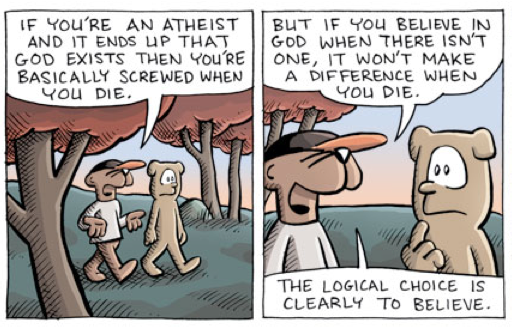
PascalsWagerYou’re probably familiar with Pascal’s Wager. It says that even if there is only an infinitesimally small possibility that god exists, the consequences of eternal reward or punishment far outweighs any earthly cost. Therefore, a smart person should “hedge their bets” and believe in god.

This is incredibly specious logic but it nevertheless holds powerful sway over a great many people. Lots of otherwise intelligent thinkers put it forth as a reasonable argument, even as an inescapable iron-clad rationale. But there are many flaws in it including the assumption that belief is a harmless hedge. In the end it is no more than a silly trick of logic that can equally justify anything whatsoever. By this logic, for example, the proposition you received via email from a Nigerian Prince might be legitimate. However small the chance that it’s real, isn’t it worth responding? In fact, the Nigerian Prince is far more likely to be real than is god. Such a prince could actually exist.

But you might reject that argument with yet more pseudo-logic. You might argue that only heaven is sufficient reward to offer compelling enough stakes to accept Pascal’s Wager. And I then counter by suggesting right here and now that you cannot get into heaven unless you give up ice cream. Regardless of how small the chance that god only favors those who prove their faith by forsaking ice cream, Pascal’s Wager demands you give it up. But I doubt you would accept that wager and actually swear off ice cream.

We reject most such nonsense out of hand. Here is yet one more flaw of Pascal’s Wager. We apply it only to one extremely specific assertion and reject an infinite number of others even though they are equally legitimate according to the logic put forth. You can counter yet again and say, well but I cannot play all possible lottery games, and I choose to play this one. Fair enough, so I can counter your counter. This logical fencing goes on and on unendingly without resolution. Playing mental games is something we humans do extremely well.

But why do we reject the same logic for pretty much anything else except the god proposition? We reject it because such logic is clearly stupid. And this brings us to yet another problem with Pascal’s Wager. There is actually in fact no possibility, none, nada, nil, zero, absolute zero, that god actually exists. Someone will in fact actually win the $100M lotto, so that might be worth a $2 ticket by Pascal’s logic. But no one can actually go to heaven because it does not exist. And you cannot claim “but it could” unless you really are equally willing to ACT ON every other impossible proposition.

This illustrates a fundamental problem with logic. As powerful and important as it is, logic has limitations. Thinking that abstract logic necessarily reflects reality can be like a Chinese Finger Trap. I just read an interesting book by Jordan Ellenberg called “How Not to be Wrong: The Power of Mathematical Thinking” (see here). I do recommend it highly. But in it he twice states emphatically that “reason cannot answer the question of god.” If that is true, then it is our reason that is flawed. And it’s easy to see how. Ellenberg is a mathematician. Even a mathematician can become too familiar and comfortable with mathematical concepts like infinity that have no actual basis in reality. Our minds can conceive of symbols and rules of logic that cannot exist in reality. God is one of those. Pascal’s Wager is one of those. It is a human conceptual model that leads to seemingly incontrovertible but nevertheless absurd conclusions.

To illustrate the problem of blindly accepting a “logical” argument without insisting upon testing that logic against reality, consider Zeno’s Paradox. In the 5th century Zeno gave us his famous paradox that says that since we cannot arrive at our destination without infinitely cutting the remaining distance in half, we can never actually arrive at it. The “logic” of this proposition has confounded thinkers ever since as it is extremely difficult to refute by the rules of logic. But a guy called Diogenes the Cynic disproved it by simply standing up and walking across the room.

We humans have an amazing capacity to imagine things outside physical reality and to conceptualize logical systems of rationality that are imperfect in describing that reality or that extend beyond physical boundaries. But we have to be careful that our own cleverness does not make us stupid. Get up and walk across the room. God does not exist and religion is not a harmless hedge.

Here’s the bottom line. If your system of logic leads you to the conclusion that god might exist or that you cannot ever reach the other side of the room, it’s because your system of logic is flawed or ever-extended or you just want it to be true. If your logic cannot disprove flying pigs or gods, you are not thereby proving that god might actually exist. You are merely encountering the limitations or failings of your logic.

And to my agnostic atheist friends who refuse to say with certainty that god does not exist, if you allow for any possibility that god might exist, you have essentially lost the argument. You have admitted that Pascal’s Wager is reasonable and that belief and religion are therefore reasonable. You may think you can logic your way out of that shifting maze, but that only leads to endless ridiculous arguments that mostly serve to give undue credibility to the ridiculous.

WE HAVE NOT YET BEGUN TO SHOUT!

gunPresident Obama’s press conference after the shooting at Umpqua Community College in Oregon yesterday set the right tone – one of barely contained anger and frustration. In appropriately subdued Presidential tones Obama screamed as passionately as he could for people to get angry and make their voices heard by our leaders.

Later in the day, when Vermont Senator Bernie Sanders gave his obligatory post-massacre interview on the Chris Hayes Show, he also conveyed evident outrage but his message was substantively less compelling:

Condolences are not enough, we’ve got to do something, we have to stop shouting at each other, we need sensible gun control legislation, and by the way we need to significantly improve mental health services.

Don’t get me wrong. I will vote for Bernie. You should vote for Bernie. He is the only one with any inclination to make substantive positive changes to the status quo. But in statements like this even Bernie merely reiterates the endless feckless calls for “sensible legislation” and again diverts the focus toward mental health. This is nowhere near the level of outrage and action that even the President understands is warranted and necessary.

Look, I’ve railed against guns for going on 40 years. I’ve argued with family, friends, associates, and even random strangers whenever the issue of guns has come up. I write impassioned articles whenever I can (see here). But none of these even begin to “shout.” These are all attempts at rational, reasonable debate about sensible gun control legislation. But here’s the thing. Calls for sensible gun-control legislation have never worked and never will. Any “sensible” regulations accepted by the killing-industry would only be those that actually do nothing at all.

Bernie, here is what shouting looks like…

BAN EVERY FUCKING GUN IN AMERICA! MAKE IT ILLEGAL TO MANUFACTURE, SELL, OR OWN ANY FUCKING GUNS WHATSOEVER! COLLECT THEM ALL UP AND MELT THEM INTO SCRAP AND DROP THE SCRAP DOWN A PIT THAT LEADS INTO HELL. FUCK THE RIGHT OF HUNTERS TO SLAUGHTER WHATEVER FEW NOBLE BEASTS REMAIN ON THIS PLANET. FUCK THE DISTORED AND PERVERTED AND ARCHAIC SECOND AMENDMENT. FUCK THE IDEA THAT GUNS ARE PATRIOTIC. FUCK THE ENTIRE GUN INDUSTRY AND GOOD RIDDENCE TO EVERY FUCKING GUN MANUFACTURING JOB. SUE OR PROSECUTE EVERY FUCKER THAT MANUFACTURES OR TRAFFICS IN GUNS EVERY TIME THEY ARE USED TO CAUSE HARM!

Now that is shouting. See the difference Bernie? The upper case and profanity kind of give it away. Perhaps now you can see that we have not actually yet even begun to shout. But we need to start. Unless we take the most extreme position, and unless we shout that extreme position in every hall of government and on every street, gun-lovers and their merchants of death will never give so much as an inch. The only way we can make any changes is if we are so extreme about gun control that they must crawl to us with hats in hand in the hopes that we might give them an inch. Maybe, if they can pass the background checks and mental health exams and buy sufficient liability insurance and jump through every other hoop we can think of, maybe we will let them keep a gun locked safely away in their house.

Readers, we need to show this country what shouting really looks like. We need to shout so loudly and with so much vitriol that the gun industry shits their pants and finally becomes willing to accept a modicum of social responsibility and accept a bit less profits.

Link this article to join my “WE HAVE NOT YET BEGUN TO SHOUT!” anti-gun movement and show our leaders and the gun-industry what shouting really sounds like.

POST-DEBATE ADDENDUM

The first Democratic Debate was held last night and Bernie doubled-down on his “stop the shouting” rhetoric. His hypocrisy on this issue is incredibly disappointing. His entire brand is the red-faced chest-thumper calling for us to get angry and shout our outrage on a wide range of issues he cares about. But when it comes to the blight of guns, he admonishes us to calm down and stop the shouting. Bernie, we are going to keep shouting until even YOU cannot ignore us!

The False Security of our Wall

wwzPeople build walls of all kinds and trust in them for protection. But walls are defenses of last resort. If determined enemies reach your walls, you are probably already doomed. Your walls may repel the initial wave, they may block a host of arrows, but eventually they fall to sappers, they’re breached by catapults, or they’re simply overrun by sheer unrelenting numbers. Even the Great Wall of China did little to defend against the Huns who never ceased probing for gaps, weaknesses, and vulnerabilities. Nor did it offer protection against the Manchus who simply bribed their way through a major gateway. The seemingly insurmountable wall built in the movie World War Z to keep the world on the other side did little to protect civilization in the end.

Still, we continue to imagine that walls will protect us against most any threat. Many think a wall will protect them from the imagined threat of illegal immigration. Many think the walls of their gated community will protect them from the increasingly impoverished masses. Many think flood walls will protect their cities from the inexorable tides of rising oceans. Clearly they are all tragically mistaken. If Mexicans really wished to find ways into America, a wall would prove to be little more than an inconvenience. A gated community is not a self-contained biosphere and the poverty of the surrounding world will still have deadly impact on those barricaded within. And if we have not taken action to halt greenhouse gas emissions before the oceans rise to claim our coastal cities, our seawalls will prove to be no more than pathetic proof of our folly.

It is similar folly to imagine that our great Wall of Separation of Church and State truly protects secular society from the relentless incursions of religion. For every religious initiative it blocks, many more get through. This Wall, like any physical wall, cannot endure continual attacks without continual vigilance. And the reality is that its defenders are few and they get tired and need to rest while their attackers are endless and inexhaustible. If we naively hope to limit the harmful impact of religious delusion, to contain it harmlessly segregated outside the Wall, we are doomed to either suffer the slow death of a thousand religious slings and arrows or fall beneath an eventual catastrophic collapse.

This is not to say the Wall is not important. It is vitally important. But it is only a seat-belt that can limit injury but cannot address fundamental car safety. It is a pair of safety goggles that helps minimize some accidents but cannot hope to protect against unsafe lab practices. The Wall can shield us somewhat but if we rely solely upon it for our protection and safety, we cannot long survive.

Yet far too many secular leaders see protecting the Wall as a sufficient end goal of secularism. Even worse, they argue that it is not our place to dictate what goes on beyond that Wall. They imagine that as long as we have the Wall, secular and religious folk can coexist happily, separate but equal, on their respective sides.

This is folly. It is folly not only because religious people will never cease their efforts to breach the Wall – though they certainly will not. But moreover as long as we condone their ideas by giving them undue respect, as long as we give mass delusions any credibility or any benefit of any doubt, the believers conclude that their beliefs have as much legitimacy as our conclusions and they will understandably never be satisfied with anything less than a decisive voice in public policy decisions.

Consider the inevitable result of halting our secular outreach at the Wall. Religious people then have the relatively unchallenged freedom to exercise their delusions on their side. On their side they will continue to educate their children to believe fairy tales. They will continue to preach to the faithful to ignore science and reason. Some will continue to incite religious radicalism. These believers can then reach right through our mighty Wall at any time with their vote and their representatives are duty-bound to represent their religious views in public policy.

The only way to ensure a sane and stable society is to eliminate the need for any Wall. And the only way to do that is to evangelize science and fact-based thinking and stop showing undeserved respect or deference for religious or new age thinking. If we do that, if we venture outside the Wall and fight for a society where science and reason are taught to all and respected by all, religion simply fades away on its own. If we do not, if we trust in our Wall to protect our secular way of life and let religious thinking fester and grow, then we cower inside the false security of a death-trap.

It is naïve, even cravenly irresponsible, to set merely protecting the Wall as the boundary of our legitimate self-interest as a secular nation. No beliefs are benign and no beliefs are without wider consequences. They are all infections that compromise the rational capacity of the greater society. We must take the fight of reason and rationality directly to religious people. If we do not eventually eliminate the magical thinking that makes us require a Wall, and probably quite soon, then we will one day look around to find that it has been trampled to rubble under the march of believers.

The Damage Done by Dawkins

I am really, really frustrated by the spineless unwillingness of my fellow atheists to just say simply, clearly, and without qualification that god does not exist. Period. End of story. Not worth debating. Drop the mic.

Instead, most are agnostic atheists who have followed the misguided lead of Richard Dawkins. Like him, they feel incessantly compelled to show how reasonable they are by pointing out that “of course scientists cannot say for certain that god does not exist” or “we can only say that god probably does not exist.” Even rabid, angry atheist “firebrand” David Silverman appends his comments with the same expected declaration of reasonableness.

The British Humanist Association did a now famous series of bus ads which said “there’s probably no god” (see here). Organizer Ariane Sherine defended the use of the word “probably” by invoking Dawkins:

There’s another reason I’m keen on the “probably”: it means the slogan is more accurate, as even though there’s no scientific evidence at all for God’s existence, it’s also impossible to prove that God doesn’t exist (or that anything doesn’t). As Richard Dawkins states in The God Delusion, saying “there’s no God” is taking a “faith” position. He writes: “Atheists do not have faith; and reason alone could not propel one to total conviction that anything definitely does not exist”.

I do understand some of the motivations behind this. First and foremost we atheists over-compensate out of fear of being called dogmatic. And we are cowered into sissy-talk to avoid the criticism that we too rely upon faith in the end. Finally, we are buffaloed into believing that a good scientist must be “open-minded” (agnostic) about everything.

Look, whenever you need to judge the reasonableness of any statement regarding god, just substitute “Easter Bunny.” It is neither dogmatic nor an expression of faith to state with absolute certainty that the Easter Bunny does not exist. You are not a bad scientist if you dismiss the Easter Bunny hypothesis out of hand. Quite the opposite, a good scientist is not a gullible scientist and good science does not require the suspension of rational thinking. A good scientist does in fact reject fundamentally implausible propositions out of hand. A good scientist does not acknowledge any possibility that perpetual motion machines might exist or that one might be able to chemically change lead into gold or that god might exist.

Although Dawkins has done a huge amount of good, this is one place where his tremendous influence has greatly undermined the cause not only of atheists but of rational thought. It does not show reasonableness to entertain unreasonable ideas and it is not enlightened to give any measure of credulity to absurd propositions.

This idea that “we cannot know anything with absolute certainty” may make for a stimulating discussion in a Philosophy 101 class, but science is built upon the foundational bedrock that we can indeed know the cosmos with certainty. Might we actually be hooked up to The Matrix being fed a simulated reality while we lie in suspended animation in a huge alien complex? Maybe, and that’s actually more plausible than granting any shred of doubt as to whether god exists. But we do not feel coerced into acknowledging that the idea we are all sleeping in The Matrix is a real possibility. Maybe when The Matrix becomes our next religious mass delusion, Richard Dawkins will feel compelled to point out that he cannot be certain it is not true.

Many argue that expressing this uncertainty is merely intellectual honesty. However it is not insignificant that no one goes to such great lengths to append this caveat to other absurd propositions. I have never heard anyone take pains to point out that “of course we cannot be certain that suicide bombers will not be greeted by 77 virgins.” We apply this only to our own Christian god proposition. And that is because this is not a principled expression of general intellectual integrity. This is a matter of showing a particular undeserved deference to our own preferred delusion. Our exceptional application of this disclaimer gives it disproportionate weight and distinction.

This is not just an academic nitpick. Repeating the meaningless truism that we cannot know anything with certainty in the context of our belief in god is highly counterproductive. When you say it, most listeners only hear “even you atheists have doubt,” and “even Richard Dawkins acknowledges that we cannot know for sure that god does not exist,” and “even David Silverman admits that we could be right.” Christians turn this language back against us with great success. Most believers or even impressionable fence-sitters are not impressed by Richard Dawkins philosophical honesty. They’re more like Jim Carrey in Dumb and Dumber with Richard Dawkins playing the role of Mary Swanson.

chanceLloyd Christmas: What are the chances of a guy like you and a girl like me? One in a thousand?
Mary Swanson: Um, more like one in a million.
Lloyd Christmas: “So you’re telling there’s a chance then! YAAAY!!”

Mary should have simply said “no chance whatsoever – not gonna happen!” So come on atheists, stop being namby-pamby agnostics already. We can say with absolute certainty that pigs cannot fly and we can say with equal certainty that god does not exist. We can say this because there has never been any evidentiary proof of god when we should expect to see some, and there is no logical inference anyone can make based upon what we do observe to suggest he might exist in the way we might postulate a form of life on a distant planet or an evolutionary descendent in our far future.

I am an Absolute Atheist and proud of it. Does that make me arrogant? Well if it is arrogant to claim certainty that the Easter Bunny does not exist, call me arrogant. The day any legitimate evidence of an Easter Bunny is credibly reported, I’ll change my mind. Wait, I take that back. Even that qualification imparts way too much undeserved legitimacy to the beliefs of the Church of the Holy Easter Bunny.

The Language of Reason

reasonWe routinely use a large number of very similar words when we talk about thinking: rational, rationale, rationality, irrational, rationalize, rationalization, reason, reasonable, and even superrational. We all kinda-sorta mostly generally understand the nuanced differences between these words, but since they are so very important and so often confused, it may be helpful to put them all on the table where we can clearly compare and contrast them.

Rational describes thinking that is based upon true facts and sound logic. This is the good kind of thinking. It requires that the thinker is unbiased, fact-based, sane, logical, and as objectively correct as one can be given the best information available. Note that the threshold here is quite high. It is not enough to merely follow “my own logic” to reach a conclusion, but that one follow independently valid logic and adhere to independently validated facts. One cannot merely feel they are being rational; they must in fact be objectively, measurably, demonstrably rational. A certifiably crazy person may be absolutely convinced they are perfectly rational in concluding that aliens are beaming signals into their brain, but that does not make them so.

Rational thinking implies that one meets all these requirements in a particular line of thought. A rational thinker is one who generally employs rational thinking. Often this term implies that one consciously values rational thinking as well. Although religious thinkers insist upon being shown respect as rational thinkers, it is difficult to see how their claims in any way reach the threshold of rational thinking. They seek to dilute and diminish the term so that it applies to them.

The term rationality is generally used in the context of questioning one’s rationality. That is, when we wish to make an assessment of a person’s capacity to be rational, either generally or at a given time.

Superrational is a term coined by cognitive scientist Douglas Hofstadter to describe a cooperative group behavior in game theory. However like many scientific concepts it has been incorrectly hijacked by New Age types. They invoke it to suggest that there is some intuitive mode of thought that transcends normal rational thinking – which they then invoke to justify any magical thinking they wish. They might say, for example, I believe in psychic powers because I’m a superrational thinker.

The word reason is trickier. In its basic form it is inherently neutral with regard to truth or rationality. It simply describes the cause, explanation, or justification one uses to explain their conclusion or action. But we also use it more generally to describe our rational capacity. It is in this sense that it is used for example in the “Reason Rally.” It sounds better there than would the “Rationality Rally.” The word reason also has the benefit of invoking feelings of reasonable or reasonableness.

However the connection between reason and reasonable is also a problem. Reason shares the fairly high bar with rational. But to be reasonable only requires that one be fair, moderate, and sensible. That’s why the word reason is a dangerous one to substitute for rational. Using reason as a synonym for rational can lower the bar for rationality in the minds of many people who might like to claim that their “reasonable” beliefs are rational conclusions because they are reasonable. Reasonable people can agree to disagree. Rational people cannot disagree for very long.

And that is a great segue into the biggest source of confusion amongst these terms. Just as the word reasonable dilutes the word reason, the word rationalization dilutes the word rational. Even worse, it totally reverses it!

Although it seems like they should be different forms of the same word, rationalize is almost the complete opposite of rational. To rationalize is to contrive some rationale, some apparent logic, to make the illogical appear perfectly rational. It is to “rationalize away” facts, logic, and reason. It is the process of deluding one’s self into thinking that some possibly preposterous idea is sound and credible regardless of the facts of the matter. We rationally reach scientific conclusions, but we rationalize our religious beliefs to convince ourselves that we are rational thinkers. These are not remotely equivalent.

This is insidious because once we have rationalized something, it then seems completely rational to us. Once rationalized, we become certain that our thinking is perfectly sound and reasonable. And we have evolved to be incredibly good at rationalizing. From the evolutionary perspective it was evidently far more important that we feel certainty in the face of ambiguity or the unknown; that we reach harmonious consensus in a delusion, than that we know the real facts of the world. There is also evidence that belief served a benefit of requiring less energy consumption as well (see here). But belief is no longer a beneficial or even harmless adaptation in our modern world.

Despite the fact that it no longer serves us well, we as a species remain incredibly good at rationalizing. Clinically delusional people are often completely certain that their delusions are perfectly rational. But this isn’t just an affliction of the insane. Rationalization is our normal human brain function that we are all susceptible to. Once rationalized, we normally continue to believe any ridiculous belief without reevaluation. We don’t need to be beyond the threshold of insanity to hold some insane rationalizations.

The lesson then is to be very skeptical when anyone insists that their conclusions are rational – even when it is ourselves. Few of us can distinguish between our own truly rational positions and completely rationalized ones. Fortunately science gives us methods to help us assess whether our conclusions are fact-based and soundly logical.

Likewise, we don’t need to train our young thinkers to rationalize problems, as they are innately quite adept at that already. Education in debate, law, marketing, sales, religion and many other fields mostly enhance our innate ability to create any argument that convinces others – to rationalize. We need far more training in science and skeptical thinking so that we can  better judge whether the rationalizations that impact our lives are truly rational.