Author Archives: Tyson

Unknown's avatar

About Tyson

Love writing all kinds of stuff including fiction, non-fiction, editorials, etc. But writing software is the only writing I do for love AND money!

Clobberin’ the Critics

FantasticFourThe Fantastic Four reboot premiered in movie theatres last weekend. Despite, or because of, the fact that I’m a huge superhero fan, I was really apprehensive about the release. The previews looked stiff, the casting looked highly questionable, it was yet another stupid origin story to “reboot” a franchise, and it was a completely “made up” origin story to boot. No one I knew was excited about it in the least. Even the director came out ahead of the release apologizing and making excuses for it. Without exception reviewers ripped it to shreds with Rotten Tomatoes giving it a disastrous 9% rating (one review).

So of course I went to see it.

This wasn’t unusual of me since I’ll see any superhero movie. And since I usually disagree with professional reviewers anyway, their unabashed bashing was a reverse-psychology encouragement for me. Moreover, I’d seen and greatly enjoyed the previous two Fantastic Four movies despite the fact that I’ve never met anyone gracious enough to utter even the most insincerely polite comment about those.

And – hey Mikey – I liked it! Although I seem to be the only person in the world who thinks so, I thought this reboot was worthy. It certainly didn’t fulfill all my preconceived ideas or hopes, but it wasn’t my tale to tell. How can I expect to enjoy any story-telling if I insist upon inserting all my own expectations? How can I ever be surprised and amazed if all filmmakers ever give me is exactly what I imagine in my limited imagination?

Which brings up a much broader observation… people are WAY too hard to please. It’s not even just that they’re hard to please; it’s that while they imagine that they want to enjoy things, they are really incapable of it. In short, often the problem is not the movie, it is us.

Maybe you just cannot appreciate the film.
I used to live in London and as a lonely bachelor I went to see movies frequently. I was continually amazed how all the Brits would go to see American comedies and chortle begrudgingly at all the most unfunny moments while sitting stone-faced though all the intended jokes. Then they would walk out of every film commenting on how unfunny it was. It’s not really that those films were not funny; they were just not funny to Brits. Similarly if you hate action films and go see one anyway, don’t complain that there were too many fist-fights and not enough kissing.

Maybe you have gotten too old and jaded.
When The Phantom Menace came out, all my coworkers complained vigorously and incessantly about how much Jar Jar Binks had ruined the movie for them. I found Jar Jar to be quite cute and funny, but most everyone universally hated him. I contend that Jar Jar was essentially exactly the same as the Ewoks those same people loved in their youth. It wasn’t the movies that changed, it was them. They have become incapable of enjoying movies through the same fresh and uncritical lens they used to, and they are continually disappointed that moviemakers don’t make any films that touch them like they used to.

Maybe you’re just a douche.
Too many people need to prove how smart and insightful they are by dissing everything. You know the type. They just can’t wait to impress their date or kids even as the credits are still rolling with their scathing critique. And if the movie is superb, they feel especially compelled to show that they are even more discriminating. “It completely ruined the whole movie for me that Gandalf’s staff had runes clearly etched in Valinor rather than ancient Moriquendi.” Really? How sad for you…

Now let’s be clear. I’m not suggesting that you should indiscriminately like everything and indeed some movies are deserving of unreserved ridicule. Battlefield Earth and Dune come to mind. But Fantastic Four has a lot to like. More often than not, your disappointments in life may say more about you than the movies or whatever other activity is disappointing you at the moment. If you don’t get something many others do, if you think nothing is as good as it used to be, or if you feel compelled to critique everything to prove your good taste, then it may just be you that is the only disappointing commonality in those equations.

I for one, am really, really happy that my standards are incredibly low. I can go see the Fantastic Four and enjoy myself while you lose out. How much better is that than setting seldom achieved standards and being disappointed in most everything life has to offer? And when it comes to people I associate with, I much prefer those rare individuals who can truly enjoy most everything, who can appreciate the filmmakers vision, rather than seek out the flaws and buzz-kill every bit of enjoyment for everyone.

  • There are few boring situations, just mostly boring people.
  • Interesting people can get interested in pretty much anything.
  • Positive people find the positive in most everything.

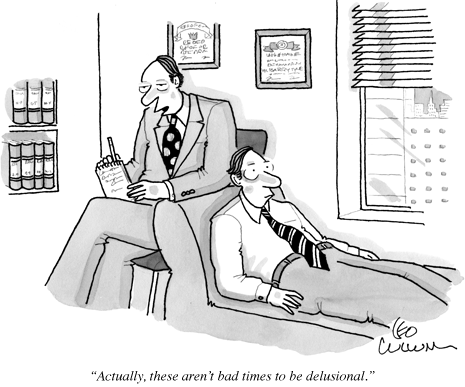
The Delusion Defense

In a previous article I made the case that all religious beliefs are delusions and should be called out as such (found here). I really do keep this view in perspective however and don’t actually feel particularly compelled to call out all my religious friends and associates as delusional at every opportunity. But I still maintain that it is absolutely necessary to do so without compunction when it comes to extremely delusional thinkers like Ken Ham (see here) who publically propagate a large number of very bizarre delusions.

Regardless of how accurate and justified it may be to characterize all religious beliefs as delusions, doing so is problematic simply because of the huge number of people who believe. If you call religious beliefs delusional, then all religious people are at least somewhat delusional. And that is most of us. And if believers are all delusional, that would produce profound ramifications in all manner of social and legal interactions.

In his book “Bad Faith” (found here), Paul Offit looks at the insane faith healing beliefs of Amish, Christian Scientists, and Jehovah’s Witnesses who feel compelled by their faith to commit murder through the withholding of medical care for their children and other loved ones. In a recent lecture I attended, Offit observed that our legal system essentially gives these families “one free murder” before the State is willing to characterize their beliefs as dangerous and harmful.

Sure they are clearly crazy. But non-religious people can be crazy too. Most normal religious beliefs are entirely reasonable.

Except it is not that simple.

In his book “Under the Banner of Heaven’ (found here), John Krakauer documents the insane history of Mormonism and the 40,000 Mormons who still believe much of it and practice polygamy. In particular, he documents the story of Ron and Dan Lafferty, Mormon brothers who felt compelled by their faith to commit multiple murders. The defense in that case argued for an insanity plea based largely upon the craziness of their religious beliefs.

Their defense argued that the delusional beliefs of the Lafferty brothers rose to the level of insanity and that their clients were therefore not fit to stand trial. However, psychiatrists for the State argued that their beliefs were essentially no different in any qualitative way from any other belief considered “normal.” (It could be argued that no person who believes in an afterlife truly understands the consequences of their actions.)

In his book “Thinking About the Insanity Defense” (found here), author Ellsworth Fersch lays out the fundamental problem in the Lafferty case:

“Their strategy was to show that he was sane through comparison with other individuals. First, they pointed out all the similarities between his fundamentalist religious beliefs and the religious beliefs of people with ordinary religious faiths. By doing so, they made his seemingly outlandish claims and ideas seem much more normal. For example, Dr. Gardner compared Ron Lafferty’s belief in reflector shields to belief in guardian angels. This strategy was effective because it forced anyone who was willing to consider whether he was insane to also consider the larger question of whether any religious person is insane.”

Belief ties sanity and delusion into an almost inescapable Gordian knot. To uphold an insanity defense would be to imply that all religious believers are similarly insane. That would never be acceptable. But to exempt religious beliefs would make it extremely difficult to ever characterize anyone as insane or make any value judgment about any belief. It would make it difficult to interfere with any dangerous behavior such as faith healing when it is claimed to be based upon a “deeply held belief.” That in fact serves the narrow self-interest of believers.

DelusionDefenseThese are extremely vexing conundrums even for psychologists.  They have been completely muddled over this all the way back to Freud who suggested that all religious beliefs are delusional and that religion is a mass-delusion. On the more diplomatic side of the argument is the definition established by the American Psychiatric Association (codified in DSM-IV) which says essentially that a belief is a delusion – well unless enough people believe it that is. Clearly if Freud is right, then that conclusion leads necessarily to widespread clinical, social, and legal ramifications. However, if the APA is correct, then sanity is completely contextual. What might be sane in one society or in one group or at one time in history may be completely delusional and result in institutionalization in another setting. Precisely how many believers must I recruit in order for my insane delusions to be considered sane and immunized from ridicule? The APA view creates significant social problems for all aspects of society.

In his paper “Faith or Delusion? At the Crossroads of Religion and Psychosis,” Joseph M. Pierre attempts to review the psychiatric literature in order to find a sensible middle ground. Pierre points out that:

“Neither Freud’s stance that all religious belief is delusional nor DSM-IV’s strategy of avoiding mention of religious thinking in discussions of psychosis is an acceptable way to resolve the ambiguity between normal religious belief and religious delusion.”

One might think this question should be resolvable by simply looking at other criteria to evaluate sanity, not merely the presence of religious beliefs. But Pierre goes on in his paper to review the body of psychiatric works that attempt to distinguish faith from delusion using a wide range of possible criteria. None of these attempts prove to be satisfactory. Since every belief is inherently not based on any objective facts, it is impossible to make qualitative distinctions between “normal” beliefs and “delusional” beliefs. Attempts to measure their impact by other indirect measures, such as excessive preoccupation, conviction, emotional valence, claims of universal validity, and level of contradiction all fail to provide a satisfactory distinction.

So the situation we are left with is that we are precluded from ever admitting that religious beliefs are delusional, even though the APA defines beliefs as delusions held by a sufficiently large number of people. Instead we are forced to make mostly arbitrary decisions about when to characterize a belief as a delusion. But I think I have a suggestion to help with this problem. It seems to me that much of this Gordian Knot is glued together by a presumption, a prejudice, and a conceit that says that sanity and insanity are exclusive binary conditions.

As I argue in my book (found here), we each have a myriad of ideas that could each be placed along a wide spectrum from sane to insane. If someone has a lot of delusional ideas a lot of the time, that person may cross the threshold of clinical insanity, but we all still do have some insane ideas some of the time.

If we would only stop applying to word delusional to people and instead start applying it with less reluctance to ideas, recognizing that we all have some delusional ideas some of the time, then I think we go a long way toward reaching the balance we need to respond to mass-delusional thinking in a more reasonable and consistent manner.

But I’m out of room for now. I’ll expand on this in a future article.

Alien Life Exists!

Pollsters love to ask us whether we believe in alien life. It is an interesting topic because it straddles the line between fact and belief. So where do you stand on it? Take a minute to mentally answer the following questions with Yes, No, or Not Sure.

1. Do you believe that alien life exists?
2. Do you believe that intelligent alien life exists?
3. Do you believe aliens have visited the Earth?

Americans are pretty divided on these questions. About 50% of us believe there is some form of life on other planets (even if only akin to bacteria) while 33% are not sure. We are more skeptical about the existence of intelligent extraterrestrial life with about 38% believing they are out there while about 42% are unsure (see here). Polls also generally report that roughly a third of us believe aliens have actually visited the Earth. Apparently most of us who believe in intelligent alien life also believe that those aliens are capable of reaching the Earth.

How did your answers compare? This may surprise you, but I am completely confident that the 50% of Americans who are believe that alien life exists are completely…. right! Regardless of what you believe, it would be understandable for you to ask, how can you be so certain? Have you seen aliens? Can you show me scientific proof of alien life?

The answer is that I have a particular kind of certainty here called a “statistical certainty.” A statistical certainty is something you can be confident is true even though you may never prove it in the conventional sense. For example, I can be statistically certain that right now as you read this most excellent article, someone somewhere is thinking about bananas. Can I prove this? Obtaining clear proof, finding even one such person may be theoretically possible but practically unlikely. Still, given the number of people in the world and the commonness of bananas, I can be quite sure of it nonetheless.

Similarly, we can clearly say with statistical certainty that life does exist on other planets. Even though I’ve never seen an alien, have absolutely no scientific evidence of alien life, and no expectation of ever meeting one, I do know that the rules of chemistry and physics that gave rise to life on Earth are equally applicable on every Earth-like planet. And all available evidence tells us that there must be a huge number of such planets in our universe. So therefore, I can bank on the statistical certainty that yes, some kind of life does exist on other planets.

Is this essentially the same as a belief then? Am I simply playing word games to rationalize my belief in aliens? Absolutely not. A belief has no basis in statistical certainty. A belief exists despite of a complete lack of any basis upon which to form a even a statistical plausibility. We have no basis upon which to believe in god or ghosts or gremlins, no consistency or conformity with observable evidence, on which to base any legitimate statistical confidence.

So let’s move on now to the second question, whether intelligent life exists in the universe. I think that the 38% who believe happen to be right again – even if for the wrong reasons. (Which brings up the side question, is one truly right if they are right for the wrong reasons?)

We can reasonably bank on a strong statistical confidence in the existence of intelligent extraterrestrial life, even if it is not quite a statistical certainty. While my confidence in intelligent aliens may not be not quite as high as in alien bacteria, it is still a sensible default to assume that yes, intelligent alien life does exist somewhere. And again, this is not belief or wishful thinking, but an assessment founded upon the consistency of physical laws throughout the universe and the sheer number of life-sustaining planets that undoubtedly exist in it.

Finally, what about the third question as to whether those intelligent aliens (that we are statistically confident must exist) have ever visited Earth? On this question I go completely the other direction. There is no credible evidence that any have ever visited Earth in the past – and we would expect to find such evidence. Some alien Coke-cans littering the Nazca Desert or anything. Further, there is no logical mechanism to give one any confidence that aliens could visit us now or for that matter ever in the future. While allowing some tiny plausibility based on what we may not know yet, the tremendous gulf of time and space between us simply makes such interstellar travel diminishingly unlikely.

Many people would argue against my skepticism. Surely, they say, you’re too narrow-minded. You lack vision. Certainly a sufficiently advanced species could produce some technology to travel between solar-systems. At one time people scoffed that we could never reach the moon, and look we did it anyway!

AtomBut the problem here is our solar system is an incredibly tiny dot in an effectively infinite ocean. The gulf between stellar systems is literally astronomical. The barriers of time and space between civilizations are so fundamental that physical travel between them simply runs up against too many inviolate laws of physics. Interstellar travel is not comparable to crossing a vast ocean. It is more comparable to shrinking down to the size of a cell like Ray Palmer (The Atom) and swimming though a blood vessel. Barring some completely fantastical warp-hole technology, it is simply not happening, not ever, not for us or for any alien species no matter how advanced.

Belief that science will always find a solution to everything illustrates the fallacy of an unreasonable belief in technology. This is a dangerous belief when it delays or undermines more effective and necessary action, as it does now in the case of global climate change.

So in summary it is a statistical certainty that life exists on other planets and it would be highly surprising if some of those life forms were not intelligent. But it is extremely unlikely we’ll ever even detect signs of each other, let alone communicate or pay each other a visit. Nevertheless I fully support continuing to look for signs of intelligent life in the universe, even knowing that by the time we see such evidence they would almost certainly have been long extinct. Knowing that intelligent life existed somewhere else, even if only light-ages in the past, would change us fundamentally forever, and I think for the better.

Ares Targets Iran

GodOfWarIn Wonder Woman comics, the Amazon Princess often does battle with Ares. The God of War ceaselessly and eternally dedicates himself to instigating violence and fomenting war. He is especially difficult to combat since he doesn’t usually act directly. Most of the time he works covertly, behind the scenes, pulling strings and pushing buttons to ensure that greedy, ideological, or even well-meaning humans are tricked or prodded and driven to war. Two of Ares most powerful lies are convincing people that war is inevitable and that war is necessary to ensure peace.

Ares would have been proud of our 1990 Gulf War which was based on “a pack of lies” (see here). In the comics, he often takes the form of humans to influence events. He certainly might have taken the form of Bush Senior in snookering Saddam into attacking Kuwait. Then, he no doubt might have inhabited Dick Cheney to lie us into the second Gulf War and subvert Colin Powell into supporting him.

We really need Wonder Woman right now because Ares has long set his gaze upon Iran as the next great senseless battleground and he is hard at work to sabotage any possible deal with them that might delay his carefully laid plans.

Of course I refer specifically to the battle over approval of the Joint Comprehensive Plan of Action (JCPOA), commonly referred to as the “Iran Deal.” The opposition to this agreement is much more than merely an honest policy debate between well-meaning people of good-will. This really is a clash between those who align with war-imperative of Ares versus the peace-making ethic of Wonder Woman. For Ares, this Iran deal threatens to delay his plans to ensure uninterrupted and perpetual war.

While Ares and Wonder Woman may be only metaphors, these figures nonetheless personify our real, iconic struggle against those who are dedicated to the ideology of war and crave the plunder that wars yield. And the rest of us are not merely spectators of this struggle, we are participants in it whether we accept it or not.

But we cannot win this war against war if we do not understand our enemy. If we naively refuse to consider that anyone would actually WANT war, we cannot hope to defeat those who do. And make no mistake. There are many people with tremendous amounts of power and influence over the political process in America who greatly desire a steady stream of war and will do anything to ensure the uninterrupted flow of the war pipeline.

In 2011, the 100 largest contractors sold $410 billion in arms and military services with some of the highest profit margins of any industry. Is that a lot you ask? Well consider that the entire world-wide cell phone market is expected to reach $341 billion in 2015. So yes, the military industry is indeed humongous by any comparative measure with far higher profit margins to boot.

But the mobile phone industry has something the war industry does not. Cell phones wear out, get lost, and need to be upgraded constantly. The viability of their market, their prospect for sustainable revenue, has no inherent limit barring some completely unforeseen new technology to replace it. The war industry however has a fundamental sustainability and growth problem. Without a constant stream of new wars to consume all those bombs they produce, without a constant stream of existential crises to convince people to pay for wars rather than for the betterment of the human condition, their entire industry collapses. Their gravy-train of war hits a brick wall.

Simply put, the war industry withers and dies without perpetual wars, and the war-profiteers understand that uncomfortable reality even if you do not. And the most foolish thing is to imagine that there just happen to be enough legitimate “organic” wars to keep the war profiteers in business and satisfy their lust for profit. There are not. On the contrary, without Ares-grade machinations, the war industry would dry up very quickly. In fact, we have innumerable quotes that reveal the determination of the war industry to ensure a permanent war economy by any means. Immediately after WWII, corporate war-moguls terrified at the prospect of peace set about ensuring that America would never return to a peace-time economy. I still recall just one memo that was circulated decades ago. It was written by a former President of General Electric and it said something close to the following:

“We can anticipate in the foreseeable future a time when aversion to war might become an insurmountable obstacle to our corporate interests. We must therefore take every action to assure a permanent war economy in the United States.”

This is not an anecdotal wacky comment. This general sentiment has been repeated by corporate leaders over and over again, often proudly. And “every action” includes searching for enemies and creating new ones to ensure wars. It includes destabilizing other countries to make them ripe for war. It includes making sure the “defense” industry is too big to fail so that any cuts can be linked to losing jobs. It includes ensuring that we remain in a perpetual state of fear. And of course it includes blocking any initiatives like the Iran Deal that might result in peace.

Some of these warmongers may truly be motivated by ideology rather than profit. But it’s hard to separate motivation from rationalization. It’s difficult to know when ideology is just a rationalization for profiteering or when ideology is the pawn of profiteers. In any case, it kind of doesn’t matter. Either way, the result is reprehensibly glib calls to “bomb bomb bomb, bomb bomb Iran.”

The bottom line is that we must recognize that Ares is not a nice, well-meaning guy who may simply be misguided or uninformed. We must acknowledge that he and real people with financial and political power actually DO want war, even cataclysmic war. They have worked a long time to set Iran up as the next bad guy in their domino chain and they don’t want see those war profits slip away.

If we keep assuming, as we typically do, that our opponents don’t really want war, or that they don’t understand that their obstructions could lead to war, we cannot hope to combat them. As unthinkable as it may be, many opponents of the Iran Deal do understand it would likely lead to war and that is exactly what they want.

If we don’t understand that reality, the real nature of our opponent, we cannot hope to help Wonder Woman to defeat Ares. And she cannot fight him without your help.

Sociopath’s Elevator Guide

If you do not happen to live in a 3D city like Manhattan, you probably don’t spend a good portion of your day getting hoisted up and lowered down again in elevators. We New Yorkers tolerate them in order to conserve the calories we need to hit the stair-master at the gym. But elevators aren’t as exciting as one might think. If these people-crates were made of glass they would be more fun, but for the most part we have to find ways to amuse ourselves during these awkward and boring rides. The good news is that there are a whole lot of shenanigans and hijinks one can play with elevators. Following is a helpful Sociopath’s Guide to Elevators.

Beat the Crowd
Here’s your first scenario. You arrive at the elevator bank to find 15 people waiting for the next elevator with a maximum occupancy rating of 12 persons. What I do in this situation is to nonchalantly meander to the middle of the crowd so that I can rush quickly ahead of the pack into the first door that opens. Admittedly I could probably get to my floor faster by waiting a moment for the next elevator which will likely be empty and make fewer stops, but the satisfaction of beating out those other losers into the first elevator is totally worth it!

Temple of Doom
Every time I see those elevator doors closing, I get a rush of adrenaline like Indiana Jones escaping from the Temple of Doom. It is super fun to lunge for the closing door and halt it in devil-may-care fashion at the last possible moment. The best part is that while the doors will grudgingly reopen, they are usually programmed to punish everyone with a long reset timer. If another Indiana Jones type comes along before they fully reclose, this fun can go on for hours!

The Ninja
While waiting impatiently for the doors to close before any more losers arrive, my best strategy is to play Ninja. The way I do this is to stealthily hide in the corner toward incoming traffic. If I can’t see anyone coming, I cannot be expected to hold the door open for them. But sometimes I cannot conceal myself in a position of plausible deniability. In these cases, I have to perform the Fake Button Reach move. As that pregnant mom is rushing for the elevator, I pretend I’m desperately trying (but failing) to reach the Open button. If you want to become a Ninja Master it pays to practice your “on no I’m too late!” expression in the mirror. Practice makes perfect!

Hold that Door!
When returning to the office with coworkers, they think I’m very chivalrous when I rush ahead and block the elevator door until they finally stroll up. This is great because the irritated people inside cannot complain for at least a minute or so without looking like jerks themselves. Also, if you’re married like me, your wife will reward you if you agree to run ahead and hold the door while she takes care of those 27 last minute urgent matters back in your apartment. Your ability to endure the hate-filled glares of everyone waiting in the elevator will prove to her how much you really do love her.

The Cigarette Run
I’m not a smoker myself, but one of the most satisfying activities for the veteran elevator sociopath is to run down and out for a quick cigarette fix five minutes before the start of that long, boring 2 o’clock meeting. If you puff frantically on that cigarette for 2 minutes you are guaranteed to reek. I mean gut-wrenching, rotting-corpse, dive-bar, up-chucking reek. Even though you can’t smell it on yourself, do not worry because I guarantee every non-smoker in the elevator will. It must be huge fun to watch them grimacing in disgust as they try to hold their breaths until the doors open and they can suck in that sweet air-conditioned oxygen! If you are a non-smoker like me, don’t worry because you accomplish almost the same effect by drenching yourself in a gallon of that “Trancher les Oignons” cologne you got from your secret Santa at last year’s office gala.

Ear Bud Antics
This elevator sociopath tip takes a bit of investment. Get a smart phone. Get crappy ear buds. Get your favorite music. Play said music at max volume on your crappy ear buds. Enter crowded elevator. Remember that while most people do love music, some inexplicably do not actually like your music, and certainly not when all they hear are the tinny frequencies that leak from your crappy ear buds. If it’s horrible music to them it’s doubly horrible coming from your crappy ear buds. Maybe if you play it loud enough through your crappy ear buds they’ll learn to appreciate it. If it’s music that your coworkers already love and treasure, it’ll be a particularly excruciating affront to hear it massacred by your crappy ear buds. No matter how you look at it, cranking music through your crappy ear buds is the best way for the elevator sociopath to make everyone cringe for the entire ride. The only way you can be even more annoying is to sing along at unnaturally high volumes like I do.

Fun with Positioning
For you more cerebral elevator sociopaths, it is great fun to experiment with positioning as the elevator fills and empties. I like to intentionally stand in non-optimal non-equidistant spacing positions and gather data on how much it freaks people out. Also, I like to stand right in front of the buttons so that people have to beg my pardon if they would like the elevator to stop at their floor. It effectively makes me the ruler of the elevator. I’m not especially tall, but if you are you can use that advantage by standing right in front of the video monitor. It’s fun to force everyone to crane their heads to read the latest stock indices or witty elevator wisdom. You can take great satisfaction that when they return to their office they will have no idea what is happening in the world and have no elevator witticisms to relate.

MonsterStrollerBundles of Joy
For more fun, wear a bulky backpack in the elevator. It’s a hoot to act like you are totally oblivious to the fact that your backpack is smooshing into the chest or face of the person behind you. If you don’t have a backpack with you, try dragging around one of those huge suitcases on a stick containing God-knows-what and wait until that 12 person elevator has at least 15 inside before deciding it can still fit you and your pet suitcase of God-knows-what. Finally, if you are a parent, be sure to invest in one of those impressive Hummer mega-strollers that take up the entire elevator. Make sure your child is at the peak of their screeching tantrum before entering the elevator to achieve maximum impact. It’s a joy that parents can only share for far too short a short time, so make the most of it while you can!

Sociopathic Politeness
Even if you don’t have crappy ear buds or a Hummer stroller, you can still be really annoying just by being polite. Try it! Guys, when the elevator opens, stand in the doorway ushering everyone in or out as if the elevator is a ship and you are its captain. Yes, it does make it far more difficult for everyone to squeeze past you and slows everything down, but tell yourself it is necessary so that the ladies will not speak ill of your discourteous behavior.

And ladies, even without being overly eager, doors do close on people. Doors are evil, it’s what they do. But despite the fact that there are virtually no injuries related to doors closing, you can still offer matronly admonishments to be careful every time someone gets caught in a door or uses their foot or hand to stop it from closing on them. The great thing is that while everyone finds this super-annoying, they can’t complain because you’re only being polite! You can practice this skill out on the street as well. Watch for someone to stumble or trip. When they do, loudly caution them to be careful and ask if they’re all right. Everyone “loves” that!

That’s all the tips for now. Watch for the upcoming Sociopath’s Guide to Subways!

Lessons from Birmingham

mlkIn April of 1963, Martin Luther King found himself enduring harsh treatment in the Birmingham jail. He had been incarcerated, along with some fellow non-violent protestors, for disobeying a blanket injunction against “parading, demonstrating, boycotting, trespassing and picketing.” He organized these actions in response to a long history of brutal racism and segregation in Alabama as well as a string of broken promises negotiated through more conventional political action.

While in jail, a Negro trustee slipped King a newspaper and he read an article co-written by a group of eight well-intentioned Alabama clergymen. The clergymen acknowledged that social injustice existed, but criticized King and his activities as “unwise and untimely.” They argued that political action should be restricted to the courts and the ballot box; that the protests violated the law; that the demonstrations caused tension; and that it was not the right time for such action.

In response to these “sensible” admonishments for moderation, King began to write a response in the margins of the newspaper and on continued it scraps of paper smuggled in to him. This became his famous “Letter from Birmingham Jail” (read it here). In it, he eloquently refuted their specific criticisms and also shared his feelings about their calls for “moderation.” Regarding well-intentioned white moderates, he wrote this:

I must confess that over the past few years I have been gravely disappointed with the white moderate. I have almost reached the regrettable conclusion that the Negro’s great stumbling block in his stride toward freedom is not the White Citizen’s Counciler or the Ku Klux Klanner, but the white moderate, who is more devoted to “order” than to justice; who prefers a negative peace which is the absence of tension to a positive peace which is the presence of justice; who constantly says: “I agree with you in the goal you seek, but I cannot agree with your methods of direct action …” Shallow understanding from people of good will is more frustrating than absolute misunderstanding from people of ill will. Lukewarm acceptance is much more bewildering than outright rejection. “

King’s observations were not only relevant to the Black struggle, but are still universal in their applicability to any social justice movement whether it be in the area of gender, race, choice, environment, or even atheism. All have been held back by these well-intentioned “supporters.” While the atheist movement (to the extent that one actually exists) is certainly not comparable to the Black experience, we can and should listen to what King said about such movements. Some leaders of the atheist movement today might be tempted to express a similar sentiment to that of King:

I must confess that over the past few years I have been gravely disappointed with the moderate Atheist. They continually offer the very reasonable-sounding counsel of moderation. Now is not the time, they say, this is not the right battle. Action will only make us look angry; it is undignified; it will put off our opponents; it will confirm their impression of us; things will get better if only we don’t make waves; it’s not a big deal; we’re the mature ones. The only thing these moderate atheists really seem to be passionate about is complaining within their safe inner circles and stridently urging inaction. The only thing they seem to be truly militant about is doing nothing.

This in no way suggests that we atheists should be or even need to be “angry.” It is a false choice to suggest that the only alternative to complacency is anger. Like King, we also must find the balance between inaction and extremism. In that same letter he wrote “we need emulate neither the “do-nothingism” of the complacent nor the hatred and despair of the black nationalist.”

In regard to accusations of extremism, King pointed out in his letter that all great persons in history were considered extremists. “So the question is not whether we will be extremists, but what kind of extremists we will be. Will we be extremists for hate or for love? Will we be extremists for the preservation of injustice or for the extension of justice?

As in other movements, it is up to us atheists to answer that same question both individually and collectively. Will we be extremists for the preservation of the status quo of belief and superstition, or extremists for the promotion of a society based on objective truths and fact-based thinking?

So this is my message, nay my plea, to our moderate atheist “friends” who incessantly criticize atheist actions with calls for “civility and moderation.” You are not actually part of a movement if you are afraid to make waves. Please stop helping or at least get out of our way. It is not our actions that empower others to portray us as extremists. It is your public pleas for moderation that give our opponents the ammunition to use against us all.

And to you atheist leaders, there are and will always be honest disagreements about what actions are too much or ill-advised. But these discussions should be taken offline, not published in the newspapers. If you leaders do not start to talk together more effectively, compete less, publically support each other more, and perhaps even coordinate and cooperate, you will remain the unwitting allies of our opponents. You will continue to make it far too easy for them to divide and conquer, painting the secular group urging inaction as the “nice reasonable atheists who know their place” and the one conducting the action as those “angry uppity atheists.”

Synonyms and Morality

moralwebThe purpose of a thesaurus is to help us to find synonyms; that is, words that have exactly or nearly the same meaning as another. But in truth, there are very few exact synonyms. The vast majority of synonyms, while generally related, each have very distinct and important nuances of meaning. A thesaurus alone doesn’t help us to appreciate those critical distinctions. In fact, it tends to minimize and obscure those differences by creating the impression that all of the synonyms are interchangeable.

The proper use of a thesaurus is to help us think of the right word, the better word, the exactly perfect word to precisely convey a particular meaning. The harmful and more common use of a thesaurus is to simply pick a different synonym so that we don’t repeat the same word twice in a paragraph. The good use of a thesaurus expands the richness of the language. The bad use of a thesaurus compresses the language, destroying its richness and subtlety of meaning.

So a thesaurus should be used with tremendous caution. For example, when a young author looks up the word “supple” in a thesaurus, they may conclude that they can freely substitute it with agile or limber or lithe or flexible or spry. But each of these words has its own uniquely distinct and important meaning. To ignore these differences and misuse a synonym is frankly a terrible waste and diminishes the language tangibly.

One book that I’ve held on to for decades is “Choose the Right Word” by S.I. Hayakawa (found here). This is an essential reference for anyone who cares about language and writing. In this book the authors compare and contrast groups of synonyms to help you understand how they are different and therefore how and when to best use them. It is one reference book that you really can just pick up and read cover to cover for fun.

In fact, “Choose the Right Word” is not only mandatory for writers, but for readers as well. If the richness of meaning is lost on the reader, it is like listening to music through crappy speakers. The reader misses out on much of the brilliant nuance that makes the writing worth reading.

This morning I was thinking of a possible blog article on morals and ethics. So as soon as I got out of the shower I naturally consulted “Choose the Right Word.” According to Hayakawa, the words moral and ethical were once nearly synonymous but have recently diverged in meaning.  Moral is now generally used in a religious context while ethical is usually used in a more secular context. We talk about the morals of a priest or saint but the ethics of a lawyer or legislator. Moreover, morals has come to mean “personal conduct as set by an external code or standard” while ethics refers to “just and fair dealings with other people, not by the application of an external standard but by a pragmatic consideration of all aspects of a situation in light of experience.

Or to put it more succinctly, “moral can often be taken to mean private, codified, rigid and a priori; ethical to mean public, improvisatory, flexible, and a posteriori.” As the authors point out we can “agree despite differing moral values on ethical ways to work together.

The discussion then contrasts some related words. Upright suggests moral conviction while decent suggests an ethical concern for others. Virtuous suggests a personal life free from moral blemish while honorable suggests someone who deals with others in a decent and ethical manner.

These distinctions, like all such distinctions, are critical to gaining a nuanced understanding of the world. Even though these words are often thought of as synonymous, there are good reasons why conservatives and religious people are quite comfortable talking about morals but are wary of ethics. And there are likewise good reasons why liberals and nones are frightened by the word moral but are very happy to talk about ethics. Whether we are talking about morals and ethics or anything else, we must first understand the powerful nuances inherent in the language we employ. That is the only way to ensure that we are speaking to, and not talking past, each other to gain real understanding.

Ideas cannot be simplified into a few generic synonyms compressed down into a convenient thesaurus and a rich language is all we have to express them.

My folks are religious but…

TeenBibleSo, you’re in High School, or maybe still in Grade School, and your parents are religious. The problem is… you’re not so much into it. Maybe you dread having to take part in prayers and other religious activities. Maybe you feel pressured to attend bible study or church services or attend a parochial school. Maybe you are ready to erupt at the next comment praising the glory of god or the next critical remark about someone who does not share your family faith.

It is really a tough situation when you’re struggling with reconciling your doubts about god and religion with your love and respect for your parents and family. If you’re wrestling with the urge to make your feelings known to your parents and others, this article is for you.

Having to “play along” with what you consider to be a whole lot of nonsense is not only hard to do, but it feels insincere, deceitful, and even cowardly. We all naturally want to be respected for our own ideas about things. But at the same time, we don’t want to offend, worry, or hurt those closest to us, especially our parents.

So here’s the first thing to understand: you’re not a bad person if you don’t believe in a god. Faith in something that isn’t real doesn’t make you a good person. What you do and how you treat others is all that really matters. Whether or not you believe in some story you are told by people is unimportant, even if they are convinced it is really essential and important.

Second, you should know that you’re not alone or unusual. While most kids do adopt their parents’ views on religion and other things, some just don’t. For whatever reason, they form their own ideas that may or may not align with those of their parents. Many atheists are born and raised in religious families. I was. Some never really buy into their family religion or any religion for that matter. I didn’t. Others grow to reject faith and religion at some point, usually starting around the age of 13 or so when kids start to form their own conclusions about the world around them.

Here is the hard one. Admit to yourself at least that your parents can be wrong. Yes, they are your parents, and you hopefully love and respect them, but anyone can be wrong about anything. When it comes to assessing the validity of a proposition, especially a highly fanciful one, you should respect evidence not people. And unfortunately when it comes to matters of faith even the smartest and wisest and kindest of people are often simply wrong.

Although this may sound a bit harsh, you don’t have any obligation to adopt the beliefs of your parents. While your parents naturally hope that you’ll embrace their deeply held beliefs, you do not need to do so just to please them. No more than you need to embrace their obsession with 70’s rock music. They frankly need to be mature enough to accept that you are an individual and that you are free to make your own decisions about these things. This can be hard for parents, but if they cannot do so, it is their problem.

But realize that if you make your doubts known, there may be repercussions. You may cause hurt feelings. Those who love you may sincerely fear for your soul and redouble their efforts to show you the light. They may communicate their disappointment and worry in a thousand ways, big and small. With the best of intentions, they may impose real restrictions about who you can see and what you can do in an effort to save you from a life of atheism and possibly eternal damnation.

If your family does some of these things, how can and should you respond? Maybe it would be wisest to not even take the risk and just play along to avoid these repercussions and the difficult emotions that “coming out” might invoke.

That of course has to be your decision and yours alone. And the wise choice will depend on both the depth of your feelings and your particular circumstance. Here are some general kinds of situations. One of these might be similar to your own:

  • I don’t really believe in all the same stuff my parents do, and they will respect and accept my own beliefs. I’ll talk to them about it because it would be far more disrespectful and damaging trying to pretend. In fact, my openness might bring us closer in the end.
  • I don’t really believe in all the same stuff my parents do, but it really doesn’t bother me too much. On the other hand, voicing my lack of belief would really upset them. I’ll be content to just play along because it makes them happy and that makes my life easier.
  • I feel very strongly that it’s wrong to pretend I believe in something when I don’t. I can’t live like that. My parents will never be able to accept my rejection of their beliefs, but even if it makes my life more difficult I’d prefer to bear any repercussions than be untrue to myself.

All of these are perfectly reasonable scenarios. The worst situations are when you feel strongly that you are being untrue to yourself by going along with religion or other “new age” kinds of beliefs, but are too fearful to make your feelings known. Or when you do make them known and your family goes to extremes to force you to come around.

In these cases, all you can do is to do your best. Accept that life will be hard and complicated either way, but trust that letting them know your true feelings is probably the better alternative in the end. Many of us have been “black sheep” and we have survived. I did and you will too. And if you’re true to yourself you’ll come out of the experience a stronger, prouder, and better person rather than a weaker and more resentful one.

If and when you do talk to your parents about your lack of faith, remember to be calm, confident, articulate, and resolute. Don’t let them see any doubt as that will only send the message that they must try harder to help bring you around. Remember that your rejection of their beliefs will implicitly reject them, attack their core values, and make them feel that they have failed. But presentation is everything. Remind them how much you love them and respect them even though you do not share their beliefs. No matter what, communicate with love and kindness and respect and they will hopefully reach an easier peace and acceptance of your atheism.

Confederate Flag Waving

ConfederateFlagIt is about time that most Americans seem to have finally moved past showing undeserved respect and deference toward Confederate culture and symbology. The Confederate flag needs take its rightful place of infamy beside the Nazi Swastika and the Burning Cross. The only legitimate home for it is in museums and in the Hate Symbols Database (found here).

This may sound overly harsh and many in the South would like us to take a more nuanced and balanced perspective. They argue that the flag holds a very benign significance for them. They insist that it is merely a fond memento of their history and an innocent remembrance of all the fine and good people who came before them.

But their protestations are sadly misguided. People who are so invested in this symbol almost invariably demonstrate other clear signs of racism, even if they refuse to acknowledge them as such. But regardless of any racist underpinnings, their attitude displays a stunning incapacity to empathize. They might just as well put on a comedic performance of lazy slaves painted in blackface and insist that they are merely honoring their cultural theatre traditions. No insult intended at all. Sorry if you took offense.

The reality is that Confederate flag-wavers are usually racist and are always incredibly insensitive individuals. But they are also stupidly, willfully uninformed. Their romance of the South conjures up images sun-dappled plantations where gallant Confederate soldiers sip juleps with demurely charming belles. But any figment of reality this may have had is completely overshadowed by the horrendously dark atrocities committed by these same Southerners and their ancestors.

The real legacy of the South is documented in “Without Sanctuary” by James Allen (found here), In this stark and graphic photo-collection Allen reveals just one part the depraved and evil history of the South. Between 1882 and 1950, some 3,436 Blacks were “officially” lynched in towns all across the Confederacy. And this reported number is certainly only a fraction of the actual number of lynchings which will remain forever undocumented. Let’s be clear. These murders were not committed by a few extremists in hoods during the dark of night. They were perpetrated by entire towns of “regular” Southern White folk in the bright light of day for fun and amusement.

What would happen is that a town would hold a “lynching festival” in which the big draw was the torture and hanging of a Black person. They would round one up, often on some trumped up charge, and lynch them to great fanfare for the amusement of the crowds drawn from far and wide. And since this was not enough to entertain these good Southern folk, the festival organizers might pull the body apart with horses and sell tickets to people to take a gun and “fill the body full of lead.” Atrocities that we can hardly imagine let alone believe were not only imagined but put on show by these everyday Southerners. People paid to have their picture taken with the Black corpse as they munched on popcorn and cotton candy. They would send these postcards to friends and families with pride. These postcards, saved away in the memory albums of White folk throughout the South were compiled for the picture book. It is difficult to imagine or cite a more horrific example, a sicker example, of institutionalized, popularized hatred than the lynchings this Southern culture committed for fun and amusement and fund-raising.

And realize that this was not that long ago. This is not far, distant history. This practice continued into mid-century. That means that some of the Southerners who organized or participated in these inhuman atrocities are still alive. Many more alive today were raised by people who participated in these events and shaped their worldview. It is no wonder these same people hold no shame over their sick nostalgia for the Confederate Flag.

So it is not unreasonable for any civilized American, not only Black Americans, to find this symbol extremely hateful and shameful. Abhorrence and revulsion are the only reasonable reactions that the flag deserves. The people who proudly display it deserve neither respect nor deference.

Harris’ Science Fiction

sam-harrisIn his 2011 book, The Moral Landscape: How Science Can Determine Human Values (see here), Sam Harris put forth the assertion that “science can determine human values.” It even says that right in the tagline of the title. He has also explained his thesis in his well-watched Ted Talk (see here) and defended it in various forums.

If Harris had elaborated on how science can inform human values, his might have been an interesting and even provocative enough thesis. But to claim that science can determine human values is a huge overreach that Harris completely fails to justify. And in failing so completely I fear he has done more harm than good.

According to Harris, happiness for the greatest number is the greatest good. Since we can measure happiness, we can use scientific methods to predict the best ways to maximize it. Those then become our ethical and moral goals. Simple right?

But competing desires for happiness cannot usually be fully weighed and resolved analytically. And to the extent they are, they are weighted against very fuzzy and subjective criteria where there are often only bad alternatives. And what about merit? Is everyone’s happiness equally important? Yet according to Harris, all these problems are just technical challenges to be solved by acquiring better happiness data and developing improved optimization algorithms.

More importantly, the very starting premise of happiness maximization is itself an ethical presumption produced not by science but by humans – namely Sam Harris. There are many competing values and there is no agreement that maximizing happiness should be our highest ethical principle. As just one example, it is my sincere opinion that ensuring the long-term habitability of our planet is more important than immediate human happiness.

But I am pretty sure Harris would respond to this by simply claiming that ensuring the habitability of our planet makes us happy and is consistent with his theory.  One need only include future generations in the overall happiness calculus. What Harris consistently attempts to do is to subsume every competing and often exclusive value under an ever-widening definition of happiness. This quickly degrades into absurdity with no help from me.

And this is just one example of how quickly Harris’ thesis breaks down or becomes irrelevant. That Mr. Harris failed utterly to make his case is not just my conclusion, but the apparent consensus of the academic ethical philosophy community. A number of academic papers and commentaries have stated this in no uncertain terms. Whitley Kaufman from the University of Massachusetts published a 2010 review paper in Neuroethics (see here) that strongly challenged essentially every one of Harris’ key arguments. Below is a synopsis of some of the main criticisms I consolidated from various academic sources. I include them for completeness but feel free to skim to get the gist.

  1. In general his arguments are full of fallacious logic including but not limited to: internal contradictions, false assumptions, straw-men, appeals to emotion (including the Islamophobia which he cannot seem to suppress), promissory arguments, and circular reasoning.
  2. He circumvents many flaws in his reasoning by simply redefining terms. He avoids others by claiming that science and philosophy are really just the same thing. Both of these machinations are quite similar to the techniques that Ken Ham uses to avoid glaring flaws in his creationism case (see here).
  3. Many of his arguments are theoretical and predicated upon some imagined future-state capabilities of science.
  4. He presents extreme positions that pose no real ethical dilemma at all as proofs of his thesis, and then contends that science can similarly answer all the infinitely more nuanced and complex questions in-between.
  5. He begins his logical progression with a moral judgment as a given, then follows with scientific evidence to support it. Thus he avoids science having to actually answer the very fundamental questions or morality he purports that science can address.
  6. His own views are essentially indistinguishable from John Stuart Mill’s utilitarianism which says that our moral imperative should be the greatest happiness for the greatest number. However, just like Mills, Harris fails to recognize that that itself is a non-scientific moral judgment. Even if one grants him that as a moral imperative, he still fails completely, again as did Mill, to explain how science would allow one to choose between a large number of conflicting happinesses, or moreover how to factor in other intangibles like justice.
  7. He fails completely in his effort to address the “is/ought” divide and show how science can answer the “ought” questions. He seems not to even fully understand the dilemma. In fact, he explicitly claims that it is a virtue that he is not familiar with cornerstone principles of ethical philosophy – principles that he claims are incorrect or substantially different from his own. He rather puts forth worn arguments that have been definitively refuted for centuries.
  8. In his desperation to find a science of ethics, he has adopted a simplistic utilitarian starting point that makes a science of ethics possible. And in completely circular logic, he concludes that therefore utilitarianism must be true and sufficient to provide a moral basis for all ethical questions.

Let’s be clear. Harris’ main goal is to take god out of the ethics and morality equation. That’s a good thing, so why bash him for trying?

It is a good goal, but to accomplish it we don’t need to replace the god of Biblical fantasy with a god of science fantasy. I fear that Harris’ overreach (so like the hubris of Icarus) only proves the religious case better than his own. His arguments are so flawed and impractical that they may cause many people to reconsider their trust in science more skeptically than their trust in religion. His arguments may sound so implausible as to cause many to conclude that the clarity of religion is in fact essential to point science in the right direction – which is exactly the same claim the Vatican has long maintained.

And the unfortunate thing is that this is a completely unnecessary overreach. We are already directed by our better natures as guided by evolution and informed by sound objective science. Trying to establish a science of morality is not visionary and before its time. In this attempt at least it is deeply flawed and probably counterproductive.