Is it any surprise that there are many more fake pro-life “abortion clinics” than there are actual abortion clinics? Is it any surprise that if you try to Google anything related to abortion services, you will get many, many more hits for fake pro-life Trojan-Horse sites than actual legitimate abortion service sites?
Frankly this should come as no surprise to anyone. This is what these fanatical pro-life activists do. As documented in the excellent HBO film “12th and Delaware” (see here) and others, Christians set up fake abortion clinics to lure in distressed, vulnerable pregnant women under false pretenses. Like any good confidence operation, they are warm and welcoming and sprinkle in as many facts as they can so that they can manipulate these women.
However, once lured into these “abortion counseling services,” the women find that the pressure on them will build and build, becoming more manipulative as these pro-life fanatics try to persuade or coerce or even trick the woman into delivering her baby. This manipulation is not merely limited to appeals to emotion, but includes many outright distortions and lies. One such tactic is to intentionally under-report the gestational age of the baby to make the client believe she has much more time than she actually has to perform the abortion. They outright lie to trick the women into delaying their abortion until it is too late. In fact, they feel justified to lie about anything and everything necessary to “save” the baby.
Clinics and web sites make the women watch “informational videos” to help in this coercion. Many are produced by an infamous anti-abortion doctor named Dr. Anthony Levitano. He has one such propaganda video on medical abortion (see here), which is an extremely safe and effective procedure. I encourage you to watch this because it provides a great crash course in how to manipulate others and what to watch for to avoid being manipulated. It starts out for the first minute or so as a fairly straight-forward description of medical abortion. The manipulation kicks in by pointing out that the medical abortion can be “reversed.” This is factually inaccurate, but pro-life advocates like to say it anyway to plant the seed of doubt – the doubt that many women “come to their senses” too late to save their baby.
At about a 90 seconds in, the video starts to turn palpably darker, emphasizing ominous words like “severe” and “heavy” and introducing phrases intended to appeal to emotion like “force the dead baby out.” Notice that they intentionally call it a baby, not a fetus or embryo, because they use every possible ploy to make the mother feel emotionally connected. After that, Levitano proceeds to up the temperature by warning that the process can be “very intense and painful.” From there it gets quickly worse, gratuitously pointing out that the woman could “loose her baby” at any time, then following up with images of a woman on a toilet “expelling her baby down the toilet which she will then flush.” The repulsive imagery that Levitano fully intends to invoke is masked under a transparently thin veil of clinical detachment.
And this is only half-way through the thing! The video goes on to repulse the viewer with increasingly horrific and increasingly blatant appeals to fear, guilt, and revulsion. He points out, for example, how [if the woman were to sift through the tissue in the toilet] she might be able to detect fingers and toes. Levitano claims that 1% of women require hospitalization after a medical abortion, but this is at least a hundred-fold exaggeration and in the extremely rare case when there is hospitalization, it is rarely serious or even the result of the abortion drug. Levitano closes his manipulation by sharing his own personal realization that “all abortions are wrong.”
Let me be perfectly clear. This is factual and emotional manipulation with no tactic too subtle or too blatant. Whatever true facts are presented are only included to establish enough credibility to sell the big lies and manipulations to come. It is sad that so many women fall prey to this kind of hateful and harmful manipulation dressed up and rationalized as Christian morality and charity. Whether they are in front of abortion clinics or hosting their Trojan-Horse web sites, in their minds no tactic is out of bounds, no lie is a lie to them if it advances their cause.
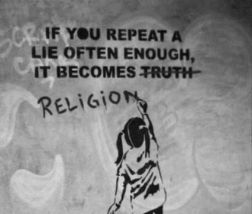 But this should come as no surprise. After all, all of religion is nothing but selling lies. It can be nothing else because it has nothing but lies to offer. Scriptures, angels, salvation, afterlife, god, devils… its all lies and Christians spend all their energy believing or convincing others to believe these lies. Is it any wonder then that Christians should have no trouble believing and spreading lies about abortion as well? Religion is not benign. Becoming comfortable rationalizing religious nonsense directly impacts our capacity to rationalize equally crazy thinking in consequential matters like abortion.
And as with religious fantasy, it is immaterial whether they sincerely, devoutly, fervently believe the nonsense they spread about abortion or how selfless their intentions might be. Their lies, deceits, manipulations, misinformation, and misguided efforts do great harm to a great many people regardless of their motivation – harm to the women directly affected as well as to the men and families in their lives.
If you are seeking an abortion, ask the clinic early and directly if they provide abortions on their premises. If you do not receive a clear and unambiguous yes, hang up. Ask again the minute you walk in the door. If they begin to use any of these tactics on you, leave immediately because their only goal is to do whatever it takes to prevent you from obtaining a legal and safe abortion.
 As long as we are reduced and diminished to a Nevers attitude of elections and leadership in this country, we are pilot and copilot struggling for control of the cockpit as the plane races into a mountainside. We are Darth and Luke fighting each other when only united can they hope to oppose the truly evil Emperor. Only when the Nevers fade away and we once again express affirmative support for civil, respectful candidates who commit to work together to solve problems, rather than working merely to destroy each other, can we thrive and survive as a people and as a nation.
 Probably the most hypocritical ethical fallacy that incenses my sensibilities is the “Forgiveness Fallacy.” This is typically invoked by Christians, particularly Evangelical Christians, to serve as both a shield and a sword. Whenever one of their own is guilty of wrongdoing, they insist that we must forgive and that only God can judge. However, when the guilty party is not one of them, they insist that only God can forgive and that we must never forget nor forgive. Seems to me that it is those who most need forgiveness are the ones to advocate for it most strongly, but only when it benefits them.
 If, after all this, you still feel compelled to vote third-party, think about who you are supporting with your symbolic vote. Johnson and Weld are Libertarians. They claim to be “fiscally conservative and socially liberal.” But this is a HUGE LIE. They are only socially liberal in as far as they support the legalization of pot and a woman’s right to choose. But they also support privatization of almost every social institution including education, the right to own assault weapons, eliminating all corporate taxes, instituting a hugely regressive consumption tax, trusting in the private sector to stop climate change, and eliminating almost all regulations. The list goes on and on. These guys are not socially liberal since all of their “fiscally conservative” positions are actually
  Of course job loss is not the only concern or even the major concern. The number of people forced to retrain and change jobs is not included in these projections. Certainly jobs always evolve, but periods of rapid and widespread job disruption are nevertheless painful and difficult. Even those who can transition through the major upheaval being caused by automation and globalization may find themselves forced into jobs they no longer love. More importantly those new jobs may pay far less than the old ones. This loss of standard of living must be mitigated through responsible corporate and governmental policies.
 Make Nice incremental advocates, don’t discredit your Make War brethren and thereby waste the leverage they afford you. Appreciate that they are an asset not a liability and use them to your advantage. Radicals, appreciate that your role is bad cop and pursue it with relish but also appreciate that it ultimately takes Make Nice folks to close the deal. When a better compromise is achieved then either camp could have negotiated alone, realize that it was only possible because both camps were strong and worked with each other rather than against each other.
 Like all animals, we humans have evolved certain preprogrammed behaviors. Some of these we call instincts but they can also be thought of as just the tuning of our pattern-recognition systems. For example we have an instinct for detecting when we are being stalked and hunted. This is a pretty valuable instinct. It is essential that our pattern recognition systems are tuned to detect some agency following us. We are in fact tuned to err heavily on the side of false-positives. That is, better that you think a tiger is following you when it is not than that you miss a real tiger stalking you. False-positives are unlikely to do you any real harm but you will be unlikely to survive even one false-negative.
 The state of the union is … great! It’s the greatest in fact. It is the greatest state of any union ever. The main reason our union is so great is because I am honestly the greatest president ever, no contest, and everyone agrees on this. Am I right?
