Category Archives: Saving the Planet

The Rise of the Nevers

If our American Presidential campaigns were envisioned as a Star Wars style movie series, the 2016 episode would be entitled The Rise of the Nevers. In this episode, the electorate has been divided as never before and we see the emergence of an ominous new movement.  The Republic becomes divided not by their sincere support for their respective candidates, but by their entrenched intransigent hatred for their opponents. They no longer care about their own candidate, they merely oppose the other side. They are The Nevers.

The rise of these Nevers is frightening. The movement both reflects and reinforces a level of divisiveness that can only bring strife and ruin. Many are SO hell-bent on wining that they gin up exaggerated reasons to take an extreme Never Clinton position. Their opposition to her is so vitriolic that they turn to the most deplorable candidate possible to carry their message. The opposition find this candidate so abhorrent that they can only respond with a Never Trump position.

As long as we have people electing or forced to take a Never stance, we are in such a hyperbolic state of rabid partisanship that democracy cannot function in a healthy fashion. We are proud of our system of government with its checks and balances. But that is a fragile thing. As we have seen, it is far too easy for that system to slip from gracious debate, advice, and consent, to win-at-all-costs internecine warfare that serves no other purpose than to crush and destroy the other party.

Think of our nation like an airplane. The wise founders of the airline put in place a system of check and balances, including a pilot and a copilot, to ensure that the planes will carry all passengers to their destinations safely and on-time. In most normal situations, the two pilots are expected to work as a team, cooperating for the good of all. But they are also there to watch each other and ensure that one of them does not become unhinged and choose to fly the plane into a mountainside. However, imagine the dysfunction if they were to say “I’ll never allow the other to fly this plane!” The pilot tries to fly one direction, but the copilot insists on flying a different route and they start fighting for control of the cockpit. It would be lucky if the plane did not crash in a spectacular fireball of metal and bodies.

duelAs long as we are reduced and diminished to a Nevers attitude of elections and leadership in this country, we are pilot and copilot struggling for control of the cockpit as the plane races into a mountainside. We are Darth and Luke fighting each other when only united can they hope to oppose the truly evil Emperor. Only when the Nevers fade away and we once again express affirmative support for civil, respectful candidates who commit to work together to solve problems, rather than working merely to destroy each other, can we thrive and survive as a people and as a nation.

The true Emperor that cackles as his grand scheme unfolds while we fight senselessly against each other has a name. He is Climate Change.


The Personal Responsibility Con

In a previous article I discussed the impact of proximity on ethical responsibility (see here). In it, I pointed out that while proximity should impact ethical decisions, we must be careful that we do not assign too much priority for benefits to groups or individuals nearest to us and push blame and responsibility for problems off to those farthest away from us. In it I said:

The bottom line is this. Be aware of the role of proximity assessments in your ethical decisions and judgments. Try to avoid giving unduly large or exclusive priority to your own narrow group. Likewise try to avoid assigning blame and responsibility disproportionately to groups farthest away from you.

We see this pulling in benefits and pushing off blame around us every day, and no where is it as stark as in Presidential politics. We have some candidates who perpetuate a self-serving inversion of proximity ethics by claiming that people “like us” deserve all benefits while those “not like us” deserve all blame. These politicians present a very self-serving set of ethical arguments.

Other politicians emphasize that “it takes a village” and present a far less self-serving vision of a society with a broad and wide view of balanced benefits and responsibility. For a society, and I would argue for individuals as well, this is far more healthy and sustainable.

But there is another spectrum by which ethics are selectively applied. We all experience a continual friction between personal and systemic blame. Is it nature or nurture? Is the individual solely responsible for his or her actions, is society to blame, or is it a combination? And even if we acknowledge that responsibility is a combination of the two, how much emphasis do we necessarily attribute to personal responsibility for purposes of punishment? Do we focus on changing the system that drove the individual to crime, on punishing the individual, or both? How do we balance these?

It is my observation that we tend to unduly blame the individual when they are “not like us“, poor, and underprivileged. However, when the individuals are rich and powerful, we tend to blame the system. When talking about poor Black teens, we tend to emphasize that they should pull themselves up by their bootstraps, tow the line, and take responsibility. However when we are talking about corrupt Wall Street billionaires who selfishly destroy countless lives and fortunes, we tend to shift blame to the system.

This kind of selective assignment of personal responsibility serves those with all the power. Corporate executives are never irresponsible, it is always the system that is to blame and must be changed. Donald Trump deserves no blame for tax avoidance, the tax system is to blame. However, when poor immigrants do their best to give their families some kind of basic standard of living, they are criminals who are fully responsible for their actions and must be punished for violating the system.

This extremely unbalanced assignment of personal and systemic blame  serves and is perpetuated by those with all the power.  When wealthy, powerful people commit terrible large scale crimes, they indict “the system.” But when poor, powerless individuals step over the line of systems designed to favor the wealthy, they must be held personally responsible for their actions. In our society, insulation from blame and punishment is a perk of power. Selfishness is a virtue reserved only for the most wealthy.

My ethics say that is backwards. I believe that with great power comes great responsibility.

Voting Third-Party in 2016

In his recent Op Ed, Paul Krugman talked about the dangerous attraction of voting Libertarian (see here). I’d like to second this. Well actually from my perspective he is seconding me, but he did hit “Publish” a few hours before this planned Monday morning post.

Look, Paul said it well but here’s my unique take on this. I have long advocated voting third-party to anyone who would listen. I argued, soundly I still think, that Progressives consistently vote out of fear and have failed to play the smarter and longer strategic game. By failing to take a stand for change and to lose a Presidency or a Supreme Court Judge in the short term, we consistently vote for the “lesser of two evils.” This has only played into the hands of the Conservatives in which they win either way, maintaining the status quo and moving the center methodically ever further to the Right with each election cycle. Unless we are willing to back a third party candidate in large numbers and lose a battle, sacrifice a Pawn or even a Queen, we cannot hope to win the war.

But there are rational limits to everything, and even in war there are some battles that we cannot give up; a hill that we cannot allow to be taken, a Rubicon that cannot allow the enemy to cross. If Jeb Bush or John Kasich were the Republican nominee, I would still be advising the long game. However, Donald Trump totally changes my calculus. A pathological liar who rivals Kim Jong-un only in his level of obscene narcissism, simply cannot be allowed to assume a position of such immense power. Allowing a reckless buffoon like Trump to take office in America, even if only for four years, is utterly unacceptable.

As much as it catches in my throat to even say it, voting third party is simply foolish in this election. I admit that I am motivated by fear here. I am afraid of the real, existential threat of Donald Trump. Sometimes fear can save our lives.

Even if one grants the silly Fox meme that Hillary is a crook, a crook in the White House is infinitely preferable to an utterly self-serving compulsive liar.

One of my biggest complaints and concerns about Hillary is that she is too hawkish. But recklessly insane Donald Trump has already said he would launch missiles if some guys give the finger to personnel on one of our Destroyers! There is absolutely no comparison here. Hillary the lesser of two evils? Absolutely, by an incalculable margin.

And don’t fool yourself. Your vote matters even if you live in a safely Blue State. Unless Hillary wins with an overwhelming popular vote, she will have no mandate and the forces that spawned Trump will only feel encouraged and emboldened to block her every effort and to keep giving us more of the same extreme Conservatism.

libertarianIf, after all this, you still feel compelled to vote third-party, think about who you are supporting with your symbolic vote. Johnson and Weld are Libertarians. They claim to be “fiscally conservative and socially liberal.” But this is a HUGE LIE. They are only socially liberal in as far as they support the legalization of pot and a woman’s right to choose. But they also support privatization of almost every social institution including education, the right to own assault weapons, eliminating all corporate taxes, instituting a hugely regressive consumption tax, trusting in the private sector to stop climate change, and eliminating almost all regulations. The list goes on and on. These guys are not socially liberal since all of their “fiscally conservative” positions are actually socially conservative positions painted up as fiscal common sense.

If you vote Libertarian, you are not just saying you reject the status quo, you are also saying you support all of their extreme Libertarian positions that are too far Right for even mainstream Conservatives to accept.

One final plea. If you DO still feel compelled to vote third-party, strongly consider voting for Dr. Jill Stein. The Green Party is not an ideologically blinded wolf in sheep’s clothing like the Libertarians. They are truly sensible, rational, intelligent, and represent real Progressive change. If we were not faced with the horrifying specter of a Donald Trump Presidency, I would be proud to vote Green. Vote for them down ticket as much as you can.

Sorry Jill, I feel terrible but please try again and again!!


Data, Data Everywhere…

In The Rime of the Ancient Mariner, poet Samuel Taylor Coleridge lamented “Water, water everywhere, nor any drop to drink.” There seems to be no better way to describe our situation today with regard to information. We sail upon a vast ocean of data and yet we die of thirst. Indeed, we are too often deluged by great waves of facts that batter us relentlessly to and fro upon treacherous seas of data.

It feels particularly disconcerting for me to write this article. In my book, Belief in Science and the Science of Belief (see here), I promote the importance of elevating facts above beliefs. After all, facts should reflect reality. They should be the basis upon which truth is known. Today however, data seems to be used far more effectively to support beliefs, fantasies, and lies than it is used to reveal truths. Indeed, those who wish to sell us nonsense don’t often bother to invoke the bible or faith anymore – they invoke their own “facts” instead.

One reason that facts have become the new champions of beliefs and cons is the sheer amount of it. We now have so much data that one can mine anything they want from the endless mountains of the stuff that we have produced. Misrepresented facts can now be dredged up to fabricate lies far easier than spinning magical stories of gods and devils.

Nowhere is this new perversion of facts more true than in politics. Today politicians like Donald Trump incessantly cite completely misleading facts to support their beliefs and positions and to outright lie. Even if the majority of people do not believe their “trumped up” facts, they nevertheless conclude that all facts are suspect and that no facts can be trusted. This tangibly undermines the level of rational thinking of our entire culture and leaves us without any sound basis for making good decisions as a society.

In his excellent Op-Ed (see here), William Davies points out that “they [facts] seem to be losing their ability to support consensus.” According to Davies, there is clear agreement that “We have entered an age of post-truth politics.” This new age of bullshit is fueled not by assertions of faith, but by assertions of facts. As Davies further points out, “Rather than sit coolly outside the fray of political argument, facts are now one of the main rhetorical weapons within it.

So facts have become the new bullshit. We claim to care about facts, but only because, as with the bible, we can always find something in them to support our beliefs and prejudices and self-interest. Our abundance of data seems to be only serving to diminish and undervalue it; to make it increasingly vulnerable to manipulation, misrepresentation, and lies by half-truth. The sheer volume of it makes it far more difficult to say anything with certainty without some other bit of data seeming to contradict it.

And this perversion and misuse of facts is not just true in politics but has become the new normal in all walks of life. All too often journalists and pundits do not pursue facts to reveal truth, but rather invoke them to advocate for opposing sides of an issue. This makes great theatre, but does little to advance the important questions that we face. It instigates and perpetuates conflict rather than help reach a sound fact-based consensus.

Even scientists, our gatekeepers and guardians of fact, all too often emphasize only those facts that advocate for their positions rather than serving the far greater goal of advancing science as a quest for truth.

Abandoning facts is simply not an option. Allowing the manipulators to turn all fact-based thinking into rationalization games and data manipulation exercises is not an option because without sound facts good decisions simply cannot be made. If we allow facts to be coopted by magical thinkers, by self-serving politicians, or even by well-meaning advocates, we might as well put the psychic hotline staff in charge of our fates.

What is the answer? We must reclaim facts. We must become smarter consumers of facts who are no more likely to be fooled by the bogus facts cited by manipulative politicians or corporations any more than we are by laughably ambiguous bible citations and interpretations. We must learn to recognize valid data and sound conclusions amidst all the cherry-picking and false claims. We must learn to treasure and respect fairly presented facts as diamonds amongst all the heaps of rubble and fool’s gold that we have to sift through every day.

Our overabundance of data should make us value – and demand – sound analysis and conclusions based on that data all that much more.


Maximum Voting Age

Lots of young folk under the age of 18 are perfectly capable of registering sound, informed votes in elections. But notwithstanding our many child geniuses, we still acknowledge that on average enough young folk are not yet capable of voting intelligently. This justifies our imposition of a minimum voting age.

SeniorVoteBy the same logic we ought to have a maximum voting age. Of course many old folk (like you and I obviously) are perfectly competent to vote intelligently right into our 100’s. But on average, age makes us old farts increasingly likely to make really, really stupid voting decisions. And when it comes to elections, even slight statistical tendencies are all that matters, not the presence of exceptions.

Look, we old folk can’t run a 4 minute mile like we used to. And although it is politically incorrect to point this out, our brains are just physical organs as well. They wear out too and while some age more badly than others, our mental faculties invariably degrade with advancing age.

This is evidenced in innumerable ways that tangibly impact elections. We don’t necessarily get wiser, but we do get slower-witted. We definitely get more gullible, increasingly more likely to fall for transparent scams by Nigerian Princes or Donald Trumps. We get more jaded and senile and closed-minded and angry and embittered and are more likely to respond to similar Tea-Party appeals. We are more likely to vote out of fear and to be swayed by the angry voices of Fox News or Rush Limbaugh. We are more likely to cling to old racist and bigoted and homophobic attitudes. We are less likely to understand the nuances of the modern world and imagine that a loaf of bread is still 25 cents and that the Internet is “a series of tubes.”

And moreover, we old folks are the very idiots that voted-in morons like George Bush who lied us into war (at least 33 well-documented lies) and also voted-in a whole insane asylum full of climate change deniers to Congress. So what specifically is there about our track record of wise decisions that suggests that we same old folks will make better voting decisions in the future?

Besides, we old folks had our chance and it’s time to let the younger generations have more say in their future and stop dominating elections already. If advancing age made us generally more likely to vote for a stable future planet for our descendants, that would be different, but age seems to only make us even more likely to vote according to our VERY near term self-interest.

So my very politically incorrect recommendation is to establish a maximum voting age of say 65. Once we retire from working life we should retire from voting as well. I acknowledge that this has no chance of becoming law, but we could still think about voluntarily stepping back from deciding the future of others. At the very least, we should strongly consider deferring to younger voters and supporting their candidates like Bernie Sanders whom they can see quite clearly is a better choice to serve their longer-term interests and those of the planet.

Fellow old folks, you’ve had your chance to screw up the country and have nothing more to prove in that regard. Step out of the way now and let the younger generations have their chance!


Dear Future Time-Traveler

If you are reading this it is probably the year 2416, give or take, you are undoubtedly one of the few technologists remaining alive in the last enclave of a largely uninhabitable future Earth decimated by the ravages of corporate planetary exploitation resulting in resource wars fueled by religious extremism. Your search algorithm undoubtedly pulled this ancient blog article off of molecular storage because you have just completed a prototype time-travel machine, you have only enough energy left on the planet to send one person back one time, and you are researching what a single lone agent could do to avert your catastrophic timeline.

ReaganHere is what you must do. It is your best chance for survival. You have to stop Ronald Reagan.

I know that time travel theory requires that you make only the most subtle possible alteration at a key intersection in the timelines, so just killing Reagan is ill-advised. Besides being ethically unacceptable, even to save the planet and billions of future lives, his death could result in wildly unpredictable repercussions. Therefore, you must send your agent back to April 22nd, 1980 just two days before the fateful Operation Eagle Claw failed famously to rescue American hostages held in Iran. Your agent must gain access to Col. Charles A. Beckwith and convince him to inspect the helicopter rotors and hydraulics and avoid flying though regions with sandy particulates.

If your agent can assure that these minor problems are avoided, he or she can thwart Reagan’s alleged conspiracy with Iran to hold the hostages until after the election in order to discredit Jimmy Carter. In any event, this will likely prevent Reagan from gaining the White House, which will keep the solar panels on the roof and ensure that the nascent enculturation of Carter’s responsible, science-based energy and social policies are not aborted by Reagan.

By thwarting the Reagan Presidency, we avoid the critically pivotal fork when we chose self-interest over social good; unrestrained consumerism over sustainability; religious extremism over humanist ethics; voodoo trickle-down economics over sound economic policies; superstition over science; beliefs over facts; hatred for the government over pride in government; rabid partisanism over political cooperation; and unrestrained militarism over a thriving peace-time economy.

If Carter had retained the Presidency, there would have been a chance at least that science and fact-based thinking would have prevailed; that the religious community would have followed his humble example of restraint and separation from government affairs; that rampant consumerism and self-interest would not have completely corrupted corporate leaders into elevating next-quarter’s profits and personal bonuses above all social considerations; that subsequent generations of government leaders would not be hell-bent to destroy government and the people that support them would not be convinced that government is their enemy. In the alternate timeline, John McCain would never have considered nominating Sarah Palin and Donald Trump would never have become the orange-haired Frankenstein’s Monster of our own creation that he is. The existential threat of Global Climate Change and all of its resultant horrors would have been managed responsibly with a long-term and forward-looking sense of responsibility for the planet and for future generations.

So, future time-traveler, this is your only hope, our final hope. You must ensure that Operation Eagle Claw does not fail. If you succeed in that mission, this whole tragically cascading timeline will never have occurred. Hopefully moments after I click Publish on this blog article, my timeline will shift because you will have read it in the future and sent your agent back in time and he or she has succeeded in averting the failure of Operation Eagle Claw which has prevented the Reagan Presidency and the ascendency of the crazy religious anti-government Right. Your future world and mine will transform into a sane, rational, humane planet, unpolluted and unthreatened by climate change, with an America that is truly the light of the world rather than the single greatest threat to its survival.

If we fail to rise to our challenge of building a sane and sustainable planet, you future time-traveler are our last hope!


Consitutution Thumping

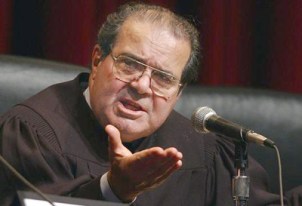
scaliaI have a colleague who is really smart. Undeniably smart. He does his complex job extremely well and is deeply conversant in all spheres of intellectual discussion. He is also Bible literalist. He truly believes that he has arrived at all of his religious views through careful reading and unbiased interpretation of the Bible. In the end all he really does is cleverly pick and choose from the Bible to claim external validation of and authority for the beliefs he wants to embrace.

Substitute the word Constitution for Bible here and I could be talking about the late Antonin Scalia.

This is not an uncommon trap that smart people fall into in order to justify their biases and beliefs. Look at Ken Ham (see here). He invokes the Bible to “prove” his truly insane ideas and uses convoluted arguments to dismiss any Bible passages that contradict him. Ham claims that any Bible passages that can be interpreted to agree with him are “literal passages,” and any that do not agree are “historical.”

Just as Ken Ham and my colleague use the Bible as their inviolate source of authority that only they can interpret correctly, so do Conservatives like Scalia attempt to turn the Constitution into a secular Bible to serve their religious and conservative agenda. To them, the Bible and the Constitution are both sources of authority that they can invoke to support their dogmatic views. They claim that any interpretation that supports their views is literal or purist or originalist, while any that disagree are attempts to reinterpret or bastardize these written in stone authorities.

Since secular society does not accept the absolute authority of the Bible, religious fundamentalists seek to transform our Constitution into a secular Bible to serve as a proxy through which they can impose their religious views. Having established themselves as the protectors of the Constitution and as the authoritative interpreters of original intent, they portray the Constitution as infallible and unchangeable, like the Bible. No one is allowed to question its authority or that of those who profess to protect it.

By coopting the Constitution, religious fundamentalists have established an authority structure by which they can mandate and enforce social change according to their religious worldview. All they require is a Supreme Court that will continue to interpret the Constitution so as to maintain and expand their theocratic worldview. Antonin Scalia has been their great champion in this effort.

There is a great deal of manipulative coded language that these religious fundamentalists employ to market their reimagining of the Constitution. Foremost, they preach the absolutism of original intent. This is actually a phrase first adopted by Bible literalists to justify their interpretation of the Bible in the same way that religious fundamentalists seek to own the Constitution.

Even if it were possible to interpret original intent, this is neither practical nor desirable. The very idea is antithetical to what was almost certainly the clearest original intent of the founders that the Constitution remain a fluid and responsive document that can be continually reinterpreted to best meet the needs of a growing and changing nation. This view has actually gained widespread acceptance in Canada and formalized as their “living tree doctrine” which mandates that their constitution remain organic and be progressively reinterpreted to adapt to changing times. However, in America fundamentalists continue to try to reshape the Constitution into their own likeness and then cast it in stone.

Ironically, those who seek to control us incessantly warn about “activist judges who reinterpret the Constitution.” They tout the intellectual purity of Supreme Court justices like Scalia who “uphold the Constitution” according to “first principles.” In short, if you hear people invoking the Constitution and ranting about Constitutional first principles, be very wary.

Supreme Court judges like Scalia who claim to rule according to original intent are as deluded or as deluding as Ken Ham. Every interpretation of the Constitution is unavoidably colored by current culture. Every ruling is necessarily constrained and shaped by the many rulings that form a chain of precedent reaching back eventually to the Constitution. But that chain of legislative rulings may have drifted far, far away from original intent, as we saw most recently in the long, twisted chain of rulings that have taken us to Citizens United, a ruling so completely in contradiction to “first principles” as to be considered almost comical. I call this process of judicial drift from one precedent to the next until it has drifted far out to sea, “judicial brainwashing.”

Ironically, these same patriots who are overwhelmingly concerned with upholding the purity of original intent when interpreted according to their religious ideals are the first to push for Constitutional changes when they find the Constitution insufficient to their ends, as in pushing for a Constitutional Right to Life amendment.

Does this mean that original intent does not matter? It certainly does. As Garrett Epps pointed out in his excellent article “Stealing the Constitution” published in the February 7, 2011 edition of The Nation magazine:

“Serious originalist scholarship is very useful as one way of learning more about the Constitution. But in the hands of judges like Antonin Scalia or demagogues like Glenn Beck, it is really a kind of intellectual weapon…”

Antonin Scalia was the Ken Ham of the Supreme Court. If he truly cared about original intent, he would have acknowledged, for example, that our forefathers could never have imagined let alone intended to protect modern weaponry. The most they might have known was that this new innovation called the “flint-lock” was soon to appear. They could never have imagined or factored in the horrific killing-power of modern weaponry. But instead, what Antonin Scalia did was focus on the word “the” in “the right to bear arms” as the key concept in his extremist interpretation. Antonin Scalia, like Ken Ham, was a deeply self-deluded individual.

Our Constitution is a tremendously important statement of principles. However, in truth there are many countries with similarly admirable Constitutions. It is only the high court system of a nation, and how it interprets and enforces that Constitution, that makes it a great nation or a poor one.

The Constitution might just as well be a Rorschach drawing or Simon and Garfunkel lyrics for that matter. Either of these alternatives might be just as good in the hands of wise men or just as abused in the hands of ideologues.  Antonin Scalia may have been smart, but he was not wise. We can only hope his successor will not be so susceptible to Justice Scalia’s insanely flawed moral and intellectual reasoning.


Dismissed with Prejudice

ElvisDo you have one of those wacky friends? The ones with a deep, sincere, heartfelt conviction that Elvis still lives. That he is actually in seclusion preparing for his epic comeback? Busy rehearsing for the ultimate Elvis concert that will transform the world?

Your friend undoubtedly has an articulate rebuttal for every possible reason you can throw at him for dismissing the possibility that Elvis might still be alive. His death was staged. The witnesses are all in on it. The corpse in Graceland is a DNA-identical clone of him. He is being kept young by a chemical concoction that the pharmaceutical industry has suppressed.

Your friend probably turns the tables on your skepticism quite easily. How can you be so arrogant to claim to know everything? Are you that close-minded? Surely you can’t prove and therefore can’t know for certain that he isn’t still alive. If you are as scientifically open-minded as you claim you must admit some possibility that he might still be alive. Surely you can admit that reasonable people can disagree on this unless you believe he is dead purely as a matter of faith. The only intellectually honest position on this question must be agnosticism.

Your friend points to several well-regarded scientists who admit that it is possible Elvis is alive. He recommends a plethora of scholarly books that debunk all those fallacious “scientific” arguments claiming that Elvis is dead.

Or perhaps your friend has a different but similarly wacky belief that he clings to and argues for with great passion.

All that was my way of setting the stage for the real point of this article – that I do not need to read any of those books purporting to prove that Elvis might be alive. Elvis is dead. Period. Any book that starts with the premise that he may still be alive is necessarily idiotic. There is no need for me to actually read them in order to legitimately dismiss them out of hand. Good scientists dismiss an infinite number of implausible claims all the time every day.

So there is no need for me to entertain arguments about how Elvis might still be alive. And there is no reason for me to read a book that starts with the premise that Elvis is alive or the Holocaust did not happen or the Moon landing was faked or alien overlords built the pyramids. I can dismiss them all out of hand without even reading the book jacket. The only reason to read them may be if your interest is studying delusional thinking or the infection of magical thinking amongst otherwise healthy individuals.

And I have read a great many of these books that purport to present a logical or scientific argument for at least allowing the possibility that god might exist. When I wrote my book Belief in Science and the Science of Belief (see here) I took the time to slog through a 4-foot stack of books that undoubtedly made Amazon the lucrative enterprise it is today. It was largely a waste of time and money on my part. Believers have had two millennia to come up with arguments so there are simply no new ones to be found.

As a concrete example, I bought several books on Neurotheology (see here). I did the world a service by throwing these out rather than reselling them. Written by Andrew B. Newberg and a host of his followers, these books typically spend 250 pages citing brain imaging and cognitive studies related to belief and god. Their real goal is to establish their science creds so that you will believe them when, in the last 50 pages, they leap to outlandish claims that go something like “since we have clearly evolved to believe in god, the only conclusion must be that god himself designed us to believe in him.”

The only conclusion is that this is an idiotic conclusion. But then again what can you hope to get from any author that starts from the silly premise that god exists and works backwards?

Religious books purporting to be scientifically legitimate examinations of the “evidence” for god pop up on Amazon every day like so many weeds. I can’t read them all but I can still dismiss them all out of hand. There simply is no god, can be no god, and therefore every book claiming to argue this point is necessarily as idiotic as books arguing that Elvis is alive and well and living in a secret wing of Graceland.

And thus, dear reader, we finally reach the heart of my dilemma: Do I read these silly books and respond to them or do I simply ignore them?

Ignoring them is not easy. If no one pushes back on them, they seem to win the argument. And there are so many of them saying the same silly things that many readers mistake quantity as an indication of quality. On the other hand, the time for engaging these silly debates is over. At this stage of the atheist movement, we must move past engaging in and thereby legitimizing these ridiculous debates. We should give no more consideration to religious ideas than we do to racist ideas or homophobic ideas or sexist ideas or the idea that Elvis is amongst us.

Still it’s hard to resist getting sucked in. Recently a new book appeared on Amazon called “Can Science Explain Religion” (see here) written by a priest who is also a Professor of Religion. It apparently “debunks” the very theory of the evolution of belief that I present in my own book. Do I buy this and read it so I can credibly criticize it and defend my position, and thereby risk encouraging this nonsense? Or is it best not to even respond and hope that the rest of the country follows my sensible example?

After struggling with this dilemma for many years, I have come to believe that refusing to engage is the best strategy moving forward. Engaging in further debate with them only feeds the beast. Like booing Donald Trump at a rally.

It’s not an easy course of action nor is it without risk or criticism. But in science, we must first ask whether our basic assumptions are valid before we enter into discussions of the resulting questions. We must not let ourselves get caught up in grand debates over how Santa manages to deliver all those presents in one night when the very premise of Santa is pure fantasy.

And that is how we should respond to these books and these arguments – by dismissing them out of hand and with great prejudice and by refusing to entertain dependent arguments arising out of purely implausible assumptions.


Proximity Ethics

Proximity EthicsIn our everyday lives we make ethical judgments resulting in ethical decisions all the time. So often in fact that we mostly don’t even realize that we are doing so. Often we don’t even think of these as ethical decisions but merely as practical routine judgments. These range from small personal decisions to collective national policy decisions.

In making these judgments we weigh and balance, largely subconsciously, a large number of different criteria across a number of different dimensions. One key criterion is the proximity of the individuals or organizational entities involved relative to ourselves and our own identity groups. In general, the closer the impacted group is to our own, the greater weight, priority, and consideration we give the issue.

This is perfectly understandable, natural, and sensible. For example, we give our spouse higher priority than our family which we give higher priority than our friends to whom we give higher priority than other people. Similarly, we give higher priority to our own neighborhood, followed by city, state, and country. We are more concerned over issues impacting our own gender or race or religion than others.

There is a great deal of sensible practicality in this kind of analysis. It’s fair that we organize into groups. It doesn’t say we should ONLY give consideration to groups closest to our own, but it’s fair that we give groups in close proximity to us greater consideration.

But there are a number of ways that this proximity calculation can fail us. The first is if our concern falls off too rapidly. While we should first look out for those close to us, too much emphasis on our own groups can lead us to be needlessly callous and insensitive to the needs of groups farther away. We demand the best school for our own kids, but completely ignore the needs of other kids in our own neighborhood. Orthodox Jews, as one example, might focus exclusively enriching their own enclave communities, regardless of the cost to society as a whole. We often maintain an extremely close proximity calculus even when helping those farther away from our own sphere would, in the long run, help ourselves as well.

The second problem that arises from our proximity calculation comes into play not when we are thinking about allocating benefits, but when we are assigning and assuming responsibility. In this case we often assign far too much weight to far groups and assume far too little for our own. How often do we hear “those Chinese should take action to stop climate change” or “I’m not responsible for US militarism.”

Of course we have to keep it in perspective. Of course the Chinese should do their part to alleviate climate change and we as individual citizens cannot bear the entire brunt of US aggression abroad. But we can and should affect change in our closest proximity groups first. Those are the groups we can and should make right first before we point fingers and deflect all blame and responsibility. We should step up and take every action we can on climate change first. We should appreciate that each of us are citizens with the right to vote and speak out. We all collectively share <some> blame and responsibility for American militarism and torture.

The bottom line is this. Be aware of the role of proximity assessments in your ethical decisions and judgments. Try to avoid giving unduly large or exclusive priority to your own narrow group. Likewise try to avoid assigning blame and responsibility disproportionately to groups farthest away from you.

How do you achieve a fair, just, and healthy balance of self-interest and social consciousness? Here’s a couple good rules of thumb:

  1. If you typically care about how others can share benefits that your group desires or enjoys, you’ve probably got it pretty right.
  2. If you first ask what your group can do to improve the world for everyone before you point fingers at other groups, you’ve probably got it pretty right.


Liberal Moderation

ModerationAll things in moderation” is a pretty sound truism. It is true for most things, but there are exceptions. Lead is never good to ingest even in moderation. Likewise, activism is not usually very effective and can even be harmful when taken in moderation.

Imagine you were an abolitionist living in the 1760’s. Would you demand a complete end to slavery or would you politely request limits on slave whippings?

Or how about if you were a feminist in the 1860’s? Would you demand equal rights or would you have request (demurely) that women be allowed to smoke in public?

How about if you were a civil rights activist in the 1960’s? Would you demand nothing less than equal rights or would you go out of your way to show how nonthreatening you are by simply asking to sit a few rows further up in the bus if all seats further back are taken?

This was the very question that troubled Martin Luther King in 1963. In his “Letter from Birmingham Jail” King pushed back against his well-meaning supporters and their strident calls for moderation. He correctly assessed that these friends were a bigger hindrance to the achievement of equal rights than were his opponents. The modest calls of his so-called allies undermined his own demands by making them seem unreasonable and even radical in comparison.

I feel his same frustration. In all the causes I care about, I feel thwarted by fellow “activists” who demand only minor incremental improvements with negligible benefits. Often doing a little bit is worse than doing nothing at all. It often gives the impression we’ve already “fixed” that issue, making it even harder to come back later for real effective change.

That was certainly true for Healthcare. Failing to demand national healthcare and accepting at least a public option was a tactical mistake of President Obama from the beginning. Now we are stuck with a private for-profit “solution” that addresses none of the systemic private-market abuses of our healthcare system.

JoyBuzzer.pngIn fact, President Obama took years to figure out that his moderate reasonable approach in all areas were doomed to fail. Over and over he reached out across the aisle with modest requests of Jokers in Congress, only to accomplish less than nothing. It took him what, 5 years of getting joy-buzzed to finally understand that moderation did not make his opponents any more reasonable or receptive.

Bargaining isn’t a new or complicated skill. In bazaars all across the continents merchants show us how to do it. You demand 10 times what that trinket is worth and finally settle for “only” 5 times its actual value. Only a fool starts out with its actual value and hopes to get anything close to it.

Yet far too many activists fail to apply these simple bargaining rules. In a vain hope of looking reasonable, they ask for next to nothing and if they are unfortunate enough to get it, it becomes extremely difficult to come back for more. The other party always wins when they give away next to nothing. Yet we see these moderate activists in every important area diligently undermining the “extreme militant activists” who might without their “help” bring about real change.

Healthcare: What we asked for and got was a “reasonable” giveaway to the private healthcare sector. What we should demand in the next round is nationalized healthcare. We may be willing to settle for a quality low cost public option.

Gun Control: What moderates call for are “sensible” expanded background checks and mental health services. What we should demand is a near total crippling of the gun industry and close security monitoring of those who own certain guns. We might settle for reestablishing the right to sue gun manufacturers and dramatically increased gun controls and insurance requirements.

Climate Change: What moderates call for are “realistic” industry-friendly systems like carbon trading. What we actually have to achieve in order to save our planet is a near total shutdown of carbon-based fuels and greatly expanded emission limits. Our planet simply does not have the time for moderation on this.

Campaign Financing: What moderates call for are modest reforms that do nothing except create yet more loopholes and workarounds. What we should demand is a complete prohibition from politicians receiving any outside money or working in the private sector for 10 years after leaving office rather receiving a generous government pension. We might settle for public campaign financing.

Atheism: “Non Angry” atheists call for mutual respect and a live-and-let-live attitude toward religion. What we should demand is that magical thinking, like racist or homophobic thinking, not be taken seriously in any aspect of civil society. What we might settle for would be a far stricter enforcement of the separation of church and state including an elimination of all religious carve outs and tax benefits.

War Funding: Our “pragmatic” moderates are thrilled if we can just limit the amount of annual increase in the Pentagon budget. What we should call for is a 90% reduction of our military budget and a retuning of our military industrial complex. Perhaps we might settle for only a 50% reduction.

Abortion: Supposedly hardcore Choice advocates feel lucky if they can mange to push back on just a few of the State actions to restrict abortion. We should call for Federal funding of abortion services and a requirement that all institutions receiving Federal funds provide abortion services. We might settle for much stronger Federal protections of abortion services that prohibit any State legislation that intentionally or unintentionally inhibits abortion services.

Income Disparity: Moderates beg for a slightly higher minimum wage. What we should demand is a steeply graduated progressive tax up to 90% with a maximum income cap based on some multiple of a guaranteed minimum income. We could possibly negotiate on the threshold levels.

Presidents: Moderate liberals feel lucky if they can elect a President that is only slightly to the Left of their Republican opponent, even if that takes us much farther to the Right than before. They should support Bernie Sanders and maybe settle for Hillary Clinton. But they should not vote for her out of fear. The timidity and fear of our liberal moderates ensures we keep losing ground and that is why our nation has drifted steadily Right for nearly 40 years.

In the end, moderation in activism does more harm than good. Moderation does not ever sway our opponents or make the battle any easier. The effort to achieve ANY compromise is not significantly lessened if the demands are modest. Rather it is often easier to get ones opponent to accept a significant compromise if far below the demands. And in the end the ground gained through a small compromise of modest demands is far less than the ground gained by a large compromise on grander demands. Further, you often only get one compromise in a decade or more so incremental movement is often a delusion, or at least far too slow for the people or the planet involved.

A bolder and smarter enemy will give a bit of inconsequential ground to keep their key institutions safe. They will give a bit of ground to gain a bunch of ground elsewhere. That is all the Conservatives give us in response to our modest demands. Conservatives are bold and smart and they know how to demand and bargain and play the long game.

But like President Obama, liberal moderates have no clue. They are neither bold nor smart and they generally lose the long game on every front by moderating each other with continual calls for moderation.