Category Archives: Social Justice

Christian Fem Therapy

FemTherapyIf you are one of the many unfortunate Christians who have been cursed with the birth of a female child, take heart. We at Evangelical Acres are here to help you during this, your trial of misery and shame. Following on the miraculous success of our patented Gay Away™ therapy technique, our theo-researchers have developed a powerful new curative program called Fem Away™.

The process starts by recognizing that this abomination is not the fault of the father. As proven by science, all babies are born of women. And we know from our Biblical analysis that all women are unclean, demon-possessed, befouled creatures. During gestation the demons inhabiting these females tempt the immaculate unborn male fetus into a life of sin. Only if the unborn child consciously agrees to let the demon into his soul does he transform into an unclean demon-possessed female.

But take heart. Our exclusive Fem Away™ therapy can help. After a totally voluntary tithing that demonstrates to God that your previous life of selfishness and greed is over, our team of transportation specialists will locate and secure your female-demon child. These professionals are trained to resist the temptations and manipulations of she-demons and relocate them safely at an Evangelical Acres treatment center.

After arrival at our secure facility, nestled in the lovely hills of a remote undisclosed location, our team of highly trained Faith Scientists will begin an intensive program of demonic expulsion, or exorcism at it is called by lay people. These treatments will be augmented by a strict regimen of sex reorientation therapy, conducted by our on-staff clergy and a large staff of dedicated male volunteers. The goal of this treatment is to show the child the disgusting nature of female intercourse and reveal unto them the joy and beauty of male sexuality.

But it’s not all serious therapy. Your child will also receive ample time to enjoy herself by engaging in a balanced recreational program of cleaning, housekeeping, and cooking activities structured to prepare her for a meaningful life after treatment is concluded when she embraces her true male nature.

During the entire course of therapy which may last many years or even a lifetime depending on the stubbornness of the demon infestation, the leadership committee at Evangelical Acres will keep you closely informed of your child’s progress through detailed prayer-based communications. You can take great comfort in knowing that through your loving donation and the grace of God, we will ensure that your evil-tainted female spawn will eventually be transformed into the pure, sinless male offspring it was meant to be.

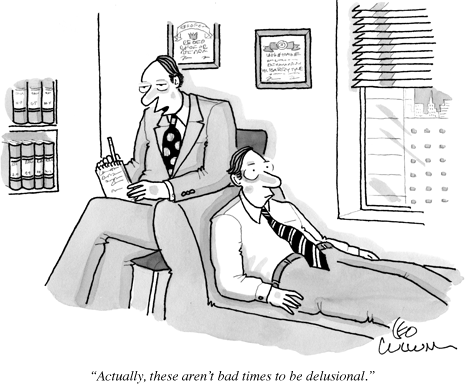
The Delusion Defense

In a previous article I made the case that all religious beliefs are delusions and should be called out as such (found here). I really do keep this view in perspective however and don’t actually feel particularly compelled to call out all my religious friends and associates as delusional at every opportunity. But I still maintain that it is absolutely necessary to do so without compunction when it comes to extremely delusional thinkers like Ken Ham (see here) who publically propagate a large number of very bizarre delusions.

Regardless of how accurate and justified it may be to characterize all religious beliefs as delusions, doing so is problematic simply because of the huge number of people who believe. If you call religious beliefs delusional, then all religious people are at least somewhat delusional. And that is most of us. And if believers are all delusional, that would produce profound ramifications in all manner of social and legal interactions.

In his book “Bad Faith” (found here), Paul Offit looks at the insane faith healing beliefs of Amish, Christian Scientists, and Jehovah’s Witnesses who feel compelled by their faith to commit murder through the withholding of medical care for their children and other loved ones. In a recent lecture I attended, Offit observed that our legal system essentially gives these families “one free murder” before the State is willing to characterize their beliefs as dangerous and harmful.

Sure they are clearly crazy. But non-religious people can be crazy too. Most normal religious beliefs are entirely reasonable.

Except it is not that simple.

In his book “Under the Banner of Heaven’ (found here), John Krakauer documents the insane history of Mormonism and the 40,000 Mormons who still believe much of it and practice polygamy. In particular, he documents the story of Ron and Dan Lafferty, Mormon brothers who felt compelled by their faith to commit multiple murders. The defense in that case argued for an insanity plea based largely upon the craziness of their religious beliefs.

Their defense argued that the delusional beliefs of the Lafferty brothers rose to the level of insanity and that their clients were therefore not fit to stand trial. However, psychiatrists for the State argued that their beliefs were essentially no different in any qualitative way from any other belief considered “normal.” (It could be argued that no person who believes in an afterlife truly understands the consequences of their actions.)

In his book “Thinking About the Insanity Defense” (found here), author Ellsworth Fersch lays out the fundamental problem in the Lafferty case:

“Their strategy was to show that he was sane through comparison with other individuals. First, they pointed out all the similarities between his fundamentalist religious beliefs and the religious beliefs of people with ordinary religious faiths. By doing so, they made his seemingly outlandish claims and ideas seem much more normal. For example, Dr. Gardner compared Ron Lafferty’s belief in reflector shields to belief in guardian angels. This strategy was effective because it forced anyone who was willing to consider whether he was insane to also consider the larger question of whether any religious person is insane.”

Belief ties sanity and delusion into an almost inescapable Gordian knot. To uphold an insanity defense would be to imply that all religious believers are similarly insane. That would never be acceptable. But to exempt religious beliefs would make it extremely difficult to ever characterize anyone as insane or make any value judgment about any belief. It would make it difficult to interfere with any dangerous behavior such as faith healing when it is claimed to be based upon a “deeply held belief.” That in fact serves the narrow self-interest of believers.

DelusionDefenseThese are extremely vexing conundrums even for psychologists.  They have been completely muddled over this all the way back to Freud who suggested that all religious beliefs are delusional and that religion is a mass-delusion. On the more diplomatic side of the argument is the definition established by the American Psychiatric Association (codified in DSM-IV) which says essentially that a belief is a delusion – well unless enough people believe it that is. Clearly if Freud is right, then that conclusion leads necessarily to widespread clinical, social, and legal ramifications. However, if the APA is correct, then sanity is completely contextual. What might be sane in one society or in one group or at one time in history may be completely delusional and result in institutionalization in another setting. Precisely how many believers must I recruit in order for my insane delusions to be considered sane and immunized from ridicule? The APA view creates significant social problems for all aspects of society.

In his paper “Faith or Delusion? At the Crossroads of Religion and Psychosis,” Joseph M. Pierre attempts to review the psychiatric literature in order to find a sensible middle ground. Pierre points out that:

“Neither Freud’s stance that all religious belief is delusional nor DSM-IV’s strategy of avoiding mention of religious thinking in discussions of psychosis is an acceptable way to resolve the ambiguity between normal religious belief and religious delusion.”

One might think this question should be resolvable by simply looking at other criteria to evaluate sanity, not merely the presence of religious beliefs. But Pierre goes on in his paper to review the body of psychiatric works that attempt to distinguish faith from delusion using a wide range of possible criteria. None of these attempts prove to be satisfactory. Since every belief is inherently not based on any objective facts, it is impossible to make qualitative distinctions between “normal” beliefs and “delusional” beliefs. Attempts to measure their impact by other indirect measures, such as excessive preoccupation, conviction, emotional valence, claims of universal validity, and level of contradiction all fail to provide a satisfactory distinction.

So the situation we are left with is that we are precluded from ever admitting that religious beliefs are delusional, even though the APA defines beliefs as delusions held by a sufficiently large number of people. Instead we are forced to make mostly arbitrary decisions about when to characterize a belief as a delusion. But I think I have a suggestion to help with this problem. It seems to me that much of this Gordian Knot is glued together by a presumption, a prejudice, and a conceit that says that sanity and insanity are exclusive binary conditions.

As I argue in my book (found here), we each have a myriad of ideas that could each be placed along a wide spectrum from sane to insane. If someone has a lot of delusional ideas a lot of the time, that person may cross the threshold of clinical insanity, but we all still do have some insane ideas some of the time.

If we would only stop applying to word delusional to people and instead start applying it with less reluctance to ideas, recognizing that we all have some delusional ideas some of the time, then I think we go a long way toward reaching the balance we need to respond to mass-delusional thinking in a more reasonable and consistent manner.

But I’m out of room for now. I’ll expand on this in a future article.

Sociopath’s Elevator Guide

If you do not happen to live in a 3D city like Manhattan, you probably don’t spend a good portion of your day getting hoisted up and lowered down again in elevators. We New Yorkers tolerate them in order to conserve the calories we need to hit the stair-master at the gym. But elevators aren’t as exciting as one might think. If these people-crates were made of glass they would be more fun, but for the most part we have to find ways to amuse ourselves during these awkward and boring rides. The good news is that there are a whole lot of shenanigans and hijinks one can play with elevators. Following is a helpful Sociopath’s Guide to Elevators.

Beat the Crowd
Here’s your first scenario. You arrive at the elevator bank to find 15 people waiting for the next elevator with a maximum occupancy rating of 12 persons. What I do in this situation is to nonchalantly meander to the middle of the crowd so that I can rush quickly ahead of the pack into the first door that opens. Admittedly I could probably get to my floor faster by waiting a moment for the next elevator which will likely be empty and make fewer stops, but the satisfaction of beating out those other losers into the first elevator is totally worth it!

Temple of Doom
Every time I see those elevator doors closing, I get a rush of adrenaline like Indiana Jones escaping from the Temple of Doom. It is super fun to lunge for the closing door and halt it in devil-may-care fashion at the last possible moment. The best part is that while the doors will grudgingly reopen, they are usually programmed to punish everyone with a long reset timer. If another Indiana Jones type comes along before they fully reclose, this fun can go on for hours!

The Ninja
While waiting impatiently for the doors to close before any more losers arrive, my best strategy is to play Ninja. The way I do this is to stealthily hide in the corner toward incoming traffic. If I can’t see anyone coming, I cannot be expected to hold the door open for them. But sometimes I cannot conceal myself in a position of plausible deniability. In these cases, I have to perform the Fake Button Reach move. As that pregnant mom is rushing for the elevator, I pretend I’m desperately trying (but failing) to reach the Open button. If you want to become a Ninja Master it pays to practice your “on no I’m too late!” expression in the mirror. Practice makes perfect!

Hold that Door!
When returning to the office with coworkers, they think I’m very chivalrous when I rush ahead and block the elevator door until they finally stroll up. This is great because the irritated people inside cannot complain for at least a minute or so without looking like jerks themselves. Also, if you’re married like me, your wife will reward you if you agree to run ahead and hold the door while she takes care of those 27 last minute urgent matters back in your apartment. Your ability to endure the hate-filled glares of everyone waiting in the elevator will prove to her how much you really do love her.

The Cigarette Run
I’m not a smoker myself, but one of the most satisfying activities for the veteran elevator sociopath is to run down and out for a quick cigarette fix five minutes before the start of that long, boring 2 o’clock meeting. If you puff frantically on that cigarette for 2 minutes you are guaranteed to reek. I mean gut-wrenching, rotting-corpse, dive-bar, up-chucking reek. Even though you can’t smell it on yourself, do not worry because I guarantee every non-smoker in the elevator will. It must be huge fun to watch them grimacing in disgust as they try to hold their breaths until the doors open and they can suck in that sweet air-conditioned oxygen! If you are a non-smoker like me, don’t worry because you accomplish almost the same effect by drenching yourself in a gallon of that “Trancher les Oignons” cologne you got from your secret Santa at last year’s office gala.

Ear Bud Antics
This elevator sociopath tip takes a bit of investment. Get a smart phone. Get crappy ear buds. Get your favorite music. Play said music at max volume on your crappy ear buds. Enter crowded elevator. Remember that while most people do love music, some inexplicably do not actually like your music, and certainly not when all they hear are the tinny frequencies that leak from your crappy ear buds. If it’s horrible music to them it’s doubly horrible coming from your crappy ear buds. Maybe if you play it loud enough through your crappy ear buds they’ll learn to appreciate it. If it’s music that your coworkers already love and treasure, it’ll be a particularly excruciating affront to hear it massacred by your crappy ear buds. No matter how you look at it, cranking music through your crappy ear buds is the best way for the elevator sociopath to make everyone cringe for the entire ride. The only way you can be even more annoying is to sing along at unnaturally high volumes like I do.

Fun with Positioning
For you more cerebral elevator sociopaths, it is great fun to experiment with positioning as the elevator fills and empties. I like to intentionally stand in non-optimal non-equidistant spacing positions and gather data on how much it freaks people out. Also, I like to stand right in front of the buttons so that people have to beg my pardon if they would like the elevator to stop at their floor. It effectively makes me the ruler of the elevator. I’m not especially tall, but if you are you can use that advantage by standing right in front of the video monitor. It’s fun to force everyone to crane their heads to read the latest stock indices or witty elevator wisdom. You can take great satisfaction that when they return to their office they will have no idea what is happening in the world and have no elevator witticisms to relate.

MonsterStrollerBundles of Joy
For more fun, wear a bulky backpack in the elevator. It’s a hoot to act like you are totally oblivious to the fact that your backpack is smooshing into the chest or face of the person behind you. If you don’t have a backpack with you, try dragging around one of those huge suitcases on a stick containing God-knows-what and wait until that 12 person elevator has at least 15 inside before deciding it can still fit you and your pet suitcase of God-knows-what. Finally, if you are a parent, be sure to invest in one of those impressive Hummer mega-strollers that take up the entire elevator. Make sure your child is at the peak of their screeching tantrum before entering the elevator to achieve maximum impact. It’s a joy that parents can only share for far too short a short time, so make the most of it while you can!

Sociopathic Politeness
Even if you don’t have crappy ear buds or a Hummer stroller, you can still be really annoying just by being polite. Try it! Guys, when the elevator opens, stand in the doorway ushering everyone in or out as if the elevator is a ship and you are its captain. Yes, it does make it far more difficult for everyone to squeeze past you and slows everything down, but tell yourself it is necessary so that the ladies will not speak ill of your discourteous behavior.

And ladies, even without being overly eager, doors do close on people. Doors are evil, it’s what they do. But despite the fact that there are virtually no injuries related to doors closing, you can still offer matronly admonishments to be careful every time someone gets caught in a door or uses their foot or hand to stop it from closing on them. The great thing is that while everyone finds this super-annoying, they can’t complain because you’re only being polite! You can practice this skill out on the street as well. Watch for someone to stumble or trip. When they do, loudly caution them to be careful and ask if they’re all right. Everyone “loves” that!

That’s all the tips for now. Watch for the upcoming Sociopath’s Guide to Subways!

Confederate Flag Waving

ConfederateFlagIt is about time that most Americans seem to have finally moved past showing undeserved respect and deference toward Confederate culture and symbology. The Confederate flag needs take its rightful place of infamy beside the Nazi Swastika and the Burning Cross. The only legitimate home for it is in museums and in the Hate Symbols Database (found here).

This may sound overly harsh and many in the South would like us to take a more nuanced and balanced perspective. They argue that the flag holds a very benign significance for them. They insist that it is merely a fond memento of their history and an innocent remembrance of all the fine and good people who came before them.

But their protestations are sadly misguided. People who are so invested in this symbol almost invariably demonstrate other clear signs of racism, even if they refuse to acknowledge them as such. But regardless of any racist underpinnings, their attitude displays a stunning incapacity to empathize. They might just as well put on a comedic performance of lazy slaves painted in blackface and insist that they are merely honoring their cultural theatre traditions. No insult intended at all. Sorry if you took offense.

The reality is that Confederate flag-wavers are usually racist and are always incredibly insensitive individuals. But they are also stupidly, willfully uninformed. Their romance of the South conjures up images sun-dappled plantations where gallant Confederate soldiers sip juleps with demurely charming belles. But any figment of reality this may have had is completely overshadowed by the horrendously dark atrocities committed by these same Southerners and their ancestors.

The real legacy of the South is documented in “Without Sanctuary” by James Allen (found here), In this stark and graphic photo-collection Allen reveals just one part the depraved and evil history of the South. Between 1882 and 1950, some 3,436 Blacks were “officially” lynched in towns all across the Confederacy. And this reported number is certainly only a fraction of the actual number of lynchings which will remain forever undocumented. Let’s be clear. These murders were not committed by a few extremists in hoods during the dark of night. They were perpetrated by entire towns of “regular” Southern White folk in the bright light of day for fun and amusement.

What would happen is that a town would hold a “lynching festival” in which the big draw was the torture and hanging of a Black person. They would round one up, often on some trumped up charge, and lynch them to great fanfare for the amusement of the crowds drawn from far and wide. And since this was not enough to entertain these good Southern folk, the festival organizers might pull the body apart with horses and sell tickets to people to take a gun and “fill the body full of lead.” Atrocities that we can hardly imagine let alone believe were not only imagined but put on show by these everyday Southerners. People paid to have their picture taken with the Black corpse as they munched on popcorn and cotton candy. They would send these postcards to friends and families with pride. These postcards, saved away in the memory albums of White folk throughout the South were compiled for the picture book. It is difficult to imagine or cite a more horrific example, a sicker example, of institutionalized, popularized hatred than the lynchings this Southern culture committed for fun and amusement and fund-raising.

And realize that this was not that long ago. This is not far, distant history. This practice continued into mid-century. That means that some of the Southerners who organized or participated in these inhuman atrocities are still alive. Many more alive today were raised by people who participated in these events and shaped their worldview. It is no wonder these same people hold no shame over their sick nostalgia for the Confederate Flag.

So it is not unreasonable for any civilized American, not only Black Americans, to find this symbol extremely hateful and shameful. Abhorrence and revulsion are the only reasonable reactions that the flag deserves. The people who proudly display it deserve neither respect nor deference.

Love It or Leave It!

happy birthday americaHappy Birthday America! It’s another July 4th and you’re another year older. Let’s reflect a bit on the ways that you are another year wiser as well.
One way we’ve matured dramatically just during my lifetime is in our worldview of other nations. Back in the late 70’s I went to India where I lived and taught for a couple years. It was part of a college program and one of my mandates was to share my experience of India with my fellow Americans upon my return. And I did try, but it felt futile and sometimes even threatening. Literally every time I tried to share any sort of balanced view of India with my fellow Americans, I was immediately shut down. All they wanted to hear was how absurdly stupid Indians were and how incredibly grateful I was to be back home in the good old U.S. of A. Any attempt at balance, nuance, or context was immediately met with almost outright belligerence.

But since that time this extreme provincialism has mostly eroded away. With increasing world travel, virtual exposure through the media, and a tremendous influx of foreign born citizens, Americans no longer have such a myopic view of the world. You can now talk about other countries in a far more balanced and realistic manner. Many Americans respect and even envy our fellow nations. To me, this is a very encouraging and little recognized sign of an older and wiser America.

More evidence of growing maturity is that we have mostly gotten past knee-jerk “Love it or Leave It” reactions to any criticism or even any modicum of self-reflection.  The phrase emerged as the mindless retort to Vietnam anti-war protesters during the 70’s. In 1973 Ray Manzarak of Doors fame recorded a song called “Bicentennial Blues (Love It or Leave It).” By the way, the album on which it appeared, The Golden Scarab (see here), has always been one of my most memorable concept albums. The funky-jazz lyrics went:

  • love-it-or-leave-itWell love it or leave it.
  • I really don’t believe it.
  • I don’t understand now.
  • What you’re talkin’ about.
  • I kind of have to wonder.
  • Well if you really mean it.
  • Cause if you really mean it.
  • I better move out.
  • You say my country right or wrong.
  • If you don’t believe it you don’t belong.

That childish Love It or Leave It mentality expanded way beyond just the anti-war protesters. For a long time it was invoked by many Americans as the immediate response to any overt or even implied criticism of America. You want to save the whales? Love It or Leave It! You don’t like Merle Haggard? Go live in Russia you damn Commie-lover!

Thankfully, we’ve mostly grown out of that kind of ridiculously unintrospective thinking. Today we are largely able to discuss our failings and challenges in a much more realistic and mature manner.

Certainly, this mentality has not yet died out completely. Amongst extreme Conservatives it is still alive and well. They still cling to it like their Bibles and their guns and their Confederate flag. But even they don’t shout this sentiment with quite as much conviction as they used to.

I’ve often been tempted to throw it back in their faces. You don’t like gay marriage? Love it or Leave It my friend. You are against abortion rights? Why don’t you go live in Russia then!

Fortunately more sensible folk dissuade me from this approach. As the Public Professor urges us (see here).

It would be fun.  It would be funny.  But I say, don’t. Because America, Love it or Leave it! is just as a horrible sentiment now as it was then. It’s caustic, it’s provincial, it’s xenophobic, and it’s anti-intellectual.

I suppose he’s right. Answering childishness childishly is SO tempting, but not really the mature or productive thing to do. Still, it would feel really, really good, wouldn’t it???

So Happy Birthday America! You are indeed not only older but wiser as well!

The Pillaging of Greece

Today’s article is about the Greek Financial crisis. But wait! Don’t click that Back button. I promise it will be interesting and will hopefully provide some thought-provoking perspectives on the important and consequential shenanigans unfolding there.

If you are like me, and despite your best efforts to avoid knowing anything about this, you have still absorbed a fairly strong narrative from our media. It probably goes something like this:

Greeks spent like drunken sailors and lived way beyond their means. They committed rampant tax evasion while overpaid public employees suckled from the public teat. Throngs of retirees lounged blissfully on Aegean beaches while enjoying their lavish pensions. The Greeks bankrupted their nation through greed and incompetence and now more responsible nations and major financial institutions have to bail them out to prevent their economic contagion from infecting the European Union and beyond.

That narrative sounds familiar doesn’t it? It sounds a lot like the narrative that many of us were led to believe about the 2008 mortgage crisis here in America. That meme was that greedy and irresponsible home buyers bought houses way beyond their means and lived the good life until their mortgages became due. When they defaulted, those poor lending institutions were the ones to suffer as they struggled to absorb massive foreclosures.

I know that was the common meme because many, many people voiced it at the time. It was also clearly, flatly wrong. Sure, it had an element of truth. All good lies and cover stories do. But all of us should understand by now that those homeowners were the victims of predatory lending practices and irresponsible financial speculation by large financial institutions (summary here). Yet the homeowners were the ones to suffer most profoundly as a consequence.

In the same way, the current meme about the Greek financial crisis may have elements of truth, but those half-truths conceal even bigger lies and malfeasance at the international institutional level. But how can we know the real truth? When trying to understand complex issues we cannot all be experts. So we have to find experts we trust. In my experience, you are best served by looking for a relatively independent expert with a track record of being right. These are usually not the big names. Big names tend to repeat the half-truths that serve big interests far too often. After all, they have way too much to lose if they don’t stay mostly in line with the corporate message.

In cases like this I most trust a more independent expert like Naomi Klein. She wrote a landmark book called “The Shock Doctrine” (found here) which meticulously detailed “crises” just like this one that have been exploited or even manufactured by large financial interests over the last 50 years. You can see an excellent synopsis of her research and analysis here along with a summary of some  countries where similar “disaster economics” have been applied.

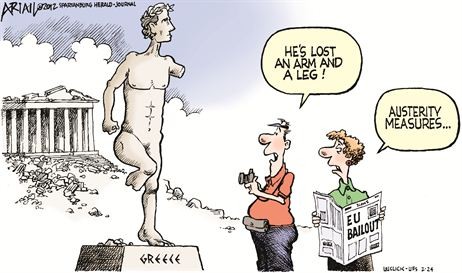
GreeceNaomi sees the current Greek crisis as yet one more example of the “Shock Doctrine” being applied to force Greece into crippling austerity measures (see here). The goal of this shock campaign is to force them to sell off fossil and mining resources, as well as any other pillageable assets, for pennies on the drachma. Think of these banking institutions as lions that pick a weak prey and run it down until it collapses to be devoured flesh and bone, leaving a carcass. Greece is the most recent prey that these predators have pulled out of the pack of nations.

Even if you agree that the lions are on the hunt to feast upon the financial problems in Greece, you may still believe that greedy and irresponsible Greeks are nevertheless guilty of making themselves vulnerable in the first place. Perhaps a weak and feeble antelope deserves no sympathy if it is culled from the herd. Maybe the lions are performing an important and essential function in a jungle of economic Darwinism.

But a very credible CNN article (found here) disputes this blame-the-victim mentality. It points out a number of things that those big news sources who repeat the meme fail to mention. For one thing, the article points out that the meme of “rampant tax evasion” is deeply misleading.

“In Greece the culprit has been rampant tax evasion by corporations owing millions in taxes and self-employed professionals who can hide their earnings, unlike salaried employees and pensioners. Under international pressure to balance its budget, the outgoing Greek government axed salaries and pensions and slapped new taxes on the bulk of citizens who were not tax-delinquent. “

We see the very same thing happening with tax “minimization” by corporations and the ultra-wealthy here in the United States, do we not? And as in our own financial crises, it was the insatiable greed of wealthy people and corporations that drove this crisis in Greece, not the greed and indolence of ordinary Greeks as it is portrayed. And just as the media propagated this “blame-the-homeowners” meme in America, they conveniently fail to specify that it is largely wealthy interests who are guilty of tax “minimization” in Greece. Also as in America, it is the regular Greeks who end up footing the bill and paying the price for the avarice of the rich.

How many times will we believe the memes spread through mainstream media? How often will we allow powerless ordinary people to be scapegoated for crises created by the same financial institutions holding all the power? How many more countries must fall to these big financial institutions before we finally begin to see them for the ravenous predators they are?

Our Secular Pope

Well it’s official. Hell has frozen over. Even as a devout secularist, atheist, and humanist I now feel that even I have a Pope. His name is Francis.

I have always had respect for the Dali Lama whom I once had the privilege of meeting. Many years ago the Dali Lama told Carl Sagan that if a tenant of Buddhism were to be disproven by science, then “Tibetan Buddhism would have to change.” This was a refreshingly rational acknowledgment from a major religious leader that science must trump belief. Of course he was still stubbornly irrational in maintaining an implausible, untestable, and wholly unscientific belief in reincarnation, but it was an encouraging concession nonetheless.

I also recognize that Pope Pius XII made a similar acknowledgment in his 1950 encyclical Humani Generis. In it he acknowledged the scientific fact of polygenism and went on, in deference to science, to specifically abandon the disprovable Adam and Eve story of human origins. He also expressed openness to the legitimacy of the relatively early evolutionary science of the 1950’s. Of course he still held that God existed and endowed humans with a divine “soul.” Like the Dali Lama, he conceded to science on the disprovable parts while still falling back upon the un-disprovable beliefs as faith.

But I’ve never been an unqualified fan of a religious leader until now. Through his recent encyclical letter Laudato Si’ (found here), Pope Francis threaded essentially the same needle as these previous religious leaders. He acknowledged the irrefutability of established climate science while still clinging to his belief in god and souls. Like Pope Pius and the Dali Lama, he is rational enough to understand that religion is better served by deferring to science on matters of fact and that it is ultimately self-defeating both for the Church and for mankind to deny established science. Like those others he is also sophisticated enough to understand that the fundamental tenants of his faith can never be specifically disproven by science and that is enough for most believers. But unlike those others, he has gone far, far beyond merely acceding to science to embracing it in an active fashion.

Even given the widespread consensus on global climate change, Pope Francis was nevertheless frank and courageous in Laudato Si’. It takes courage for any leader to acknowledge the science of global climate change, to disavow the environmentally irresponsible worldviews held by many Christians today, and to call for deep changes to the status quo. This is a courage that many of our secular leaders still sadly lack. The Pope acknowledged that man is responsible for protecting the Earth, that we are responsible for catastrophic global climate change, that climate change endangers our very survival, and that it is our responsibility to fix it.

Following are some important points that I pulled from my reading of his encyclical:

  • The Pope challenged us to “protect our common home,” entrusted to us by God.
  • He discussed many real threats to the planet including “pollution, waste and a throwaway culture,”  “the issue of water,” and “loss of biodiversity.”
  • He pointed out that the climate is a “common good” that is “a complex system linked to many of the essential conditions for human life.”
  • He acknowledged that a “very solid scientific consensus indicates that we are presently witnessing a disturbing warming of the climatic system.”
  • He acknowledged that all these things result in “global inequality” and a “decline in the quality of human life and the breakdown of society.”
  • He acknowledged “the human roots of the ecological crisis.”
  • He pointed out that our responses to these challenges so far have been “weak.”
  • He challenged people who defend the status quo by rejecting “those who doggedly uphold the myth of progress and tell us that ecological problems will solve themselves simply with the application of new technology and without any need for ethical considerations or deep change.”
  • He acknowledged the dangers of “misguided anthropocentrism” that places the gratification of mankind above all other considerations.
  • He acknowledged the principle of the “common good” and called for “justice between the generations” which imposes a responsibility to pass along a habitable planet to future generations.
  • He issued many calls for “dialog” and immediate action.
  • He held that the role of religion is to “guide” science.

Although these may all seem like obvious points to some, it is critically important that the Pope made them. Many religious people still do not accept the 1950 encyclical regarding evolution and they are not likely to accept this encyclical on climate change, or our role in creating a sustainable planet, let alone our responsibility to respond to the social and ecological challenges we face.  It is amazing to see the Pope and the Catholic Church taking such a strong leadership role for social justice and environmental sanity.

But it is important to also look at what the Pope did not say. Most noticeably, while he called for action by others, he did not so far lead by example with tangible actions within his power to initiate. I hope these kinds of actions are to come.

  • He did not call for divestment from the fossil fuel industry and other environmentally irresponsible industries nor did he promise to do so with the reported $8B Vatican portfolio.
  • He did not call for the extremely large worldwide Church infrastructure to “go green” and lower their very substantial carbon footprint.
  • He did not specifically instruct his clergy to take tangible local action to promote a culture that helps to achieve the goals he outlines so passionately.

Less obviously but more notably, Pope Francis did not call for prayer as a solution to our environmental crisis. In fact, he only used the word “prayer” a few times in the entire encyclical and never in the context of a call to action. Instead he used the words “science” and “scientific” dozens of times in the context of providing real solutions.

Evidently even though the Pope supposedly believes in an active, caring, and omnipotent god, even he is not silly enough to rely upon the power of prayer when the outcome really matters.

PopeFrancisI close with sincere thanks to Pope Francis. He is courageously using his bully pulpit in a responsible way that most secular leaders including President Obama have not. His strong statements regarding climate change in particular and social justice generally are desperately needed. I particularly appreciate his continuing calling out of “people, managers, businessmen who call themselves Christian and they manufacture weapons” as the immoral hypocrites that they are (see here).

Thanks Francis. You go Pope! Keep it up!

The Polling Crisis

poll-box“Election polling is in near crisis, and we pollsters know. Two trends are driving the increasing unreliability of election and other polling in the United States: the growth of cellphones and the decline in people willing to answer surveys. Coupled, they have made high-quality research much more expensive to do, so there is less of it.”

 “In short, polls and pollsters are going to be less reliable. We may not even know when we’re off base. What this means for 2016 is anybody’s guess.”

This is a quote from a recent NYT opinion article by Cliff Zukin entitled “What’s the Matter With Polling?” If you pay for access to the NYT website, the link is here (NYT Article).  In short, the author points out that the polling industry is in crisis. It has become hugely more expensive, if not essentially infeasible, to do reliable polling anymore. Trends including the disappearance of land-lines and growth of the Internet have converged to undermine what little reliability polls used to have. The main takeaway is that polling “science” is really bad and is only getting worse and pollsters have no idea how to make it better.

The author focuses primarily on the growing financial and logistical challenges for the polling companies. Since pollsters must make a huge number of calls to obtain even a remotely valid sampling of reliable data, the cost of doing accurate polling has become extremely high – even prohibitively high.

However I prefer to focus on the problems that this situation creates for rational governance. Even good polls have undesirable consequences. Their mere existence creates an almost irresistible compulsion for politicians to pander to poll results, saying whatever the numbers tell them that likely voters want to hear. Even if the polls are accurate, this may not be the best way to govern – or even to campaign. But if polls have become woefully inaccurate to boot, and yet we continue to pander to them, then we have taken what was already a problematic approach to governance and made it far, far worse.

One specific problem I’d like to focus upon more deeply is the self-fulfilling prophesies that these polls create. If the polls tell us that, for example, Bernie Sanders cannot possibly win, then those polls influence huge numbers of people to respond by not voting for Bernie Sanders – creating a self-fulfilling feedback loop. And what if those admittedly unreliable polls were simply wrong? What if perhaps they were even disingenuously promoted as a stealth strategy by a big money Clinton campaign (theoretically) for exactly that purpose?

Maybe we’re better off without any polls. Good riddance, I say. Maybe we’re better off if politicians campaign and govern according to actual scientific data and humanistic ethical principles, not according to polling. Maybe we voters are far better off if we remain uninfluenced by polls as well.

Whoa there, you say. If you have read my book “Belief in Science and the Science of Belief” (found here) you know that a fundamental principle I champion is that decisions based on facts are inherently better than decisions based on beliefs. If that is the case, aren’t polling facts important information to consider in campaigns and in governance?

Yes but I’m also suggesting that polls aren’t the best facts to use and that they push all the air out of the space for actual, more important and more reliable facts to sufficiently drive political campaigns and decision-making.

Poll any group of alcoholics and the data will likely show that they want more alcohol. As antithetically “paternal” as this may sound to some, a government must provide what society needs, not necessarily what people want. Private corporations can be driven by market research to provide exactly what their customers want (when not unethical or illegal). But a government simply cannot make policy based primarily on polls if they are there to serve the common good.

Now if even accurate polling can create unhealthy pressures for governance, imagine the consequences if we continue to listen to polls that have now become even less reliable. Now we are making decisions that impact the lives of people and the life of the planet that are primarily based not merely on polling data but on really bad polling data.

I say again, good riddance to polls. My hope is that we turn this crisis into opportunity. This is our chance not to merely improve polling methodologies, but to start to weigh polling data far lower in our decisions and instead find ways to make policy decisions based more upon the best objective science and rational decision-making possible. I hope that our emphasis on “what people polled want” is permanently diminished and replaced by more indirect and sophisticated methods of data mining to understand what they actually need and what will best serve humanity and planet Earth in the long-term.

Government by Jury

We all know it.  Our democratic government isn’t all that democratic. It is inherently corruptible by the influence of big money – obscenely so since the Citizens United ruling. That big money necessarily compels our legislators to work for the short-term interests of wealthy individuals and big business, rather than for the long-term common good.

The most common response to this reality is resignation. Well yes, our system may not be perfect, but it’s the best we can do. How defeatist and unimaginative is that? We certainly could do a lot better if we only had the will to do so. We could enforce far stronger conflict of interest rules for our legislators – the same sort of rules we already enforce for judges. Oh we nip around the edges, passing token campaign and conflict of interest regulations, but nothing that would fundamentally reduce the river of big money flowing into government like a raging river. But we could.

And there are more fundamental things we conceivably do. Just brainstorming here, but I’ll offer one such idea. Feel free to use it if you ever start your own country or overthrow a government.

juryMy form of government would be a “Jurist Democracy.” In my Government by Jury, legislators would propose legislation but could not pass it. To enact their proposed legislation, lawmakers would function as advocates, arguing the cases for and against the proposed legislation based on their own ethics, or their constituents, or their financial backers just as they do now. A non-partisan judge would preside over a Legislative Hearing and ensure that all evidence is vetted and all rules are followed. Once both sides have presented their arguments and their expert witnesses, a jury of ordinary people would retire to discuss and rule upon the proposed legislation. Jury selection would be conducted just as it is for criminal cases. The citizen-jury would decide whether a strong enough case had been presented and would make the final decision on whether the proposed legislation should be passed into law. Teleconferencing could eliminate previous geographical limitations.

No claim of a panacea is made here. Certainly this system would be neither perfect nor foolproof. Games could still be played by the legislators; horses traded, bribes offered, and so on. We would have to be assiduously vigilant to prevent or punish malpractice and jury tampering. But we know how to do those things.

And these corruptions will happen in any system. The key difference here is that at least we have removed the final decision from those who are most directly corruptible. If the legislators cannot convince twelve reasonable citizens that their legislation is good for the country then it does not deserve to be made into law. I for one would be much more confident that twelve impartial citizen-jurors would on the whole make better decisions than career politicians.

And I don’t buy the argument that citizen jurors could not understand the issues involved sufficiently to render intelligent decisions on complex issues. That sounds a lot like medieval priests who maintained that they alone could interpret the word of god for the common man. In fact I have far stronger concerns about the impartiality and expertise of professional lawmakers (many of whom do not even believe in evolution), and trust that if a bill cannot be explained to reasonably smart people is it probably too convoluted to pass. This idea that a bill is too complex for ordinary folk is mostly just used as an excuse to make our government less transparent and more susceptible to the disastrous impact of small print obscured within intentionally complexicated legislation.

This Government by Jury would be far more democratic because it would directly involve large numbers of citizens directly in the process of governing. I for one at least, would be far more willing to put my faith in the good sense and civic-mindedness of 12 random individuals than in professional legislators who are saturated in conflicts of interest starting with keeping their jobs and their positions of influence within the system.

It is pretty much impossible to put forth any idea that has not been thought of before. In his article called “Government by Jury” (found here), Stephen H. Unger from Columbia University discusses this general concept in greater detail and provides additional references. His suggestion is to conscript citizens into some longer period of service. I suggest that legislative jurors could be recruited only to decide one piece of legislation with minimal modifications to our current system. We recruit juries to make decisions in criminal and civil cases of comparable complexity. To recruit them for longer periods of service would include fewer citizens, would be much more logistically difficult, and would introduce more possibility of the very sort of corruptions that we are trying to avoid.

Ideas such as these should be discussed more often, more openly, and more seriously. They help stimulate real innovative, out of the box thinking rather than restricting ourselves to ideas that do not disrupt the current dysfunctional status quo. Merely raising and discussing proposals like this makes it more likely that legislators will consider more substantive conventional measures to improve the integrity and effectiveness of government.

Religion and Torture

Recently we Americans have been forced to confront real questions arising from our use of torture. Do we rationalize its use in certain circumstances but not others? Even ignoring the question of whether it actually works, does the end ever really justify the means? Is torture acceptable when our government is responsible but unacceptable when conducted by some foreign entity? Do we outright deny the validity of the Geneva Conventions or do we merely deny that what we do is technically torture? Do we view it as a necessary evil to protect our lives and freedoms?

Or do we condemn torture categorically regardless of any rationale? Do we support the prosecution of those who engage in torture regardless of their position in our government or even within our own party?

It turns out that our views on religion are a strong indicator of how we are likely to answer these important questions.

Religion has long walked hand in hand with violence, war, and torture; neither leading, neither following, but each symbiotically sustaining the other. Most of us are quick to draw an unholy relationship between radical Islam and a culture of war and torture. But we are extremely reluctant to acknowledge that a majority of Christians are also willing to embrace violence and even torture. The marriage of guns and Bible has been a long and horrific union, but the Christian embrace of torture goes back to the Inquisitions and far beyond that to the Old Testament.

ReligionAndTorture

And this tendency still persists. That is not merely a biased, anecdotal assessment based on long-abandoned barbarisms of the distant past, or even more recent cultural memories of racial atrocities perpetrated by Christian zealots during the last century. Religious rationalizations of and even engagement in violence and torture is still alive and well today. Certainly, many Christians and Muslims alike denounce violence and torture in word and deed, but amongst Christians at least, those who take a stand against torture are a statistical minority.

The Christian willingness, and even eagerness, to embrace the inhumanity of man towards man is exposed and quantified by the findings of current and credible polling studies. According to a recent Pew survey, people who attend church at least once a week are more likely to say that torture is often or sometimes justifiable. Christians in fact are often measurably ahead of the rest of the country when it comes to waging war or condoning brutality and violence. Indeed, Evangelicals supported President Bush and his fabricated Iraq war more strongly than most any other demographic.

And the Pew poll is hardly the only one confirming that this Christian embrace of violence extends to torture. A recent Washington Post/ABC News poll found that while 59% of Americans believe that the CIA treatment of suspected terrorists while held in detention was justified, the level of approval was much higher among Christians. That poll found that while 72% of non-religious people believe that the CIA treatment of detainees amounted to torture, only 39% of Evangelicals agree with that assessment. By all measures, Christians are more likely to condone torture than non-religious folk.

When the same poll asked whether the CIA “treatment” was justified, approval for this activity (whether or not you call it torture) was dramatically higher amongst all religious demographics than non-religious ones. Conversely, disapproval was far higher amongst non-religious respondents than it was for any religious demographic.

Demographic
Evangelicals
Protestants
Catholics
Non-religious
Approve
69%
75%
66%
41%
Disapprove
28%
22%
23%
53%


As is evident in these results, non-religious Americans are far more likely to view this treatment as torture and likewise to disapprove of its use than any Christian demographic. These findings directly dispute the raison d’être of religion, which is the claim that it imparts superior moral and ethical principles and that a lack of a religious foundation results in less developed moral reasoning.

We atheists and other non-religious groups clearly hold the moral high-ground on torture as well as on a wide range of critical moral and ethical issues. But we need to do far better in translating our deeply held humanist convictions into tangible actions that make the world a more humane place in which to live, starting with abolishing torture in our own country – even with regard to enemy combatants. We need to not only hold the high ground here, but build a great beacon of light upon it and shine it upon the world. We need to speak out and even march at every opportunity against violence, war, and torture and draw clear and unmistakable lines between where we stand on these issues, and the culture of violence and torture that many in the religious community would like perpetuate and even expand.

You can explore this topic further by starting with this post by Sarah Posner.