Trump’s Cabinet of Sycophants

Like the rest of the nation, I have lots of other topics I’d like to blog about, but I instead need to vent about Donald Trump’s pathetic first “Cabinet Meeting” held today. It was a new low for a President who keeps surpassing expectations for how low a President could possibly sink – and that made it a new low for our nation.

donald-trump-cabinet-meetingThere was no actual meeting. No normal business was conducted. No information was exchanged. It began unsurprisingly with Trump touting how he is the greatest President ever. His obscene self-aggrandizement was followed with each of his cabinet ministers taking their turn to genuflect at his feet and pour praises upon him in the most hyperbolic manner they could (see here). Each one affirmed that their lord and master is the greatest president ever, that he has accomplished more than anyone else could possibly imagine, and showered him with their deep gratitude for the singularly great honor of serving under him.

Trump accepted each sickeningly fawning public declaration of adulation and adoration like some cheap fantasy novel King, nodding his approval as each of his Barons pledged undying loyalty with flattery and tributes of gold.

It felt like we imagine North Korea to be, but then again I’m not sure even Kim Jong-un is actually as pathetically needy or that he has a more disgustingly sycophantic group of advisors around him than Trump does. Today, at least in the Executive Branch, we became worse than North Korea because unlike the North Koreans, we chose to empower this ridiculous child-king.

Trump is still not a President. He holds the title but he does not act like one. He rather acts like the winner of a reality TV show – Survivor or Last Man Standing. Or maybe he’s closer to a romance novel Beauty Pageant winner, doing the circuit of required appearances to revel in the applause and envy of all those who called her plain and dull in High School. Dressing up each day only to feed her vanity but with absolutely nothing of any actual substance to offer from atop her throne.

This meeting today dashes all hope that Trump would bring together a Cabinet of distinguished advisors who could competently manage this nation. To be sure, he has succeeded, but he has succeeded in assembling a Cabinet of Sycophants who are willing to debase themselves and grovel to feed the insatiable ego of this egomaniacally compulsive liar.

As long as there have been kings and dictators, the worst of these have found sycophants to serve them. Donald Trump has found his.

Don’t Get Used to It

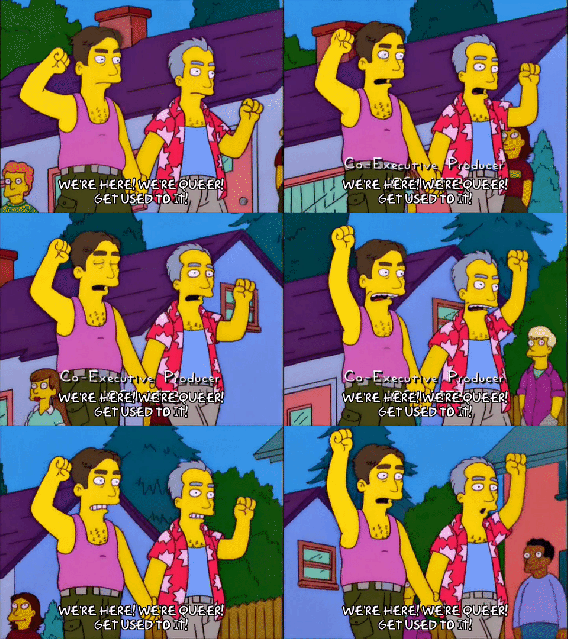
WeAreHereIn the early 1990’s, a group called Queer Nation came up with the “We’re here! We’re queer! Get used to it!” chant. It was wildly successful and contributed greatly to the phenomenal success of the Gay Rights movement. That movement was so successful that other movements still look to it as the gold standard for both inspiration and strategy. Many of them have adapted and adopted the “We’re here!” slogan-as-a-strategy in form, in spirt, and in attitude.

Arguably however, the slogan has jumped the shark. Even Lisa Simpson, longtime advocate for Gay Rights, eventually shouted in frustration “You do this every year, we ARE used to it!” (seen here). At this point, one could launch a counter-chant “You’re here! We’re used to it! Get used to it!

But the slogan is past its day in deeper ways. I’ll get to that shortly.

First let me point out that the slogan has become much more than a mere rallying chant. It reflects a worldview, an attitude, a tone, and an approach to relationships, both societal and personal that has influenced all of our culture. This message was so successful that it became deeply internalized and enculturated.  It permeated the very thinking of a generation of liberals and conservatives alike. It says, in the most uncompromising terms, that you get what you want by ultimatum. There is no room to negotiate. There is no shared responsibility nor shared blame. The burden is all on the other side. You had better change because I am what I am and I am not going to change or go back into any form of a closet. It is a problem when this no-compromise attitude is generalized beyond the bounds of movements like Gay Rights.

In addition, Liberals were particularly influenced in a much different way. The slogan enculturated the idea that we should not expect others to compromise. We must accept anything and everything no matter how distasteful we find it. We must never criticize other ideas or behaviors, let alone expect or demand anyone else to change. Good liberals chasten each other when they are insufficiently accepting of other viewpoints and differences. This is another unfortunate lasting impact of this movement which taught that it is wrong to judge or criticize.

If this seems confusing to you, I say good! It means you are paying attention! I am suggesting that the Gay Right’s movement in general and the “We’re here!” slogan in particular had two seemingly contradictory side-effects. One was to encourage a destructively uncompromising posture, and the other was to instill an attitude of principled acceptance. These actually reinforce each other.

In current culture this encourages us to assert an unwillingness to accommodate others in any way – even as we chide and criticize those who a do not accept the inflexibility of others. In practice, this is manifest by self-righteous “take me or leave me” declarations when the issue impacts us strongly, and at the same time preachy “you should accommodate others” admonitions when the issue does not impact us as personally.

While it was the right message at the right time for the Gay Rights movement, this confrontational get-over-it ultimatum it isn’t necessarily a good template for other movements. Moreover, it isn’t a particularly good attitude for society in general and it certainly is not a good approach to interpersonal relations. It is a strategy adopted even by the most vile and indefensible groups and individuals.

We’re here! We’re loud and obnoxious! Get used to it!

We’re here! We’re Confederates! Get used to it!

We’re here! We’re Gun-toters! Get used to it

Civilized societies have to cooperate, negotiate, moderate, and compromise if they are to survive. In most cases, an ultimatum strategy is doomed to result in unfortunate outcomes for both parties. When we can compromise and make changes, we can demand that both sides make some effort, some accommodation.

The same is true for interpersonal relationships. If one roommate declares “I’m a messy slob but I’m not going anywhere so you better just get used to it,” it leaves the other party no choice but to walk out. Love me or leave me doesn’t work. Unlike gender identity, most things are somewhat under our control and there are things we can and should do to improve our own behaviors.

In truth, this attitude is dated. Those still influenced by it are blind to the times we live in today. During this Era of Trump, uncompromising declarations and pious acceptance are not as appealing as they once were. People who are making a difference today are people who say “I am willing to change and I do not accept your assertion that you cannot change as well.”

WereHereWith radical crazies infesting the government and with Trump running a for-profit White House, we can no longer accept the “Accept the things I cannot change…” platitude. We cannot accept the fact that Donald was elected President. This picture posted like subversive graffiti on a telephone pole near my house. It reflects the new, more engaged attitude. It reads “I am no longer accepting the things I cannot change. I am changing the things I cannot accept.

We cannot simply accept evolution and climate change deniers in the Congress and Senate. We cannot simply accept a narcissistic lunatic in the Oval Office. We have to criticize. We have to fight. We have to demand change. We have to give up this “liberal principle” of polite acceptance that has lobotomized our brains since the Gay Rights movement launched its famous slogan. We must stop falling for the jiu jitsu logic of Conservatives who tell us that – as we told them about Gay Rights – we now must “get used” to Trump and everything he fails to stand for.

The Gay Rights movement did not intend to teach us acquiescence. Quite the opposite – it was all about boldly fighting for your cause. But it also did not intend to teach that any assertion of an absolute position on any issue must be completely accepted. If both sides take absolute positions of ultimatum, we can only have division and dysfunction.

Apart from basic human rights issues, we do NOT have to accept every card we are dealt. No one should be allowed to build unassailable walls around their intransigence and we should not be pressured by our own peers into respecting and accepting those artificial constructs. “Get used to it!” should not be a principle that we apply in an uncompromising and self-destructive fashion.

Ultimatums are not a strategy, and neither is Zen-like acceptance. In most things, engagement with others and compromise on both sides is how we find win-win solutions.

In realms of faith, many of us conclude that my need for you to respect my crazy belief forces me to respect and support any crazy faith you may have. Truth and belief become inextricably blurred. It’s kind of the same thing here. If we want others to accept our ultimatums, we must then accept the ultimatums of others – no matter how crazy.

We have to exert more nuanced and fact-based judgement in both areas. It’s time to deprogram ourselves away from the old ultimatum-based “We’re here!” thinking of the Gay Rights era and adopt more sophisticated strategies to win hearts and minds and make real change. That starts with not accepting ultimatums or wisdom that tells us to accept what those who profit from the status quo tell us we cannot hope to change.

 

Healthcare is a Limited Right

PrivilegeIt is obscenely immoral when Conservatives argue that healthcare is a privilege reserved only for the privileged few who deserve it, especially when the only criteria that determines whether the privileged few deserve healthcare is whether they happen to be rich enough to afford it. For Conservatives, wealth is the only measure of merit and the wealthy are the only ones meriting healthcare.

Conservatives have a wide range of specious logical arguments and appeals to emotion that they invoke with great fervor to support their petty shortsighted selfishness. Here is just one horrible article in the Washington Times that regurgitates much of this vomitous bile (see here). Among these arguments are 1) the Constitution does not explicitly enumerate any such right, 2) why should others pay for your healthcare, 3) this right to healthcare would have no limits, 4) it would lead to government death panels, 5) it would ration healthcare and slow it down, 6) it would stop all new research, 7) the free market is the best solution, 7) healthcare is a commodity like any other, 8) free healthcare would disincentivize work, and 9) we don’t consider food, shelter, or clothing to be rights, so why should healthcare be one?

Of course these all have relatively simple and well-known rebuttals so I won’t go into them all here. I won’t repeat the overall cost savings or make further appeals to basic humanity and decency. I will only point out that Conservative claims that healthcare as a right cannot work are all empirically proven wrong by the fact that every other civilized country in the world manages to make it work. And their claims that national healthcare in those nations leads to worse outcomes is empiracally proven wrong by actual metrics of healthcare outcomes.

The most popular recent argument worth singling out is “why should young people pay for the healthcare of older people?” Well, not ONLY because when today’s younger generation gets old, tomorrow’s younger generation will subsidize THEIR healthcare, but also because today’s older generation helps to pay for the colossal medical bills incurred when young people break their neck while skate-boarding or bungee-jumping.

Religion does not help us out much in this debate. As with pretty much every issue, religion only rationalizes and provides justification for whatever position one wishes to take. For progressive Christians, the Bible demands universal healthcare. But conservative Christians manage to find passages to justify their healthcare Darwinism. Representative Jodey C. Arrington, Republican of Texas, defended work mandates at a Congressional hearing for food stamps by quoting the Bible: “If a man will not work, he shall not eat.” This “Bible logic” has been applied to healthcare as well (see here).

Look, the answer is not that complicated. It is only made complicated by Conservatives who strive to make it seem murky and fraught with practical and ethical problems. The answer is simply reasonable moderation. No one suggests that a “right” to healthcare would not be a limited right. No right is unlimited. We should and could provide basic public healthcare that would do immesurable good. Just as we should provide a minimum wage and, yes, a minimum amount of food, clothes, and shelter to our fellow humans.

Rich people could still buy whatever elective or costly life-extending healthcare they like, just as they can still buy all the expensive food, clothes, or homes they can afford. But Conservatives won’t abide even reasonable moderation. They don’t want those good for nothing, undeserving poor people to have one penny “handed out” to them, whether it be food, clothes, shelter – or healthcare.

The false choice that Conservatives try to force us to accept is either to provide no base level of public healthcare whatsoever – like mindless animals – or to grant everyone an unlimited right to medical care. That is an intentionally paralyzing false choice. We can provide reasonable healthcare and retain an elective healthcare market and retain all the advantages of a private market with a public safety net. No one would turn up their nose at life-saving healthcare because it will not pay for their boob job.

We should not let Conservatives engage us in this false choice arguement, rather insist upon a sane and humane universal public system that ensures reasonable basic healthcare for all. The only debate should concern the extent and limits of healthcare that is covered under the public system. But that debate should not endlessly paralyze us either. Tweaks to specifics can be made at any time as needed.

And as to paying for all this… I say what I say about all social funding. Cut the military to a fraction of its current budget and tax the rich far more progressively, then we can talk about how much, if any, we still need to limit social programs.

We are Townsfolk in a Spaghetti Western

ClintAre you old enough to have watched those wonderful old Spaghetti Westerns? The typical story went something like this…

When the townsfolk people of some poor dust bowl are abused and impoverished by a gang of ruthless cutthroats, they elect an unsavory drifter as “sheriff” to protect them. A bloody shootout ensues, involving lots of gratuitous gunfire and dynamite explosions.  When the smoke finally clears, it never ends all that well for the townsfolk. Most of them are dead or wounded and their ramshackle town is pretty much reduced to a smoldering wood-heap. Their “sheriff,” having done what they asked of him, rides away from the dead bodies and the smoking rubble with saddlebags overflowing with their life savings.

None of those townsfolk were crazy extremists. They were just regular folk, farmers and shop owners, out of options and fearful for their futures. They were driven by desperation and circumstance to put their faith in the toughest, meanest, bad-ass Alpha male they could find.

Many of us lament that we vote so many arguably dangerous people into high office. Not only into the Presidency, but into the Congress and the Senate and even into the Supreme Court. Too many of these office holders hold frankly crazy views on science, on climate change, and on evolution. They advocate for policies rooted in their faith in the twin religions of capitalism and god. They take extreme positions on guns and militarization. They hold crazy Libertarian and Free-Market views on health care and social programs and racism and sexism and sexuality and abortion and deregulation. They seem to have no scruples whatsoever and will make any ridiculous argument, propagate any lie, to pursue their self-interest and ideology.

No wonder chaos ensues.

We generally blame the crazy extreme of our population for this situation. We argue that our lunatic fringe, driven by their zealous energy and amplified by Gerrymandering, have disproportionate power over electoral outcomes. If only we moderates could take charge, then we’d elect sane, reasonable, and compassionate leaders!

But I want to suggest that moderates are culpable as well. It’s human nature, or at least American nature. Even moderates, like the townsfolk in a Spaghetti Western, turn to crazy and dangerous individuals when they are looking for someone who can make a difference in their lives.

Look at it this way. Most of us are understandably concerned about our physical security and economic self-interest. When we’re worried about home security, we don’t hire someone like ourselves to protect us. We hire a bad-ass body guard, or maybe we adopt a vicious pit bull and buy a deadly semi-automatic pistol. If we are worried about going to jail, we don’t want the most reasonable and knowledgeable lawyer to represent us. We rather want the most aggressive and unscrupulous lawyer possible. We want a lawyer who is willing to say or do whatever it takes to protect our interests, law be damned.

Similarly, to protect our physical and economic security, we elect representatives that are far more extreme than we are. We find the nastiest, most crazy representative we can to fight for us and defend our interests. Even if our head tells us to hire someone smart and reasonable, we are overwhelmingly attracted to the brutal, unreasoning Alpha male (or female).

Part of our decision process is our calculation that no leader can be fully successful. So for example if we believe it would be good to eliminate fat from social programs, we elect a leader who says he wants to dismantle all social programs. We figure that maybe at least he’ll be successful in getting rid of that waste and abuse we are so outraged by. When our elected leader ACTUALLY dismantles vital social programs that we value, we are shocked and outraged. Even though the crazy candidate campaigned on throwing out the baby, we figured he would really just get rid of that dirty bathwater.

So when extremists vote, they tend to vote in someone much more extreme than they are whom they believe will fight hardest for them. They make extreme demands that they don’t necessarily hope to achieve. And then even those same extremists express shock and anger when that representative they worked so hard to elect actually does succeed in achieving what they demanded. I don’t think it is so much about voting against our own self-interest as it is about adopting a pit bull to protect our baby.

But moderates do the essentially same thing. Even moderates in large numbers buy guns as “reasonable” protection, then lament when they are used to shoot up a school-full of kids. Even moderates vote for the Alpha male to keep our country safe, then express outrage when he lies us into an unnecessary war. Even moderates vote for extreme “strongmen” (or strong-women) whom they foolishly believe will become reasonable and restrained and diplomatic upon taking office.

Just like in those Spaghetti Westerns, we moderates and lunatic fringe alike, have elected President Trump and a dirty dozen of tough, extreme bad boys to save us. One has to wonder what will be left of America when they get done protecting it. Or will Trump and the corporatist elite around him merely ride into the sunset of America with saddlebags packed full of our life savings?


Scientific Models

I recently attended a book club discussion on The Meme Machine by Susan Blackmore (see here).  In it, Blackmore puts forth a thesis of “memetic evolution” to describe how our minds work. In fact, her assertion is that our minds can only be understood in terms of memetic selection. Although that seems to be a wildly exaggerated claim, the scientific model she proposes is both stimulating and promising.

But memetic evolution is not the topic of this article. I only cite it as one example of the kind of topic that  many non-scientists and even some scientists have great difficulty discussing fairly. Often in discussing such topics, a great many unfounded criticisms are lodged, and these quite often flow from an inadequate understanding and appreciation of scientific models.

This is understandable. Unless you are a trained, experienced, and particularly thoughtful scientist, you probably have had inadequate background to fully appreciate the concept of a scientific model. In fact, if you look up the word model in most dictionaries, the scientific usage of the term is typically not even mentioned. No wonder many people have a very limited if not completely mistaken appreciation of what a scientific model is. A scientific model is not analogous to a plastic model kit that is intended to look just like the real race car in every detail. It is not at all like a fashion model, intended to present something in an attractive manner. Nor is it like an aspirational model to be put forth as a goal to emulate and strive toward.

No, a scientific model is a working system that does not need to actually “look like” the real system it describes in any conventional way. The important characteristic of a scientific model is that it behave like the real system it describes. How accurately a scientific model reflects the real system it models is measured by how well it explains observed behaviors of the real system and is able to predict future behaviors of the real system.

For example, in 1913 Ernest Rutherford and Niels Bohr put forth the atomic model of matter that we are all familiar with – a nucleus of protons and neutrons orbited by electrons. This was a highly successful model because it described a huge number of observed characteristics and behaviors of matter, allowed us to gain great understanding of matter, and most importantly allowed us to predict as yet unobserved traits of matter.

But in truth the Bohr model is a laughably simplistic stick-figure representation of matter. It describes certain behaviors adequately but completely fails to describe others. It was quickly extended by De Broglie, by Schrödinger, and innumerable others to include wave and then quantum characteristics.

Despite its almost laughable simplicity and innumerable refinements and extensions made over the last century, the Bohr model remains one of the most important and consequential scientific models of all time. If the Bohr model was presented in many book discussion groups today, it would be criticized, dismissed, and even mocked as having no value.

Certainly we can and should recognize and discuss the limitations of models. But we must not dismiss them out of a mistaken lack of appreciation of the limitations of scientific models. Often these misguided criticisms have the more widespread effect of unfairly discrediting all science. Following are some examples of the kinds of criticisms that are valid and some that are invalid.

  1. We must first recognize when we are talking about a new idea like memetic evolution, that we are talking about a scientific model.
  2. A scientific model does not need to answer everything. We must recognize the limitations of every model, but the more important focus is on how useful it is within its applicable limits. Newton’s Laws do not describe relativistic motion, but in our everyday world Newtonian physics is still fantastically useful. Critics of science should not claim that a model – or science in general – is fundamentally flawed or unreliable because a particular model is not universal.
  3. Many critics of science think they have scored points by pointing out that “you can’t trust science because their models are always being replaced!” But models are hardly ever replaced, rather they are extended. The Bohr model was greatly extended, but the basic model is still perfectly valid within its range of applicability.
  4. The fact that there are many different models of the same thing is not proof that “science contradicts itself and cannot make up its mind.” We famously have the two major models of light- the wave model and particle model. The wave model correctly predicts some behaviors and the particle model correctly predicts others. Though they appear irreconcilably different, both are absolutely valid. Real light is not exactly like either model but is exactly like both models. Think of your mother. She has a mother-model that describes her behavior as a mother. But she also has a wife-model, a career-model, a daughter-model, a skeletal-model, and many others. None of these in themselves completely describes your mother, and many may seem irreconcilably different, but all of them correctly model a different set of behaviors in different situations and only collectively do they all communicate a more complete picture of your mother.

So, when discussing something like memetic evolution, it is proper and correct to ascertain its boundaries and to critique how well it describes and predicts observed behaviors within those boundaries. But it is wrong and counter-productive to dismiss it either because there exist other models or because it does not – yet – describe everything. And worst is to dismiss all of science as flawed because it puts forth multiple models of reality and extends them over time.

To describe and predict human thinking, Skinner put forth a stimulus-response model, Blackmore puts for forth a meme-model, and I often focus on a pattern-recognition model. These are not in competition. One is not right and the others all necessarily wrong. The fact that there are these three and many other models of human thinking does not reflect any fundamental weakness of science, but rather its strength.

It us unfortunate that far too few people have a sufficiently deep appreciation and level of comfort with scientific models. We must do much better to understand and communicate these subtleties that are so fundamental and critical to science.


Out of Context

Charles MurrayIn the Grey Matter section of the Sunday Review in the New York Times, Cornell Professors Wendy M. Williams and Stephen J. Ceci published an article entitled “Charles Murray’s ‘Provocative’ Talk.” In it, they described a small ad hoc study that they conducted to test whether the words of Charles Murray are objectively offensive and thus deserving of the level of resistance to his lecture at Middlebury College (see here).

In their study, the authors took a transcript of Murray’s actual talk and sent it without attribution to 70 college professors with a request to rate the words on a 9 point scale from very conservative to very liberal. They found that although “American college professors are overwhelmingly liberal,” those surveyed found Murray’s words to be “middle of the road” with an average score of about 5. Williams and Ceci interpret this finding as indicating that the protest over Murray’s invitation to speak was objectively ill-informed and unjustified.

This argument is deeply and fundamentally flawed. We often see similar tricks played when someone reads an excerpt from the Constitution or Mein Kampf and asks for an opinion about it – before the gotcha reveal when they identify the authorship.

One major study flaw is the premise that words stand alone. Context matters and the meaning and intent of words can only be fully assessed with due consideration of the person making the statement. Authorship is an essential part of that greater context. If PT Barnum claimed he had a Yeti in his house, I would have received it with tremendous skepticism. If Carl Sagan made the exact same claim, I would have been very excited about the potential of an important new anthropological discovery.

The reality is that Charles Murray has a long history of promoting what many consider to be highly destructive public policy research and analysis that has undermined valuable social programs and has attacked and divided us along gender and racial differences. For example, his statement that “We believe that human happiness requires freedom and that freedom requires limited government,” may sound perfectly reasonable to 70 of our professional contacts if unattributed. Coming from a known liberal speaker, this could be meant to affirm that we should not be forced to live in an overly-policed state. However, coming from Charles Murray it is clear that his intent is to promote the dismantling of social assistance programs. The same statement might mean something even more extreme if David Duke had said it.

Based on the work of Williams and Ceci one might argue that we should remove all bias in approving speakers by using a blinded, unidentified process in which presenters are approved or rejected based solely on the text of their planned presentation. That would be extremely foolish. The reality is that the larger views and history of any speaker plays an essential role in how we should interpret their statements. Reasonable but isolated statements can conceal a larger and very different agenda that is only apparent if we know the source.

I have no doubt that the authors would respond by saying that intellectually unbiased people should be willing to hear any reasonable speaker and make this assessment for themselves, without forced censorship. However, surely they would also agree that there is some limit beyond which a speaker would not be acceptable even to them. But reasonable people can reasonably disagree about where this fuzzy boundary should lie – and that boundary must consider not only the message but the messenger as well.

Clearly a determinative number of alumni, faculty, and students at Middlebury judged that the lifetime body of work by Charles Murray, as well as his very clear lifelong mission, crossed that fuzzy line for them. Williams and Ceci may disagree on their placement of this line and that is legitimate and fair debate. But it is not legitimate and fair to conduct what amounts to a gotcha stunt under the guise of objective science to prove that these people’s determination in this instance is illegitimate and irrational.

All that Williams and Ceci may have actually shown is that, without attribution, college professors don’t assume the worst or the best. They may merely fill the void with their own middle-of-the-road interpretation of unattributed quotations.

Taking Stock-Well

john-stockwellSome of us are lucky enough, or unlucky enough, to stumble into a pivotal event in our lives that reshapes us, blows our minds, opens our eyes, changes our perspective, forever and irrevocably. I stumbled into mine back in college in the 1980’s when I blundered into a lecture by former CIA bureau chief Major John Stockwell (see here). I walked into the event as a relatively naïve and oblivious college kid, and walked out a stunned and shell-shocked cynic with regard to official motivations and storylines. Never again could I accept any official news story without some degree of skepticism and doubt, or for that matter dismiss any “conspiracy theory” out of hand simply because it questioned the official narrative.

Stockwell walked the audience through his recruitment as a young CIA officer in Vietnam and his rapid rise through the ranks, eventually attaining one of the highest positions in the bureau. He told how, during his career, he was repeatedly asked to perform actions that seemed not only immoral but counterproductive. Each time that he asked for some rationale to justify the actions requested of him, his superiors would tell him “if you only knew what we know you’d understand why this is necessary.” He believed that line, over and over, because he had to. Working under that assurance, he was personally aware of or responsible for operations to bomb infrastructure in other nations, disrupt business transactions to destabilize economies,  plant rumors to spread discord in legitimate governments, assassinate key leaders, and foment war. He detailed one of his most shameful accomplishments, how he personally orchestrated his totally contrived build up to the otherwise improbable war in Angola.

His own moment of realization finally came when reached one of the highest levels in the bureau, the level of a world chief. When he got close to the pinnacle of his career ladder, it became obvious that there was no actual reason, no secret justification, for the terrible things he did. It was painful to watch him in the lecture, almost vomiting out his pained confession like an act of penance. In a period of despair, he met for drinks with the few other world chiefs at his peer level in the CIA. They asked each other for just one example of anything they had ever done that was good for the world. None of them could justify even one thing.

That was when he “came out” and wrote his exposé “In Search of Enemies” which the CIA litigated and suppressed for many years. For most of my life it was essentially impossible to find, but I see that it is now finally available on Amazon (see here). In it, Stockwell answers the question “if they CIA accomplishes nothing, why do they do what they do?” His analysis is that the CIA is a bureaucracy that was formed to gather intelligence and take covert action during a time of war. Post-war, they have had to justify their continued existence and their obscene undisclosed budget. How do they prove their worth? They can only do this by finding enemies of the State. They are constantly “In Search of Enemies.” And since they cannot find enough enemies, they create them. They manufacture enemies so that they can then expand operations to combat them. In this way, their self-justification and self-preservation synergizes with an industrial-military complex in which the rich profit from every new or expanded conflict and war.

Stockwell spoke about the “tricks” the CIA uses to destabilize governments, ruin economies, and foment war. One of the most reliable excuses was the old “Russian Arms!” ploy. They would plant and then brilliantly discover Russian arms in a country. They would go back and report this to Kissinger of this who would then order a modest increase in their activities in that nation to counter “Russian Aggression.” It was always an increase. The Russians would see these increased activities (the CIA in fact ensured that they would) and counter, which the CIA would then report back to Kissinger to obtain the go-ahead for even further escalation… And so it goes, the game is repeated over and over and replicated all across the globe.

Unsurprisingly, his obviously heartfelt and first-hand account was NOT well-received by that college audience. They asked very tough and skeptical and even hostile questions. This is natural. No one wants to admit even to themselves that they live in a nation that does terrible things. No one wants to admit that they, by virtue of citizenship, are partially responsible and culpable for those terrible things. So we reject everything. To admit anything is to open the door on all of it. So we simply don’t want to hear it, we dismiss it all as conspiracy theory, we call it hating America and unpatriotic, we excuse it as unfortunate but necessary, we claim “they do it too.” Worst perhaps are those that tell themselves that by being avid readers of the New York Times, they would have been informed if there was anything to this stuff.

But for my part, after Stockwell’s lecture I never again accepted news reports of government accounts with the same level of trust I had earlier. When Ronald Reagan inexplicably invaded Granada, he got on television and fended off questions from the press by assuring them “If only you knew what I know.” That didn’t quite satisfy the press because they continued to ask tough questions. The next night he came out and announced that “Russian arms have been found in Granada,” and suddenly most of the press corps said, oh ok then.

When the first Iraq war came along I was similarly skeptical, but had no alternate theory of the action. I had maintained some personal contact with John Stockwell since that lecture and spoke to him occasionally. So I gave him a phone call and asked for his take on the war. He shared that Bush Senior had used back channels to assure Saddam that the US would not interfere if Iraq took action against Kuwait for their slant drilling into their oil fields. This was just a set-up by Bush who needed a war partially to boost his historically low ratings. This was later confirmed to be largely if not completely true by many corroborating reports.

When Bush Junior initiated the second Iraq war, my Stockman-esque skepticism resurged. Bush put forth – by one accounting – over 40 discrete falsehoods to lie us into that war (see here). When Bush first announced that Iraq was seeking “aluminum tubes” to refine uranium for a nuclear bomb I did an immediate Internet search and found a large number of credible experts already shouting that these tubes were not the type that would be needed for that purpose. Yet the Bush Administration kept citing this false “evidence” and the media kept reporting it, the whole while scoffing at “conspiracy theories” that called this evidence into question. It was almost a year later, after the war was inextricably committed, and after the truth about these tubes was everywhere to be seen except in the mainstream press, that they finally “broke” this revelation with their crack and bold investigative reporting.

And now today we are still hearing stories about why we must – regrettably – launch attacks against a large number of countries. We just launched missiles into Syria. One has to at least wonder if “Chemical Attack!” is the new “Russian Arms!” ploy. It works every time. And overt attacks such as this are only a very small part of our effort to ensure that there are plenty of permanent wars to feed the insatiable machine.

Look, I’m not asking you to believe every seemingly crazy story out there – you shouldn’t. But a healthy skeptic questions both sides – including what their government tells them. If you are only skeptical of the alternative view, then you are NOT a healthy skeptic, you are a Kool-Aid drinker. In fact, I argue that it is better to err on the side of skepticism of our self-perpetuating war-making machine, and force them to provide extreme evidence for their operations, rather than continuing to drink the official Kool-Aid and placing rigorous burdens of proof only on the whistle-blowers while the government merely has to appeal to their own authority as proof of their claims.

This alternate perspective used to be terribly hard to research, but today it is easy. Stockwell was hardly a lone voice but he was one of the bravest and most credentialed voices. Heck, in his 1989 lecture, Stockwell referenced over 120 books out of the thousands available at that time. Today there are innumerably more. So there is no longer any excuse for ignorance and the only ignorance possible is willful. You can start with this YouTube video of John Stockwell speaking at American University, broadcast on C-SPAN in 1989 (see here). It is still relevant today. The lecture part takes up the first hour and the remainder is questions. That hour only scratches the surface exposing the filthy and disgusting rats nest that is American Intelligence.

I urge you to give this video a fair look and consider it in the light of today’s current events. Hey, it’s only an hour and I know you find way more time than that to browse adorable cat videos. Be brave and crack the door open and peek inside. The truth will not destroy you, it will set you free. Becoming aware of and acknowledging the extent of our intelligence operations will not fix anything in and of itself, but we certainly can’t begin to fix anything until we are all willing to take that first crucial step.


Feud Delivery

I don’t often do articles on television shows because only a truly superb series can inspire me to promote it. My very first figmentum was a review of Penny Dreadful on Showtime (see here and here). In a subsequent figmentum, I raved about the Netflix series Daredevil (see here). Given what those two series say about my taste in entertainment, you may find it surprising that I would now feel inspired to rave about Feud: Bette and Joan (see here) which is currently playing on FX (preview here).

FeudTo sum it up in typical Hollywood fashion: Feud delivers a spicy pair of dishes!

The 8 episode series recreates the bitterly tempestuous rivalry between the legendary actresses Bette Davis (see here) and Joan Crawford (see here). Screen icon Bette Davis is portrayed with masterfully understated brilliance by Susan Sarandon (see here). Sarandon exquisitely captures the quirky but many-layered personality of Davis without succumbing to portraying her as the caricature of the actress that has been depicted through innumerable movie and cartoon parodies. Jessica Lange (see here) delivers an equally brilliant performance, fearlessly inhabiting a bitter and ever-acting Joan Crawford, desperately clinging to old grudges and her fading superstar status.

zetajonesThe series doesn’t rely only upon these great lead performances. The 1960’s sets are recreated with impeccable attention to detail and the supporting cast is just wonderful. Catherine Zeta Jones is radiant as always in her portrayal of Davis’ friend Olivia de Havilland. Kathy Bates is believably engaging as actress Joan Blondell and Alfred Molina resonates as the beleaguered film director Robert Aldrich. Judy Davis is shamelessly scheming as gossip columnist Hedda Hopper and Jackie Hoffman delivers a comically low key performance as Crawford’s Lady Friday, Manacita. Many other classic stars make “cameo” appearances.

Here’s the other thing about Feud that I really appreciate. Whenever I see a movie or television show that is “based on actual events,” I immediately do some research to fact-check the accuracy of the dramatization. In the vast majority of these recreations, the film proves to be about as realistic as an animated George Washington confessing to his father that he cut down the cherry tree. Feud, however, appears to be meticulously researched and faithfully recreated. Despite some relatively minor historical nits (see here), the series seems to be spot-on in style, substance, and sequence.

In fact, I find that one of the biggest flaws in historical films is that they under-dramatize the reality of the actual events. For the most part, reality is just too raw, too disturbing to depict on film. If real events were shown as they actually happened, most viewers would turn away in disbelief and/or revulsion. Truth is indeed more difficult to believe than fiction. While Feud is presumably somewhat sanitized, it doesn’t shirk away from raw emotions and ugly behaviors.

Feud is both a comedy and a tragedy. You want to laugh at the over-the-top behaviors of these people but you can’t because their feelings and motivations hit way too close to the heart.

Check out Feud. I hope you enjoy it as much as I am. This is the kind of great filmmaking that we should all support.


Music Appreciation

PatI’m flying to Vegas this weekend to catch “Pat Benatar and Neil Geraldo: A Very Intimate Acoustic Evening.” I have been a fan of theirs since the 70’s and am thrilled to get to see them once again. Unlike so many other older artists who simply run on autopilot, Pat and Neil have just gotten better and better with age, reinventing themselves in fresh ways while still remaining unapologetically true to their rock hard roots. No longer having megastar status has actually freed them to be truly great. Rather than being carefully manicured by the contrived glitz of big concert venues, they truly shine in intimate settings where they can stroll out on stage and warmly greet the audience wearing sweat pants and holding Styrofoam mugs of coffee.

My upcoming concert trip inspired me to upgrade my music system. I used to have an admittedly insane $50K worth of audiophile equipment, but like many others I have gradually traded away all that great equipment for the convenience and unlimited access of the digital age. I know that many people are perfectly happy with their crappy ear buds (see here), and are convinced that high-end audio is just pretentious nonsense, like people who insist that a $1000 bottle of wine really is worth every penny. But whether you can hear it or not, to people who can and do appreciate fine audio, you get what you pay for.

While for a long time the very alluring benefits of digital libraries and streaming access have forced us to compromise on quality, the industry has made huge strides. The good news is that today most of us can now get really, really good quality for a very affordable price. You no longer have to invest $20K and dedicate a room to get very good audio that rates at least a B+.

But as a consequence, concessions to digital convenience has pushed the dream of an A+ quality experience even further out of reach. For a while, I feared that truly exquisite high end audio had been essentially killed by digital. But I am pleased that the industry is not remaining satisfied with mass market B+ audio. Streaming services have invested heavily in delivering high quality source material, and the traditional audiophile industry is catching up to provide new digital-friendly equipment that can take those who care enough to the heights of sonic rapture.

Yesterday I visited a local high end audio store here in Tacoma called Advanced Audio (see here). I have to say that the staff there were incredibly warm and friendly, not at all the cliché snooty types that all too often manage these stores. I picked up a Sonos Playbar for my television (see here). The audio is very nice for both music and movies. Certainly not audiophile quality, but excellent for the money with amazing ease of connectivity to all my digital equipment.

Victor, the owner of Advanced Audio, took me into a listening room to show off his combination of Sonos Connect, Auralic Altair, Macintosh MC275 tube amplifier, and small-format Focal Sopra N1 speakers. He let me listen to “Papa’s Roses” by Pat Benatar on the system. I’ve used this track as my reference piece for many years, along with a few others like “Big Love – Live” by Lindsey Buckingham. I know from experience that these songs simply get better and better as your equipment gets better.

I’ve auditioned Papa’s Roses on the best of the best and thought I knew how gorgeous it could be, but I was still blown away this time. I had never heard it reproduced this beautifully. It was like a heavenly orchestra of angels. The song was rendered with such exquisite detail as to bring tears to ones eyes.

I was particularly blown away because the source was streaming digital! It is very gratifying that the high end audio industry not gone the way of vinyl records. Instead, it has met the challenge to bring stunning quality to the digital world of music. Now it is true that if you want to experience this acoustic nirvana, you will have to fork out around $25K. But while out of reach for many, it is still good to know that it is out there waiting for you and yielding technical breakthroughs that will improve everything downstream.

If you decide to audition a high end system, I can offer some practical advise. While an expert like Victor can talk your head off with acoustic science and engineering, here are 10 simple guidelines to help you pick out the best system for you:

  1. Don’t be swayed by specs. They don’t matter in the final analysis. The only thing that matters is the listening test.
  2. Don’t be fooled by complexity. The best speakers I’ve ever found have been simple two-way speakers, not gimmicky contraptions with 38 emitters designed to wow the unsophisticated buyer.
  3. Bring your own source material that you know very well.
  4. Some systems only sound good with particular types of music. Unless you only care about a particular music type, audition a representative range of genres.
  5. Some systems only sound good with sufficiently high quality sources. This greatly limits what you can enjoy. If I cannot still enjoy my beloved but crappy-quality Nina Hagen recordings on a system, I don’t want it.
  6. If the salesperson won’t let you play your own source material, walk away. He or she is trying to cherry pick only that particular music that flatters the system and avoid music that exposes its flaws.
  7. Don’t be wowed by heavy bass. I don’t want a system that sounds like a woofer array in the trunk of a ’79 caddie.
  8. Look for natural balance, dispersion, and clarity that flatters all parts of the music. Every instrument should stand out clear as the clearest bell. You should hear fingers sliding on the frets, breath on the reeds, and the subtle reverberations of an actor speaking in a hallway.
  9. Test it at all volumes. A great system should sound full and satisfying at low volumes. It should also still sound great – and not tire you out – at 100+ decibels.
  10. Don’t be rushed. The only test that really matters is what I call the “can I walk away” test. Many systems will knock your socks off for a few minutes, then leave you fatigued and ready to enjoy some silence. A great system leaves you wanting ever more and more and more. You desperately want to play everything you own. You could listen for hours and not get tired of it. If you cannot stop listening, you’ve found the right system for you.

Claiming that the experience of true audiophile quality music enjoyment is just made up, is like claiming that watching Star Wars on your television is just as good as experiencing it at an extreme digital big screen 3D movie theater. Great music can only be fully appreciated with great music systems. And I am overjoyed that digital and audio technologies are today converging and synergizing to make that experience accessible to more and more people.


Competition Improves Healthcare?

MedicalMoneyI really, really wanted to get to my backlog of scientific blog topics today, but was distracted once again by Shawn Spicer at his daily press briefing. In defending “Trump/Ryan Care,” he repeated perhaps a hundred times that “It is an economic certainty that increased competition unquestionably brings down costs.”

(Note that he uses the word “costs” but he presumably intends this to mean “prices.” Cost is really the cost of manufacturing a product. Price is the cost to the consumer. Price minus cost equals profit. I will use these words consistently in this way to eliminate ambiguity and confusion.)

Shawn’s assertion is a meme that is almost universally accepted in America as a fundamental principle, a given, but it is simply untrue. It is part of the falsely simplistic “Economics 101” nonsense that has been repeated so often that it feels like perfectly sound common sense (see here).

Our acceptance of false arguments like this manipulates us into adopting “free market” solutions that harm our own self-interest and shovels money from poor Americans to rich Corporations.

The reality is that the “free market” does not give a hoot about low costs or even about high quality and there is nothing inherently forcing it to provide the highest possible quality at the lowest possible price. Quite the opposite. Businesses in unregulated free markets will minimize cost (quality) and maximize price to realize the highest possible profit.

If their manufacturing costs are reduced through deregulation, they will not lower their prices to the consumer, they will enjoy higher profits. If they are forced to lower prices through regulation, they will lower their costs (quality) before lowering their profits.

But wait you say. Of course that is true and that is why competition works! If there is competition then if a business wants to survive they must deliver higher quality at lower prices than their competitors. Eventually we reach an optimum for the consumer.

Except that rarely works in the real world, and works least well in providing essential services that really matter, things we must have to live and work and even survive.

The example that is invariably given in idiotic Economics 101 courses is the lemonade stand. If Sally sets up a stand in her yard and charges $1 per cup, but then Billy across the street sees her making money and sets up his own competing stand charging $.95 for the same lemonade, then Sally must either increase her quality or lower her prices or accept less profit if she wishes to stay in business.

But in the real world, Sally and Billy would both quickly understand that getting into a price war is a lose-lose scenario in game theory. If they both just keep their prices the same, they both enjoy higher profits than if they compete. If Jimmy were to open up a stand in his yard and sell lemonade for $.50 at no profit, Sally and Billy would quickly buy him out and return prices to $1. Further, they would both lower the quality of their lemonade, thereby increasing their profits, right up to the point at which they lose sufficient customers to cause a net loss.

In reality, the free market optimizes for the lowest quality at the highest price the market will bear to maximize profits.

When I lived in India, I often had to use a rickshaw to get around. The rickshaw wallahs would see that I was a Westerner and smarmily quote me exorbitant prices for a ride. Now, there were at least 100 wallahs waiting around with nothing to do, all perfectly able to take me. But if I went from one to another they would all give me the same inflated prices. Even if I simply left and walked the 5 miles, none would budge. In that free market, like most, businessmen would rather lose customers than lower their prices. The wallahs all knew as big corporations well know, that I would eventually have to pay their high fees to someone and that benefitted them all much more than undercutting each other.

The last people who should be fooled into believing that competition lowers prices are Walmart customers.  Walmart literally destroys all competition and then, as essentially monopolies in their markets, they provide the lowest prices to their customers. Where is the “free market competition” argument here? Monopolies clearly can do way better. They have huge purchasing power and don’t have to pay advertising overhead.

So it is with essential services like healthcare in America. Free market competition will not force healthcare companies to lower their prices, improve their quality, and sacrifice any of their profits. Competition inherently segregates risk pools which particularly damages this industry. Deregulation will only allow insurers to work together to maximize profits by lowering their costs and raising prices to the highest level the market will bear, which in the case of essential healthcare is cripplingly high.

What we need in healthcare is not deceitful free-market snake oil, but a healthcare monopoly like Walmart. We need public healthcare that can create the largest possible nation-wide risk pool, negotiate the best costs, and take all profit out of the equation. Our free-market system has a vested interest in maximizing profits over patient health. These interests are simply not compatible and never can be (further reading).