
Tag Archives: Belief

The False Security of our Wall

wwzPeople build walls of all kinds and trust in them for protection. But walls are defenses of last resort. If determined enemies reach your walls, you are probably already doomed. Your walls may repel the initial wave, they may block a host of arrows, but eventually they fall to sappers, they’re breached by catapults, or they’re simply overrun by sheer unrelenting numbers. Even the Great Wall of China did little to defend against the Huns who never ceased probing for gaps, weaknesses, and vulnerabilities. Nor did it offer protection against the Manchus who simply bribed their way through a major gateway. The seemingly insurmountable wall built in the movie World War Z to keep the world on the other side did little to protect civilization in the end.

Still, we continue to imagine that walls will protect us against most any threat. Many think a wall will protect them from the imagined threat of illegal immigration. Many think the walls of their gated community will protect them from the increasingly impoverished masses. Many think flood walls will protect their cities from the inexorable tides of rising oceans. Clearly they are all tragically mistaken. If Mexicans really wished to find ways into America, a wall would prove to be little more than an inconvenience. A gated community is not a self-contained biosphere and the poverty of the surrounding world will still have deadly impact on those barricaded within. And if we have not taken action to halt greenhouse gas emissions before the oceans rise to claim our coastal cities, our seawalls will prove to be no more than pathetic proof of our folly.

It is similar folly to imagine that our great Wall of Separation of Church and State truly protects secular society from the relentless incursions of religion. For every religious initiative it blocks, many more get through. This Wall, like any physical wall, cannot endure continual attacks without continual vigilance. And the reality is that its defenders are few and they get tired and need to rest while their attackers are endless and inexhaustible. If we naively hope to limit the harmful impact of religious delusion, to contain it harmlessly segregated outside the Wall, we are doomed to either suffer the slow death of a thousand religious slings and arrows or fall beneath an eventual catastrophic collapse.

This is not to say the Wall is not important. It is vitally important. But it is only a seat-belt that can limit injury but cannot address fundamental car safety. It is a pair of safety goggles that helps minimize some accidents but cannot hope to protect against unsafe lab practices. The Wall can shield us somewhat but if we rely solely upon it for our protection and safety, we cannot long survive.

Yet far too many secular leaders see protecting the Wall as a sufficient end goal of secularism. Even worse, they argue that it is not our place to dictate what goes on beyond that Wall. They imagine that as long as we have the Wall, secular and religious folk can coexist happily, separate but equal, on their respective sides.

This is folly. It is folly not only because religious people will never cease their efforts to breach the Wall – though they certainly will not. But moreover as long as we condone their ideas by giving them undue respect, as long as we give mass delusions any credibility or any benefit of any doubt, the believers conclude that their beliefs have as much legitimacy as our conclusions and they will understandably never be satisfied with anything less than a decisive voice in public policy decisions.

Consider the inevitable result of halting our secular outreach at the Wall. Religious people then have the relatively unchallenged freedom to exercise their delusions on their side. On their side they will continue to educate their children to believe fairy tales. They will continue to preach to the faithful to ignore science and reason. Some will continue to incite religious radicalism. These believers can then reach right through our mighty Wall at any time with their vote and their representatives are duty-bound to represent their religious views in public policy.

The only way to ensure a sane and stable society is to eliminate the need for any Wall. And the only way to do that is to evangelize science and fact-based thinking and stop showing undeserved respect or deference for religious or new age thinking. If we do that, if we venture outside the Wall and fight for a society where science and reason are taught to all and respected by all, religion simply fades away on its own. If we do not, if we trust in our Wall to protect our secular way of life and let religious thinking fester and grow, then we cower inside the false security of a death-trap.

It is naïve, even cravenly irresponsible, to set merely protecting the Wall as the boundary of our legitimate self-interest as a secular nation. No beliefs are benign and no beliefs are without wider consequences. They are all infections that compromise the rational capacity of the greater society. We must take the fight of reason and rationality directly to religious people. If we do not eventually eliminate the magical thinking that makes us require a Wall, and probably quite soon, then we will one day look around to find that it has been trampled to rubble under the march of believers.
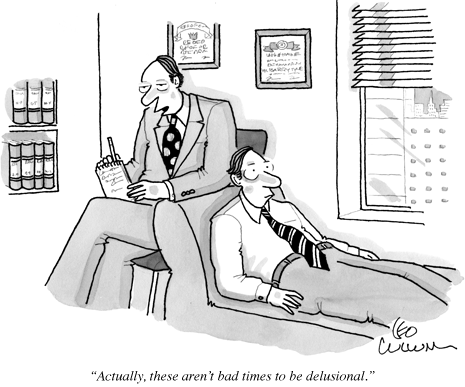
The Delusion Defense

In a previous article I made the case that all religious beliefs are delusions and should be called out as such (found here). I really do keep this view in perspective however and don’t actually feel particularly compelled to call out all my religious friends and associates as delusional at every opportunity. But I still maintain that it is absolutely necessary to do so without compunction when it comes to extremely delusional thinkers like Ken Ham (see here) who publically propagate a large number of very bizarre delusions.

Regardless of how accurate and justified it may be to characterize all religious beliefs as delusions, doing so is problematic simply because of the huge number of people who believe. If you call religious beliefs delusional, then all religious people are at least somewhat delusional. And that is most of us. And if believers are all delusional, that would produce profound ramifications in all manner of social and legal interactions.

In his book “Bad Faith” (found here), Paul Offit looks at the insane faith healing beliefs of Amish, Christian Scientists, and Jehovah’s Witnesses who feel compelled by their faith to commit murder through the withholding of medical care for their children and other loved ones. In a recent lecture I attended, Offit observed that our legal system essentially gives these families “one free murder” before the State is willing to characterize their beliefs as dangerous and harmful.

Sure they are clearly crazy. But non-religious people can be crazy too. Most normal religious beliefs are entirely reasonable.

Except it is not that simple.

In his book “Under the Banner of Heaven’ (found here), John Krakauer documents the insane history of Mormonism and the 40,000 Mormons who still believe much of it and practice polygamy. In particular, he documents the story of Ron and Dan Lafferty, Mormon brothers who felt compelled by their faith to commit multiple murders. The defense in that case argued for an insanity plea based largely upon the craziness of their religious beliefs.

Their defense argued that the delusional beliefs of the Lafferty brothers rose to the level of insanity and that their clients were therefore not fit to stand trial. However, psychiatrists for the State argued that their beliefs were essentially no different in any qualitative way from any other belief considered “normal.” (It could be argued that no person who believes in an afterlife truly understands the consequences of their actions.)

In his book “Thinking About the Insanity Defense” (found here), author Ellsworth Fersch lays out the fundamental problem in the Lafferty case:

“Their strategy was to show that he was sane through comparison with other individuals. First, they pointed out all the similarities between his fundamentalist religious beliefs and the religious beliefs of people with ordinary religious faiths. By doing so, they made his seemingly outlandish claims and ideas seem much more normal. For example, Dr. Gardner compared Ron Lafferty’s belief in reflector shields to belief in guardian angels. This strategy was effective because it forced anyone who was willing to consider whether he was insane to also consider the larger question of whether any religious person is insane.”

Belief ties sanity and delusion into an almost inescapable Gordian knot. To uphold an insanity defense would be to imply that all religious believers are similarly insane. That would never be acceptable. But to exempt religious beliefs would make it extremely difficult to ever characterize anyone as insane or make any value judgment about any belief. It would make it difficult to interfere with any dangerous behavior such as faith healing when it is claimed to be based upon a “deeply held belief.” That in fact serves the narrow self-interest of believers.

DelusionDefenseThese are extremely vexing conundrums even for psychologists.  They have been completely muddled over this all the way back to Freud who suggested that all religious beliefs are delusional and that religion is a mass-delusion. On the more diplomatic side of the argument is the definition established by the American Psychiatric Association (codified in DSM-IV) which says essentially that a belief is a delusion – well unless enough people believe it that is. Clearly if Freud is right, then that conclusion leads necessarily to widespread clinical, social, and legal ramifications. However, if the APA is correct, then sanity is completely contextual. What might be sane in one society or in one group or at one time in history may be completely delusional and result in institutionalization in another setting. Precisely how many believers must I recruit in order for my insane delusions to be considered sane and immunized from ridicule? The APA view creates significant social problems for all aspects of society.

In his paper “Faith or Delusion? At the Crossroads of Religion and Psychosis,” Joseph M. Pierre attempts to review the psychiatric literature in order to find a sensible middle ground. Pierre points out that:

“Neither Freud’s stance that all religious belief is delusional nor DSM-IV’s strategy of avoiding mention of religious thinking in discussions of psychosis is an acceptable way to resolve the ambiguity between normal religious belief and religious delusion.”

One might think this question should be resolvable by simply looking at other criteria to evaluate sanity, not merely the presence of religious beliefs. But Pierre goes on in his paper to review the body of psychiatric works that attempt to distinguish faith from delusion using a wide range of possible criteria. None of these attempts prove to be satisfactory. Since every belief is inherently not based on any objective facts, it is impossible to make qualitative distinctions between “normal” beliefs and “delusional” beliefs. Attempts to measure their impact by other indirect measures, such as excessive preoccupation, conviction, emotional valence, claims of universal validity, and level of contradiction all fail to provide a satisfactory distinction.

So the situation we are left with is that we are precluded from ever admitting that religious beliefs are delusional, even though the APA defines beliefs as delusions held by a sufficiently large number of people. Instead we are forced to make mostly arbitrary decisions about when to characterize a belief as a delusion. But I think I have a suggestion to help with this problem. It seems to me that much of this Gordian Knot is glued together by a presumption, a prejudice, and a conceit that says that sanity and insanity are exclusive binary conditions.

As I argue in my book (found here), we each have a myriad of ideas that could each be placed along a wide spectrum from sane to insane. If someone has a lot of delusional ideas a lot of the time, that person may cross the threshold of clinical insanity, but we all still do have some insane ideas some of the time.

If we would only stop applying to word delusional to people and instead start applying it with less reluctance to ideas, recognizing that we all have some delusional ideas some of the time, then I think we go a long way toward reaching the balance we need to respond to mass-delusional thinking in a more reasonable and consistent manner.

But I’m out of room for now. I’ll expand on this in a future article.

Alien Life Exists!

Pollsters love to ask us whether we believe in alien life. It is an interesting topic because it straddles the line between fact and belief. So where do you stand on it? Take a minute to mentally answer the following questions with Yes, No, or Not Sure.

1. Do you believe that alien life exists?
2. Do you believe that intelligent alien life exists?
3. Do you believe aliens have visited the Earth?

Americans are pretty divided on these questions. About 50% of us believe there is some form of life on other planets (even if only akin to bacteria) while 33% are not sure. We are more skeptical about the existence of intelligent extraterrestrial life with about 38% believing they are out there while about 42% are unsure (see here). Polls also generally report that roughly a third of us believe aliens have actually visited the Earth. Apparently most of us who believe in intelligent alien life also believe that those aliens are capable of reaching the Earth.

How did your answers compare? This may surprise you, but I am completely confident that the 50% of Americans who are believe that alien life exists are completely…. right! Regardless of what you believe, it would be understandable for you to ask, how can you be so certain? Have you seen aliens? Can you show me scientific proof of alien life?

The answer is that I have a particular kind of certainty here called a “statistical certainty.” A statistical certainty is something you can be confident is true even though you may never prove it in the conventional sense. For example, I can be statistically certain that right now as you read this most excellent article, someone somewhere is thinking about bananas. Can I prove this? Obtaining clear proof, finding even one such person may be theoretically possible but practically unlikely. Still, given the number of people in the world and the commonness of bananas, I can be quite sure of it nonetheless.

Similarly, we can clearly say with statistical certainty that life does exist on other planets. Even though I’ve never seen an alien, have absolutely no scientific evidence of alien life, and no expectation of ever meeting one, I do know that the rules of chemistry and physics that gave rise to life on Earth are equally applicable on every Earth-like planet. And all available evidence tells us that there must be a huge number of such planets in our universe. So therefore, I can bank on the statistical certainty that yes, some kind of life does exist on other planets.

Is this essentially the same as a belief then? Am I simply playing word games to rationalize my belief in aliens? Absolutely not. A belief has no basis in statistical certainty. A belief exists despite of a complete lack of any basis upon which to form a even a statistical plausibility. We have no basis upon which to believe in god or ghosts or gremlins, no consistency or conformity with observable evidence, on which to base any legitimate statistical confidence.

So let’s move on now to the second question, whether intelligent life exists in the universe. I think that the 38% who believe happen to be right again – even if for the wrong reasons. (Which brings up the side question, is one truly right if they are right for the wrong reasons?)

We can reasonably bank on a strong statistical confidence in the existence of intelligent extraterrestrial life, even if it is not quite a statistical certainty. While my confidence in intelligent aliens may not be not quite as high as in alien bacteria, it is still a sensible default to assume that yes, intelligent alien life does exist somewhere. And again, this is not belief or wishful thinking, but an assessment founded upon the consistency of physical laws throughout the universe and the sheer number of life-sustaining planets that undoubtedly exist in it.

Finally, what about the third question as to whether those intelligent aliens (that we are statistically confident must exist) have ever visited Earth? On this question I go completely the other direction. There is no credible evidence that any have ever visited Earth in the past – and we would expect to find such evidence. Some alien Coke-cans littering the Nazca Desert or anything. Further, there is no logical mechanism to give one any confidence that aliens could visit us now or for that matter ever in the future. While allowing some tiny plausibility based on what we may not know yet, the tremendous gulf of time and space between us simply makes such interstellar travel diminishingly unlikely.

Many people would argue against my skepticism. Surely, they say, you’re too narrow-minded. You lack vision. Certainly a sufficiently advanced species could produce some technology to travel between solar-systems. At one time people scoffed that we could never reach the moon, and look we did it anyway!

AtomBut the problem here is our solar system is an incredibly tiny dot in an effectively infinite ocean. The gulf between stellar systems is literally astronomical. The barriers of time and space between civilizations are so fundamental that physical travel between them simply runs up against too many inviolate laws of physics. Interstellar travel is not comparable to crossing a vast ocean. It is more comparable to shrinking down to the size of a cell like Ray Palmer (The Atom) and swimming though a blood vessel. Barring some completely fantastical warp-hole technology, it is simply not happening, not ever, not for us or for any alien species no matter how advanced.

Belief that science will always find a solution to everything illustrates the fallacy of an unreasonable belief in technology. This is a dangerous belief when it delays or undermines more effective and necessary action, as it does now in the case of global climate change.

So in summary it is a statistical certainty that life exists on other planets and it would be highly surprising if some of those life forms were not intelligent. But it is extremely unlikely we’ll ever even detect signs of each other, let alone communicate or pay each other a visit. Nevertheless I fully support continuing to look for signs of intelligent life in the universe, even knowing that by the time we see such evidence they would almost certainly have been long extinct. Knowing that intelligent life existed somewhere else, even if only light-ages in the past, would change us fundamentally forever, and I think for the better.

Changing Minds

beliefs-behaviors-resultsBeliefs drive behaviors and behaviors produce real-world results. If beliefs are mistaken, those results are probably suspect. To improve results we must ensure our beliefs are valid.

But can we atheists ever convince any believer that they are wrong to put their faith in fantasies? Indeed, can anyone ever even change anyone’s mind about anything? Most people would answer this question with a resounding no! The prevailing view is that no matter what evidence or logic you put forth, people are unwilling, even incapable, of ever changing their opinion about anything – let alone their deeply held beliefs.

Do you think that is at least somewhat true? If so, let’s test it by seeing if I can change your mind about changing your mind.

You almost certainly believe that your own mind can be changed. You are probably confident that if you are presented with reasonable proof you will adjust your beliefs accordingly. Well like you, everyone else believes the very same thing about themselves. Either you are the only one with this capacity while everyone else is deluded, or you are as deluded as everyone else, or everyone else is actually quite capable of changing their minds just like you.

I’m pretty confident it’s the last option. One proof is simply that we are here. We could not have survived the gauntlet of evolution without a tremendous ability to adjust our beliefs in response to new information. It is unreasonable to think that we could have adapted to a rapidly changing world without that innate capacity. And it is consistent and reasonable to assume that this malleability cannot inherently differentiate between religious beliefs and beliefs about anything else.

Another proof is that we actually see beliefs change all around us all the time. Our beliefs have been and are being continually shaped, even transformed, by sales and marketing, education, culture, indoctrination, religion, brainwashing, media, personal experiences, life events, new information, and a host of other influences. Indeed, beliefs are some of our most fluid of ideas because they are not fettered by physical constraints. Missionaries prove this every day.

Sure, you are quick to say. It’s easy to adopt beliefs, but once formed it’s virtually impossible to eliminate them. But religion itself disproves that idea too. The mere fact that organized religion must expend such an incredible amount of resources to instill and maintain their fantasies acknowledges the inherent fragility and vulnerability of even the most deeply held beliefs.

Still, it is understandable that one might come to the conclusion that beliefs are impervious to reason. Most of us personally never seem to succeed in convincing anyone of anything. Whenever we try, whenever we put forth what we think is a clearly indisputable rational argument, we seem to be talking to a brick wall.

No doubt it is quite difficult to change minds. But that doesn’t make the effort futile. Consider that dating is one particular form of persuasion. For many of us it’s frustratingly difficult to find a date let alone true love. We can’t seem to convince anyone we’re worth dating and so we conclude that dating itself is hopeless. But people all around us do it all the time and we can too. And as with dating, there well-known techniques that have proven to work extremely well in the art of persuasion in general. These include establishing trust, reframing the debate, making it personal, making it their idea, systematically dismantling rationalizations, and moving the other party along in small incremental steps.

So we should not be discouraged if our efforts to evangelize atheism do not seem to yield perceptible results. Our collective efforts do matter. Sure, they are unlikely to be rewarded with some “come to atheism” epiphany. But we must trust that every little drip, drip, drip of reason erodes away at the brittle sandstone upon which religion is constructed and does make a real difference even if we don’t often see it.

And as my final proof, do you feel even a bit more optimistic about your chances of having a real impact on individuals and on society? If so, I have changed your mind at least a bit. If not, that only proves that I failed to make my case or that you cannot perceive how your thinking has been influenced. Either way, I rest my case.

This article written by me was first published in the New York City Atheists July Newsletter and I reprint it here with their kind permission. NYCA holds monthly meetings with great speakers on topics of general interest as well as a large number of more focused meetings and events. Even if you don’t live in NYC, you can still find tons of resources on their website (found here).

But however…

In a recent blog I pushed back against critics of the serial comma (see here). Coincidentally, shortly after that one was posted, my best friend received reviewer comments regarding a scientific paper she had submitted for publication. One was the following comment regarding the use of conjunctions at the start of sentences:

 “… in deference to conventional usage, please attend to the following: A number of sentences (even paragraphs) begin with a conjunction (But, However…) As these are conjunctions, they certainly cannot begin a new paragraph, and generally, even within a paragraph, ought to be connected with the preceding sentence by a comma or semi-colon.”

Since this friend is an exceptionally good scientist the first thing she did was to fact-check this assertion. She found no support for the reviewer’s claim of some well-established convention regarding conjunctions. Quite the opposite – every authoritative source she could find supported, or at least did not condemn, the use of conjunctions at the start of a sentence.

According to the Columbia Journalism Review: (see here):

Many generations of students have had certain grammar “truths” drilled into their little heads. One is the “myth” that infinitives can’t be split. But today we’re going to discuss the myth that sentences can’t start with conjunctions.

It’s perfectly OK to start a sentence with “and,” “but,” “or,” and all of those conjunctions. The Bible does it; the most persnickety writers do it; grammar authorities do it. Even going back to early Fowler (A Dictionary of Modern English Usage), the prohibition on conjunctions was being dismissed. 

The American Heritage Dictionary notes that “this rule has been ridiculed by grammarians for decades, and the stricture has been ignored by writers from Shakespeare to Joyce Carol Oates.”

But whose rule is it, anyway? Of the dozen or so grammar books intended for grammar schools that we consulted, not one bars conjunctions at the starts of sentences. No reliable grammar website bars them, either.

Again, as a good scientist my friend was not willing to accept any one source so she confirmed this independently from multiple sources. Every respected and authoritative site she consulted confirmed essentially the same thing.

So if no major literary authority was or is responsible for these grammar myths, and in fact they have gone to great effort to dispel these, why do many well-educated people adopt and hold strongly to these mistaken beliefs with such strong conviction? The Chicago School of Style article suggested one likely reason. They point out that in grade school children have a tendency to overuse conjunctions, starting every single sentence with “and” or “but.” So in an effort to force their students to vary their writing, some teachers make a “rule” never to use them at all.

It is likely that some students ingrain this “rule” so strongly that they never feel the need to perform so much as a quick Google search to validate their belief, concluding instead that everyone else who violates this unfounded rule must be the ones who are grammatically uninformed.

By the way, here’s a secret. My best friend is also my wife!

Ken Ham Crib Sheet

As a follow-up to yesterday’s blog questioning the sanity of Ken Ham (found here), I have compiled a list of the essential arguments put forth by Ken during his debate with Bill Nye. While it seems at first viewing that he commands a dizzying array of arguments, they are mostly rephrased or derivative versions of the same few silly assertions. Distilled below is pretty much the entire Creationist repertoire that he repeats over and over in different ways with great airs of authority. I added my own sometimes mostly snarky rebuttals. Feel free to use these when you feel compelled to respond quickly to friends or coworkers who repeat these delusional arguments.

ken-ham

Man is not the ultimate authority. God is.

Science agrees that man is not the ultimate authority. It simply acknowledges that verifiable and reproducible facts are.

Science has been hijacked by secularists.

Ballsy try, but it’s clearly the other way around, with creationists like Ken desperately trying to gain legitimacy by donning the mantle of science.

Some scientists are creationists.

Ken repeatedly attempts to argue by authority by trotting out testimonials from scientists who share his delusions. Yes a very few scientists are creationists – and some priests are child-molesters. What does that prove except that some priests can be immoral and some scientists can be crazy? By the way, I sincerely doubt that he would accept the literal belief of a few demented Hindi scientists as proof that the universe was created by Brahma.

Interpretations depend upon your presuppositions.

Absolutely, and the scientific method is the only method we have to prove or disprove those presuppositions. But science doesn’t start by proudly proclaiming its presupposition that the bible is the inerrant and irrefutable source of all truth.

The bible predicts things and we see them actually confirmed.

No surprise when you proclaim anything you choose in the bible to be “symbolic” and then take license to interpret those symbols however necessary to confirm your desired predictions. Nostradamus made many more correct predictions than the bible.

How could we have logic without god if we are just random?

This is a centuries-old argument that is unworthy of a first-year philosophy class. The cosmos is not random and logic has no need for god when it can depend upon physical laws and causality.

Observational science is legitimate but Historical science is not.

There is no such distinction except within Ken Ham’s addled brain. He simply fabricated this artificial distinction to dismiss any science he does not like. Science is science. But when you try to understand what qualifies as ‘Observational’ science and what qualifies as “Historical” science, you quickly see that the only criterion is whatever Ken Ham wants to believe. Anything he agrees with is by his definition the good “Observational” science. Anything he wants to deny is by his definition illegitimate “Historical” science.

You must understand that parts of the bible are Literal and other parts are Poetic.

Just as he dismisses any science he finds inconvenient as “Historical,” he conveniently dismisses anything in the bible he disagrees with as “Poetic” while anything he chooses to believe is “Literal.” It must be very convenient when you can define reality based on whatever you want to believe. But that is also the unmistakable hallmark of delusion and even insanity.

The evolutionary tree should really be organized into Kinds.

Another way Mr. Ham attempts to redefine reality to fit his insanity is in his concept of biological “Kinds.” This is a cornerstone fabrication by Mr. Ham. By imposing his completely artificial notion of “Kinds” of species as a starting point, he is then able to make ridiculous claims and suggest completely contrived flaws in evolutionary theory. By starting with his “Kinds” construct, he is then able to argue that Noah could reasonably have carried every “Kind” of animal in the Arc, that the species diversity we see today could have plausibly arisen out of his “Kinds,” and that there is no evidence of his “Kinds” evolving into another “Kind,” thus denying the evolution of species. This is of course all utter nonsense, but if he can get people to accept his premise of “Kinds” as a starting point, then he can get them to follow him down this rabbit hole into Alice in Wonderland-land. The Mad Hatter was quite inventive and clever.

You can’t know that what is true today was true in the past.

Only if you are delusional. We actually do know that the laws of chemistry and physics apply always and everywhere in our universe without exception.

You didn’t observe the past directly so you can’t know anything about it.

So then Ken can’t know anything about his family history by leafing through a photo album – he didn’t observe the events directly after all. The simple truth is that we can and do know a tremendous amount about the past. We can observe the past directly just by looking into space after all. Or we can simply study all the evidence just lying all around us like little fossilized photographs.

Dating methods don’t agree.

Technically true, but still an obvious lie. Any differences between various scientific dating methods are minuscule compared to their vast disagreement with biblical claim of 6,000 years.

Can you name one piece of technology that could only have been developed starting with a belief in molecules-to-man evolution?

This is a red-herring, an invalid diversionary question. But sure we’ll play this game. How about clones, genetically modified foods, transgenic plants and animals, hybrid species, designer bacteria, and an exploding number of patents for new life forms? The list goes on and on.

You can’t prove any instance of a new trait appearing that wasn’t already there.

If Ken merely did a simple Google search of popular articles, he might find “10 Astounding Cases of Modern Evolution” reported by Popular Science (found here). There are thousands of such examples including the sudden development of new survival traits amongst bedbugs here in New York City. But this is yet another red-herring since most changes are incredibly tiny and only accumulate into observable traits after exceedingly long periods of time.

I hope this summary helps you to recognize and respond to these laughably fallacious sorts of arguments that some Creationists put forth. Unfortunately, guys like Ken are practiced at making themselves appear to be scientifically literate and they do appear to cite a plethora of legitimate arguments raising doubt in the science of evolution, but in reality they offer only smoke floating on air.

From Belief to Delusion

When I wrote my 2008 book Belief in Science and the Science of Belief (here on Amazon), I intentionally treated belief as just, well – belief. I intentionally softened any characterizations that might seem excessively inflammatory and personal. But in this more intimate setting amongst friends like you, we can ask whether the word belief is far too weak and benign, even inaccurate, to describe many of the assertions of the Religious Right.

Remember the formal debate between Bill Nye and Ken Ham on creationism? Ham challenged Nye to debate the topic and the notable exchange took place on February 4th, 2014. You can find the debate online if you missed it (here on YouTube). If you are old enough, you might know Bill Nye as the amiable “Science Guy” from his highly-regarded science show that ran from 1993 through 1998. Mr. Nye continues to be a passionate advocate and popularist of science.

Creation Museum

“Learning” at the Creation Museum

His opponent, Mr. Ham, was and is the President of the Answers in Genesis Ministry and is a tireless evangelist preaching young Earth creationism – mainly targeting kids. Mr. Ham is a key principal behind the Creation “Museum” (website) – a Biblical-themed amusement park that you may have glimpsed in the film Religulous by Bill Maher.

As I listened to the specious and frankly ludicrous arguments put forth with such conviction by Mr. Ham (see here), I could not help but wonder whether belief is far too mealy-mouthed a word for what Ham and those like him suffer from. Is not delusion is a far more accurate word to describe his kind of thinking? And if so, is it really helpful to be so very reluctant to call it what it is?

Now, before the psychologists amongst you get all up in arms that I’m diagnosing my fellow human beings, let me assure you that I use the word delusional purely in a lay sense, not as any kind of clinical diagnosis. But just because the word has particular meaning in clinical settings, does not mean we are not allowed to use it in a more general sense. We don’t need a judge to certify certain criminal activity as criminal and we don’t need a priest to proclaim certain behaviors as evil. We are perfectly free to do so as well.

For a fair and impartial definition of delusion we can most conveniently start with Wikipedia (go to link), which defines it as follows:

“A delusion is a belief held with strong conviction despite superior evidence to the contrary. As a pathology, it is distinct from a belief based on false or incomplete information, confabulation, dogma, illusion, or other effects of perception.”

That definition establishes a very clear distinction between belief and delusion, one which is easily recognizable at least at the extremes. A belief is simply an unsupported conclusion based on insufficient or incorrect information. A delusion is a belief that persists regardless of any amount of evidence to the contrary.

In the case of Ken Ham, his creationist views go far beyond a mistaken belief based on false or incomplete information. He maintains his unalterable convictions despite incomparably superior evidence to the contrary. No doubt, he would argue that the evidence for evolution is not actually superior, but any delusional person would similarly deny all evidence contrary to their delusion. Any objectively rational person could not help but conclude that the evidence for evolution goes far beyond merely superior to overwhelming and that the convoluted arguments that Ham puts forth to deny this evidence are utterly irrational.

According to Wikipedia again, delusions are further subcategorized into four distinct groups. One of these, the “Bizarre Delusion,” is defined as follows:

“A delusion that is very strange and completely implausible; an example of a bizarre delusion would be that aliens have removed the reporting person’s brain.”

I contend that the thinking of Ken Ham and other evolution deniers should be fairly and accurately categorized as a Bizarre Delusion. Their creationist views are certainly “completely implausible” and it would be considered “very strange” if they were not so commonplace. It is important to recognize that they have studied this a lot, and do not simply hold a completely uninformed and clueless belief in creation like presumably say, Rick Perry. And they are evidently not just lying about their belief like at least some other Conservative politicians. They are truly delusional.

Words matter and they should be used accurately. In principle, if a more accurate word is available it should be used. It seems undeniable that Bizarre Delusion is a far more appropriate word than belief to describe the thinking of Ham and those who share his delusions. But words also have power, and we should avoid words that convey implications or elicit reactions we would like to avoid. So even if the bizarre thinking of Ham and others like him is in fact delusional by definition, what value is there in labeling it as such? Doesn’t that just necessarily alienate those you would like to bring around to a less delusional way of thinking?

Even considering those possible undesirable side-effects, the word belief is neither accurate nor helpful in describing these delusions. It is not merely polite and non-confrontational but it actively helps enable these delusions. It suggests that such delusional thinking is harmless and even reasonable and acceptable when sheltered under the protective umbrella of other more rational beliefs. But delusions are seldom harmless and never reasonable or acceptable. Calling this kind of delusional thinking “belief” gives it more legitimacy than it deserves. If we were to consistently refer to this kind of thinking as delusions rather than as beliefs, we would more accurately communicate the true nature and real-world implications of these tangibly harmful assertions.

Certainly using the word delusion instead of belief would elicit a much more visceral response by opponents and allies alike, but I for one would welcome that reaction. I say call a delusion a delusion and stand by the implicit assertion that such delusional thinking goes way beyond mere belief and that it is irrational, unacceptable, and harmful. Calling a delusion a delusion may be just the hit of reality that these deluded people need, or at least those influenced by them need, to honestly reconsider the soundness of their reasoning. At the very least, it may give some people, politicians in particular, some hesitation in associating themselves with these delusional ideas.

So the next time someone espouses delusionary thinking, consider calling it out (nicely) as delusion. Instead of responding with the customary “I respect your beliefs but I don’t share them,” you might say something more provocative like “sorry but I can’t give any credence to such delusions.” If the other party questions how you dare characterize their sincere, heartfelt belief as a delusion, you should be able to give them a very clear and compelling justification for your use of that word. Or just refer them to Wikipedia.

But do not overuse it. Although one could arguably call any belief in god delusional, to do so would only dilute its effectiveness. There is a wide grey spectrum between belief and delusion. Reserve the label of delusional to those like Ken Ham who are clearly at the delusional end of the spectrum.

Here is an extra credit homework question for you. If Ken Ham has clearly slipped from belief into delusion, how far has he slid down the slope from delusion to insanity?