Author Archives: Tyson

Unknown's avatar

About Tyson

Love writing all kinds of stuff including fiction, non-fiction, editorials, etc. But writing software is the only writing I do for love AND money!

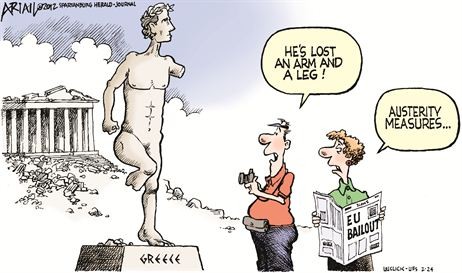
The Pillaging of Greece

Today’s article is about the Greek Financial crisis. But wait! Don’t click that Back button. I promise it will be interesting and will hopefully provide some thought-provoking perspectives on the important and consequential shenanigans unfolding there.

If you are like me, and despite your best efforts to avoid knowing anything about this, you have still absorbed a fairly strong narrative from our media. It probably goes something like this:

Greeks spent like drunken sailors and lived way beyond their means. They committed rampant tax evasion while overpaid public employees suckled from the public teat. Throngs of retirees lounged blissfully on Aegean beaches while enjoying their lavish pensions. The Greeks bankrupted their nation through greed and incompetence and now more responsible nations and major financial institutions have to bail them out to prevent their economic contagion from infecting the European Union and beyond.

That narrative sounds familiar doesn’t it? It sounds a lot like the narrative that many of us were led to believe about the 2008 mortgage crisis here in America. That meme was that greedy and irresponsible home buyers bought houses way beyond their means and lived the good life until their mortgages became due. When they defaulted, those poor lending institutions were the ones to suffer as they struggled to absorb massive foreclosures.

I know that was the common meme because many, many people voiced it at the time. It was also clearly, flatly wrong. Sure, it had an element of truth. All good lies and cover stories do. But all of us should understand by now that those homeowners were the victims of predatory lending practices and irresponsible financial speculation by large financial institutions (summary here). Yet the homeowners were the ones to suffer most profoundly as a consequence.

In the same way, the current meme about the Greek financial crisis may have elements of truth, but those half-truths conceal even bigger lies and malfeasance at the international institutional level. But how can we know the real truth? When trying to understand complex issues we cannot all be experts. So we have to find experts we trust. In my experience, you are best served by looking for a relatively independent expert with a track record of being right. These are usually not the big names. Big names tend to repeat the half-truths that serve big interests far too often. After all, they have way too much to lose if they don’t stay mostly in line with the corporate message.

In cases like this I most trust a more independent expert like Naomi Klein. She wrote a landmark book called “The Shock Doctrine” (found here) which meticulously detailed “crises” just like this one that have been exploited or even manufactured by large financial interests over the last 50 years. You can see an excellent synopsis of her research and analysis here along with a summary of some  countries where similar “disaster economics” have been applied.

GreeceNaomi sees the current Greek crisis as yet one more example of the “Shock Doctrine” being applied to force Greece into crippling austerity measures (see here). The goal of this shock campaign is to force them to sell off fossil and mining resources, as well as any other pillageable assets, for pennies on the drachma. Think of these banking institutions as lions that pick a weak prey and run it down until it collapses to be devoured flesh and bone, leaving a carcass. Greece is the most recent prey that these predators have pulled out of the pack of nations.

Even if you agree that the lions are on the hunt to feast upon the financial problems in Greece, you may still believe that greedy and irresponsible Greeks are nevertheless guilty of making themselves vulnerable in the first place. Perhaps a weak and feeble antelope deserves no sympathy if it is culled from the herd. Maybe the lions are performing an important and essential function in a jungle of economic Darwinism.

But a very credible CNN article (found here) disputes this blame-the-victim mentality. It points out a number of things that those big news sources who repeat the meme fail to mention. For one thing, the article points out that the meme of “rampant tax evasion” is deeply misleading.

“In Greece the culprit has been rampant tax evasion by corporations owing millions in taxes and self-employed professionals who can hide their earnings, unlike salaried employees and pensioners. Under international pressure to balance its budget, the outgoing Greek government axed salaries and pensions and slapped new taxes on the bulk of citizens who were not tax-delinquent. “

We see the very same thing happening with tax “minimization” by corporations and the ultra-wealthy here in the United States, do we not? And as in our own financial crises, it was the insatiable greed of wealthy people and corporations that drove this crisis in Greece, not the greed and indolence of ordinary Greeks as it is portrayed. And just as the media propagated this “blame-the-homeowners” meme in America, they conveniently fail to specify that it is largely wealthy interests who are guilty of tax “minimization” in Greece. Also as in America, it is the regular Greeks who end up footing the bill and paying the price for the avarice of the rich.

How many times will we believe the memes spread through mainstream media? How often will we allow powerless ordinary people to be scapegoated for crises created by the same financial institutions holding all the power? How many more countries must fall to these big financial institutions before we finally begin to see them for the ravenous predators they are?

Our Secular Pope

Well it’s official. Hell has frozen over. Even as a devout secularist, atheist, and humanist I now feel that even I have a Pope. His name is Francis.

I have always had respect for the Dali Lama whom I once had the privilege of meeting. Many years ago the Dali Lama told Carl Sagan that if a tenant of Buddhism were to be disproven by science, then “Tibetan Buddhism would have to change.” This was a refreshingly rational acknowledgment from a major religious leader that science must trump belief. Of course he was still stubbornly irrational in maintaining an implausible, untestable, and wholly unscientific belief in reincarnation, but it was an encouraging concession nonetheless.

I also recognize that Pope Pius XII made a similar acknowledgment in his 1950 encyclical Humani Generis. In it he acknowledged the scientific fact of polygenism and went on, in deference to science, to specifically abandon the disprovable Adam and Eve story of human origins. He also expressed openness to the legitimacy of the relatively early evolutionary science of the 1950’s. Of course he still held that God existed and endowed humans with a divine “soul.” Like the Dali Lama, he conceded to science on the disprovable parts while still falling back upon the un-disprovable beliefs as faith.

But I’ve never been an unqualified fan of a religious leader until now. Through his recent encyclical letter Laudato Si’ (found here), Pope Francis threaded essentially the same needle as these previous religious leaders. He acknowledged the irrefutability of established climate science while still clinging to his belief in god and souls. Like Pope Pius and the Dali Lama, he is rational enough to understand that religion is better served by deferring to science on matters of fact and that it is ultimately self-defeating both for the Church and for mankind to deny established science. Like those others he is also sophisticated enough to understand that the fundamental tenants of his faith can never be specifically disproven by science and that is enough for most believers. But unlike those others, he has gone far, far beyond merely acceding to science to embracing it in an active fashion.

Even given the widespread consensus on global climate change, Pope Francis was nevertheless frank and courageous in Laudato Si’. It takes courage for any leader to acknowledge the science of global climate change, to disavow the environmentally irresponsible worldviews held by many Christians today, and to call for deep changes to the status quo. This is a courage that many of our secular leaders still sadly lack. The Pope acknowledged that man is responsible for protecting the Earth, that we are responsible for catastrophic global climate change, that climate change endangers our very survival, and that it is our responsibility to fix it.

Following are some important points that I pulled from my reading of his encyclical:

  • The Pope challenged us to “protect our common home,” entrusted to us by God.
  • He discussed many real threats to the planet including “pollution, waste and a throwaway culture,”  “the issue of water,” and “loss of biodiversity.”
  • He pointed out that the climate is a “common good” that is “a complex system linked to many of the essential conditions for human life.”
  • He acknowledged that a “very solid scientific consensus indicates that we are presently witnessing a disturbing warming of the climatic system.”
  • He acknowledged that all these things result in “global inequality” and a “decline in the quality of human life and the breakdown of society.”
  • He acknowledged “the human roots of the ecological crisis.”
  • He pointed out that our responses to these challenges so far have been “weak.”
  • He challenged people who defend the status quo by rejecting “those who doggedly uphold the myth of progress and tell us that ecological problems will solve themselves simply with the application of new technology and without any need for ethical considerations or deep change.”
  • He acknowledged the dangers of “misguided anthropocentrism” that places the gratification of mankind above all other considerations.
  • He acknowledged the principle of the “common good” and called for “justice between the generations” which imposes a responsibility to pass along a habitable planet to future generations.
  • He issued many calls for “dialog” and immediate action.
  • He held that the role of religion is to “guide” science.

Although these may all seem like obvious points to some, it is critically important that the Pope made them. Many religious people still do not accept the 1950 encyclical regarding evolution and they are not likely to accept this encyclical on climate change, or our role in creating a sustainable planet, let alone our responsibility to respond to the social and ecological challenges we face.  It is amazing to see the Pope and the Catholic Church taking such a strong leadership role for social justice and environmental sanity.

But it is important to also look at what the Pope did not say. Most noticeably, while he called for action by others, he did not so far lead by example with tangible actions within his power to initiate. I hope these kinds of actions are to come.

  • He did not call for divestment from the fossil fuel industry and other environmentally irresponsible industries nor did he promise to do so with the reported $8B Vatican portfolio.
  • He did not call for the extremely large worldwide Church infrastructure to “go green” and lower their very substantial carbon footprint.
  • He did not specifically instruct his clergy to take tangible local action to promote a culture that helps to achieve the goals he outlines so passionately.

Less obviously but more notably, Pope Francis did not call for prayer as a solution to our environmental crisis. In fact, he only used the word “prayer” a few times in the entire encyclical and never in the context of a call to action. Instead he used the words “science” and “scientific” dozens of times in the context of providing real solutions.

Evidently even though the Pope supposedly believes in an active, caring, and omnipotent god, even he is not silly enough to rely upon the power of prayer when the outcome really matters.

PopeFrancisI close with sincere thanks to Pope Francis. He is courageously using his bully pulpit in a responsible way that most secular leaders including President Obama have not. His strong statements regarding climate change in particular and social justice generally are desperately needed. I particularly appreciate his continuing calling out of “people, managers, businessmen who call themselves Christian and they manufacture weapons” as the immoral hypocrites that they are (see here).

Thanks Francis. You go Pope! Keep it up!

The Polling Crisis

poll-box“Election polling is in near crisis, and we pollsters know. Two trends are driving the increasing unreliability of election and other polling in the United States: the growth of cellphones and the decline in people willing to answer surveys. Coupled, they have made high-quality research much more expensive to do, so there is less of it.”

 “In short, polls and pollsters are going to be less reliable. We may not even know when we’re off base. What this means for 2016 is anybody’s guess.”

This is a quote from a recent NYT opinion article by Cliff Zukin entitled “What’s the Matter With Polling?” If you pay for access to the NYT website, the link is here (NYT Article).  In short, the author points out that the polling industry is in crisis. It has become hugely more expensive, if not essentially infeasible, to do reliable polling anymore. Trends including the disappearance of land-lines and growth of the Internet have converged to undermine what little reliability polls used to have. The main takeaway is that polling “science” is really bad and is only getting worse and pollsters have no idea how to make it better.

The author focuses primarily on the growing financial and logistical challenges for the polling companies. Since pollsters must make a huge number of calls to obtain even a remotely valid sampling of reliable data, the cost of doing accurate polling has become extremely high – even prohibitively high.

However I prefer to focus on the problems that this situation creates for rational governance. Even good polls have undesirable consequences. Their mere existence creates an almost irresistible compulsion for politicians to pander to poll results, saying whatever the numbers tell them that likely voters want to hear. Even if the polls are accurate, this may not be the best way to govern – or even to campaign. But if polls have become woefully inaccurate to boot, and yet we continue to pander to them, then we have taken what was already a problematic approach to governance and made it far, far worse.

One specific problem I’d like to focus upon more deeply is the self-fulfilling prophesies that these polls create. If the polls tell us that, for example, Bernie Sanders cannot possibly win, then those polls influence huge numbers of people to respond by not voting for Bernie Sanders – creating a self-fulfilling feedback loop. And what if those admittedly unreliable polls were simply wrong? What if perhaps they were even disingenuously promoted as a stealth strategy by a big money Clinton campaign (theoretically) for exactly that purpose?

Maybe we’re better off without any polls. Good riddance, I say. Maybe we’re better off if politicians campaign and govern according to actual scientific data and humanistic ethical principles, not according to polling. Maybe we voters are far better off if we remain uninfluenced by polls as well.

Whoa there, you say. If you have read my book “Belief in Science and the Science of Belief” (found here) you know that a fundamental principle I champion is that decisions based on facts are inherently better than decisions based on beliefs. If that is the case, aren’t polling facts important information to consider in campaigns and in governance?

Yes but I’m also suggesting that polls aren’t the best facts to use and that they push all the air out of the space for actual, more important and more reliable facts to sufficiently drive political campaigns and decision-making.

Poll any group of alcoholics and the data will likely show that they want more alcohol. As antithetically “paternal” as this may sound to some, a government must provide what society needs, not necessarily what people want. Private corporations can be driven by market research to provide exactly what their customers want (when not unethical or illegal). But a government simply cannot make policy based primarily on polls if they are there to serve the common good.

Now if even accurate polling can create unhealthy pressures for governance, imagine the consequences if we continue to listen to polls that have now become even less reliable. Now we are making decisions that impact the lives of people and the life of the planet that are primarily based not merely on polling data but on really bad polling data.

I say again, good riddance to polls. My hope is that we turn this crisis into opportunity. This is our chance not to merely improve polling methodologies, but to start to weigh polling data far lower in our decisions and instead find ways to make policy decisions based more upon the best objective science and rational decision-making possible. I hope that our emphasis on “what people polled want” is permanently diminished and replaced by more indirect and sophisticated methods of data mining to understand what they actually need and what will best serve humanity and planet Earth in the long-term.

Government by Jury

We all know it.  Our democratic government isn’t all that democratic. It is inherently corruptible by the influence of big money – obscenely so since the Citizens United ruling. That big money necessarily compels our legislators to work for the short-term interests of wealthy individuals and big business, rather than for the long-term common good.

The most common response to this reality is resignation. Well yes, our system may not be perfect, but it’s the best we can do. How defeatist and unimaginative is that? We certainly could do a lot better if we only had the will to do so. We could enforce far stronger conflict of interest rules for our legislators – the same sort of rules we already enforce for judges. Oh we nip around the edges, passing token campaign and conflict of interest regulations, but nothing that would fundamentally reduce the river of big money flowing into government like a raging river. But we could.

And there are more fundamental things we conceivably do. Just brainstorming here, but I’ll offer one such idea. Feel free to use it if you ever start your own country or overthrow a government.

juryMy form of government would be a “Jurist Democracy.” In my Government by Jury, legislators would propose legislation but could not pass it. To enact their proposed legislation, lawmakers would function as advocates, arguing the cases for and against the proposed legislation based on their own ethics, or their constituents, or their financial backers just as they do now. A non-partisan judge would preside over a Legislative Hearing and ensure that all evidence is vetted and all rules are followed. Once both sides have presented their arguments and their expert witnesses, a jury of ordinary people would retire to discuss and rule upon the proposed legislation. Jury selection would be conducted just as it is for criminal cases. The citizen-jury would decide whether a strong enough case had been presented and would make the final decision on whether the proposed legislation should be passed into law. Teleconferencing could eliminate previous geographical limitations.

No claim of a panacea is made here. Certainly this system would be neither perfect nor foolproof. Games could still be played by the legislators; horses traded, bribes offered, and so on. We would have to be assiduously vigilant to prevent or punish malpractice and jury tampering. But we know how to do those things.

And these corruptions will happen in any system. The key difference here is that at least we have removed the final decision from those who are most directly corruptible. If the legislators cannot convince twelve reasonable citizens that their legislation is good for the country then it does not deserve to be made into law. I for one would be much more confident that twelve impartial citizen-jurors would on the whole make better decisions than career politicians.

And I don’t buy the argument that citizen jurors could not understand the issues involved sufficiently to render intelligent decisions on complex issues. That sounds a lot like medieval priests who maintained that they alone could interpret the word of god for the common man. In fact I have far stronger concerns about the impartiality and expertise of professional lawmakers (many of whom do not even believe in evolution), and trust that if a bill cannot be explained to reasonably smart people is it probably too convoluted to pass. This idea that a bill is too complex for ordinary folk is mostly just used as an excuse to make our government less transparent and more susceptible to the disastrous impact of small print obscured within intentionally complexicated legislation.

This Government by Jury would be far more democratic because it would directly involve large numbers of citizens directly in the process of governing. I for one at least, would be far more willing to put my faith in the good sense and civic-mindedness of 12 random individuals than in professional legislators who are saturated in conflicts of interest starting with keeping their jobs and their positions of influence within the system.

It is pretty much impossible to put forth any idea that has not been thought of before. In his article called “Government by Jury” (found here), Stephen H. Unger from Columbia University discusses this general concept in greater detail and provides additional references. His suggestion is to conscript citizens into some longer period of service. I suggest that legislative jurors could be recruited only to decide one piece of legislation with minimal modifications to our current system. We recruit juries to make decisions in criminal and civil cases of comparable complexity. To recruit them for longer periods of service would include fewer citizens, would be much more logistically difficult, and would introduce more possibility of the very sort of corruptions that we are trying to avoid.

Ideas such as these should be discussed more often, more openly, and more seriously. They help stimulate real innovative, out of the box thinking rather than restricting ourselves to ideas that do not disrupt the current dysfunctional status quo. Merely raising and discussing proposals like this makes it more likely that legislators will consider more substantive conventional measures to improve the integrity and effectiveness of government.

But however…

In a recent blog I pushed back against critics of the serial comma (see here). Coincidentally, shortly after that one was posted, my best friend received reviewer comments regarding a scientific paper she had submitted for publication. One was the following comment regarding the use of conjunctions at the start of sentences:

 “… in deference to conventional usage, please attend to the following: A number of sentences (even paragraphs) begin with a conjunction (But, However…) As these are conjunctions, they certainly cannot begin a new paragraph, and generally, even within a paragraph, ought to be connected with the preceding sentence by a comma or semi-colon.”

Since this friend is an exceptionally good scientist the first thing she did was to fact-check this assertion. She found no support for the reviewer’s claim of some well-established convention regarding conjunctions. Quite the opposite – every authoritative source she could find supported, or at least did not condemn, the use of conjunctions at the start of a sentence.

According to the Columbia Journalism Review: (see here):

Many generations of students have had certain grammar “truths” drilled into their little heads. One is the “myth” that infinitives can’t be split. But today we’re going to discuss the myth that sentences can’t start with conjunctions.

It’s perfectly OK to start a sentence with “and,” “but,” “or,” and all of those conjunctions. The Bible does it; the most persnickety writers do it; grammar authorities do it. Even going back to early Fowler (A Dictionary of Modern English Usage), the prohibition on conjunctions was being dismissed. 

The American Heritage Dictionary notes that “this rule has been ridiculed by grammarians for decades, and the stricture has been ignored by writers from Shakespeare to Joyce Carol Oates.”

But whose rule is it, anyway? Of the dozen or so grammar books intended for grammar schools that we consulted, not one bars conjunctions at the starts of sentences. No reliable grammar website bars them, either.

Again, as a good scientist my friend was not willing to accept any one source so she confirmed this independently from multiple sources. Every respected and authoritative site she consulted confirmed essentially the same thing.

So if no major literary authority was or is responsible for these grammar myths, and in fact they have gone to great effort to dispel these, why do many well-educated people adopt and hold strongly to these mistaken beliefs with such strong conviction? The Chicago School of Style article suggested one likely reason. They point out that in grade school children have a tendency to overuse conjunctions, starting every single sentence with “and” or “but.” So in an effort to force their students to vary their writing, some teachers make a “rule” never to use them at all.

It is likely that some students ingrain this “rule” so strongly that they never feel the need to perform so much as a quick Google search to validate their belief, concluding instead that everyone else who violates this unfounded rule must be the ones who are grammatically uninformed.

By the way, here’s a secret. My best friend is also my wife!

Superheroes on Screen

Superheroes have transitioned from the pages of comics to the screen with varying degrees of success. Heroes from the DC universe have long been animated extremely well. The bar was set almost insurmountably high back in the 1940’s with the peerless Superman cartoon shorts by Max Fleischer. Television shows like Batman: The Animated Series and Justice League (Unlimited) established an extremely high level of excellence that was carried into many well-crafted animated movies like Justice League: The New Frontier and Wonder Woman.

In live action, however, DC heroes have tended to disappoint or even embarrass. Although there are still folk who look fondly upon the old Batman and Superman movie franchises, that fondness is mostly just nostalgia. More recently, even Amy Adams could not breathe any life into Man of Steel and it fell upon stoic and dull Russell Crowe to offer something resembling an engaging performance. And do you even remember there was a movie called Superman Returns? I personally didn’t think Green Lantern deserved such hate, but hardly anyone agrees with me so I cannot claim it as an exception to this dismal track record. The current Arrow series is a tedious soap opera. Perhaps the best live action DC series was Smallville and that was mostly about Clark Kent.

Chris Nolan’s Dark Knight Trilogy is widely acknowledged as a masterpiece, but even there I have real problems with how Batman was portrayed. Only in a few scenes does he appear as the frighteningly agile creature of the night that most fans expect. Rather he is generally depicted as a stiff, plodding, lumbering version of Iron Man (except considerably less able to avoid a slowly telegraphed punch).

There is shining beacon of hope however. The recent Flash television series is an excitingly refreshing work of love that pays due homage to the very respectable 1980’s series and to the essential nature of the character. It’s absolutely great and I only hope the upcoming Supergirl series will be half as endearing and faithful to its heroine.

We could go on and on about DC, but now let us turn to the Marvel universe. They are the mirror image of DC with fantastic live action and underwhelming animated efforts. With the exception of X-Men: The Animated Series which was pretty decent, their animated series and movies have been poorly animated junk food. However their live action movies, and yes I’m even including the Fantastic Four series which I alone seem to have loved, are generally well – fantastic.

True, Marvel admittedly has produced a few flicks we’d like to conveniently forget – I’m looking at you Daredevil, Elektra, and Hulk – but the truly great Marvel live action movies are too numerous to name, right up to Guardians of the Galaxy (which could have easily been quite ridiculous), Iron Man, Thor, Cap, and Avengers.

Last but definitely not least, the new Daredevil series on Netflix deserves very special recognition. This show is the best thing I’ve seen in …, well the best thing I’ve seen period. It literally draws you into the sweltering, seedy urban jungle of Hell’s Kitchen and makes you believe a blind man can be an actual superhero. The supporting performances are compelling, particularly by Deborah Ann Woll and Vincent D’Onofrio as Kingpin. And the brutal, exhausting, cringe-inducing fighting sequences are affectionately choreographed by brilliant students of the art.

I urge you to check out this link that analyzes one particularly memorable but representative fight scene from Daredevil. This single shot in Daredevil is the best fight scene in years (view here).

DaredevilDespite a sporadic history in both comic universes, I look forward to a lot more great Marvel movies and I remain hopeful that DC will eventually find their mojo. On television, DC’s Flash and Marvel’s Daredevil encourage me that the superhero genre will thrive in episodic live action by offering complex story lines that movies cannot match in richly crafted settings that exquisitely complement the tone and style of each uniquely individual hero, heroine, or team.

Ken Ham Crib Sheet

As a follow-up to yesterday’s blog questioning the sanity of Ken Ham (found here), I have compiled a list of the essential arguments put forth by Ken during his debate with Bill Nye. While it seems at first viewing that he commands a dizzying array of arguments, they are mostly rephrased or derivative versions of the same few silly assertions. Distilled below is pretty much the entire Creationist repertoire that he repeats over and over in different ways with great airs of authority. I added my own sometimes mostly snarky rebuttals. Feel free to use these when you feel compelled to respond quickly to friends or coworkers who repeat these delusional arguments.

ken-ham

Man is not the ultimate authority. God is.

Science agrees that man is not the ultimate authority. It simply acknowledges that verifiable and reproducible facts are.

Science has been hijacked by secularists.

Ballsy try, but it’s clearly the other way around, with creationists like Ken desperately trying to gain legitimacy by donning the mantle of science.

Some scientists are creationists.

Ken repeatedly attempts to argue by authority by trotting out testimonials from scientists who share his delusions. Yes a very few scientists are creationists – and some priests are child-molesters. What does that prove except that some priests can be immoral and some scientists can be crazy? By the way, I sincerely doubt that he would accept the literal belief of a few demented Hindi scientists as proof that the universe was created by Brahma.

Interpretations depend upon your presuppositions.

Absolutely, and the scientific method is the only method we have to prove or disprove those presuppositions. But science doesn’t start by proudly proclaiming its presupposition that the bible is the inerrant and irrefutable source of all truth.

The bible predicts things and we see them actually confirmed.

No surprise when you proclaim anything you choose in the bible to be “symbolic” and then take license to interpret those symbols however necessary to confirm your desired predictions. Nostradamus made many more correct predictions than the bible.

How could we have logic without god if we are just random?

This is a centuries-old argument that is unworthy of a first-year philosophy class. The cosmos is not random and logic has no need for god when it can depend upon physical laws and causality.

Observational science is legitimate but Historical science is not.

There is no such distinction except within Ken Ham’s addled brain. He simply fabricated this artificial distinction to dismiss any science he does not like. Science is science. But when you try to understand what qualifies as ‘Observational’ science and what qualifies as “Historical” science, you quickly see that the only criterion is whatever Ken Ham wants to believe. Anything he agrees with is by his definition the good “Observational” science. Anything he wants to deny is by his definition illegitimate “Historical” science.

You must understand that parts of the bible are Literal and other parts are Poetic.

Just as he dismisses any science he finds inconvenient as “Historical,” he conveniently dismisses anything in the bible he disagrees with as “Poetic” while anything he chooses to believe is “Literal.” It must be very convenient when you can define reality based on whatever you want to believe. But that is also the unmistakable hallmark of delusion and even insanity.

The evolutionary tree should really be organized into Kinds.

Another way Mr. Ham attempts to redefine reality to fit his insanity is in his concept of biological “Kinds.” This is a cornerstone fabrication by Mr. Ham. By imposing his completely artificial notion of “Kinds” of species as a starting point, he is then able to make ridiculous claims and suggest completely contrived flaws in evolutionary theory. By starting with his “Kinds” construct, he is then able to argue that Noah could reasonably have carried every “Kind” of animal in the Arc, that the species diversity we see today could have plausibly arisen out of his “Kinds,” and that there is no evidence of his “Kinds” evolving into another “Kind,” thus denying the evolution of species. This is of course all utter nonsense, but if he can get people to accept his premise of “Kinds” as a starting point, then he can get them to follow him down this rabbit hole into Alice in Wonderland-land. The Mad Hatter was quite inventive and clever.

You can’t know that what is true today was true in the past.

Only if you are delusional. We actually do know that the laws of chemistry and physics apply always and everywhere in our universe without exception.

You didn’t observe the past directly so you can’t know anything about it.

So then Ken can’t know anything about his family history by leafing through a photo album – he didn’t observe the events directly after all. The simple truth is that we can and do know a tremendous amount about the past. We can observe the past directly just by looking into space after all. Or we can simply study all the evidence just lying all around us like little fossilized photographs.

Dating methods don’t agree.

Technically true, but still an obvious lie. Any differences between various scientific dating methods are minuscule compared to their vast disagreement with biblical claim of 6,000 years.

Can you name one piece of technology that could only have been developed starting with a belief in molecules-to-man evolution?

This is a red-herring, an invalid diversionary question. But sure we’ll play this game. How about clones, genetically modified foods, transgenic plants and animals, hybrid species, designer bacteria, and an exploding number of patents for new life forms? The list goes on and on.

You can’t prove any instance of a new trait appearing that wasn’t already there.

If Ken merely did a simple Google search of popular articles, he might find “10 Astounding Cases of Modern Evolution” reported by Popular Science (found here). There are thousands of such examples including the sudden development of new survival traits amongst bedbugs here in New York City. But this is yet another red-herring since most changes are incredibly tiny and only accumulate into observable traits after exceedingly long periods of time.

I hope this summary helps you to recognize and respond to these laughably fallacious sorts of arguments that some Creationists put forth. Unfortunately, guys like Ken are practiced at making themselves appear to be scientifically literate and they do appear to cite a plethora of legitimate arguments raising doubt in the science of evolution, but in reality they offer only smoke floating on air.

From Belief to Delusion

When I wrote my 2008 book Belief in Science and the Science of Belief (here on Amazon), I intentionally treated belief as just, well – belief. I intentionally softened any characterizations that might seem excessively inflammatory and personal. But in this more intimate setting amongst friends like you, we can ask whether the word belief is far too weak and benign, even inaccurate, to describe many of the assertions of the Religious Right.

Remember the formal debate between Bill Nye and Ken Ham on creationism? Ham challenged Nye to debate the topic and the notable exchange took place on February 4th, 2014. You can find the debate online if you missed it (here on YouTube). If you are old enough, you might know Bill Nye as the amiable “Science Guy” from his highly-regarded science show that ran from 1993 through 1998. Mr. Nye continues to be a passionate advocate and popularist of science.

Creation Museum

“Learning” at the Creation Museum

His opponent, Mr. Ham, was and is the President of the Answers in Genesis Ministry and is a tireless evangelist preaching young Earth creationism – mainly targeting kids. Mr. Ham is a key principal behind the Creation “Museum” (website) – a Biblical-themed amusement park that you may have glimpsed in the film Religulous by Bill Maher.

As I listened to the specious and frankly ludicrous arguments put forth with such conviction by Mr. Ham (see here), I could not help but wonder whether belief is far too mealy-mouthed a word for what Ham and those like him suffer from. Is not delusion is a far more accurate word to describe his kind of thinking? And if so, is it really helpful to be so very reluctant to call it what it is?

Now, before the psychologists amongst you get all up in arms that I’m diagnosing my fellow human beings, let me assure you that I use the word delusional purely in a lay sense, not as any kind of clinical diagnosis. But just because the word has particular meaning in clinical settings, does not mean we are not allowed to use it in a more general sense. We don’t need a judge to certify certain criminal activity as criminal and we don’t need a priest to proclaim certain behaviors as evil. We are perfectly free to do so as well.

For a fair and impartial definition of delusion we can most conveniently start with Wikipedia (go to link), which defines it as follows:

“A delusion is a belief held with strong conviction despite superior evidence to the contrary. As a pathology, it is distinct from a belief based on false or incomplete information, confabulation, dogma, illusion, or other effects of perception.”

That definition establishes a very clear distinction between belief and delusion, one which is easily recognizable at least at the extremes. A belief is simply an unsupported conclusion based on insufficient or incorrect information. A delusion is a belief that persists regardless of any amount of evidence to the contrary.

In the case of Ken Ham, his creationist views go far beyond a mistaken belief based on false or incomplete information. He maintains his unalterable convictions despite incomparably superior evidence to the contrary. No doubt, he would argue that the evidence for evolution is not actually superior, but any delusional person would similarly deny all evidence contrary to their delusion. Any objectively rational person could not help but conclude that the evidence for evolution goes far beyond merely superior to overwhelming and that the convoluted arguments that Ham puts forth to deny this evidence are utterly irrational.

According to Wikipedia again, delusions are further subcategorized into four distinct groups. One of these, the “Bizarre Delusion,” is defined as follows:

“A delusion that is very strange and completely implausible; an example of a bizarre delusion would be that aliens have removed the reporting person’s brain.”

I contend that the thinking of Ken Ham and other evolution deniers should be fairly and accurately categorized as a Bizarre Delusion. Their creationist views are certainly “completely implausible” and it would be considered “very strange” if they were not so commonplace. It is important to recognize that they have studied this a lot, and do not simply hold a completely uninformed and clueless belief in creation like presumably say, Rick Perry. And they are evidently not just lying about their belief like at least some other Conservative politicians. They are truly delusional.

Words matter and they should be used accurately. In principle, if a more accurate word is available it should be used. It seems undeniable that Bizarre Delusion is a far more appropriate word than belief to describe the thinking of Ham and those who share his delusions. But words also have power, and we should avoid words that convey implications or elicit reactions we would like to avoid. So even if the bizarre thinking of Ham and others like him is in fact delusional by definition, what value is there in labeling it as such? Doesn’t that just necessarily alienate those you would like to bring around to a less delusional way of thinking?

Even considering those possible undesirable side-effects, the word belief is neither accurate nor helpful in describing these delusions. It is not merely polite and non-confrontational but it actively helps enable these delusions. It suggests that such delusional thinking is harmless and even reasonable and acceptable when sheltered under the protective umbrella of other more rational beliefs. But delusions are seldom harmless and never reasonable or acceptable. Calling this kind of delusional thinking “belief” gives it more legitimacy than it deserves. If we were to consistently refer to this kind of thinking as delusions rather than as beliefs, we would more accurately communicate the true nature and real-world implications of these tangibly harmful assertions.

Certainly using the word delusion instead of belief would elicit a much more visceral response by opponents and allies alike, but I for one would welcome that reaction. I say call a delusion a delusion and stand by the implicit assertion that such delusional thinking goes way beyond mere belief and that it is irrational, unacceptable, and harmful. Calling a delusion a delusion may be just the hit of reality that these deluded people need, or at least those influenced by them need, to honestly reconsider the soundness of their reasoning. At the very least, it may give some people, politicians in particular, some hesitation in associating themselves with these delusional ideas.

So the next time someone espouses delusionary thinking, consider calling it out (nicely) as delusion. Instead of responding with the customary “I respect your beliefs but I don’t share them,” you might say something more provocative like “sorry but I can’t give any credence to such delusions.” If the other party questions how you dare characterize their sincere, heartfelt belief as a delusion, you should be able to give them a very clear and compelling justification for your use of that word. Or just refer them to Wikipedia.

But do not overuse it. Although one could arguably call any belief in god delusional, to do so would only dilute its effectiveness. There is a wide grey spectrum between belief and delusion. Reserve the label of delusional to those like Ken Ham who are clearly at the delusional end of the spectrum.

Here is an extra credit homework question for you. If Ken Ham has clearly slipped from belief into delusion, how far has he slid down the slope from delusion to insanity?

On Grammar, Punctuation, and Serial Commas

Commas

Dear Editor

Yes, you personally! Stop messing with my Serial commas, or my Oxford commas, or my Harvard commas, or my Series commas or however else you wish to refer to that punctuation mark I placed before the “and” at the end of a series. I do know quite well that you are philosophically opposed to them, but there are good reasons why I keep putting them in anyway – I mean apart from my sadistic compulsion to make your job miserable or to cleverly distract you from focusing on actual flaws in my manuscript.

Believe me I do sympathize with the visceral pain of abandoning a proofreading rule that was drilled into you back in Editing 101. After all, the AP Stylebook banned it for all eternity. But that journalism convention is now an archaic remnant of the olden days when every character had to be manually typeset on the printed page and every “excess” character that could be eliminated meant less typesetting effort, faster time to print, and greater profits. But that is no longer a concern today, and there is no longer any need to continue to sacrifice clarity and precision in order to avoid the manual placement of another comma.

And make no mistake; any writing that abandons the correct use of the serial comma is far less precise. For example, if I craft the following sentence…

We received shipments of produce, livestock, tea, and spice.

I intend this to clearly communicate that four separate shipments were received. If you automatically remove my serial comma as follows…

We received shipments of produce, livestock, tea and spice.

You have materially undermined my intent. Does this sentence now communicate clearly that four shipments were received or might it have been only three? The reader can no longer be sure. By automatically removing all of my serial commas, you have reduced the richness of information, lowered precision, created ambiguity, and even introduced an error.

And depending on the context and purpose of the statement, it might really, really matter whether four shipments were received instead of only three. You would not willy-nilly delete “unnecessary” parentheses from a mathematics equation, so why would you effectively do the same with my precisely punctuated prose?

Deletion of the serial comma is especially egregious to anyone with a math, science, legal, or computer programming background. We are trained to be as clear and unambiguous in our writing as possible. But when you are editing any work, let alone a scientific paper or technical manual, you probably do not have the subject matter expertise to determine if and how you might be changing the precise meaning that the author has communicated by including or omitting a serial comma.

Even in fiction and non-technical writing, a smart author uses the serial comma in a smart manner. Not only to indicate non-grouping of the final items in the series, but to establish style. I read all my writing out loud, especially dialog, to get just the right, natural-sounding cadence from the character’s unique voice. Sometimes that calls for a comma to make it sound or read the way I intend. When you remove that carefully crafted comma, you undermine not only the meaning, but also the artistic voice of the author. That frankly violates what should be your most sacred prime directive as an editor – do no harm.

Editors: Get over what you were taught about serial commas. Even the AP Stylebook endorses its use when it enhances clarity. But more importantly, trust the author to appropriately express subtleties of meaning and style through their careful use of the serial comma. Unless they obviously misuse it, like if they include it when they really intended the final two items to be grouped, or vice versa, don’t presume that you fully understand how the comma might alter the intent and meaning of the text.

Authors: Don’t be bullied into following some archaic rule of grammar here, but do be consistent. Use the serial comma if the final two items are ungrouped; exclude it if they are grouped. And if it makes no difference, use it artistically to express nuances of cadence or style.

And to both of you, take heart. You are not out on a limb here. If your literary competency is questioned, you can simply refer your critic to the Chicago Manual of Style, MLA Style Guide, and many other institutions who all endorse consistent use of the serial comma. Proof by authority is all some people will accept.

But if that isn’t enough to sufficiently pacify the stubborn stickler regarding the serial commas included by you, cite starting conjunctions, split infinitives, passive verbs, and ending prepositions as other outmoded grammatical proscriptions that should no longer be mindlessly adhered to.

Sincerely, Author

P.S. Further reading can be found in this post on Tin House.

Comic Book Kid

As a kid I had a super power. It was reading comics. And I read lots. I mean lots. I mean like every one ever printed up until that time. And that was a lot. Moreover I read each one many, many times. Not online, but actual ink imprinted upon actual paper. They were best savored at 2 a.m. on a school night under the covers with a flashlight.

During grade school in the 60’s, my friend Mike and I were mentored in superhero comportment by George Reeves in Superman reruns from the 50’s. From our super-secret base in Mike’s garage, we protected South-side Milwaukee from super-villains who were only detectable by means of our super-vision. Equipped with dramatically flowing capes fabricated from advanced bed sheet technology, we tracked them using our super-computer cleverly disguised as an old hub cap and leapt into action to foil their diabolical plans that always seemed to unfold in Mike’s back yard.

Other than George Reeves, superheroes pretty much only lived in comics and in our imaginations. At that time, new comics only appeared on drug store racks every Thursday. I’d make the rounds every week before the new stock even made it to the rack, ready with my 12 cents per copy that I mostly earned by collecting newspapers door-to-door for recycling; old boring paper out, new exciting paper in. I was hit hard by the big financial disaster of ’69 when comic prices jumped to 15 cents.

There was no real “comic collecting” back then. In fact, comics were almost universally seen as even less valuable than old newspapers. Not even suitable for parakeet cage liners. There were no dedicated stores, no conventions, no fan magazines, no web sites, no price guides, no Comic Book Men TV show, nothing. The entire industry around comic collection is a relatively recent invention.

Back then I procured my old comics from Mary’s second-hand store. It was a tiny hole-in-the-wall with all kinds of useless junk and even in that setting Mary didn’t feel that comics deserved to be placed out in public view. She acquired them when she could buy them dirt cheap and tossed them into a box under her cluttered desk that she dragged out for me each Saturday.

Gradually, week by week, my collection expanded organically. I rescued many of the virtually discarded comics from Mary’s box under the desk like they were abandoned kittens, sheltering them in my bedroom where their number grew steadily. To be clear, I never had any intent to collect. My only goal was to discover these precious comics so I could read them over and over and fill in the gaps as I read episodes of mostly forgotten old story lines in random order.

When I started my paper delivery route (again my fortunes were tied to the newspaper industry), I became flush with actual dollar bills every week. I quickly exhausted Mary’s relatively meager supply and discovered the “Old Town” vintage store in downtown Milwaukee. Although ostensibly a “collectable” store, it was really pretty much just an upgraded version of Mary’s second-hand junk store. But they did value comics and had a whole section in back with boxes bulging with them. It was the mother-load of those flat, rectangular gems!

So my Saturdays throughout the 60’s and 70’s routinely entailed trekking west out to Mary’s and then east back across the viaduct to Old Town to spend my paper route money or earnings from subsequent jobs. My collection gradually grew into many thousands of issues. Let’s be clear, my mother was not enthusiastic about this. Every time she ventured into my bedroom she would direct me to “get rid of all this crap.” Somehow I never got around to it. Each one was too valuable to part with. Not because of their monetary value but because they were innately precious. They told long lost stories that needed to be protected. Parting with even one issue in a series would be to leave a hole in a puzzle; a missing page in a larger book.

In 7th grade I augmented my paper route money with a second job as a bus boy at a Vera’s restaurant. That same 7th grade summer Mike and I took a roadtrip to central Manhattan where we visited DC comics where we appeared unannounced and talked ourselves into a personal tour from Carmine Infantino. A waitress at the restaurant introduced me to her son Greg, twice my age, who had also amassed a large comic empire. I became friends with him and he introduced me to a larger world of collecting, buying, and even selling. At that time there was not yet any formal comic market. It was just enthusiasts who mostly knew each other and communicated by letters or phone calls. There were new “fanzines” that were very crudely “published” advertisements from individuals to buy and sell comics between each other.

Comic AdSo, in order to satisfy my comic appetite quicker, I started to buy and sell too. I would sell duplicate issues for comics I needed to fill out my series. That entailed road trips to get together with other collectors to swap directly or typing out ads to publish in a fanzine, describing each item’s individual condition in meticulous detail. As a kid with no adult supervision whatsoever I was engaged in mail-order commerce, fulfilling daily orders for comics, carefully packaging them, and hauling them down to the post office. One had to be scrupulous in all these regards as in this small community one misrepresentation could destroy ones credibility.

Eventually my mom started to realize that these comics were actually worth real money. Suddenly the attitudes about my now barely tolerated collection, then well over 10,000, changed dramatically. Now suddenly it was respectable, even valued. My family quickly subsidized my passion with bookcases and wall-shelving for my bedroom to store all these suddenly precious comics. But I always found this distasteful. To me their worth was purely in their stories, never in their monetary value. I felt scorn for those who only started caring about comics after they became it became popular and lucrative and geeky-sheek to do so.

In fact, as the entire nation woke up to the “value” of comics, as more and more people started to buy them mostly because of their rapidly inflating monetary value, I inverse-proportionately lost interest. After I left home and it became logistically unfeasible to haul around my collection, I finally sold it all off. Collecting is best suited to sedentary types, not college students barely living in one dorm room very long, let alone in any one country.

When Greg bought up the remainder of my collection in one big bulk purchase, my puzzle was virtually complete with every issue, from #1 onwards, of every series printed up to that time. My DC collection went way back to a 1938 issue of Adventure comics and included series that went back as far as Action #10 and Batman #5. At one point I held in my very own hands a “good” copy of Action #1, agonizing over buying it, but I decided to put the $500 that was being asked into other issues. In the relatively recent Marvel world I had every single issue – right back to multiple copies of Spiderman #1, Fantastic Four #1 and the rest.

When I sold off my collection it was just at the start of the skyrocketing price curve. So I didn’t make a fortune my any stretch. But I did make enough profit to help see me through college. Do I regret selling off what would today be an immensely valuable collection? A bit but not really. The thing about collecting is that there is never a good time to sell. If you hold on it will always eventually get more valuable, if not for you for your children.

But making or losing money didn’t matter anyway. What mattered was not the short-term profit my efforts yielded, but the priceless and undying experiences those comics gave me. They instilled me with a “comic book” sensibility and a heroic world-view that I proudly retain to this day.

Back when Mike and I ran around zapping villains in his yard, we dreamed of an impossible future when we might see our heroes portrayed in the movies. We specifically speculated about the possibility of a day when Green Lantern might come to life in a live-action movie, showing off the full capability of his amazing Power Ring. What amazes me is that we lived to see that impossible dream come to life pushing 50 years later. I have to think that comics were instrumental in giving us the imagination to dream that crazy dream and the enduring spirit to remain “true believers” until it became reality.