Category Archives: Education

The Anatomy of Thought

Mind-uploading is the fictional process by which a person’s consciousness is transferred into some inanimate object. In fantasy stories this is typically accomplished using magic. By casting some arcane spell, the person’s consciousness is transferred into a physical talisman – or it might just float around in the ether in disembodied spirit form.

Mind_switcherIn science fiction, this kind of magic is routinely accomplished by means of technology. Upgraded hair-dryers transfer the person’s consciousness into a computer or some external storage unit. There it is retained until  it can be transferred back to the original host or into some new person or device. This science fiction mainstay goes back at least to the 1951 novel “Izzard and the Membrane” by Walter M. Miller Jr.

In some of these stories, the disembodied consciousness retains awareness within the computer or within whatever golem it has been placed. Sometimes the consciousness is downloaded into a new host body. It might inhabit a recently dead body but other times it might take over a living host or even swap bodies with another consciousness. Fictional stories involving technology being used for a variety mind-downloading and body-swapping scenarios or possessions go back at least to the book to “Vice Versa” written by Thomas Anstey Guthrie in 1982.

The 2009 movie “Avatar” depicts of all sorts of sophisticated technological mind-uploading, remote consciousness-control, and even the mystical downloading of consciousness into a new body. In this and innumerable other science fiction, fantasy, and horror plots, minds are portrayed as things that can be removed and swapped out given sufficiently advanced magic or technology – like a heart or liver. This is depicted so often in fact that it seems like some routine medical procedure that must be right around the technological corner at a Body-Swap™ franchise near you.

One reason this idea seems so believable to us because it is so similar to installing new software into your computer. But the computer analogy fails here. Brains are not analogous to computers in this regard and consciousness is not analogous to a computer program. Our hardware and software are not independent. Our hardware is our software. Our thoughts are literally our anatomy.

It might be a better analogy to rather think of our brains as non-programmable analog computers in which the thinking is performed by specific electronic circuits designed to perform that logic. The logic is not programmed into the circuits, the logic is the circuitry itself. Our thoughts are not programmed into our brains, our thoughts are produced by our neural circuitry. Obviously  our thinking does change over time, but this is a physical re-linking and re-weighting of our neural connections, not the inhabitation of some separable, independent consciousness within our brains.

I allow that we might conceivably copy our consciousness into a computer, but it would only be a mapped translation programmed to emulate our thought patterns. And as far-fetched as that is, downloading our consciousness into another brain is infinitely more far-fetched. That would require rewiring the target brain, that is, changing its physical microstructure. Maybe there is some scientific plausibility to that, like a magnet aligning all the particles of iron along magnetic ley lines. But it’s incredibly unlikely. We’d essentially have to scan all the connections in the subject’s brain and then physically realign all the neurons in the target brain in exactly the same way and tune the strength of all the connections identically.

And even if we did that, there are lots of nuanced effects that would still introduce differences. Our body chemistry and external drugs influence how these neurons fire. In fact, it’s likely that even if our brain were physically transplanted into a new host body, subtle differences in the environment of the new body would affect us in unanticipatable ways, influencing the very thoughts and emotions that make us – us.

Yet our fantasy imagining of consciousness as an independent abstraction not only persists but largely dominates our thinking. Even the most modern intellectuals tend to be locked into at least an implicit assumption of a mind-body dualism. René Descartes was a key figure in bringing scientific and philosophical credibility to what is fundamentally a religious fantasy concocted to make religion seem plausible (see here).

For religious thinkers, a mind-body duality MUST exist in order for there to be an after-life. In order for religious fantasies to seem reasonable, the soul (essentially just our disembodied mind) must be independent and independently viable outside the body. For many, the mind or soul is bestowed by god and is the uniquely holy and human thing that we have that lesser species do not. For them, the mind has to be separable to support their fantasy of God-given uniqueness from the rest of the animal kingdom. A unified mind-body greatly undermines their case for creationism, human divinity, and an afterlife.

So this illusory assumption of dualism is propagated by familiar computer analogies, by ubiquitous fantasy and science fiction, by horror ghost stories, and by our dominant religious and new age thinking. But this dualistic pseudoscience leads to many false and misleading ideas about how our brains work. That in turn results leads us to a great deal of mistaken thinking about a broad and diverse range of questions and precludes our ability to even imagine more realistic answers to those questions.

One harm this idea does is to provide a circular, self-fulfilling basis for belief in the supernatural. If we accept the assumption that our mind is independent, that then demands some kind of mystical explanation. But this dualistic thinking hinders our understanding of many non-religious questions as well. How do newborns fresh out of the womb or the egg know what to do? How can thoughts be inherited? How can a child be born gay? The answer to all these questions become quite simple if you shed your mistaken assumption of dualism. We all start with an inherited brain structure which is the same as to say that we are all born with thoughts and emotions and personalities.

When you truly internalize that the mind and body are one and the same, that our thoughts arise purely from our brain micro-structure and our unique body chemistry, new and far simpler solutions and perspectives open up for a wide range of otherwise perplexing and vexing social, scientific, and metaphysical questions.

Someone smarter than me could write a fascinating book about all the ways that this fantasy of an independent consciousness leads us to false conclusions and inhibits our ability to consider real answers to important questions. But if you simply become aware of this false assumption of duality, you will find that you’ll naturally start to look at a wide range of questions in far more satisfying and logically self-consistent ways.


If Only I Had a Photographic Memory!

Few of us probably remember the 1968 B-film cult classic Barbarella. In that fantasy story the naively buxom Barbarella battled the sadistic Durand-Durand and the evilly beautiful Dark Tyrant. One notable character in this sex romp was the blind angel Pygar. The white-winged angel befriends Barbarella but is then kidnapped and cruelly tortured by the Dark Tyrant.

pygarIn the climax of the film, with the city exploding around them, Pygar swoops down and rescues both Barbarella and the Dark Tyrant, flying off with one woman in each arm. Barbarella looks up at his angelic face, confused, and says “Pygar, why did you save her, after all the terrible things she did to you?” Pygar answers serenely, “Angels have no memory.”
It’s an interesting thought. Angels have no memory. Perhaps only without memory can one really be an angel. Perhaps memory makes us just too bitter, too angry, to resentful, too hurt to be truly forgiving. Perhaps it just isn’t possible to remember every hurt one caused you and still fully forgive them. Perhaps those memories must be sacrificed to gain your wings.

There is data to support this premise.  Researches have looked at individuals on both extremes of memory. They have studied those rare individuals who have no long-term memory – who cannot recall anything beyond very recent events. They have compared those individuals to those equally rare individuals with nearly perfect recall, people who can exactly remember almost every incident, no matter how unremarkable, that they ever experienced.

When you compare these two groups, you see clear differences. Those with impaired long-term memory tend to be quite happy and contented while those with exceptional long-term memory tend to be quite unhappy, depressed, angry, and even suicidal. Apparently, having perfect memory takes its toll. One cannot forget every slight, every insult, every disappointment, and every disillusionment. Such unselective memories make one quite unhappy. Not having memories can be a blessing.

On the other hand, those with perfect memories tend to be excellent networkers. They recall every birthday, every anniversary, and every name. So they tend to have lots of social support that can offset their hurtful memories. Those with poor memories on the other hand tend to have few social contact and fewer friends. The cost of happiness may be loneliness and the loss of social connectivity. Are they then still happy? Kind of a sad internal contradiction.

Don’t hire an angel to become your salesperson and don’t expect them to win celebrity Jeopardy.

Thankfully most of us aren’t angels with no memory and we aren’t elephants who never forget a slight and stomp their trainer into a bloody pulp years later. We lie in the broad middle of the spectrum. I am certainly no angel but I think I lie off toward the bad memory end of the continuum. I have a terrible memory but am pretty free from regrets and grudges. But I’m also quite bad at social networking as I am hopeless at remembering things, let alone birthdays and anniversaries. I’ve wisely perhaps stayed away from professions that rely upon memory and entered instead into a career where things change quickly, where continually looking up current information is an advantage.

Many of us imagine that perfect memory would be kind of a cool superpower but that such recall is just not really possible. But it is clearly possible and evolution is wise enough not to give us what we think we want. Sometimes less is better. We could have much better smell or hearing or taste, for example, and some people do and it makes them painfully miserable. Longer lifespans are apparently possible as well, but evolution knows that longer lifespans are not actually a good thing for the individual or for the species.

Evolution has given us the balance of memory we need to make us both functional and happy. If technology eventually lets us override evolution on this, we may regret being burdened with all those painful best-forgotten memories.

What Aliens Look Like

We aren’t likely to ever meet an alien. As I argued in a previous post, although it is a statistical certainty that alien life must exist, the laws of physics simply make it implausibly improbable that they could ever visit us or we them (see here). The most likely way we might learn what aliens once looked like would be if we happen to pick up an interstellar message in a bottle from some distant ancient civilization, their own version of Voyager with candid snapshots and videos from back home.

But we can make educated guesses based on the fundamental design constraints of the elemental building blocks and physical processes that apply throughout the universe. For example, intelligent aliens must have a lower and upper size limit based on fundamental constraints of molecular dimensions and gravity.

We can similarly surmise much more. For example, any intelligent alien species is likely to be highly mobile – for that they require large bursts of energy – for that they require a fluid chemical transfer system – for that they require a variable speed pump controlled by a central nervous system that adjusts the amplitude and frequency of pumping based upon a large amount of sensor data – and that control mechanism would have to be autonomic so that the pumping controller is highly responsive and unaffected by their state of consciousness.

So, intelligent alien species are likely to have circulatory and nervous systems that are mechanically and functionally quite similar to our own. For vision they are likely to have two sensors placed up high for optimum line of sight and depth perception. They are likely to be similarly similar in the design of their other major systems. In short, after looking past superficial differences, alien life would almost certainly be quite familiar to human physicians and biologists.

It would be foolishly egotistical to imagine that all alien life will be exactly like us and the other species present on Earth. Certainly there would be dramatic and astounding variations that we cannot begin to imagine. But it would also be equally foolish to imagine that the bulk of species in the universe would not evolve following much the same processes with much the same results as life here. A human exobiologist could almost certainly be trained to understand, diagnose, and treat almost any form of alien life.

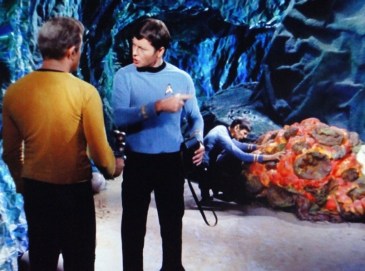
hortaIn Star Trek, after Doctor McCoy got over his initial revulsion (You expect me to treat that thing Jim?!?), he was able to patch up even the exotically alien silicon-based Horta with some simple spackle compound.

But apart from exceptions like the Horta, Star Trek and most every science fiction universe depicts very human-like aliens. This implicit assumption of similarity is made mostly so that alien creatures will be relatable and to make them playable by human actors with minimal make-up and costumes.

AlienBut we create human-like creatures even when there are no technical constraints. The astoundingly terrifying alien created by HR Giger is remarkably human-like with 2 arms, 2 legs, a head, a tail, a mouth, and so on. Despite having acid for blood, his alien follows the evolutionary design model of a human quite closely. It is likely not the case, as many imagine, that such alien depictions represent an unimaginative human conceit and lack of imagination. Rather, it is likely that such physics-defying aliens are actually much more fanciful than evolution is mechanically capable of producing – on any planet.

And let me be clear. Its unfathomably unlikely that any alien could remotely pass as human and walk amongst us undetected – that’s purely a movie fancy as unrealistic as aliens with acid for blood that can eat through feet of metal. However, they will be biologically similar in function if not form. They will not have any superpowers or godlike abilities that defy basic chemistry and physics because they can not. If they can fly they will need wings. And as any dolphin can tell you, there is a fundamental limit to how far they could advance without appendages that allow them to manipulate their environment.

Even many of us who are wise enough to understand that god cannot exist are still far too willing to remain agnostic in insisting that there might be aliens out there with what would effectively be godlike powers.

If my hypothesis of fundamental similarity is true, and I suggest that it must be more true than not, it should encourage us that we’re not actually missing out on as much as we might imagine because we are effectively bed-ridden here on Earth. Aliens would be marvelous to see, but evolution has offered us a pretty representative sampling of the range of life typically found in the universe.

Unless a message in a bottle lands on our Earthly beaches, we’re unlikely to ever know for sure how typical we are. Even then, that would give us only one more example of life. But we can make some pretty good assumptions about the nature of life in the universe without direct experience. And it is likely that the range of actual life in the universe is no where near as wide as our unconstrained imaginations.

So what do aliens look like? Probably a lot more like us than we might imagine.


How These Things Get Started

There are no end to the crazy stories that go around. My uncle was saved from a bear by Bigfoot and has the scars to prove it. This guy on TV was molested by aliens – his story was checked out by a team of scientists. My grandmother was kissed by her dead husband and she wouldn’t make that kind of thing up. The Virgin Mary appeared to a homeless guy in the Bronx who had no reason to lie. Forty-Seven cows mysteriously died in Iowa after a Haitian witch doctor got snubbed at a truck stop and cursed the town – couldn’t be coincidence. Everyone knows that old house is haunted by a woman who was murdered by her lover in the 40’s. That was the day my dead pet returned to save my life.

Given that there is absolutely no possibility that any of these stories are actually true, one has to wonder how they ever get started in the first place. We even have to wonder whether they might have some element of truth if only because there seems to be no conceivable way that such tales could ever get started if there wasn’t some truth to them.

But get started they do. While I cannot give you every particular origin story, I can relate to you one real example to illustrate how these things get started.

One summer during college I was rooming with my longtime buddy Steve. As I walked back to our place late one sweltering night in Wisconsin, I was feeling particularly bored and fanciful. The nighttime shadows helped work my imagination into a receptive frame of mind and when I walked past the window of a local craft shop I was struck by these hand-crafted dolls on display in the window. Now like many people I do admit to being generally spooked by dolls and as I looked at this one particularly creepy looking doll bathed in old-time street lamps, I got inspired to mischief.

I took off running (I had been a track and cross-country runner) but got myself plenty winded by the time I reached our building. I stumbled, intentionally falling and crashing up the stairway and pounded on our door with desperate urgency. Steve opened the door to the sight of me in very convincing panic-stricken terror. I rushed into the room and I made him drag my terrifying story from me. I told him that I had been walking past this store and noticed this doll and suddenly I felt an eerie presence, like some evil spirit, and without warning this doll leapt at the window and clawed at me. I panicked and ran all the way back to the room, the entire time feeling like some malevolent demon was chasing me.

Steve’s reaction was all I could have hoped for. Though frightened he valiantly insisted that we go back that very night to face this demon. I reluctantly agreed to show him where the store was but refused to get closer than the end of the block. I watched down the street as Steve heroically inched forward, craning his neck tentatively to glimpse this demon-doll. Suddenly he jerked, bolted, almost got hit by a passing car as he stumbled into the street, ran all the way back to and past me, shouting breathlessly “I saw it dude! It was the most hideous thing I’ve ever seen!!”

RamonaAudleyYup, in retrospect I should have owned up to my prank right then and there. But Steve was so pumped up I decided to tell him in the morning. By the next morning I had forgotten all about it, and anyway Steve had already left to go somewhere before I woke up. I was reminded of my folly when Steve returned and proudly related how he had gone to the craft shop, paranormal investigator like, to sleuth out the origins of this demon doll. The owner told him that by the greatest of coincidences, the doll-maker, a lady by the name of Ramona Audley (pictured right) happened to be paying a visit at that very same moment. Steve politely confronted Ramona and asked her whether she knew that she was crafting possessed dolls. Ramona apparently nearly went into a terrified state of shock and I was later to learn that the dolls were removed from the store window that very day (Ramona, I did you wrong and I’m so sorry).

It gets worse. When Steve told me what he had done I was mortified. That poor Ramona Audley! I never intended to frighten her or the shop owner! But how could I tell Steve the truth of my prank now that he had done this? I settled for hoping that this whole debacle would just blow over.

Needless to say it did not just blow over. It took on a life of its own like Godzilla emerging from the ocean to wrack havoc. For the next several decades, whenever Steve introduced me at any kind of gathering, he insisted that I tell the doll story. Of course I would refuse, feigning intentionally ambiguous reluctance. But Steve would invariably take over and tell the story on my behalf, prefacing it with a lengthy introduction about how he would never believe this story from anyone else in the entire world except from me. My credibility and sanity and integrity are (were) apparently just that irreproachable.

If you dear reader could have admitted to making up this story prior to this you are a better person than me.  And to make matters even worse, Steve is a naturally gregarious guy who became a minor celebrity with a sizable fan following. Who knows how many people he has told this story to who have in turn related it to many other people, who all swear that they were assured that this story came from an impeachable source. Every year that went by while I hoped that the story would be finally forgotten, every time I failed to disavow it, the myth became that much more indestructible.

My dolls truly had become demons. A few years ago I agreed to be interviewed for a video documentary about my friend Steve. To my horror and chagrin Steve had prompted the documentarian to ask me about the “Doll Story,” which he did, on camera. The story had finally advanced to a line I could not cross and I admitted to my prank on camera rather than perpetuate it any further.

Even after that public admission, I still live in perpetual dread of seeing this bogus story reenacted on the History or Science channel. Lots of people are probably more willing to believe that I lied about it not happening rather than believe that I simply made it up as a silly impulsive prank. After all, what kind of inconceivably horrible person would make up such a story? Umm, yes, that would be me.

And that, my friends, is how these things get started.

There is Always a Trick

We are all tempted at times to be open-minded about  supernatural claims. Indeed, it can seem narrow-minded to dismiss the seemingly inexplicable stories related by sensible, credible people we trust. Sometimes we ourselves experience things that seem to defy any rational scientific explanation. These experiences seem to prove that there must indeed be more to the universe than reason can explain. It can be hard to push back on the logic that if one cannot offer proof of a scientific explanation then one must accept a supernatural one.

Whenever you are tempted to entertain belief in something supernatural or paranormal, just remember one invariably true thing as a given: there is always a trick.

DougHenningI’m reminded of a formative event back in the 1970’s when I went to a performance by the late magician Doug Henning. Between making live tigers disappear, he would walk out to the edge of the stage and do slight-of-hand magic. In one such interlude, he held up a newspaper and showed it to us, turning each page so we would remember the layout. He then proceeded to methodically tear it into smaller and smaller pieces. As he did so he kept a great dialog going:

You think you see it tearing, you think you hear the sound of paper ripping apart, you think you see me holding two separate pieces. All your senses are convinced that I’m tearing up this paper, but I am not.

He continued to rip the paper into shreds and stack up the pieces, in full view, into a little folded-up pile. Then he began to unfold it and show us the full newspaper perfectly in-tact once more. As he paged through the “reassembled” newspaper, he continued his narration:

There is no magic, this is a simple trick. Obviously I could not actually have torn up the paper. But the trick is the magic and the magic is the trick.

Doug Henning was brilliantly messing with the audiences minds there, but what I learned from him is that there is always a trick. No matter how inexplicable something might seem, you only need to know the trick. But moreover, you can be still amazed by the trick and, even knowing it is only a trick, it can still amaze and astound you every bit as much as true magic. In fact, knowing there is no magic, nothing supernatural, no god, does not need to make the world one bit less exciting and inspiring. Quite the opposite. You can feel even more amazed knowing that the real explanation must actually be so clever, so masterfully executed, that one imagines that only some supernatural story could possibly explain it. The trick is SO amazing that it is easier for us to consider some magical explanation rather then the real mundane one.

Years later I watched one of those shows on television that exposes magical tricks. In this episode, they showed the magician and his gorgeous assistants make a mini-sub disappear right on stage. It was astoundingly, compellingly real. Surely there could be no conceivable way that such a feat could be accomplished without true supernatural intervention.

But after the commercial break they simply showed the exact same performance shot from a rear angle. It suddenly seemed stupidly crude and simple, so pathetically obvious that one could not imagine anyone actually trying to fool anyone with it, let alone anyone actually being fooled by it.

It was incredibly disappointing to see that trick exposed. It was ruined forever. I vowed never again to watch any explanation of magic. I want to be amazed. I want to experience that awe and wonder over and over. But I know there is always a trick. All it takes is to move the camera ever so slightly and it becomes ridiculously obvious.

But  the “good” magic that magicians or fantasy novelists or artists offer us does not extend similar benign merit and value to the “bad” magic of hucksters, con-artists, priests, rabbis, imams, televangelists, psychics, and other charlatans. These promoters of the supernatural do not simply entertain and inspire. They tangibly damage our capacity to reason and lead us to unreasonably dangerous or exploitive attitudes and behaviors. And, before you ask, the answer is no. There is no equivalence between our choice to suspend our disbelief in an entertaining magic trick or ghost movie and our choice to suspend disbelief about the idea that a psychic can predict the future or that some god influences the present. We simply choose not to ruin the illusion by pulling back the curtain to expose the trick. We do not believe or tell others that stage magic is true and we certainly do not base life decisions upon a conviction that you really can saw a woman in half.

And it is often the smartest of us who are most susceptible and gullible with regard to magical thinking, and most likely to influence others. I recall when at the height of the “crop circle” craze, one network interviewed a “scientist” who had investigated the circles. He proclaimed that he had studied the markings extensively and could see no earthly method by which they could have been produced. Therefore, he concluded in stentorian tones, they could only have been created by an extraterrestrial (supernatural) force.

Of course the actual method that those guys who later came forward used was as silly as making the mini-sub disappear. But the arrogance and ego of that scientist led him to conclude that if HE could not see the trick, the only explanation must be a supernatural one. Even Sir Isaac Newton, one of humanity’s most brilliant thinkers, was compromised by similar hubris when he assumed that if HE, Sir Isaac Newton, could not explain the stability of planetary orbits, it can only mean that God must intervene.

So remember, there is always a trick, and let that certain knowledge make you more confidently skeptical regarding religious and supernatural claims, confident enough even to simply reject them out-of-hand. But yet be no less awed and inspired by the perfectly explainable but nevertheless amazing magic in the world.

For elaboration of this and further discussions about facts and belief, I refer you to my book “Belief in Science and the Science of Belief” (found here).


Our MacLean Revival

MacLean“A small dusty man in a small dusty room. That’s how I’d always remember him, just a small dusty man in a small dusty room.”

Grabs your interest doesn’t it? That was the opening line of The Dark Crusader by Alistair MacLean. I first devoured this and other adventure novels by MacLean while in High School back in the 70’s. Recently, my wife and I have taken to reading his books out loud to each other and – even in this high-tech era of blockbuster 3D adventure movies – MacLean’s novels continue to be singularly engaging adventures. We can’t wait to take up where we left off reading and we spend much of our time between sessions discussing the implications of whatever bits and pieces MacLean has revealed thus far.

Beyond the marvelous storytelling, MacLean was technically and aesthetically the most gifted author I have ever read. One part of what he achieved with seemingly effortless nonchalance was to deliver the catchiest openings ever. From them his stories flowed, briskly gushing and careening, like rivers of words through the coldly entrancing arctic landscape that was his favored setting. So daunting are his prose, that just taking on the challenge of reading them out-loud has made us both infinitely more fluid and polished readers.

His writing characteristically flows on in methodical rambling, like a symphony put to words, each sentence sometimes strung together over the course of a page or more, leaving the reader as breathless and exhilarated as after a hard swim, only to snatch a quick breath before diving into the next incoming wave.

“My red rose has turned to white.”

His plot lines are so tight, so carefully constructed with milimetric attention to detail, that when his protagonist laments in the prologue of Fear is the Key that his red rose has turned to white, you presage that MacLean will inevitably return to that same powerful imagery in his epilogue.

While his general storytelling elements recur in every book, MacLean’s writing does not feel overly formulaic. Within his general adventure fiction structure, MacLean paints distinctive characters and settings for each book. Unlike other authors, he doesn’t have one main character, no James Bond or Jason Bourne, but he does invariably feature smart but fallible male protagonists who face opponents who are far smarter and much less fallible in their utter ruthlessness.

MacLean also knew how to create a strong supporting cast with whom you engage every bit as much as his protagonist. In fact, I think that one of the reasons I went into chemistry was the inspiring moment in Night Without End when that frail little chemist Theodore Mahler used his knowledge to save the desperate survivors of the plane crash from the grasp of icy death in the deadly and merciless arctic. In that same book, the climax was not when the main hero saved the day, but when boxer Johnny Zagaro, hands rendered useless by crippling frostbite, finally had his inevitable bloody, brutal battle on the ice with the cold-blooded Nick Corazzini.

In MacLean’s novels, nature is invariably the most implacable enemy of all – whether it be the frigid clutch of the arctic, the unforgiving cliffs of Navarone, or torrential storms of the Adriatic. His books are typically light on romance, and in fact MacLean isn’t averse to nipping a budding romance with tragedy. Another distinctive quirk of MacLean is that he does tend to use certain words over and over again. My wife and I play a game to see who will be the first to encounter “milimetric” or “threnody” or “St. Vitus’s Dance” when we take turns reading a book. And be assured that in most every book, teeth will be lost, frostbite will claim fingers, and cigarettes will be burned in liberal quantities.

I find MacLean’s writing particularly noteworthy in how unlike conventional writing it is. He routinely devotes little more than a few short sentences to masterfully describe people and settings, for he needs no more than that, so powerfully potent are his descriptions. But then he is just as likely to go on in excruciating detail about how to wire the detonator for an explosive bobby trap. You have the feeling that he really did have the whole thing wired up and even tested in his office next to his typewriter. In fact all of his writing conveys a particularly strong sense that the author has actually been there and done that. MacLean’s actual background as a seaman and torpedo operator in the Royal Navy is keenly evident in all his writing.

Beyond his astounding gift for writing, I also admire the tone, the characteristic humanity of his works. Throughout his yarns, he weaves in his passion for humanity, for peace amidst cold-war intrigue and violence. Indeed, it was his clearly heretical defense of people, particularly Communists, and his cosmopolitan skepticism toward politics and religion, that caused such negative backlash to his book “The Last Frontier.” It was bold and provocative writing back in 1959, too much for the times he lived in.

“Jansci spoke of himself not at all, and of his organization and its methods of operation only where necessary … He talked instead of people … of their hopes and fears and terrors of this world. He talked of peace, of his hope for the world, of his conviction that that peace would ultimately come for the world if only one good man in a thousand worked for it … He spoke of Communists and non-Communists, and of the distinctions between them that existed only in the tiny minds of men, of the intolerance and the infinite littleness of minds that knew beyond question that all men were inescapably different by virtue of their births and beliefs, their creeds and religions, and that the God that said that every man was the brother of the next man was really a poor judge of these things. He spoke of the tragedies of the creed that knew beyond doubt that theirs was the only way that was the right way, of the religious sects that usurped the gates of heaven against all comers … for there were no gates anyway.”

Though now somewhat anachronistic and dated by patronizing 50’s attitudes toward women (even though his women definitely show great strength) MacLean’s work is still nevertheless as fresh and timelessly potent as the day it was written. My wife and I rather dread the day that we finish up our Alistair MacLean revival. There is very little in the marketplace of literary ideas that match up for us. As just one example, we tried reading Jack Reacher and having been so spoiled by the mastery of MacLean we find the writing and the characters as flat and empty and devoid of life as a cardboard cutout. Are there other authors as gifted as MacLean? Certainly, but it is a very short list indeed.

“A small dusty man in a small dusty room. That’s how I’d always remember him, just a small dusty man in a small dusty room.”


Creative Dreaming

I came up with this blog topic in the shower this morning. That’s where I come up with the vast majority of my blog topics. Why is that do you suppose?

PsychicReaderI occasionally have psychic readings for fun. Purely for fun as I have absolutely zero belief that psychics are really psychic. There simply is no such thing. But I am extremely impressed and fascinated by the rare and marvelous talent of these people to make others believe that they actually have real psychic powers. I see them as a type of stage magician.

As in the art of horoscope writing, the biggest trick in being a convincing psychic is coming up with observations that are universally true but little appreciated, and seemingly specific yet actually very vague and generic. Then you make a lot of them and the mark will selectively remember those that ring true.

Decades ago, one particular psychic gazed deeply into my eyes and revealed to me “You have many of your best ideas in the shower, don’t you?”

YES! That’s amazing! How could you possibly know this quirky and intimate detail about me? The only possible explanation is that you must be truly psychic! What else can you tell me? Oh, you need more money to unveil even more startling revelations about where I’m destined to meet my true love? Do you take MasterCard?

But in reality  this is just a great example of a using a near-universal truth that we falsely imagine is something unique about us that no one could possibly know unless they have psychic powers.

Why is it that so many of us relate to this particular “psychic” insight? My theory of shower-thoughts begins involves dreams.

I suspect that dreams have a very important and largely unrecognized evolutionary benefit. I think that dreams are an essential part of our creative thinking process. In his 1993 book The Metaphoric Mind (see here) author Bob Samples summarized current thought about the creative process. He said that creative thinking requires that we alternate between “play” mode and “logic” mode in order to arrive at creative solutions. We must follow a line of reasoning logically until we reach a dead-end, then enter play mode and make wild leaps of free-association to find a new starting point from which to reenter a new logical train of thought. Techniques like brainstorming are methods for formalizing this process.

I speculate that dreams are a way that evolution has already hard-wired the creative process. Dreams give us a method for entering this “play mode” in which we rearrange the niggling facts of the previous day (selectively those that are unresolved threads of dead-end logic) and make wild leaps unconstrained by logic, by assumptions, or even by the physical reality of our real-world desk and pen and gravity. In the morning, our minds freshly brimming with “play” thoughts, the shower gives us the undistracted time we need to logically process them, to connect and rationalize them into something sensible, and to follow new trains of logical inquiry to unexpectedly new creative conclusions.

Shower-thinking isn’t very novel insight anymore. It’s now pretty well-known (see here), but I am not sure that the role of dreaming in this process is sufficiently appreciated. Nevertheless, this is exactly the kind of detail that a good psychic latches on to in order to establish credibility with an otherwise skeptical client.

The job of a psychic must be getting harder however. Even 20 years ago a psychic could make this kind of “reading” and it would be fairly difficult and unlikely that their client could learn that this amazing insight isn’t actually that amazing at all. If I went to a psychic today and they told me that I have all my best ideas in the shower, a quick Internet search would show me that this is actually pretty universal and quite well-known and documented. It would be clearly obvious that one did not need psychic powers to divine this.

But here is the important lesson. Even 25 years ago when that particular psychic told me this about myself, even though I could not easily fact check this particular phenomenon at that time, my conclusion was not “this person must be a real psychic.” It was “this phenomenon must be more common than I realized.” Keep that in mind when some psychic makes a seemingly correct observation about you, even if their “psychic impression” isn’t quite common knowledge on the Internet yet. Even if you can’t imagine what it might be, there is necessarily some mundane trick to their apparent psychic powers.

Lack of information and openness to magical thinking are the essential conditions for mysticism and fakery to thrive. Religion makes us more susceptible to other kinds of magical thinking. And some of what we are lead to believe through mysticism and fakery is not so harmless and benign as the entertaining insights of a $20 psychic.

So use your dreams creatively. Evolution almost certainly produced them to give you an advantage over your non-dreaming cousins. But don’t imagine there is anything mystical or magical about them.


Consitutution Thumping

scaliaI have a colleague who is really smart. Undeniably smart. He does his complex job extremely well and is deeply conversant in all spheres of intellectual discussion. He is also Bible literalist. He truly believes that he has arrived at all of his religious views through careful reading and unbiased interpretation of the Bible. In the end all he really does is cleverly pick and choose from the Bible to claim external validation of and authority for the beliefs he wants to embrace.

Substitute the word Constitution for Bible here and I could be talking about the late Antonin Scalia.

This is not an uncommon trap that smart people fall into in order to justify their biases and beliefs. Look at Ken Ham (see here). He invokes the Bible to “prove” his truly insane ideas and uses convoluted arguments to dismiss any Bible passages that contradict him. Ham claims that any Bible passages that can be interpreted to agree with him are “literal passages,” and any that do not agree are “historical.”

Just as Ken Ham and my colleague use the Bible as their inviolate source of authority that only they can interpret correctly, so do Conservatives like Scalia attempt to turn the Constitution into a secular Bible to serve their religious and conservative agenda. To them, the Bible and the Constitution are both sources of authority that they can invoke to support their dogmatic views. They claim that any interpretation that supports their views is literal or purist or originalist, while any that disagree are attempts to reinterpret or bastardize these written in stone authorities.

Since secular society does not accept the absolute authority of the Bible, religious fundamentalists seek to transform our Constitution into a secular Bible to serve as a proxy through which they can impose their religious views. Having established themselves as the protectors of the Constitution and as the authoritative interpreters of original intent, they portray the Constitution as infallible and unchangeable, like the Bible. No one is allowed to question its authority or that of those who profess to protect it.

By coopting the Constitution, religious fundamentalists have established an authority structure by which they can mandate and enforce social change according to their religious worldview. All they require is a Supreme Court that will continue to interpret the Constitution so as to maintain and expand their theocratic worldview. Antonin Scalia has been their great champion in this effort.

There is a great deal of manipulative coded language that these religious fundamentalists employ to market their reimagining of the Constitution. Foremost, they preach the absolutism of original intent. This is actually a phrase first adopted by Bible literalists to justify their interpretation of the Bible in the same way that religious fundamentalists seek to own the Constitution.

Even if it were possible to interpret original intent, this is neither practical nor desirable. The very idea is antithetical to what was almost certainly the clearest original intent of the founders that the Constitution remain a fluid and responsive document that can be continually reinterpreted to best meet the needs of a growing and changing nation. This view has actually gained widespread acceptance in Canada and formalized as their “living tree doctrine” which mandates that their constitution remain organic and be progressively reinterpreted to adapt to changing times. However, in America fundamentalists continue to try to reshape the Constitution into their own likeness and then cast it in stone.

Ironically, those who seek to control us incessantly warn about “activist judges who reinterpret the Constitution.” They tout the intellectual purity of Supreme Court justices like Scalia who “uphold the Constitution” according to “first principles.” In short, if you hear people invoking the Constitution and ranting about Constitutional first principles, be very wary.

Supreme Court judges like Scalia who claim to rule according to original intent are as deluded or as deluding as Ken Ham. Every interpretation of the Constitution is unavoidably colored by current culture. Every ruling is necessarily constrained and shaped by the many rulings that form a chain of precedent reaching back eventually to the Constitution. But that chain of legislative rulings may have drifted far, far away from original intent, as we saw most recently in the long, twisted chain of rulings that have taken us to Citizens United, a ruling so completely in contradiction to “first principles” as to be considered almost comical. I call this process of judicial drift from one precedent to the next until it has drifted far out to sea, “judicial brainwashing.”

Ironically, these same patriots who are overwhelmingly concerned with upholding the purity of original intent when interpreted according to their religious ideals are the first to push for Constitutional changes when they find the Constitution insufficient to their ends, as in pushing for a Constitutional Right to Life amendment.

Does this mean that original intent does not matter? It certainly does. As Garrett Epps pointed out in his excellent article “Stealing the Constitution” published in the February 7, 2011 edition of The Nation magazine:

“Serious originalist scholarship is very useful as one way of learning more about the Constitution. But in the hands of judges like Antonin Scalia or demagogues like Glenn Beck, it is really a kind of intellectual weapon…”

Antonin Scalia was the Ken Ham of the Supreme Court. If he truly cared about original intent, he would have acknowledged, for example, that our forefathers could never have imagined let alone intended to protect modern weaponry. The most they might have known was that this new innovation called the “flint-lock” was soon to appear. They could never have imagined or factored in the horrific killing-power of modern weaponry. But instead, what Antonin Scalia did was focus on the word “the” in “the right to bear arms” as the key concept in his extremist interpretation. Antonin Scalia, like Ken Ham, was a deeply self-deluded individual.

Our Constitution is a tremendously important statement of principles. However, in truth there are many countries with similarly admirable Constitutions. It is only the high court system of a nation, and how it interprets and enforces that Constitution, that makes it a great nation or a poor one.

The Constitution might just as well be a Rorschach drawing or Simon and Garfunkel lyrics for that matter. Either of these alternatives might be just as good in the hands of wise men or just as abused in the hands of ideologues.  Antonin Scalia may have been smart, but he was not wise. We can only hope his successor will not be so susceptible to Justice Scalia’s insanely flawed moral and intellectual reasoning.


Satisfaction Surveys

SatisfactionSurveyHave you ever filled out one of those ubiquitous satisfaction surveys? Of course you have. Everyone wants to know how satisfied you are. Whether it be your phone company or your local dry cleaner or your waiter, everyone is keen to quantify, record, and report your level of customer satisfaction.

But despite the fact that satisfaction surveys are as annoyingly common as pennies, how truly useful are they? If you’re anything like me, you probably don’t provide exactly high quality response data to these surveys. If I cannot escape the survey without being rude, I just check “Excellent” for everything without even reading the questions. It’s the easiest thing to do. And what direct benefit is there in it for me to be thoughtful and honest? I’m much more likely to get better service next time if I indicate that my waitress is excellent in every possible way, especially if she was terrible!

And there are lots of reasons beyond immediate self-interest and laziness that most of us lie like Persian rugs on these surveys:

  1. People forget the bad stuff. We have selective memories, and the longer it is after our terrible customer experience, the more likely we are to remember it positively.
  2. People never want to seem like complainers. Even if we had gripes, we are programmed that complaining only reflects badly on us.
  3. People are nice. We don’t want to hurt anyone’s feelings unnecessarily – even if we are anonymous.
  4. People are habituated to say “I’m fine.” Even if we’re in the middle of vomiting up our lunch after being told that our beloved kitty just got electrocuted attacking an electrical outlet, we automatically say we’re fine.
  5. We assume no one <really> wants to know. We figure that this is pointless paperwork that no one will ever actually read let alone act on it.
  6. Saying everything was wonderful is the easiest way to dispense with this annoying and meaningless survey and get home in time for The Walking Dead.

Here’s an even bigger problem worth discussing in depth. We don’t know what we don’t know and have poor imaginations to envision what we could have. Satisfied compared to what? How do you rate your Toyota? Excellent. Oh wait, I didn’t realize I could have had a Porsche instead… Can I change that answer to Poor?

How do you rate your healthcare? Excellent? Great! But did you know that Norway has a healthcare system that costs ½ the price and ranks 11th to your 37th? Would you like to change your survey answer?

Since we don’t know what we don’t know let alone what we cannot even imagine, Poor to Excellent is not an absolute scale. It only encompasses what we know. If we’re given a dozen similarly bad options, we’re likely to rate the least worst of them Excellent. By the way, this is one of the reasons that “happiness scientists” tell us that more choices make us less happy. We become less satisfied with what we can get if we are made aware of all the better options that we cannot hope to get our hands on.

I have a more nefarious theory about these surveys. I think that smart customer service providers offer these surveys knowing all of this, but they figure that when you indicate that their service was great you’ll actually remember it as being great. Probably sound psychology!

But here’s the biggest problem with these victim-less white lies called satisfaction surveys. We sometimes really, really do need an accurate answer to assess satisfaction. We have lots of important social science studies that have little choice but to measure satisfaction through this sort of survey. Unfortunately, for all the reasons given, this data is usually just so much garbage in.

We need smarter measures of satisfaction.

One solution is to de-emphasize or even abandon the self-reporting of satisfaction measures. Instead, smart companies or researchers measure indirect indicators of satisfaction. Rather than ask for a self-reported satisfaction, they look at objective behaviors that correlate with satisfaction.

For example, given a subsequent choice of options, what option does the person actually choose? Do they recommend the option to others? Instead of asking whether they like the coffee or the ambiance of the restaurant, measure how many refills they ask for and how long they remain to digest and converse over their coffee.

Satisfaction surveys are just a microcosm within a wide range of human behaviors. In almost every situation dealing with people, looking at actual behaviors can tell us far, far more than relying upon anything they tell us about their motivations or their opinions.

Dismissed with Prejudice

ElvisDo you have one of those wacky friends? The ones with a deep, sincere, heartfelt conviction that Elvis still lives. That he is actually in seclusion preparing for his epic comeback? Busy rehearsing for the ultimate Elvis concert that will transform the world?

Your friend undoubtedly has an articulate rebuttal for every possible reason you can throw at him for dismissing the possibility that Elvis might still be alive. His death was staged. The witnesses are all in on it. The corpse in Graceland is a DNA-identical clone of him. He is being kept young by a chemical concoction that the pharmaceutical industry has suppressed.

Your friend probably turns the tables on your skepticism quite easily. How can you be so arrogant to claim to know everything? Are you that close-minded? Surely you can’t prove and therefore can’t know for certain that he isn’t still alive. If you are as scientifically open-minded as you claim you must admit some possibility that he might still be alive. Surely you can admit that reasonable people can disagree on this unless you believe he is dead purely as a matter of faith. The only intellectually honest position on this question must be agnosticism.

Your friend points to several well-regarded scientists who admit that it is possible Elvis is alive. He recommends a plethora of scholarly books that debunk all those fallacious “scientific” arguments claiming that Elvis is dead.

Or perhaps your friend has a different but similarly wacky belief that he clings to and argues for with great passion.

All that was my way of setting the stage for the real point of this article – that I do not need to read any of those books purporting to prove that Elvis might be alive. Elvis is dead. Period. Any book that starts with the premise that he may still be alive is necessarily idiotic. There is no need for me to actually read them in order to legitimately dismiss them out of hand. Good scientists dismiss an infinite number of implausible claims all the time every day.

So there is no need for me to entertain arguments about how Elvis might still be alive. And there is no reason for me to read a book that starts with the premise that Elvis is alive or the Holocaust did not happen or the Moon landing was faked or alien overlords built the pyramids. I can dismiss them all out of hand without even reading the book jacket. The only reason to read them may be if your interest is studying delusional thinking or the infection of magical thinking amongst otherwise healthy individuals.

And I have read a great many of these books that purport to present a logical or scientific argument for at least allowing the possibility that god might exist. When I wrote my book Belief in Science and the Science of Belief (see here) I took the time to slog through a 4-foot stack of books that undoubtedly made Amazon the lucrative enterprise it is today. It was largely a waste of time and money on my part. Believers have had two millennia to come up with arguments so there are simply no new ones to be found.

As a concrete example, I bought several books on Neurotheology (see here). I did the world a service by throwing these out rather than reselling them. Written by Andrew B. Newberg and a host of his followers, these books typically spend 250 pages citing brain imaging and cognitive studies related to belief and god. Their real goal is to establish their science creds so that you will believe them when, in the last 50 pages, they leap to outlandish claims that go something like “since we have clearly evolved to believe in god, the only conclusion must be that god himself designed us to believe in him.”

The only conclusion is that this is an idiotic conclusion. But then again what can you hope to get from any author that starts from the silly premise that god exists and works backwards?

Religious books purporting to be scientifically legitimate examinations of the “evidence” for god pop up on Amazon every day like so many weeds. I can’t read them all but I can still dismiss them all out of hand. There simply is no god, can be no god, and therefore every book claiming to argue this point is necessarily as idiotic as books arguing that Elvis is alive and well and living in a secret wing of Graceland.

And thus, dear reader, we finally reach the heart of my dilemma: Do I read these silly books and respond to them or do I simply ignore them?

Ignoring them is not easy. If no one pushes back on them, they seem to win the argument. And there are so many of them saying the same silly things that many readers mistake quantity as an indication of quality. On the other hand, the time for engaging these silly debates is over. At this stage of the atheist movement, we must move past engaging in and thereby legitimizing these ridiculous debates. We should give no more consideration to religious ideas than we do to racist ideas or homophobic ideas or sexist ideas or the idea that Elvis is amongst us.

Still it’s hard to resist getting sucked in. Recently a new book appeared on Amazon called “Can Science Explain Religion” (see here) written by a priest who is also a Professor of Religion. It apparently “debunks” the very theory of the evolution of belief that I present in my own book. Do I buy this and read it so I can credibly criticize it and defend my position, and thereby risk encouraging this nonsense? Or is it best not to even respond and hope that the rest of the country follows my sensible example?

After struggling with this dilemma for many years, I have come to believe that refusing to engage is the best strategy moving forward. Engaging in further debate with them only feeds the beast. Like booing Donald Trump at a rally.

It’s not an easy course of action nor is it without risk or criticism. But in science, we must first ask whether our basic assumptions are valid before we enter into discussions of the resulting questions. We must not let ourselves get caught up in grand debates over how Santa manages to deliver all those presents in one night when the very premise of Santa is pure fantasy.

And that is how we should respond to these books and these arguments – by dismissing them out of hand and with great prejudice and by refusing to entertain dependent arguments arising out of purely implausible assumptions.