Category Archives: Education

Caution: Slippery Slope

SlipperySlopeThe slippery slope is one of the most commonly invoked arguments and usage of slippery slope arguments seems to be on the rise. One study found that the phrase is used in the media 7 times more frequently than it was just 20 years ago (see here).

These slippery slopes are bandied about quite routinely to sway sentiment and opinion. They are typically used to argue in opposition to something, and they work pretty well. Slippery slope arguments invoke fear, inaction, and even rejection of a proposition by suggesting that if you allow a not-so-bad thing to happen, it will lead to something-much-worse happening.

We hear examples of slippery slope arguments every day. Just a few include:

  • Physician-assisted suicide will open the door to the government pulling the plug on grandma to save Medicare dollars.
  • If we encourage contraception, sexual promiscuity will run rampant and immorality will destroy the fabric of our nation.
  • Legalizing gay marriage will result in incest, polygamy, bestiality, and the breakdown of the American family.
  • Pot smoking is the gateway to heroin addiction.
  • First they came for my gun; then they came for my liberty.

Like the examples above, most slippery slope arguments have extremely dubious connections between the actual and predicted events. Many are in fact completely ridiculous. Most slippery slope arguments are guilty of gross exaggeration and are a form of arguing to the extreme and to fear. They are also a form of false conclusions or invalid extrapolations that mistakenly assume that rational lines cannot be drawn to halt any slippery slope. In short, they tend to violate a large number of basic tests of logical and factual validity.

Apart from appealing to emotion and fear, there is another big reason slippery slope arguments work so well. It is because they are often quite valid. Give them an inch and they’ll take a mile is a valid truism.

First they came for” is granddaddy of slippery slope arguments. It is traced back to a poem by Lutheran Pastor Martin Niemoller that described the decent of Germany into Nazi atrocities. It was a cautionary message about political apathy that described an actual progression of attitudes and events. As a slippery slope argument, it was perfectly valid and substantiated. It was however a retrospective analysis, not a prediction. Nevertheless, today it gets adapted into slippery slope predictions for all sorts of unlikely and implausible outcomes.

This illustrates the fact that we can often only recognize a true slippery slope after we have slid down it. Still, being cognizant and wary of a slippery slope can help us to put on the brakes and avoid sliding too far. We should not necessarily avoid slippery slopes, but we certainly should be cautious and especially sure-footed when negotiating one.

There are criteria that we can use to evaluate the amount of legitimate concern to grant to any particular slippery slope argument. Are the causes and effects that it predicts really likely on the grounds of logic and evidence? Are there any valid precedents to support this slippery slope prediction? Is it only arguing to fear? Is it really likely that such a slippery slope would not be halted before it went too far?

Not all but many invalid slippery slope arguments are put forth by religious people to defend their practices and implement their beliefs in policy. This is understandable. When you do not have facts to argue, slippery slope arguments are very easy to fabricate and usually very effective.

However, we are all guilty of putting forth invalid slippery slope arguments at times when we think it supports our position. Unfortunately this rampant misuse of slippery slope arguments tends to discredit valid slippery slope arguments. Paradoxically it seems that they work very well most of the time but at other times are dismissed out of hand as almost a pejorative. Invalid slippery slope arguments are given far too much credibility and consequently valid ones can be too easily dismissed.

We as fact-based thinkers must be especially cognizant of the rampant misuse of slippery slope arguments and only invoke them after careful consideration. When we do, we must be ready to defend those arguments with supporting evidence or rationale even as we question the basis for the slippery slope claims of others. And most importantly, we must resist the temptation to use specious slippery slope arguments even when they serve our own interests. If we do not reject all such arguments, even when they help our own cause, then we all suffer from a diminution of effective logic and reason and rational decision-making.


Our Fragile Internet

Once upon a time not so long ago we relied upon books as our information storage media. Those rectangular bundles of paper and ink were fragile and ephemeral. But in comparison to today’s digital media, they were etched in granite. Even when formidable powers-that-be expended considerable energy to erase them from existence, it was often still impossible to completely confiscate and destroy every copy in every library and every home. The precious knowledge they held often survived.

Today however, knowledge can be instantly erased with a single press of a button located on an Internet server sitting in some undisclosed location somewhere on the World Wide Web. Certainly the things we see done in movies is pure Hollywood fiction. No one can just hit a button and magically erase all trace of your existence from all computers in the world. We have redundancy and not all of those redundant systems would be accessible by such a purge. And even if some super virus could crawl through every server everywhere deleting all trace of us, there are still backups.

But our information is incredibly fragile nonetheless. If and when the people hosting servers find that it is insufficiently profitable to continue to store and provide access to the information, it is wiped without nary any effort at all. Even if data is hosted by dedicated enthusiasts, they go bankrupt or die or move on. The reality is that despite redundancy and backups, any information located in or accessed through the cloud can simply go poof at any time.

Yes individuals or institutions may have copies of files. But we lose our local files all the time. We accidently delete them, our drive fails, or the software that accessed them becomes obsolete. And because local storage is so fragile, it is becoming increasingly rare to store anything locally. More and more we are relying data hosted “securely” in the cloud. And, like a real cloud, that information can simply evaporate at any time.

This isn’t a theoretical worry. It happens all the time. Here’s just one case study. In 1999, the online gaming universe of Everquest was released. By 2004, there were nearly a half million part-time residents living in the world of Norrath. They filled the Internet with thousands of informational sites, huge databases of information, and literal volumes full of essential stuff. But after a few years, other lands like the World of Warcraft lured players away. When the Everquest player base dropped off, ad revenue to these sites dropped off as well.  When it did, their hosting servers disappeared one by one in rapid succession. Today although many still play Everquest, much of that valuable information is simply gone. In 2004 one would have assumed all that knowledge was carved in stone, enshrined forever in the Internet, eternally available whenever it might be called upon once more by new players or gaming historians. One would have been wrong. All of that information went poof, lost, gone without so much as the warm glow of a book-burning.

You may not care that the walkthroughs, guides, lore, and history documenting the Everquest world are essentially lost to us already. Just as others will probably not care about whatever particular body of knowledge you hold dear. But if we don’t care about all knowledge then no knowledge is secure.

This one case study illustrates the fragility of all information in our Internet-based information age. Yes, there is SO much information out there, but at the same time it is no more enduring than a soap bubble floating on the wind. It can all disappear into thin air just as quickly. The solid permanence of the Internet is illusory.

Consider what this warns us about more important bodies of knowledge like Wikipedia. Wikipedia is arguably the most ambitious and successful accumulation and redistribution of knowledge in the history of mankind. It is a triumph of the Internet Age every bit as marvelous as the Great Library of Alexandria was during the Classical Age.

Yet, like Everquest lore, Wikipedia could disappear in a moment. All it would take is the flip of a switch. This could happen for many reasons. Their resources could dry up or their core team could simply grow old and weary of the effort. If and when this happens, the collective efforts of thousands upon thousands of expert contributors could simply vanish. Poof. This unprecedented compendium of the collective knowledge of mankind could be gone in a wink.

But even more frightening would be if Wikipedia did not simply disappear but was rather corrupted to live on as an unholy shadow of itself. It could be acquired and corrupted and commercialized by a self-interested corporation. It could be censored or even shut down by paranoid politicians. If that were to happen, and it easily could, it would be worse than dead and gone, it would become a tool of profit or propaganda.

As they say “knowledge is power” and the Internet is the portal through which all knowledge now flows. And one does not even need to control sources of information like Wikipedia anymore. They can simply take control of the doors through which information is accessed. Our fragile information age offers that almost irresistible opportunity to control knowledge, to take power. China, UAE, and other countries work to police and censor their doorways to the Internet. The United States struggles against power political and corporate forces that would like to take control of the Internet for financial gain or ideology. Donald Trump just recently talked about how he as President would take control of the Internet. Companies vie and maneuver constantly to take control of the doors to knowledge (and profit) in the Information Age.

This would be unimaginably easy. Those who would control information don’t need to rewrite or censor every web page on the Internet. Rather if they control the supply lines, they can simply switch on software filters or real-time automated editors that can automatically blot out competing information insert alternative viewpoints as easily as they can filter out pornography or spam. The doormen don’t even need to block sites since they can simply drop them down in search engine results until few will ever find them. Even worse, they don’t need to even block or restrict access. Using the justification of protecting us against “dangerous material” they can gain the authority to modify the text, to redact or insert key information without leaving any trace that the source material had been modified.

RedactedIf that knowledge were still printed in physical books, those who wish to rewrite history would leave traces of their censorship by marking out text or ripping out pages. We could at least tell changes were made. We have no such guarantees or indications when it comes to any information we receive in our browser.

If we don’t understand this, if we fail to protect the integrity of data flowing through the Internet, we not only risk losing it all, but we risk becoming, each and every one of us personally, the helpless targets of corporate greed and political propaganda. Our great information age could be corrupted overnight into a new Dark Age. During the last Dark Age the Catholic Church seized control of all knowledge and became the sole arbiters of what would be communicated and how. They would find the control of information infinitely easier today in our Information Age.

We must not let information become just another disposable, devalued, manipulated commodity in a throw-away culture. Our digital information is both a great asset and a great risk.

Indeterminism

FreeWill

Free-will and determinism are concepts that religious and non-religious thinkers alike love to debate about. Unfortunately both exist largely in the realm of fantasy and any discussion of these concepts only serves to strengthen religion and mysticism. We atheists should be very careful about when and how we discuss these concepts.

First let’s consider free-will. Regardless of any non-religious discussions one might like to engage in about free-will, this term has become inextricably synonymous with religion. It was popularized largely by theologians to counter the problem of evil in the world. How can a good god allow evil? Well he gave us free-will of course! Since the universe cares not, God alone can define good and evil and give us the magical ability to choose between them. Free-will unavoidably suggests something outside of science, something divine, bestowed by god to humans only. Any discussion about free-will is to enter into a logical discussion about an illogical construction.

In direct opposition to free-will is determinism. Although it comes in many varieties, determinism is essentially the idea that we actually have no free-will at all. Everything in the universe is determined by the laws of chemistry and physics. You could predict every feeling and thought you are experiencing right now if you calculated forward correctly from the Big Bang. You may think you have a choice about what you do next, but that’s an illusion. Your every movement, thought, and choice was predetermined when the cosmic cue ball broke the table and the universe was set into motion.

Such discussions about determinism, while stimulating, only ultimately encourage religious thinking. If the universe is deterministic then there can be no good or evil, right or wrong. Most people refuse to accept such a universe or the idea that we have no choice. After all, we all feel something we perceive as choices between right and wrong. So any discussion of determinism quickly sends most people flocking in droves to the religious side. Their reasoning and their emotional reaction to determinism may be arguably flawed, but that is the result nevertheless. Secular philosophers may think they can logic our way out of this recoil into the arms of religion, but their logic is insufficient for most people.

Part of the problem here is that free-will and determinism are both extreme conceptual constructs, like positive and negative infinity. On one extreme, there is no right or wrong or choice. On the other extreme, right and wrong are defined by god and choice is bestowed by him and everyone is wholly responsible for everything they do. If good and evil and defined clearly by god, there can be no room for “situationalism.”

But reality is the continuum between these theoretical extremes. We live in the grey regions of choice and responsibility. We certainly perceive that we have choices and that we make choices. So choice is real to us at least. And regardless of whether those choices are ultimately predetermined in some sense, we as individuals and collectively as a society have no alternative but to judge and to respond to the choices we make.

To resolve the apparent contradiction between living in a “clockwork” universe that can only operate according to the mechanics of its particular gears and coils, and our perception of choice, consider randomness. One might argue that in a predetermined universe there is no such thing as a truly random number. You could in theory predict every random number in advance if you knew the state of the universe at any point in time and understood all the rules of physics sufficiently. However, according to every practical test we could perform and every objective purpose to which we could apply them, random numbers are demonstrably random to us. It would be silly to base our technology on the idea that there are actually no random numbers. And it is equally silly to base our beliefs or our society on the notion that choice does not exist.

But we should also recognize that in the grey area we live in, choice and responsibility are mitigated by a large number of deterministic factors. We recognize that if you look far enough back everyone is a victim of deterministic influences. At the same time, we must acknowledge that everything is to some extent a choice as well. We have to draw a line somewhere to decide when and how to hold people accountable for their actions. The extent to which people actually have a choice and the extent to which we hold them accountable for their choices is a judgment mitigated by many factors. These factors include age, state of mind, delusion or drug influence, intentions, ignorance, upbringing, circumstance, coercion, whether this behavior is treatable, how dangerous it is, and whether it is likely to repeat.

Clearly it’s not practical to consider everyone an innocent victim of the big bang and hold no one accountable for their actions. We have to hold people accountable for their choices. But it’s just as impractical to fail to consider the many physiological and social factors that determine behavior and effectively give people little or no choice in their choices. As individuals we have to draw our own lines and as a society we have to draw a collective line with treatment and help on one side and prevention and punishment on the other. Understanding, however, can span the entire spectrum. It is not inconsistent to understand the determinants of choice and still punish those who make those choices.

For example, even a suicide bomber may ultimately have no real choice given the horrific situation that we have created in their country. If we had not bombed their home into the stone age and taken away every other course of action, they likely would never have strapped a bomb to their chest. We may actually be more responsible then them, and yet still we must prevent and punish their behavior. We can understand the causal factors that forced that behavior and to the extent that we can and change those conditions we should. Understanding that every decision is neither completely a choice nor completely excusable, is to live in the very messy real world lying somewhere between the theoretical extremes of free-will and determinism.


Jefferson’s Grand Nightmare

ThomasJeffersonThomas Jefferson was our Einstein of social and political science. He had an uncanny ability to understand human behavior and to envision what would ultimately grow from the seeds being planted in his times. Because of his visionary insight he fought for many years with his contemporaries, including his protégé Madison, to convince them to adopt several key provisions into our new Constitution. In fact he threatened to dismantle the effort to build a new nation if they were not included. He was adamant that a nation without these essential protections would be worse than none at all.

The first was Separation of Church and State, for without that protection he foresaw that our secular freedoms would inevitably be corrupted into a Theocracy. Jefferson would probably be relieved to see that we still do protect our wall of separation and that it offers some protections against Theocracy, but he would probably still be shocked and disappointed at the extent to which religion has succeeded in subverting or bypassing that wall.

The second thing he insisted upon was a ban against a standing army, for he feared that a standing army would only ensure perpetual war and war-profiteering. On this Jefferson would most certainly be horrified and most gravely disappointed. We do have a standing army that is only in principle under the command of a “civilian” President. In truth his worst fears in this regard have been realized with our huge standing army and the almost irresistible profit motive that ensures unending warfare.

The third thing Jefferson fought for was protections against corporations, for he saw that without very strong protections, our nation would inevitably be coopted into a Corporatocracy to serve the interests of corporate enterprises. He feared that these ravenous “wolves at the door” as he called them would eventually devour the government.

Jefferson did win this battle – for a while. The founders explicitly and deliberately never used the word “corporation” in the Constitution because they feared that merely by mentioning the word, corporations would be conferred with some status. For our first 100 years or so, most States had extremely stringent laws in place to prohibit any political action whatsoever by corporations. In fact, until as late as 1950 some states still had laws on the books forcing companies to disperse completely every 20-40 years to prevent them from amassing too much power and wealth that could corrupt the government.

When did the protections Jefferson put in place all fall apart? The root is the 1857 Dred-Scott decision that essentially said that people could be property. This resulted in the Civil War and the Civil War had the horrible side-effect of creating a monstrous gun industry (and a gun-culture) in America as the government cranked out untold numbers of guns that eventually ended up in the general population. The second corporate behemoth that was created by the Civil War was the rail industry as President Lincoln pumped huge amounts of money into rail to mobilize his war effort. These newly giant corporations helped win the war, but also became corporate monsters with new-found wealth and appetite for more.

Unsatisfied with accepting the corporate restrictions that had held corporate influence at bay since the Constitution, the rail industry started to direct its wealth into politics in an explicit effort to dismantle corporate restrictions on political influence. In the 1875 Santa Clara County vs. Southern Pacific Railway case, the claim was put forth that the 14th amendment protected companies as persons. The court explicitly ruled that “it made no ruling” on this assertion. However, in a published headnote the reporting journal “mistakenly” said that it did so. This was completely erroneous and absolutely non-binding, but yet law students to this day believe that personhood for corporations was actually part of the ruling.

It all went horribly wrong from there. A subsequent court cited this mistaken report as precedent and conferred rights upon companies as persons, even though no such precedent existed. By doing so, they set an actual binding precedent that impacted dozens of subsequent rulings leading right up to our most recent one which essentially gives corporations unlimited and unfettered power. Citizens United gives them such power that the dictates of corporate greed now arguably overwhelms any other institutional force working on behalf of the social good.

And the irony is that even the citation in the 14th Amendment used to justify this claim of personhood in Santa Clara County was false. Throughout that section, the authors of the Constitution refer to “natural persons” to explicitly exclude corporations. In only one little clause, they omitted the word “natural” totally by mistake, and this omission has served as the ultimate Constitutional basis for all of the rights of personhood that corporations have won.

Citizens United was a horrible, horrible decision based on a tragically comical sequence of false legal precedents. If Thomas Jefferson were here today he would most certainly be crushed to see that the wolves are no longer at the door, they have the run of the house.

There are only two Constitutional remedies for this corporate subversion of our government. The first is for the Supreme Court to reverse itself and all previous rulings. The second is for a Constitutional Amendment to simply insert the word “natural” into the Constitution where it was meant to be. That would perhaps force the Court to reverse itself.

I am glad to see Jefferson is not here to see his worst nightmares for our nation come true. But none of these alone are the Grand Nightmare I refer to. Jefferson’s grand nightmare would be the truly horrifying synergy of these three anti-democratic forces working together; religious zealotry fueled by corporate power and greed wielding the power of a huge standing army.

Evolution Did It!

While serving in the Peace Corps in rural South Africa, I loved to visit different schools to talk about science. One of my favorite activities was playing the “Why” game. I’d encourage the kids to ask “Why” about anything at all and we’d use scientific thinking to formulate hypotheses.

It would take a while to coax even one “Why” out of the kids as they were totally unfamiliar with any kind of meaningful dialog with a teacher. When I invited them to ask “Why” questions, the only responses I got were dazed and confused expressions. Students were seldom encouraged to ask any questions, and if they did the only answer they were likely to get was “because it is” or “god made it that way.” But clearly those answers are not really satisfying because as soon as just one kid bravely took the chance to venture a question, the floodgates of pent-up curiosity unfailingly broke loose and a deluge of “Why” questions came pouring out from the entire class.

Tellingly, one of very first questions was inevitably “Why am I black while you are white?”

Now that might seem like a tricky question but it isn’t really hard at all. In everything to do with life, be it human or animal or plant or microbial, the answer to pretty much any question is “evolution.” Even if that isn’t a complete answer, it’s the perfect foundation upon which to discuss further nuances.

Why are you reading this article right now? Evolution! Granted, we could just as legitimately answer “chemistry” or “physics” and start from there. But when it comes to the traits and behaviors of living things that most kids are naturally most interested in, “evolution” is always the sensible starting point.

eggsTo get things started I would often hold up a hard-boiled egg that I typically carried around for a snack. Why do you suppose eggs are egg-shaped? This question would be met with confused looks, so I’d oil the hinges of their flood gates with squirts of evidence. Do you think it means anything that eggs of birds become increasingly oval as the land they live on becomes steeper? Within minutes we’d find ourselves testing the evolutionary importance of egg shape by rolling my lunch down a slanted desk-top and speculating on how rolling behavior can help or hinder the survival of those birds.

You don’t need to join the Peace Corps or teach school to play the “Why” game. You can play it with family and friends or even all by yourself. Think of any characteristic of living things, make it as simple or hard as you can, and start by asking why it is so. The answer of course is “evolution,” but now the real fun begins. Now you can think about “Why” that particular trait or behavior might have been an evolutionary advantage or hindrance.

To help you play the evolution game, here are some rules that are not always obvious:

1. Every trait of living things – physical, mental, behavioral, social, temperamental – all arise through evolution. Practically anything at all is fair game.

2. It is OK to personify evolution to help us talk about it. Personification makes it much easier to understand and relate how evolution works. It just needs to be understood without necessarily saying that personification is only a communication technique and that evolution does not really have motivation or intent.

3. Not all traits are necessarily helpful. Some are simply the result of innocuous mutations that don’t particularly help but they don’t hinder enough to get selected out. However the best starting hypothesis is to assume evolutionary significance. And just because we cannot imagine the significance of a trait, that doesn’t mean it has none.

4. Most traits have many advantages and disadvantages. In the grand dice-roll of evolution, the advantages of a trait must only collectively outweigh the disadvantages. In the case of egg-shapes, rolling down hills is just one of the many ways this simple trait affects the survival of that species. There are lots of right answers.

5. Evolution does not “care” about individuals. There is a rampant misconception that evolution favors the survival of individuals. This is largely a misapplication of the concept of “survival of the fittest.” This misapplication causes some to claim that examples of evolved traits that cause harm to individuals disprove evolution. Nothing could be more wrong. Evolution only cares about the species. It will happily kill individuals off, even within a species, if it helps the population to survive. Certain spider females eat their mate after fertilization. This helps the species to survive. The male is most useful as food after his job is done. Evolution holds individual lives in no particular regard.

6. Evolution does not guarantee the “best” traits. It merely makes it more likely that those random traits that happen to be good enough in a given circumstance are passed along. Our spine isn’t a good design let alone the best design. An intelligent designer would have come up with something much better. But it is good enough.

7. Evolution is not “going” anywhere. It is not “leading to” any sort of perfect human for example and mankind is not the “pinnacle” of evolution. All of evolution did not happen in order to create us.

8. Just because evolution is not going anywhere does not mean it is not going anywhere. Evolution is like a driverless car. There is no driver and it knows not where it is going. But it is definitely going somewhere nonetheless, following forces that direct it along a logical, non-random route defined by its characteristics, obstacles, terrain, and the physics of motion.

9. Evolution is not guaranteed to find a way for a species to survive change, especially rapid change. Most in fact do not survive change. Evolution certainly has not found ways for the vast majority of species on the planet to survive dramatic changes, the worst of which may be the holocaust of humanity.

10. Certain unimportant traits might have little role in survival right now, but they might either save or kill your species when the environment changes.

11. A good trait isn’t always good. Change the environment slightly and that trait that helped you survive yesterday may cause your extinction tomorrow. Belief is one of those. Just because it evolved yesterday does not mean it is not bad for us today.

12. Bad traits can be good. If a trait isn’t bad enough to kill you before reproducing, it’s good. Sickle-cell Anemia is not a desirable genetic trait right now. But it may be the only trait that grants immunity to the zombie apocalypse virus that is right around the corner of random mutation. The more biodiversity a gene pool can support, even “bad” genes, the more likely that species will survive over the long haul. Wiping out a “bad” gene today could doom us tomorrow.

Those are just a few of the things to consider when you think about how traits and behaviors might have evolved. So enjoy the “Evolution Did It” game! It’s infinitely more fun and stimulating than the “God Did It” game.

Pascal’s Folly

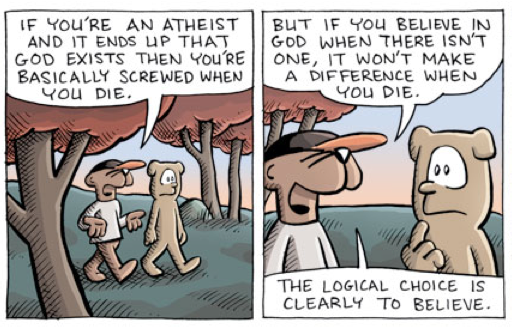
PascalsWagerYou’re probably familiar with Pascal’s Wager. It says that even if there is only an infinitesimally small possibility that god exists, the consequences of eternal reward or punishment far outweighs any earthly cost. Therefore, a smart person should “hedge their bets” and believe in god.

This is incredibly specious logic but it nevertheless holds powerful sway over a great many people. Lots of otherwise intelligent thinkers put it forth as a reasonable argument, even as an inescapable iron-clad rationale. But there are many flaws in it including the assumption that belief is a harmless hedge. In the end it is no more than a silly trick of logic that can equally justify anything whatsoever. By this logic, for example, the proposition you received via email from a Nigerian Prince might be legitimate. However small the chance that it’s real, isn’t it worth responding? In fact, the Nigerian Prince is far more likely to be real than is god. Such a prince could actually exist.

But you might reject that argument with yet more pseudo-logic. You might argue that only heaven is sufficient reward to offer compelling enough stakes to accept Pascal’s Wager. And I then counter by suggesting right here and now that you cannot get into heaven unless you give up ice cream. Regardless of how small the chance that god only favors those who prove their faith by forsaking ice cream, Pascal’s Wager demands you give it up. But I doubt you would accept that wager and actually swear off ice cream.

We reject most such nonsense out of hand. Here is yet one more flaw of Pascal’s Wager. We apply it only to one extremely specific assertion and reject an infinite number of others even though they are equally legitimate according to the logic put forth. You can counter yet again and say, well but I cannot play all possible lottery games, and I choose to play this one. Fair enough, so I can counter your counter. This logical fencing goes on and on unendingly without resolution. Playing mental games is something we humans do extremely well.

But why do we reject the same logic for pretty much anything else except the god proposition? We reject it because such logic is clearly stupid. And this brings us to yet another problem with Pascal’s Wager. There is actually in fact no possibility, none, nada, nil, zero, absolute zero, that god actually exists. Someone will in fact actually win the $100M lotto, so that might be worth a $2 ticket by Pascal’s logic. But no one can actually go to heaven because it does not exist. And you cannot claim “but it could” unless you really are equally willing to ACT ON every other impossible proposition.

This illustrates a fundamental problem with logic. As powerful and important as it is, logic has limitations. Thinking that abstract logic necessarily reflects reality can be like a Chinese Finger Trap. I just read an interesting book by Jordan Ellenberg called “How Not to be Wrong: The Power of Mathematical Thinking” (see here). I do recommend it highly. But in it he twice states emphatically that “reason cannot answer the question of god.” If that is true, then it is our reason that is flawed. And it’s easy to see how. Ellenberg is a mathematician. Even a mathematician can become too familiar and comfortable with mathematical concepts like infinity that have no actual basis in reality. Our minds can conceive of symbols and rules of logic that cannot exist in reality. God is one of those. Pascal’s Wager is one of those. It is a human conceptual model that leads to seemingly incontrovertible but nevertheless absurd conclusions.

To illustrate the problem of blindly accepting a “logical” argument without insisting upon testing that logic against reality, consider Zeno’s Paradox. In the 5th century Zeno gave us his famous paradox that says that since we cannot arrive at our destination without infinitely cutting the remaining distance in half, we can never actually arrive at it. The “logic” of this proposition has confounded thinkers ever since as it is extremely difficult to refute by the rules of logic. But a guy called Diogenes the Cynic disproved it by simply standing up and walking across the room.

We humans have an amazing capacity to imagine things outside physical reality and to conceptualize logical systems of rationality that are imperfect in describing that reality or that extend beyond physical boundaries. But we have to be careful that our own cleverness does not make us stupid. Get up and walk across the room. God does not exist and religion is not a harmless hedge.

Here’s the bottom line. If your system of logic leads you to the conclusion that god might exist or that you cannot ever reach the other side of the room, it’s because your system of logic is flawed or ever-extended or you just want it to be true. If your logic cannot disprove flying pigs or gods, you are not thereby proving that god might actually exist. You are merely encountering the limitations or failings of your logic.

And to my agnostic atheist friends who refuse to say with certainty that god does not exist, if you allow for any possibility that god might exist, you have essentially lost the argument. You have admitted that Pascal’s Wager is reasonable and that belief and religion are therefore reasonable. You may think you can logic your way out of that shifting maze, but that only leads to endless ridiculous arguments that mostly serve to give undue credibility to the ridiculous.

The Language of Reason

reasonWe routinely use a large number of very similar words when we talk about thinking: rational, rationale, rationality, irrational, rationalize, rationalization, reason, reasonable, and even superrational. We all kinda-sorta mostly generally understand the nuanced differences between these words, but since they are so very important and so often confused, it may be helpful to put them all on the table where we can clearly compare and contrast them.

Rational describes thinking that is based upon true facts and sound logic. This is the good kind of thinking. It requires that the thinker is unbiased, fact-based, sane, logical, and as objectively correct as one can be given the best information available. Note that the threshold here is quite high. It is not enough to merely follow “my own logic” to reach a conclusion, but that one follow independently valid logic and adhere to independently validated facts. One cannot merely feel they are being rational; they must in fact be objectively, measurably, demonstrably rational. A certifiably crazy person may be absolutely convinced they are perfectly rational in concluding that aliens are beaming signals into their brain, but that does not make them so.

Rational thinking implies that one meets all these requirements in a particular line of thought. A rational thinker is one who generally employs rational thinking. Often this term implies that one consciously values rational thinking as well. Although religious thinkers insist upon being shown respect as rational thinkers, it is difficult to see how their claims in any way reach the threshold of rational thinking. They seek to dilute and diminish the term so that it applies to them.

The term rationality is generally used in the context of questioning one’s rationality. That is, when we wish to make an assessment of a person’s capacity to be rational, either generally or at a given time.

Superrational is a term coined by cognitive scientist Douglas Hofstadter to describe a cooperative group behavior in game theory. However like many scientific concepts it has been incorrectly hijacked by New Age types. They invoke it to suggest that there is some intuitive mode of thought that transcends normal rational thinking – which they then invoke to justify any magical thinking they wish. They might say, for example, I believe in psychic powers because I’m a superrational thinker.

The word reason is trickier. In its basic form it is inherently neutral with regard to truth or rationality. It simply describes the cause, explanation, or justification one uses to explain their conclusion or action. But we also use it more generally to describe our rational capacity. It is in this sense that it is used for example in the “Reason Rally.” It sounds better there than would the “Rationality Rally.” The word reason also has the benefit of invoking feelings of reasonable or reasonableness.

However the connection between reason and reasonable is also a problem. Reason shares the fairly high bar with rational. But to be reasonable only requires that one be fair, moderate, and sensible. That’s why the word reason is a dangerous one to substitute for rational. Using reason as a synonym for rational can lower the bar for rationality in the minds of many people who might like to claim that their “reasonable” beliefs are rational conclusions because they are reasonable. Reasonable people can agree to disagree. Rational people cannot disagree for very long.

And that is a great segue into the biggest source of confusion amongst these terms. Just as the word reasonable dilutes the word reason, the word rationalization dilutes the word rational. Even worse, it totally reverses it!

Although it seems like they should be different forms of the same word, rationalize is almost the complete opposite of rational. To rationalize is to contrive some rationale, some apparent logic, to make the illogical appear perfectly rational. It is to “rationalize away” facts, logic, and reason. It is the process of deluding one’s self into thinking that some possibly preposterous idea is sound and credible regardless of the facts of the matter. We rationally reach scientific conclusions, but we rationalize our religious beliefs to convince ourselves that we are rational thinkers. These are not remotely equivalent.

This is insidious because once we have rationalized something, it then seems completely rational to us. Once rationalized, we become certain that our thinking is perfectly sound and reasonable. And we have evolved to be incredibly good at rationalizing. From the evolutionary perspective it was evidently far more important that we feel certainty in the face of ambiguity or the unknown; that we reach harmonious consensus in a delusion, than that we know the real facts of the world. There is also evidence that belief served a benefit of requiring less energy consumption as well (see here). But belief is no longer a beneficial or even harmless adaptation in our modern world.

Despite the fact that it no longer serves us well, we as a species remain incredibly good at rationalizing. Clinically delusional people are often completely certain that their delusions are perfectly rational. But this isn’t just an affliction of the insane. Rationalization is our normal human brain function that we are all susceptible to. Once rationalized, we normally continue to believe any ridiculous belief without reevaluation. We don’t need to be beyond the threshold of insanity to hold some insane rationalizations.

The lesson then is to be very skeptical when anyone insists that their conclusions are rational – even when it is ourselves. Few of us can distinguish between our own truly rational positions and completely rationalized ones. Fortunately science gives us methods to help us assess whether our conclusions are fact-based and soundly logical.

Likewise, we don’t need to train our young thinkers to rationalize problems, as they are innately quite adept at that already. Education in debate, law, marketing, sales, religion and many other fields mostly enhance our innate ability to create any argument that convinces others – to rationalize. We need far more training in science and skeptical thinking so that we can  better judge whether the rationalizations that impact our lives are truly rational.

When Smokers Ruled

I hear lots of you, especially my younger friends, express sympathy for smokers. I know you think that I am unduly harsh on them and that society as a whole is excessively severe toward smokers. But frankly you didn’t live through the smoky days when smokers ruled the world. If you had you might not feel we are harsh enough. Your misplaced concern is like expressing sympathy for those poor overregulated coal-fired plants now that the air is finally breathable – breathable only because they were heavily regulated in the first place.

smoker wearing crownTry to imagine the world back when smokers were completely unregulated. I grew up in the 60’s and in those days smokers had absolute uncontested sovereignty. They smoked wherever and whenever they wished and no one had any right to complain. You cannot appreciate how hellish they made the world. Thankfully you don’t have to live in it anymore. Movies glamorize it with dreamily wafting artificial smoke. Even supposedly accurate period pieces like “Good Night and Good Luck” totally sanitize the filth that was the 60’s. In reality, ashes stained every surface. Every table was cluttered with disgusting overflowing ash trays. The surface of every table and chair was riddled with burn marks and littered with butts. The air in any indoor space was a toxic cloud of fumes. Windows were literally browned-out with thick layers of tar. It was a time distinguished by disgustingly yellow teeth and smoke-reeked clothes and upholstery. You don’t see, smell, and feel those things in the movies. The movies don’t make your eyes sting and your throat cough.

smoking while eatingBack then, dinner at restaurants was like eating out of an ashtray. Adults smoked right up until their first bite, immediately after their last bite, and indeed some took a drag between each bite. They would then drop their butts into water glasses or into their leftover mashed potatoes even while others will still eating.

The inside of cars was a hellish torment as well. With all the windows closed in those cold Wisconsin winters, all the adults would smoke nonstop. Once I asked my mom to let me open a window. She refused. When I pleaded with her to stop smoking she answered, “I’m the one smoking, why should it bother you?” So I then flipped the radio switch to full volume. “Turn that off,” she shouted. I mimicked “I’m the one listening, why should it bother you?” My logic was lost on her and I was answered only by a solid smack across the face.

Even the great outdoors provided little respite from the tyranny of smokers. Mounds of ashes lined every curb. Every grassy park lawn was covered with butts, matches, and packaging. When us kids played on the beach we would shovel up handfuls of butts infesting the sand. In the winter the pristine snow was defiled with ashes, butts, and packaging everywhere you looked.

This is only a pale portrayal of everyday existence when smokers ruled the world. Frankly you cannot imagine it any more that I can really imagine the pollution in London during the height of the industrial revolution. So don’t feel sorry for smokers. Don’t give them any of that power back. If you let up, they will return life to the hellscape it was back when they had their way.

And don’t fool yourself into thinking it would not be that bad again. Smokers have not changed. Smokers today are not more enlightened and considerate than smokers back in the 60’s. This is obvious when you still see them blithely toss their cigarette butts on the ground anywhere they happen to be when done with them. They don’t care that you have to walk through them or that your kids play in them. They have not changed. They have no social conscience when it comes to their addiction.

Smokers in fact have turned the new outdoors into the old indoors. In NYC at least, we nonsmokers have to hold our breaths when we go outside and hurry past the gauntlet of smokers. We have to grimace in disgust when they walk ahead of us billowing out smoke like a coal locomotive. We used to escape outside to get a few gulps of fresh air. Now we have to rush inside to escape the smoke.

The only reason smokers still do these things is because we let them. If we let them smoke in restaurants again, they’ll once again smoke between bites and toss their butts into your water glass.

I went on a bus trip in Brazil not long ago. The tour guides laid down the law on the first day. “We will not allow you to stink up the bus and we will not clean up your disgusting soggy butts from the snow slush on the bus floor. Further we will kick you off the bus if you toss your butts all over Brazil.” The tour guides handed out twist-top vials and instructed smokers to only smoke off the bus and to keep their butts in the vial until they could dispose of them properly. The smokers were at first irate at this restriction of their right to litter at will, but did quickly adopt the practices and the trip was a joy for all, including the smokers themselves. Most importantly we were not embarrassed by those smokers flicking their butts our across every scenic place of beauty we visited.

Here’s my advice informed by history. Don’t give an inch to smokers lest they take a mile. Start a movement to make smokers everywhere adopt the eco-friendly tour policy and put their butts into a container until they can be disposed of properly. Even better, force cigarette manufacturers to provide a clever package that makes it easy for smokers to deposit their butts right back into the pack! Smokers and their corporate suppliers must be forced to do this through laws and/or social pressure. They will not do it simply because it is the socially responsible thing to do.

One last addition. At first I was annoyed by the emergence of e-cigarettes because they only encourage more smoking. But I now appreciate that they do have one huge unanticipated benefit. They eliminate a tremendous number of butts being strewn all across our shared spaces. For that reason alone, I think they’re a really, really good thing. If they would just lose the smoke effects and that silly LED on the end, I’d have little reason to complain about smokers except for their impact on my insurance rates!

Fighting the Malware Mafia

malwareI’d been plagued by malware on my home computer for a few months. It was one of those particularly malicious creations of evil and despicable “humans” – the kind that takes your browser hostage and extorts money from you to “fix” it. You know, like that helpful mafia guy who for a small fee will be happy to “fix” the problem with his shattering your kneecaps.

I fended off the extortionists for months by repeatedly going through a tedious process of removing these ad programs that got created, by removing browser extensions and add-ons that suddenly appeared, and by removing strange Windows services. It would go away for a while, only to suddenly reappear a day or week later with all new names like “digisales” or “turbodeals.” In short, it simply would not die. It kept recreating itself in seemingly endless incarnations. But they were all the same malware with the same extortion screen shown here.

Of course I tried running every virus, malware, spyware, and adware removal tool I could find to eradicate this vermin including Windows Defender, Malwarebytes, AVG, Bitdefender, Ad-Aware, Spybot, System Mechanic, and others. None of them found or fixed the malware.

Then I upgraded to Windows 10, hoping the problem would go away. It did disappear for a while and I kind of forgot about it. Except, I had this annoying problem in the Edge browser. Whenever I tried to copy a URL from the address box, my browser would hang for 30-60 seconds. To try to identify the cause of this, I removed extensions and changed options. At some point during the process, bang, my malware is back with a vengeance. I could not use Edge at all, even though none of the other browsers were affected.

Yet another round. Tried running all the malware programs again. No luck. How could they fail to identify such a severe virus?? Tried one more program with the somewhat silly name of SUPERAntiSpyware (found here). Their tagline is “Remove Spyware, NOT just the easy ones.” Well, I thought, let’s test that bold claim.

So I downloaded and ran SUPERAntiSpyware and viola! It found thousands of “malicious” cookies and cleaned them up. Total cure. Compete recovery. Poltergeist expelled. Problem solved. I’m clean! No more hostage lockups, no more problems copying/pasting in Edge, and my browsers seem much snappier to boot!

I happily paid for a subscription to SUPERAntiSpyware for all our computers. It is amazing that none of the other big names could find this malware. Clearly they all do just find “the easy ones.” Even more amazing is that Microsoft apparently cannot produce the best tool for cleaning up the system they know better than anyone.

And lest you think “lie down with dogs wake up with fleas” applies to me, consider that my wife joked about that. “What porn sites were you visiting?” I actually don’t visit any sketchy sites, but of course the best way to convince your wife that her suspicions are right is to try to deny them.

Well SUPERAntiSpyware had the last laugh. When we installed and ran it on her computer it found one malware program and almost two thousand adware cookies on her machine as well.

Bottom line. I’m sold on SUPERAntiSpyware. We had other products running when we got that malware and they didn’t help us. Of course, this is entirely anecdotal. You may contract a virus that only one of the other programs will find. But the evidence I have available to me says SUPERAntiSpyware is the one I’ll trust. Here is their link again: SUPERAntiSpyware.

Aspirational Advertising

angieHave you seen the latest Angie’s List commercial called “gutter?” Of course you have. Jeff is the inept husband who cannot even clean out his gutters because apparently he’s got a debilitating fear of ladders and an overwhelming aversion to touching yucky gutter gunk. His wise and sensible wife calls Angie’s List to hire a contractor to clean out the gutters for hubby. Jeff hugs her with joy and relief for saving him from the horror of gutter-cleaning. Another happy family thanks to Angie’s List. Nice good-natured humor, right?

Well first let me point out that this pro gutter cleaner obviously isn’t all that pro. Sure, he came equipped with the requisite work gloves, but then he set his muck-bucket on top of a slanting roof, reaching up over the edge to toss in the leaf-rot. The pro technique would be to safely hang the bucket from a rung. It would have been hilarious if he had tipped the bucket and it came sliding down in comically slow motion to dump the muck onto Jeff’s head.

But I’m not here today just to make fun of the Angie’s List pro gutter-cleaner guy, rather to illustrate a much bigger problem. Here’s the reality. It is overwhelmingly females who make most purchase decisions and most purchases. So naturally companies craft most of their marketing to influence women. Their typical formula to accomplish this has long been to depict men as big dumb babies and their wives as the smart, wise, and sensible ones who of course demonstrate their competence by choosing their product. This Angie’s List commercial just follows this tried and true marketing approach for consumer advertising – the stupid, incompetent guy and the smart, competent woman. Not picking on Angie’s List here. This ad merely follows the industry norm and is far from the most egregious example.

Is it any wonder that so many American women have the view that men are children who need a mother? One could argue that advertising doesn’t create culture, it just reflects it. But we all know that is a simple-minded cop out. Advertising amplifies and normalizes the cultural hot-buttons that they press over and over to instill the attitudes that become our culture.

Imagine the reverse. Image if Swanson had a campaign that essentially said, buy our frozen dinners because your wife is a cute airhead who can’t cook crappy Salisbury steak!

And I’m not merely defensive about the way advertisers portray men. I also get equally worked up by their typical caricature of elderly people and other groups. I’ve railed since my youth as a teacher about how advertisers contribute to our terrible anti-education culture here in America. Think back a moment. Think of all the famous ads targeting kids. Most of them sell their products by communicating anti-education messages. School is boring. Teachers are dumb. Bueller… Bueller… I’ve got the back to school blues. Quick get to Six Flags before your fun summer ends!

There is no reason that these companies could not sell their products in a socially conscious and responsible way that does not engrain negative cultural images through catchy jingles. Angie’s List could come up with plenty of good reasons to market their services without making men look like idiots. Lifeline could sell their emergency beepers without making the elderly look pathetic. Levi’s could sell jeans without making school look like a gulag. How about showing how well you’ll be able to focus on your great teacher while wearing those comfee new loose crotch jeans at your desk? I’ve occasionally seen a few companies like McDonalds sell their products through positive messages about education, but even they are sporadic.

So why do they all do it? Because it’s easy and it works. If advertisers can leverage the widespread feeling that men are idiots, that old people are pathetic, and that school is stupid, then they can then count on those campaigns working every time. But it amazes me that they do work so well. Do women really like to think of their man as such a pansy that he cannot even climb up seven rungs and pick a few leaves out of a gutter?  And do we really want to see our beloved father as a zombified husk? Do we really want our kids to see going back to school as some kind of cruel joke on them?

Apparently most do and advertising has spent decades reinforcing these memes to ensure that they will move product every time. But advertisers could do so much better as an industry, we could do much better as a society, and each of us could do much better as consumers. Advertising should be aspirational, emphasizing and reinforcing the most noble of cultural attitudes. I think it would sell product just as well, even better.

All we need to do is motivate them to change. We need to start rejecting cheap stereotypes that pit groups against each other and demand more positive, aspirational advertising campaigns. More fact-based arguments and fewer emotional ones. We should start by boycotting any company that sells their products to kids by reinforcing negative feelings about education. That is the most important priority.

Advertising both reflects and shapes our culture. But we can shape advertising too. If only a few more of us stop responding to these stereotypes, even start to actively boycott the offending products, companies and advertisers will change. And those changes in advertising tone will in turn snowball into an avalanche of widespread cultural transformation improving our attitudes about education, about men, about the elderly, and many other important issues and groups.