Category Archives: Fact-Based Thinking

Swarm Stupidity in Humans

swarmI am eternally fascinated by swarm intelligence and emergent behaviors. These terms describe the phenomenon by which individual organisms, following only simple local logic without any wider intent or awareness, contribute to highly complex and far-reaching behaviors that “emerge” or arise out of their collective activity.

The most observable examples include bird flocking, animal herding, fish schooling, bacterial growth, and ant colonies. Ants, as the most dramatic example, collectively create extremely complex bridges and nests, even though no particular individual organizes that activity or is even aware of it.

The amazingly complex creations of ants emerge from very simple individual logic such as “if another ant is on top of me, stop moving.” From this kind of deceptively simple behavior, ants collectively exhibit astounding feats of mass migration, swarming, tactical warfare, nest construction, and engineering. If however, a significant number of ants were to abandon their “belief” that it is their responsibility to hold still while another ant is felt upon their back, then their ability to create bridges and nests could collapse, and perhaps their species would as well.

What intrigues me most about this sort of swarm intelligence is the intriguing certainty that we humans collectively exhibit our own highly complex emergent behaviors. Even though none of us intend it, each of us nevertheless contributes to the emergent behaviors of our collective population, just as if we were merely cells in some greater human super-organism.

Therefore, the basic rules of logic that we live by as individuals likely do contribute rather more directly than we imagine to the large scale behavior of our species. For example, if we base our everyday logic on the assumption that god does or does not exist, we profoundly alter our collective behavior accordingly. Belief is not then merely some personal thing. It has profound consequence. Religious believers intrinsically know this to be true, that their belief fundamentally shapes the world we live in, and that is why it is so important to them to internalize, express, and evangelize it.

While Christians inherently believe that their religion produces what they feel are desirable emergent behaviors, many atheists conclude that they are wrong. We conclude rather that a personal religious worldview results in highly damaging emergent behaviors like bigotry and intolerance, gullibility, susceptibility to manipulation, disregard for the planet, and even warfare. We conclude that a personal belief in god is, in significant part at least, responsible for swarm behaviors like gun violence, terrorism, torture (see here), and jihad.

Therefore, we atheists should trust that there are no “benign” religious beliefs. We should never doubt that our simple rule of logic, that we believe in facts and reason not in gods, serves our species far better moving forward. We must trust that our personal atheist thinking, when expressed through a sufficiently large number of individuals, will indeed result in emergent behaviors that are more ethical than dogmatic, more fact than fantasy based, and more focused on our lives and our planet right now rather than life ever after. We must trust that atheism will better give rise to the more enlightened swarm intelligence that we so desperately need if we are to survive as a species.

Religion is a prime example of “swarm stupidity” in humans.


But I Know What I Saw!

A while back I wrote a blog about the likelihood (or unlikelihood rather) that we could ever meet aliens from another planet (see here). Even though it is highly unlikely we’ll ever meet them, I also wrote another article about what aliens probably look like (see here). In response to the latter article, I received the following comment and question. I thought it might be useful to respond in some detail.

Hi my name is Mark. 2 days ago around 1pm I had a encounter. It almost brought tears to my eyes and my emotional state was altered with unknown feelings. I was sitting on my patio when I noticed something watching me. I looked up at it. And it was aware of me spoting it and its prescense. The alien was a pure white flame/orb??? It flew down wards looked towards me and dissapered. I wrote all I could down about it and what and how I thought it worked or functioned. Some ppl wait there whole life to see what I saw. It was real!!!!!!!! It was so different. The light was extremly bright yet it had no glow to it. It was alive. (It somehow uses the golden ration to dissaper. Such as folding our perpective dimension. Only my theory ) Help Me………. I wanna let the world know how beautiful diffrent strange and awe strucking it was. The scariest part was it was spying on me. It came close and vanished??? Into nothing. Thank you this is no joke please let me know of what u think.

Let’s consider the rational way to respond to such an incident. First, I cannot completely accept this report as is. It could be, Mark, that you are just profoundly delusional. Or it could be that you simply cooked this up to troll and get a response. Or it could be that this was not actually your experience, but something someone told you that you are representing as a first-hand account. Crazy stories like this get started all the time (see here).

But Mark, let’s assume that you are not insane and are not pulling a joke but that you truly believe this experience happened to you. There are still many, many ways of intellectually and emotionally responding to such an incident that do not require you to suspend all of your rationality and accept incredible explanations.

Indeed, such an incident happened to me. I write about it in my book, Belief in Science and the Science of Belief (see here). I highly recommend you read it as it goes into far greater depth about how one should interpret unexplainable experiences. Indeed, it is not particularly rational to acknowledge that you have five fingers. Only when our rationality is sorely tested can we truly discover whether we are really rational thinkers. It is only when  we refuse to accept easy explanations, when we reject the ridiculous beliefs of others, that we can claim to be rational. If we believe ridiculous propositions like alien visitations, psychic powers, ghosts, or even gods – no matter how many other people may believe these things – then we are not truly rational.

As to your particular experience Mark, there are many explanations that are far more likely than that you were visited by aliens. First, you may be remembering a dream. I have difficulty differentiating some dream memories from actual memories. You may have had a waking dream. And realize that none of us are either fully sane or insane. None of us are immune to an occasional delusion. It is only when these episodes become profoundly persistent that they become a mental illness. We are all somewhat susceptible to paranoid delusions (see here), and frankly your report has elements of paranoia.

I’m sure, Mark, that you’ll insist that none of those things apply to you, and they may not. But that doesn’t mean that therefore you are at liberty to believe that you were spied upon by aliens. When we don’t understand something, the truly rational response is to suspend any judgement, forestall any conclusions, until if and when we learn more. A rational person, as does any good scientist, accepts not knowing what happened rather than accept some implausibly easy fantasy as a substitute for knowing.

My ghost-encounter happened 30 years ago Mark, and I still am far happier not knowing what happened than to accept that I actually saw a ghost. By remaining in the dark with my eyes open, I leave open the possibility of one day seeing the real truth, even if that truth turns out to be that I simply had a momentary brain-fart.


Data, Data Everywhere…

In The Rime of the Ancient Mariner, poet Samuel Taylor Coleridge lamented “Water, water everywhere, nor any drop to drink.” There seems to be no better way to describe our situation today with regard to information. We sail upon a vast ocean of data and yet we die of thirst. Indeed, we are too often deluged by great waves of facts that batter us relentlessly to and fro upon treacherous seas of data.

It feels particularly disconcerting for me to write this article. In my book, Belief in Science and the Science of Belief (see here), I promote the importance of elevating facts above beliefs. After all, facts should reflect reality. They should be the basis upon which truth is known. Today however, data seems to be used far more effectively to support beliefs, fantasies, and lies than it is used to reveal truths. Indeed, those who wish to sell us nonsense don’t often bother to invoke the bible or faith anymore – they invoke their own “facts” instead.

One reason that facts have become the new champions of beliefs and cons is the sheer amount of it. We now have so much data that one can mine anything they want from the endless mountains of the stuff that we have produced. Misrepresented facts can now be dredged up to fabricate lies far easier than spinning magical stories of gods and devils.

Nowhere is this new perversion of facts more true than in politics. Today politicians like Donald Trump incessantly cite completely misleading facts to support their beliefs and positions and to outright lie. Even if the majority of people do not believe their “trumped up” facts, they nevertheless conclude that all facts are suspect and that no facts can be trusted. This tangibly undermines the level of rational thinking of our entire culture and leaves us without any sound basis for making good decisions as a society.

In his excellent Op-Ed (see here), William Davies points out that “they [facts] seem to be losing their ability to support consensus.” According to Davies, there is clear agreement that “We have entered an age of post-truth politics.” This new age of bullshit is fueled not by assertions of faith, but by assertions of facts. As Davies further points out, “Rather than sit coolly outside the fray of political argument, facts are now one of the main rhetorical weapons within it.

So facts have become the new bullshit. We claim to care about facts, but only because, as with the bible, we can always find something in them to support our beliefs and prejudices and self-interest. Our abundance of data seems to be only serving to diminish and undervalue it; to make it increasingly vulnerable to manipulation, misrepresentation, and lies by half-truth. The sheer volume of it makes it far more difficult to say anything with certainty without some other bit of data seeming to contradict it.

And this perversion and misuse of facts is not just true in politics but has become the new normal in all walks of life. All too often journalists and pundits do not pursue facts to reveal truth, but rather invoke them to advocate for opposing sides of an issue. This makes great theatre, but does little to advance the important questions that we face. It instigates and perpetuates conflict rather than help reach a sound fact-based consensus.

Even scientists, our gatekeepers and guardians of fact, all too often emphasize only those facts that advocate for their positions rather than serving the far greater goal of advancing science as a quest for truth.

Abandoning facts is simply not an option. Allowing the manipulators to turn all fact-based thinking into rationalization games and data manipulation exercises is not an option because without sound facts good decisions simply cannot be made. If we allow facts to be coopted by magical thinkers, by self-serving politicians, or even by well-meaning advocates, we might as well put the psychic hotline staff in charge of our fates.

What is the answer? We must reclaim facts. We must become smarter consumers of facts who are no more likely to be fooled by the bogus facts cited by manipulative politicians or corporations any more than we are by laughably ambiguous bible citations and interpretations. We must learn to recognize valid data and sound conclusions amidst all the cherry-picking and false claims. We must learn to treasure and respect fairly presented facts as diamonds amongst all the heaps of rubble and fool’s gold that we have to sift through every day.

Our overabundance of data should make us value – and demand – sound analysis and conclusions based on that data all that much more.


Studies Show That…

One of the most compelling arguments in support of religion is the totally pragmatic one. What does it matter if religion is false, if god is totally made up, if faith is only a placebo effect, or even if it’s all ultimately just a scam to separate you from your hard-earned money? In the end isn’t all that matters that it makes you happier and more successful?

Reporters and opinion writers propagate this pragmatic justification of religion every day. It is actually difficult to get through any newspaper issue without encountering yet another article or op-ed touting the benefits of religion and faith. Here is an example of the typical kind of happiness claims put out there most every day in popular media:

Research suggests that children who attend church perform better in school, divorce less as adults and commit fewer crimes. Regular church attendees even exhibit less racial prejudice than their nonreligious peers. (see here).

happinessThese articles invariably cite scientific studies and statistics to support their claims. But those claims frequently go far beyond study design or the conclusions made by the scientists involved.

There are many ways that studies are misused by advocates to advance their causes or market their products. So we must all be very savvy when we see broad, sweeping conclusions being supported by narrow scientific studies, particularly by social science studies.

To help you to recognize these manipulations, following are some of the typical falsehoods and distortions used by advocates to misrepresent science or to promote bad science.

Failing to Mention the Negatives
Studies show that chocolate supplies 11 grams of fiber! Wow, maybe we should all eat chocolate to get our fiber! But to get that 11 grams of fiber from chocolate you have to consume a whopping 600 calories. Likewise, studies tout selected admirable ethical qualities of religious people, but fail to mention other studies that show, for example, that religious people are far more likely to support torture, guns, violence, and drone attacks.

Failing to Mention Better Alternatives
Another way advocates misuse studies is by failing to mention far better alternatives. For example, the chocolate industry fails to mention that practically any fruit, vegetable, or grain is a far healthier source of fiber. That may not be their responsibility, but if they are implying that you should eat chocolate in order to get your fiber, they are lying. Likewise, advocates often tout the morality of religious people, implying that religion is the only way to achieve these values. But you don’t need to consume 600 calories to get your fiber and you do not need religion along with all its negative characteristics to be a good person.

Failing to Quantify the Benefits
Advocates will often claim a benefit without quantifying it, thereby giving a false impression of how important it is. For example, religion advocates may cite studies showing that fewer religious people go to prison, without mentioning that this difference is inconsequentially tiny.

Misrepresenting Statistics
Advocates often misrepresent statistics. If they are trying to magnify a small difference they report it as a percentage or ratio. If they are trying to exaggerate a tiny difference in a huge population, they cite the numerical difference.  For example, religion advocates might claim that “secular people are twice as likely to commit suicide as religious ones.” Sounds fantastic right? But this could very well mean that out of a population of 10,000 people, 1 religious person committed suicide and 2 non-religious people committed suicide. Not quite as alarmingly persuasive when presented that way.

Using Bad Indicators
In epidemiology, an indicator is a specific test that can be used to measure a more general condition. But a bad indicator tells one little or nothing about the general trait being evaluated. For example, religious advocates typically conclude that believers are “happier” based upon highly questionable measurements such as divorce rate which have little to do with happiness. As we all know, married people can be far more miserable than divorced ones.

Failing to Prove Causation
Most clinical studies are observational, or association studies. That is, they simply show that two variables are both observed in or associated with a given population. This is valuable information. But proving that those two variables are directly related to each other is quite difficult. Proving causality between one and the other is even more difficult. Even if two things seem to be related, they may be indirectly associated through some third thing called a confounding factor. For example, a study may show that church-goers cheat less on their spouses. That is merely an association. But advocates use that observed association to claim that church attendance promotes ethical behavior even though the researchers themselves never made that claim. However, it may well be that church attendance and marital fidelity are not directly related at all, let alone that church attendance causes fidelity as advocates claim. The most we could say based on the research is that, for whatever reason, people who go to church are also more likely to be people who have fewer affairs. Maybe the reality is that unattractive people tend to go to church in a desperate and futile attempt to start an affair. Attractiveness may the just one confounding factor here. That we cannot determine or even imagine what the confounding factors may be is not proof of causality.

Failing to Consider Reporting Bias
Many of the narrow social studies used to make sweeping claims rely upon self-reporting. However, self-reporting is incredibly unreliable. People intentionally or unintentionally report all kinds of things in all kinds of ways for all kinds of reasons. For example, men are likely to brag about their infidelity while women are likely to conceal it. Self-reports are poor measures of the relative level of infidelity between the sexes. Likewise, religious people are deeply invested in the fiction that religion makes them happier and are very likely to report that they are even if they are totally miserable.

Failure to Mention Study Limitations
Years ago, upon reading commonly cited statistics that “98% of women report incidents of sexual abuse,” radio host Dr. Laura Schlessigner did what a good consumer of information should do. On-air, she called the scientist who conducted the study being referenced to support this claim. The researcher was eager to express her frustration with all of the advocacy groups citing her research without mentioning that her study narrowly targeted an extremely at-risk population. Dr. Laura then called the head of one of those women’s advocacy groups employing this scare-tactic and asked her why she knowingly misrepresented this research. When confronted, the head of the organization stood firm, saying that anything is justified if it raises awareness of real issues faced by women.

Choosing the Wrong Measurement
Even if we could measure happiness, it should not be assumed that happiness is the best or only goal. Believing that  global warming is a hoax probably does make one sleep sounder. Allowing your kids to eat pizza at every meal will probably result in fewer observed food-related tantrums. But clearly these measures of happiness do not justify accepting those positions. Likewise with religion.

Selective Skepticism
We tend to do pretty good at being skeptical about things we disagree with. But when it’s something we’re predispositioned to like and want, like chocolate or religion, we tend to set all skepticism aside and whole-heartedly embrace any arguments in favor, no matter how much of a stretch they may be. The happiness-arguments supporting religion are definitely one area in which our society demonstrates far too little critical scrutiny, as evidenced by the huge number of happiness claims repeated in major publications with virtually no skeptical analysis.

Baby With the Bath Water
Please, please, please don’t conclude from this that you can never trust social studies and that these studies never have any value at all. Association studies are very valuable. We need to know when things are observed together in a given population. However, you should be a smart consumer of these studies and understand the ways that advocates misuse study results to contrive claims that advance their cause. This is particularly important when we are predisposed to believe those claims. When in doubt, look past the claims made by advocates or even by seemingly objective “science reporters” and read the typically more careful and restrained conclusions reported by the scientists who conducted the studies. With the Internet at our fingertips today that is not usually very difficult to do.

Agnosticism Just Won’t Die

I know I run the risk of beating a dead zombie with my blog, but I feel compelled to write yet one more article about the rotting abomination that just won’t die – agnosticism.

The reason I simply must respond yet again is because news articles and opinion pieces touting the intellectual purity of agnosticism just keep getting published everywhere you look. And these aren’t written only by religious proponents, but by scientific and academic intellectuals as well (here’s one). Like most of these agnostics, this author contends that agnosticism is misunderstood. Being agnostic is not merely being undecided or ambivalent or apathetic, but rather it’s a highly principled position that upholds sound scientific skepticism and empiricism.

The author gleefully notes, as do all agnostics as their go-to-proof-by-authority, that even Richard Dawkins admitted he is agnostic! This well-intentioned but misguided and tactically disastrous statement of philosophical agnosticism by Richard Dawkins, given who he is, has caused incredible harm to reason and rationality. Don’t follow his lead on this one.

Skepticism is indeed a hallmark of the scientific method. But skepticism is not synonymous with gullibility and science does not require you to abdicate logic and reason and common sense. Good scientists can and do reject an infinite number of ridiculous propositions out-of-hand every day. Healthy scientific skepticism does not require you to doubt everything. It merely requires that you withhold drawing conclusions regarding plausible assertions until sufficient evidence is obtained.

This is where the agnostics think they have an iron-clad argument. Since supposedly science cannot prove a negative (e.g. god does not exist), then despite the lack of positive evidence, any good scientist must be agnostic regarding anything and everything! Gotcha!!

First, scientific rigor does not require that scientists disprove every possible ridiculous statement. Imagine anything that is clearly untrue. Take for example, my claim that my banana is actually a sentient life-form named Ned from planet Zorcon that just happens to exactly resemble a banana right down to the molecular level. Ned is in a coma right now and cannot respond or do anything un-banana-like but he deserves the rights of personhood. Healthy scientific skepticism simply does not require scientists to admit that my assertion might be true. It certainly does not require that they perform studies to try to prove or disprove this claim. Scientists have no burden whatsoever of disproving my absurd claim about Ned the comatose alien banana. It is entirely my burden to prove it and until I do good scientists can and should simply reject it out of hand.

And keep in mind, these agnostics do not claim god is a plausible belief, they rather claim that regardless of how implausible it may be we must allow that it may be true nevertheless.

Next these agnostics will – cleverly they think – point out that science cannot prove a negative. This fallacy is typically summed up by quoting Martin Rees who famously pointed out that absence of evidence is not evidence of absence. What this correctly points out is that just because we see no evidence of something doesn’t necessarily mean it does not exist. In fact, this quotation would be far more accurate and less misused if stated as “absence of evidence is not always evidence of absence. When this phrase is quoted by agnostics they fail to recognize that a sufficiently conclusive lack of evidence absolutely can prove a negative.

Let’s contrive an example for fun.

I do not need to even look in my bedroom to assert with 100% certainty that there is no dragon in it. There is no such thing as dragons and no reason to even consider that possibility, so therefore I can dismiss this proposition out of hand. Further, as a good scientist it is my obligation to dismiss such claims with prejudice.

elephant-in-roomBut what if the claim is not a dragon but an elephant. Well, elephants do exist and while I cannot imagine how one would get into my house, I can easily prove or disprove this claim just by glancing around my bedroom. Having done so, I can legitimately conclude with 100% certainty that there is no elephant in my bedroom. If there were an elephant hiding under the bed or behind the curtains, I would reasonably expect to have seen at least some evidence of it. Therefore, I do not need to remain agnostic with regard to the sincere heart-felt beliefs of the elephant-in-every-bedroom cult to prove I am a good scientist. I have sufficient proof to conclude with certainty that my bedroom is elephant-free and that all claims of an elephant in my bedroom are delusional.

God is like that elephant. He is SO huge that if He existed we would certainly have seen evidence. There is none.

But let’s argue that god is more elusive and secretive – like bedbugs. Let’s say that the bedbug cult claims that I have bedbugs in my bedroom. Even though I don’t see any bedbugs just by glancing around, it is still possible they may exist and as a good scientist I take the advice of Martin Rees to heart and withhold conclusion pending further evidence, positive or negative. So, I bring in trained dogs and bedbug residue detectors. I carefully examine all the places where they would be found if they were there. If, after that, I find no evidence of bedbugs I can conclude beyond any reasonable doubt that my bedroom is bedbug free. I do not have to remain agnostic about whether dragons or elephants or even bedbugs are in my room to prove I am a good scientist. Such agnosticism would only prove that a fool exists my bedroom.

Similarly no legitimate evidence of god, however secretive he may be, has ever been found, despite the fact that believers make extravagant claims about his tremendous influence over our world. 

In fact, unhealthy agnostic skepticism is the exact opposite of good science. Science, unlike mysticism, relies upon the certainty that our cosmos is knowable; that it follows rules. Not just anything is possible. If it were, the cosmos would not be knowable at all and science would be meaningless. In science, things are true, observable and logical, or they simply do not exist and are untrue, period. To say that good scientists cannot know anything for certain is to turn science into mysticism.

To be frank, agnostics are not the champions of science and reason they imagine themselves to be. Ultimately their position renders science and reason invalid. If they insist that we cannot disprove things for which there is no proof, then they are necessarily saying we cannot positively assert anything at all. For anything you could assert as true, you could simply make up any story to cause all that evidence to be in doubt. Agnostics are required by their dogma to accept that.

You can have fun with agnostics. Make up some unprovable reason to claim something silly. Agnostics will be forced to admit you might be correct because they cannot disprove your un-disprovable fantasy. This exposes how bereft of any meaning their position really is. Truth and falsity, science and mysticism, evidence and belief all collapse upon themselves into a meaningless jumble of pseudo-intellectual nonsense if you accept the agnostic view of reality.

So agnostics have a huge problem. They think they are purists in being “open-minded” enough to admit that god might exist by making a philosophical claim that we cannot really disprove (or thereby even prove) anything whatsoever. But they don’t actually apply their intellectual purity to every possible ridiculous proposition. They only selectively apply it to this particular ridiculous god assertion. Though they might stubbornly claim to apply this thinking to everything universally, clearly they do not do so in practice. In the end either these are just smart people applying convoluted logic to rationalize a particular ridiculous proposition that they want to believe or they are misguided atheists who mistakenly believe that agnosticism demonstrates their sophisticated and superior intellectual standing.

What harm does agnosticism cause? It undermines logic and reason and moves us toward a pseudo-scientific kind of mystical thinking in which anything is possible. Moreover, if we accept the agnostic argument, if we give it any credibility whatsoever, then we accept that god might exist. And if we accept that god might exist, then we must accept Pascal’s Wager and concede that it makes some sense to assume he does. And if we assume he does, then it only makes sense that believers proselytize and fight to shape government and public policy in accordance with their delusional religious thinking.

Agnosticism is the brain-eating zombie of philosophical nonsense that just won’t die. Accepting agnostic arguments is to follow them down their rabbit hole into Wonderland where the ridiculous is accepted as the norm and crazy ideas are rationalized with insanely inescapable logic.


Followers and the Followed

schizephrenicLike all animals, we humans have evolved certain preprogrammed behaviors. Some of these we call instincts but they can also be thought of as just the tuning of our pattern-recognition systems. For example we have an instinct for detecting when we are being stalked and hunted. This is a pretty valuable instinct. It is essential that our pattern recognition systems are tuned to detect some agency following us. We are in fact tuned to err heavily on the side of false-positives. That is, better that you think a tiger is following you when it is not than that you miss a real tiger stalking you. False-positives are unlikely to do you any real harm but you will be unlikely to survive even one false-negative.
But like an overly-sensitive sense of smell or hearing, a pattern-recognition system that is tuned so as to detect a huge number of false positives becomes debilitating. We call this condition paranoid schizophrenia. People suffering from this delusion think they are being stalked all the time. Their pattern recognition system signals continual red-alerts, constantly detecting patterns of stalking, even when there is clearly no actual threat.

Naturally these people feel 100% confident that their instincts, their very perceptions, are real. Everyone around them tells them they are mistaken or even deluded. But it does not feel that way to them. They remain alone and isolated, questioning their own sanity or the sanity of everyone else. They are fairly numerous in the population, but not numerous enough to find many others who believe as they do.

Then the Internet appeared. Now for the first time these paranoid schizophrenics can find each other quite easily online. They can now communicate, discover that others believe as they do, support each other in their delusions, align the specifics of their delusions so that they appear to have an extraordinary degree of internal consistency, be reassured that they are not the crazy ones, socialize between each other and avoid formal or informal intervention, and become politically active to legitimize their delusions and to force public policy to accommodate them.

This is exactly what is happening. According to a New York Times story (see here) growing numbers of schizophrenics, or “targeted individuals” as they call themselves, believe they are constantly stalked by “operatives” disguised as ordinary people pretending that they are simply going about their own business. They decline mental health services and instead band together in insular groups who support each other’s delusions, raise money, host international conferences, and even take legal and legislative action in accordance with their beliefs.

Last year one such group persuaded the Richmond CA City Council to pass a ban against space-based mind-control weapons. These people form an “echo chamber” of paranoia, and are told that anyone outside their group, even family and mental health professionals, are likely in on the conspiracy. Members of these groups are not relegated lives of to destitution. Members of these groups span all aspects of social and professional life. Your lawyer or doctor or boss may be part of a growing cult of paranoid schizophrenics, hiding their delusions from you believing that you are also an operative of the conspiracy against them. They can’t let you know they know you are stalking them.

It sounds fantastic doesn’t it? It seems incredible that people with such a profound delusion could function in our modern world, let alone band together into a self-reinforcing and self-sustaining political action groups that can force our government to craft policies and laws in accordance with their delusions.

But I ask you this. How is this any different than organized religion in any substantive way whatsoever? I maintain that there is not a sliver, not a single iota, of difference.

Like paranoid schizophrenics, religious people hold delusional beliefs that arise from an overly-developed pattern recognition mechanism – the instinct to assign agency to patterns we see around us. That is, to assume that shadow in the woods could be a living thing that is watching us. When these people see agency where there is none, they band together to fabricate a mutually reinforced set of shared beliefs not at all unlike the formalized beliefs of paranoid schizophrenics. And like paranoid schizophrenics in the age of the Internet, religious people band together to force social and political policies to conform to their group delusion.

Both syndromes arise from an overly-tuned pattern recognition system for agency detection. Both are reinforced, amplified, and propagated by grouping behaviors. One sees both local agents (operatives) and a global presence (government) that are watching them and ready to punish or reward them. The other sees local agents (angels) and a global presence (god) that are watching them and ready to punish or reward them. Religious and paranoid delusions are fundamentally exactly the same syndrome with differences only in the details.

The main reason religious delusions seem so much more reasonable to many is that the religiously deluded have been grouping together for a far longer time and are far more organized and prevalent. Just give the paranoid schizophrenics some time to catch up and they will be building tax-exempt fortified citadels with satellite-killing laser defenses.

The sooner we see religious delusions exactly the same way that we see paranoid delusions, the sooner we can arrive at the sanest, the most effective public policies and educational methodologies to protect individuals and society from these contagious mental illnesses.

What Aliens Look Like

We aren’t likely to ever meet an alien. As I argued in a previous post, although it is a statistical certainty that alien life must exist, the laws of physics simply make it implausibly improbable that they could ever visit us or we them (see here). The most likely way we might learn what aliens once looked like would be if we happen to pick up an interstellar message in a bottle from some distant ancient civilization, their own version of Voyager with candid snapshots and videos from back home.

But we can make educated guesses based on the fundamental design constraints of the elemental building blocks and physical processes that apply throughout the universe. For example, intelligent aliens must have a lower and upper size limit based on fundamental constraints of molecular dimensions and gravity.

We can similarly surmise much more. For example, any intelligent alien species is likely to be highly mobile – for that they require large bursts of energy – for that they require a fluid chemical transfer system – for that they require a variable speed pump controlled by a central nervous system that adjusts the amplitude and frequency of pumping based upon a large amount of sensor data – and that control mechanism would have to be autonomic so that the pumping controller is highly responsive and unaffected by their state of consciousness.

So, intelligent alien species are likely to have circulatory and nervous systems that are mechanically and functionally quite similar to our own. For vision they are likely to have two sensors placed up high for optimum line of sight and depth perception. They are likely to be similarly similar in the design of their other major systems. In short, after looking past superficial differences, alien life would almost certainly be quite familiar to human physicians and biologists.

It would be foolishly egotistical to imagine that all alien life will be exactly like us and the other species present on Earth. Certainly there would be dramatic and astounding variations that we cannot begin to imagine. But it would also be equally foolish to imagine that the bulk of species in the universe would not evolve following much the same processes with much the same results as life here. A human exobiologist could almost certainly be trained to understand, diagnose, and treat almost any form of alien life.

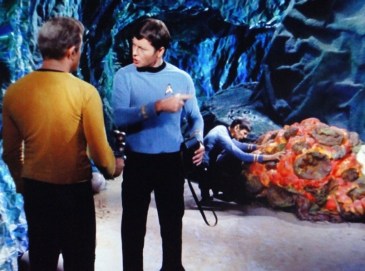
hortaIn Star Trek, after Doctor McCoy got over his initial revulsion (You expect me to treat that thing Jim?!?), he was able to patch up even the exotically alien silicon-based Horta with some simple spackle compound.

But apart from exceptions like the Horta, Star Trek and most every science fiction universe depicts very human-like aliens. This implicit assumption of similarity is made mostly so that alien creatures will be relatable and to make them playable by human actors with minimal make-up and costumes.

AlienBut we create human-like creatures even when there are no technical constraints. The astoundingly terrifying alien created by HR Giger is remarkably human-like with 2 arms, 2 legs, a head, a tail, a mouth, and so on. Despite having acid for blood, his alien follows the evolutionary design model of a human quite closely. It is likely not the case, as many imagine, that such alien depictions represent an unimaginative human conceit and lack of imagination. Rather, it is likely that such physics-defying aliens are actually much more fanciful than evolution is mechanically capable of producing – on any planet.

And let me be clear. Its unfathomably unlikely that any alien could remotely pass as human and walk amongst us undetected – that’s purely a movie fancy as unrealistic as aliens with acid for blood that can eat through feet of metal. However, they will be biologically similar in function if not form. They will not have any superpowers or godlike abilities that defy basic chemistry and physics because they can not. If they can fly they will need wings. And as any dolphin can tell you, there is a fundamental limit to how far they could advance without appendages that allow them to manipulate their environment.

Even many of us who are wise enough to understand that god cannot exist are still far too willing to remain agnostic in insisting that there might be aliens out there with what would effectively be godlike powers.

If my hypothesis of fundamental similarity is true, and I suggest that it must be more true than not, it should encourage us that we’re not actually missing out on as much as we might imagine because we are effectively bed-ridden here on Earth. Aliens would be marvelous to see, but evolution has offered us a pretty representative sampling of the range of life typically found in the universe.

Unless a message in a bottle lands on our Earthly beaches, we’re unlikely to ever know for sure how typical we are. Even then, that would give us only one more example of life. But we can make some pretty good assumptions about the nature of life in the universe without direct experience. And it is likely that the range of actual life in the universe is no where near as wide as our unconstrained imaginations.

So what do aliens look like? Probably a lot more like us than we might imagine.


How These Things Get Started

There are no end to the crazy stories that go around. My uncle was saved from a bear by Bigfoot and has the scars to prove it. This guy on TV was molested by aliens – his story was checked out by a team of scientists. My grandmother was kissed by her dead husband and she wouldn’t make that kind of thing up. The Virgin Mary appeared to a homeless guy in the Bronx who had no reason to lie. Forty-Seven cows mysteriously died in Iowa after a Haitian witch doctor got snubbed at a truck stop and cursed the town – couldn’t be coincidence. Everyone knows that old house is haunted by a woman who was murdered by her lover in the 40’s. That was the day my dead pet returned to save my life.

Given that there is absolutely no possibility that any of these stories are actually true, one has to wonder how they ever get started in the first place. We even have to wonder whether they might have some element of truth if only because there seems to be no conceivable way that such tales could ever get started if there wasn’t some truth to them.

But get started they do. While I cannot give you every particular origin story, I can relate to you one real example to illustrate how these things get started.

One summer during college I was rooming with my longtime buddy Steve. As I walked back to our place late one sweltering night in Wisconsin, I was feeling particularly bored and fanciful. The nighttime shadows helped work my imagination into a receptive frame of mind and when I walked past the window of a local craft shop I was struck by these hand-crafted dolls on display in the window. Now like many people I do admit to being generally spooked by dolls and as I looked at this one particularly creepy looking doll bathed in old-time street lamps, I got inspired to mischief.

I took off running (I had been a track and cross-country runner) but got myself plenty winded by the time I reached our building. I stumbled, intentionally falling and crashing up the stairway and pounded on our door with desperate urgency. Steve opened the door to the sight of me in very convincing panic-stricken terror. I rushed into the room and I made him drag my terrifying story from me. I told him that I had been walking past this store and noticed this doll and suddenly I felt an eerie presence, like some evil spirit, and without warning this doll leapt at the window and clawed at me. I panicked and ran all the way back to the room, the entire time feeling like some malevolent demon was chasing me.

Steve’s reaction was all I could have hoped for. Though frightened he valiantly insisted that we go back that very night to face this demon. I reluctantly agreed to show him where the store was but refused to get closer than the end of the block. I watched down the street as Steve heroically inched forward, craning his neck tentatively to glimpse this demon-doll. Suddenly he jerked, bolted, almost got hit by a passing car as he stumbled into the street, ran all the way back to and past me, shouting breathlessly “I saw it dude! It was the most hideous thing I’ve ever seen!!”

RamonaAudleyYup, in retrospect I should have owned up to my prank right then and there. But Steve was so pumped up I decided to tell him in the morning. By the next morning I had forgotten all about it, and anyway Steve had already left to go somewhere before I woke up. I was reminded of my folly when Steve returned and proudly related how he had gone to the craft shop, paranormal investigator like, to sleuth out the origins of this demon doll. The owner told him that by the greatest of coincidences, the doll-maker, a lady by the name of Ramona Audley (pictured right) happened to be paying a visit at that very same moment. Steve politely confronted Ramona and asked her whether she knew that she was crafting possessed dolls. Ramona apparently nearly went into a terrified state of shock and I was later to learn that the dolls were removed from the store window that very day (Ramona, I did you wrong and I’m so sorry).

It gets worse. When Steve told me what he had done I was mortified. That poor Ramona Audley! I never intended to frighten her or the shop owner! But how could I tell Steve the truth of my prank now that he had done this? I settled for hoping that this whole debacle would just blow over.

Needless to say it did not just blow over. It took on a life of its own like Godzilla emerging from the ocean to wrack havoc. For the next several decades, whenever Steve introduced me at any kind of gathering, he insisted that I tell the doll story. Of course I would refuse, feigning intentionally ambiguous reluctance. But Steve would invariably take over and tell the story on my behalf, prefacing it with a lengthy introduction about how he would never believe this story from anyone else in the entire world except from me. My credibility and sanity and integrity are (were) apparently just that irreproachable.

If you dear reader could have admitted to making up this story prior to this you are a better person than me.  And to make matters even worse, Steve is a naturally gregarious guy who became a minor celebrity with a sizable fan following. Who knows how many people he has told this story to who have in turn related it to many other people, who all swear that they were assured that this story came from an impeachable source. Every year that went by while I hoped that the story would be finally forgotten, every time I failed to disavow it, the myth became that much more indestructible.

My dolls truly had become demons. A few years ago I agreed to be interviewed for a video documentary about my friend Steve. To my horror and chagrin Steve had prompted the documentarian to ask me about the “Doll Story,” which he did, on camera. The story had finally advanced to a line I could not cross and I admitted to my prank on camera rather than perpetuate it any further.

Even after that public admission, I still live in perpetual dread of seeing this bogus story reenacted on the History or Science channel. Lots of people are probably more willing to believe that I lied about it not happening rather than believe that I simply made it up as a silly impulsive prank. After all, what kind of inconceivably horrible person would make up such a story? Umm, yes, that would be me.

And that, my friends, is how these things get started.

There is Always a Trick

We are all tempted at times to be open-minded about  supernatural claims. Indeed, it can seem narrow-minded to dismiss the seemingly inexplicable stories related by sensible, credible people we trust. Sometimes we ourselves experience things that seem to defy any rational scientific explanation. These experiences seem to prove that there must indeed be more to the universe than reason can explain. It can be hard to push back on the logic that if one cannot offer proof of a scientific explanation then one must accept a supernatural one.

Whenever you are tempted to entertain belief in something supernatural or paranormal, just remember one invariably true thing as a given: there is always a trick.

DougHenningI’m reminded of a formative event back in the 1970’s when I went to a performance by the late magician Doug Henning. Between making live tigers disappear, he would walk out to the edge of the stage and do slight-of-hand magic. In one such interlude, he held up a newspaper and showed it to us, turning each page so we would remember the layout. He then proceeded to methodically tear it into smaller and smaller pieces. As he did so he kept a great dialog going:

You think you see it tearing, you think you hear the sound of paper ripping apart, you think you see me holding two separate pieces. All your senses are convinced that I’m tearing up this paper, but I am not.

He continued to rip the paper into shreds and stack up the pieces, in full view, into a little folded-up pile. Then he began to unfold it and show us the full newspaper perfectly in-tact once more. As he paged through the “reassembled” newspaper, he continued his narration:

There is no magic, this is a simple trick. Obviously I could not actually have torn up the paper. But the trick is the magic and the magic is the trick.

Doug Henning was brilliantly messing with the audiences minds there, but what I learned from him is that there is always a trick. No matter how inexplicable something might seem, you only need to know the trick. But moreover, you can be still amazed by the trick and, even knowing it is only a trick, it can still amaze and astound you every bit as much as true magic. In fact, knowing there is no magic, nothing supernatural, no god, does not need to make the world one bit less exciting and inspiring. Quite the opposite. You can feel even more amazed knowing that the real explanation must actually be so clever, so masterfully executed, that one imagines that only some supernatural story could possibly explain it. The trick is SO amazing that it is easier for us to consider some magical explanation rather then the real mundane one.

Years later I watched one of those shows on television that exposes magical tricks. In this episode, they showed the magician and his gorgeous assistants make a mini-sub disappear right on stage. It was astoundingly, compellingly real. Surely there could be no conceivable way that such a feat could be accomplished without true supernatural intervention.

But after the commercial break they simply showed the exact same performance shot from a rear angle. It suddenly seemed stupidly crude and simple, so pathetically obvious that one could not imagine anyone actually trying to fool anyone with it, let alone anyone actually being fooled by it.

It was incredibly disappointing to see that trick exposed. It was ruined forever. I vowed never again to watch any explanation of magic. I want to be amazed. I want to experience that awe and wonder over and over. But I know there is always a trick. All it takes is to move the camera ever so slightly and it becomes ridiculously obvious.

But  the “good” magic that magicians or fantasy novelists or artists offer us does not extend similar benign merit and value to the “bad” magic of hucksters, con-artists, priests, rabbis, imams, televangelists, psychics, and other charlatans. These promoters of the supernatural do not simply entertain and inspire. They tangibly damage our capacity to reason and lead us to unreasonably dangerous or exploitive attitudes and behaviors. And, before you ask, the answer is no. There is no equivalence between our choice to suspend our disbelief in an entertaining magic trick or ghost movie and our choice to suspend disbelief about the idea that a psychic can predict the future or that some god influences the present. We simply choose not to ruin the illusion by pulling back the curtain to expose the trick. We do not believe or tell others that stage magic is true and we certainly do not base life decisions upon a conviction that you really can saw a woman in half.

And it is often the smartest of us who are most susceptible and gullible with regard to magical thinking, and most likely to influence others. I recall when at the height of the “crop circle” craze, one network interviewed a “scientist” who had investigated the circles. He proclaimed that he had studied the markings extensively and could see no earthly method by which they could have been produced. Therefore, he concluded in stentorian tones, they could only have been created by an extraterrestrial (supernatural) force.

Of course the actual method that those guys who later came forward used was as silly as making the mini-sub disappear. But the arrogance and ego of that scientist led him to conclude that if HE could not see the trick, the only explanation must be a supernatural one. Even Sir Isaac Newton, one of humanity’s most brilliant thinkers, was compromised by similar hubris when he assumed that if HE, Sir Isaac Newton, could not explain the stability of planetary orbits, it can only mean that God must intervene.

So remember, there is always a trick, and let that certain knowledge make you more confidently skeptical regarding religious and supernatural claims, confident enough even to simply reject them out-of-hand. But yet be no less awed and inspired by the perfectly explainable but nevertheless amazing magic in the world.

For elaboration of this and further discussions about facts and belief, I refer you to my book “Belief in Science and the Science of Belief” (found here).


The Last Gasp of God

One book that I frequently recommend is “The Merchants of Doubt” (see here). It was even made into a documentary film. The authors document the decades-long campaign of misinformation orchestrated largely by a small group of “reputable” scientists with the goal of discrediting any legitimate arguments against DDT and other hazardous pollutants, ozone-destroying CFC propellants and refrigerants, acid rain caused by coal burning, tobacco and its links to lung cancer, and most recently man-made climate change.

These scientists employed well-refined tactics to delay any meaningful reform in these areas. Essentially, their strategy was to create doubt about these dangers. As long as they could manufacture even the thinnest illusion of doubt, they could delay any efforts to restrict those industries. They succeeded for a long time – and still succeed with climate change – but only with the complicity of mainstream media organizations that publish their made-up arguments over and over again because they create bankable controversy and bolster the impression that their media coverage is fair-mined and impartial.

The New York Times has consistently been, unwittingly or not, one of the most influential misinformation machines for these merchants of doubt. And they are still helping them out. The other day they published an opinion called “God Is a Question, Not an Answer” (see here). In it, author William Irwin, a Professor of Philosophy at King’s College, puts forth ridiculous arguments in an attempt to discredit atheism. Or, more specifically, to create doubts about the fundamental intellectual validity of atheism.

Irwin claims that any reasonable, intellectually honest atheist must admit some possibility that god might actually exist. This is the exact same manipulation that pro-tobacco advocates put forth for years – surely any scientist with integrity must admit that he has some doubt that tobacco causes lung cancer. Similarly, Irwin attempts to shame us at least into a position of agnosticism that legitimizes religious belief. He says:

“Any honest atheist must admit that he has his doubts, that occasionally he thinks he might be wrong, that there could be a God after all …”

“People who claim certainty about God worry me, both those who believe and those who don’t believe. They do not really listen to the other side of conversations, and they are too ready to impose their views on others. It is impossible to be certain about God.”

These are false and totally ridiculous assertions. The only people that actually worry me are those that express any doubt whatsoever. As to the first claim, it is simply as silly as if one said:

“Any honest atheist must admit that he has his doubts, that occasionally he thinks he might be wrong, that there could be an Easter Bunny after all …”

This is a totally fair substitution since God has not one iota more factual credibility than the Easter Bunny. And again – just as with DDT, and tobacco, and CFC’s – the New York Times is complicit in helping to propagate and maintain this illusion of legitimate doubt by publishing this article.

I don’t condemn the New York Times for printing a viewpoint that doesn’t agree with me; I don’t condemn them for publishing a wide range of ideas; and it isn’t my goal to muzzle free-speech; but it is fair to criticize the New York Times for publishing harmful factual nonsense – just as they did in all those other areas so well documented in the Merchants of Doubt. And facts aside, this particular article is not even theoretically sound as an intellectual debate or legitimately valid discussion.

Make no mistake, belief in god is harmful factual nonsense. And this campaign to create intellectual doubt has been working. Even the vast majority of my atheist friends have been at least partially influenced by this argument and shamed by articles like this one, published by respected organizations like the New York Times, into a false position of agnostic intellectual “honesty.” But in my opinion, the only intellectually honest and courageous position is that there simply can be, is no god.

I would have come away dispirited and disappointed by this article, but happily the New York Times readers are far more intelligent and less gullible than New York Times contributors and reviewers. When I scanned the more than 750 comments, I found that essentially all of them see right through this nonsense for exactly what it is. The vast majority were clear-eyed and astute in calling bullshit on this transparent manipulation.

DyingCandleThat makes me VERY encouraged. When merchants of doubt like William Irwin have to resort to manufacturing doubt, it is an admission that they know they cannot win on the merits of their position. It is their last gasp to cling to religion and delay the widespread outright rejection of god. That the dying candle of religion should finally burn out is inevitable because facts inevitably win in the end. Tobacco does cause cancer whether you admit it or not. Man-made climate change threatens our planet whether you choose to believe it or not. And there is no god to come and save us no matter how much you would like there to be. It’s all up to us and only us.

The public is obviously figuring that out. Too bad it is taking so long for the New York Times, once again, to stand for facts rather than propagating manufactured illusions of doubt on factual matters. I thank all the New York Times readers who posted their comments to this article and thereby reminding me that just because some professor of philosophy publishes some nonsense, even if it is published in the New York Times, many, many of us are simply not buying the doubt they’re selling any longer.

Let’s hope that desperate articles like this one are nothing more than the last gasps of a dying god.