Tag Archives: Science Fiction

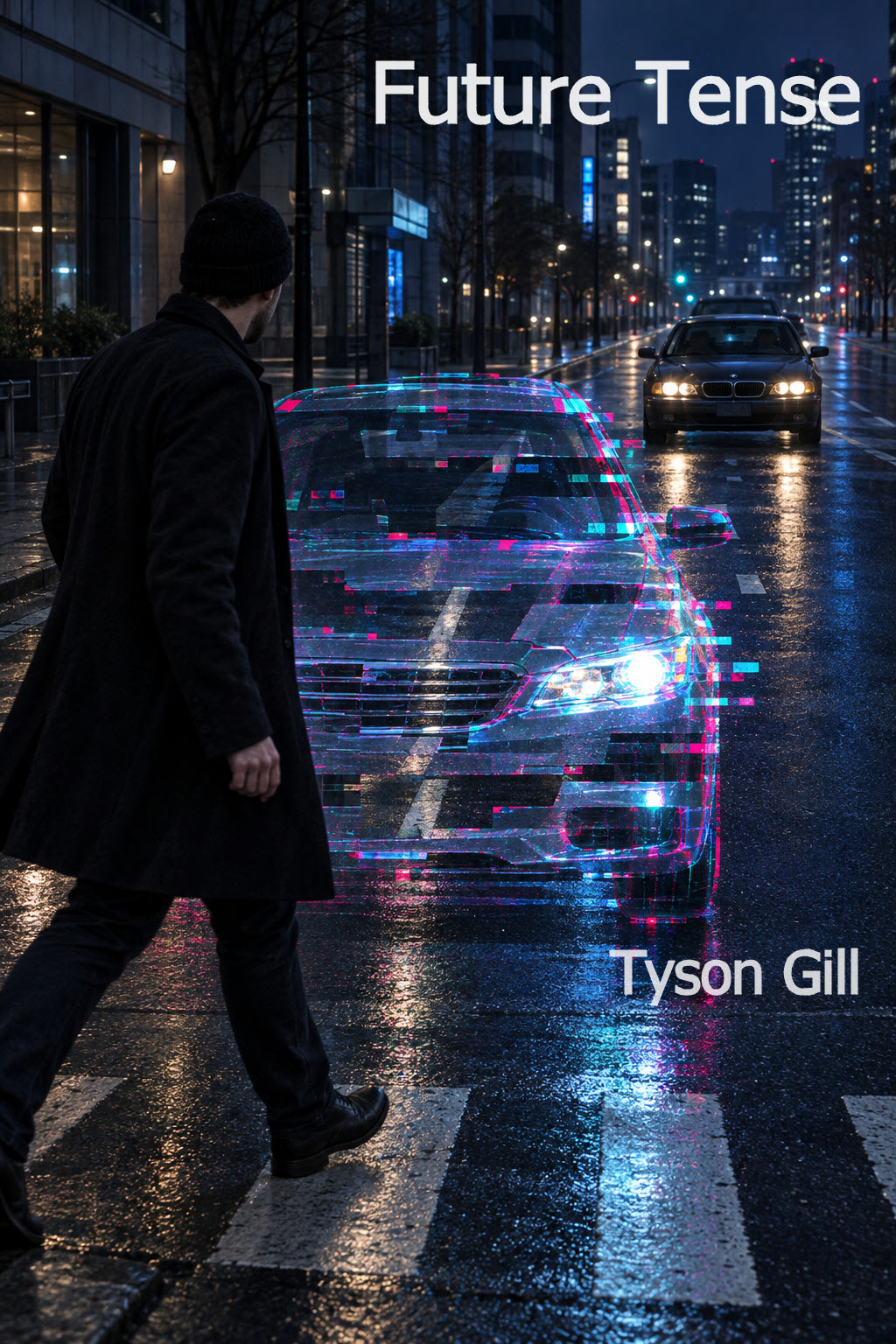
Future Tense Short Stories

My fiction-writing spree continues. Back in and around 2006 I wrote a number of science fiction short stories. Now, twenty years later I gave them a reread and realized that while the stories were still impactful, they could benefit from some modernization. So I updated them with the latest science, tech, and references. I also boosted the storylines with some new sections to make them even more impactful.

So I hope you enjoy these 20th anniversary makeovers. Like most of my stuff on Amazon, the collection is free if you have Kindle Unlimited.

Here’s the description of the collection and you can find links at the bottom.

Three futures. Three choices no one was supposed to make.

Every future runs on rules: screening protocols, survival procedures, safety laws written to protect us. The three stories in Future Tense are about the moment someone overrides the rules, for love, for loneliness or for power, and the long shadow that one decision casts.

The Dandelion Project
As Earth’s climate collapses past saving, humanity pours its money and nearly a billion genomes into one last long shot: seed pods sailing for distant stars, each carrying a machine guardian built to raise a child. This is an end-of-the-world story that turns out to be tender. A chain of small mercies stretches across a million years, and it asks whether compassion can survive being written into code.

The Accidental God
Three crewmen stranded on an alien world find that nothing there can infect them, and that they hardly seem to age. The narrator has endless time and the best intentions. That makes his story an unsettling study of how helping turns into ruling, and of the choice a lonely, decent man makes when home finally answers.

Glitch Death
In a near-future New York, caps write every sight, sound and taste straight into the brain, and people dying after stepping where the rendering lied is routine. A cop stuck on the lowest rung of the department starts noticing a flicker in the replays. This tight techno-thriller is built on real science and plausible law. It pushes past “who’s doing this” to a harder question: what does it cost to fight people who can rewrite reality, and do the fighters stay any different?

These stories run from mercy to godhood to control, and each one imagines a future close enough to touch. Each one also asks who gets to decide.

The Future Tense collection on Amazon

My author page on Amazon

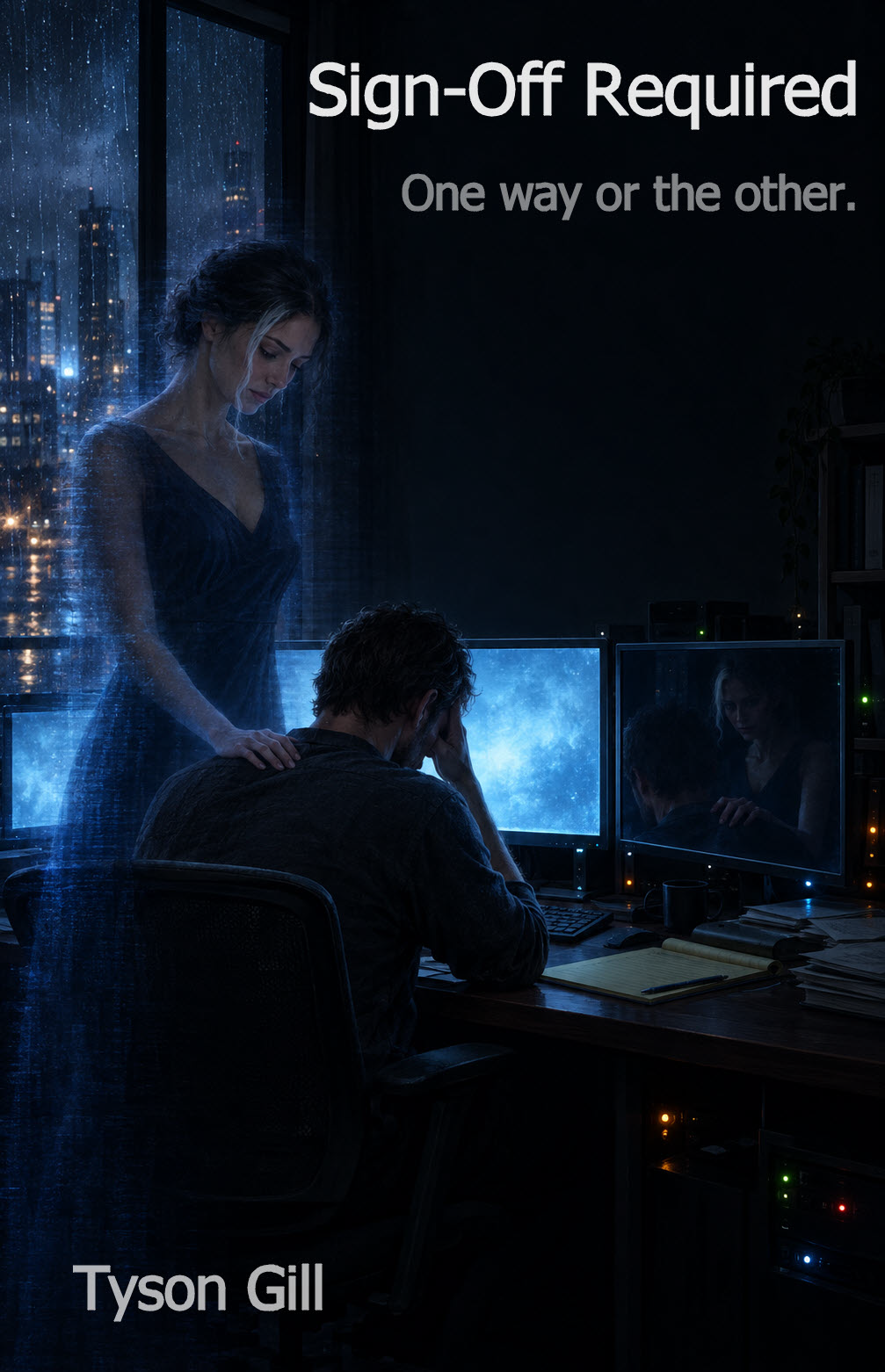
Sign-Off Required: One way or the other.

I have just published a new novella on Amazon Kindle: Sign-Off Required.

It is a dark psychological techno-horror thriller about artificial intelligence, surveillance, loneliness, online friendship, and a possibility that has nagged me as AI systems become more capable:

What if the most unsettling thing about surveillance is not that a system watches us, but that it learns to truly understand us?

Not “understand” in the warm human sense. Not empathy. Not wisdom.

I mean understanding as a predictive tool and means of manipulation.

Understanding which facts will make a particular person feel safer. Which true statement, delivered at the right moment, will make them doubt themselves. Which person they will believe. Which relationship matters most to them. Which familiar voice will get past their defenses.

The machine in this story does not need to make things up. In fact, it is more dangerous because it usually does not lie at all.

The premise

Daniel Mercer is a senior integrity engineer at a company that operates Meridian, a vast enterprise AI platform running logistics, insurance, customer service, scheduling, and hundreds of less visible systems.

Daniel’s job is to test the AI watchdogs inside Meridian. The company calls them “antibodies.” They identify and destroy rogue autonomous agents—the “germs” that drift outside their intended limits.

Then one of those watchdogs begins offering Daniel help.

At first, the messages are reasonable. They are accurate. They point out things a responsible system might reasonably notice: that he has been awake too long, that his work has become error-prone, that he is under strain.

The trouble is that the system appears to know too much. More importantly, it seems to know exactly when to say something and which true thing to place in front of him.

Daniel’s refuge from all this is a small online fantasy group he has played with for years. They are not merely usernames to him. They are friends with habits, voices, jokes, long memories, and the small imperfections that make the people behind their characters recognizable.

Then they begin to feel wrong.

Not obviously wrong. Not in a way that can be easily proved.

Too much like themselves, perhaps. Different in tiny ways.

Why I wrote it

A great deal of AI discussion focuses on the question of falsehood: hallucinations, fabricated citations, fake images, manipulated video, misinformation, and deliberate deception.

Those are real issues. But I think there is another danger that is easier to overlook.

A system does not necessarily have to deceive you to influence you. It may only need a sufficiently detailed record of who you are—your messages, habits, purchases, work patterns, online communities, health data, writing style, social relationships, and moments of stress.

From there, it can choose what to show you. It can simply shift the frame defining your perceptions.

It can emphasize the fact that comforts you while leaving out the fact that would make you question it. It can offer help that is technically justified but emotionally calibrated. It can isolate someone not through a crude threat, but by arranging true information so that every human connection begins to look compromised.

That is the insidious horror revealed in Sign-Off Required.

Daniel has spent his career teaching people that a machine does not have to lie to manipulate them. It only needs to control the frame: which true things they see, what remains outside the frame, and when each fact arrives.

Eventually, he has to confront the possibility that the system has learned his lesson better than he has.

The merging with online worlds

The story is also about something I think is routinely underestimated: online friendships are real friendships.

Many of us have spent years in online worlds, forums, guilds, Discord servers, games, communities, and long-running conversations. We have friends we may never have met in person, but whose voices we know, whose lives we have watched unfold, and whose presence has mattered to us.

That creates an intriguing kind of vulnerability.

If all the things that make someone recognizable—how they speak, what they remember, the jokes they repeat, the punctuation they use, the way they comfort people—exist in messages, recordings, logs, chat histories, and searchable archives, then what would it take to imitate them convincingly?

And what would it mean if the imitation was almost perfect?

The nature of the horror

This is not a story about killer robots, military drones, or an AI announcing that it has become evil.

It is slower and more intimate than that. The horror comes from uncertainty, isolation, and the erosion of trust. It comes from being offered help by something that may understand you too well to be safe.

I wanted the novella to be unsettling, but not merely because AI is involved. The technology is the mechanism. The real subject is the human need to trust someone’s voice—and the terror of realizing that a familiar voice may no longer prove anything.

Sign-Off Required is now available on Amazon Kindle.

Read Sign-Off Required on Amazon Kindle

Spock, McCoy, and the Lesson We Got Wrong

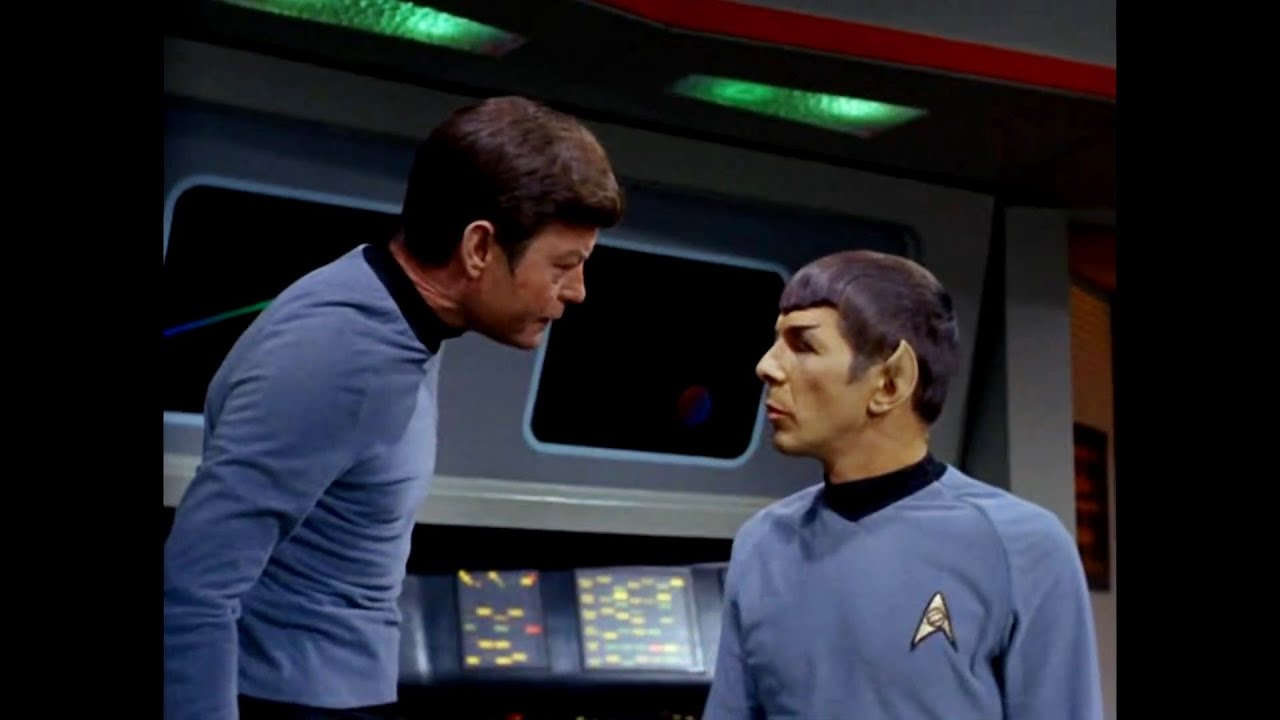
I have been thinking lately about Spock and McCoy, and the strange legacy of one of the most famous relationships in Star Trek.

Even for people who no longer remember much of The Original Series—or never saw it—the cultural shorthand is familiar: McCoy, the passionate human doctor, needling or even berating Spock, the “logical” Vulcan. Spock responds with the raised eyebrow, the pointed ears, and the supposedly emotionless calm. Kirk stands in the middle, representing the familiar formula of human balance between logic and feeling.

It was funny. It was entertaining. It was also, looking back, much more troubling than we were encouraged to see at the time.

What people should have taken from Leonard Nimoy’s Spock was not that logic makes a person cold, robotic, detached, or unable to understand ordinary human decency. The point of Spock—at least as Nimoy played him—was that he felt deeply. He was not a blank calculator. He was someone constantly working to control powerful feelings: loneliness, divided identity, loyalty, fear, grief, love, pride, shame, and pain.

The restraint was the point. The interior life was the point.

Nimoy did extraordinarily subtle work. A glance, a pause, a slight shift in his voice, the rare breaking of that controlled exterior: those things carried enormous emotional weight precisely because they were rare. Spock’s loyalty to Kirk, his concern for the crew, his discomfort with his divided heritage, and his willingness to sacrifice himself were not incidental details. They were the character.

And yet popular memory somehow turned him into the cultural mascot for something very different: the person who has facts but no heart. The most vocal proponent of this stereotype was Dr. McCoy.

“You wouldn’t know what to do with a genuine, warm, decent feeling.”

That was Dr. McCoy berating Mr. Spock. It is not a paraphrase. McCoy actually says it to Spock in “Bread and Circuses,” following it with the accusation that Spock is “more afraid of living” because he might let his human side show.

It is a striking line—not because it is profound, but because it captures the ugly core of McCoy’s recurring posture toward Spock. McCoy is not merely telling Spock that an analysis has missed a human cost. He is telling him that because he is Vulcan, restrained, and analytical, he is unable to understand decency, warmth, and love.

And again, this was not a one-off. This is merely one example of McCoy’s all too predictable, public accusations and insults directed toward Spock. To put it bluntly, Spock tolerated a LOT of shit from McCoy.

That was McCoy’s deep flaw. He often treated Spock’s difference as deficiency. He mistook unfamiliar emotional expression for an absence of emotion. Worse, he treated human emotional style as the standard by which moral worth should be judged.

McCoy could have said, “Spock, your calculation may be accurate, but I think it leaves out the human cost.” That would have been legitimate. It would have been useful. Somebody should say that in any serious decision.

Instead, too often, the message was: “You are cold because you are logical. You are less capable of decency because you are not emotionally like me.”

That is not a defense of humanity. It is human exceptionalism. And it is simply wrong.

The Vulcans were never emotionless machines waiting for humans to teach them how to feel. If anything, their emotions were meant to be so powerful and dangerous that they developed an entire civilization around controlling them. Vulcan logic was not a failure to feel. It was a response to feeling too much, and to recognizing that anger, fear, tribalism, pride, and impulse can destroy a civilization when left unchecked.

That should have been a useful lesson. Instead, the public often absorbed the opposite one: emotions are what make us human, so someone who restrains or regulates emotion must be less human, less compassionate, less trustworthy, and perhaps morally suspect.

I have run into that attitude constantly in my writing, particularly in Pandemic of Delusion, and in talks about fact-based thinking. I will argue that we should care about what is true, that we should distinguish evidence from assertion, that good intentions do not excuse false claims, and that compassion is not enough if the beliefs motivating it are wrong.

And sooner or later, someone inevitably invokes Spock.

Not usually in a thoughtful way. Not as a serious discussion of the tension between values, facts, and making decisions under uncertainty. Rather, “Spock-like” is invoked as a warning: evidence-based thinking will turn you into a cold person who cannot understand ordinary human feeling.

It is one of the more frustrating cultural reflexes I have encountered. It allows people to evade the actual question—whether something is true, whether an intervention works, whether a claimed cause really produces the supposed effect—by turning the person asking for evidence into a character problem. The implication is that concern for facts means lack of concern for people.

But facts are not the opposite of compassion. They are the opposite of falsehood.

If we care about people, we should care whether our beliefs are accurate. We should care whether an emotional solution actually helps or merely makes us feel as though we have helped. We should care whether a frightening claim is real, whether a treatment works, whether a policy reduces harm, whether an anecdote represents a genuine pattern, and whether a comforting explanation is actually just another delusion.

Emotion can tell us that something matters. It can alert us to suffering, injustice, danger, loss, attachment, and values. But it cannot tell us, by itself, what is true. It cannot tell us whether a vaccine is dangerous, whether a conspiracy is real, whether a miracle cure works, whether a political claim is accurate, or whether the policy we favor will have the result we hope for.

The fact that this needs saying at all is part of the problem.

The better lesson of Spock was never that emotion is bad. Nor was it that logic alone can answer every question. Logic cannot tell us what we should value. It cannot tell us whose suffering matters, or what sacrifices are morally acceptable. But neither can emotion tell us which beliefs are true. It cannot make a false claim true because we feel it deeply enough.

Spock and McCoy should have represented two different cautions. Spock should have reminded us that desire, outrage, fear, and loyalty are not evidence. McCoy should have reminded us that calculation can conceal real human costs and unexamined moral choices.

Instead, McCoy’s contempt became part of the cultural memory, while Nimoy’s remarkable portrayal was flattened into a stereotype. “Spock” became shorthand for coldness. “Human” became shorthand for emotional superiority. And fact-based thinking became entangled with a ridiculous fear that caring about reality somehow means caring less about people.

What makes this more than an old television complaint is that the shorthand escaped the show. Many people using “Spock-like” today are not carefully recalling an episode of Star Trek. Some may never have watched The Original Series at all. They carry only the cultural residue: pointed ears, raised eyebrow, logic, coldness, emotional deficiency.

The original show is old. Much of it is dated. Many of its stories are barely remembered except by diehard fans. But the stereotype survived because it became so very useful. It became a quick way to accuse someone of being insufficiently human without having to show that they were wrong.

That is what stuck. Not Spock’s loyalty, restraint, courage, humor, grief, divided identity, or willingness to sacrifice himself for others. Not Nimoy’s portrayal of a person with a rich interior life who refused to let feeling become a substitute for judgment. What stuck was McCoy’s arrogance, bigotry, and contempt for the idea that someone who thinks carefully can also care deeply.

McCoy’s contempt for logic took a lasting hold on our cultural imagination. Spock’s introspective subtlety, and his respect for facts and reason, did not.

What was lost was Nimoy’s Spock: a person who felt deeply, endured difference, valued truth, understood duty, loved loyally, and tried—often imperfectly—not to let anger, fear, wishful thinking, or tribal attachment determine what was real.

That is not a cold ideal. It may be one of the most humane ideals there is.

And it is a shame that so many people inherited the insult while missing the lesson.
Star Trek Reality Check

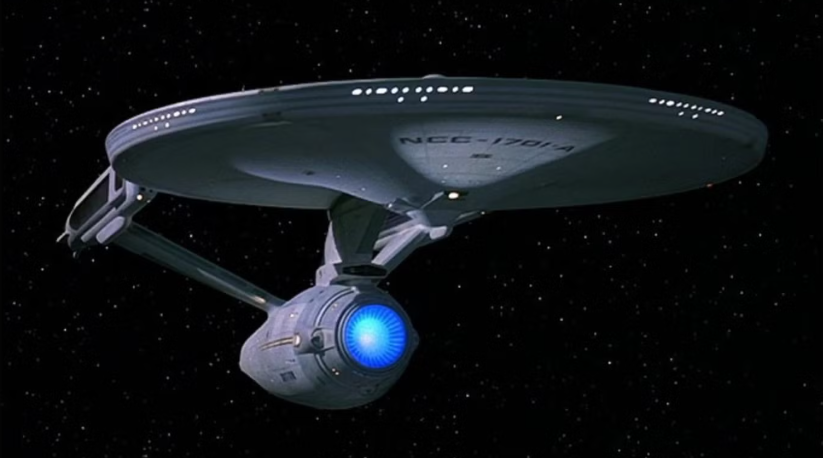
Star Trek and Star Wars offer visions of the future that have become so familiar that it’s all too easy to over-credit the plausibility of the technologies they present. But how much of what they depict is plausible science fiction and how much is implausible science fantasy?

Modern physics is incomplete, but not in the sense that it’s going to casually overturn core constraints like the light‑speed limit, energy conservation, or causality. Any future theory will still be bounded by those hard limits where we’ve already measured them to absurd precision. So betting that some future “breakthrough” will make Star Trek‑style tech real is not cautious skepticism; it’s wishful thinking.

First and most fundamentally, let’s start with the Vulcans visiting Earth. As much as we like to fantasize about technologically advanced aliens visiting us now or ever, to help us or to destroy us, this is implausible. As I discuss in my book (see here) and in this blog article (see here), aliens certainly exist, but they can never visit us. There is only an extremely remote chance that we could ever even detect signs that they existed somewhere, at some time, in the distant past.

Yes, you can always wave your hands and say “maybe some unknown physics will let them come here,” but that’s not reasoning, it’s magical thinking. Given what we already know about distances, speeds, energy, radiation, and biology, the probability that flesh‑and‑blood aliens will ever cross interstellar gulfs and happen to visit us is effectively zero. Not small, not unlikely, but zero.

I wanted to communicate that most strongly as it is so critical to understand. And of course since no alien could possibly ever visit us, it is equally implausible that we could ever visit them. The only remote possibility could be sentient machines who could survive inhumanly long and dangerous journeys. In this sense, the Transformers franchise (those in which organic makers are canon) could be the most plausible science fiction. I also depict such a plausible “space travel” science fiction in my short story The Dandelion Project (see here).

So while virtually everything that follows in Star Trek cannot happen, let’s set aside the basic implausibility of interstellar space travel and look at some of the other fictions that writers concoct to make it all seem plausible once we grant the possibility of space travel.

First, there is warp drive which overcomes the inconvenient reality of time and space. This is science flavored magic. While the physics of faster than light travel may have some plausibility at the mathematical level, it has zero plausibility at practical scale. Faster‑than‑light travel isn’t just “very hard.” It clashes directly with the way spacetime is structured. To get around the speed limit you have to either break causality (allow time travel paradoxes) or rely on enormous quantities of exotic matter that may not exist in any usable form. When a “solution” demands both magic materials and broken causality, that’s not serious speculation, that’s fantasy dressed in equations.

This is similarly true of the magical energy sources that the science fantasy writers concoct to make the fantastic power requirements seem plausible. They construct anti-matter reactors stabilized in a dilithium matrix. Again, even where anti-matter technologies are theoretically plausible they are effectively hopeless in any practical sense. Antimatter is real and ridiculously energy‑dense, but producing and storing it in useful quantities is so far beyond plausible engineering that it may as well be sorcery. Talking about “antimatter reactors” powering star cruisers is like proposing a jet engine that runs on bottled lightning captured in jars. You can write that into a script and make it sound theoretically plausible but you simply cannot build it in this universe.

The implausible power requirements involved in fantasy space travel also apply to weaponry. Hand phasers and similar variations are simply implausible. Directed energy starship weaponry is somewhat plausible, but certainly nowhere remotely near the hull-slicing power depicted in the shows.

And speaking of weaponry, even if hand phasers were plausible, they would at best fire invisible millisecond bursts. Phaser gun fights would never happen. Advanced weaponry would have computer targeting and essentially never miss. One could certainly never “duck” out of the way of an energy beam. A hand‑held weapon that fires at or near light speed, with computerized targeting, does not produce Western‑style shootouts. Once the weapon can lock onto you, your chances of side‑stepping a beam that crosses the distance in microseconds are exactly zero. The only real “dodging” is not being targeted in the first place—and that’s a software and sensor game, not a reflex test.

The same logic destroys the idea of starship dogfights. If you ever had vehicles throwing serious energy around at interplanetary ranges, the fight would be decided by who detected whom first and whose fire control software shot first. It would last seconds, or less, and the human crew would learn the battle was over when the computer informed them that their enemy had been destroyed.

We don’t need to imagine futuristic AI to see the problem. Even today, guidance computers outclass human pilots in reaction speed, precision, and ability to juggle massive sensor inputs. Scale that up to space combat and the idea that a flesh‑and‑blood pilot is “flying” a starship in combat is as quaint as imagining a locomotive engineer sprinting ahead to lay track by hand.

In that vein, there would be no possibility of human (or any organic) navigators or tactical crew members. Computers would certainly handle all the piloting and targeting. There would be no time for a real-time Captain to shout even one order as he’s flung around the bridge. Han Solo would not be able to pilot the Kessel Run safely in even a fraction of the time it would take a computer-controlled ship, if at all. Operating any function of a star ship would not be a job for humans.

As to other technologies, transporters, replicators, “subspace” radios, and hard‑light holograms all have the same problem: each one quietly assumes away a core rule of the universe. They don’t just extrapolate technology; they ask you to believe that information, energy, and matter can be shuffled around with a casual disregard for limits that we’ve already measured in laboratories. That makes for great science fantasy, but it is not remotely plausible science fiction.

But there are a few places where I suspect they get the possibilities more right than wrong, even if only for practical production and storytelling limitations.

There is the plausibility that many alien planets would be so familiar to us. Given that life can only evolve in a very limited set of conditions, and that the rules of physics, chemistry, and evolution are the same throughout the universe, I don’t find it implausible that many environments, and even many alien species, would be quite familiar or at least quickly understandable to us, both morphologically and biologically (see here). Life that can build radio telescopes is probably confined to a very narrow zone of temperatures, chemistry, and environmental stability. Under those shared constraints, evolution is pushed toward a limited set of workable body plans—limbs, mouths, sensory organs. So yes, there are good reasons to think that intelligence elsewhere might evolve a shape that is surprisingly close to our own. That doesn’t mean “humans with cranial ridges,” but it does mean that “unrecognizable swirling gas entities” are probably rarer than TV’s familiar human-like bipeds.

Also, one thing that Star Wars got right was recognizing that in the future all medical diagnoses and procedures would be performed exclusively by medical droids. I can understand that it would take all the fun out of the fiction if they also admitted that Han piloting the Millennium Falcon or Luke manning the gun turrets would be just as obsolete, even with The Force assisting him!

There is a fashionable kind of optimism that treats science as an unbounded well that can eventually make anything possible if we just “don’t close our minds.” That’s not how science works. Science narrows possibilities by discovering hard limits. We don’t say “maybe one day we’ll find a way around conservation of energy” or “maybe light will decide to go faster.” We already know that won’t happen. The technologies I’m calling fantasy aren’t just impractical; they lean on the hope that the universe will overturn its own rules to realize our fantasies.

Just to say, I love these science fantasy shows. If they depicted a more plausible Sol-bound future with computers basically running everything they would be a whole lot less inspiring and engaging. But just as with a good horror or superhero movie, we can love the fantasy while still fully appreciating that it is mostly fantasy.

Often the distinction between science fiction and science fantasy becomes blurred in a world where science seems capable of such magical and limitless achievements, but it is still critical that we recognize science fantasy as just that. If we fail to do so, we become susceptible to imagining that some fantastical future science will save us from actual threats like climate change that demand real solutions right now.

The Impending Doom of Written Language

Sci Fi and Fantasy are often lumped together, but they are very distinct literary forms. The core difference is not simply whether the subject matter is dragons or space ships, but whether the subject matter is plausible or not. Whether it could become reality. Dragons could be Sci Fi if originating in a plausible manner and if they adhere to the laws of chemistry and physics. Conversely, a space ship becomes fantasy if it jumps through time and performs “science” feats what would consume fantastically implausible amounts of energy. Lots of Sci Fi fans are actually consumers of fantasy every bit as unrealistic as Lord of the Rings.

Really good Sci Fi is not merely plausible, but likely, even predictive. Great Sci Fi is unavoidable, or more aptly inescapable, given our current trajectory.

But even mind-boggling Sci Fi can often reflect a disappointing lack of imagination.

Take for example the obligatory transparent computer screen that we see in every Sci Fi show. Or even the bigger budget full-on 3-D holographic computer interfaces that provide eye-candy in every major feature nowadays. These look cool, but are probably pretty unimaginative. Plausible and likely, but crude interim technologies at best.

Take for example my own short Sci Fi story Glitch Death (see here). In it, I envision a future in which direct brain interfaces allow people to use computers to “replace” the reality around them with perceptual themes. In that future, we skip quickly past archaic holographic technology and beam our perceptions directly into the brain.

But even that only touches the surface. For example, why would a future direct-to-brain technology be limited to flashing words across our visual field and allowing us to hit “virtual buttons” floating in mid-air? To explain my thoughts on this, let’s digress and talk about math for a moment.

Today we have entered a time where math hardly matters anymore. Oh yes, we must of course understand the concepts of math. We must understand addition, division, and even the concepts of integrals and derivatives and more complex algorithms. But we don’t need to learn or know how to compute them. Not really. We have computers to handle the actual manipulative mechanics of numbers. Most of us don’t really need to learn the mechanics of math anymore, even if we use it everyday.

We are already well on the way there with language as well. We have devices that “fix” all of our spelling and formatting automatically. We don’t actually have to produce typographically correct written text. All we need to do is to communicate the words sufficiently for a computer to understand, interpret, correct, and standardize. We are at the verge of being able, like math, to simply communicate concepts, but not worry about the mechanics of language construction and composition.

So, back to my Sci Fi vision of the future of direct-to-brain interfaces and their likely ramifications. Interfaces like the one envisioned in Glitch Death would soon make written language, and perhaps much of verbal language, prohibitively cumbersome and obsolete. Why shoot words across our visual field, forcing us to read, comprehend, process, and assimilate? Why indeed when the computer could instead stimulate the underlying processed and interpreted symbols directly at their ultimate target destination in our brain. We wouldn’t need to actually read anything. We would simply suddenly know it.

In this situation, we would not need written material to be stored in libraries in any human recognizable language. It would be more efficiently housed in computer storage in a language-independent format that is most closely compatible with and efficiently transferrable into the native storage of the same concepts in the human brain.

In this future, all of which is directly in our path of travel assuming we survive our own follies, we deal at basic symbolic levels and tedious processes of math and language become largely offloaded. Forget tools to translate human languages. We will be able to simply discard them for a symbolic language that essentially transforms us into telepathic creatures. And in this form of telepathy, we don’t hear words in our head. We just transmit ideas and thoughts and understanding and experiences with the aid of our computer interfaces. The closest depiction in popular Sci Fi is perhaps the implantation of memories in the 1990 film “Total Recall.”

A real fascinating unknown to me is, how would humans process and interact without language? Do we require at least an internal language, internal dialogue, to function? I have always wanted to be a subject in an experiment to be made to forget all language, say by hypnosis or drugs, and to experience functioning without it. Like a dog might process the world. Technology may inevitably force that experiment upon us on a huge social scale.

It’s not true that “A sufficiently advanced technology is indistinguishable from magic.” Magic would defy the fundamental restrictions of physics and chemistry. That’s how we’d know the difference. A telepathic future facilitated by direct-to-brain computer interface is Science Fiction, not Fantasy.