An Alternate View of Automation

People are rightfully concerned about robotics and automation costing us jobs. A report issued by the World Economic Forum early this year (see here) projected that 5.1 million jobs will be lost by 2020 across the 15 leading economies. This loss is attributed to “labor market changes” which includes robotics and automation. But for sake of this discussion, let’s blame robots for all 5.1 million lost jobs.

Tim Worstall, unsurprisingly a contributor to Forbes Magazine, puts this number into a less gloomy light (see here). He points out that while this 5.1 million figure sounds huge, it is out of a total labor pool of about 1.68 billion workers. This translates to a projected unemployment increase of only 0.3%, well below the noise level in these projections. Coincidentally, I wrote a recent article about how statistics are often reported in a very misleading fashion (see here).

RobotOf course job loss is not the only concern or even the major concern. The number of people forced to retrain and change jobs is not included in these projections. Certainly jobs always evolve, but periods of rapid and widespread job disruption are nevertheless painful and difficult. Even those who can transition through the major upheaval being caused by automation and globalization may find themselves forced into jobs they no longer love. More importantly those new jobs may pay far less than the old ones. This loss of standard of living must be mitigated through responsible corporate and governmental policies.

But I contend that human nature will win out in the end over automation. Automation ostensibly promises greater efficiency but this is simply counter to human nature. I’ve written in the past about the tendency of really smart people to come up with astoundingly convoluted solutions to simple problems (see here). Given that tendency, smart people will naturally direct automation toward enabling more complicated systems rather than merely replacing humans in existing ones.

Our tendency toward complication is synergistic with another characteristic of human nature – empire building. In my book on business management (see here), I talk at length about how inefficiency is ironically desirable in the workplace. Contrary to typical intuition, deadwood workers are assets while high-performers are obstacles to the inherent goal of managers to expand their head counts and their budgets. Therefore, automation will be unavoidably applied in such a way as to increase human headcounts by increasing complexity rather than decreasing headcounts through greater efficiency.

Here’s just one example. Ten years ago I designed and developed a customer management system for my employer for negligible cost. Ongoing support costs were also negligible. But this simple, robust, and powerful system would never be replicated today. Now there are new “automation” frameworks available designed to make this easier. But, despite all the promised efficiencies of moving to an automation platform, no jobs were lost in this transition. Quite the opposite, implementing this new system required literally hundreds of people and tens of millions of dollars, not to mention a huge explosion in personnel required to support it moving forward. The benefits are very debatable, but the costs are not.

In this as in many cases, the automation that one might fear would cut jobs proves to dramatically increase the number of jobs needed to support far more complex and fragile systems. Automation, when implemented in accordance with our human nature and self-interest, is likely to create many, many new jobs overall. While this won’t help with the disruption problem, loosing net jobs overall is not likely to be a problem.

Human nature, and the benefits that inefficiency and complexity offer for empire-building, effectively protects us from a future where automation takes over all our jobs.


Make Nice or Make War

When it comes to advocating for social change, some people prefer to Make Nice while others prefer to Make War. The Make Nice people tend to look for common ground upon which compromise can be found to achieve incremental changes. The Make War people are willing to take a confrontational stance in order to achieve more profound change more quickly.

Although these two camps of advocates are on the same side of their mutual issues, they incessantly squabble over tactics. They undermine each others efforts, effectively becoming adversaries when they should be allies. Their infighting sometimes causes more harm to their shared cause than their actual adversaries do.

The Make Nice folks accuse their Make War allies of being radical and unrealistic. They argue that a confrontational approach undermines their more serious and responsible efforts to reach compromise and achieve incremental change.

The Make War folks lament that their Make Nice allies are too timid and conciliatory. They argue that settling for minor concessions that do not achieve a minimal threshold does more damage than holding out for real meaningful change.

Much of this infighting is really over bargaining tactics. Both camps would love to get as much as they can. But the Make Nice folks insist that you catch more flies with honey and that you should ask for a fair and reasonable price and trust the other side to be reasonable. They fear that if they ask for too much the other party will just walk away and you’ll end up with nothing.

The Make War folks start with the assumption that the other side does not wish to be reasonable and will only give up what they are forced to give up. They feel that rather than asking nicely for $10 and getting only $2, a good haggler demands $100 and reluctantly settles for $20. They fear that if your demands are too modest you’ll end up settling for far too little.

We see these dynamics play out in almost every arena. We watched this conflict rage during the racial struggles of the 60’s. We see it today in the Presidential race with the Make War Bernie camp pushing for “aspirational” change while the Make Nice Hillary camp advocates for “incremental” change. We see this in the fight for gun control with Make War crowd fighting for sweeping gun restrictions while the Make Nice camp advocates for  “sensible” regulations. We see this in the secular movement with Make Nice secularists calling for “respect and cooperation” with religious groups while Make War atheists condemn religion more strongly.

In any particular situation, one or the other approach may be a better strategy but its hard to know which even in hindsight. What is certain in my mind at least is that the best results are achieved when these two camps work together rather than at cross-purposes.

In almost every movement, the Make Nice camps tend to dismiss and discredit their own Make War camps. This is unfortunate because it would be much smarter to use the Make War folks as bad cops in their persuasive effort in order to achieve far greater incremental change than would be possible without the pressure of their more radical fringe. Rather than delegitimize their Make War militants, the Make Nice camp should support them and use them. Yes, they should argue, that used car is really worth $10,000 but if you work with me I’ll convince my stubborn branch manager to let it go for $1,500.

GoodCopBadCopMake Nice incremental advocates, don’t discredit your Make War brethren and thereby waste the leverage they afford you. Appreciate that they are an asset not a liability and use them to your advantage. Radicals, appreciate that your role is bad cop and pursue it with relish but also appreciate that it ultimately takes Make Nice folks to close the deal. When a better compromise is achieved then either camp could have negotiated alone, realize that it was only possible because both camps were strong and worked with each other rather than against each other.


Studies Show That…

One of the most compelling arguments in support of religion is the totally pragmatic one. What does it matter if religion is false, if god is totally made up, if faith is only a placebo effect, or even if it’s all ultimately just a scam to separate you from your hard-earned money? In the end isn’t all that matters that it makes you happier and more successful?

Reporters and opinion writers propagate this pragmatic justification of religion every day. It is actually difficult to get through any newspaper issue without encountering yet another article or op-ed touting the benefits of religion and faith. Here is an example of the typical kind of happiness claims put out there most every day in popular media:

Research suggests that children who attend church perform better in school, divorce less as adults and commit fewer crimes. Regular church attendees even exhibit less racial prejudice than their nonreligious peers. (see here).

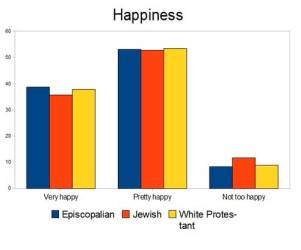
happinessThese articles invariably cite scientific studies and statistics to support their claims. But those claims frequently go far beyond study design or the conclusions made by the scientists involved.

There are many ways that studies are misused by advocates to advance their causes or market their products. So we must all be very savvy when we see broad, sweeping conclusions being supported by narrow scientific studies, particularly by social science studies.

To help you to recognize these manipulations, following are some of the typical falsehoods and distortions used by advocates to misrepresent science or to promote bad science.

Failing to Mention the Negatives
Studies show that chocolate supplies 11 grams of fiber! Wow, maybe we should all eat chocolate to get our fiber! But to get that 11 grams of fiber from chocolate you have to consume a whopping 600 calories. Likewise, studies tout selected admirable ethical qualities of religious people, but fail to mention other studies that show, for example, that religious people are far more likely to support torture, guns, violence, and drone attacks.

Failing to Mention Better Alternatives
Another way advocates misuse studies is by failing to mention far better alternatives. For example, the chocolate industry fails to mention that practically any fruit, vegetable, or grain is a far healthier source of fiber. That may not be their responsibility, but if they are implying that you should eat chocolate in order to get your fiber, they are lying. Likewise, advocates often tout the morality of religious people, implying that religion is the only way to achieve these values. But you don’t need to consume 600 calories to get your fiber and you do not need religion along with all its negative characteristics to be a good person.

Failing to Quantify the Benefits
Advocates will often claim a benefit without quantifying it, thereby giving a false impression of how important it is. For example, religion advocates may cite studies showing that fewer religious people go to prison, without mentioning that this difference is inconsequentially tiny.

Misrepresenting Statistics
Advocates often misrepresent statistics. If they are trying to magnify a small difference they report it as a percentage or ratio. If they are trying to exaggerate a tiny difference in a huge population, they cite the numerical difference.  For example, religion advocates might claim that “secular people are twice as likely to commit suicide as religious ones.” Sounds fantastic right? But this could very well mean that out of a population of 10,000 people, 1 religious person committed suicide and 2 non-religious people committed suicide. Not quite as alarmingly persuasive when presented that way.

Using Bad Indicators
In epidemiology, an indicator is a specific test that can be used to measure a more general condition. But a bad indicator tells one little or nothing about the general trait being evaluated. For example, religious advocates typically conclude that believers are “happier” based upon highly questionable measurements such as divorce rate which have little to do with happiness. As we all know, married people can be far more miserable than divorced ones.

Failing to Prove Causation
Most clinical studies are observational, or association studies. That is, they simply show that two variables are both observed in or associated with a given population. This is valuable information. But proving that those two variables are directly related to each other is quite difficult. Proving causality between one and the other is even more difficult. Even if two things seem to be related, they may be indirectly associated through some third thing called a confounding factor. For example, a study may show that church-goers cheat less on their spouses. That is merely an association. But advocates use that observed association to claim that church attendance promotes ethical behavior even though the researchers themselves never made that claim. However, it may well be that church attendance and marital fidelity are not directly related at all, let alone that church attendance causes fidelity as advocates claim. The most we could say based on the research is that, for whatever reason, people who go to church are also more likely to be people who have fewer affairs. Maybe the reality is that unattractive people tend to go to church in a desperate and futile attempt to start an affair. Attractiveness may the just one confounding factor here. That we cannot determine or even imagine what the confounding factors may be is not proof of causality.

Failing to Consider Reporting Bias
Many of the narrow social studies used to make sweeping claims rely upon self-reporting. However, self-reporting is incredibly unreliable. People intentionally or unintentionally report all kinds of things in all kinds of ways for all kinds of reasons. For example, men are likely to brag about their infidelity while women are likely to conceal it. Self-reports are poor measures of the relative level of infidelity between the sexes. Likewise, religious people are deeply invested in the fiction that religion makes them happier and are very likely to report that they are even if they are totally miserable.

Failure to Mention Study Limitations
Years ago, upon reading commonly cited statistics that “98% of women report incidents of sexual abuse,” radio host Dr. Laura Schlessigner did what a good consumer of information should do. On-air, she called the scientist who conducted the study being referenced to support this claim. The researcher was eager to express her frustration with all of the advocacy groups citing her research without mentioning that her study narrowly targeted an extremely at-risk population. Dr. Laura then called the head of one of those women’s advocacy groups employing this scare-tactic and asked her why she knowingly misrepresented this research. When confronted, the head of the organization stood firm, saying that anything is justified if it raises awareness of real issues faced by women.

Choosing the Wrong Measurement
Even if we could measure happiness, it should not be assumed that happiness is the best or only goal. Believing that  global warming is a hoax probably does make one sleep sounder. Allowing your kids to eat pizza at every meal will probably result in fewer observed food-related tantrums. But clearly these measures of happiness do not justify accepting those positions. Likewise with religion.

Selective Skepticism
We tend to do pretty good at being skeptical about things we disagree with. But when it’s something we’re predispositioned to like and want, like chocolate or religion, we tend to set all skepticism aside and whole-heartedly embrace any arguments in favor, no matter how much of a stretch they may be. The happiness-arguments supporting religion are definitely one area in which our society demonstrates far too little critical scrutiny, as evidenced by the huge number of happiness claims repeated in major publications with virtually no skeptical analysis.

Baby With the Bath Water
Please, please, please don’t conclude from this that you can never trust social studies and that these studies never have any value at all. Association studies are very valuable. We need to know when things are observed together in a given population. However, you should be a smart consumer of these studies and understand the ways that advocates misuse study results to contrive claims that advance their cause. This is particularly important when we are predisposed to believe those claims. When in doubt, look past the claims made by advocates or even by seemingly objective “science reporters” and read the typically more careful and restrained conclusions reported by the scientists who conducted the studies. With the Internet at our fingertips today that is not usually very difficult to do.

Glitch Death

glitch

Copyright © 2008 by Tyson Gill

Mariah paused to caress the pristine oval-cut gem that served in the lowly capacity of door knob mounted upon the deeply grained mahogany backdrop of her grand entryway. Unconsciously ignoring the incongruity of the rough, tarnished surface beneath her flawlessly manicured fingers, she glanced back around to take in her magnificent accommodations.

Imperiously she scanned the fine Persian carpet, the impeccable Victorian furnishings, and the classic period artworks featuring “A Reading from Homer” framed upon the far wall. Light took liberties with the laws of physics to flatter each perfect surface with reflections and shadows that accentuated each detail exquisitely. Her silken hair bedded a sparkling tiara upon her head like velvet in a showcase at Tiffany’s.

Glowing with satisfaction that all was exactly as she wished it to be, she rotated the gem of her portal and stepped outside. There was a momentary flicker as the hallway came into focus. While the common passage was clearly inferior to her own opulent quarters, it was clean and elegant. A woman of her taste and bearing would demand no less. There was no indication that anyone else lived in the building apart from the oak-stained doors leading into the less stately quarters of the commoners.

Mariah hurried past the inconsequential doorways, eager to arrive at the department store during the few hours during which they were open for visits. Though there was no real need to walk to the store to shop, her addiction could only be satisfied with a physical experience. Virtual shopping simply did not offer her the same rush of acquisition. Of course she would eventually return most of what she purchased, but that was half the fun of it.

Mariah turned ninety degrees and paused at the top of the stairs. The spacious steps unfolded before her like the opulent entrance to a palatial ballroom. She paused momentarily as courtiers and sycophants appeared at the base of the staircase, reveling in anticipation of her fleeting presence.

Satisfied with the reception, she continued her regal descent. Keeping her eyes fixed majestically on the reception line forming below, she lit her foot upon the first step, innocuously visible at the base of her peripheral vision. When her foot reached it, the edge dug oddly into her arch, barely in front of the heel. It took her a second to realize that she had overstepped the edge, but her sedentary reactions were not quick enough to compensate. Her momentum carried her forward and she toppled over, landing head-first six steps below. She continued to tumble, crashing into the stairs with fragile, porous bones shattering with each impact. When she finally came to rest at the base of the steps, she lay there until a neighbor found her twisted, lifeless body, tangled up in her threadbare cotton frock.


Though it could only be described as tacky and even unabashedly sleazy, Rick was quite proud of his apartment. The walls sported garish colors and tasteless artwork, mostly animated feeds from porn sites. One woman, her long blonde hair cascading down around the black leather collar of her skin-like tights, lounged against a pillow as she regarded him with never-fading lust. Another woman, lithe and catlike, curled naked next to him, purring in satisfaction like a faithful pet.

The cat-girl slipped gracefully aside as Rick suddenly got up from the couch with a grunt of bored irritation. He pulled on a washed out black long-coat that nevertheless made him feel like Neo and topped it off with a tired old knit cap.

“Where you going baby?” it was the blonde offering a seductive invitation to stay. The other turned away with cat-like aloofness to doze.

Rick ignored her tedious interest and left the apartment, walking quickly out of the nondescript building. As he hurried along the city streets, he passed through a Vegas-parody of neon signs and cruising convertibles. The men, all street-gang tough, showed open deference to his presence. The women he passed were all hookers right off a low budget movie set, eying him with the promise of waving any usual fees.

He turned into one particularly ostentatious club, nodding tersely to the indifferent bouncer at the door. As he stepped inside, he paused to let his vision become accustomed to the lighting. Suddenly, relentless jungle-dance beats blasted him like a brisk wind. The crowds within took shape, all clad in sequins and vinyl interpretations of skimpy native clothing. Dancing girls lined the walls like animated statuary and writhed within the confines of bamboo cages hanging from the ceiling.

As he drank, dozens of women approached Rick with offers that covered the full range from conventional to perverse. He didn’t bother to check which of these were real. It didn’t matter. It was all the same. Eventually, staggering slightly at the bar, he downed the remainder of his drink. He didn’t want to check his account, but he estimated it was probably close to tapped-out until he could scam up some more credits.

Back out on the street, lights and sounds drifted by along the fringes of Rick’s consciousness. He paused at the curb across from his building and glanced automatically to the left. A car approached, safely off in the distance. The right was clear, so he stepped into the crossing. Immediately the car smashed into him from the left and his body crumpled over the hood like a rag. As the driver slammed into the brakes, Rick’s body arced off into the night air.

The last things Rick observed in his miserable life were the mundane faces of fascinated onlookers gaping at him as he sailed numbly through the air. He never registered the impact against the inconveniently placed brick wall across the intersection.


For a while he’d been temped to abandon his run early, but a second wind blew in from places unknown, reinvigorating him. As he picked up his pace, Kam noted how unattractive Central Park looked in winter, stark and dead. It was tempting to drop in a nice spring theme to clothe the naked trees, to wake up the sleeping grass, and to brighten the hazy gloom, but he couldn’t allow himself such luxuries. His job was disorienting enough without introducing unnecessary layers of confusion.

But the temptation reminded him that he was on the clock, so he turned the brim of his baseball cap forward and a menu transitioned smoothly into his field of vision. With a tiny flick of a finger, he selected Next and a video frame superimposed upon the wintry park. Kam watched through Mariah McKenzie’s eyes as she walked down the seedy tenement hallway. The image suddenly went wild as she tumbled head over heels down rotting steps before the replay halted suddenly, freezing the accident in mid-tumble.

Over the last few years Kam had reviewed thousands of such death scenes, released by statute to the authorities for postmortem analysis. His assignment to “death watch” duty was the sewer-cleaner rung of the police caste system. It was his job to scan deaths flagged by the system, looking for any evidence of foul play to pass along to the “real” detectives. When he handed them a homicide collar, they got accolades while he got demeaned or at best overlooked for his effort. The job was not only thankless but it was psychologically taxing as they come.

Even as the cracks and ruts of the running path demanded Kam’s attention, something about that last replay nagged at him. He knew he shouldn’t spend more time on it. His queue was loaded and this was just another obvious glitch death. It was apparent that the woman’s theme had caused her to misjudge the depth of the step and she simply overstepped it. It happened all the time. When the size or position of a theme overlay didn’t match exactly, such small surface mapping errors were often fatal.

Case closed. The most he could do was to post another glitch death for the stats, but it would do no good. The courts had ruled long ago that the virtual reality vendors could not be prosecuted for glitch deaths.

But yet the incoherent nagging just wouldn’t relent. Kam stopped, letting his pulse fall back to normal as he flicked his finger to click the virtual replay button. Looking around the room, opening the door, walking into the hall… there… what was that? He leaned forward, resting his hands on his knees, and flicked Rewind and Slow in quick succession. As she opened the door, there was a barely discernible flash of static. It was probably nothing. Visual overlays actually produced lots of such artifacts. High bandwidth feeds, especially with complex themes, could cause severe anomalies in the visual or audio streams. But this particular one was familiar. It reminded him exactly of the one he’d just noticed in that car accident.


Bernard Hoob sat on the bench in Battery Park, looking out over the river. In the distance, British Spitfires buzzed down from the clouds like angry wasps, guns blazing. The bullets seemed have little effect on the giant kraken reaching out of the water to wrap its massive tentacles around the Statue of Liberty.

Without warning, a chat window popped up over the scene. Bernard flicked a finger and the battle froze as clouds wandered past, unaware of the mighty virtual battle below. An avatar, kind of a dark vampire knight, appeared in the chat window.

“Dude, Amy uploaded the next episode. Are you ready to get started?”

“Ya, I’m in the park where I left off last time,” ready when you are.

“Ok, one sec Bern.”

Bernard flicked a finger and the Quit button highlighted momentarily. The Kraken, the Spitfires, and the wreckage disappeared leaving a raw view of the island – it held no interest for him. Seconds later, a confirmation popped up, the Statue of Liberty visible behind the semi-transparent display.

“Amy invites you to share a custom theme, do you wish to join?”

Bernard clicked on “Yes” and there was a brief flicker. Suddenly it was dark. The torch of Lady Liberty glowed in the distance, reflecting in the lazily rippling water.

A billowing figure stepped from the shadows to block Bernard’s view, his face barely visible behind a hooded cloak. He held a gun in a latex-gloved hand, directed squarely at Bernard’s heart.

“Did you think you could escape me?” he demanded dispassionately.


Kam stood on the wall, looking down at the cold river. The impassive surface the physical barrier between life and death. He wasn’t authorized to conduct field investigations, but the Hoob replay obsessed him. Although he couldn’t point to anything that would justify the assignment of an investigator, he was sure that the static flash just prior to his misstep into the river linked it to the other nagging glitch deaths he had catalogued over the years.

He had tried to work through the system. He took his suspicions to the Captain who had reluctantly directed the tech boys to analyze the telltale static flashes. But their analysis revealed nothing beyond a signature similarity. There were many vague technical explanations, but they could not definitively explain them. In the end, Kam could not press any harder and was already being mocked as a conspiracy quack. The Captain insisted he get a psych evaluation and enjoy a long vacation.

Ever since that experience he followed up unofficially when he could, keeping his investigations off the record.

“I still can’t see how it could have happened,” Amy lamented, shaking her head. “The role-playing overlay I designed inserted virtual characters, but it didn’t include any visual themes. I wanted the location to be raw. How could he have glitched over the edge?”

“That’s what I’d like to know,” said Kam. “I want to show you something. Do you think you would be able to look at his last moments? I’d like you to tell me if you see anything unusual.”

Amy, her sheer scarf fluttering amongst her windblown hair, bit her lower lip. “OK, if you think it might help,” she breathed.

Kam pushed a pointer over Amy and flicked a finger to bring up a context menu, clicking the Share item. Amy’s avatar appeared in the group area of his visual field when she accepted the invitation.

“This isn’t technically legal, so you’ve never seen what I’m going to show you, right?

Amy nodded solemnly.

Kam clicked a Play button floating in space and they both watched through Bern’s eyes as he was backed up to the river by a hooded figure with a gun. His eyes shifted from the gun, to his feet, slowly drifting with unnerving finality to the unforgiving river behind him.

“Too bad you didn’t play ball,” the hooded man said with matter-of-fact calm. “You would have been more use to us alive.”

As Bern shifted his gaze back toward the cloaked man, the watchers could see a small vial drop from his sleeve into his cupped hand. When the hooded figure was once again in the center of his visual field, Bern’s hand shot forward, tossing the vial into his chest. The ampoule shattered, releasing gas into the hooded face.

As the assassin gagged, Bern produced a small device and pressed a quick combination of buttons. A teleportation gate opened to his side.

“Perhaps another day,” Bern quipped as he stepped into the shimmering blue gate.

Suddenly, the video jerked and water splashed. It went dim, then quiet, and then quickly black as the replay ended.

Amy gasped, slumping down to sit on the cold cement walkway.

“That was so horrible,” she whispered in shock and disbelief.

“This is where he struck his head as he fell,” Kam told her softly. “He was unconscious before he hit the water. I don’t think he suffered.”

“Still,” Amy said, looking up tearfully, “how could that happen?”

“I was hoping you could tell me,” Kam prompted her gently.

“I had given him the compressed gas vial in episode four,” she said. “I was hoping he’d use it here. He was a good player.”

“But I don’t understand how the teleportation field could have appeared over the edge of the dock,” she continued. “That gob is configured as a land-based object. There should be no way the simulation engine could place it over water.”

“Could it be a bug in the system?” Kam asked her.

“I suppose it had to be,” Amy answered, “but it’s hard to imagine how such an obvious bug could be undiscovered in the 3.0 merge engine. It’s in use everywhere by everyone all the time.”

“Let me show you something else,” Kam persisted, rewinding and resuming the replay for her on extreme slow.

“There,” he said, pausing the video. “Do you see that static flash?”

“Weird,” she said, her technical interest peaked. “I’d swear that artifact wasn’t caused by my simulation.”


Kam was on his way home. He’d just finished investigating SGD number 37. That’s what he called them. It was his code for Suspicious Glitch Deaths. He had to do some fast talking to imply that he was conducting an official investigation without ever actually saying he was, but it hadn’t netted him much. He still could find no relation among the possible victims except for the same signature static flash shortly prior to their glitch deaths.

Unlike the vast majority of people, he didn’t normally use themes. His intimate association with glitch deaths kept him free of the technological addiction. As a cop, he heard daily about the scams and cons associated with the technology. Despite the risks, most people couldn’t live without themes to give reality the visual and auditory style that made them feel comfortable or excited or whatever.

He wasn’t a purist or anything, but he preferred keeping it raw. He didn’t like the thought of his visual and auditory perceptions being preprocessed by some computer array. He didn’t subscribe to the rampant conspiracy theories that the government was looking in on or even manipulating everything the population saw and heard, but he did have a visceral discomfort with the fuzzy line between raw and computer-enhanced realities.

The industry argued that perceptual filters enhanced safety and productivity by providing real-time enhancements and alerts. But safety subroutines didn’t save that guy that stepped out in front of a speeding car. He’d seen too many glitch deaths.

But despite his reservations, he had just used an auditory translation filter to interview the Spanish-speaking witnesses to the last SGD. The reality was that few people, other than the lunatic purists, could simply not get by without real-time perceptual filtering technology.

With a sigh, he glanced around at the bleak raw streets. One of the purist arguments against themes was the resulting neglect of architecture and aesthetics. In fact, most modern buildings had essentially dispensed with any effort to look attractive at all. Why bother when perceptual themes were used by most people to give their environment any look they desired?

One positive benefit to going raw was avoiding advertisements. Advertisers didn’t bother with real billboards any more. Instead, almost all advertising was accomplished by embedded adds in perceptual themes. Most people could not afford network service without accepting some level of embedded advertising, and many of the most popular themes were produced by corporations to promote their products.

But tonight, Kam found the raw city too depressing. With the resignation of a reformed alcoholic reaching for a bottle, he flicked his finger to the theme selection menu. He scrolled through a long list, each one smoothly flowing on top of the environment around him. He rolled past Roman Holiday , The Jetsons, Life in Bedrock, XXX-perience, The Wild, Wild West, and Dark Shadows to stop at Star Trek. Although not a old-school Trekkie, he liked the Star Trek theme. It was the only overlay that reflected a positive role model for mankind. It was a unique vision of a future where humanity had matured into rational adulthood without loosing child-like passion and curiosity. It always made him feel a renewed sense of optimism that the Star Trek theme might someday become raw.

The futuristic architecture around him was clean and functional, but nevertheless open and inviting. The people passing on the opposite side of the street wore high-tech garments that were apparently impervious to dirt or wrinkles. A Bajoran and a blue-skinned Andorian were engaged in an animated discussion on the far corner, the Andorian’s antennae bent forward in interest.

Kam veered down a subway ramp, familiar despite its sleek 24th century theme, until he reached the platform. Two people, probably real, who now looked like Federation officers were the only others waiting in the station. Several minutes later, the loudspeaker politely announced the arrival of the next train. In the distance, there was a soft rumble heralding its approach. The train slid with frictionless grace to a halt and the doors opened with a signature Star Trek sound effect.

The two Federation officers made no move, so Kam stepped forward into the open door. As he advanced, a sudden panic caused him to recoil. He spun wildly to regain his balance as the front of a subway train rushed past just inches from his face. It was only then that it struck him. The flash. Some part of him had noticed an almost subliminal flash just before stepping forward. It had caused him to instinctively hesitate just in time.


The walkways eight stories below their balcony looked just like any other raw midtown street. People hurried with chaotic order in every direction, almost all of them wearing some kind of networked headwear.

Just then, perhaps a third of the people paused, looking up to point at a costumed superhero soaring through the air just above them.

“Protect yourself with Glitch Guard!” the flying figure urged them with a salute and a reassuring smile.

Amy turned to Kam and grinned.

“Looks like our new ad campaign is going to pay off big,” she assured him.

“I sure hope so,” Kam replied, trying to muster an optimistic smile.

“It just has too,” she assured him. “I know it’s been a rough three years getting Glitch Guard off the ground, and you’ve invested everything you have. But I still believe in it.”

“And in you,” she added.

He answered with an appreciative nod. The development was complete, and their ad campaign was officially underway. Now came the hard part.


Lord Graham Haggarty, one of the new breed of anointed American royalty, buttoned his designer housecoat and rose to answer the delicately tasteful ringer of his hotel room door, tipping his virtual receiver cap jauntily on his head.

After a quick glance at the overlay that seemed to give him x-ray vision, he swiped his hand across a virtual lock and the door retracted smoothly to reveal his visitors.

Kam reached out his hand across the threshold in greeting, “Lord Haggerty, so kind of you to see us.”

“Not at all, it’s my pleasure,” the dapper man replied to Kam but his eyes lingered upon Amy.

“Amy Hoob,” she said by way of acknowledgment, emphasizing the last name.

“Charmed,” he told her, taking her hand superfluously to usher them into his luxury suite.

After a few pleasantries the Lord offered his two guests a love seat.

“Can I get you a drink?” he asked. “I have a splendidly rare vintage of brandy that just demands attention.”

“Only if you will promise to join us,” Amy answered demurely. “I would not want to drink alone.”

“Perish the thought, my dear,” Haggarty reassured her as he poured three deep amber aliquots.

The host set the fine glasses on the table and took his place opposite, smoothing his slacks across his knee.

Kam set the small bag he carried with him onto the arm of the seat and hurried to raise his glass to his lips with the others.

“To a long life,” Kam said by way of toast.

“Health and wealth to you both,” the Lord answered as he enjoyed a sip. “Speaking of which, I am curious as to what kind of business proposition you have for me.”

Kam answered evenly, with business-like formality. “ Well, as you know, we manufacture and market Glitch Guard. It has been the number one anti-glitch software for the last 6 years.”

“Of course, of course,” Lord Haggerty assured them, a trace of impatience creeping into his cordial demeanor. “But I am just a simple bureaucrat. I am afraid I’m not looking for any investment opportunities.”

“We are doing quite well thanks,” said Kam. “We aren’t looking for any new capital. As a matter of fact, we’d like you to put us out of business.”

Lord Haggerty was suddenly more intrigued, “How do you imagine I could do that, even if I had any such desire?”

“Perhaps your desire will grow when we tell you that we know that you are responsible for at least 278 glitch deaths,” Amy answered evenly.

“That we are aware of, at least,” Kam added casually.

The Lord smiled as if tutoring a pair of slow students and took another sip of his brandy.

“And what evidence, may I ask, do you have to make such an outrageous accusation?”

“None that would stand up against your legal team,” Kam answered frankly. “But nevertheless we know that a secret government organization, conceived and directed by you, has been testing techniques to kill people through manufactured glitches for over a decade.”

Lord Haggarty took a final sip of his brandy and set down the empty glass with assured ease.

“Actually,” Lord Haggerty corrected the record with pride, “the success count is over a thousand. But that is for terminations only. That doesn’t begin to reflect the other forms of covert surveillance,  manipulation, and subterfuge that our technology enables. I am quite proud of our superb rate of success.”

“How could such a thing possibly make you proud?” Amy asked, horrified even having known in advance of his hideously untouchable crimes.

“I know it is hard for citizens to accept,” he told them comfortingly. “But you have to realize that we are only keeping this country, keeping you, your families, safe. This research gives us tools we can use to defeat our enemies, your enemies, and to anticipate how they might attack us.”

“Research,” Kam interrupted. “Is that what you call it? Was it just research when you tried to kill me?”

“And why do you think you are still alive? It is because your investigations, your software, helps our mission. Your anti-glitch innovations challenge us to find more subtle methods, to correct tells like that pesky flash you first identified.”

“You’re helping us in your own way,” he added with a smirk. “We value your contributions.”

“You’re a monster,” Amy hissed.

“Perhaps,” he agreed amiably. “But a necessary evil. I hope that it gives you some satisfaction to have this knowledge, but no one will pay attention to any conspiracy theories you spread around. Far too few will ever believe their government capable of such unthinkable activities. And spreading such rumors would only harm your own business – if any slanderous accusations should ever slip through our real-time stream scrubbers of course.”

Lord Haggerty grimaced and flexed his stiff fingers.

“Feeling a bit stiff?” Kam asked solicitously as he rose, retrieving his bag with one hand as he offered Amy the other.

The older man began to rise, but didn’t seem able to stand. He settled back into his chair and looked up curiously. He tried to speak, but his mouth didn’t seem to willing to respond.

“Don’t bother,” Kam told him. “Have you heard of the popular “Last Round” that hit the streets? The last drink for those who have nothing left to live for? You were seen asking about it on the streets tonight. Didn’t you notice the flash just after we came in? I’m afraid our technology is not as sophisticated as yours has become. That was when Amy poured a Last Round into your brandy.”

The soon-to-be-late Lord’s eyes shifted to his empty brandy glass with horror.

Amy answered his unspoken questions as Kam took handfuls from the bag he carried, sprinkling dust about the room.

“Fortunately, by the time the muscular paralysis has advanced to your autonomic systems, enough time will have passed so that our visit will be purged from your terminal buffer.” Amy told him. “There won’t be anything for Kam’s replacement to see except you sitting here breathing your last.”

Amy leaned in close to the face of the dying man, staring him dead in the eyes as Kam wiped the glasses with the empty bag.

“Dust from Grand Central,” she explained. “There must be a hundred thousand samples of DNA in it.”

She leaned closer, her lips brushing his ear as she whispered.

“Say hello to Bern for me.”


Agnosticism Just Won’t Die

I know I run the risk of beating a dead zombie with my blog, but I feel compelled to write yet one more article about the rotting abomination that just won’t die – agnosticism.

The reason I simply must respond yet again is because news articles and opinion pieces touting the intellectual purity of agnosticism just keep getting published everywhere you look. And these aren’t written only by religious proponents, but by scientific and academic intellectuals as well (here’s one). Like most of these agnostics, this author contends that agnosticism is misunderstood. Being agnostic is not merely being undecided or ambivalent or apathetic, but rather it’s a highly principled position that upholds sound scientific skepticism and empiricism.

The author gleefully notes, as do all agnostics as their go-to-proof-by-authority, that even Richard Dawkins admitted he is agnostic! This well-intentioned but misguided and tactically disastrous statement of philosophical agnosticism by Richard Dawkins, given who he is, has caused incredible harm to reason and rationality. Don’t follow his lead on this one.

Skepticism is indeed a hallmark of the scientific method. But skepticism is not synonymous with gullibility and science does not require you to abdicate logic and reason and common sense. Good scientists can and do reject an infinite number of ridiculous propositions out-of-hand every day. Healthy scientific skepticism does not require you to doubt everything. It merely requires that you withhold drawing conclusions regarding plausible assertions until sufficient evidence is obtained.

This is where the agnostics think they have an iron-clad argument. Since supposedly science cannot prove a negative (e.g. god does not exist), then despite the lack of positive evidence, any good scientist must be agnostic regarding anything and everything! Gotcha!!

First, scientific rigor does not require that scientists disprove every possible ridiculous statement. Imagine anything that is clearly untrue. Take for example, my claim that my banana is actually a sentient life-form named Ned from planet Zorcon that just happens to exactly resemble a banana right down to the molecular level. Ned is in a coma right now and cannot respond or do anything un-banana-like but he deserves the rights of personhood. Healthy scientific skepticism simply does not require scientists to admit that my assertion might be true. It certainly does not require that they perform studies to try to prove or disprove this claim. Scientists have no burden whatsoever of disproving my absurd claim about Ned the comatose alien banana. It is entirely my burden to prove it and until I do good scientists can and should simply reject it out of hand.

And keep in mind, these agnostics do not claim god is a plausible belief, they rather claim that regardless of how implausible it may be we must allow that it may be true nevertheless.

Next these agnostics will – cleverly they think – point out that science cannot prove a negative. This fallacy is typically summed up by quoting Martin Rees who famously pointed out that absence of evidence is not evidence of absence. What this correctly points out is that just because we see no evidence of something doesn’t necessarily mean it does not exist. In fact, this quotation would be far more accurate and less misused if stated as “absence of evidence is not always evidence of absence. When this phrase is quoted by agnostics they fail to recognize that a sufficiently conclusive lack of evidence absolutely can prove a negative.

Let’s contrive an example for fun.

I do not need to even look in my bedroom to assert with 100% certainty that there is no dragon in it. There is no such thing as dragons and no reason to even consider that possibility, so therefore I can dismiss this proposition out of hand. Further, as a good scientist it is my obligation to dismiss such claims with prejudice.

elephant-in-roomBut what if the claim is not a dragon but an elephant. Well, elephants do exist and while I cannot imagine how one would get into my house, I can easily prove or disprove this claim just by glancing around my bedroom. Having done so, I can legitimately conclude with 100% certainty that there is no elephant in my bedroom. If there were an elephant hiding under the bed or behind the curtains, I would reasonably expect to have seen at least some evidence of it. Therefore, I do not need to remain agnostic with regard to the sincere heart-felt beliefs of the elephant-in-every-bedroom cult to prove I am a good scientist. I have sufficient proof to conclude with certainty that my bedroom is elephant-free and that all claims of an elephant in my bedroom are delusional.

God is like that elephant. He is SO huge that if He existed we would certainly have seen evidence. There is none.

But let’s argue that god is more elusive and secretive – like bedbugs. Let’s say that the bedbug cult claims that I have bedbugs in my bedroom. Even though I don’t see any bedbugs just by glancing around, it is still possible they may exist and as a good scientist I take the advice of Martin Rees to heart and withhold conclusion pending further evidence, positive or negative. So, I bring in trained dogs and bedbug residue detectors. I carefully examine all the places where they would be found if they were there. If, after that, I find no evidence of bedbugs I can conclude beyond any reasonable doubt that my bedroom is bedbug free. I do not have to remain agnostic about whether dragons or elephants or even bedbugs are in my room to prove I am a good scientist. Such agnosticism would only prove that a fool exists my bedroom.

Similarly no legitimate evidence of god, however secretive he may be, has ever been found, despite the fact that believers make extravagant claims about his tremendous influence over our world. 

In fact, unhealthy agnostic skepticism is the exact opposite of good science. Science, unlike mysticism, relies upon the certainty that our cosmos is knowable; that it follows rules. Not just anything is possible. If it were, the cosmos would not be knowable at all and science would be meaningless. In science, things are true, observable and logical, or they simply do not exist and are untrue, period. To say that good scientists cannot know anything for certain is to turn science into mysticism.

To be frank, agnostics are not the champions of science and reason they imagine themselves to be. Ultimately their position renders science and reason invalid. If they insist that we cannot disprove things for which there is no proof, then they are necessarily saying we cannot positively assert anything at all. For anything you could assert as true, you could simply make up any story to cause all that evidence to be in doubt. Agnostics are required by their dogma to accept that.

You can have fun with agnostics. Make up some unprovable reason to claim something silly. Agnostics will be forced to admit you might be correct because they cannot disprove your un-disprovable fantasy. This exposes how bereft of any meaning their position really is. Truth and falsity, science and mysticism, evidence and belief all collapse upon themselves into a meaningless jumble of pseudo-intellectual nonsense if you accept the agnostic view of reality.

So agnostics have a huge problem. They think they are purists in being “open-minded” enough to admit that god might exist by making a philosophical claim that we cannot really disprove (or thereby even prove) anything whatsoever. But they don’t actually apply their intellectual purity to every possible ridiculous proposition. They only selectively apply it to this particular ridiculous god assertion. Though they might stubbornly claim to apply this thinking to everything universally, clearly they do not do so in practice. In the end either these are just smart people applying convoluted logic to rationalize a particular ridiculous proposition that they want to believe or they are misguided atheists who mistakenly believe that agnosticism demonstrates their sophisticated and superior intellectual standing.

What harm does agnosticism cause? It undermines logic and reason and moves us toward a pseudo-scientific kind of mystical thinking in which anything is possible. Moreover, if we accept the agnostic argument, if we give it any credibility whatsoever, then we accept that god might exist. And if we accept that god might exist, then we must accept Pascal’s Wager and concede that it makes some sense to assume he does. And if we assume he does, then it only makes sense that believers proselytize and fight to shape government and public policy in accordance with their delusional religious thinking.

Agnosticism is the brain-eating zombie of philosophical nonsense that just won’t die. Accepting agnostic arguments is to follow them down their rabbit hole into Wonderland where the ridiculous is accepted as the norm and crazy ideas are rationalized with insanely inescapable logic.


Followers and the Followed

schizephrenicLike all animals, we humans have evolved certain preprogrammed behaviors. Some of these we call instincts but they can also be thought of as just the tuning of our pattern-recognition systems. For example we have an instinct for detecting when we are being stalked and hunted. This is a pretty valuable instinct. It is essential that our pattern recognition systems are tuned to detect some agency following us. We are in fact tuned to err heavily on the side of false-positives. That is, better that you think a tiger is following you when it is not than that you miss a real tiger stalking you. False-positives are unlikely to do you any real harm but you will be unlikely to survive even one false-negative.

But like an overly-sensitive sense of smell or hearing, a pattern-recognition system that is tuned so as to detect a huge number of false positives becomes debilitating. We call this condition paranoid schizophrenia. People suffering from this delusion think they are being stalked all the time. Their pattern recognition system signals continual red-alerts, constantly detecting patterns of stalking, even when there is clearly no actual threat.

Naturally these people feel 100% confident that their instincts, their very perceptions, are real. Everyone around them tells them they are mistaken or even deluded. But it does not feel that way to them. They remain alone and isolated, questioning their own sanity or the sanity of everyone else. They are fairly numerous in the population, but not numerous enough to find many others who believe as they do.

Then the Internet appeared. Now for the first time these paranoid schizophrenics can find each other quite easily online. They can now communicate, discover that others believe as they do, support each other in their delusions, align the specifics of their delusions so that they appear to have an extraordinary degree of internal consistency, be reassured that they are not the crazy ones, socialize between each other and avoid formal or informal intervention, and become politically active to legitimize their delusions and to force public policy to accommodate them.

This is exactly what is happening. According to a New York Times story (see here) growing numbers of schizophrenics, or “targeted individuals” as they call themselves, believe they are constantly stalked by “operatives” disguised as ordinary people pretending that they are simply going about their own business. They decline mental health services and instead band together in insular groups who support each other’s delusions, raise money, host international conferences, and even take legal and legislative action in accordance with their beliefs.

Last year one such group persuaded the Richmond CA City Council to pass a ban against space-based mind-control weapons. These people form an “echo chamber” of paranoia, and are told that anyone outside their group, even family and mental health professionals, are likely in on the conspiracy. Members of these groups are not relegated lives of to destitution. Members of these groups span all aspects of social and professional life. Your lawyer or doctor or boss may be part of a growing cult of paranoid schizophrenics, hiding their delusions from you believing that you are also an operative of the conspiracy against them. They can’t let you know they know you are stalking them.

It sounds fantastic doesn’t it? It seems incredible that people with such a profound delusion could function in our modern world, let alone band together into a self-reinforcing and self-sustaining political action groups that can force our government to craft policies and laws in accordance with their delusions.

But I ask you this. How is this any different than organized religion in any substantive way whatsoever? I maintain that there is not a sliver, not a single iota, of difference.

Like paranoid schizophrenics, religious people hold delusional beliefs that arise from an overly-developed pattern recognition mechanism – the instinct to assign agency to patterns we see around us. That is, to assume that shadow in the woods could be a living thing that is watching us. When these people see agency where there is none, they band together to fabricate a mutually reinforced set of shared beliefs not at all unlike the formalized beliefs of paranoid schizophrenics. And like paranoid schizophrenics in the age of the Internet, religious people band together to force social and political policies to conform to their group delusion.

Both syndromes arise from an overly-tuned pattern recognition system for agency detection. Both are reinforced, amplified, and propagated by grouping behaviors. One sees both local agents (operatives) and a global presence (government) that are watching them and ready to punish or reward them. The other sees local agents (angels) and a global presence (god) that are watching them and ready to punish or reward them. Religious and paranoid delusions are fundamentally exactly the same syndrome with differences only in the details.

The main reason religious delusions seem so much more reasonable to many is that the religiously deluded have been grouping together for a far longer time and are far more organized and prevalent. Just give the paranoid schizophrenics some time to catch up and they will be building tax-exempt fortified citadels with satellite-killing laser defenses.

The sooner we see religious delusions exactly the same way that we see paranoid delusions, the sooner we can arrive at the sanest, the most effective public policies and educational methodologies to protect individuals and society from these contagious mental illnesses.

2017 State of the Union

trumpThe state of the union is … great! It’s the greatest in fact. It is the greatest state of any union ever. The main reason our union is so great is because I am honestly the greatest president ever, no contest, and everyone agrees on this. Am I right?

Our rebranding of America is going really, really well – it’s amazing. The golden Trump sign we installed on the White House is spectacular, so classy. I’ve gotten so many tweets about it you wouldn’t believe. The flashing can be seen all the way from the new Trump Tower. I mean who was this Washington guy anyway? What did he do that was so great? Wear wooden teeth? Give me a break! And we are still looking for an artist to replace the statue in that Lincoln Memorial with one that people care about. Everyone wants it to be me; what can I say? Once I’m sitting there all huge you’ll be so proud to be an American. Also, I’ve got even more exciting news. We’re working on a new flag with the stars forming a constellation in my image. It’ll be classy, trust me, it’ll be so classy you won’t believe it.

And when it comes to the economy, let me tell you, last year we’ve made absolutely the best deals ever. Our deal to sell Atlantic City to The Trump Organization is the greatest deal for this country. It’s a big deal, the biggest. The new Trump City is gonna be fabulous, you’ll be so proud. And let me tell you, once our corporate takeover of Las Vegas is complete, the new Trump City West will be incredible. It’s going to make us the envy of the world that I can tell you. Tourists will flock there by the millions, trust me, millions.

The transition of my cabinet and staff is complete, and all those old losers are out. What morons and scum bags, jeesh. Today I’m pleased to announce that David Duke will be my new FBI Director. He’s going to make sure that the Congress and Supreme Court get in line, believe me. And I’m also happy to announce David Koch as Director of the newly combined Departments of Energy and EPA. I was just gonna disband them but frankly David paid so much money for the job I’d be an idiot to say no, and I’m not an idiot. And here’s the best news. Lovely Melania has agreed to be our new Secretary of State. She asked me, what do they do? I said, don’t worry your pretty head, you just have to look fantastic and keep your mouth shut. She’s so good at that I can’t tell you, she’s the best.

I gotta be honest; there have been some problems, that can I tell you. But now with old lady Ginsburg and hysterical Sotomexicano put away in Guantanamo, my lawsuits should all disappear. OK folks? Look, women and Hispanics and old people all love me by the way. And now that Pelosi is back in her place and Palsy Ryan has slithered back to whatever hick town in Wisconsin he crawled out of – sorry but it’s the truth – everyone else is falling in line with my plan to privatize the Senate and Congress. Excuse me, it’s just a fact… private companies can govern so much better than the “government,” am I right? And don’t worry, I’ll hire only the very best people to run my government, believe me, THE best. I’m personally interviewing the guys who made a killing in Michigan. They know how to get things done let me tell you. After a crash course at Trump National University, they will be ready to take over and make America great again, totally great again.

America will be so great you won’t even recognize it!

Our Curious Public Mood Swings

PolicyMood

This is a fascinating and revealing chart illustrating our curious public mood swings. It was produced by Larry Bartels (see here) using data compiled by James Stimson (see here). It measures the “policy mood” of the country since 1950. The higher the score, the more conservative was public opinion at that particular point in time.

Stinson derived this policy mood index from responses to a wide range of public policy surveys. Since it does not rely upon self-identification as liberal or conservative, it is arguably a more nuanced and accurate measure of where public attitudes fall on the liberal-conservative spectrum.

The most obvious thing to note here are the dramatic swings. Clearly public attitudes about major issues are not as fixed as we might imagine. Over the past 65 years public opinion has swung up and down by almost 20 points. Clearly public sentiment can be swayed significantly.

The most interesting thing about these swings is revealed when you refer to the Administration timeline that Bartels added to the x-axis. If you study this a bit you’ll undoubtedly start to scratch your head in confusion. Under each Democrat administration the country became more conservative, and under each Conservative administration the country became more liberal. This is entirely counter-intuitive and immensely important.

The nation became dramatically more liberal during the Eisenhower years. Ike was moderately conservative overall but staunchly conservative on economic issues. It became slightly more conservative during the moderately liberal Kennedy/Johnson era but shifted far toward the conservative extreme during the very liberal Carter years. Similarly, during the extremely conservative Reagan era, public sentiment shot back down again toward the liberal end of the spectrum. Under Clinton, the public then became more conservative and after a year or two of George Bush became more liberal again. Finally, under the very liberal President Obama, we have become dramatically more conservative.

The next observation may or may not be significant, but the swing has been between 30 and 50 on this scale of conservatism. I can’t imagine what kind of views it would require to earn a 100% rating on this scale, but for what it’s worth public opinion has remained solidly on the liberal side of the spectrum. This seems to defy the popular meme that America is a “near Right” country. It suggests we are actually (still) a “near Left” country.

But that may not last if trends continue. Although this chart bounces up and down, there is still a clear upward best fit line. This supports the long-term trend toward conversativism reported independently by other sources. Essentially each President since Eisenhower has rated as more conservative. More specifically, each Republican President has been more conservative than the previous Republican President and each Democrat President has been more conservative than the previous Democrat President. This reinforces the observation that despite these swings, the Conservatives succeed year after year in moving the “center” ever farther toward the Right.

So what conclusions can we draw from these data? First, it isn’t true that we are intractably divided and cannot change. Clearly a very significant fraction of us can be moved a substantial amount in one direction or the other. Next, we are perhaps overall more liberal than the Right would like to have us believe. However, we are trending ever more conservative and that is never likely to reverse as long as liberals keep voting for the “lesser of two evils” who is still ever more conservative than his or her predecessor.

Finally, as Bartels pointed out in his article, Presidents do not actually succeed in shifting public opinion their direction. The data rather show that the public tends to recoil reliably away from the President in their attitudes. Paradoxically and counter-intuitively, these data suggest that the fastest way to shift public sentiment toward the liberal end would be to elect a highly conservative President. And the best way to reverse the long-term trend toward conservatism may be to allow our “lesser of two evils” Democratic candidates to lose.


The Anatomy of Thought

Mind-uploading is the fictional process by which a person’s consciousness is transferred into some inanimate object. In fantasy stories this is typically accomplished using magic. By casting some arcane spell, the person’s consciousness is transferred into a physical talisman – or it might just float around in the ether in disembodied spirit form.

Mind_switcherIn science fiction, this kind of magic is routinely accomplished by means of technology. Upgraded hair-dryers transfer the person’s consciousness into a computer or some external storage unit. There it is retained until  it can be transferred back to the original host or into some new person or device. This science fiction mainstay goes back at least to the 1951 novel “Izzard and the Membrane” by Walter M. Miller Jr.

In some of these stories, the disembodied consciousness retains awareness within the computer or within whatever golem it has been placed. Sometimes the consciousness is downloaded into a new host body. It might inhabit a recently dead body but other times it might take over a living host or even swap bodies with another consciousness. Fictional stories involving technology being used for a variety mind-downloading and body-swapping scenarios or possessions go back at least to the book to “Vice Versa” written by Thomas Anstey Guthrie in 1982.

The 2009 movie “Avatar” depicts of all sorts of sophisticated technological mind-uploading, remote consciousness-control, and even the mystical downloading of consciousness into a new body. In this and innumerable other science fiction, fantasy, and horror plots, minds are portrayed as things that can be removed and swapped out given sufficiently advanced magic or technology – like a heart or liver. This is depicted so often in fact that it seems like some routine medical procedure that must be right around the technological corner at a Body-Swap™ franchise near you.

One reason this idea seems so believable to us because it is so similar to installing new software into your computer. But the computer analogy fails here. Brains are not analogous to computers in this regard and consciousness is not analogous to a computer program. Our hardware and software are not independent. Our hardware is our software. Our thoughts are literally our anatomy.

It might be a better analogy to rather think of our brains as non-programmable analog computers in which the thinking is performed by specific electronic circuits designed to perform that logic. The logic is not programmed into the circuits, the logic is the circuitry itself. Our thoughts are not programmed into our brains, our thoughts are produced by our neural circuitry. Obviously  our thinking does change over time, but this is a physical re-linking and re-weighting of our neural connections, not the inhabitation of some separable, independent consciousness within our brains.

I allow that we might conceivably copy our consciousness into a computer, but it would only be a mapped translation programmed to emulate our thought patterns. And as far-fetched as that is, downloading our consciousness into another brain is infinitely more far-fetched. That would require rewiring the target brain, that is, changing its physical microstructure. Maybe there is some scientific plausibility to that, like a magnet aligning all the particles of iron along magnetic ley lines. But it’s incredibly unlikely. We’d essentially have to scan all the connections in the subject’s brain and then physically realign all the neurons in the target brain in exactly the same way and tune the strength of all the connections identically.

And even if we did that, there are lots of nuanced effects that would still introduce differences. Our body chemistry and external drugs influence how these neurons fire. In fact, it’s likely that even if our brain were physically transplanted into a new host body, subtle differences in the environment of the new body would affect us in unanticipatable ways, influencing the very thoughts and emotions that make us – us.

Yet our fantasy imagining of consciousness as an independent abstraction not only persists but largely dominates our thinking. Even the most modern intellectuals tend to be locked into at least an implicit assumption of a mind-body dualism. René Descartes was a key figure in bringing scientific and philosophical credibility to what is fundamentally a religious fantasy concocted to make religion seem plausible (see here).

For religious thinkers, a mind-body duality MUST exist in order for there to be an after-life. In order for religious fantasies to seem reasonable, the soul (essentially just our disembodied mind) must be independent and independently viable outside the body. For many, the mind or soul is bestowed by god and is the uniquely holy and human thing that we have that lesser species do not. For them, the mind has to be separable to support their fantasy of God-given uniqueness from the rest of the animal kingdom. A unified mind-body greatly undermines their case for creationism, human divinity, and an afterlife.

So this illusory assumption of dualism is propagated by familiar computer analogies, by ubiquitous fantasy and science fiction, by horror ghost stories, and by our dominant religious and new age thinking. But this dualistic pseudoscience leads to many false and misleading ideas about how our brains work. That in turn results leads us to a great deal of mistaken thinking about a broad and diverse range of questions and precludes our ability to even imagine more realistic answers to those questions.

One harm this idea does is to provide a circular, self-fulfilling basis for belief in the supernatural. If we accept the assumption that our mind is independent, that then demands some kind of mystical explanation. But this dualistic thinking hinders our understanding of many non-religious questions as well. How do newborns fresh out of the womb or the egg know what to do? How can thoughts be inherited? How can a child be born gay? The answer to all these questions become quite simple if you shed your mistaken assumption of dualism. We all start with an inherited brain structure which is the same as to say that we are all born with thoughts and emotions and personalities.

When you truly internalize that the mind and body are one and the same, that our thoughts arise purely from our brain micro-structure and our unique body chemistry, new and far simpler solutions and perspectives open up for a wide range of otherwise perplexing and vexing social, scientific, and metaphysical questions.

Someone smarter than me could write a fascinating book about all the ways that this fantasy of an independent consciousness leads us to false conclusions and inhibits our ability to consider real answers to important questions. But if you simply become aware of this false assumption of duality, you will find that you’ll naturally start to look at a wide range of questions in far more satisfying and logically self-consistent ways.


If Only I Had a Photographic Memory!

Few of us probably remember the 1968 B-film cult classic Barbarella. In that fantasy story the naively buxom Barbarella battled the sadistic Durand-Durand and the evilly beautiful Dark Tyrant. One notable character in this sex romp was the blind angel Pygar. The white-winged angel befriends Barbarella but is then kidnapped and cruelly tortured by the Dark Tyrant.

pygarIn the climax of the film, with the city exploding around them, Pygar swoops down and rescues both Barbarella and the Dark Tyrant, flying off with one woman in each arm. Barbarella looks up at his angelic face, confused, and says “Pygar, why did you save her, after all the terrible things she did to you?” Pygar answers serenely, “Angels have no memory.”

It’s an interesting thought. Angels have no memory. Perhaps only without memory can one really be an angel. Perhaps memory makes us just too bitter, too angry, to resentful, too hurt to be truly forgiving. Perhaps it just isn’t possible to remember every hurt one caused you and still fully forgive them. Perhaps those memories must be sacrificed to gain your wings.

There is data to support this premise.  Researches have looked at individuals on both extremes of memory. They have studied those rare individuals who have no long-term memory – who cannot recall anything beyond very recent events. They have compared those individuals to those equally rare individuals with nearly perfect recall, people who can exactly remember almost every incident, no matter how unremarkable, that they ever experienced.

When you compare these two groups, you see clear differences. Those with impaired long-term memory tend to be quite happy and contented while those with exceptional long-term memory tend to be quite unhappy, depressed, angry, and even suicidal. Apparently, having perfect memory takes its toll. One cannot forget every slight, every insult, every disappointment, and every disillusionment. Such unselective memories make one quite unhappy. Not having memories can be a blessing.

On the other hand, those with perfect memories tend to be excellent networkers. They recall every birthday, every anniversary, and every name. So they tend to have lots of social support that can offset their hurtful memories. Those with poor memories on the other hand tend to have few social contact and fewer friends. The cost of happiness may be loneliness and the loss of social connectivity. Are they then still happy? Kind of a sad internal contradiction.

Don’t hire an angel to become your salesperson and don’t expect them to win celebrity Jeopardy.

Thankfully most of us aren’t angels with no memory and we aren’t elephants who never forget a slight and stomp their trainer into a bloody pulp years later. We lie in the broad middle of the spectrum. I am certainly no angel but I think I lie off toward the bad memory end of the continuum. I have a terrible memory but am pretty free from regrets and grudges. But I’m also quite bad at social networking as I am hopeless at remembering things, let alone birthdays and anniversaries. I’ve wisely perhaps stayed away from professions that rely upon memory and entered instead into a career where things change quickly, where continually looking up current information is an advantage.

Many of us imagine that perfect memory would be kind of a cool superpower but that such recall is just not really possible. But it is clearly possible and evolution is wise enough not to give us what we think we want. Sometimes less is better. We could have much better smell or hearing or taste, for example, and some people do and it makes them painfully miserable. Longer lifespans are apparently possible as well, but evolution knows that longer lifespans are not actually a good thing for the individual or for the species.

Evolution has given us the balance of memory we need to make us both functional and happy. If technology eventually lets us override evolution on this, we may regret being burdened with all those painful best-forgotten memories.