Author Archives: Tyson

Unknown's avatar

About Tyson

Love writing all kinds of stuff including fiction, non-fiction, editorials, etc. But writing software is the only writing I do for love AND money!

Confederate Flag Waving

ConfederateFlagIt is about time that most Americans seem to have finally moved past showing undeserved respect and deference toward Confederate culture and symbology. The Confederate flag needs take its rightful place of infamy beside the Nazi Swastika and the Burning Cross. The only legitimate home for it is in museums and in the Hate Symbols Database (found here).

This may sound overly harsh and many in the South would like us to take a more nuanced and balanced perspective. They argue that the flag holds a very benign significance for them. They insist that it is merely a fond memento of their history and an innocent remembrance of all the fine and good people who came before them.

But their protestations are sadly misguided. People who are so invested in this symbol almost invariably demonstrate other clear signs of racism, even if they refuse to acknowledge them as such. But regardless of any racist underpinnings, their attitude displays a stunning incapacity to empathize. They might just as well put on a comedic performance of lazy slaves painted in blackface and insist that they are merely honoring their cultural theatre traditions. No insult intended at all. Sorry if you took offense.

The reality is that Confederate flag-wavers are usually racist and are always incredibly insensitive individuals. But they are also stupidly, willfully uninformed. Their romance of the South conjures up images sun-dappled plantations where gallant Confederate soldiers sip juleps with demurely charming belles. But any figment of reality this may have had is completely overshadowed by the horrendously dark atrocities committed by these same Southerners and their ancestors.

The real legacy of the South is documented in “Without Sanctuary” by James Allen (found here), In this stark and graphic photo-collection Allen reveals just one part the depraved and evil history of the South. Between 1882 and 1950, some 3,436 Blacks were “officially” lynched in towns all across the Confederacy. And this reported number is certainly only a fraction of the actual number of lynchings which will remain forever undocumented. Let’s be clear. These murders were not committed by a few extremists in hoods during the dark of night. They were perpetrated by entire towns of “regular” Southern White folk in the bright light of day for fun and amusement.

What would happen is that a town would hold a “lynching festival” in which the big draw was the torture and hanging of a Black person. They would round one up, often on some trumped up charge, and lynch them to great fanfare for the amusement of the crowds drawn from far and wide. And since this was not enough to entertain these good Southern folk, the festival organizers might pull the body apart with horses and sell tickets to people to take a gun and “fill the body full of lead.” Atrocities that we can hardly imagine let alone believe were not only imagined but put on show by these everyday Southerners. People paid to have their picture taken with the Black corpse as they munched on popcorn and cotton candy. They would send these postcards to friends and families with pride. These postcards, saved away in the memory albums of White folk throughout the South were compiled for the picture book. It is difficult to imagine or cite a more horrific example, a sicker example, of institutionalized, popularized hatred than the lynchings this Southern culture committed for fun and amusement and fund-raising.

And realize that this was not that long ago. This is not far, distant history. This practice continued into mid-century. That means that some of the Southerners who organized or participated in these inhuman atrocities are still alive. Many more alive today were raised by people who participated in these events and shaped their worldview. It is no wonder these same people hold no shame over their sick nostalgia for the Confederate Flag.

So it is not unreasonable for any civilized American, not only Black Americans, to find this symbol extremely hateful and shameful. Abhorrence and revulsion are the only reasonable reactions that the flag deserves. The people who proudly display it deserve neither respect nor deference.

Harris’ Science Fiction

sam-harrisIn his 2011 book, The Moral Landscape: How Science Can Determine Human Values (see here), Sam Harris put forth the assertion that “science can determine human values.” It even says that right in the tagline of the title. He has also explained his thesis in his well-watched Ted Talk (see here) and defended it in various forums.

If Harris had elaborated on how science can inform human values, his might have been an interesting and even provocative enough thesis. But to claim that science can determine human values is a huge overreach that Harris completely fails to justify. And in failing so completely I fear he has done more harm than good.

According to Harris, happiness for the greatest number is the greatest good. Since we can measure happiness, we can use scientific methods to predict the best ways to maximize it. Those then become our ethical and moral goals. Simple right?

But competing desires for happiness cannot usually be fully weighed and resolved analytically. And to the extent they are, they are weighted against very fuzzy and subjective criteria where there are often only bad alternatives. And what about merit? Is everyone’s happiness equally important? Yet according to Harris, all these problems are just technical challenges to be solved by acquiring better happiness data and developing improved optimization algorithms.

More importantly, the very starting premise of happiness maximization is itself an ethical presumption produced not by science but by humans – namely Sam Harris. There are many competing values and there is no agreement that maximizing happiness should be our highest ethical principle. As just one example, it is my sincere opinion that ensuring the long-term habitability of our planet is more important than immediate human happiness.

But I am pretty sure Harris would respond to this by simply claiming that ensuring the habitability of our planet makes us happy and is consistent with his theory.  One need only include future generations in the overall happiness calculus. What Harris consistently attempts to do is to subsume every competing and often exclusive value under an ever-widening definition of happiness. This quickly degrades into absurdity with no help from me.

And this is just one example of how quickly Harris’ thesis breaks down or becomes irrelevant. That Mr. Harris failed utterly to make his case is not just my conclusion, but the apparent consensus of the academic ethical philosophy community. A number of academic papers and commentaries have stated this in no uncertain terms. Whitley Kaufman from the University of Massachusetts published a 2010 review paper in Neuroethics (see here) that strongly challenged essentially every one of Harris’ key arguments. Below is a synopsis of some of the main criticisms I consolidated from various academic sources. I include them for completeness but feel free to skim to get the gist.

  1. In general his arguments are full of fallacious logic including but not limited to: internal contradictions, false assumptions, straw-men, appeals to emotion (including the Islamophobia which he cannot seem to suppress), promissory arguments, and circular reasoning.
  2. He circumvents many flaws in his reasoning by simply redefining terms. He avoids others by claiming that science and philosophy are really just the same thing. Both of these machinations are quite similar to the techniques that Ken Ham uses to avoid glaring flaws in his creationism case (see here).
  3. Many of his arguments are theoretical and predicated upon some imagined future-state capabilities of science.
  4. He presents extreme positions that pose no real ethical dilemma at all as proofs of his thesis, and then contends that science can similarly answer all the infinitely more nuanced and complex questions in-between.
  5. He begins his logical progression with a moral judgment as a given, then follows with scientific evidence to support it. Thus he avoids science having to actually answer the very fundamental questions or morality he purports that science can address.
  6. His own views are essentially indistinguishable from John Stuart Mill’s utilitarianism which says that our moral imperative should be the greatest happiness for the greatest number. However, just like Mills, Harris fails to recognize that that itself is a non-scientific moral judgment. Even if one grants him that as a moral imperative, he still fails completely, again as did Mill, to explain how science would allow one to choose between a large number of conflicting happinesses, or moreover how to factor in other intangibles like justice.
  7. He fails completely in his effort to address the “is/ought” divide and show how science can answer the “ought” questions. He seems not to even fully understand the dilemma. In fact, he explicitly claims that it is a virtue that he is not familiar with cornerstone principles of ethical philosophy – principles that he claims are incorrect or substantially different from his own. He rather puts forth worn arguments that have been definitively refuted for centuries.
  8. In his desperation to find a science of ethics, he has adopted a simplistic utilitarian starting point that makes a science of ethics possible. And in completely circular logic, he concludes that therefore utilitarianism must be true and sufficient to provide a moral basis for all ethical questions.

Let’s be clear. Harris’ main goal is to take god out of the ethics and morality equation. That’s a good thing, so why bash him for trying?

It is a good goal, but to accomplish it we don’t need to replace the god of Biblical fantasy with a god of science fantasy. I fear that Harris’ overreach (so like the hubris of Icarus) only proves the religious case better than his own. His arguments are so flawed and impractical that they may cause many people to reconsider their trust in science more skeptically than their trust in religion. His arguments may sound so implausible as to cause many to conclude that the clarity of religion is in fact essential to point science in the right direction – which is exactly the same claim the Vatican has long maintained.

And the unfortunate thing is that this is a completely unnecessary overreach. We are already directed by our better natures as guided by evolution and informed by sound objective science. Trying to establish a science of morality is not visionary and before its time. In this attempt at least it is deeply flawed and probably counterproductive.

Bravo Penny!

VanessaWe interrupt our regularly scheduled blog topic to gush over the Season Two finale of Penny Dreadful. Of course gothic horror isn’t everyone’s cup of tea, but if not you are missing some of the finest storytelling, acting, and filmmaking ever produced.

Arguably, a story cannot be truly great if it does not shock the audience in some way. And Penny Dreadful does not wield horror gratuitously but rather as a master surgeon’s scalpel to cut deeply into the soul of the viewer.

One might have worried that Season One was just too good; that the exceptional quality could never be maintained; that the novelty would have worn off; that all the possible shock value had been expended; that Season Two could never hope to thrill the audience like it was their first time.

But Season Two somehow continued to amaze, astound, and even surprise. It works well that the seasons are short, so much like Penny Dreadful novels themselves. If you have not seen the series, stop reading now and go watch it you fool.

The penultimate episode of Season Two opened with an exquisitely brutal confrontation during which Ethan and Vanessa dispatch Pinkerton Agent Warren Roper in a manner that is absolutely mesmerizing in its raw unapologetic brutality. That one could continue to view Vanessa as a relatable and sympathetic victim / heroine after her demonic murder of sadistic Lord Cromwell and then continue to do so after her repeated stabbing of Warren Roper is a testimony to the depth of these characters.

Then in the final episode she walks knowingly into the deadly trap long arranged for her by the devil himself, alone, unprotected, with naked vulnerability. She listens defiantly to his seductive manipulations and eventually draws her lips near his, a faint breath away from a final kiss of surrender, only to snatch it from him with scorn. “Beloved, know your master” she spits at him as she banishes him in spectacular verbal combat.

Is she a sympathetic victim, a mere damsel in distress? Yes, but so much more. And so it is with the entire ensemble cast. They all have tremendous depth and duality of character; all are flawed to the brink of evil yet redeemed all the more profoundly by their nobler qualities.

As Vanessa confronts the devil himself, Victor and Sir Malcom confront their own demons. In a brilliantly parallel sequence, they each battle the horrors and failures of their respective tragic families, each tormented by the very monsters they created.

But since even all that is not near enough drama for Penny Dreadful, Ethan simultaneously confronts the monster within him, and chooses to stop fighting against it and to abandon his chance for love.

We are even treated to another (see here) intimate and powerful conversation between Vanessa and John (paraphrased and abbreviated):

Vanessa: All my life I have fled the darkness only to find myself in deeper darkness still.
John: No matter how far you run from God he is still just ahead waiting for you.
Vanessa: You don’t believe in God.
John: But you do.

Perhaps most surprising is where the writers left the show. It seems to have ended well only for Ferdinand Lyle who has redeemed himself from his duplicity and cowardice. Sembene is dead. As is Miss Poole. Ethan has been shipped off to America shackled in a cage like the animal he is. Victor has taken what refuge he can find in drugs. Sir Malcom is finally aboard ship bound for Africa, taking the body of his son to final rest. John has apparently fled normal society and we see him standing on a boat in the arctic, immune to the cold of death. And Vanessa is left alone, abandoned and purposeless, even forsaken by or at least forsaking her own faith in god.

With the cast so utterly crushed and dispersed, where can the show possibly go from here?

I for one cannot wait to find out. The future will undoubtedly follow the unholy romance between Dorian and Brona, and Hecate will certainly tie in somehow. Hopefully we’ll learn the significance of the scorpion that merged with Vanessa. Beyond that, I am quite happy that I have absolutely no idea what to expect. I will only be surprised if I am not completely surprised by Season Three.

Love It or Leave It!

happy birthday americaHappy Birthday America! It’s another July 4th and you’re another year older. Let’s reflect a bit on the ways that you are another year wiser as well.

One way we’ve matured dramatically just during my lifetime is in our worldview of other nations. Back in the late 70’s I went to India where I lived and taught for a couple years. It was part of a college program and one of my mandates was to share my experience of India with my fellow Americans upon my return. And I did try, but it felt futile and sometimes even threatening. Literally every time I tried to share any sort of balanced view of India with my fellow Americans, I was immediately shut down. All they wanted to hear was how absurdly stupid Indians were and how incredibly grateful I was to be back home in the good old U.S. of A. Any attempt at balance, nuance, or context was immediately met with almost outright belligerence.

But since that time this extreme provincialism has mostly eroded away. With increasing world travel, virtual exposure through the media, and a tremendous influx of foreign born citizens, Americans no longer have such a myopic view of the world. You can now talk about other countries in a far more balanced and realistic manner. Many Americans respect and even envy our fellow nations. To me, this is a very encouraging and little recognized sign of an older and wiser America.

More evidence of growing maturity is that we have mostly gotten past knee-jerk “Love it or Leave It” reactions to any criticism or even any modicum of self-reflection.  The phrase emerged as the mindless retort to Vietnam anti-war protesters during the 70’s. In 1973 Ray Manzarak of Doors fame recorded a song called “Bicentennial Blues (Love It or Leave It).” By the way, the album on which it appeared, The Golden Scarab (see here), has always been one of my most memorable concept albums. The funky-jazz lyrics went:

  • love-it-or-leave-itWell love it or leave it.
  • I really don’t believe it.
  • I don’t understand now.
  • What you’re talkin’ about.
  • I kind of have to wonder.
  • Well if you really mean it.
  • Cause if you really mean it.
  • I better move out.
  • You say my country right or wrong.
  • If you don’t believe it you don’t belong.

That childish Love It or Leave It mentality expanded way beyond just the anti-war protesters. For a long time it was invoked by many Americans as the immediate response to any overt or even implied criticism of America. You want to save the whales? Love It or Leave It! You don’t like Merle Haggard? Go live in Russia you damn Commie-lover!

Thankfully, we’ve mostly grown out of that kind of ridiculously unintrospective thinking. Today we are largely able to discuss our failings and challenges in a much more realistic and mature manner.

Certainly, this mentality has not yet died out completely. Amongst extreme Conservatives it is still alive and well. They still cling to it like their Bibles and their guns and their Confederate flag. But even they don’t shout this sentiment with quite as much conviction as they used to.

I’ve often been tempted to throw it back in their faces. You don’t like gay marriage? Love it or Leave It my friend. You are against abortion rights? Why don’t you go live in Russia then!

Fortunately more sensible folk dissuade me from this approach. As the Public Professor urges us (see here).

It would be fun.  It would be funny.  But I say, don’t. Because America, Love it or Leave it! is just as a horrible sentiment now as it was then. It’s caustic, it’s provincial, it’s xenophobic, and it’s anti-intellectual.

I suppose he’s right. Answering childishness childishly is SO tempting, but not really the mature or productive thing to do. Still, it would feel really, really good, wouldn’t it???

So Happy Birthday America! You are indeed not only older but wiser as well!

Changing Minds

beliefs-behaviors-resultsBeliefs drive behaviors and behaviors produce real-world results. If beliefs are mistaken, those results are probably suspect. To improve results we must ensure our beliefs are valid.

But can we atheists ever convince any believer that they are wrong to put their faith in fantasies? Indeed, can anyone ever even change anyone’s mind about anything? Most people would answer this question with a resounding no! The prevailing view is that no matter what evidence or logic you put forth, people are unwilling, even incapable, of ever changing their opinion about anything – let alone their deeply held beliefs.

Do you think that is at least somewhat true? If so, let’s test it by seeing if I can change your mind about changing your mind.

You almost certainly believe that your own mind can be changed. You are probably confident that if you are presented with reasonable proof you will adjust your beliefs accordingly. Well like you, everyone else believes the very same thing about themselves. Either you are the only one with this capacity while everyone else is deluded, or you are as deluded as everyone else, or everyone else is actually quite capable of changing their minds just like you.

I’m pretty confident it’s the last option. One proof is simply that we are here. We could not have survived the gauntlet of evolution without a tremendous ability to adjust our beliefs in response to new information. It is unreasonable to think that we could have adapted to a rapidly changing world without that innate capacity. And it is consistent and reasonable to assume that this malleability cannot inherently differentiate between religious beliefs and beliefs about anything else.

Another proof is that we actually see beliefs change all around us all the time. Our beliefs have been and are being continually shaped, even transformed, by sales and marketing, education, culture, indoctrination, religion, brainwashing, media, personal experiences, life events, new information, and a host of other influences. Indeed, beliefs are some of our most fluid of ideas because they are not fettered by physical constraints. Missionaries prove this every day.

Sure, you are quick to say. It’s easy to adopt beliefs, but once formed it’s virtually impossible to eliminate them. But religion itself disproves that idea too. The mere fact that organized religion must expend such an incredible amount of resources to instill and maintain their fantasies acknowledges the inherent fragility and vulnerability of even the most deeply held beliefs.

Still, it is understandable that one might come to the conclusion that beliefs are impervious to reason. Most of us personally never seem to succeed in convincing anyone of anything. Whenever we try, whenever we put forth what we think is a clearly indisputable rational argument, we seem to be talking to a brick wall.

No doubt it is quite difficult to change minds. But that doesn’t make the effort futile. Consider that dating is one particular form of persuasion. For many of us it’s frustratingly difficult to find a date let alone true love. We can’t seem to convince anyone we’re worth dating and so we conclude that dating itself is hopeless. But people all around us do it all the time and we can too. And as with dating, there well-known techniques that have proven to work extremely well in the art of persuasion in general. These include establishing trust, reframing the debate, making it personal, making it their idea, systematically dismantling rationalizations, and moving the other party along in small incremental steps.

So we should not be discouraged if our efforts to evangelize atheism do not seem to yield perceptible results. Our collective efforts do matter. Sure, they are unlikely to be rewarded with some “come to atheism” epiphany. But we must trust that every little drip, drip, drip of reason erodes away at the brittle sandstone upon which religion is constructed and does make a real difference even if we don’t often see it.

And as my final proof, do you feel even a bit more optimistic about your chances of having a real impact on individuals and on society? If so, I have changed your mind at least a bit. If not, that only proves that I failed to make my case or that you cannot perceive how your thinking has been influenced. Either way, I rest my case.

This article written by me was first published in the New York City Atheists July Newsletter and I reprint it here with their kind permission. NYCA holds monthly meetings with great speakers on topics of general interest as well as a large number of more focused meetings and events. Even if you don’t live in NYC, you can still find tons of resources on their website (found here).

The Evolution Standings

evolution by country graduatedWe have all seen these ubiquitous bar charts showing the level of acceptance of evolution by country. It’s fun to see how different nations are doing in the evolution standings and I’ve got a few choice things to say to some of our rivals.

First to Turkey (from maybe a third of Americans)… Thank You! Based on this totally fair litmus test we would clearly be THE stupidest, most insane people in the world if not for you. Don’t change Turkey, we love you!

But to Turkey again (from the other two-thirds of Americans)… Damn You! Were it not for you we Americans would be 1st in doubting or outright rejecting this evolution nonsense. Watch out Turkey, we’re training a new generation to overtake you!

icelandic womanNow to you Iceland. I’m really happy you’re at the top of the list. We all know you’re dominated by a race of gorgeous super-women adapted to the harsh climate and long nights, so you have direct proof of the survival of the fittest. It’s only fair that you top the litmus test for intelligence and sanity since what else do you have up there to be proud of except for giant volcanos and mossy green Matrix-themed landscapes.

And on to Denmark and Sweden. Haha, you losers were beat by Iceland! You’re always so smug about being first in every quality of life measure we can come up with, how does it feel to be second in rationality to those highly evolved Icelandic beauties? Next time I run into you guys on vacation maybe you’ll be a bit less smug about being first in “almost” everything.

To you French, nice work edging out Britain. Take that Brits! It must be especially humiliating to lose out to the French on this, especially considering that Darwin was one of your own. Way to blow an early lead and a big home-field advantage.

Haruhi SuzumiyaAnd Japan, way to go! Nice to see you sitting so high up in the standings. However you do know that Haruhi Suzumiya counts as a god too right? Just making sure.

Now, ignoring all those unremarkable countries in the middle, we come to Latvia and Cyprus near the bottom. Hey Cyprus you have a ways to go to catch up with Latvia, but if you can find a public school in America where the teacher isn’t too afraid to teach evolution, you could send like 30 exchange students there and overtake Latvia easy.

Finally, we need to mention a country that is conspicuously missing… China. Guess we don’t need to worry about what the biggest and most populous country in the world thinks. After all, they’re all the way over there in like… China. Actually China would be at or near the top of the list as they have perhaps the highest rate of unqualified acceptance of evolution in the world. But according to my Christian friends they are cheating yet again. They tell me that Chinese people only believe in evolution because they are mind-controlled by their dictatorial government. Isn’t that like totally unbelievable?

But views on evolution are far more convoluted and nuanced than this simple chart reflects. In some countries an acceptance of evolution somehow does not correlate with a rejection of creationism. Apparently while 73% of South Africans say they never heard of Darwin or evolution, 42% of them nevertheless agree with it. Having lived in South Africa this makes some bizarre sort of sense to me.

But I also lived in India, and I’m still perplexed how 77% of them accept the science of evolution as valid yet 43% of them also believe that life on Earth was created by God and has always existed in its current form (citation here). The Indians are indeed complex and mysterious folk.

Then there is America. Here is a truly interesting statistic. Even though 71% of Americans surveyed profess to be familiar with the science of evolution, roughly that same amount reject the science or think it is inconclusive. Evidently the scientific training of these Americans is SO advanced, they can find critical flaws in the “theory” that generations of scientists have failed to recognize.

It is also interesting to note that national wealth has a very strong correlation with the acceptance of evolution. In every case, the wealthier a nation becomes the more likely its people are to accept the science of evolution.

evolution by wealth

Well, there is that one anomalous data point off to the lower right there. Yup, that’s America again, way, way off by ourselves. We are by far the wealthiest nation with the lowest acceptance of evolution. We win after all!

Better yet, similar charts of health outcomes, education, wealth inequality, and many other measures would all look essentially the same. Overwhelming proof of that American Exceptionalism I keep hearing about!

The Pillaging of Greece

Today’s article is about the Greek Financial crisis. But wait! Don’t click that Back button. I promise it will be interesting and will hopefully provide some thought-provoking perspectives on the important and consequential shenanigans unfolding there.

If you are like me, and despite your best efforts to avoid knowing anything about this, you have still absorbed a fairly strong narrative from our media. It probably goes something like this:

Greeks spent like drunken sailors and lived way beyond their means. They committed rampant tax evasion while overpaid public employees suckled from the public teat. Throngs of retirees lounged blissfully on Aegean beaches while enjoying their lavish pensions. The Greeks bankrupted their nation through greed and incompetence and now more responsible nations and major financial institutions have to bail them out to prevent their economic contagion from infecting the European Union and beyond.

That narrative sounds familiar doesn’t it? It sounds a lot like the narrative that many of us were led to believe about the 2008 mortgage crisis here in America. That meme was that greedy and irresponsible home buyers bought houses way beyond their means and lived the good life until their mortgages became due. When they defaulted, those poor lending institutions were the ones to suffer as they struggled to absorb massive foreclosures.

I know that was the common meme because many, many people voiced it at the time. It was also clearly, flatly wrong. Sure, it had an element of truth. All good lies and cover stories do. But all of us should understand by now that those homeowners were the victims of predatory lending practices and irresponsible financial speculation by large financial institutions (summary here). Yet the homeowners were the ones to suffer most profoundly as a consequence.

In the same way, the current meme about the Greek financial crisis may have elements of truth, but those half-truths conceal even bigger lies and malfeasance at the international institutional level. But how can we know the real truth? When trying to understand complex issues we cannot all be experts. So we have to find experts we trust. In my experience, you are best served by looking for a relatively independent expert with a track record of being right. These are usually not the big names. Big names tend to repeat the half-truths that serve big interests far too often. After all, they have way too much to lose if they don’t stay mostly in line with the corporate message.

In cases like this I most trust a more independent expert like Naomi Klein. She wrote a landmark book called “The Shock Doctrine” (found here) which meticulously detailed “crises” just like this one that have been exploited or even manufactured by large financial interests over the last 50 years. You can see an excellent synopsis of her research and analysis here along with a summary of some  countries where similar “disaster economics” have been applied.

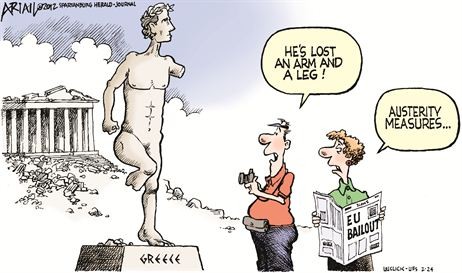
GreeceNaomi sees the current Greek crisis as yet one more example of the “Shock Doctrine” being applied to force Greece into crippling austerity measures (see here). The goal of this shock campaign is to force them to sell off fossil and mining resources, as well as any other pillageable assets, for pennies on the drachma. Think of these banking institutions as lions that pick a weak prey and run it down until it collapses to be devoured flesh and bone, leaving a carcass. Greece is the most recent prey that these predators have pulled out of the pack of nations.

Even if you agree that the lions are on the hunt to feast upon the financial problems in Greece, you may still believe that greedy and irresponsible Greeks are nevertheless guilty of making themselves vulnerable in the first place. Perhaps a weak and feeble antelope deserves no sympathy if it is culled from the herd. Maybe the lions are performing an important and essential function in a jungle of economic Darwinism.

But a very credible CNN article (found here) disputes this blame-the-victim mentality. It points out a number of things that those big news sources who repeat the meme fail to mention. For one thing, the article points out that the meme of “rampant tax evasion” is deeply misleading.

“In Greece the culprit has been rampant tax evasion by corporations owing millions in taxes and self-employed professionals who can hide their earnings, unlike salaried employees and pensioners. Under international pressure to balance its budget, the outgoing Greek government axed salaries and pensions and slapped new taxes on the bulk of citizens who were not tax-delinquent. “

We see the very same thing happening with tax “minimization” by corporations and the ultra-wealthy here in the United States, do we not? And as in our own financial crises, it was the insatiable greed of wealthy people and corporations that drove this crisis in Greece, not the greed and indolence of ordinary Greeks as it is portrayed. And just as the media propagated this “blame-the-homeowners” meme in America, they conveniently fail to specify that it is largely wealthy interests who are guilty of tax “minimization” in Greece. Also as in America, it is the regular Greeks who end up footing the bill and paying the price for the avarice of the rich.

How many times will we believe the memes spread through mainstream media? How often will we allow powerless ordinary people to be scapegoated for crises created by the same financial institutions holding all the power? How many more countries must fall to these big financial institutions before we finally begin to see them for the ravenous predators they are?

Our Secular Pope

Well it’s official. Hell has frozen over. Even as a devout secularist, atheist, and humanist I now feel that even I have a Pope. His name is Francis.

I have always had respect for the Dali Lama whom I once had the privilege of meeting. Many years ago the Dali Lama told Carl Sagan that if a tenant of Buddhism were to be disproven by science, then “Tibetan Buddhism would have to change.” This was a refreshingly rational acknowledgment from a major religious leader that science must trump belief. Of course he was still stubbornly irrational in maintaining an implausible, untestable, and wholly unscientific belief in reincarnation, but it was an encouraging concession nonetheless.

I also recognize that Pope Pius XII made a similar acknowledgment in his 1950 encyclical Humani Generis. In it he acknowledged the scientific fact of polygenism and went on, in deference to science, to specifically abandon the disprovable Adam and Eve story of human origins. He also expressed openness to the legitimacy of the relatively early evolutionary science of the 1950’s. Of course he still held that God existed and endowed humans with a divine “soul.” Like the Dali Lama, he conceded to science on the disprovable parts while still falling back upon the un-disprovable beliefs as faith.

But I’ve never been an unqualified fan of a religious leader until now. Through his recent encyclical letter Laudato Si’ (found here), Pope Francis threaded essentially the same needle as these previous religious leaders. He acknowledged the irrefutability of established climate science while still clinging to his belief in god and souls. Like Pope Pius and the Dali Lama, he is rational enough to understand that religion is better served by deferring to science on matters of fact and that it is ultimately self-defeating both for the Church and for mankind to deny established science. Like those others he is also sophisticated enough to understand that the fundamental tenants of his faith can never be specifically disproven by science and that is enough for most believers. But unlike those others, he has gone far, far beyond merely acceding to science to embracing it in an active fashion.

Even given the widespread consensus on global climate change, Pope Francis was nevertheless frank and courageous in Laudato Si’. It takes courage for any leader to acknowledge the science of global climate change, to disavow the environmentally irresponsible worldviews held by many Christians today, and to call for deep changes to the status quo. This is a courage that many of our secular leaders still sadly lack. The Pope acknowledged that man is responsible for protecting the Earth, that we are responsible for catastrophic global climate change, that climate change endangers our very survival, and that it is our responsibility to fix it.

Following are some important points that I pulled from my reading of his encyclical:

  • The Pope challenged us to “protect our common home,” entrusted to us by God.
  • He discussed many real threats to the planet including “pollution, waste and a throwaway culture,”  “the issue of water,” and “loss of biodiversity.”
  • He pointed out that the climate is a “common good” that is “a complex system linked to many of the essential conditions for human life.”
  • He acknowledged that a “very solid scientific consensus indicates that we are presently witnessing a disturbing warming of the climatic system.”
  • He acknowledged that all these things result in “global inequality” and a “decline in the quality of human life and the breakdown of society.”
  • He acknowledged “the human roots of the ecological crisis.”
  • He pointed out that our responses to these challenges so far have been “weak.”
  • He challenged people who defend the status quo by rejecting “those who doggedly uphold the myth of progress and tell us that ecological problems will solve themselves simply with the application of new technology and without any need for ethical considerations or deep change.”
  • He acknowledged the dangers of “misguided anthropocentrism” that places the gratification of mankind above all other considerations.
  • He acknowledged the principle of the “common good” and called for “justice between the generations” which imposes a responsibility to pass along a habitable planet to future generations.
  • He issued many calls for “dialog” and immediate action.
  • He held that the role of religion is to “guide” science.

Although these may all seem like obvious points to some, it is critically important that the Pope made them. Many religious people still do not accept the 1950 encyclical regarding evolution and they are not likely to accept this encyclical on climate change, or our role in creating a sustainable planet, let alone our responsibility to respond to the social and ecological challenges we face.  It is amazing to see the Pope and the Catholic Church taking such a strong leadership role for social justice and environmental sanity.

But it is important to also look at what the Pope did not say. Most noticeably, while he called for action by others, he did not so far lead by example with tangible actions within his power to initiate. I hope these kinds of actions are to come.

  • He did not call for divestment from the fossil fuel industry and other environmentally irresponsible industries nor did he promise to do so with the reported $8B Vatican portfolio.
  • He did not call for the extremely large worldwide Church infrastructure to “go green” and lower their very substantial carbon footprint.
  • He did not specifically instruct his clergy to take tangible local action to promote a culture that helps to achieve the goals he outlines so passionately.

Less obviously but more notably, Pope Francis did not call for prayer as a solution to our environmental crisis. In fact, he only used the word “prayer” a few times in the entire encyclical and never in the context of a call to action. Instead he used the words “science” and “scientific” dozens of times in the context of providing real solutions.

Evidently even though the Pope supposedly believes in an active, caring, and omnipotent god, even he is not silly enough to rely upon the power of prayer when the outcome really matters.

PopeFrancisI close with sincere thanks to Pope Francis. He is courageously using his bully pulpit in a responsible way that most secular leaders including President Obama have not. His strong statements regarding climate change in particular and social justice generally are desperately needed. I particularly appreciate his continuing calling out of “people, managers, businessmen who call themselves Christian and they manufacture weapons” as the immoral hypocrites that they are (see here).

Thanks Francis. You go Pope! Keep it up!

The Polling Crisis

poll-box“Election polling is in near crisis, and we pollsters know. Two trends are driving the increasing unreliability of election and other polling in the United States: the growth of cellphones and the decline in people willing to answer surveys. Coupled, they have made high-quality research much more expensive to do, so there is less of it.”

 “In short, polls and pollsters are going to be less reliable. We may not even know when we’re off base. What this means for 2016 is anybody’s guess.”

This is a quote from a recent NYT opinion article by Cliff Zukin entitled “What’s the Matter With Polling?” If you pay for access to the NYT website, the link is here (NYT Article).  In short, the author points out that the polling industry is in crisis. It has become hugely more expensive, if not essentially infeasible, to do reliable polling anymore. Trends including the disappearance of land-lines and growth of the Internet have converged to undermine what little reliability polls used to have. The main takeaway is that polling “science” is really bad and is only getting worse and pollsters have no idea how to make it better.

The author focuses primarily on the growing financial and logistical challenges for the polling companies. Since pollsters must make a huge number of calls to obtain even a remotely valid sampling of reliable data, the cost of doing accurate polling has become extremely high – even prohibitively high.

However I prefer to focus on the problems that this situation creates for rational governance. Even good polls have undesirable consequences. Their mere existence creates an almost irresistible compulsion for politicians to pander to poll results, saying whatever the numbers tell them that likely voters want to hear. Even if the polls are accurate, this may not be the best way to govern – or even to campaign. But if polls have become woefully inaccurate to boot, and yet we continue to pander to them, then we have taken what was already a problematic approach to governance and made it far, far worse.

One specific problem I’d like to focus upon more deeply is the self-fulfilling prophesies that these polls create. If the polls tell us that, for example, Bernie Sanders cannot possibly win, then those polls influence huge numbers of people to respond by not voting for Bernie Sanders – creating a self-fulfilling feedback loop. And what if those admittedly unreliable polls were simply wrong? What if perhaps they were even disingenuously promoted as a stealth strategy by a big money Clinton campaign (theoretically) for exactly that purpose?

Maybe we’re better off without any polls. Good riddance, I say. Maybe we’re better off if politicians campaign and govern according to actual scientific data and humanistic ethical principles, not according to polling. Maybe we voters are far better off if we remain uninfluenced by polls as well.

Whoa there, you say. If you have read my book “Belief in Science and the Science of Belief” (found here) you know that a fundamental principle I champion is that decisions based on facts are inherently better than decisions based on beliefs. If that is the case, aren’t polling facts important information to consider in campaigns and in governance?

Yes but I’m also suggesting that polls aren’t the best facts to use and that they push all the air out of the space for actual, more important and more reliable facts to sufficiently drive political campaigns and decision-making.

Poll any group of alcoholics and the data will likely show that they want more alcohol. As antithetically “paternal” as this may sound to some, a government must provide what society needs, not necessarily what people want. Private corporations can be driven by market research to provide exactly what their customers want (when not unethical or illegal). But a government simply cannot make policy based primarily on polls if they are there to serve the common good.

Now if even accurate polling can create unhealthy pressures for governance, imagine the consequences if we continue to listen to polls that have now become even less reliable. Now we are making decisions that impact the lives of people and the life of the planet that are primarily based not merely on polling data but on really bad polling data.

I say again, good riddance to polls. My hope is that we turn this crisis into opportunity. This is our chance not to merely improve polling methodologies, but to start to weigh polling data far lower in our decisions and instead find ways to make policy decisions based more upon the best objective science and rational decision-making possible. I hope that our emphasis on “what people polled want” is permanently diminished and replaced by more indirect and sophisticated methods of data mining to understand what they actually need and what will best serve humanity and planet Earth in the long-term.

Government by Jury

We all know it.  Our democratic government isn’t all that democratic. It is inherently corruptible by the influence of big money – obscenely so since the Citizens United ruling. That big money necessarily compels our legislators to work for the short-term interests of wealthy individuals and big business, rather than for the long-term common good.

The most common response to this reality is resignation. Well yes, our system may not be perfect, but it’s the best we can do. How defeatist and unimaginative is that? We certainly could do a lot better if we only had the will to do so. We could enforce far stronger conflict of interest rules for our legislators – the same sort of rules we already enforce for judges. Oh we nip around the edges, passing token campaign and conflict of interest regulations, but nothing that would fundamentally reduce the river of big money flowing into government like a raging river. But we could.

And there are more fundamental things we conceivably do. Just brainstorming here, but I’ll offer one such idea. Feel free to use it if you ever start your own country or overthrow a government.

juryMy form of government would be a “Jurist Democracy.” In my Government by Jury, legislators would propose legislation but could not pass it. To enact their proposed legislation, lawmakers would function as advocates, arguing the cases for and against the proposed legislation based on their own ethics, or their constituents, or their financial backers just as they do now. A non-partisan judge would preside over a Legislative Hearing and ensure that all evidence is vetted and all rules are followed. Once both sides have presented their arguments and their expert witnesses, a jury of ordinary people would retire to discuss and rule upon the proposed legislation. Jury selection would be conducted just as it is for criminal cases. The citizen-jury would decide whether a strong enough case had been presented and would make the final decision on whether the proposed legislation should be passed into law. Teleconferencing could eliminate previous geographical limitations.

No claim of a panacea is made here. Certainly this system would be neither perfect nor foolproof. Games could still be played by the legislators; horses traded, bribes offered, and so on. We would have to be assiduously vigilant to prevent or punish malpractice and jury tampering. But we know how to do those things.

And these corruptions will happen in any system. The key difference here is that at least we have removed the final decision from those who are most directly corruptible. If the legislators cannot convince twelve reasonable citizens that their legislation is good for the country then it does not deserve to be made into law. I for one would be much more confident that twelve impartial citizen-jurors would on the whole make better decisions than career politicians.

And I don’t buy the argument that citizen jurors could not understand the issues involved sufficiently to render intelligent decisions on complex issues. That sounds a lot like medieval priests who maintained that they alone could interpret the word of god for the common man. In fact I have far stronger concerns about the impartiality and expertise of professional lawmakers (many of whom do not even believe in evolution), and trust that if a bill cannot be explained to reasonably smart people is it probably too convoluted to pass. This idea that a bill is too complex for ordinary folk is mostly just used as an excuse to make our government less transparent and more susceptible to the disastrous impact of small print obscured within intentionally complexicated legislation.

This Government by Jury would be far more democratic because it would directly involve large numbers of citizens directly in the process of governing. I for one at least, would be far more willing to put my faith in the good sense and civic-mindedness of 12 random individuals than in professional legislators who are saturated in conflicts of interest starting with keeping their jobs and their positions of influence within the system.

It is pretty much impossible to put forth any idea that has not been thought of before. In his article called “Government by Jury” (found here), Stephen H. Unger from Columbia University discusses this general concept in greater detail and provides additional references. His suggestion is to conscript citizens into some longer period of service. I suggest that legislative jurors could be recruited only to decide one piece of legislation with minimal modifications to our current system. We recruit juries to make decisions in criminal and civil cases of comparable complexity. To recruit them for longer periods of service would include fewer citizens, would be much more logistically difficult, and would introduce more possibility of the very sort of corruptions that we are trying to avoid.

Ideas such as these should be discussed more often, more openly, and more seriously. They help stimulate real innovative, out of the box thinking rather than restricting ourselves to ideas that do not disrupt the current dysfunctional status quo. Merely raising and discussing proposals like this makes it more likely that legislators will consider more substantive conventional measures to improve the integrity and effectiveness of government.