 I really, really wanted to get to my backlog of scientific blog topics today, but was distracted once again by Shawn Spicer at his daily press briefing. In defending “Trump/Ryan Care,” he repeated perhaps a hundred times that “It is an economic certainty that increased competition unquestionably brings down costs.”
(Note that he uses the word “costs” but he presumably intends this to mean “prices.” Cost is really the cost of manufacturing a product. Price is the cost to the consumer. Price minus cost equals profit. I will use these words consistently in this way to eliminate ambiguity and confusion.)
Shawn’s assertion is a meme that is almost universally accepted in America as a fundamental principle, a given, but it is simply untrue. It is part of the falsely simplistic “Economics 101” nonsense that has been repeated so often that it feels like perfectly sound common sense (see here).
Our acceptance of false arguments like this manipulates us into adopting “free market” solutions that harm our own self-interest and shovels money from poor Americans to rich Corporations.
The reality is that the “free market” does not give a hoot about low costs or even about high quality and there is nothing inherently forcing it to provide the highest possible quality at the lowest possible price. Quite the opposite. Businesses in unregulated free markets will minimize cost (quality) and maximize price to realize the highest possible profit.
If their manufacturing costs are reduced through deregulation, they will not lower their prices to the consumer, they will enjoy higher profits. If they are forced to lower prices through regulation, they will lower their costs (quality) before lowering their profits.
But wait you say. Of course that is true and that is why competition works! If there is competition then if a business wants to survive they must deliver higher quality at lower prices than their competitors. Eventually we reach an optimum for the consumer.
Except that rarely works in the real world, and works least well in providing essential services that really matter, things we must have to live and work and even survive.
The example that is invariably given in idiotic Economics 101 courses is the lemonade stand. If Sally sets up a stand in her yard and charges $1 per cup, but then Billy across the street sees her making money and sets up his own competing stand charging $.95 for the same lemonade, then Sally must either increase her quality or lower her prices or accept less profit if she wishes to stay in business.
But in the real world, Sally and Billy would both quickly understand that getting into a price war is a lose-lose scenario in game theory. If they both just keep their prices the same, they both enjoy higher profits than if they compete. If Jimmy were to open up a stand in his yard and sell lemonade for $.50 at no profit, Sally and Billy would quickly buy him out and return prices to $1. Further, they would both lower the quality of their lemonade, thereby increasing their profits, right up to the point at which they lose sufficient customers to cause a net loss.
In reality, the free market optimizes for the lowest quality at the highest price the market will bear to maximize profits.
When I lived in India, I often had to use a rickshaw to get around. The rickshaw wallahs would see that I was a Westerner and smarmily quote me exorbitant prices for a ride. Now, there were at least 100 wallahs waiting around with nothing to do, all perfectly able to take me. But if I went from one to another they would all give me the same inflated prices. Even if I simply left and walked the 5 miles, none would budge. In that free market, like most, businessmen would rather lose customers than lower their prices. The wallahs all knew as big corporations well know, that I would eventually have to pay their high fees to someone and that benefitted them all much more than undercutting each other.
The last people who should be fooled into believing that competition lowers prices are Walmart customers. Walmart literally destroys all competition and then, as essentially monopolies in their markets, they provide the lowest prices to their customers. Where is the “free market competition” argument here? Monopolies clearly can do way better. They have huge purchasing power and don’t have to pay advertising overhead.
So it is with essential services like healthcare in America. Free market competition will not force healthcare companies to lower their prices, improve their quality, and sacrifice any of their profits. Competition inherently segregates risk pools which particularly damages this industry. Deregulation will only allow insurers to work together to maximize profits by lowering their costs and raising prices to the highest level the market will bear, which in the case of essential healthcare is cripplingly high.
What we need in healthcare is not deceitful free-market snake oil, but a healthcare monopoly like Walmart. We need public healthcare that can create the largest possible nation-wide risk pool, negotiate the best costs, and take all profit out of the equation. Our free-market system has a vested interest in maximizing profits over patient health. These interests are simply not compatible and never can be (further reading).
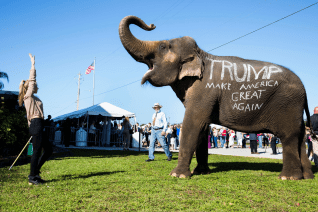 Both of these vulnerabilities are at the mercy of us, the public. If we work individually but in sufficient numbers we can bring him to his knees like an army of ants swarming to bring down an elephant – the Trumpephant.
 I’m sure you have heard the term “tin pot dictator.” It refers to “an autocratic ruler with little political credibility, but with self-delusions of grandeur.” This pejorative was coined in the early days of the British Empire and it associates certain rulers with the cheap, disposable containers used before the creation of the modern tin can. Like the one on the right, these cheap cans boasted labels that portrayed the contents in a highly overblown and pretentious manner. But the common people were not all fooled. They knew full well that Dinner Time Brand coffee was not exactly the Royal experience promised on the label. Thus the term “tin pot dictator” spoke volumes to them.
 No one, even his worst critics, can do anything but praise and applaud the dignity and bearing with which Obama and his family have represented the office of President. Yet, it is that very characteristic that we now feel compelled as a people to reject. So what do we do? We elect Donald Trump – a man who is the antithesis of dignity. A trash-talking trailer-trash President who is about as refined as Cousin Eddie played by Randy Quaid in the Vacation movies. We love Eddie because he is NOT dignified. Likewise we see Trump as a refreshingly frank person who is a great natural businessman.
 One thing that Wall Street loves most of all are disasters. Disasters make bankers salivate. Life is full of its little ironies, and as it turns out I just moved away from New York City after 10 years of living literally on Wall Street. In another strange twist of fate, I worked on Church Street (I’m a devout atheist). Anyway, back on point. I used to meet lots of financial types. I remember after a tornado leveled some towns in the South, these guys were like kids in a candy store. They could hardly contain their enthusiasm over this disaster and all the new loans and sales it would create.
 A lot of what is says is well-taken tough love, but it does generalize too much. It paints all men as Dodo Birds, and all women by implication as enlightened beings. Certainly there are far too many men, largely Trump voters, who absolutely need to go extinct as quickly as possible for the good of all humanity. But huge numbers of men vehemently reject Trump and all he stands for.
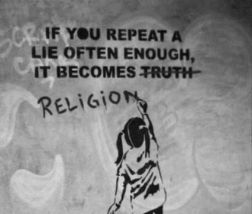 But this should come as no surprise. After all, all of religion is nothing but selling lies. It
  As long as we are reduced and diminished to a Nevers attitude of elections and leadership in this country, we are pilot and copilot struggling for control of the cockpit as the plane races into a mountainside. We are Darth and Luke fighting each other when only united can they hope to oppose the truly evil Emperor. Only when the Nevers fade away and we once again express affirmative support for civil, respectful candidates who commit to work together to solve problems, rather than working merely to destroy each other, can we thrive and survive as a people and as a nation.
 Probably the most hypocritical ethical fallacy that incenses my sensibilities is the “Forgiveness Fallacy.” This is typically invoked by Christians, particularly Evangelical Christians, to serve as both a shield and a sword. Whenever one of their own is guilty of wrongdoing, they insist that we must forgive and that only God can judge. However, when the guilty party is not one of them, they insist that only God can forgive and that we must never forget nor forgive. Seems to me that it is those who most need forgiveness are the ones to advocate for it most strongly, but only when it benefits them.
 figmentums