The Trump Zone Shocker Ending

For those of you who are too young to have grown up on it, The Twilight Zone was a science fiction show that featured a shocker ending, typically in the form of a sudden reversal of perspective. There was one episode, for example, when an astronaut to Mars is welcomed by aliens who greet him warmly and offer him a comfortable Earth-like room with all the amenities. Everything seems wonderful until he notices a sign that says “Earthling in its natural habitat.” Then the wall drops open and he is stunned by the realization that he is actually in a zoo (see here).

Last night was a real life Twilight Zone shocker ending. There we were. My wife and I and all our friends were in an uptown Manhattan apartment expecting to watch Hillary declared the winner within the first hour – or two at most – before popping our champagne. As the first states went to Trump, many reassured us that there was absolutely nothing to worry about. Hillary did not need that state to win. As each subsequent state fell to Trump, we kept clinging to the next certain path to victory. When it finally became undeniably apparent that Hillary was out of paths to 270, the utterly stunned looks of shock and disbelief were every bit as profound as if we suddenly discovered we were actually exhibits in a Martian zoo.

This is the Twilight Zone ending of this long election cycle. All of us who opposed Trump lived under a delusion of absolute certainty that all those crazy Trump people were living in some artificial bubble created by Fox News. But suddenly we had to accept that is we who have been living in the bubble, not them. It is we who thoroughly denied the reality of a disillusioned, hurting, and profoundly desperate majority in America. It is we, including those in the media, whose bubble of relative affluence did not allow us appreciate or even imagine that too many of our fellow Americans are so fundamentally damaged by our system that disqualifiers like misogyny and all the rest are merely frivolous preoccupations of the privileged classes.

Those with all the power are always shocked and surprised when the “masses” rise up. Many slave-owners in the South were probably mystified to learn that there was so much discontent amongst their slaves. In every country when there is a popular revolution, the leaders and those who are well off live in their own bubble that only gets penetrated when the workers rise up in some form of Marxian revolt. They are always stunned and shocked.

That may be exactly what we have seen here. In recent decades SO much wealth has gone to the upper classes, siphoned by the rich like vampires directly from the life blood of the working class, that Karl Marx would be nodding his head saying “I told you so.” He would probably only be surprised that it took so long for reality to burst through our happy little bubble.


Leaving Men Behind

I recently read an interesting article in the New York Times called “The Men Feminists Left Behind” by Jill Filipovic (see here). You should read it in entirety, but here is a synopsis:

Women have evolved, men have not. While women have soared, men have remained stuck in the past. Donald Trump is representative of far too many men, and they are a threat to our country. Women cannot reach their full potential unless men change. If men feel left behind, disrespected, and ignored, they need to follow the example of women and move forward into a new and more flexible gender role.

womanvsmanA lot of what is says is well-taken tough love, but it does generalize too much. It paints all men as Dodo Birds, and all women by implication as enlightened beings. Certainly there are far too many men, largely Trump voters, who absolutely need to go extinct as quickly as possible for the good of all humanity. But huge numbers of men vehemently reject Trump and all he stands for.
Conversely, the author seems blind to the fact that far, far too many women support Trump the candidate and the hateful rhetoric he spews. Kellyanne Conway, Ann Coulter, Sarah Palin and his army of female surrogates are not anomalies, but are examples of a disturbingly large number of female Trump supporters. These are hardly luminous beings of exemplary wisdom. Their support is particularly inexplicable and disturbing given how much of his rhetoric ought to be especially horrifying to women.

Here’s another thing. The author is correct that men do need to adjust. We had been driving in our station wagon together as families for many generations. The man driving, the woman knitting while occasionally checking the map for directions. Recently, the woman has demanded to drive and the man has had to relinquish the steering wheel. But he loved driving, doesn’t know how to knit, and is constitutionally and philosophically opposed to maps. So what does he do now? Maybe he sits in his passenger seat and reminisces about the good old days when he got to drive as he drinks lots of beer.

Back when I was in the Peace Corps, I used to walk by construction sites in my village. Each one was “manned” exclusively by female construction workers doing heavy labor. I knew full well that the corner bar was filled with men sitting around drinking. I was infuriated by this. It offended my sensibilities in every possible way. What was the matter with these lazy, good-for-nothing men? Unfortunately, my ire couldn’t have been more myopic. It turned out that, in a well-intentioned effort to encourage equal opportunity, the government provided generous incentives for these companies to hire women. Almost over night, that put men out of work with absolutely nothing to do, no prospects, no opportunities, and no self-respect.

I tell you this story to suggest to you that situations are seldom simple. Yes, women have made great strides and that is good. In fact, to the extent it is a competition, they have clearly won. Jill’s article could only be written by someone that has internalized the fact that women have won. They are on top now, if not in every measure, in every measure that portends future trends and prospects. She knows women are driving the train moving forward, and feels confident enough to warn men that they need to get on-board or get left behind.

Let’s be clear, there has been a strong element of competition here for a largely fixed pie. Women flocked into previously male jobs and these well-paying jobs have not doubled over this period, rather the number of these jobs has shrunk dramatically over this same period. So you do the math. To tell men in America that they simply need to “get with the program” is as naïve as my thinking that those African men simply need to “get out there and work.” It is as short-sighted and callous and indifferent as it is when we tell impoverished Blacks to simply pull themselves up by their bootstraps, or immigrants to stop just complaining and get to work, or displaced coal workers to just evolve.

These social upheavals, while good and necessary, do cause real pain. Major social transitions to create greater equity do cause localized inequity and in this case men have been the losers. When feminists like Jill ignore this and chide men into “just get over it,” they ignore the systemic and emotional challenges involved. It is not that simple or easy. Necessary, yes of course. Easy? No way. Men are not Neanderthals. They are actual people with feelings who are trying their best to adjust to real loss and change. Sometimes part of that adjustment includes clinging to the past or getting belligerent. But these things are normal stages of adjustment. Women have had generations to adapt and grow. Men need and deserve some time.

Despite the fact that men have been hit hard, they have adjusted a great deal. You seldom hear sexist language in most workplaces. Many men find that they are suddenly a minority in largely female workplaces and many report to women. Lots of men are thriving house-moms today.

So women, you deserve to celebrate but try not to gloat. Refrain from telling men they are Neanderthals or treating them that way. Try not to discount the unprecedented social barriers and challenges that men have been adapting to. Maybe try to give them some support and encouragement rather than getting impatient with them, demeaning them, and issuing Conservative-sounding “get on the train or get left behind” ultimatums.

And as you give your men the time and understanding they need to adjust, maybe you can work on evolving the many women who have adopted all the worst traits associated with the old school males you deride as Neanderthals. I, as do many males, desperately want to see female compassion and sensibilities provide real leadership to help to save this planet, not merely share equally with men in exploiting and plundering it.

Aborting the Lies

Is it any surprise that there are many more fake pro-life “abortion clinics” than there are actual abortion clinics? Is it any surprise that if you try to Google anything related to abortion services, you will get many, many more hits for fake pro-life Trojan-Horse sites than actual legitimate abortion service sites?

Frankly this should come as no surprise to anyone. This is what these fanatical pro-life activists do. As documented in the excellent HBO film “12th and Delaware” (see here) and others, Christians set up fake abortion clinics to lure in distressed, vulnerable pregnant women under false pretenses. Like any good confidence operation, they are warm and welcoming and sprinkle in as many facts as they can so that they can manipulate these women.

However, once lured into these “abortion counseling services,” the women find that the pressure on them will build and build, becoming more manipulative as these pro-life fanatics try to persuade or coerce or even trick the woman into delivering her baby. This manipulation is not merely limited to appeals to emotion, but includes many outright distortions and lies. One such tactic is to intentionally under-report the gestational age of the baby to make the client believe she has much more time than she actually has to perform the abortion. They outright lie to trick the women into delaying their abortion until it is too late. In fact, they feel justified to lie about anything and everything necessary to “save” the baby.

Clinics and web sites make the women watch “informational videos” to help in this coercion. Many are produced by an infamous anti-abortion doctor named Dr. Anthony Levitano. He has one such propaganda video on medical abortion (see here), which is an extremely safe and effective procedure. I encourage you to watch this because it provides a great crash course in how to manipulate others and what to watch for to avoid being manipulated. It starts out for the first minute or so as a fairly straight-forward description of medical abortion. The manipulation kicks in by pointing out that the medical abortion can be “reversed.” This is factually inaccurate, but pro-life advocates like to say it anyway to plant the seed of doubt – the doubt that many women “come to their senses” too late to save their baby.

At about a 90 seconds in, the video starts to turn palpably darker, emphasizing ominous words like “severe” and “heavy” and introducing phrases intended to appeal to emotion like “force the dead baby out.” Notice that they intentionally call it a baby, not a fetus or embryo, because they use every possible ploy to make the mother feel emotionally connected. After that, Levitano proceeds to up the temperature by warning that the process can be “very intense and painful.” From there it gets quickly worse, gratuitously pointing out that the woman could “loose her baby” at any time, then following up with images of a woman on a toilet “expelling her baby down the toilet which she will then flush.” The repulsive imagery that Levitano fully intends to invoke is masked under a transparently thin veil of clinical detachment.

And this is only half-way through the thing! The video goes on to repulse the viewer with increasingly horrific and increasingly blatant appeals to fear, guilt, and revulsion. He points out, for example, how [if the woman were to sift through the tissue in the toilet] she might be able to detect fingers and toes. Levitano claims that 1% of women require hospitalization after a medical abortion, but this is at least a hundred-fold exaggeration and in the extremely rare case when there is hospitalization, it is rarely serious or even the result of the abortion drug. Levitano closes his manipulation by sharing his own personal realization that “all abortions are wrong.”

Let me be perfectly clear. This is factual and emotional manipulation with no tactic too subtle or too blatant. Whatever true facts are presented are only included to establish enough credibility to sell the big lies and manipulations to come. It is sad that so many women fall prey to this kind of hateful and harmful manipulation dressed up and rationalized as Christian morality and charity. Whether they are in front of abortion clinics or hosting their Trojan-Horse web sites, in their minds no tactic is out of bounds, no lie is a lie to them if it advances their cause.

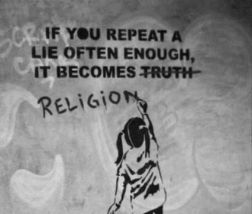
liesBut this should come as no surprise. After all, all of religion is nothing but selling lies. It can be nothing else because it has nothing but lies to offer. Scriptures, angels, salvation, afterlife, god, devils… its all lies and Christians spend all their energy believing or convincing others to believe these lies. Is it any wonder then that Christians should have no trouble believing and spreading lies about abortion as well? Religion is not benign. Becoming comfortable rationalizing religious nonsense directly impacts our capacity to rationalize equally crazy thinking in consequential matters like abortion.

And as with religious fantasy, it is immaterial whether they sincerely, devoutly, fervently believe the nonsense they spread about abortion or how selfless their intentions might be. Their lies, deceits, manipulations, misinformation, and misguided efforts do great harm to a great many people regardless of their motivation – harm to the women directly affected as well as to the men and families in their lives.

If you are seeking an abortion, ask the clinic early and directly if they provide abortions on their premises. If you do not receive a clear and unambiguous yes, hang up. Ask again the minute you walk in the door. If they begin to use any of these tactics on you, leave immediately because their only goal is to do whatever it takes to prevent you from obtaining a legal and safe abortion.


The Rise of the Nevers

If our American Presidential campaigns were envisioned as a Star Wars style movie series, the 2016 episode would be entitled The Rise of the Nevers. In this episode, the electorate has been divided as never before and we see the emergence of an ominous new movement.  The Republic becomes divided not by their sincere support for their respective candidates, but by their entrenched intransigent hatred for their opponents. They no longer care about their own candidate, they merely oppose the other side. They are The Nevers.

The rise of these Nevers is frightening. The movement both reflects and reinforces a level of divisiveness that can only bring strife and ruin. Many are SO hell-bent on wining that they gin up exaggerated reasons to take an extreme Never Clinton position. Their opposition to her is so vitriolic that they turn to the most deplorable candidate possible to carry their message. The opposition find this candidate so abhorrent that they can only respond with a Never Trump position.

As long as we have people electing or forced to take a Never stance, we are in such a hyperbolic state of rabid partisanship that democracy cannot function in a healthy fashion. We are proud of our system of government with its checks and balances. But that is a fragile thing. As we have seen, it is far too easy for that system to slip from gracious debate, advice, and consent, to win-at-all-costs internecine warfare that serves no other purpose than to crush and destroy the other party.

Think of our nation like an airplane. The wise founders of the airline put in place a system of check and balances, including a pilot and a copilot, to ensure that the planes will carry all passengers to their destinations safely and on-time. In most normal situations, the two pilots are expected to work as a team, cooperating for the good of all. But they are also there to watch each other and ensure that one of them does not become unhinged and choose to fly the plane into a mountainside. However, imagine the dysfunction if they were to say “I’ll never allow the other to fly this plane!” The pilot tries to fly one direction, but the copilot insists on flying a different route and they start fighting for control of the cockpit. It would be lucky if the plane did not crash in a spectacular fireball of metal and bodies.

duelAs long as we are reduced and diminished to a Nevers attitude of elections and leadership in this country, we are pilot and copilot struggling for control of the cockpit as the plane races into a mountainside. We are Darth and Luke fighting each other when only united can they hope to oppose the truly evil Emperor. Only when the Nevers fade away and we once again express affirmative support for civil, respectful candidates who commit to work together to solve problems, rather than working merely to destroy each other, can we thrive and survive as a people and as a nation.

The true Emperor that cackles as his grand scheme unfolds while we fight senselessly against each other has a name. He is Climate Change.


Ethical Fallacies

A fallacy is a mistaken belief, particularly those based on invalid arguments. There are many general forms that fallacious arguments take, and they are almost always an indicator of faulty reasoning, incorrect conclusions, and even outright manipulation. Familiar examples of these include the Straw Man, Appeal to Authority, Ad Hominem, Circular Reasoning, and False Choice. If you learn to recognize the general patterns of fallacious logic, you can see through disingenuous or manipulative arguments far more quickly and clearly. I discuss these and many other logical fallacies in my book “Belief in Science and the Science of Belief (see here).

But in addition to logical fallacies, I’d like to suggest that there is also such a thing as ethical fallacies that we encounter just as often. In fact, in this 2016 election cycle we have been ceaselessly deluged by ethical fallacies. Note that it is with deliberate intent that I speak of ethical fallacies and not moral fallacies. Morality is itself a form of ethical fallacy. For a discussion of the difference, see here.

The reason I make that distinction is because moral thinking is typically based on ethical fallacies including “Appeal to the Bible.” Note that a related and no less dogmatic form of ethical fallacy is “Appeal to the Constitution.” In fact, many of the same people who would like to bind us to their interpretation of the Bible would also like to turn the Constitution into another Bible, binding even secular individuals to their particular religiously-based interpretation of yet another literal and unassailable scripture.

Two related ethical fallacies are “Appeal to the Majority” and “Appeal to Individual Rights.” Sometimes these are valid arguments, but often they are not. When some argue that “a majority of Americans support the death penalty,” that does not constitute a valid ethical argument. Likewise when some argue that we should not restrict any gun sales because it is an individual right, clearly this is insufficient ethical justification. Politicians and advocates often similarly appeal to Federal versus State Rights inconsistently and arbitrarily when it serves their narrow interests.

Another set of ethical arguments that are often invoked are fallacies of “Time and Space.” Just because something may have been accepted or considered ethical in Biblical times or even in Revolutionary War days, does not mean it is ethical today. And just because something may be ethical in one place, does not ensure that it is ethical in another. Note that religious people have great trouble with this concept. It is too complicated and messy for them. It requires too much thought. They disparagingly call this kind of ethical thinking “situational” and therefore immoral. They prefer immutable dogma.

Note that just because something is lawful does not make it ethical either. “Invoking the Law” is therefore another possible fallacy. Of course we do our best to create ethical laws, but just because something is law does not make it ethical in all situations. Laws should be fluid enough to ensure fairness in individual situations. This concept is antithetical to some religious thinkers who have trouble with anything beyond simple dogmatic thinking. Ironically, they are most likely to insist the law be adhered to by others, but allow themselves to override the law when they can rationalize that it is in contradiction to their faith.

There are other fallacies related to belief. Many of the same people are most likely to invoke the “Fallacy of Sincerity.” Just because a belief is “sincere or heartfelt” does not make it any more or less ethical. Similarly, there is sometimes an “Appeal to Intent or Ignorance.” These may be extenuating factors, but neither of them make an action any more or less ethical.

In my last article I talked about two other ethical fallacies (see here). The first is the “Ethical Proximity” fallacy. This is the fallacy used grab all benefits for those in closest proximity to us while shifting all blame away to those farthest from ourselves or our group. The second is the “Personal Responsibility” fallacy. This version of ethical proximity is used to argue that those farthest away or least powerful must take personal responsibility for their actions while those closest to us or in the most powerful positions in our society are merely victims of “the system.”

And then there is the “Character versus Issues” fallacy. When we are talking about the flaws in an opposing politician, pundits focus on their basic character failings. But when forced to respond to character flaws in their own candidate, advocates insist that we should instead focus exclusively on “the issues.”

Another ethical fallacy that is constantly used, particularly during elections or during the aftermath of a ginned up march to war, is the “Water Under the Bridge” fallacy. This is frequently invoked by those guilty of past failures or even crimes, to insist that all of that is simply water under the bridge, that we must instead look forward. However, when an opponent has similar past failures, they insist that we must never, ever forget.

shieldoffaithProbably the most hypocritical ethical fallacy that incenses my sensibilities is the “Forgiveness Fallacy.” This is typically invoked by Christians, particularly Evangelical Christians, to serve as both a shield and a sword. Whenever one of their own is guilty of wrongdoing, they insist that we must forgive and that only God can judge. However, when the guilty party is not one of them, they insist that only God can forgive and that we must never forget nor forgive. Seems to me that it is those who most need forgiveness are the ones to advocate for it most strongly, but only when it benefits them.

There is a theme here. We tend to selectively use one set of ethical arguments to rationalize away problems with those in closest proximity to us, and a different and entirely contradictory set of ethical arguments to attack those we disagree with, often for completely unrelated reasons. This is called spin by some, advocacy or good debate tactics by others, and bald-faced hypocrisy by most objective observers. Yet we see and hear these and other fallacious ethical argument all the time.

But this is the thing. Just because almost every line of rhetorical attack or defense in our public discourse is some manifestation of these basic tactics, doesn’t mean we should just tune out. That is simply not an option. However, just as with logical fallacies, by learning to quickly recognize the general forms of ethical fallacies, we can quickly “tune past” all the nonsense intended to obscure and deflect and see through to the heart of contentious issues that are critically important to all of us.

Can you think of any other ethical fallacies? If so, add to this list through your comments!


The Personal Responsibility Con

In a previous article I discussed the impact of proximity on ethical responsibility (see here). In it, I pointed out that while proximity should impact ethical decisions, we must be careful that we do not assign too much priority for benefits to groups or individuals nearest to us and push blame and responsibility for problems off to those farthest away from us. In it I said:

The bottom line is this. Be aware of the role of proximity assessments in your ethical decisions and judgments. Try to avoid giving unduly large or exclusive priority to your own narrow group. Likewise try to avoid assigning blame and responsibility disproportionately to groups farthest away from you.

We see this pulling in benefits and pushing off blame around us every day, and no where is it as stark as in Presidential politics. We have some candidates who perpetuate a self-serving inversion of proximity ethics by claiming that people “like us” deserve all benefits while those “not like us” deserve all blame. These politicians present a very self-serving set of ethical arguments.

Other politicians emphasize that “it takes a village” and present a far less self-serving vision of a society with a broad and wide view of balanced benefits and responsibility. For a society, and I would argue for individuals as well, this is far more healthy and sustainable.

But there is another spectrum by which ethics are selectively applied. We all experience a continual friction between personal and systemic blame. Is it nature or nurture? Is the individual solely responsible for his or her actions, is society to blame, or is it a combination? And even if we acknowledge that responsibility is a combination of the two, how much emphasis do we necessarily attribute to personal responsibility for purposes of punishment? Do we focus on changing the system that drove the individual to crime, on punishing the individual, or both? How do we balance these?

It is my observation that we tend to unduly blame the individual when they are “not like us“, poor, and underprivileged. However, when the individuals are rich and powerful, we tend to blame the system. When talking about poor Black teens, we tend to emphasize that they should pull themselves up by their bootstraps, tow the line, and take responsibility. However when we are talking about corrupt Wall Street billionaires who selfishly destroy countless lives and fortunes, we tend to shift blame to the system.

This kind of selective assignment of personal responsibility serves those with all the power. Corporate executives are never irresponsible, it is always the system that is to blame and must be changed. Donald Trump deserves no blame for tax avoidance, the tax system is to blame. However, when poor immigrants do their best to give their families some kind of basic standard of living, they are criminals who are fully responsible for their actions and must be punished for violating the system.

This extremely unbalanced assignment of personal and systemic blame  serves and is perpetuated by those with all the power.  When wealthy, powerful people commit terrible large scale crimes, they indict “the system.” But when poor, powerless individuals step over the line of systems designed to favor the wealthy, they must be held personally responsible for their actions. In our society, insulation from blame and punishment is a perk of power. Selfishness is a virtue reserved only for the most wealthy.

My ethics say that is backwards. I believe that with great power comes great responsibility.

Voting Third-Party in 2016

In his recent Op Ed, Paul Krugman talked about the dangerous attraction of voting Libertarian (see here). I’d like to second this. Well actually from my perspective he is seconding me, but he did hit “Publish” a few hours before this planned Monday morning post.

Look, Paul said it well but here’s my unique take on this. I have long advocated voting third-party to anyone who would listen. I argued, soundly I still think, that Progressives consistently vote out of fear and have failed to play the smarter and longer strategic game. By failing to take a stand for change and to lose a Presidency or a Supreme Court Judge in the short term, we consistently vote for the “lesser of two evils.” This has only played into the hands of the Conservatives in which they win either way, maintaining the status quo and moving the center methodically ever further to the Right with each election cycle. Unless we are willing to back a third party candidate in large numbers and lose a battle, sacrifice a Pawn or even a Queen, we cannot hope to win the war.

But there are rational limits to everything, and even in war there are some battles that we cannot give up; a hill that we cannot allow to be taken, a Rubicon that cannot allow the enemy to cross. If Jeb Bush or John Kasich were the Republican nominee, I would still be advising the long game. However, Donald Trump totally changes my calculus. A pathological liar who rivals Kim Jong-un only in his level of obscene narcissism, simply cannot be allowed to assume a position of such immense power. Allowing a reckless buffoon like Trump to take office in America, even if only for four years, is utterly unacceptable.

As much as it catches in my throat to even say it, voting third party is simply foolish in this election. I admit that I am motivated by fear here. I am afraid of the real, existential threat of Donald Trump. Sometimes fear can save our lives.

Even if one grants the silly Fox meme that Hillary is a crook, a crook in the White House is infinitely preferable to an utterly self-serving compulsive liar.

One of my biggest complaints and concerns about Hillary is that she is too hawkish. But recklessly insane Donald Trump has already said he would launch missiles if some guys give the finger to personnel on one of our Destroyers! There is absolutely no comparison here. Hillary the lesser of two evils? Absolutely, by an incalculable margin.

And don’t fool yourself. Your vote matters even if you live in a safely Blue State. Unless Hillary wins with an overwhelming popular vote, she will have no mandate and the forces that spawned Trump will only feel encouraged and emboldened to block her every effort and to keep giving us more of the same extreme Conservatism.

libertarianIf, after all this, you still feel compelled to vote third-party, think about who you are supporting with your symbolic vote. Johnson and Weld are Libertarians. They claim to be “fiscally conservative and socially liberal.” But this is a HUGE LIE. They are only socially liberal in as far as they support the legalization of pot and a woman’s right to choose. But they also support privatization of almost every social institution including education, the right to own assault weapons, eliminating all corporate taxes, instituting a hugely regressive consumption tax, trusting in the private sector to stop climate change, and eliminating almost all regulations. The list goes on and on. These guys are not socially liberal since all of their “fiscally conservative” positions are actually socially conservative positions painted up as fiscal common sense.

If you vote Libertarian, you are not just saying you reject the status quo, you are also saying you support all of their extreme Libertarian positions that are too far Right for even mainstream Conservatives to accept.

One final plea. If you DO still feel compelled to vote third-party, strongly consider voting for Dr. Jill Stein. The Green Party is not an ideologically blinded wolf in sheep’s clothing like the Libertarians. They are truly sensible, rational, intelligent, and represent real Progressive change. If we were not faced with the horrifying specter of a Donald Trump Presidency, I would be proud to vote Green. Vote for them down ticket as much as you can.

Sorry Jill, I feel terrible but please try again and again!!


Swarm Stupidity in Humans

swarmI am eternally fascinated by swarm intelligence and emergent behaviors. These terms describe the phenomenon by which individual organisms, following only simple local logic without any wider intent or awareness, contribute to highly complex and far-reaching behaviors that “emerge” or arise out of their collective activity.

The most observable examples include bird flocking, animal herding, fish schooling, bacterial growth, and ant colonies. Ants, as the most dramatic example, collectively create extremely complex bridges and nests, even though no particular individual organizes that activity or is even aware of it.

The amazingly complex creations of ants emerge from very simple individual logic such as “if another ant is on top of me, stop moving.” From this kind of deceptively simple behavior, ants collectively exhibit astounding feats of mass migration, swarming, tactical warfare, nest construction, and engineering. If however, a significant number of ants were to abandon their “belief” that it is their responsibility to hold still while another ant is felt upon their back, then their ability to create bridges and nests could collapse, and perhaps their species would as well.

What intrigues me most about this sort of swarm intelligence is the intriguing certainty that we humans collectively exhibit our own highly complex emergent behaviors. Even though none of us intend it, each of us nevertheless contributes to the emergent behaviors of our collective population, just as if we were merely cells in some greater human super-organism.

Therefore, the basic rules of logic that we live by as individuals likely do contribute rather more directly than we imagine to the large scale behavior of our species. For example, if we base our everyday logic on the assumption that god does or does not exist, we profoundly alter our collective behavior accordingly. Belief is not then merely some personal thing. It has profound consequence. Religious believers intrinsically know this to be true, that their belief fundamentally shapes the world we live in, and that is why it is so important to them to internalize, express, and evangelize it.

While Christians inherently believe that their religion produces what they feel are desirable emergent behaviors, many atheists conclude that they are wrong. We conclude rather that a personal religious worldview results in highly damaging emergent behaviors like bigotry and intolerance, gullibility, susceptibility to manipulation, disregard for the planet, and even warfare. We conclude that a personal belief in god is, in significant part at least, responsible for swarm behaviors like gun violence, terrorism, torture (see here), and jihad.

Therefore, we atheists should trust that there are no “benign” religious beliefs. We should never doubt that our simple rule of logic, that we believe in facts and reason not in gods, serves our species far better moving forward. We must trust that our personal atheist thinking, when expressed through a sufficiently large number of individuals, will indeed result in emergent behaviors that are more ethical than dogmatic, more fact than fantasy based, and more focused on our lives and our planet right now rather than life ever after. We must trust that atheism will better give rise to the more enlightened swarm intelligence that we so desperately need if we are to survive as a species.

Religion is a prime example of “swarm stupidity” in humans.


But I Know What I Saw!

A while back I wrote a blog about the likelihood (or unlikelihood rather) that we could ever meet aliens from another planet (see here). Even though it is highly unlikely we’ll ever meet them, I also wrote another article about what aliens probably look like (see here). In response to the latter article, I received the following comment and question. I thought it might be useful to respond in some detail.

Hi my name is Mark. 2 days ago around 1pm I had a encounter. It almost brought tears to my eyes and my emotional state was altered with unknown feelings. I was sitting on my patio when I noticed something watching me. I looked up at it. And it was aware of me spoting it and its prescense. The alien was a pure white flame/orb??? It flew down wards looked towards me and dissapered. I wrote all I could down about it and what and how I thought it worked or functioned. Some ppl wait there whole life to see what I saw. It was real!!!!!!!! It was so different. The light was extremly bright yet it had no glow to it. It was alive. (It somehow uses the golden ration to dissaper. Such as folding our perpective dimension. Only my theory ) Help Me………. I wanna let the world know how beautiful diffrent strange and awe strucking it was. The scariest part was it was spying on me. It came close and vanished??? Into nothing. Thank you this is no joke please let me know of what u think.

Let’s consider the rational way to respond to such an incident. First, I cannot completely accept this report as is. It could be, Mark, that you are just profoundly delusional. Or it could be that you simply cooked this up to troll and get a response. Or it could be that this was not actually your experience, but something someone told you that you are representing as a first-hand account. Crazy stories like this get started all the time (see here).

But Mark, let’s assume that you are not insane and are not pulling a joke but that you truly believe this experience happened to you. There are still many, many ways of intellectually and emotionally responding to such an incident that do not require you to suspend all of your rationality and accept incredible explanations.

Indeed, such an incident happened to me. I write about it in my book, Belief in Science and the Science of Belief (see here). I highly recommend you read it as it goes into far greater depth about how one should interpret unexplainable experiences. Indeed, it is not particularly rational to acknowledge that you have five fingers. Only when our rationality is sorely tested can we truly discover whether we are really rational thinkers. It is only when  we refuse to accept easy explanations, when we reject the ridiculous beliefs of others, that we can claim to be rational. If we believe ridiculous propositions like alien visitations, psychic powers, ghosts, or even gods – no matter how many other people may believe these things – then we are not truly rational.

As to your particular experience Mark, there are many explanations that are far more likely than that you were visited by aliens. First, you may be remembering a dream. I have difficulty differentiating some dream memories from actual memories. You may have had a waking dream. And realize that none of us are either fully sane or insane. None of us are immune to an occasional delusion. It is only when these episodes become profoundly persistent that they become a mental illness. We are all somewhat susceptible to paranoid delusions (see here), and frankly your report has elements of paranoia.

I’m sure, Mark, that you’ll insist that none of those things apply to you, and they may not. But that doesn’t mean that therefore you are at liberty to believe that you were spied upon by aliens. When we don’t understand something, the truly rational response is to suspend any judgement, forestall any conclusions, until if and when we learn more. A rational person, as does any good scientist, accepts not knowing what happened rather than accept some implausibly easy fantasy as a substitute for knowing.

My ghost-encounter happened 30 years ago Mark, and I still am far happier not knowing what happened than to accept that I actually saw a ghost. By remaining in the dark with my eyes open, I leave open the possibility of one day seeing the real truth, even if that truth turns out to be that I simply had a momentary brain-fart.


Data, Data Everywhere…

In The Rime of the Ancient Mariner, poet Samuel Taylor Coleridge lamented “Water, water everywhere, nor any drop to drink.” There seems to be no better way to describe our situation today with regard to information. We sail upon a vast ocean of data and yet we die of thirst. Indeed, we are too often deluged by great waves of facts that batter us relentlessly to and fro upon treacherous seas of data.

It feels particularly disconcerting for me to write this article. In my book, Belief in Science and the Science of Belief (see here), I promote the importance of elevating facts above beliefs. After all, facts should reflect reality. They should be the basis upon which truth is known. Today however, data seems to be used far more effectively to support beliefs, fantasies, and lies than it is used to reveal truths. Indeed, those who wish to sell us nonsense don’t often bother to invoke the bible or faith anymore – they invoke their own “facts” instead.

One reason that facts have become the new champions of beliefs and cons is the sheer amount of it. We now have so much data that one can mine anything they want from the endless mountains of the stuff that we have produced. Misrepresented facts can now be dredged up to fabricate lies far easier than spinning magical stories of gods and devils.

Nowhere is this new perversion of facts more true than in politics. Today politicians like Donald Trump incessantly cite completely misleading facts to support their beliefs and positions and to outright lie. Even if the majority of people do not believe their “trumped up” facts, they nevertheless conclude that all facts are suspect and that no facts can be trusted. This tangibly undermines the level of rational thinking of our entire culture and leaves us without any sound basis for making good decisions as a society.

In his excellent Op-Ed (see here), William Davies points out that “they [facts] seem to be losing their ability to support consensus.” According to Davies, there is clear agreement that “We have entered an age of post-truth politics.” This new age of bullshit is fueled not by assertions of faith, but by assertions of facts. As Davies further points out, “Rather than sit coolly outside the fray of political argument, facts are now one of the main rhetorical weapons within it.

So facts have become the new bullshit. We claim to care about facts, but only because, as with the bible, we can always find something in them to support our beliefs and prejudices and self-interest. Our abundance of data seems to be only serving to diminish and undervalue it; to make it increasingly vulnerable to manipulation, misrepresentation, and lies by half-truth. The sheer volume of it makes it far more difficult to say anything with certainty without some other bit of data seeming to contradict it.

And this perversion and misuse of facts is not just true in politics but has become the new normal in all walks of life. All too often journalists and pundits do not pursue facts to reveal truth, but rather invoke them to advocate for opposing sides of an issue. This makes great theatre, but does little to advance the important questions that we face. It instigates and perpetuates conflict rather than help reach a sound fact-based consensus.

Even scientists, our gatekeepers and guardians of fact, all too often emphasize only those facts that advocate for their positions rather than serving the far greater goal of advancing science as a quest for truth.

Abandoning facts is simply not an option. Allowing the manipulators to turn all fact-based thinking into rationalization games and data manipulation exercises is not an option because without sound facts good decisions simply cannot be made. If we allow facts to be coopted by magical thinkers, by self-serving politicians, or even by well-meaning advocates, we might as well put the psychic hotline staff in charge of our fates.

What is the answer? We must reclaim facts. We must become smarter consumers of facts who are no more likely to be fooled by the bogus facts cited by manipulative politicians or corporations any more than we are by laughably ambiguous bible citations and interpretations. We must learn to recognize valid data and sound conclusions amidst all the cherry-picking and false claims. We must learn to treasure and respect fairly presented facts as diamonds amongst all the heaps of rubble and fool’s gold that we have to sift through every day.

Our overabundance of data should make us value – and demand – sound analysis and conclusions based on that data all that much more.