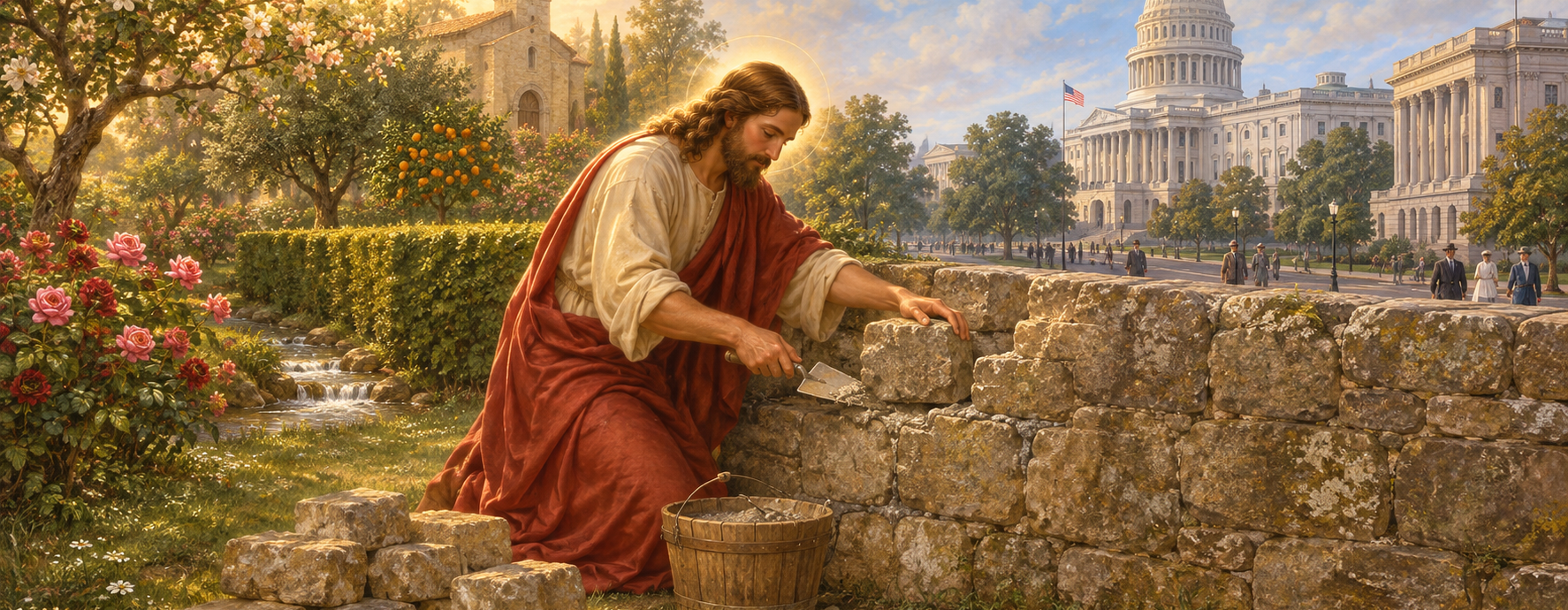
I’ve been rereading The Name of the Rose by Umberto Eco, and one scene really captured my interest. It wasn’t the dark, labyrinthine library or the macabre murders. It was the combative debate between the religious scholars.
Delegates representing the Pope in Avignon came to defend his ruling that it was heresy to claim Christ and the apostles owned nothing. A delegation from the Franciscan order came to defend exactly that claim, with obvious implications for a very wealthy papal court. Seated opposite each other, these learned men soon started furiously firing off verses like volleys of arrows raining upon the other side. They cited scripture and the writings of the saints to distinguish owning from using, perishable from non-perishable goods, and all manner of other distinctions. The scholarly debate quickly degraded into insults, threats, and finally blows.
The questions raised in the debate over material possessions could not help but become entangled with even stickier questions regarding the rightful domain of the clergy under the Pope and the secular government of the emperor. That is the very thread Brother William of Baskerville yanks when, once tempers have cooled, he is asked to present the views of the emperor’s theologians.
What he offers, with his mild, reluctant oration, is a softly thundering case for the separation of church and state.
One might expect that from a novel published in 1980. What surprised me was the specific argument he makes. William doesn’t say that sensible men have concluded that society works better if we keep religion out of government. He instead argues that God set it up that way. Separation is not a human compromise imposed on the faithful. It is separation that God prefers, even demands.
I had never heard a religious argument for separation beyond the usual point that it actually protects religious freedom. I suspect most Americans haven’t either.
It’s worth emphasizing that Brother William is not a modern rationalist smuggled into a fourteenth-century period piece. Sean Connery does play him that way in the movie. But in the book, Brother William is an authentic Franciscan, steeped in the religious thinking of his time, and he believes every word of it. That’s what makes his case land.
His reasoning goes roughly like this.
God’s command not to eat of the forbidden tree was divine law. But God gave Adam and his descendants power over the things of this earth and let Adam name the animals as he saw fit. The ordinary business of running the world, in other words, God handed over to us.
Pagans and infidels govern themselves too, William points out, and some of them, like the emperor Trajan, did it well. Where did they get that ability? Not from their false gods, and certainly not from the Pope. It could only have come from God directly. So political authority was “ordained by God beyond all ecclesiastical confirmation and even before our holy religion was founded.”
Then he adds the kicker. Christ came to submit to Caesar’s laws, not to command. He never gave his apostles coercive power. “If Christ had wanted his priests to obtain coercive power, he would have laid down specific precepts as Moses did in the ancient law. He did not do it; therefore he did not wish it. Or does someone want to suggest the idea that he did wish it but lacked the time or the ability to say so in three years of preaching?”
That is a powerful biblical argument. It flips the burden of proof onto the side seeking power. You want the church to dictate civil law and wield the sword? Show me where Jesus said so.
William even lands a theological blow against clerical coercion in matters of faith. No one can be tortured into following the Gospel, he says, “otherwise what would become of that free will on the exercising of which each of us will be judged in the next world?” If salvation depends on free choice, then coerced faith is worthless. It isn’t faith at all. And religious authority wielding the power of the state is coercion by definition.
To be fair, William is making the same sort of faith-based arguments as everyone else in that room. They all squeeze the deepest meanings out of the most mundane details of scripture, and William builds part of his case for elected, secular legislatures on Adam naming the animals. But within their religious context, he makes powerful arguments.
Here’s what really surprised me when I researched these views. William’s speech is not Umberto Eco being clever. Eco was dramatizing actual religious scholarship. William’s arguments are very nearly a paraphrase of a real book written in 1324, Marsilius of Padua’s Defensor Pacis, and William even names Marsilius as one of his brethren in the speech.
Marsilius argued that Christ “did not come into the world to rule men, or to judge them by civil judgment, nor to govern in a temporal sense, but rather to subject Himself to the state and condition of this world,” and that by word and example He excluded His apostles and their successors “from all governing and worldly, that is, coercive rule.” (Defensor Pacis) The priest, he said, is a physician of the soul who “neither can nor should hold anyone to such things by coercive power in this world.” (Stanford Encyclopedia of Philosophy) Even William’s odd phrase about “the better part of the citizens” comes straight from Marsilius’s valentior pars, the “weightier part” of the people who make the laws.
Appreciate how important this is. Seven hundred years ago, Christian scholars were arguing in theological terms that the church should hold no coercive power over anyone, and that making and enforcing law belonged to the people and their rulers. Marsilius actually went further than most of us would today, putting even church appointments under civil authority. But the core idea was there. Nobody had to wait for the Enlightenment, let alone our Founding Fathers, to come up with it.
Fast forward three centuries. The man who first wrote of a “wall of separation” wasn’t Thomas Jefferson. It was Roger Williams, a Puritan minister banished from Massachusetts for his views, who went on to found Rhode Island.
In 1644 he wrote that whenever God’s people “opened a gap in the hedge or wall of separation between the garden of the church and the wilderness of the world, God hath ever broke down the wall itself, removed the candlestick, and made His garden a wilderness.” (Smithsonian)
Notice which way that wall faces. Roger Williams wasn’t protecting government from religion. He was protecting the church from government. Mixing the two, in his view, didn’t make the state holier. It made the church worldly. He put it more bluntly elsewhere: “Forced worship stinks in God’s nostrils.” He considered Constantine, the emperor who made Christianity official, a worse enemy of the faith than Nero, who fed Christians to the lions. (Wikipedia)
Think about that for a moment. Back in 1644, Roger Williams was saying that a ruler who embraces Christianity and puts it to work for the state does it more harm than one who persecutes it.
James Madison made a similar argument in 1785 when Virginia proposed taxing citizens to support Christian teachers. His objection opened not with politics but with God: religious liberty is unalienable “because what is here a right towards men, is a duty towards the Creator,” a duty that comes before “the claims of Civil Society.” (Founders Online) In other words, your duty to God comes first, so government has no business in it.
And then there’s that famous Jefferson letter. In 2022, Rep. Lauren Boebert told a church congregation that “the church is supposed to direct the government,” adding, “I’m tired of this separation of church and state junk that’s not in the Constitution. It was in a stinking letter, and it means nothing like what they say it does.” (Washington Post)
That line packs in two claims, and it’s a common talking point, so it’s worth unpacking. The first is that “separation of church and state” appears nowhere in the Constitution. That’s true. The phrase comes from a letter Jefferson wrote in 1802, so the argument goes that it’s one man’s private opinion with no legal force. The second claim is that even the letter has been twisted. On this telling, Jefferson’s wall was only meant to keep government out of the church, never to keep the church out of government.
The first claim ignores that the Supreme Court adopted Jefferson’s phrase as its reading of the First Amendment, first in 1879 and then emphatically in 1947. The second falls apart once you ask who that stinking letter was written to, and why.
It was written to Baptists.
The Danbury Baptist Association wrote to Jefferson in 1801 because Connecticut still had an established church, and they were tired of holding their religious freedom “as favors granted, and not as inalienable rights.” Religion, they wrote, “is at all times and places a Matter between God and Individuals,” and “the legitimate Power of civil Government extends no further than to punish the man who works ill to his neighbour.” They praised Jefferson because he would not “assume the prerogative of Jehovah and make Laws to govern the Kingdom of Christ.” (Founders Online)
The prerogative of Jehovah. That’s the Baptists talking, not the atheists. To them, a government making religious law was usurping God’s job. And a government limited to punishing people who harm their neighbors is about as far from “the church is supposed to direct the government” as you can get. Jefferson’s famous reply simply agreed with them.
Nor is this ancient history. The Southern Baptist Convention’s statement of faith still says it plainly: “Church and state should be separate… A free church in a free state is the Christian ideal.” (Baptist Faith and Message 2000)
The Catholic Church took longer. In 1864, Pope Pius IX listed “The Church ought to be separated from the State, and the State from the Church” among the errors of the modern age. (Syllabus of Errors) A century later, the Second Vatican Council declared that “the truth cannot impose itself except by virtue of its own truth, as it makes its entrance into the mind at once quietly and with power.” (Dignitatis Humanae) That isn’t American-style separation, exactly, but it is Brother William’s core point: faith cannot be imposed by force. The Avignon delegation would have been appalled.
Yet Pew found in 2022 that 45 percent of Americans say the country should be a “Christian nation,” and that among them, 54 percent say the Bible should take precedence over the will of the people when the two conflict. (Pew Research Center) Most Americans, including most Christians, still say churches should stay out of politics. But a large and vocal share of believers now hear separation as something nonbelievers use against them.
How did that happen? I’d suggest two reasons.
First, the religious argument won and then went quiet. Once Massachusetts ended the last state church in 1833, believers no longer needed to make the theological case, and over time it was forgotten. In the twentieth century the courts took over, declaring in 1947 that the wall “must be kept high and impregnable” (Everson v. Board of Education) and striking down official school prayer in the early 1960s. Courts speak in neutral legal language, as they must, and the plaintiffs were often nonbelievers or religious minorities. So the public face of separation became a lawsuit against a prayer, and the theology that built the wall disappeared behind it.
Second, it’s easier to love the wall when you’re the minority it protects. The Danbury Baptists were outsiders paying taxes to someone else’s church. To a minority, the wall is a shield. To a majority used to setting the tone, the same wall can start to feel like a fence.
I’ve always argued that separation protects religious freedom as much as it limits religious influence. That’s true, but it still treats separation as a sort of territorial treaty.
For those on the religious side, Marsilius, Roger Williams, Madison, the Danbury Baptists, and Vatican II were all offering a much more attractive proposition. They weren’t saying separation is a sensible compromise. They were saying it is what God wants. That forced faith isn’t faith. That God doesn’t want worship at the point of a sword or under the duress of legislation. Madison called using religion as “an engine of Civil policy” “an unhallowed perversion of the means of salvation.” Putting the state to work for God doesn’t elevate Him. It debases Him.
So here’s my plea.
First, stop thinking of separation of church and state as a secular attack. It isn’t. Some of its most forceful champions were deeply devout men who believed God wanted separation. The secular argument came later and borrowed their wall metaphor.
Second, recognize that serious religious thinkers came to see the wisdom in it, Protestant dissenters for centuries and the Catholic Church since the 1960s. Baptists were jailed for it. Their descendants still write it into their confession of faith. The idea that true believers should want the church to “direct the government” isn’t the tradition. It’s a sharp departure from it.
If you are a Christian who wants the government to enforce or even promote your faith, you might ask yourself Brother William’s question. If Christ wanted that, why didn’t He say so? He had three years. He seems to have managed to say everything else.
Or, to put it succinctly, if you are working to tear down the wall between church and state, you may not be doing God’s work at all. In the view of Marsilius, Roger Williams, and the Danbury Baptists, you might just be the heretic.

