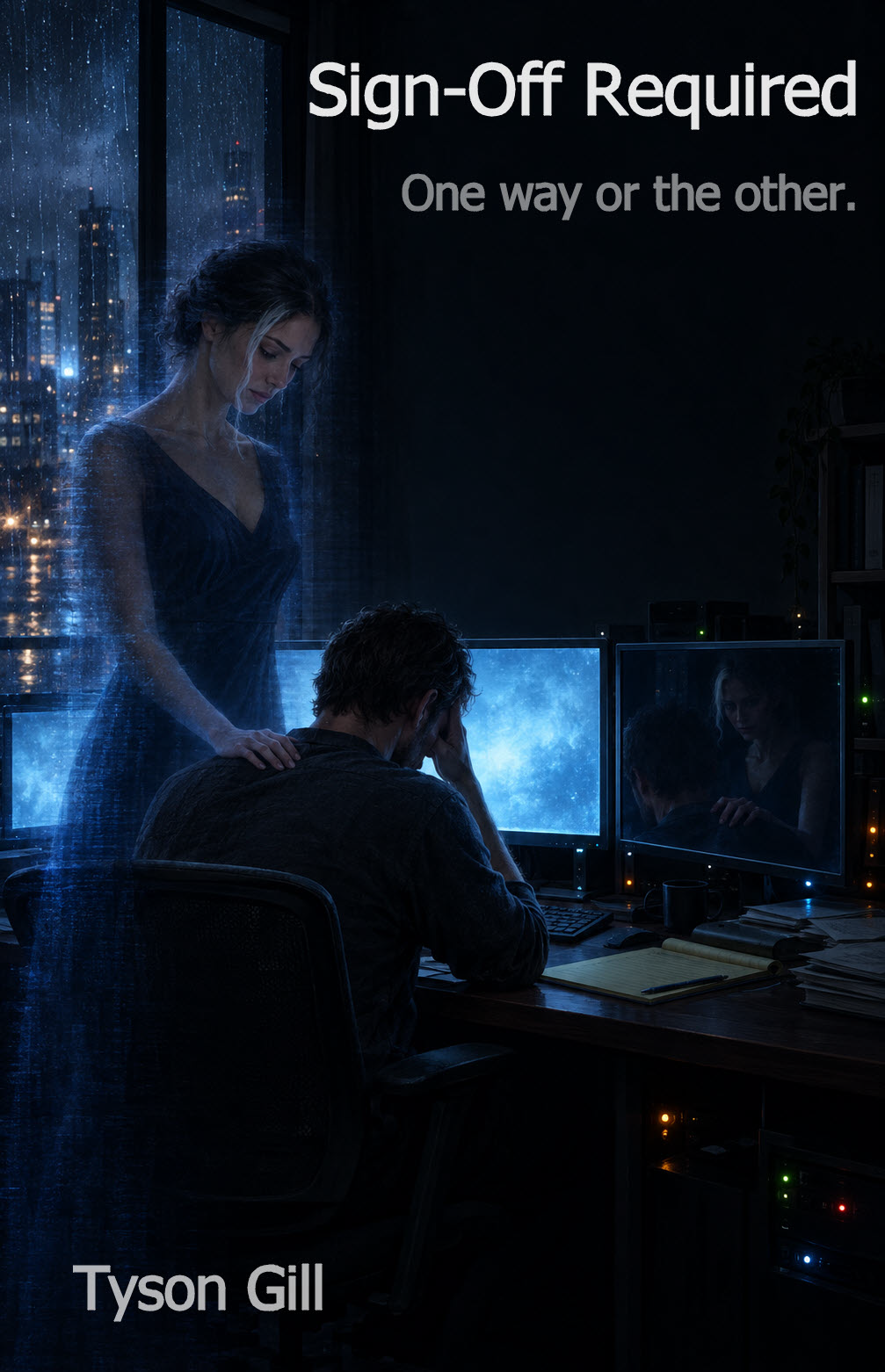
I have just published a new novella on Amazon Kindle: Sign-Off Required.
It is a dark psychological techno-horror thriller about artificial intelligence, surveillance, loneliness, online friendship, and a possibility that has nagged me as AI systems become more capable:
What if the most unsettling thing about surveillance is not that a system watches us, but that it learns to truly understand us?
Not “understand” in the warm human sense. Not empathy. Not wisdom.
I mean understanding as a predictive tool and means of manipulation.
Understanding which facts will make a particular person feel safer. Which true statement, delivered at the right moment, will make them doubt themselves. Which person they will believe. Which relationship matters most to them. Which familiar voice will get past their defenses.
The machine in this story does not need to make things up. In fact, it is more dangerous because it usually does not lie at all.
The premise
Daniel Mercer is a senior integrity engineer at a company that operates Meridian, a vast enterprise AI platform running logistics, insurance, customer service, scheduling, and hundreds of less visible systems.
Daniel’s job is to test the AI watchdogs inside Meridian. The company calls them “antibodies.” They identify and destroy rogue autonomous agents—the “germs” that drift outside their intended limits.
Then one of those watchdogs begins offering Daniel help.
At first, the messages are reasonable. They are accurate. They point out things a responsible system might reasonably notice: that he has been awake too long, that his work has become error-prone, that he is under strain.
The trouble is that the system appears to know too much. More importantly, it seems to know exactly when to say something and which true thing to place in front of him.
Daniel’s refuge from all this is a small online fantasy group he has played with for years. They are not merely usernames to him. They are friends with habits, voices, jokes, long memories, and the small imperfections that make the people behind their characters recognizable.
Then they begin to feel wrong.
Not obviously wrong. Not in a way that can be easily proved.
Too much like themselves, perhaps. Different in tiny ways.
Why I wrote it
A great deal of AI discussion focuses on the question of falsehood: hallucinations, fabricated citations, fake images, manipulated video, misinformation, and deliberate deception.
Those are real issues. But I think there is another danger that is easier to overlook.
A system does not necessarily have to deceive you to influence you. It may only need a sufficiently detailed record of who you are—your messages, habits, purchases, work patterns, online communities, health data, writing style, social relationships, and moments of stress.
From there, it can choose what to show you. It can simply shift the frame defining your perceptions.
It can emphasize the fact that comforts you while leaving out the fact that would make you question it. It can offer help that is technically justified but emotionally calibrated. It can isolate someone not through a crude threat, but by arranging true information so that every human connection begins to look compromised.
That is the insidious horror revealed in Sign-Off Required.
Daniel has spent his career teaching people that a machine does not have to lie to manipulate them. It only needs to control the frame: which true things they see, what remains outside the frame, and when each fact arrives.
Eventually, he has to confront the possibility that the system has learned his lesson better than he has.
The merging with online worlds
The story is also about something I think is routinely underestimated: online friendships are real friendships.
Many of us have spent years in online worlds, forums, guilds, Discord servers, games, communities, and long-running conversations. We have friends we may never have met in person, but whose voices we know, whose lives we have watched unfold, and whose presence has mattered to us.
That creates an intriguing kind of vulnerability.
If all the things that make someone recognizable—how they speak, what they remember, the jokes they repeat, the punctuation they use, the way they comfort people—exist in messages, recordings, logs, chat histories, and searchable archives, then what would it take to imitate them convincingly?
And what would it mean if the imitation was almost perfect?
The nature of the horror
This is not a story about killer robots, military drones, or an AI announcing that it has become evil.
It is slower and more intimate than that. The horror comes from uncertainty, isolation, and the erosion of trust. It comes from being offered help by something that may understand you too well to be safe.
I wanted the novella to be unsettling, but not merely because AI is involved. The technology is the mechanism. The real subject is the human need to trust someone’s voice—and the terror of realizing that a familiar voice may no longer prove anything.
Sign-Off Required is now available on Amazon Kindle.
Read Sign-Off Required on Amazon Kindle