Category Archives: Science

If Only I Had a Photographic Memory!

Few of us probably remember the 1968 B-film cult classic Barbarella. In that fantasy story the naively buxom Barbarella battled the sadistic Durand-Durand and the evilly beautiful Dark Tyrant. One notable character in this sex romp was the blind angel Pygar. The white-winged angel befriends Barbarella but is then kidnapped and cruelly tortured by the Dark Tyrant.

pygarIn the climax of the film, with the city exploding around them, Pygar swoops down and rescues both Barbarella and the Dark Tyrant, flying off with one woman in each arm. Barbarella looks up at his angelic face, confused, and says “Pygar, why did you save her, after all the terrible things she did to you?” Pygar answers serenely, “Angels have no memory.”
It’s an interesting thought. Angels have no memory. Perhaps only without memory can one really be an angel. Perhaps memory makes us just too bitter, too angry, to resentful, too hurt to be truly forgiving. Perhaps it just isn’t possible to remember every hurt one caused you and still fully forgive them. Perhaps those memories must be sacrificed to gain your wings.

There is data to support this premise.  Researches have looked at individuals on both extremes of memory. They have studied those rare individuals who have no long-term memory – who cannot recall anything beyond very recent events. They have compared those individuals to those equally rare individuals with nearly perfect recall, people who can exactly remember almost every incident, no matter how unremarkable, that they ever experienced.

When you compare these two groups, you see clear differences. Those with impaired long-term memory tend to be quite happy and contented while those with exceptional long-term memory tend to be quite unhappy, depressed, angry, and even suicidal. Apparently, having perfect memory takes its toll. One cannot forget every slight, every insult, every disappointment, and every disillusionment. Such unselective memories make one quite unhappy. Not having memories can be a blessing.

On the other hand, those with perfect memories tend to be excellent networkers. They recall every birthday, every anniversary, and every name. So they tend to have lots of social support that can offset their hurtful memories. Those with poor memories on the other hand tend to have few social contact and fewer friends. The cost of happiness may be loneliness and the loss of social connectivity. Are they then still happy? Kind of a sad internal contradiction.

Don’t hire an angel to become your salesperson and don’t expect them to win celebrity Jeopardy.

Thankfully most of us aren’t angels with no memory and we aren’t elephants who never forget a slight and stomp their trainer into a bloody pulp years later. We lie in the broad middle of the spectrum. I am certainly no angel but I think I lie off toward the bad memory end of the continuum. I have a terrible memory but am pretty free from regrets and grudges. But I’m also quite bad at social networking as I am hopeless at remembering things, let alone birthdays and anniversaries. I’ve wisely perhaps stayed away from professions that rely upon memory and entered instead into a career where things change quickly, where continually looking up current information is an advantage.

Many of us imagine that perfect memory would be kind of a cool superpower but that such recall is just not really possible. But it is clearly possible and evolution is wise enough not to give us what we think we want. Sometimes less is better. We could have much better smell or hearing or taste, for example, and some people do and it makes them painfully miserable. Longer lifespans are apparently possible as well, but evolution knows that longer lifespans are not actually a good thing for the individual or for the species.

Evolution has given us the balance of memory we need to make us both functional and happy. If technology eventually lets us override evolution on this, we may regret being burdened with all those painful best-forgotten memories.

What Aliens Look Like

We aren’t likely to ever meet an alien. As I argued in a previous post, although it is a statistical certainty that alien life must exist, the laws of physics simply make it implausibly improbable that they could ever visit us or we them (see here). The most likely way we might learn what aliens once looked like would be if we happen to pick up an interstellar message in a bottle from some distant ancient civilization, their own version of Voyager with candid snapshots and videos from back home.

But we can make educated guesses based on the fundamental design constraints of the elemental building blocks and physical processes that apply throughout the universe. For example, intelligent aliens must have a lower and upper size limit based on fundamental constraints of molecular dimensions and gravity.

We can similarly surmise much more. For example, any intelligent alien species is likely to be highly mobile – for that they require large bursts of energy – for that they require a fluid chemical transfer system – for that they require a variable speed pump controlled by a central nervous system that adjusts the amplitude and frequency of pumping based upon a large amount of sensor data – and that control mechanism would have to be autonomic so that the pumping controller is highly responsive and unaffected by their state of consciousness.

So, intelligent alien species are likely to have circulatory and nervous systems that are mechanically and functionally quite similar to our own. For vision they are likely to have two sensors placed up high for optimum line of sight and depth perception. They are likely to be similarly similar in the design of their other major systems. In short, after looking past superficial differences, alien life would almost certainly be quite familiar to human physicians and biologists.

It would be foolishly egotistical to imagine that all alien life will be exactly like us and the other species present on Earth. Certainly there would be dramatic and astounding variations that we cannot begin to imagine. But it would also be equally foolish to imagine that the bulk of species in the universe would not evolve following much the same processes with much the same results as life here. A human exobiologist could almost certainly be trained to understand, diagnose, and treat almost any form of alien life.

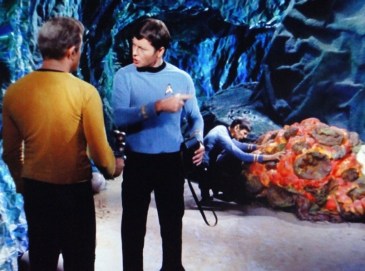
hortaIn Star Trek, after Doctor McCoy got over his initial revulsion (You expect me to treat that thing Jim?!?), he was able to patch up even the exotically alien silicon-based Horta with some simple spackle compound.

But apart from exceptions like the Horta, Star Trek and most every science fiction universe depicts very human-like aliens. This implicit assumption of similarity is made mostly so that alien creatures will be relatable and to make them playable by human actors with minimal make-up and costumes.

AlienBut we create human-like creatures even when there are no technical constraints. The astoundingly terrifying alien created by HR Giger is remarkably human-like with 2 arms, 2 legs, a head, a tail, a mouth, and so on. Despite having acid for blood, his alien follows the evolutionary design model of a human quite closely. It is likely not the case, as many imagine, that such alien depictions represent an unimaginative human conceit and lack of imagination. Rather, it is likely that such physics-defying aliens are actually much more fanciful than evolution is mechanically capable of producing – on any planet.

And let me be clear. Its unfathomably unlikely that any alien could remotely pass as human and walk amongst us undetected – that’s purely a movie fancy as unrealistic as aliens with acid for blood that can eat through feet of metal. However, they will be biologically similar in function if not form. They will not have any superpowers or godlike abilities that defy basic chemistry and physics because they can not. If they can fly they will need wings. And as any dolphin can tell you, there is a fundamental limit to how far they could advance without appendages that allow them to manipulate their environment.

Even many of us who are wise enough to understand that god cannot exist are still far too willing to remain agnostic in insisting that there might be aliens out there with what would effectively be godlike powers.

If my hypothesis of fundamental similarity is true, and I suggest that it must be more true than not, it should encourage us that we’re not actually missing out on as much as we might imagine because we are effectively bed-ridden here on Earth. Aliens would be marvelous to see, but evolution has offered us a pretty representative sampling of the range of life typically found in the universe.

Unless a message in a bottle lands on our Earthly beaches, we’re unlikely to ever know for sure how typical we are. Even then, that would give us only one more example of life. But we can make some pretty good assumptions about the nature of life in the universe without direct experience. And it is likely that the range of actual life in the universe is no where near as wide as our unconstrained imaginations.

So what do aliens look like? Probably a lot more like us than we might imagine.


Alexa, Like This Article

Back in 1966 we watched Captain Kirk chat with Mr. Spock through his Starfleet issue flip phone communicator. Such technology was so fantastic back then that that most people assumed we’d have to wait until 2265 for personal wireless communications. Little did we know that in 1996, just a mere 30 years later, Motorola would release the StarTAC flip-phone (StarTAC, StarTrek, hmm). Although it had buttons instead of a tuning dial, it was essentially the same design and functionality as those Starfleet Communicators.

Despite the futuristic awesomeness of the flip-phone, most people back in 1996 didn’t see much value in wireless phones. Why do we need them? Our trusty old Ma Bell phone works just fine! People could not imagine that soon they’d spend a huge part of their day with their head bent over their cell phones.  And so it is with most every new innovation. At first no one can imagine why they’d want that new gadget – even if only a few years it would be the one thing they’d take along if stranded on a desert island.

AmazonEchoAnd here we are again. Now we have the Echo from Amazon. It is our new StarTAC flip-phone. Remember how the Enterprise computer spoke with Kirk wherever he happened to be? Echo is our own personal Enterprise computer. It is Tony Stark’s Jarvis – before getting incarnated as Vision. It is Gideon, the AI of the Waverider from Legends of Tomorrow. Well the start of Jarvis and Gideon at least. Most people don’t see it as anything more than a novelty. But today it’s already immensely useful. Tomorrow it’ll be as indispensable to our households as electricity.

The Echo is a simple device, elegantly simple. It is a small cylinder you place centrally in your house, plug it in, let it connect to your WIFI, and start talking to it. The Echo is mostly speaker, and a pretty good one. I have always been a hardcore audiophile and I’m happy enough with the quality. The rest of it is just a WIFI device that communicates with a very pleasant and smart woman named Alexa whom I assume works 24/7 at Amazon just to talk to me. Just ask Alexa something, anything, and she’ll respond in her reassuringly competent voice with helpful information. Alexa isn’t quite “Her” but she’s pretty insightful.

Alexa, what time is it?
Alexa, spell consensus.
Alexa, what is the population of Uruguay?
Alexa, what’s in the news today?
Alexa, play Enchanted by Taylor Swift.
Alexa, read about Deadpool on Wikipedia.
Alexa, wake me at 8 A.M.
Alexa, set a timer for 15 minutes.
Alexa, put peanut butter cookies on my shopping list.
Alexa, what’s another word for amazing?
Alexa, why is the sky blue?
Alexa, when was Kennedy president?
Alexa, who is the Speaker of the House?
Alexa, play Ratatat Radio on Pandora.
Alexa, what is 34 + 75 + 26?
Alexa, what’s on my calendar tomorrow?
Alexa, what was Mark Twain’s real name?
Alexa, continue reading Night Without End by Alistair MacLean.

I know, I know, big deal. I tried Siri. She lost her attraction pretty quickly. Don’t talk to her much anymore. Have flirted with Cortana too I guess. Don’t talk to her that at all. I could look up any of those questions just as quickly on my phone. I’m pretty good with my thumbs. Voice is just a novelty gimmick with little real value.

How wrong you are. The big deal here is not what it does but how it does it. Sure, you could stop what you’re doing, get your phone, find an app, select some options, type in some stuff, and read an answer. Or, you could just conversationally mumble “Alexa, how many tablespoons in an ounce” from the kitchen while you continue to stir your batter. While you’re tying your shoes in the morning you can just ask “Alexa, will it rain today?” You don’t need to make a mental note to listen to “Scenes from an Italian Restaurant” after you finish your soak in the tub. Just ask Alexa to play it for you.

Even in its current young form, Alexa is incredibly empowering. I find myself asking tons of questions and making many more casual requests than I would have if I had to go to my computer or my phone. It deeply enriches my life with a world of information not at my fingertips, but simply “in the air” of my house.

Alexa is has access to the Internet but it is also essentially a platform for third party applications. Other third parties can write Alexa “skills” to do pretty much anything. Right now, most skills are pretty silly. Why people write take the time to write skills to tell jokes or play random dog barks is beyond me. But the potential for far more serious stuff is there and they will come in the near future. Alexa and successors like it will continue to get more and more powerful. Soon you will be able to ask them questions like “what percentage of males under 35 voted for Donald Trump in North Carolina as compared to females in the same age group?” Through 3rd party skills you’ll be able to give directions like “let my uncle Joe into the house when he arrives today.” The possibilities extend far beyond my imagination.

But you don’t need to wait for another 20 years or even another 10 years. Alexa can enrich your life in subtle but dramatic ways right now. You can already free yourself from your “mobile” device in liberating ways with an even more intimate connection to the world. Do I have an ulterior motive in trying to get you to buy an Echo? Damn right I do. Every Echo that you purchase pulls those amazing new killer skills out of the distant future and into my immediate future.

Alexa, where is the nearest coconut on this desert island?

Satisfaction Surveys

SatisfactionSurveyHave you ever filled out one of those ubiquitous satisfaction surveys? Of course you have. Everyone wants to know how satisfied you are. Whether it be your phone company or your local dry cleaner or your waiter, everyone is keen to quantify, record, and report your level of customer satisfaction.

But despite the fact that satisfaction surveys are as annoyingly common as pennies, how truly useful are they? If you’re anything like me, you probably don’t provide exactly high quality response data to these surveys. If I cannot escape the survey without being rude, I just check “Excellent” for everything without even reading the questions. It’s the easiest thing to do. And what direct benefit is there in it for me to be thoughtful and honest? I’m much more likely to get better service next time if I indicate that my waitress is excellent in every possible way, especially if she was terrible!

And there are lots of reasons beyond immediate self-interest and laziness that most of us lie like Persian rugs on these surveys:

  1. People forget the bad stuff. We have selective memories, and the longer it is after our terrible customer experience, the more likely we are to remember it positively.
  2. People never want to seem like complainers. Even if we had gripes, we are programmed that complaining only reflects badly on us.
  3. People are nice. We don’t want to hurt anyone’s feelings unnecessarily – even if we are anonymous.
  4. People are habituated to say “I’m fine.” Even if we’re in the middle of vomiting up our lunch after being told that our beloved kitty just got electrocuted attacking an electrical outlet, we automatically say we’re fine.
  5. We assume no one <really> wants to know. We figure that this is pointless paperwork that no one will ever actually read let alone act on it.
  6. Saying everything was wonderful is the easiest way to dispense with this annoying and meaningless survey and get home in time for The Walking Dead.

Here’s an even bigger problem worth discussing in depth. We don’t know what we don’t know and have poor imaginations to envision what we could have. Satisfied compared to what? How do you rate your Toyota? Excellent. Oh wait, I didn’t realize I could have had a Porsche instead… Can I change that answer to Poor?

How do you rate your healthcare? Excellent? Great! But did you know that Norway has a healthcare system that costs ½ the price and ranks 11th to your 37th? Would you like to change your survey answer?

Since we don’t know what we don’t know let alone what we cannot even imagine, Poor to Excellent is not an absolute scale. It only encompasses what we know. If we’re given a dozen similarly bad options, we’re likely to rate the least worst of them Excellent. By the way, this is one of the reasons that “happiness scientists” tell us that more choices make us less happy. We become less satisfied with what we can get if we are made aware of all the better options that we cannot hope to get our hands on.

I have a more nefarious theory about these surveys. I think that smart customer service providers offer these surveys knowing all of this, but they figure that when you indicate that their service was great you’ll actually remember it as being great. Probably sound psychology!

But here’s the biggest problem with these victim-less white lies called satisfaction surveys. We sometimes really, really do need an accurate answer to assess satisfaction. We have lots of important social science studies that have little choice but to measure satisfaction through this sort of survey. Unfortunately, for all the reasons given, this data is usually just so much garbage in.

We need smarter measures of satisfaction.

One solution is to de-emphasize or even abandon the self-reporting of satisfaction measures. Instead, smart companies or researchers measure indirect indicators of satisfaction. Rather than ask for a self-reported satisfaction, they look at objective behaviors that correlate with satisfaction.

For example, given a subsequent choice of options, what option does the person actually choose? Do they recommend the option to others? Instead of asking whether they like the coffee or the ambiance of the restaurant, measure how many refills they ask for and how long they remain to digest and converse over their coffee.

Satisfaction surveys are just a microcosm within a wide range of human behaviors. In almost every situation dealing with people, looking at actual behaviors can tell us far, far more than relying upon anything they tell us about their motivations or their opinions.

Dismissed with Prejudice

ElvisDo you have one of those wacky friends? The ones with a deep, sincere, heartfelt conviction that Elvis still lives. That he is actually in seclusion preparing for his epic comeback? Busy rehearsing for the ultimate Elvis concert that will transform the world?
Your friend undoubtedly has an articulate rebuttal for every possible reason you can throw at him for dismissing the possibility that Elvis might still be alive. His death was staged. The witnesses are all in on it. The corpse in Graceland is a DNA-identical clone of him. He is being kept young by a chemical concoction that the pharmaceutical industry has suppressed.

Your friend probably turns the tables on your skepticism quite easily. How can you be so arrogant to claim to know everything? Are you that close-minded? Surely you can’t prove and therefore can’t know for certain that he isn’t still alive. If you are as scientifically open-minded as you claim you must admit some possibility that he might still be alive. Surely you can admit that reasonable people can disagree on this unless you believe he is dead purely as a matter of faith. The only intellectually honest position on this question must be agnosticism.

Your friend points to several well-regarded scientists who admit that it is possible Elvis is alive. He recommends a plethora of scholarly books that debunk all those fallacious “scientific” arguments claiming that Elvis is dead.

Or perhaps your friend has a different but similarly wacky belief that he clings to and argues for with great passion.

All that was my way of setting the stage for the real point of this article – that I do not need to read any of those books purporting to prove that Elvis might be alive. Elvis is dead. Period. Any book that starts with the premise that he may still be alive is necessarily idiotic. There is no need for me to actually read them in order to legitimately dismiss them out of hand. Good scientists dismiss an infinite number of implausible claims all the time every day.

So there is no need for me to entertain arguments about how Elvis might still be alive. And there is no reason for me to read a book that starts with the premise that Elvis is alive or the Holocaust did not happen or the Moon landing was faked or alien overlords built the pyramids. I can dismiss them all out of hand without even reading the book jacket. The only reason to read them may be if your interest is studying delusional thinking or the infection of magical thinking amongst otherwise healthy individuals.

And I have read a great many of these books that purport to present a logical or scientific argument for at least allowing the possibility that god might exist. When I wrote my book Belief in Science and the Science of Belief (see here) I took the time to slog through a 4-foot stack of books that undoubtedly made Amazon the lucrative enterprise it is today. It was largely a waste of time and money on my part. Believers have had two millennia to come up with arguments so there are simply no new ones to be found.

As a concrete example, I bought several books on Neurotheology (see here). I did the world a service by throwing these out rather than reselling them. Written by Andrew B. Newberg and a host of his followers, these books typically spend 250 pages citing brain imaging and cognitive studies related to belief and god. Their real goal is to establish their science creds so that you will believe them when, in the last 50 pages, they leap to outlandish claims that go something like “since we have clearly evolved to believe in god, the only conclusion must be that god himself designed us to believe in him.”

The only conclusion is that this is an idiotic conclusion. But then again what can you hope to get from any author that starts from the silly premise that god exists and works backwards?

Religious books purporting to be scientifically legitimate examinations of the “evidence” for god pop up on Amazon every day like so many weeds. I can’t read them all but I can still dismiss them all out of hand. There simply is no god, can be no god, and therefore every book claiming to argue this point is necessarily as idiotic as books arguing that Elvis is alive and well and living in a secret wing of Graceland.

And thus, dear reader, we finally reach the heart of my dilemma: Do I read these silly books and respond to them or do I simply ignore them?

Ignoring them is not easy. If no one pushes back on them, they seem to win the argument. And there are so many of them saying the same silly things that many readers mistake quantity as an indication of quality. On the other hand, the time for engaging these silly debates is over. At this stage of the atheist movement, we must move past engaging in and thereby legitimizing these ridiculous debates. We should give no more consideration to religious ideas than we do to racist ideas or homophobic ideas or sexist ideas or the idea that Elvis is amongst us.

Still it’s hard to resist getting sucked in. Recently a new book appeared on Amazon called “Can Science Explain Religion” (see here) written by a priest who is also a Professor of Religion. It apparently “debunks” the very theory of the evolution of belief that I present in my own book. Do I buy this and read it so I can credibly criticize it and defend my position, and thereby risk encouraging this nonsense? Or is it best not to even respond and hope that the rest of the country follows my sensible example?

After struggling with this dilemma for many years, I have come to believe that refusing to engage is the best strategy moving forward. Engaging in further debate with them only feeds the beast. Like booing Donald Trump at a rally.

It’s not an easy course of action nor is it without risk or criticism. But in science, we must first ask whether our basic assumptions are valid before we enter into discussions of the resulting questions. We must not let ourselves get caught up in grand debates over how Santa manages to deliver all those presents in one night when the very premise of Santa is pure fantasy.

And that is how we should respond to these books and these arguments – by dismissing them out of hand and with great prejudice and by refusing to entertain dependent arguments arising out of purely implausible assumptions.


The Winter Solstice

SolsticeDecember 22nd is the Winter Solstice in the Northern Hemisphere. It is the shortest day and longest night of the year. On this day, the noon Sun is at the lowest point of the year, lower the further north you are.

The solstice is the one universal event that all of us humans share in common each year. It has always been the most powerful recurring event in our shared human experience.

This annual solar phenomenon connects us viscerally to all of humanity; to all those living now as well as all those who lived before us. Virtually every culture that has existed has celebrated the Winter Solstice.

Surely every tribe extending back to the very first humanoids able to recognize their surroundings, remember their past, and anticipate their future have noted the significance of the Winter Solstice and have been moved to fear or honor it. Each year we become a part of the unbroken chain of solstice commemorations, formal or informal, that have preceded us.

The significance of the winter solstice lies not simply in the fact that it is periodic and conspicuous, like the return of Halley’s Comet, but because it relates so intimately to our shared human experience.

For most of human history the winter solstice was a time of uncertainty and relief, of fear and hope. As we approach this cyclic transition the Sun falls lower and lower. At the solstice, it gets frighteningly close to abandoning us forever. How easy it would be for it to just sink below the horizon and never return.

Imagine the terrible apprehension this invoked in our ancestors for whom the Sun was everything. Believing that the Sun must be a real being with intelligence and emotions, how could they be assured that it had not decided to simply abandon them to eternal darkness and cold? How could they be sure that they had not done anything to offend it causing it to completely disappear, never to return?

So also imagine our ancestors’ great relief and joy when the Sun resumed its upward ascent for another year.

The Incas of Machu Picchu, for example, believed the Sun was a god named Inti. On the Winter Solstice they performed a ceremony which tied the Sun to a great hitching post of stone in order to prevent it from escaping. The Mapuche people of Chile would stay up all night on that longest night out of fear that dawn may never come again. Only after 3 days, when it became evident that the Sun had returned, would they emerge to celebrate the New Year.

Today of course we know that the Sun will never go away, well not for another 5 billion years at least, but it is still everything to us and we still have compelling reasons for commemorating the solstice.

One day, if we continue our foolish disregard for our planet, if we allow our short-sightedness and greed to destroy our atmosphere, we may no longer be here to appreciate the life-giving gifts of the Sun.

It would be not the Sun who abandons us, but rather we who abandon him, leaving him one again alone and unappreciated in a lifeless solar system.

Sometimes I think that we would be better off still believing that the Sun is a godlike being that we might offend by mistreating animals or ruining the land or spoiling the waters or polluting the air. Perhaps then we would show more appreciation and be less inclined to sully and squander all those precious gifts.

So join our ancestors in once again recognizing the Winter Solstice and contemplating our tenuous place in the universe. As it was with them, the Winter Solstice gives us pause to look back in appreciation for what the Sun has given us and to think about the hard work we must do to ensure another bountiful spring harvest.  It is a time when we humbly celebrate the New Year not of man, but the New Year of our Sun and Earth.


Evolution Did It!

While serving in the Peace Corps in rural South Africa, I loved to visit different schools to talk about science. One of my favorite activities was playing the “Why” game. I’d encourage the kids to ask “Why” about anything at all and we’d use scientific thinking to formulate hypotheses.

It would take a while to coax even one “Why” out of the kids as they were totally unfamiliar with any kind of meaningful dialog with a teacher. When I invited them to ask “Why” questions, the only responses I got were dazed and confused expressions. Students were seldom encouraged to ask any questions, and if they did the only answer they were likely to get was “because it is” or “god made it that way.” But clearly those answers are not really satisfying because as soon as just one kid bravely took the chance to venture a question, the floodgates of pent-up curiosity unfailingly broke loose and a deluge of “Why” questions came pouring out from the entire class.

Tellingly, one of very first questions was inevitably “Why am I black while you are white?”

Now that might seem like a tricky question but it isn’t really hard at all. In everything to do with life, be it human or animal or plant or microbial, the answer to pretty much any question is “evolution.” Even if that isn’t a complete answer, it’s the perfect foundation upon which to discuss further nuances.

Why are you reading this article right now? Evolution! Granted, we could just as legitimately answer “chemistry” or “physics” and start from there. But when it comes to the traits and behaviors of living things that most kids are naturally most interested in, “evolution” is always the sensible starting point.

eggsTo get things started I would often hold up a hard-boiled egg that I typically carried around for a snack. Why do you suppose eggs are egg-shaped? This question would be met with confused looks, so I’d oil the hinges of their flood gates with squirts of evidence. Do you think it means anything that eggs of birds become increasingly oval as the land they live on becomes steeper? Within minutes we’d find ourselves testing the evolutionary importance of egg shape by rolling my lunch down a slanted desk-top and speculating on how rolling behavior can help or hinder the survival of those birds.

You don’t need to join the Peace Corps or teach school to play the “Why” game. You can play it with family and friends or even all by yourself. Think of any characteristic of living things, make it as simple or hard as you can, and start by asking why it is so. The answer of course is “evolution,” but now the real fun begins. Now you can think about “Why” that particular trait or behavior might have been an evolutionary advantage or hindrance.

To help you play the evolution game, here are some rules that are not always obvious:

1. Every trait of living things – physical, mental, behavioral, social, temperamental – all arise through evolution. Practically anything at all is fair game.

2. It is OK to personify evolution to help us talk about it. Personification makes it much easier to understand and relate how evolution works. It just needs to be understood without necessarily saying that personification is only a communication technique and that evolution does not really have motivation or intent.

3. Not all traits are necessarily helpful. Some are simply the result of innocuous mutations that don’t particularly help but they don’t hinder enough to get selected out. However the best starting hypothesis is to assume evolutionary significance. And just because we cannot imagine the significance of a trait, that doesn’t mean it has none.

4. Most traits have many advantages and disadvantages. In the grand dice-roll of evolution, the advantages of a trait must only collectively outweigh the disadvantages. In the case of egg-shapes, rolling down hills is just one of the many ways this simple trait affects the survival of that species. There are lots of right answers.

5. Evolution does not “care” about individuals. There is a rampant misconception that evolution favors the survival of individuals. This is largely a misapplication of the concept of “survival of the fittest.” This misapplication causes some to claim that examples of evolved traits that cause harm to individuals disprove evolution. Nothing could be more wrong. Evolution only cares about the species. It will happily kill individuals off, even within a species, if it helps the population to survive. Certain spider females eat their mate after fertilization. This helps the species to survive. The male is most useful as food after his job is done. Evolution holds individual lives in no particular regard.

6. Evolution does not guarantee the “best” traits. It merely makes it more likely that those random traits that happen to be good enough in a given circumstance are passed along. Our spine isn’t a good design let alone the best design. An intelligent designer would have come up with something much better. But it is good enough.

7. Evolution is not “going” anywhere. It is not “leading to” any sort of perfect human for example and mankind is not the “pinnacle” of evolution. All of evolution did not happen in order to create us.

8. Just because evolution is not going anywhere does not mean it is not going anywhere. Evolution is like a driverless car. There is no driver and it knows not where it is going. But it is definitely going somewhere nonetheless, following forces that direct it along a logical, non-random route defined by its characteristics, obstacles, terrain, and the physics of motion.

9. Evolution is not guaranteed to find a way for a species to survive change, especially rapid change. Most in fact do not survive change. Evolution certainly has not found ways for the vast majority of species on the planet to survive dramatic changes, the worst of which may be the holocaust of humanity.

10. Certain unimportant traits might have little role in survival right now, but they might either save or kill your species when the environment changes.

11. A good trait isn’t always good. Change the environment slightly and that trait that helped you survive yesterday may cause your extinction tomorrow. Belief is one of those. Just because it evolved yesterday does not mean it is not bad for us today.

12. Bad traits can be good. If a trait isn’t bad enough to kill you before reproducing, it’s good. Sickle-cell Anemia is not a desirable genetic trait right now. But it may be the only trait that grants immunity to the zombie apocalypse virus that is right around the corner of random mutation. The more biodiversity a gene pool can support, even “bad” genes, the more likely that species will survive over the long haul. Wiping out a “bad” gene today could doom us tomorrow.

Those are just a few of the things to consider when you think about how traits and behaviors might have evolved. So enjoy the “Evolution Did It” game! It’s infinitely more fun and stimulating than the “God Did It” game.

Alien Life Exists!

Pollsters love to ask us whether we believe in alien life. It is an interesting topic because it straddles the line between fact and belief. So where do you stand on it? Take a minute to mentally answer the following questions with Yes, No, or Not Sure.

1. Do you believe that alien life exists?
2. Do you believe that intelligent alien life exists?
3. Do you believe aliens have visited the Earth?

Americans are pretty divided on these questions. About 50% of us believe there is some form of life on other planets (even if only akin to bacteria) while 33% are not sure. We are more skeptical about the existence of intelligent extraterrestrial life with about 38% believing they are out there while about 42% are unsure (see here). Polls also generally report that roughly a third of us believe aliens have actually visited the Earth. Apparently most of us who believe in intelligent alien life also believe that those aliens are capable of reaching the Earth.

How did your answers compare? This may surprise you, but I am completely confident that the 50% of Americans who are believe that alien life exists are completely…. right! Regardless of what you believe, it would be understandable for you to ask, how can you be so certain? Have you seen aliens? Can you show me scientific proof of alien life?

The answer is that I have a particular kind of certainty here called a “statistical certainty.” A statistical certainty is something you can be confident is true even though you may never prove it in the conventional sense. For example, I can be statistically certain that right now as you read this most excellent article, someone somewhere is thinking about bananas. Can I prove this? Obtaining clear proof, finding even one such person may be theoretically possible but practically unlikely. Still, given the number of people in the world and the commonness of bananas, I can be quite sure of it nonetheless.

Similarly, we can clearly say with statistical certainty that life does exist on other planets. Even though I’ve never seen an alien, have absolutely no scientific evidence of alien life, and no expectation of ever meeting one, I do know that the rules of chemistry and physics that gave rise to life on Earth are equally applicable on every Earth-like planet. And all available evidence tells us that there must be a huge number of such planets in our universe. So therefore, I can bank on the statistical certainty that yes, some kind of life does exist on other planets.

Is this essentially the same as a belief then? Am I simply playing word games to rationalize my belief in aliens? Absolutely not. A belief has no basis in statistical certainty. A belief exists despite of a complete lack of any basis upon which to form a even a statistical plausibility. We have no basis upon which to believe in god or ghosts or gremlins, no consistency or conformity with observable evidence, on which to base any legitimate statistical confidence.

So let’s move on now to the second question, whether intelligent life exists in the universe. I think that the 38% who believe happen to be right again – even if for the wrong reasons. (Which brings up the side question, is one truly right if they are right for the wrong reasons?)

We can reasonably bank on a strong statistical confidence in the existence of intelligent extraterrestrial life, even if it is not quite a statistical certainty. While my confidence in intelligent aliens may not be not quite as high as in alien bacteria, it is still a sensible default to assume that yes, intelligent alien life does exist somewhere. And again, this is not belief or wishful thinking, but an assessment founded upon the consistency of physical laws throughout the universe and the sheer number of life-sustaining planets that undoubtedly exist in it.

Finally, what about the third question as to whether those intelligent aliens (that we are statistically confident must exist) have ever visited Earth? On this question I go completely the other direction. There is no credible evidence that any have ever visited Earth in the past – and we would expect to find such evidence. Some alien Coke-cans littering the Nazca Desert or anything. Further, there is no logical mechanism to give one any confidence that aliens could visit us now or for that matter ever in the future. While allowing some tiny plausibility based on what we may not know yet, the tremendous gulf of time and space between us simply makes such interstellar travel diminishingly unlikely.

Many people would argue against my skepticism. Surely, they say, you’re too narrow-minded. You lack vision. Certainly a sufficiently advanced species could produce some technology to travel between solar-systems. At one time people scoffed that we could never reach the moon, and look we did it anyway!

AtomBut the problem here is our solar system is an incredibly tiny dot in an effectively infinite ocean. The gulf between stellar systems is literally astronomical. The barriers of time and space between civilizations are so fundamental that physical travel between them simply runs up against too many inviolate laws of physics. Interstellar travel is not comparable to crossing a vast ocean. It is more comparable to shrinking down to the size of a cell like Ray Palmer (The Atom) and swimming though a blood vessel. Barring some completely fantastical warp-hole technology, it is simply not happening, not ever, not for us or for any alien species no matter how advanced.

Belief that science will always find a solution to everything illustrates the fallacy of an unreasonable belief in technology. This is a dangerous belief when it delays or undermines more effective and necessary action, as it does now in the case of global climate change.

So in summary it is a statistical certainty that life exists on other planets and it would be highly surprising if some of those life forms were not intelligent. But it is extremely unlikely we’ll ever even detect signs of each other, let alone communicate or pay each other a visit. Nevertheless I fully support continuing to look for signs of intelligent life in the universe, even knowing that by the time we see such evidence they would almost certainly have been long extinct. Knowing that intelligent life existed somewhere else, even if only light-ages in the past, would change us fundamentally forever, and I think for the better.

The Evolution Standings

evolution by country graduatedWe have all seen these ubiquitous bar charts showing the level of acceptance of evolution by country. It’s fun to see how different nations are doing in the evolution standings and I’ve got a few choice things to say to some of our rivals.

First to Turkey (from maybe a third of Americans)… Thank You! Based on this totally fair litmus test we would clearly be THE stupidest, most insane people in the world if not for you. Don’t change Turkey, we love you!

But to Turkey again (from the other two-thirds of Americans)… Damn You! Were it not for you we Americans would be 1st in doubting or outright rejecting this evolution nonsense. Watch out Turkey, we’re training a new generation to overtake you!

icelandic womanNow to you Iceland. I’m really happy you’re at the top of the list. We all know you’re dominated by a race of gorgeous super-women adapted to the harsh climate and long nights, so you have direct proof of the survival of the fittest. It’s only fair that you top the litmus test for intelligence and sanity since what else do you have up there to be proud of except for giant volcanos and mossy green Matrix-themed landscapes.

And on to Denmark and Sweden. Haha, you losers were beat by Iceland! You’re always so smug about being first in every quality of life measure we can come up with, how does it feel to be second in rationality to those highly evolved Icelandic beauties? Next time I run into you guys on vacation maybe you’ll be a bit less smug about being first in “almost” everything.

To you French, nice work edging out Britain. Take that Brits! It must be especially humiliating to lose out to the French on this, especially considering that Darwin was one of your own. Way to blow an early lead and a big home-field advantage.

Haruhi SuzumiyaAnd Japan, way to go! Nice to see you sitting so high up in the standings. However you do know that Haruhi Suzumiya counts as a god too right? Just making sure.

Now, ignoring all those unremarkable countries in the middle, we come to Latvia and Cyprus near the bottom. Hey Cyprus you have a ways to go to catch up with Latvia, but if you can find a public school in America where the teacher isn’t too afraid to teach evolution, you could send like 30 exchange students there and overtake Latvia easy.

Finally, we need to mention a country that is conspicuously missing… China. Guess we don’t need to worry about what the biggest and most populous country in the world thinks. After all, they’re all the way over there in like… China. Actually China would be at or near the top of the list as they have perhaps the highest rate of unqualified acceptance of evolution in the world. But according to my Christian friends they are cheating yet again. They tell me that Chinese people only believe in evolution because they are mind-controlled by their dictatorial government. Isn’t that like totally unbelievable?

But views on evolution are far more convoluted and nuanced than this simple chart reflects. In some countries an acceptance of evolution somehow does not correlate with a rejection of creationism. Apparently while 73% of South Africans say they never heard of Darwin or evolution, 42% of them nevertheless agree with it. Having lived in South Africa this makes some bizarre sort of sense to me.

But I also lived in India, and I’m still perplexed how 77% of them accept the science of evolution as valid yet 43% of them also believe that life on Earth was created by God and has always existed in its current form (citation here). The Indians are indeed complex and mysterious folk.

Then there is America. Here is a truly interesting statistic. Even though 71% of Americans surveyed profess to be familiar with the science of evolution, roughly that same amount reject the science or think it is inconclusive. Evidently the scientific training of these Americans is SO advanced, they can find critical flaws in the “theory” that generations of scientists have failed to recognize.

It is also interesting to note that national wealth has a very strong correlation with the acceptance of evolution. In every case, the wealthier a nation becomes the more likely its people are to accept the science of evolution.

evolution by wealth

Well, there is that one anomalous data point off to the lower right there. Yup, that’s America again, way, way off by ourselves. We are by far the wealthiest nation with the lowest acceptance of evolution. We win after all!

Better yet, similar charts of health outcomes, education, wealth inequality, and many other measures would all look essentially the same. Overwhelming proof of that American Exceptionalism I keep hearing about!

Our Secular Pope

Well it’s official. Hell has frozen over. Even as a devout secularist, atheist, and humanist I now feel that even I have a Pope. His name is Francis.

I have always had respect for the Dali Lama whom I once had the privilege of meeting. Many years ago the Dali Lama told Carl Sagan that if a tenant of Buddhism were to be disproven by science, then “Tibetan Buddhism would have to change.” This was a refreshingly rational acknowledgment from a major religious leader that science must trump belief. Of course he was still stubbornly irrational in maintaining an implausible, untestable, and wholly unscientific belief in reincarnation, but it was an encouraging concession nonetheless.

I also recognize that Pope Pius XII made a similar acknowledgment in his 1950 encyclical Humani Generis. In it he acknowledged the scientific fact of polygenism and went on, in deference to science, to specifically abandon the disprovable Adam and Eve story of human origins. He also expressed openness to the legitimacy of the relatively early evolutionary science of the 1950’s. Of course he still held that God existed and endowed humans with a divine “soul.” Like the Dali Lama, he conceded to science on the disprovable parts while still falling back upon the un-disprovable beliefs as faith.

But I’ve never been an unqualified fan of a religious leader until now. Through his recent encyclical letter Laudato Si’ (found here), Pope Francis threaded essentially the same needle as these previous religious leaders. He acknowledged the irrefutability of established climate science while still clinging to his belief in god and souls. Like Pope Pius and the Dali Lama, he is rational enough to understand that religion is better served by deferring to science on matters of fact and that it is ultimately self-defeating both for the Church and for mankind to deny established science. Like those others he is also sophisticated enough to understand that the fundamental tenants of his faith can never be specifically disproven by science and that is enough for most believers. But unlike those others, he has gone far, far beyond merely acceding to science to embracing it in an active fashion.

Even given the widespread consensus on global climate change, Pope Francis was nevertheless frank and courageous in Laudato Si’. It takes courage for any leader to acknowledge the science of global climate change, to disavow the environmentally irresponsible worldviews held by many Christians today, and to call for deep changes to the status quo. This is a courage that many of our secular leaders still sadly lack. The Pope acknowledged that man is responsible for protecting the Earth, that we are responsible for catastrophic global climate change, that climate change endangers our very survival, and that it is our responsibility to fix it.

Following are some important points that I pulled from my reading of his encyclical:

  • The Pope challenged us to “protect our common home,” entrusted to us by God.
  • He discussed many real threats to the planet including “pollution, waste and a throwaway culture,”  “the issue of water,” and “loss of biodiversity.”
  • He pointed out that the climate is a “common good” that is “a complex system linked to many of the essential conditions for human life.”
  • He acknowledged that a “very solid scientific consensus indicates that we are presently witnessing a disturbing warming of the climatic system.”
  • He acknowledged that all these things result in “global inequality” and a “decline in the quality of human life and the breakdown of society.”
  • He acknowledged “the human roots of the ecological crisis.”
  • He pointed out that our responses to these challenges so far have been “weak.”
  • He challenged people who defend the status quo by rejecting “those who doggedly uphold the myth of progress and tell us that ecological problems will solve themselves simply with the application of new technology and without any need for ethical considerations or deep change.”
  • He acknowledged the dangers of “misguided anthropocentrism” that places the gratification of mankind above all other considerations.
  • He acknowledged the principle of the “common good” and called for “justice between the generations” which imposes a responsibility to pass along a habitable planet to future generations.
  • He issued many calls for “dialog” and immediate action.
  • He held that the role of religion is to “guide” science.

Although these may all seem like obvious points to some, it is critically important that the Pope made them. Many religious people still do not accept the 1950 encyclical regarding evolution and they are not likely to accept this encyclical on climate change, or our role in creating a sustainable planet, let alone our responsibility to respond to the social and ecological challenges we face.  It is amazing to see the Pope and the Catholic Church taking such a strong leadership role for social justice and environmental sanity.

But it is important to also look at what the Pope did not say. Most noticeably, while he called for action by others, he did not so far lead by example with tangible actions within his power to initiate. I hope these kinds of actions are to come.

  • He did not call for divestment from the fossil fuel industry and other environmentally irresponsible industries nor did he promise to do so with the reported $8B Vatican portfolio.
  • He did not call for the extremely large worldwide Church infrastructure to “go green” and lower their very substantial carbon footprint.
  • He did not specifically instruct his clergy to take tangible local action to promote a culture that helps to achieve the goals he outlines so passionately.

Less obviously but more notably, Pope Francis did not call for prayer as a solution to our environmental crisis. In fact, he only used the word “prayer” a few times in the entire encyclical and never in the context of a call to action. Instead he used the words “science” and “scientific” dozens of times in the context of providing real solutions.

Evidently even though the Pope supposedly believes in an active, caring, and omnipotent god, even he is not silly enough to rely upon the power of prayer when the outcome really matters.

PopeFrancisI close with sincere thanks to Pope Francis. He is courageously using his bully pulpit in a responsible way that most secular leaders including President Obama have not. His strong statements regarding climate change in particular and social justice generally are desperately needed. I particularly appreciate his continuing calling out of “people, managers, businessmen who call themselves Christian and they manufacture weapons” as the immoral hypocrites that they are (see here).

Thanks Francis. You go Pope! Keep it up!