Category Archives: Science

An Alternate View of Automation

People are rightfully concerned about robotics and automation costing us jobs. A report issued by the World Economic Forum early this year (see here) projected that 5.1 million jobs will be lost by 2020 across the 15 leading economies. This loss is attributed to “labor market changes” which includes robotics and automation. But for sake of this discussion, let’s blame robots for all 5.1 million lost jobs.

Tim Worstall, unsurprisingly a contributor to Forbes Magazine, puts this number into a less gloomy light (see here). He points out that while this 5.1 million figure sounds huge, it is out of a total labor pool of about 1.68 billion workers. This translates to a projected unemployment increase of only 0.3%, well below the noise level in these projections. Coincidentally, I wrote a recent article about how statistics are often reported in a very misleading fashion (see here).

RobotOf course job loss is not the only concern or even the major concern. The number of people forced to retrain and change jobs is not included in these projections. Certainly jobs always evolve, but periods of rapid and widespread job disruption are nevertheless painful and difficult. Even those who can transition through the major upheaval being caused by automation and globalization may find themselves forced into jobs they no longer love. More importantly those new jobs may pay far less than the old ones. This loss of standard of living must be mitigated through responsible corporate and governmental policies.
But I contend that human nature will win out in the end over automation. Automation ostensibly promises greater efficiency but this is simply counter to human nature. I’ve written in the past about the tendency of really smart people to come up with astoundingly convoluted solutions to simple problems (see here). Given that tendency, smart people will naturally direct automation toward enabling more complicated systems rather than merely replacing humans in existing ones.

Our tendency toward complication is synergistic with another characteristic of human nature – empire building. In my book on business management (see here), I talk at length about how inefficiency is ironically desirable in the workplace. Contrary to typical intuition, deadwood workers are assets while high-performers are obstacles to the inherent goal of managers to expand their head counts and their budgets. Therefore, automation will be unavoidably applied in such a way as to increase human headcounts by increasing complexity rather than decreasing headcounts through greater efficiency.

Here’s just one example. Ten years ago I designed and developed a customer management system for my employer for negligible cost. Ongoing support costs were also negligible. But this simple, robust, and powerful system would never be replicated today. Now there are new “automation” frameworks available designed to make this easier. But, despite all the promised efficiencies of moving to an automation platform, no jobs were lost in this transition. Quite the opposite, implementing this new system required literally hundreds of people and tens of millions of dollars, not to mention a huge explosion in personnel required to support it moving forward. The benefits are very debatable, but the costs are not.

In this as in many cases, the automation that one might fear would cut jobs proves to dramatically increase the number of jobs needed to support far more complex and fragile systems. Automation, when implemented in accordance with our human nature and self-interest, is likely to create many, many new jobs overall. While this won’t help with the disruption problem, loosing net jobs overall is not likely to be a problem.

Human nature, and the benefits that inefficiency and complexity offer for empire-building, effectively protects us from a future where automation takes over all our jobs.


Studies Show That…

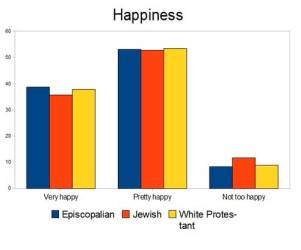
One of the most compelling arguments in support of religion is the totally pragmatic one. What does it matter if religion is false, if god is totally made up, if faith is only a placebo effect, or even if it’s all ultimately just a scam to separate you from your hard-earned money? In the end isn’t all that matters that it makes you happier and more successful?

Reporters and opinion writers propagate this pragmatic justification of religion every day. It is actually difficult to get through any newspaper issue without encountering yet another article or op-ed touting the benefits of religion and faith. Here is an example of the typical kind of happiness claims put out there most every day in popular media:

Research suggests that children who attend church perform better in school, divorce less as adults and commit fewer crimes. Regular church attendees even exhibit less racial prejudice than their nonreligious peers. (see here).

happinessThese articles invariably cite scientific studies and statistics to support their claims. But those claims frequently go far beyond study design or the conclusions made by the scientists involved.

There are many ways that studies are misused by advocates to advance their causes or market their products. So we must all be very savvy when we see broad, sweeping conclusions being supported by narrow scientific studies, particularly by social science studies.

To help you to recognize these manipulations, following are some of the typical falsehoods and distortions used by advocates to misrepresent science or to promote bad science.

Failing to Mention the Negatives
Studies show that chocolate supplies 11 grams of fiber! Wow, maybe we should all eat chocolate to get our fiber! But to get that 11 grams of fiber from chocolate you have to consume a whopping 600 calories. Likewise, studies tout selected admirable ethical qualities of religious people, but fail to mention other studies that show, for example, that religious people are far more likely to support torture, guns, violence, and drone attacks.

Failing to Mention Better Alternatives
Another way advocates misuse studies is by failing to mention far better alternatives. For example, the chocolate industry fails to mention that practically any fruit, vegetable, or grain is a far healthier source of fiber. That may not be their responsibility, but if they are implying that you should eat chocolate in order to get your fiber, they are lying. Likewise, advocates often tout the morality of religious people, implying that religion is the only way to achieve these values. But you don’t need to consume 600 calories to get your fiber and you do not need religion along with all its negative characteristics to be a good person.

Failing to Quantify the Benefits
Advocates will often claim a benefit without quantifying it, thereby giving a false impression of how important it is. For example, religion advocates may cite studies showing that fewer religious people go to prison, without mentioning that this difference is inconsequentially tiny.

Misrepresenting Statistics
Advocates often misrepresent statistics. If they are trying to magnify a small difference they report it as a percentage or ratio. If they are trying to exaggerate a tiny difference in a huge population, they cite the numerical difference.  For example, religion advocates might claim that “secular people are twice as likely to commit suicide as religious ones.” Sounds fantastic right? But this could very well mean that out of a population of 10,000 people, 1 religious person committed suicide and 2 non-religious people committed suicide. Not quite as alarmingly persuasive when presented that way.

Using Bad Indicators
In epidemiology, an indicator is a specific test that can be used to measure a more general condition. But a bad indicator tells one little or nothing about the general trait being evaluated. For example, religious advocates typically conclude that believers are “happier” based upon highly questionable measurements such as divorce rate which have little to do with happiness. As we all know, married people can be far more miserable than divorced ones.

Failing to Prove Causation
Most clinical studies are observational, or association studies. That is, they simply show that two variables are both observed in or associated with a given population. This is valuable information. But proving that those two variables are directly related to each other is quite difficult. Proving causality between one and the other is even more difficult. Even if two things seem to be related, they may be indirectly associated through some third thing called a confounding factor. For example, a study may show that church-goers cheat less on their spouses. That is merely an association. But advocates use that observed association to claim that church attendance promotes ethical behavior even though the researchers themselves never made that claim. However, it may well be that church attendance and marital fidelity are not directly related at all, let alone that church attendance causes fidelity as advocates claim. The most we could say based on the research is that, for whatever reason, people who go to church are also more likely to be people who have fewer affairs. Maybe the reality is that unattractive people tend to go to church in a desperate and futile attempt to start an affair. Attractiveness may the just one confounding factor here. That we cannot determine or even imagine what the confounding factors may be is not proof of causality.

Failing to Consider Reporting Bias
Many of the narrow social studies used to make sweeping claims rely upon self-reporting. However, self-reporting is incredibly unreliable. People intentionally or unintentionally report all kinds of things in all kinds of ways for all kinds of reasons. For example, men are likely to brag about their infidelity while women are likely to conceal it. Self-reports are poor measures of the relative level of infidelity between the sexes. Likewise, religious people are deeply invested in the fiction that religion makes them happier and are very likely to report that they are even if they are totally miserable.

Failure to Mention Study Limitations
Years ago, upon reading commonly cited statistics that “98% of women report incidents of sexual abuse,” radio host Dr. Laura Schlessigner did what a good consumer of information should do. On-air, she called the scientist who conducted the study being referenced to support this claim. The researcher was eager to express her frustration with all of the advocacy groups citing her research without mentioning that her study narrowly targeted an extremely at-risk population. Dr. Laura then called the head of one of those women’s advocacy groups employing this scare-tactic and asked her why she knowingly misrepresented this research. When confronted, the head of the organization stood firm, saying that anything is justified if it raises awareness of real issues faced by women.

Choosing the Wrong Measurement
Even if we could measure happiness, it should not be assumed that happiness is the best or only goal. Believing that  global warming is a hoax probably does make one sleep sounder. Allowing your kids to eat pizza at every meal will probably result in fewer observed food-related tantrums. But clearly these measures of happiness do not justify accepting those positions. Likewise with religion.

Selective Skepticism
We tend to do pretty good at being skeptical about things we disagree with. But when it’s something we’re predispositioned to like and want, like chocolate or religion, we tend to set all skepticism aside and whole-heartedly embrace any arguments in favor, no matter how much of a stretch they may be. The happiness-arguments supporting religion are definitely one area in which our society demonstrates far too little critical scrutiny, as evidenced by the huge number of happiness claims repeated in major publications with virtually no skeptical analysis.

Baby With the Bath Water
Please, please, please don’t conclude from this that you can never trust social studies and that these studies never have any value at all. Association studies are very valuable. We need to know when things are observed together in a given population. However, you should be a smart consumer of these studies and understand the ways that advocates misuse study results to contrive claims that advance their cause. This is particularly important when we are predisposed to believe those claims. When in doubt, look past the claims made by advocates or even by seemingly objective “science reporters” and read the typically more careful and restrained conclusions reported by the scientists who conducted the studies. With the Internet at our fingertips today that is not usually very difficult to do.

The Anatomy of Thought

Mind-uploading is the fictional process by which a person’s consciousness is transferred into some inanimate object. In fantasy stories this is typically accomplished using magic. By casting some arcane spell, the person’s consciousness is transferred into a physical talisman – or it might just float around in the ether in disembodied spirit form.

Mind_switcherIn science fiction, this kind of magic is routinely accomplished by means of technology. Upgraded hair-dryers transfer the person’s consciousness into a computer or some external storage unit. There it is retained until  it can be transferred back to the original host or into some new person or device. This science fiction mainstay goes back at least to the 1951 novel “Izzard and the Membrane” by Walter M. Miller Jr.

In some of these stories, the disembodied consciousness retains awareness within the computer or within whatever golem it has been placed. Sometimes the consciousness is downloaded into a new host body. It might inhabit a recently dead body but other times it might take over a living host or even swap bodies with another consciousness. Fictional stories involving technology being used for a variety mind-downloading and body-swapping scenarios or possessions go back at least to the book to “Vice Versa” written by Thomas Anstey Guthrie in 1982.

The 2009 movie “Avatar” depicts of all sorts of sophisticated technological mind-uploading, remote consciousness-control, and even the mystical downloading of consciousness into a new body. In this and innumerable other science fiction, fantasy, and horror plots, minds are portrayed as things that can be removed and swapped out given sufficiently advanced magic or technology – like a heart or liver. This is depicted so often in fact that it seems like some routine medical procedure that must be right around the technological corner at a Body-Swap™ franchise near you.

One reason this idea seems so believable to us because it is so similar to installing new software into your computer. But the computer analogy fails here. Brains are not analogous to computers in this regard and consciousness is not analogous to a computer program. Our hardware and software are not independent. Our hardware is our software. Our thoughts are literally our anatomy.

It might be a better analogy to rather think of our brains as non-programmable analog computers in which the thinking is performed by specific electronic circuits designed to perform that logic. The logic is not programmed into the circuits, the logic is the circuitry itself. Our thoughts are not programmed into our brains, our thoughts are produced by our neural circuitry. Obviously  our thinking does change over time, but this is a physical re-linking and re-weighting of our neural connections, not the inhabitation of some separable, independent consciousness within our brains.

I allow that we might conceivably copy our consciousness into a computer, but it would only be a mapped translation programmed to emulate our thought patterns. And as far-fetched as that is, downloading our consciousness into another brain is infinitely more far-fetched. That would require rewiring the target brain, that is, changing its physical microstructure. Maybe there is some scientific plausibility to that, like a magnet aligning all the particles of iron along magnetic ley lines. But it’s incredibly unlikely. We’d essentially have to scan all the connections in the subject’s brain and then physically realign all the neurons in the target brain in exactly the same way and tune the strength of all the connections identically.

And even if we did that, there are lots of nuanced effects that would still introduce differences. Our body chemistry and external drugs influence how these neurons fire. In fact, it’s likely that even if our brain were physically transplanted into a new host body, subtle differences in the environment of the new body would affect us in unanticipatable ways, influencing the very thoughts and emotions that make us – us.

Yet our fantasy imagining of consciousness as an independent abstraction not only persists but largely dominates our thinking. Even the most modern intellectuals tend to be locked into at least an implicit assumption of a mind-body dualism. René Descartes was a key figure in bringing scientific and philosophical credibility to what is fundamentally a religious fantasy concocted to make religion seem plausible (see here).

For religious thinkers, a mind-body duality MUST exist in order for there to be an after-life. In order for religious fantasies to seem reasonable, the soul (essentially just our disembodied mind) must be independent and independently viable outside the body. For many, the mind or soul is bestowed by god and is the uniquely holy and human thing that we have that lesser species do not. For them, the mind has to be separable to support their fantasy of God-given uniqueness from the rest of the animal kingdom. A unified mind-body greatly undermines their case for creationism, human divinity, and an afterlife.

So this illusory assumption of dualism is propagated by familiar computer analogies, by ubiquitous fantasy and science fiction, by horror ghost stories, and by our dominant religious and new age thinking. But this dualistic pseudoscience leads to many false and misleading ideas about how our brains work. That in turn results leads us to a great deal of mistaken thinking about a broad and diverse range of questions and precludes our ability to even imagine more realistic answers to those questions.

One harm this idea does is to provide a circular, self-fulfilling basis for belief in the supernatural. If we accept the assumption that our mind is independent, that then demands some kind of mystical explanation. But this dualistic thinking hinders our understanding of many non-religious questions as well. How do newborns fresh out of the womb or the egg know what to do? How can thoughts be inherited? How can a child be born gay? The answer to all these questions become quite simple if you shed your mistaken assumption of dualism. We all start with an inherited brain structure which is the same as to say that we are all born with thoughts and emotions and personalities.

When you truly internalize that the mind and body are one and the same, that our thoughts arise purely from our brain micro-structure and our unique body chemistry, new and far simpler solutions and perspectives open up for a wide range of otherwise perplexing and vexing social, scientific, and metaphysical questions.

Someone smarter than me could write a fascinating book about all the ways that this fantasy of an independent consciousness leads us to false conclusions and inhibits our ability to consider real answers to important questions. But if you simply become aware of this false assumption of duality, you will find that you’ll naturally start to look at a wide range of questions in far more satisfying and logically self-consistent ways.


If Only I Had a Photographic Memory!

Few of us probably remember the 1968 B-film cult classic Barbarella. In that fantasy story the naively buxom Barbarella battled the sadistic Durand-Durand and the evilly beautiful Dark Tyrant. One notable character in this sex romp was the blind angel Pygar. The white-winged angel befriends Barbarella but is then kidnapped and cruelly tortured by the Dark Tyrant.

pygarIn the climax of the film, with the city exploding around them, Pygar swoops down and rescues both Barbarella and the Dark Tyrant, flying off with one woman in each arm. Barbarella looks up at his angelic face, confused, and says “Pygar, why did you save her, after all the terrible things she did to you?” Pygar answers serenely, “Angels have no memory.”
It’s an interesting thought. Angels have no memory. Perhaps only without memory can one really be an angel. Perhaps memory makes us just too bitter, too angry, to resentful, too hurt to be truly forgiving. Perhaps it just isn’t possible to remember every hurt one caused you and still fully forgive them. Perhaps those memories must be sacrificed to gain your wings.

There is data to support this premise.  Researches have looked at individuals on both extremes of memory. They have studied those rare individuals who have no long-term memory – who cannot recall anything beyond very recent events. They have compared those individuals to those equally rare individuals with nearly perfect recall, people who can exactly remember almost every incident, no matter how unremarkable, that they ever experienced.

When you compare these two groups, you see clear differences. Those with impaired long-term memory tend to be quite happy and contented while those with exceptional long-term memory tend to be quite unhappy, depressed, angry, and even suicidal. Apparently, having perfect memory takes its toll. One cannot forget every slight, every insult, every disappointment, and every disillusionment. Such unselective memories make one quite unhappy. Not having memories can be a blessing.

On the other hand, those with perfect memories tend to be excellent networkers. They recall every birthday, every anniversary, and every name. So they tend to have lots of social support that can offset their hurtful memories. Those with poor memories on the other hand tend to have few social contact and fewer friends. The cost of happiness may be loneliness and the loss of social connectivity. Are they then still happy? Kind of a sad internal contradiction.

Don’t hire an angel to become your salesperson and don’t expect them to win celebrity Jeopardy.

Thankfully most of us aren’t angels with no memory and we aren’t elephants who never forget a slight and stomp their trainer into a bloody pulp years later. We lie in the broad middle of the spectrum. I am certainly no angel but I think I lie off toward the bad memory end of the continuum. I have a terrible memory but am pretty free from regrets and grudges. But I’m also quite bad at social networking as I am hopeless at remembering things, let alone birthdays and anniversaries. I’ve wisely perhaps stayed away from professions that rely upon memory and entered instead into a career where things change quickly, where continually looking up current information is an advantage.

Many of us imagine that perfect memory would be kind of a cool superpower but that such recall is just not really possible. But it is clearly possible and evolution is wise enough not to give us what we think we want. Sometimes less is better. We could have much better smell or hearing or taste, for example, and some people do and it makes them painfully miserable. Longer lifespans are apparently possible as well, but evolution knows that longer lifespans are not actually a good thing for the individual or for the species.

Evolution has given us the balance of memory we need to make us both functional and happy. If technology eventually lets us override evolution on this, we may regret being burdened with all those painful best-forgotten memories.

What Aliens Look Like

We aren’t likely to ever meet an alien. As I argued in a previous post, although it is a statistical certainty that alien life must exist, the laws of physics simply make it implausibly improbable that they could ever visit us or we them (see here). The most likely way we might learn what aliens once looked like would be if we happen to pick up an interstellar message in a bottle from some distant ancient civilization, their own version of Voyager with candid snapshots and videos from back home.

But we can make educated guesses based on the fundamental design constraints of the elemental building blocks and physical processes that apply throughout the universe. For example, intelligent aliens must have a lower and upper size limit based on fundamental constraints of molecular dimensions and gravity.

We can similarly surmise much more. For example, any intelligent alien species is likely to be highly mobile – for that they require large bursts of energy – for that they require a fluid chemical transfer system – for that they require a variable speed pump controlled by a central nervous system that adjusts the amplitude and frequency of pumping based upon a large amount of sensor data – and that control mechanism would have to be autonomic so that the pumping controller is highly responsive and unaffected by their state of consciousness.

So, intelligent alien species are likely to have circulatory and nervous systems that are mechanically and functionally quite similar to our own. For vision they are likely to have two sensors placed up high for optimum line of sight and depth perception. They are likely to be similarly similar in the design of their other major systems. In short, after looking past superficial differences, alien life would almost certainly be quite familiar to human physicians and biologists.

It would be foolishly egotistical to imagine that all alien life will be exactly like us and the other species present on Earth. Certainly there would be dramatic and astounding variations that we cannot begin to imagine. But it would also be equally foolish to imagine that the bulk of species in the universe would not evolve following much the same processes with much the same results as life here. A human exobiologist could almost certainly be trained to understand, diagnose, and treat almost any form of alien life.

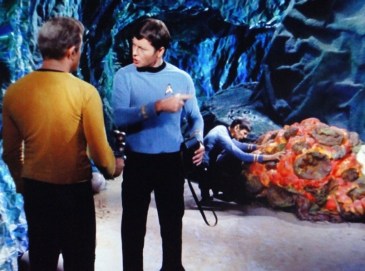
hortaIn Star Trek, after Doctor McCoy got over his initial revulsion (You expect me to treat that thing Jim?!?), he was able to patch up even the exotically alien silicon-based Horta with some simple spackle compound.

But apart from exceptions like the Horta, Star Trek and most every science fiction universe depicts very human-like aliens. This implicit assumption of similarity is made mostly so that alien creatures will be relatable and to make them playable by human actors with minimal make-up and costumes.

AlienBut we create human-like creatures even when there are no technical constraints. The astoundingly terrifying alien created by HR Giger is remarkably human-like with 2 arms, 2 legs, a head, a tail, a mouth, and so on. Despite having acid for blood, his alien follows the evolutionary design model of a human quite closely. It is likely not the case, as many imagine, that such alien depictions represent an unimaginative human conceit and lack of imagination. Rather, it is likely that such physics-defying aliens are actually much more fanciful than evolution is mechanically capable of producing – on any planet.

And let me be clear. Its unfathomably unlikely that any alien could remotely pass as human and walk amongst us undetected – that’s purely a movie fancy as unrealistic as aliens with acid for blood that can eat through feet of metal. However, they will be biologically similar in function if not form. They will not have any superpowers or godlike abilities that defy basic chemistry and physics because they can not. If they can fly they will need wings. And as any dolphin can tell you, there is a fundamental limit to how far they could advance without appendages that allow them to manipulate their environment.

Even many of us who are wise enough to understand that god cannot exist are still far too willing to remain agnostic in insisting that there might be aliens out there with what would effectively be godlike powers.

If my hypothesis of fundamental similarity is true, and I suggest that it must be more true than not, it should encourage us that we’re not actually missing out on as much as we might imagine because we are effectively bed-ridden here on Earth. Aliens would be marvelous to see, but evolution has offered us a pretty representative sampling of the range of life typically found in the universe.

Unless a message in a bottle lands on our Earthly beaches, we’re unlikely to ever know for sure how typical we are. Even then, that would give us only one more example of life. But we can make some pretty good assumptions about the nature of life in the universe without direct experience. And it is likely that the range of actual life in the universe is no where near as wide as our unconstrained imaginations.

So what do aliens look like? Probably a lot more like us than we might imagine.


Alexa, Like This Article

Back in 1966 we watched Captain Kirk chat with Mr. Spock through his Starfleet issue flip phone communicator. Such technology was so fantastic back then that that most people assumed we’d have to wait until 2265 for personal wireless communications. Little did we know that in 1996, just a mere 30 years later, Motorola would release the StarTAC flip-phone (StarTAC, StarTrek, hmm). Although it had buttons instead of a tuning dial, it was essentially the same design and functionality as those Starfleet Communicators.

Despite the futuristic awesomeness of the flip-phone, most people back in 1996 didn’t see much value in wireless phones. Why do we need them? Our trusty old Ma Bell phone works just fine! People could not imagine that soon they’d spend a huge part of their day with their head bent over their cell phones.  And so it is with most every new innovation. At first no one can imagine why they’d want that new gadget – even if only a few years it would be the one thing they’d take along if stranded on a desert island.

AmazonEchoAnd here we are again. Now we have the Echo from Amazon. It is our new StarTAC flip-phone. Remember how the Enterprise computer spoke with Kirk wherever he happened to be? Echo is our own personal Enterprise computer. It is Tony Stark’s Jarvis – before getting incarnated as Vision. It is Gideon, the AI of the Waverider from Legends of Tomorrow. Well the start of Jarvis and Gideon at least. Most people don’t see it as anything more than a novelty. But today it’s already immensely useful. Tomorrow it’ll be as indispensable to our households as electricity.

The Echo is a simple device, elegantly simple. It is a small cylinder you place centrally in your house, plug it in, let it connect to your WIFI, and start talking to it. The Echo is mostly speaker, and a pretty good one. I have always been a hardcore audiophile and I’m happy enough with the quality. The rest of it is just a WIFI device that communicates with a very pleasant and smart woman named Alexa whom I assume works 24/7 at Amazon just to talk to me. Just ask Alexa something, anything, and she’ll respond in her reassuringly competent voice with helpful information. Alexa isn’t quite “Her” but she’s pretty insightful.

Alexa, what time is it?
Alexa, spell consensus.
Alexa, what is the population of Uruguay?
Alexa, what’s in the news today?
Alexa, play Enchanted by Taylor Swift.
Alexa, read about Deadpool on Wikipedia.
Alexa, wake me at 8 A.M.
Alexa, set a timer for 15 minutes.
Alexa, put peanut butter cookies on my shopping list.
Alexa, what’s another word for amazing?
Alexa, why is the sky blue?
Alexa, when was Kennedy president?
Alexa, who is the Speaker of the House?
Alexa, play Ratatat Radio on Pandora.
Alexa, what is 34 + 75 + 26?
Alexa, what’s on my calendar tomorrow?
Alexa, what was Mark Twain’s real name?
Alexa, continue reading Night Without End by Alistair MacLean.

I know, I know, big deal. I tried Siri. She lost her attraction pretty quickly. Don’t talk to her much anymore. Have flirted with Cortana too I guess. Don’t talk to her that at all. I could look up any of those questions just as quickly on my phone. I’m pretty good with my thumbs. Voice is just a novelty gimmick with little real value.

How wrong you are. The big deal here is not what it does but how it does it. Sure, you could stop what you’re doing, get your phone, find an app, select some options, type in some stuff, and read an answer. Or, you could just conversationally mumble “Alexa, how many tablespoons in an ounce” from the kitchen while you continue to stir your batter. While you’re tying your shoes in the morning you can just ask “Alexa, will it rain today?” You don’t need to make a mental note to listen to “Scenes from an Italian Restaurant” after you finish your soak in the tub. Just ask Alexa to play it for you.

Even in its current young form, Alexa is incredibly empowering. I find myself asking tons of questions and making many more casual requests than I would have if I had to go to my computer or my phone. It deeply enriches my life with a world of information not at my fingertips, but simply “in the air” of my house.

Alexa is has access to the Internet but it is also essentially a platform for third party applications. Other third parties can write Alexa “skills” to do pretty much anything. Right now, most skills are pretty silly. Why people write take the time to write skills to tell jokes or play random dog barks is beyond me. But the potential for far more serious stuff is there and they will come in the near future. Alexa and successors like it will continue to get more and more powerful. Soon you will be able to ask them questions like “what percentage of males under 35 voted for Donald Trump in North Carolina as compared to females in the same age group?” Through 3rd party skills you’ll be able to give directions like “let my uncle Joe into the house when he arrives today.” The possibilities extend far beyond my imagination.

But you don’t need to wait for another 20 years or even another 10 years. Alexa can enrich your life in subtle but dramatic ways right now. You can already free yourself from your “mobile” device in liberating ways with an even more intimate connection to the world. Do I have an ulterior motive in trying to get you to buy an Echo? Damn right I do. Every Echo that you purchase pulls those amazing new killer skills out of the distant future and into my immediate future.

Alexa, where is the nearest coconut on this desert island?

Satisfaction Surveys

SatisfactionSurveyHave you ever filled out one of those ubiquitous satisfaction surveys? Of course you have. Everyone wants to know how satisfied you are. Whether it be your phone company or your local dry cleaner or your waiter, everyone is keen to quantify, record, and report your level of customer satisfaction.

But despite the fact that satisfaction surveys are as annoyingly common as pennies, how truly useful are they? If you’re anything like me, you probably don’t provide exactly high quality response data to these surveys. If I cannot escape the survey without being rude, I just check “Excellent” for everything without even reading the questions. It’s the easiest thing to do. And what direct benefit is there in it for me to be thoughtful and honest? I’m much more likely to get better service next time if I indicate that my waitress is excellent in every possible way, especially if she was terrible!

And there are lots of reasons beyond immediate self-interest and laziness that most of us lie like Persian rugs on these surveys:

  1. People forget the bad stuff. We have selective memories, and the longer it is after our terrible customer experience, the more likely we are to remember it positively.
  2. People never want to seem like complainers. Even if we had gripes, we are programmed that complaining only reflects badly on us.
  3. People are nice. We don’t want to hurt anyone’s feelings unnecessarily – even if we are anonymous.
  4. People are habituated to say “I’m fine.” Even if we’re in the middle of vomiting up our lunch after being told that our beloved kitty just got electrocuted attacking an electrical outlet, we automatically say we’re fine.
  5. We assume no one <really> wants to know. We figure that this is pointless paperwork that no one will ever actually read let alone act on it.
  6. Saying everything was wonderful is the easiest way to dispense with this annoying and meaningless survey and get home in time for The Walking Dead.

Here’s an even bigger problem worth discussing in depth. We don’t know what we don’t know and have poor imaginations to envision what we could have. Satisfied compared to what? How do you rate your Toyota? Excellent. Oh wait, I didn’t realize I could have had a Porsche instead… Can I change that answer to Poor?

How do you rate your healthcare? Excellent? Great! But did you know that Norway has a healthcare system that costs ½ the price and ranks 11th to your 37th? Would you like to change your survey answer?

Since we don’t know what we don’t know let alone what we cannot even imagine, Poor to Excellent is not an absolute scale. It only encompasses what we know. If we’re given a dozen similarly bad options, we’re likely to rate the least worst of them Excellent. By the way, this is one of the reasons that “happiness scientists” tell us that more choices make us less happy. We become less satisfied with what we can get if we are made aware of all the better options that we cannot hope to get our hands on.

I have a more nefarious theory about these surveys. I think that smart customer service providers offer these surveys knowing all of this, but they figure that when you indicate that their service was great you’ll actually remember it as being great. Probably sound psychology!

But here’s the biggest problem with these victim-less white lies called satisfaction surveys. We sometimes really, really do need an accurate answer to assess satisfaction. We have lots of important social science studies that have little choice but to measure satisfaction through this sort of survey. Unfortunately, for all the reasons given, this data is usually just so much garbage in.

We need smarter measures of satisfaction.

One solution is to de-emphasize or even abandon the self-reporting of satisfaction measures. Instead, smart companies or researchers measure indirect indicators of satisfaction. Rather than ask for a self-reported satisfaction, they look at objective behaviors that correlate with satisfaction.

For example, given a subsequent choice of options, what option does the person actually choose? Do they recommend the option to others? Instead of asking whether they like the coffee or the ambiance of the restaurant, measure how many refills they ask for and how long they remain to digest and converse over their coffee.

Satisfaction surveys are just a microcosm within a wide range of human behaviors. In almost every situation dealing with people, looking at actual behaviors can tell us far, far more than relying upon anything they tell us about their motivations or their opinions.

Dismissed with Prejudice

ElvisDo you have one of those wacky friends? The ones with a deep, sincere, heartfelt conviction that Elvis still lives. That he is actually in seclusion preparing for his epic comeback? Busy rehearsing for the ultimate Elvis concert that will transform the world?

Your friend undoubtedly has an articulate rebuttal for every possible reason you can throw at him for dismissing the possibility that Elvis might still be alive. His death was staged. The witnesses are all in on it. The corpse in Graceland is a DNA-identical clone of him. He is being kept young by a chemical concoction that the pharmaceutical industry has suppressed.

Your friend probably turns the tables on your skepticism quite easily. How can you be so arrogant to claim to know everything? Are you that close-minded? Surely you can’t prove and therefore can’t know for certain that he isn’t still alive. If you are as scientifically open-minded as you claim you must admit some possibility that he might still be alive. Surely you can admit that reasonable people can disagree on this unless you believe he is dead purely as a matter of faith. The only intellectually honest position on this question must be agnosticism.

Your friend points to several well-regarded scientists who admit that it is possible Elvis is alive. He recommends a plethora of scholarly books that debunk all those fallacious “scientific” arguments claiming that Elvis is dead.

Or perhaps your friend has a different but similarly wacky belief that he clings to and argues for with great passion.

All that was my way of setting the stage for the real point of this article – that I do not need to read any of those books purporting to prove that Elvis might be alive. Elvis is dead. Period. Any book that starts with the premise that he may still be alive is necessarily idiotic. There is no need for me to actually read them in order to legitimately dismiss them out of hand. Good scientists dismiss an infinite number of implausible claims all the time every day.

So there is no need for me to entertain arguments about how Elvis might still be alive. And there is no reason for me to read a book that starts with the premise that Elvis is alive or the Holocaust did not happen or the Moon landing was faked or alien overlords built the pyramids. I can dismiss them all out of hand without even reading the book jacket. The only reason to read them may be if your interest is studying delusional thinking or the infection of magical thinking amongst otherwise healthy individuals.

And I have read a great many of these books that purport to present a logical or scientific argument for at least allowing the possibility that god might exist. When I wrote my book Belief in Science and the Science of Belief (see here) I took the time to slog through a 4-foot stack of books that undoubtedly made Amazon the lucrative enterprise it is today. It was largely a waste of time and money on my part. Believers have had two millennia to come up with arguments so there are simply no new ones to be found.

As a concrete example, I bought several books on Neurotheology (see here). I did the world a service by throwing these out rather than reselling them. Written by Andrew B. Newberg and a host of his followers, these books typically spend 250 pages citing brain imaging and cognitive studies related to belief and god. Their real goal is to establish their science creds so that you will believe them when, in the last 50 pages, they leap to outlandish claims that go something like “since we have clearly evolved to believe in god, the only conclusion must be that god himself designed us to believe in him.”

The only conclusion is that this is an idiotic conclusion. But then again what can you hope to get from any author that starts from the silly premise that god exists and works backwards?

Religious books purporting to be scientifically legitimate examinations of the “evidence” for god pop up on Amazon every day like so many weeds. I can’t read them all but I can still dismiss them all out of hand. There simply is no god, can be no god, and therefore every book claiming to argue this point is necessarily as idiotic as books arguing that Elvis is alive and well and living in a secret wing of Graceland.

And thus, dear reader, we finally reach the heart of my dilemma: Do I read these silly books and respond to them or do I simply ignore them?

Ignoring them is not easy. If no one pushes back on them, they seem to win the argument. And there are so many of them saying the same silly things that many readers mistake quantity as an indication of quality. On the other hand, the time for engaging these silly debates is over. At this stage of the atheist movement, we must move past engaging in and thereby legitimizing these ridiculous debates. We should give no more consideration to religious ideas than we do to racist ideas or homophobic ideas or sexist ideas or the idea that Elvis is amongst us.

Still it’s hard to resist getting sucked in. Recently a new book appeared on Amazon called “Can Science Explain Religion” (see here) written by a priest who is also a Professor of Religion. It apparently “debunks” the very theory of the evolution of belief that I present in my own book. Do I buy this and read it so I can credibly criticize it and defend my position, and thereby risk encouraging this nonsense? Or is it best not to even respond and hope that the rest of the country follows my sensible example?

After struggling with this dilemma for many years, I have come to believe that refusing to engage is the best strategy moving forward. Engaging in further debate with them only feeds the beast. Like booing Donald Trump at a rally.

It’s not an easy course of action nor is it without risk or criticism. But in science, we must first ask whether our basic assumptions are valid before we enter into discussions of the resulting questions. We must not let ourselves get caught up in grand debates over how Santa manages to deliver all those presents in one night when the very premise of Santa is pure fantasy.

And that is how we should respond to these books and these arguments – by dismissing them out of hand and with great prejudice and by refusing to entertain dependent arguments arising out of purely implausible assumptions.


The Winter Solstice

SolsticeDecember 22nd is the Winter Solstice in the Northern Hemisphere. It is the shortest day and longest night of the year. On this day, the noon Sun is at the lowest point of the year, lower the further north you are.

The solstice is the one universal event that all of us humans share in common each year. It has always been the most powerful recurring event in our shared human experience.

This annual solar phenomenon connects us viscerally to all of humanity; to all those living now as well as all those who lived before us. Virtually every culture that has existed has celebrated the Winter Solstice.

Surely every tribe extending back to the very first humanoids able to recognize their surroundings, remember their past, and anticipate their future have noted the significance of the Winter Solstice and have been moved to fear or honor it. Each year we become a part of the unbroken chain of solstice commemorations, formal or informal, that have preceded us.

The significance of the winter solstice lies not simply in the fact that it is periodic and conspicuous, like the return of Halley’s Comet, but because it relates so intimately to our shared human experience.

For most of human history the winter solstice was a time of uncertainty and relief, of fear and hope. As we approach this cyclic transition the Sun falls lower and lower. At the solstice, it gets frighteningly close to abandoning us forever. How easy it would be for it to just sink below the horizon and never return.

Imagine the terrible apprehension this invoked in our ancestors for whom the Sun was everything. Believing that the Sun must be a real being with intelligence and emotions, how could they be assured that it had not decided to simply abandon them to eternal darkness and cold? How could they be sure that they had not done anything to offend it causing it to completely disappear, never to return?

So also imagine our ancestors’ great relief and joy when the Sun resumed its upward ascent for another year.

The Incas of Machu Picchu, for example, believed the Sun was a god named Inti. On the Winter Solstice they performed a ceremony which tied the Sun to a great hitching post of stone in order to prevent it from escaping. The Mapuche people of Chile would stay up all night on that longest night out of fear that dawn may never come again. Only after 3 days, when it became evident that the Sun had returned, would they emerge to celebrate the New Year.

Today of course we know that the Sun will never go away, well not for another 5 billion years at least, but it is still everything to us and we still have compelling reasons for commemorating the solstice.

One day, if we continue our foolish disregard for our planet, if we allow our short-sightedness and greed to destroy our atmosphere, we may no longer be here to appreciate the life-giving gifts of the Sun.

It would be not the Sun who abandons us, but rather we who abandon him, leaving him one again alone and unappreciated in a lifeless solar system.

Sometimes I think that we would be better off still believing that the Sun is a godlike being that we might offend by mistreating animals or ruining the land or spoiling the waters or polluting the air. Perhaps then we would show more appreciation and be less inclined to sully and squander all those precious gifts.

So join our ancestors in once again recognizing the Winter Solstice and contemplating our tenuous place in the universe. As it was with them, the Winter Solstice gives us pause to look back in appreciation for what the Sun has given us and to think about the hard work we must do to ensure another bountiful spring harvest.  It is a time when we humbly celebrate the New Year not of man, but the New Year of our Sun and Earth.


Evolution Did It!

While serving in the Peace Corps in rural South Africa, I loved to visit different schools to talk about science. One of my favorite activities was playing the “Why” game. I’d encourage the kids to ask “Why” about anything at all and we’d use scientific thinking to formulate hypotheses.

It would take a while to coax even one “Why” out of the kids as they were totally unfamiliar with any kind of meaningful dialog with a teacher. When I invited them to ask “Why” questions, the only responses I got were dazed and confused expressions. Students were seldom encouraged to ask any questions, and if they did the only answer they were likely to get was “because it is” or “god made it that way.” But clearly those answers are not really satisfying because as soon as just one kid bravely took the chance to venture a question, the floodgates of pent-up curiosity unfailingly broke loose and a deluge of “Why” questions came pouring out from the entire class.

Tellingly, one of very first questions was inevitably “Why am I black while you are white?”

Now that might seem like a tricky question but it isn’t really hard at all. In everything to do with life, be it human or animal or plant or microbial, the answer to pretty much any question is “evolution.” Even if that isn’t a complete answer, it’s the perfect foundation upon which to discuss further nuances.

Why are you reading this article right now? Evolution! Granted, we could just as legitimately answer “chemistry” or “physics” and start from there. But when it comes to the traits and behaviors of living things that most kids are naturally most interested in, “evolution” is always the sensible starting point.

eggsTo get things started I would often hold up a hard-boiled egg that I typically carried around for a snack. Why do you suppose eggs are egg-shaped? This question would be met with confused looks, so I’d oil the hinges of their flood gates with squirts of evidence. Do you think it means anything that eggs of birds become increasingly oval as the land they live on becomes steeper? Within minutes we’d find ourselves testing the evolutionary importance of egg shape by rolling my lunch down a slanted desk-top and speculating on how rolling behavior can help or hinder the survival of those birds.

You don’t need to join the Peace Corps or teach school to play the “Why” game. You can play it with family and friends or even all by yourself. Think of any characteristic of living things, make it as simple or hard as you can, and start by asking why it is so. The answer of course is “evolution,” but now the real fun begins. Now you can think about “Why” that particular trait or behavior might have been an evolutionary advantage or hindrance.

To help you play the evolution game, here are some rules that are not always obvious:

1. Every trait of living things – physical, mental, behavioral, social, temperamental – all arise through evolution. Practically anything at all is fair game.

2. It is OK to personify evolution to help us talk about it. Personification makes it much easier to understand and relate how evolution works. It just needs to be understood without necessarily saying that personification is only a communication technique and that evolution does not really have motivation or intent.

3. Not all traits are necessarily helpful. Some are simply the result of innocuous mutations that don’t particularly help but they don’t hinder enough to get selected out. However the best starting hypothesis is to assume evolutionary significance. And just because we cannot imagine the significance of a trait, that doesn’t mean it has none.

4. Most traits have many advantages and disadvantages. In the grand dice-roll of evolution, the advantages of a trait must only collectively outweigh the disadvantages. In the case of egg-shapes, rolling down hills is just one of the many ways this simple trait affects the survival of that species. There are lots of right answers.

5. Evolution does not “care” about individuals. There is a rampant misconception that evolution favors the survival of individuals. This is largely a misapplication of the concept of “survival of the fittest.” This misapplication causes some to claim that examples of evolved traits that cause harm to individuals disprove evolution. Nothing could be more wrong. Evolution only cares about the species. It will happily kill individuals off, even within a species, if it helps the population to survive. Certain spider females eat their mate after fertilization. This helps the species to survive. The male is most useful as food after his job is done. Evolution holds individual lives in no particular regard.

6. Evolution does not guarantee the “best” traits. It merely makes it more likely that those random traits that happen to be good enough in a given circumstance are passed along. Our spine isn’t a good design let alone the best design. An intelligent designer would have come up with something much better. But it is good enough.

7. Evolution is not “going” anywhere. It is not “leading to” any sort of perfect human for example and mankind is not the “pinnacle” of evolution. All of evolution did not happen in order to create us.

8. Just because evolution is not going anywhere does not mean it is not going anywhere. Evolution is like a driverless car. There is no driver and it knows not where it is going. But it is definitely going somewhere nonetheless, following forces that direct it along a logical, non-random route defined by its characteristics, obstacles, terrain, and the physics of motion.

9. Evolution is not guaranteed to find a way for a species to survive change, especially rapid change. Most in fact do not survive change. Evolution certainly has not found ways for the vast majority of species on the planet to survive dramatic changes, the worst of which may be the holocaust of humanity.

10. Certain unimportant traits might have little role in survival right now, but they might either save or kill your species when the environment changes.

11. A good trait isn’t always good. Change the environment slightly and that trait that helped you survive yesterday may cause your extinction tomorrow. Belief is one of those. Just because it evolved yesterday does not mean it is not bad for us today.

12. Bad traits can be good. If a trait isn’t bad enough to kill you before reproducing, it’s good. Sickle-cell Anemia is not a desirable genetic trait right now. But it may be the only trait that grants immunity to the zombie apocalypse virus that is right around the corner of random mutation. The more biodiversity a gene pool can support, even “bad” genes, the more likely that species will survive over the long haul. Wiping out a “bad” gene today could doom us tomorrow.

Those are just a few of the things to consider when you think about how traits and behaviors might have evolved. So enjoy the “Evolution Did It” game! It’s infinitely more fun and stimulating than the “God Did It” game.