Mind-uploading is the fictional process by which a person’s consciousness is transferred into some inanimate object. In fantasy stories this is typically accomplished using magic. By casting some arcane spell, the person’s consciousness is transferred into a physical talisman – or it might just float around in the ether in disembodied spirit form.
 In science fiction, this kind of magic is routinely accomplished by means of technology. Upgraded hair-dryers transfer the person’s consciousness into a computer or some external storage unit. There it is retained until it can be transferred back to the original host or into some new person or device. This science fiction mainstay goes back at least to the 1951 novel “Izzard and the Membrane” by Walter M. Miller Jr.
In some of these stories, the disembodied consciousness retains awareness within the computer or within whatever golem it has been placed. Sometimes the consciousness is downloaded into a new host body. It might inhabit a recently dead body but other times it might take over a living host or even swap bodies with another consciousness. Fictional stories involving technology being used for a variety mind-downloading and body-swapping scenarios or possessions go back at least to the book to “Vice Versa” written by Thomas Anstey Guthrie in 1982.
The 2009 movie “Avatar” depicts of all sorts of sophisticated technological mind-uploading, remote consciousness-control, and even the mystical downloading of consciousness into a new body. In this and innumerable other science fiction, fantasy, and horror plots, minds are portrayed as things that can be removed and swapped out given sufficiently advanced magic or technology – like a heart or liver. This is depicted so often in fact that it seems like some routine medical procedure that must be right around the technological corner at a Body-Swap™ franchise near you.
One reason this idea seems so believable to us because it is so similar to installing new software into your computer. But the computer analogy fails here. Brains are not analogous to computers in this regard and consciousness is not analogous to a computer program. Our hardware and software are not independent. Our hardware is our software. Our thoughts are literally our anatomy.
It might be a better analogy to rather think of our brains as non-programmable analog computers in which the thinking is performed by specific electronic circuits designed to perform that logic. The logic is not programmed into the circuits, the logic is the circuitry itself. Our thoughts are not programmed into our brains, our thoughts are produced by our neural circuitry. Obviously our thinking does change over time, but this is a physical re-linking and re-weighting of our neural connections, not the inhabitation of some separable, independent consciousness within our brains.
I allow that we might conceivably copy our consciousness into a computer, but it would only be a mapped translation programmed to emulate our thought patterns. And as far-fetched as that is, downloading our consciousness into another brain is infinitely more far-fetched. That would require rewiring the target brain, that is, changing its physical microstructure. Maybe there is some scientific plausibility to that, like a magnet aligning all the particles of iron along magnetic ley lines. But it’s incredibly unlikely. We’d essentially have to scan all the connections in the subject’s brain and then physically realign all the neurons in the target brain in exactly the same way and tune the strength of all the connections identically.
And even if we did that, there are lots of nuanced effects that would still introduce differences. Our body chemistry and external drugs influence how these neurons fire. In fact, it’s likely that even if our brain were physically transplanted into a new host body, subtle differences in the environment of the new body would affect us in unanticipatable ways, influencing the very thoughts and emotions that make us – us.
Yet our fantasy imagining of consciousness as an independent abstraction not only persists but largely dominates our thinking. Even the most modern intellectuals tend to be locked into at least an implicit assumption of a mind-body dualism. René Descartes was a key figure in bringing scientific and philosophical credibility to what is fundamentally a religious fantasy concocted to make religion seem plausible (see here).
For religious thinkers, a mind-body duality MUST exist in order for there to be an after-life. In order for religious fantasies to seem reasonable, the soul (essentially just our disembodied mind) must be independent and independently viable outside the body. For many, the mind or soul is bestowed by god and is the uniquely holy and human thing that we have that lesser species do not. For them, the mind has to be separable to support their fantasy of God-given uniqueness from the rest of the animal kingdom. A unified mind-body greatly undermines their case for creationism, human divinity, and an afterlife.
So this illusory assumption of dualism is propagated by familiar computer analogies, by ubiquitous fantasy and science fiction, by horror ghost stories, and by our dominant religious and new age thinking. But this dualistic pseudoscience leads to many false and misleading ideas about how our brains work. That in turn results leads us to a great deal of mistaken thinking about a broad and diverse range of questions and precludes our ability to even imagine more realistic answers to those questions.
One harm this idea does is to provide a circular, self-fulfilling basis for belief in the supernatural. If we accept the assumption that our mind is independent, that then demands some kind of mystical explanation. But this dualistic thinking hinders our understanding of many non-religious questions as well. How do newborns fresh out of the womb or the egg know what to do? How can thoughts be inherited? How can a child be born gay? The answer to all these questions become quite simple if you shed your mistaken assumption of dualism. We all start with an inherited brain structure which is the same as to say that we are all born with thoughts and emotions and personalities.
When you truly internalize that the mind and body are one and the same, that our thoughts arise purely from our brain micro-structure and our unique body chemistry, new and far simpler solutions and perspectives open up for a wide range of otherwise perplexing and vexing social, scientific, and metaphysical questions.
Someone smarter than me could write a fascinating book about all the ways that this fantasy of an independent consciousness leads us to false conclusions and inhibits our ability to consider real answers to important questions. But if you simply become aware of this false assumption of duality, you will find that you’ll naturally start to look at a wide range of questions in far more satisfying and logically self-consistent ways.
 In the climax of the film, with the city exploding around them, Pygar swoops down and rescues both Barbarella and the Dark Tyrant, flying off with one woman in each arm. Barbarella looks up at his angelic face, confused, and says “Pygar, why did you save her, after all the terrible things she did to you?” Pygar answers serenely, “Angels have no memory.”
 How could Donald Trump conceivably be good for us and for the USA? I’m glad you asked!
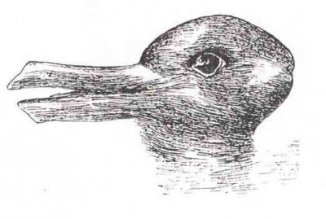 Think of it like the picture to the right. What do you see? If you see a rabbit facing right, then for whatever reason your pattern-recognition system is more programmed to spot rabbits. But if you first see a duck facing left, then you’re more attuned to look for duck patterns. With this particular image, you can switch back and forth between the rabbit and the duck quite easily, but it’s extremely hard to see them both at the same time.
 One thing we enjoy doing here is to tie together interesting concepts in innovative ways, particularly mixing physical or social science with fantasy. For instance, relating our pledge drive to battling The Nothingness in The Neverending Story. In that movie, a boy named Bastian was engrossed in a book called The Neverending Story. Gradually he became aware that by reading the book, he had become an active participant in it. And unless Bastian would take responsibility to verbally give the Child Emperess a name, The Nothingness of apathy would destroy the wondrous world in the book forever. She pled desperately with Bastian to overcome his hesitation and say her name out loud.
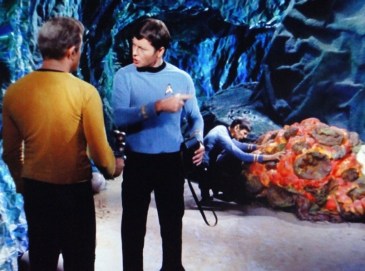 In Star Trek, after Doctor McCoy got over his initial revulsion (You expect me to treat that thing Jim?!?), he was able to patch up even the exotically alien silicon-based Horta with some simple spackle compound.
 But we create human-like creatures even when there are no technical constraints. The astoundingly terrifying alien created by HR Giger is remarkably human-like with 2 arms, 2 legs, a head, a tail, a mouth, and so on. Despite having acid for blood, his alien follows the evolutionary design model of a human quite closely. It is likely not the case, as many imagine, that such alien depictions represent an unimaginative human conceit and lack of imagination. Rather, it is likely that such physics-defying aliens are actually much more fanciful than evolution is mechanically capable of producing – on any planet.
 Yup, in retrospect I should have owned up to my prank right then and there. But Steve was so pumped up I decided to tell him in the morning. By the next morning I had forgotten all about it, and anyway Steve had already left to go somewhere before I woke up. I was reminded of my folly when Steve returned and proudly related how he had gone to the craft shop, paranormal investigator like, to sleuth out the origins of this demon doll. The owner told him that by the greatest of coincidences, the doll-maker, a lady by the name of Ramona Audley (pictured right) happened to be paying a visit at that very same moment. Steve politely confronted Ramona and asked her whether she knew that she was crafting possessed dolls. Ramona apparently nearly went into a terrified state of shock and I was later to learn that the dolls were removed from the store window that very day (Ramona, I did you wrong and I’m so sorry).
 I’m reminded of a formative event back in the 1970’s when I went to a performance by the late magician Doug Henning. Between making live tigers disappear, he would walk out to the edge of the stage and do slight-of-hand magic. In one such interlude, he held up a newspaper and showed it to us, turning each page so we would remember the layout. He then proceeded to methodically tear it into smaller and smaller pieces. As he did so he kept a great dialog going:
 That makes me VERY encouraged. When merchants of doubt like William Irwin have to resort to manufacturing doubt, it is an admission that they know they cannot win on the merits of their position. It is their last gasp to cling to religion and delay the widespread outright rejection of god. That the dying candle of religion should finally burn out is inevitable because facts inevitably win in the end. Tobacco does cause cancer whether you admit it or not. Man-made climate change threatens our planet whether you choose to believe it or not. And there is no god to come and save us no matter how much you would like there to be. It’s all up to us and only us.
 And here we are again. Now we have the Echo from Amazon. It is our new StarTAC flip-phone. Remember how the Enterprise computer spoke with Kirk wherever he happened to be? Echo is our own personal Enterprise computer. It is Tony Stark’s Jarvis – before getting incarnated as Vision. It is Gideon, the AI of the Waverider from Legends of Tomorrow. Well the start of Jarvis and Gideon at least. Most people don’t see it as anything more than a novelty. But today it’s already immensely useful. Tomorrow it’ll be as indispensable to our households as electricity.
